
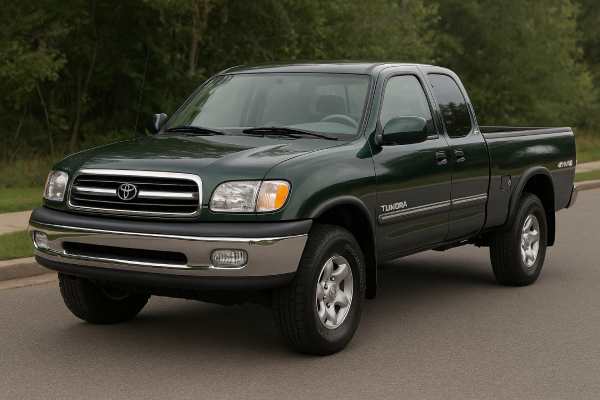
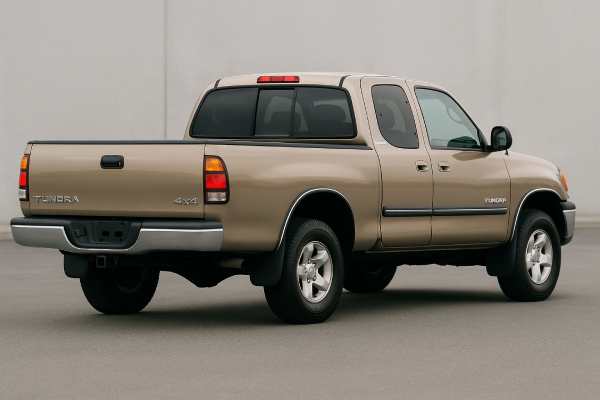
The first-generation Toyota Tundra 4×4 (XK40) with the 5VZ-FE 3.4 litre V6 sits in a sweet spot between mid-size agility and full-size utility. With 190 hp, a stout ladder frame, and a part-time four-wheel drive system, it was aimed at owners who wanted real off-road traction and winter confidence without stepping up to a thirsty V8. The 5VZ-FE V6 had already proven itself in the Tacoma and 4Runner, and in the Tundra it gets more room, more towing capacity, and a more comfortable cabin.
Two decades later, most of these trucks have lived hard lives: snow, towing, trails, or all three. That makes questions about rust, maintenance, and parts support more important than brochure numbers. This guide focuses on the XK40 4×4 with the 3.4 V6, covering specs and dimensions, real-world performance on and off road, known reliability patterns, safety ratings, and the maintenance strategy that keeps these trucks working long after many rivals are gone.
Owner Snapshot
- Proven 5VZ-FE 3.4 l V6 shared with Tacoma and 4Runner, with a timing belt and a reputation for high-mileage reliability when serviced on time.
- Part-time 4×4 with low range, independent front suspension, and available off-road packages gives useful trail and winter capability without making the truck hard to live with on pavement.
- Key ownership caveat is frame and underbody corrosion on trucks from heavy-road-salt regions; a clean chassis matters more than low odometer readings.
- Typical oil change interval is 5,000–7,500 miles (8,000–12,000 km) or 6–12 months; timing belt and water pump are usually due about every 90,000 miles (145,000 km).
- Expect mixed fuel economy in the 13–16 mpg US (15–18 l/100 km) range, with off-road use and roof loads pulling numbers down further.
What’s inside
- XK40 Tundra 3.4 4×4 fundamentals
- Toyota Tundra 5VZ-FE specs and data
- 4×4 XK40 trims options and safety
- Off-road Tundra reliability and issues
- Service schedule and buyer guidance
- Driving feel and off-road capability
- How this 3.4 4×4 compares
XK40 Tundra 3.4 4×4 fundamentals
The XK40-generation Tundra 4×4 with the 5VZ-FE V6 is the four-wheel drive counterpart to the rear-wheel drive XK30 V6 truck. The basic recipe is the same: a compact full-size pickup built to be more refined than contemporary domestic half-tons, but still robust enough for towing, hauling, and off-road work. The difference is a proper two-speed transfer case and a driven front axle, giving the XK40 genuine four-season and trail capability.
The 5VZ-FE itself is a 60° V6 with an iron block and aluminium double overhead cam cylinder heads. With four valves per cylinder and sequential multiport fuel injection, it prioritises durability and usable low to midrange torque over peak output. In the Tundra 4×4, the 190 hp rating is less about speed and more about torque delivery for climbing, towing, and pulling away smoothly when loaded.
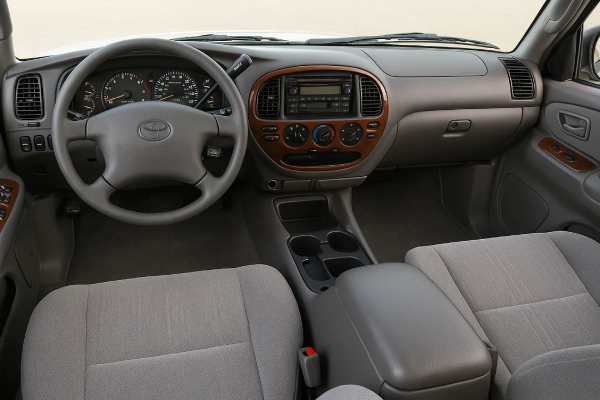
Most XK40 Tundras are Access Cab or Double Cab-style vehicles with rear-hinged or conventional back doors and short to standard-length beds. Compared with modern half-tons, they feel modestly sized: easier to park, easier to fit in a garage, and less bulky on tight forest roads. The cabin design is straightforward, with big controls, clear analogue gauges, and durable plastics that generally age well.
Underneath, the front suspension uses an independent double-wishbone layout with coil springs, while the rear sticks with a solid axle and leaf springs. This gives a good balance of ride quality and strength. The 4×4 system is part-time: you run in rear-wheel drive on dry pavement, then select 4H or 4L when traction is low or terrain demands. Depending on year and spec, engagement is via a lever or a console-mounted selector, with an automatic disconnect front differential rather than manual locking hubs.
Owners are often drawn to the XK40 3.4 4×4 because it offers genuine off-road ability without the running costs of a V8, and because the powertrain is shared with other popular Toyota trucks and SUVs. That means good parts support, plenty of community knowledge, and a well-understood list of wear points. At the same time, the usual first-gen Tundra concerns around rust, bushings, and aging rubber all apply, so condition matters at least as much as the badge.
Toyota Tundra 5VZ-FE specs and data
This section focuses on the part-time four-wheel drive XK40 Tundra with the 5VZ-FE 3.4 litre V6 and 4-speed automatic. Figures vary slightly by year and regional spec, so always confirm against documentation for a specific VIN.
Engine and performance
| Item | Value |
|---|---|
| Engine code | 5VZ-FE V6 petrol |
| Layout and valvetrain | 60° V6, DOHC, 4 valves per cylinder |
| Displacement | 3.4 l (3,378 cc) |
| Bore × stroke | 93.5 mm × 82.0 mm |
| Induction | Naturally aspirated |
| Fuel system | Sequential multiport fuel injection |
| Compression ratio | Around 9.6 : 1 |
| Max power | 190 hp (approx. 142 kW) @ 4,800 rpm |
| Max torque | About 220 lb-ft (≈300 Nm) @ ~3,600 rpm |
| Firing order | 1–2–3–4–5–6 |
| Emissions standard (period) | Low-emission petrol, US-focused regulations |
| Typical combined consumption | About 15–17 l/100 km (14–16 mpg US) for 4×4 automatic |
The 5VZ-FE is known more for its broad torque curve and durability than for outright speed. In a 4×4 Tundra with automatic transmission, 0–100 km/h (0–62 mph) times are typically in the mid- to high-10-second range, depending on axle ratio, cab style, and load.
Transmission and driveline
| Item | Value |
|---|---|
| Transmission | 4-speed automatic with lock-up torque converter (A340-series) |
| Gear ratios (typical) | 1st 2.804, 2nd 1.531, 3rd 1.000, 4th 0.705, Rev 2.393 |
| Transfer case | Part-time, 2H / 4H / 4L |
| Drive type | 4×4, rear-biased, selectable front axle engagement |
| Front differential | Independent front differential with CV shafts |
| Rear differential | Solid axle, usually open; limited-slip optional in some markets |
| Common axle ratios | Around 3.91:1 or similar, varying by build code |
| Towing hardware | Optional tow package with hitch receiver and wiring; no factory integrated brake controller |
Chassis and dimensions
| Item | Value |
|---|---|
| Front suspension | Independent double wishbone with coil springs |
| Rear suspension | Solid axle with leaf springs |
| Steering | Rack-and-pinion, hydraulic assist |
| Brakes | Front ventilated discs, rear drums; ABS widely available |
| Typical wheel/tyre sizes | About 245/70 R16; off-road packages may use more aggressive tyres |
| Overall length | Approx. 5,525–5,600 mm (217–220 in), depending on bed |
| Width | Around 1,910 mm (75 in) excluding mirrors |
| Height | Roughly 1,800–1,820 mm (≈71–72 in) with 4×4 ride height |
| Wheelbase | Around 3,260 mm (128.3 in) for common cab/bed combinations |
| Ground clearance | Typically 270–290 mm (10.5–11.4 in) unladen for 4×4 models |
| Curb weight | Roughly 2,000–2,050 kg (4,400–4,500 lb) |
| GVWR | Around 2,720–2,770 kg (6,000–6,100 lb) |
Performance and capability
| Item | Value |
|---|---|
| 0–100 km/h (0–62 mph) | Approx. mid-/high-10s seconds, unloaded |
| Top speed | Around 170 km/h (105 mph), limited by gearing and drag |
| Max trailer weight (braked) | Often in the 2,700–3,000 kg (6,000–6,500 lb) range with tow package |
| Typical payload | About 700–850 kg (1,500–1,900 lb), depending on options |
| Approach angle | Respectable for a stock IFS truck; varies with tyres and skid plates |
| Departure/breakover | Limited mainly by tow hitch and leaf spring mounts |
Fluids, service capacities, and electrical
Values are indicative; always check the specific manual for your truck.
- Engine oil: about 5.3–5.6 l (5.6–6.0 US qt) with filter; common viscosity 5W-30 meeting current Toyota and API standards.
- Engine coolant: Toyota long-life coolant; typically around 7–9 l total depending on configuration.
- Automatic transmission fluid: Toyota ATF Type T-IV (or later-approved equivalent), about 8–9 l total; drain-and-fill replaces less.
- Front differential oil: hypoid gear oil, usually 75W-90 GL-5; capacity depends on housing.
- Rear differential oil: 75W-90 GL-5 or similar; follow manual for volume.
- Transfer case fluid: ATF or gear oil as specified by Toyota for the exact transfer case model.
- Power steering: ATF-type fluid, checked and topped up as per reservoir markings.
- Spark plugs: long-life plugs (often platinum or iridium), with service interval typically between 60,000 and 100,000 miles depending on recommendations and usage.
- Alternator: output sufficient for factory loads; heavy accessory loads (winches, lighting) may benefit from upgrades.
4×4 XK40 trims options and safety
The 5VZ-FE 4×4 Tundra was offered in several trims, usually mirroring the rear-wheel drive range but with additional hardware and option packages tailored to off-road and winter use. Trim names and exact features vary slightly by year and region, but three broad levels are typical: basic work-oriented trims, SR5, and Limited.
Work-focused 4×4 V6
Entry-level 4×4 V6 trucks often combined:
- Cloth bench or split bench seats.
- Steel wheels, black or painted bumpers.
- Manual air conditioning and simpler audio systems.
- Minimal chrome and fewer power features, keeping purchase price and complexity down.
Mechanically, they shared the same core hardware as higher trims: 5VZ-FE V6, 4-speed automatic, part-time 4×4, and independent front suspension. The main differences were in comfort and appearance rather than capability.
SR5 4×4 V6
SR5 models made up a large part of the 4×4 V6 sales:
- Power windows and locks, and often keyless entry.
- Alloy wheels, chrome bumpers and grille trim, and more interior storage.
- Upgraded cloth seats and options for bucket seats with a centre console.
- Cruise control and better audio systems.
Important mechanical options often bundled with SR5 included:
- Factory tow package with hitch receiver, wiring, and sometimes an extra transmission cooler.
- Different axle ratios depending on region and whether the tow package was ordered.
- Larger tyres or unique wheel designs, particularly if paired with appearance or off-road groups.
Limited and off-road packages
Some markets offered a Limited trim or packages that added:
- Leather seating surfaces, power-adjustable front seats, and more sound insulation.
- Additional exterior features such as body-colour bumpers, fog lamps, and upgraded alloys.
- In certain cases, “TRD Off-Road” type packages with Bilstein shocks, skid plates, and specific tyres.
These packages matter because they can provide better suspension control, improved underbody protection, and slightly more ground clearance, which are all valuable on rough tracks.
Safety equipment and ratings
Passive safety features across the 1999–2002 Tundra line generally include:
- Dual front airbags.
- Three-point belts for outboard seating positions; lap belts for some centre positions, depending on seat type.
- Energy-absorbing steering column and crumple-zone design that helped first-gen Tundras perform well in frontal crash tests for their time.
Active safety systems are basic by modern standards:
- Anti-lock brakes (ABS) widely available and often standard on 4×4 models.
- No factory electronic stability control or traction control on most early Tundras.
- No advanced driver assistance systems such as automatic emergency braking, lane keeping assistance, or adaptive cruise control.
Crash-test ratings from period agencies generally placed the Tundra among the better performers in frontal offset impacts in its segment. Side impact and roof strength ratings were less commonly published in the early years, and the truck predates modern small-overlap frontal tests and many pedestrian safety standards.
Child seats and calibration considerations
Because these trucks were built before widespread standardisation of ISOFIX/LATCH anchors in all markets, child seats typically rely on seat belt routing and, where fitted, top tether anchors. Owners should confirm:
- The presence and condition of tether anchor points.
- That belts retract and lock properly and the buckles latch positively.
After repairs involving the frame, steering, front suspension, or brake lines, it is essential to:
- Perform a full alignment and road test to confirm straight-line tracking and braking stability.
- Ensure ABS sensors and tone rings are clean and correctly installed; any ABS warning light should be resolved before regular use.
Even without complex electronic safety systems, a well-maintained chassis and braking system play a critical role in real-world safety for these trucks.
Off-road Tundra reliability and issues
The 5VZ-FE-powered Tundra 4×4 is widely regarded as durable, but age, mileage, climate, and usage patterns all shape its current condition. Off-road use and frequent towing can accelerate some wear patterns, especially when combined with infrequent maintenance.
Engine and ancillaries
Timing belt system
- The 5VZ-FE uses a timing belt, not a chain.
- Neglecting the belt and tensioner, particularly beyond 90,000 miles (145,000 km) or 9 years, increases the risk of sudden failure.
- A complete service typically includes the belt, idlers, tensioner, water pump, thermostat, and cam/crank seals if needed.
Cooling system
- Original radiators may crack at the plastic end tanks after years of heat cycling.
- Mud and debris from off-road use can clog the radiator and A/C condenser, reducing airflow.
- Hoses, heater core connections, and the water pump should be inspected for leaks, swelling, or corrosion, especially on trucks used in cold climates with corrosive coolants or tap water mixes.
Oil leaks and gaskets
- Valve cover gaskets and cam plugs can seep over time, causing oil smells and minor drips.
- Front crankshaft seals and oil pump O-rings may seep, particularly on high-mileage engines.
- These are often most efficiently addressed during timing belt service, when front engine access is already open.
4×4 hardware and driveline
The presence of a driven front axle and transfer case adds a few failure modes not seen on 2WD Tundras.
Common issues include:
- CV joint and boot wear: torn boots allow grease loss and contamination, eventually leading to clicking joints on turns or vibration under load.
- Front differential seals: age and off-road impacts can cause leaks at axle seals.
- Transfer case leaks: ageing seals or damage to mating surfaces can allow fluid loss, especially if rocks or debris have struck the case.
- 4×4 engagement issues: vacuum or electric actuators for front axle disconnects and transfer case selection can stick or fail if rarely used or exposed to mud and salt.
Symptoms can range from difficulty engaging 4H/4L to grinding noises or warning lights. Regular 4×4 exercise and periodic fluid changes go a long way toward prevention.
The rear axle and driveshafts also see more strain when towing or driving off road:
- U-joints may develop play or vibration if not lubricated or replaced as they wear.
- Rear differential bearings can become noisy after prolonged overload or low fluid levels.
- Driveshaft slip-yoke clunk can develop, causing a thud when shifting between drive and reverse or coming to a stop.
Suspension, steering, and frame
Off-road and rough-road use put extra load on the suspension and frame:
- Lower ball joints, tie rods, and control arm bushings can wear, leading to imprecise steering and uneven tyre wear.
- Shock absorbers can fade or leak, especially if used heavily on washboard or corrugated tracks.
- Rear leaf springs and shackles can rust or crack in severe climates.
Frame corrosion is a critical concern on early Tundras, especially in regions with heavy winter salting:
- The rear crossmember, spare tyre carrier area, and brake line mounts are notable hotspots.
- Advanced rust can compromise the frame’s ability to carry loads, even if the engine and gearbox are still healthy.
Many trucks were subject to corrosion inspection and remediation campaigns, but paperwork alone is not enough; a physical inspection is always recommended.
Recalls, service actions, and checks
Typical recall and service action themes include:
- Frame corrosion inspection and treatment or, in some cases, frame replacement.
- Corrosion-related repairs for brake lines and fuel tank straps.
- Occasional service bulletins around driveline vibrations, steering components, or brake performance.
Pre-purchase reliability checks for a 4×4 Tundra should include:
- Confirming timing belt history and looking for evidence of major cooling system work.
- Operating the 4×4 system in 2H, 4H, and 4L on a suitable surface to ensure smooth engagement.
- Checking boots, joints, and seals on front CVs and differentials for damage or leaks.
- Listening for diff whine, transfer case noises, and clunks under load changes.
- Performing a thorough frame and underbody inspection, including tapping suspect areas to detect hidden rust.
When looked after, the 5VZ-FE XK40 Tundra can achieve high mileages. However, extensive corrosion or ignored 4×4 maintenance can change the picture quickly, so a careful evaluation is vital.
Service schedule and buyer guidance
A 20+ year-old 4×4 Tundra needs a maintenance plan that considers both calendar time and mileage. Many trucks now see lower annual mileage but still require regular fluid and rubber renewal to remain reliable.
Practical maintenance schedule
Engine and cooling
- Engine oil and filter: every 5,000–7,500 miles (8,000–12,000 km) or 6–12 months depending on use and environment. Shorter intervals are wise for frequent short trips, dusty driving, or heavy towing.
- Engine air filter: inspect every 15,000 miles (24,000 km); replace at least every 30,000 miles (48,000 km) or more often in dusty conditions.
- Cabin filter (if fitted): replace every 15,000–20,000 miles (24,000–32,000 km).
- Coolant: replace every 5 years or 60,000 miles (100,000 km), then inspect annually.
- Spark plugs: replace at 60,000–100,000 miles (100,000–160,000 km) depending on plug type and driving patterns.
- Fuel filter: if a serviceable external filter is used, change around 60,000 miles or according to the manual.
Timing components and belts
- Timing belt, tensioner, idlers, and water pump: typically every 90,000 miles (145,000 km) or 9 years. Consider earlier replacement if history is unknown.
- Serpentine and accessory belts: inspect at each oil change; replace around 90,000 miles or at the first sign of cracking, fraying, or glazing.
- Hoses: inspect for soft spots, swelling, and cracking; replace proactively after 10–12 years if original.
Driveline, 4×4 system, and brakes
- Automatic transmission fluid: drain and fill every 30,000–60,000 miles (50,000–100,000 km), with shorter intervals for regular towing or hot climates.
- Front and rear differential oils: replace roughly every 60,000 miles (100,000 km) or 5 years.
- Transfer case fluid: change at similar intervals; more often for heavy off-road use.
- Brake fluid: flush every 2–3 years regardless of mileage.
- Brake pads and rotors: inspect at least annually; replace when worn or if there is pulsing, noise, or cracking.
- 4×4 engagement: exercise 4H and 4L a few times a year to keep actuators, hubs, and internal components moving and lubricated.
Chassis, tyres, and electrical
- Steering and suspension: inspect ball joints, tie rods, bushings, shocks, and struts at least annually. Address play, leaking dampers, or torn boots promptly.
- Tyre rotation and alignment: rotate every 5,000–7,500 miles (8,000–12,000 km) and check alignment annually or after any hard impact or suspension work.
- Wheel bearings: check for play and noise during regular service; replace if roughness or looseness is detected.
- Battery and charging: test the 12 V battery yearly once it is over 4–5 years old; inspect alternator output if there are starting or charging issues.
Fluid specs and torque guidance
Using the correct fluids and torques is essential:
- Choose engine oil that meets current Toyota and API specifications for petrol engines and suits your climate.
- Stick to Toyota long-life coolant or a compatible formulation approved for aluminium engines and avoid mixing unknown coolant types.
- Use GL-5-rated gear oils in differentials and the grade specified by Toyota for the transfer case.
- Always torque wheel nuts, suspension fasteners, and steering joints to factory values with a calibrated torque wrench.
Buyer guidance and inspection checklist
When evaluating a used 5VZ-FE 4×4 Tundra:
- Frame and underbody
- Look for heavy rust, flaking, and previous repairs along the frame rails, crossmembers, and spring mounts.
- Check the spare tyre carrier area, fuel tank straps, and brake line mounts.
- Avoid trucks with significant perforation or poorly executed structural repairs.
- 4×4 and driveline
- Engage 4H and 4L during the test drive on an appropriate surface; note engagement speed, noises, and steering behaviour.
- Listen for CV joint clicking, diff whine, or clunks on take-off and over bumps.
- Look for leaks at front and rear differentials and the transfer case.
- Powertrain health
- Check for service records of timing belt and water pump changes.
- Look under the oil filler cap and inside the valve cover area (if visible) for heavy sludge.
- Watch coolant temperature during the drive; any tendency to overheat is a red flag.
- Interior, electrics, and body
- Ensure heater, A/C, gauges, lights, wipers, and power features all work.
- Inspect door seals, window tracks, and latches for wear and water leaks.
- Check for signs of accident damage or poor repainting.
In general, a high-mileage but well-serviced and rust-free Tundra is often a better bet than a lower-mileage truck with poor maintenance or serious frame corrosion. Budget for an initial round of catch-up maintenance when taking ownership, especially if history is incomplete.
Driving feel and off-road capability
On the road, the Tundra XK40 3.4 4×4 feels like a slightly smaller, more refined alternative to period domestic half-tons. It does not have the surge of a big V8, but its manners and consistency make it easy to live with.
Ride, handling, and NVH
The independent front suspension and tuned rear leaf springs give the 4×4 Tundra a more settled ride than many leaf-sprung-front rivals of the same era. Unladen, the rear can feel a little firm over sharp edges and potholes, but the overall impression is controlled rather than harsh. With some weight in the bed, the ride often improves further.
Steering is light at parking speeds and gains reassuring weight as speed increases. The truck tracks straight on the highway when alignment and tyres are in good shape. Body roll is predictable in corners; this is a truck, not a sports car, but the chassis does not feel sloppy.
Noise levels are moderate. The V6 is audible under hard throttle but fades into the background at cruise. Wind noise depends on accessories such as roof racks or light bars, while tyre noise rises if aggressive off-road tyres are fitted.
Powertrain character
The 5VZ-FE V6 has a smooth, slightly rev-happy character compared with some V8s:
- Throttle response is linear and easy to modulate, which helps when manoeuvring in tight spaces or on loose surfaces.
- Peak torque arrives in the mid-range, but there is usable pull from low revs for crawling and slow climbs.
- The 4-speed automatic favours early upshifts for economy in 2H, but kicks down promptly when more power is demanded.
In town, the truck feels composed and capable. On the highway, it will hold speed without drama, though steep grades may require downshifts and higher revs, especially with a full load or trailer.
Off-road behaviour
The part-time 4×4 system with low range makes the XK40 Tundra suitable for:
- Snow and ice when equipped with appropriate tyres.
- Gravel and forestry roads, including moderate washboard and ruts.
- Light to moderate trails, with rock, mud, or sand, when driven with mechanical sympathy.
Independent front suspension provides ride comfort and keeps steering reasonably precise off road, though it limits maximum articulation compared with a solid-axle design. Skid plates and careful line choice mitigate the risk of damage to underbody components such as the front diff and transfer case.
With mild modifications (all-terrain tyres, slightly stiffer shocks, basic armour), the Tundra 3.4 4×4 becomes a very capable multi-role vehicle: comfortable on the commute, confident on mountain tracks, and able to tow small campers or utility trailers.
Efficiency, range, and towing feel
Fuel consumption depends heavily on driving style and usage:
- City use with frequent stops: often 13–15 mpg US (15–18 l/100 km).
- Highway cruising at moderate speeds: 15–17 mpg US (14–16 l/100 km) is realistic for a healthy, stock truck.
- Off-road low-range work, heavy roof loads, and oversized tyres can push consumption into the low teens mpg or worse.
Towing small to medium trailers is well within the truck’s capabilities. The V6 works harder than a V8 when pulling near the rated maximum, but with proper trailer brakes and realistic expectations, it handles boats, small campers, and equipment trailers without drama. Stability is generally good if the suspension, tyres, and hitch setup are in good condition.
Overall, the driving experience can be summed up as honest and predictable: no fancy drive modes, no complex electronic terrain systems, just straightforward mechanical tools that reward attentive driving and regular maintenance.
How this 3.4 4×4 compares
When new, the Tundra 3.4 4×4 sat in a crowded field that included V6 and small V8 versions of the Ford F-150, Chevrolet Silverado 1500, GMC Sierra 1500, Dodge Dakota, and Nissan Frontier/Xterra in some shopper cross-shops. Today, buyers often compare it not only to those trucks but also to Toyota’s own Tacoma and to later Tundra generations.
Versus domestic half-ton 4x4s
Strengths of the Tundra 3.4 4×4:
- Refinement and ride: The independent front suspension and careful chassis tuning give a more car-like ride than some leaf-sprung domestic front ends of the same era.
- Powertrain durability: The 5VZ-FE V6 and A340-series automatic, when maintained, have strong reputations for reaching high mileages without internal major failures.
- Cabin quality: Interior materials and assembly tend to age gracefully, with fewer squeaks and rattles than some rivals.
Trade-offs:
- Power and towing: Domestic V8s and high-output V6s of the time generally offer more towing performance and acceleration. The Tundra V6 is adequate but not fast when loaded.
- Aftermarket depth: While there is good support for maintenance and mild modifications, the ecosystem is not as deep as that for the most common domestic platforms.
Versus the Tundra 4.7 V8 4×4
Within the first-generation Tundra family, many buyers also consider the 2UZ-FE 4.7 V8 4×4:
- The V8 offers stronger towing and easier highway passing, especially with heavy trailers or steep grades.
- Fuel consumption between the V6 and V8 may be closer than expected, especially when the V6 works hard; in some use cases the V8’s extra torque lets it operate more efficiently.
- The V6 can have slightly lower parts costs and easier access in some engine bay areas, though both engines are known for durability.
Choosing between them often comes down to how much towing and high-load work the truck will do and how important simplicity and initial purchase price are to the buyer.
Versus mid-size 4x4s (Tacoma, Frontier, etc.)
Compared with mid-size trucks of its era:
- The Tundra 3.4 4×4 offers more cabin space, a bigger bed, and higher payload and tow ratings.
- It can feel only slightly larger in day-to-day use, thanks to relatively modest exterior dimensions by modern standards.
- Off road, the Tundra is heavier and longer than a Tacoma, which can limit agility on tight trails, but it remains capable with the right tyres and driver.
Where the XK40 3.4 4×4 makes sense today
The 5VZ-FE Tundra 4×4 is a strong choice if you are looking for:
- A reliable, mechanically simple 4×4 truck that can tow moderately and handle real off-road use.
- A comfortable, straightforward driving experience without complex electronics.
- A platform with widely available service parts and a large knowledge base, especially in Toyota off-road communities.
It is less ideal if you need maximum towing capacity, cutting-edge safety and ADAS features, or the absolute most refined cabin by modern standards. In those cases, newer full-size trucks or larger-displacement engines may be more suitable.
For many buyers, though, a rust-free XK40 3.4 Tundra with a solid maintenance history offers an appealing balance of capability, durability, and manageable operating costs that is hard to match among older 4×4 pickups.
References
- 2000 Toyota Tundra Owner’s Manual 2000 (Owner’s Manual)
- Toyota Technical Information System 2023 (Service Manual)
- Vehicle Detail Search – 2000 TOYOTA TUNDRA 2010 (Recall Database)
- 2000 Toyota Tundra 2005 (Safety Rating)
- Fuel Economy of 2000 Toyota Tundra 2020 (Fuel Consumption Data)
Disclaimer
This article is for informational purposes only and is not a substitute for professional diagnosis, repair, or official service documentation. Specifications, torque values, maintenance intervals, and procedures can vary by VIN, market, production date, and installed equipment. Always confirm details against your vehicle’s owner’s manual and factory service information, and consult a qualified technician before performing safety-critical work.
If you found this guide helpful, consider sharing it with other owners or enthusiasts on Facebook, X/Twitter, or your preferred forums to support xcar’s work and to help more people keep their trucks on the road.