
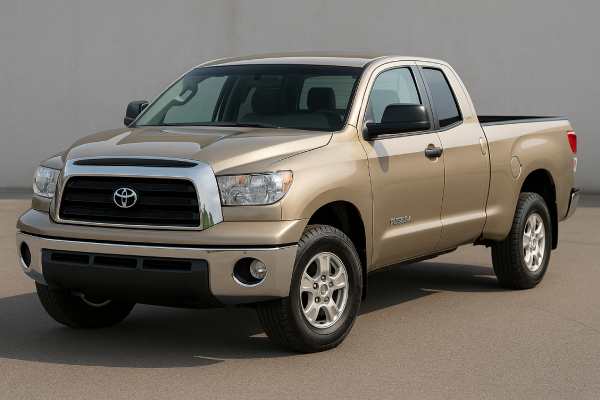
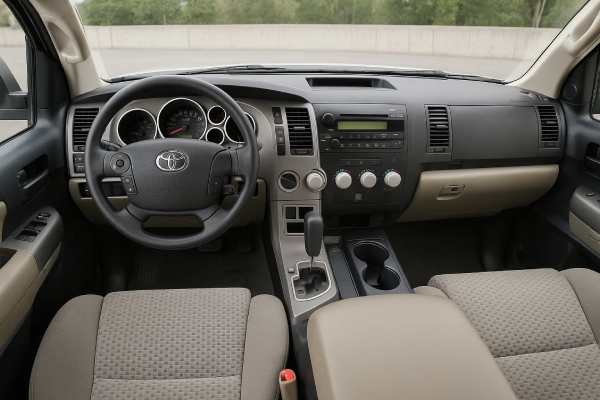
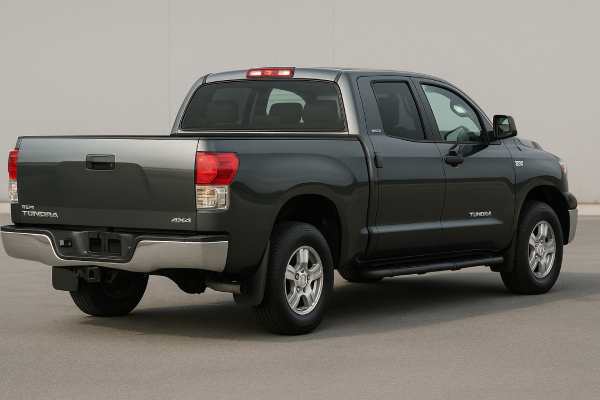
The 2007–2009 Toyota Tundra 4×4 with the 2UZ-FE 4.7-liter V8 sits in a sweet spot between old-school truck durability and modern usability. This first wave of XK50 trucks brought a larger frame, stronger brakes, and a more refined cabin than the original Tundra, yet the 4.7 V8 stayed close to its proven roots. It is not the quickest option in the range—that title belongs to the later 5.7—but many owners choose the 4.7 for its smoother character, lower stress in daily use, and long track record in Land Cruiser and Lexus applications.
In this guide, we focus specifically on the 4×4 4.7-liter XK50: what the specs really mean, how it tows and rides, typical problem areas, and what you should plan for in maintenance. If you are weighing a used Tundra against domestic half-tons or simply deciding between Toyota engines, this article gives you a clear, practical view of ownership.
Owner Snapshot
- Naturally aspirated 4.7 V8 and robust 6-lug 4×4 hardware make the XK50 Tundra a stable, confident tow vehicle for loads around 3,000–4,000 kg (6,500–8,500 lb).
- The 2UZ-FE is known for high mileage when serviced on time, with a non-stressed tune, conservative compression, and a timing belt instead of a chain.
- Chassis, brakes, and interior are a big step up from the first-generation Tundra, with better cabin space and more planted highway manners.
- Watch for timing-belt age, frame and underbody corrosion in harsh climates, and secondary air injection issues on higher-mileage trucks.
- As a rule of thumb, plan engine oil and filter every 5,000 miles / 8,000 km or 6 months, whichever comes first, especially if towing or short-tripping.
Navigate this guide
- Toyota Tundra XK50 4×4 overview
- Tundra 4×4 engine and specs
- Trims, equipment and safety
- Reliability and common issues
- Maintenance plan and buying tips
- Driving, towing and real-world performance
- How the Tundra compares to rivals
Toyota Tundra XK50 4×4 overview
The XK50 Tundra launched for 2007 as Toyota’s first truly full-size half-ton pickup aimed squarely at the Detroit Big Three. For the 4×4 2UZ-FE models, the focus is on a balance of capability and dependability rather than headline performance.
The 4.7-liter 2UZ-FE V8 is an iron-block, aluminum-head, 32-valve engine with a long history in Land Cruiser, Sequoia, and Lexus SUVs. In this application it is tuned to roughly 276 hp and just over 310 lb-ft of torque. Power delivery is linear and predictable rather than explosive, which suits owners who prioritize smoothness and durability over maximum acceleration.
All 4.7-liter 4×4 Tundras of this period use a 5-speed automatic with a two-speed transfer case and a full-time 6-lug, heavy-duty chassis. Depending on cab and bed configuration—Regular Cab, Double Cab, or CrewMax—the truck offers a mix of work-focused payload and family-friendly interior space. The 4×4 system uses an electronically controlled transfer case with 2-High, 4-High, and 4-Low, plus stability and traction control to help manage grip when differentials are open.
Compared with the first-generation Tundra, the XK50 rides on a much larger frame, with a longer wheelbase and wider track. That brings a more planted highway feel, higher tow ratings, and greater cargo volume. At the same time, the cabin is quieter and more refined, especially in SR5 and Limited trims with upgraded seats and sound deadening.
For buyers, the 2UZ-FE 4×4 configuration appeals if you want a full-size, body-on-frame truck that can tow mid-size travel trailers or boats, tackle winter conditions, and still deliver Toyota’s typical long-term reliability—without the higher running costs and heavier feel of the 5.7-liter models.
Tundra 4×4 engine and specs
Engine and performance
| Item | Specification (approximate) |
|---|---|
| Engine code | 2UZ-FE |
| Layout and cylinders | 90° V8, DOHC, 32 valves, 4 valves per cylinder |
| Displacement | 4.7 L (≈ 4,663 cc) |
| Bore × stroke | ~94.0 mm × 84.0 mm (3.70 in × 3.31 in) |
| Induction | Naturally aspirated |
| Fuel system | Sequential multi-port fuel injection |
| Compression ratio | ~9.6 : 1 |
| Max power | ~276 hp (206 kW) @ ~5,400 rpm |
| Max torque | ~313 lb-ft (≈ 424 Nm) @ ~3,400 rpm |
| Timing drive | Toothed timing belt driving camshafts |
| Emissions standard | ULEV II / Tier 2 (North American spec) |
| Recommended fuel | Regular unleaded (87 AKI) |
Efficiency and aerodynamics (typical 4×4 models)
| Parameter | Value (typical) |
|---|---|
| EPA-style rating city | ≈14 mpg US (≈16.8 L/100 km) |
| EPA-style rating highway | ≈18 mpg US (≈13.1 L/100 km) |
| Mixed real-world range | ~13–16 mpg US (≈17–21 L/100 km) |
| Drag coefficient (Cd, approx.) | ~0.38–0.40 depending on cab/bed |
Transmission and driveline
| Item | Specification |
|---|---|
| Transmission | 5-speed automatic (A750F family, console or column shift) |
| Gear ratios (1st–5th) | ~3.5 / 2.1 / 1.4 / 1.0 / 0.7 (typical A750 layout) |
| Reverse | ~3.2 : 1 |
| Final drive ratio | ~3.91 or 4.10 (varies by axle and tow package) |
| Drive type | Part-time 4×4 (2H / 4H / 4L) |
| Transfer case | Two-speed, electrically actuated, low range ~2.6 : 1 |
| Differential type | Open front; open or automatic limited-slip rear (A-LSD) |
| Available tow package | Class IV hitch, 7-pin wiring, transmission cooler, etc. |
Chassis and dimensions (typical Double Cab 4×4)
Values vary with cab and bed; below is representative for a Double Cab standard-bed 4×4.
| Item | Approximate value |
|---|---|
| Frame type | Fully boxed front, C-channel rear ladder frame |
| Front suspension | Double wishbone, coil spring, gas shocks |
| Rear suspension | Leaf springs, solid axle, gas shocks |
| Steering | Rack-and-pinion power steering |
| Front brakes | Ventilated discs (≈ 13.9 in) with 4-piston calipers |
| Rear brakes | Ventilated discs (≈ 13.6 in) |
| Wheel / tire examples | 18×8 in alloy with 255/70R18 all-season or A/T |
| Overall length | ≈ 5,800–5,820 mm (≈ 228–229 in) |
| Width (mirror-folded) | ≈ 2,030 mm (≈ 80 in) |
| Height | ≈ 1,930–1,950 mm (≈ 76–77 in) |
| Wheelbase (Double Cab) | ≈ 3,700 mm (≈ 145.7 in) |
| Ground clearance | ≈ 250–260 mm (≈ 9.8–10.2 in) |
| Turning circle (kerb-to-kerb) | ≈ 13 m (≈ 42–43 ft) |
| Curb weight | ≈ 2,450–2,600 kg (≈ 5,400–5,700 lb) |
| GVWR | ≈ 3,175–3,265 kg (≈ 7,000–7,200 lb) |
| Fuel tank capacity | ≈ 100 L (≈ 26 US gal / 21.6 UK gal) |
| Cargo box volume | Varies by bed; roughly 1,500–1,800 L (≈ 53–64 ft³) |
Performance and capability
| Item | Value (typical 4×4 4.7 V8) |
|---|---|
| 0–100 km/h (0–62 mph) | ~8.5–9.5 s (unloaded, axle/weight dependent) |
| Top speed (governed) | ~175–180 km/h (≈ 108–112 mph) |
| 100–0 km/h braking distance | ~40–43 m (≈ 130–140 ft) with good tires |
| Max towing capacity | ~3,000–3,850 kg (≈ 6,600–8,500 lb) depending on configuration |
| Typical payload range | ~635–800 kg (≈ 1,400–1,750 lb) |
| Roof load (with rails) | ~75–100 kg (≈ 165–220 lb), check manual |
Fluids, service capacities and key torques (typical)
Always verify against the specific owner’s or service manual for your VIN.
| System | Specification and capacity (approx.) |
|---|---|
| Engine oil | 5W-30 API SL/SM; ≈ 5.5–6.0 L (≈ 5.8–6.3 US qt) |
| Engine coolant | Toyota Super Long Life Coolant; ≈ 11–13 L (≈ 3 US gal) |
| Automatic transmission | Toyota WS ATF; service fill ≈ 4–5 L (≈ 4–5 qt) |
| Front differential | 75W-85/75W-90 gear oil; ≈ 1.4–1.5 L (≈ 1.5–1.6 qt) |
| Rear differential | 75W-85/75W-90; ≈ 3.0 L (≈ 3.2 qt) |
| Transfer case | ATF or gear oil per spec; ≈ 1.5–1.7 L |
| A/C refrigerant | R-134a; charge typically ~700–800 g (24–28 oz) |
Key torque examples (typical Toyota values):
| Fastener | Torque (approx.) |
|---|---|
| Wheel lug nuts | ≈ 113 Nm (≈ 83 lb-ft) |
| Engine oil drain plug | ≈ 39 Nm (≈ 29 lb-ft) |
| Differential drain/fill plugs | ≈ 49–59 Nm (≈ 36–44 lb-ft) |
Electrical
| Item | Specification (typical) |
|---|---|
| Alternator | ≈ 130 A output |
| 12 V battery | ~70–80 Ah, ~650–750 CCA, Group 27F or similar |
| Spark plugs | Long-life iridium, heat range per 2UZ-FE spec |
| Spark plug gap | ~1.0–1.1 mm (≈ 0.039–0.043 in) |
Trims, equipment and safety
Trims and mechanical options (4.7 4×4 focus)
The 4.7-liter 4×4 Tundra was typically offered in work-focused and mid-range trims rather than the most luxurious variants. Depending on market, you will most often see:
- Base / Work Truck: Vinyl or basic cloth seats, simple audio, steel wheels, minimal chrome. Same 4×4 hardware but fewer comfort features.
- SR5: The “sweet spot” for many buyers—cloth buckets or split bench, upgraded audio, power driver’s seat, alloy wheels, carpet, and more storage.
- Limited (select configurations): Leather, dual-zone climate control, premium audio, power passenger seat, and more extensive chrome and trim.
Common functional and off-road-related options include:
- TRD Off-Road or similar package (name varies by region):
- Bilstein or sport-tuned shocks
- All-terrain tires
- Skid plates under the engine and transfer case
- Locking rear differential or enhanced A-LSD behavior (market-dependent)
- Tow package:
- Class IV hitch receiver
- 7-pin wiring and brake controller provision
- Transmission fluid temperature management (cooler, revised calibration)
- Heavier-duty alternator in some configurations
Easy visual identifiers: Off-Road package trucks usually have specific badging on the bed, slightly taller stance, skid plates visible under the front, and sometimes different wheel designs. Tow package trucks will have factory-integrated hitch and wiring, not aftermarket add-ons bolted to the bumper.
Safety equipment and ratings
All XK50 Tundras of this era come with a fairly comprehensive passive safety set for the time:
- Dual front airbags and front seat-mounted side airbags.
- Full-length side curtain airbags covering both rows on Double Cab and CrewMax.
- Three-point belts in all seating positions and adjustable front belt anchors.
- LATCH/ISOFIX-style lower anchors in rear outboard positions on crew cabs.
Active safety systems typically include:
- Four-wheel disc brakes with ABS and electronic brake-force distribution.
- Vehicle Stability Control (VSC) and Traction Control (TRAC).
- In some markets, an automatic limited-slip function that uses the rear brakes to simulate an LSD.
- Brake Assist, which increases braking pressure in panic stops.
Advanced driver-assistance systems familiar today (automatic emergency braking, lane keep assist, adaptive cruise control, blind-spot monitoring) were not yet offered on 2007–2009 Tundras. This means crash avoidance relies on basic ABS/VSC and driver awareness rather than camera- and radar-based systems.
Crash-test results for contemporary tests generally show strong occupant protection in frontal and side impacts, reflecting the larger structure and multiple airbags. Rollover risk ratings are typical for a tall, body-on-frame 4×4 pickup: acceptable but not exceptional, emphasizing the need for sensible loading, good tires, and moderate cornering speeds.
Calibration and service implications
Because ADAS is minimal on these trucks, collision or suspension repairs are usually simpler than on newer vehicles. The main electronic components that may require calibration or relearn after service include:
- Steering angle sensor (after steering or alignment work).
- Yaw rate / acceleration sensor if the stability control module or sensors are replaced.
- Tire pressure monitoring system (TPMS) registration after wheel changes or TPMS sensor replacement.
For prospective buyers, this simplicity is a plus: you get essential stability and traction systems without the complexity and potential expense of radar or camera calibration.
Reliability and common issues
The 2UZ-FE-powered XK50 Tundra is generally regarded as one of the more durable full-size pickups from its era, but no vehicle is free of issues. It helps to categorize problems by frequency, cost, and likely mileage bands.
Engine and fuel system
Common to occasional issues include:
- Timing belt overdue
- Symptoms: No obvious symptom until failure; belt may show cracks or glazing on inspection.
- Risk: If ignored well past the recommended interval, a broken belt can lead to loss of power and potential internal damage.
- Remedy: Replace timing belt, tensioner, idlers, and often water pump around 90,000 miles / 145,000 km or 9 years.
- Secondary air injection system faults (where fitted)
- Symptoms: Check-engine light, reduced power or limp mode, codes relating to air pumps or switching valves.
- Cause: Moisture or debris in the air injection pumps and valves.
- Remedy: Replace or clean pumps and valves; some owners fit updated components or relocation kits where available.
- Exhaust manifold leaks
- Symptoms: Ticking noise on cold start that quiets as the engine warms.
- Cause: Cracks or leaking gaskets at the manifold.
- Remedy: Replace manifold or gasket; this can be a moderate-to-high labor job due to access and seized fasteners.
Oil consumption is usually modest on a healthy 2UZ-FE, but long intervals on cheap oil can accelerate ring and seal wear. A truck that has seen consistent 5,000-mile oil changes is far more reassuring than one with unknown history.
Cooling, driveline and chassis
- Radiator and transmission cooler aging (higher-mileage trucks):
- Look for signs of external corrosion, seepage at seams, or discolored ATF. Replacing the radiator proactively on trucks that tow frequently is relatively inexpensive insurance.
- Front suspension bushings and ball joints:
- Expect control arm bushings, sway-bar links, and occasionally ball joints to wear by 150,000–200,000 km (90,000–125,000 miles), especially with heavy loads or rough roads.
- Symptoms are clunks over bumps, vague steering, and uneven tire wear.
- Steering rack seepage:
- Some owners report slow leaks from the steering rack seals at higher mileage.
- Address with rack replacement or quality remanufactured units; plan for an alignment afterward.
- 4×4 actuator or ADD (automatic disconnecting differential) issues:
- Symptoms include flashing 4×4 indicator, delayed engagement, or refusal to go into low range.
- Causes range from sticky actuators (from lack of use) to wiring issues. Regularly cycling the system, even when you do not “need” 4×4, helps keep components free.
Frame rust and severe corrosion were more notorious on the earlier first-generation Tundra, but XK50 trucks in salt-heavy regions can still suffer. Pay close attention to:
- Rear frame section near the spare tire.
- Bed mounts and cab mounts.
- Brake lines and fuel lines running along the frame rails.
Electronics and interior
Overall, interior electronics are relatively simple and generally robust. Recurrent but usually low-to-medium-cost items include:
- Failing window regulators or switches.
- Aging blower motor resistors or fan motors leading to intermittent HVAC fan operation.
- TPMS sensor failures as batteries age (often 8–12 years).
Recalls and service actions
Depending on build date, many XK50 Tundras were subject to recalls over the years, for items such as:
- Propeller shaft or driveshaft concerns on early builds.
- Airbag inflator replacements as part of larger campaigns.
- Accelerator pedal / floor mat interactions during Toyota’s wider unintended-acceleration response period.
For any prospective or current owner, it is essential to:
- Use the official VIN-check tool in your region (manufacturer or transport authority).
- Ask for printed or digital service records confirming recall completion.
A truck with complete recall and maintenance documentation is far more reassuring than one with unknown history, even if the odometer figures are similar.
Maintenance plan and buying tips
A well-maintained 2UZ-FE Tundra can comfortably exceed 200,000 miles (320,000 km) and beyond. The key is sticking to sensible intervals and using fluids that meet Toyota specifications.
Practical maintenance schedule (typical guidance)
Always verify against local conditions and official documentation.
| Item | Interval (time / distance) | Notes |
|---|---|---|
| Engine oil and filter | Every 5,000 mi / 8,000 km or 6 months | Shorter intervals for towing, off-road, or short trips |
| Engine air filter | Inspect 15,000 mi / 24,000 km; replace ~30,000 mi / 48,000 km | Sooner in dusty conditions |
| Cabin air filter | Every 2 years or 20,000–25,000 mi | More frequent in urban or dusty areas |
| Engine coolant | First change ~100,000 mi / 160,000 km or 10 years; then every 50,000 mi / 80,000 km | Use Toyota Super Long Life or equivalent |
| Spark plugs (iridium) | Around 90,000–120,000 mi (145,000–190,000 km) | Replace with correct long-life plug type |
| Fuel filter | In-tank; usually “lifetime” unless issues present | Replace only when diagnosing fuel-delivery problems |
| Timing belt, tensioner, idlers | ~90,000 mi / 145,000 km or 9 years | Combine with water pump and cam seals if needed |
| Serpentine / accessory belt | Inspect annually; replace ~60,000–90,000 mi | Look for cracking and glazing |
| Automatic transmission fluid | 60,000–90,000 mi depending on towing/usage | Toyota WS or equivalent; drain-and-fill preferred |
| Front and rear differential oil | ~60,000 mi / 96,000 km (sooner if heavy towing/off-road) | Check level and condition during services |
| Transfer case fluid | ~60,000 mi / 96,000 km | Cycle 4H/4L periodically to keep internals free |
| Brake fluid | Every 2–3 years | Helps prevent corrosion in calipers and ABS valves |
| Brake pads and rotors | Inspect at every service; replace as needed | Heavy towing shortens life significantly |
| Tire rotation | Every 5,000–7,500 mi (8,000–12,000 km) | Maintain even wear; align if abnormal patterns appear |
| Alignment | Every 30,000–40,000 mi or after major suspension work | Essential for tire life and straight-line stability |
| Valve clearance | Hydraulic lifters; no routine adjustment | |
| 12 V battery | Test annually after year 4; expect 5–7-year life |
For torque-sensitive work (wheels, suspension arms, steering components, driveline flanges), always consult the factory service manual for the exact value—do not rely only on generic figures.
Buyer’s checklist
When inspecting a used 2007–2009 Tundra 4×4 4.7:
- Documentation first
- Service history with stamps/invoices, especially for timing belt and coolant changes.
- Evidence of transmission and differential services if the truck was used for towing.
- Underbody and frame
- Inspect frame rails, crossmembers, and rear frame near the spare tire for corrosion or repairs.
- Check brake and fuel lines for rust or wet spots.
- Driveline and 4×4 system
- Engage 4H and 4L on a test drive; ensure smooth engagement and no binding on gravel or loose surfaces.
- Listen for clunks from U-joints or differentials on take-off or during throttle transitions.
- Suspension and steering
- Check for play in tie rods and ball joints; uneven front tire wear often signals alignment or bushing issues.
- Note any excessive wandering or vibration at highway speeds.
- Engine and transmission behavior
- Cold start should be quick with no loud metallic knocks; a brief tick from exhaust manifolds may hint at a future repair.
- Transmission should shift cleanly without flare or harsh engagement; watch for hunting between gears on gentle grades.
- Interior and electronics
- Test all windows, locks, seat adjustments, and HVAC blower speeds.
- Confirm TPMS light operation and that no warning lights remain on during the test drive.
Recommended configurations
- Strong all-rounder: Double Cab 4×4 SR5 with tow package and Off-Road package. This setup offers useful rear seat space, good towing stability, and a balance between comfort and simplicity.
- Work-focused: Regular Cab or basic Double Cab 4×4 with vinyl or simple cloth interior, minimal electronics, and tow package—ideal for fleets or rural use.
- What to avoid: Trucks with unclear timing-belt history, visible frame repairs from severe corrosion, or persistent 4×4 warning lights. These can quickly erase the cost advantage of buying used.
Overall, a well-kept 4.7-liter 4×4 Tundra offers long-term durability, straightforward maintenance, and solid parts support, making it a strong candidate for owners who want to keep a truck for many years.
Driving, towing and real-world performance
Powertrain character
On the road, the 2UZ-FE 4.7-liter feels relaxed and composed rather than urgent. Throttle response is smooth, and there is useful torque from just above idle, which helps in stop-and-go traffic, on steep driveways, and when maneuvering trailers. The 5-speed automatic keeps revs relatively low at highway speeds, with a tall overdrive gear that allows quiet cruising.
Compared with the 5.7-liter 3UR-FE, acceleration is noticeably softer, especially with a full load or larger tires. However, many owners appreciate that the 4.7 rarely feels strained in normal use and does not demand premium fuel. Kickdown from the automatic is predictable, though you may need to plan overtakes a bit more carefully on two-lane roads, especially at higher elevations or with heavy trailers.
Ride, handling and NVH
The XK50 chassis is significantly more stable than the first-generation Tundra. On the 4×4 4.7:
- Ride: Unladen ride can be firm, especially on trucks with off-road packages or E-load-range tires. With even a modest load in the bed, the suspension settles and becomes more composed.
- Handling: Steering is light but not overly vague once suspension components are in good condition. Body roll is typical for a full-size pickup but well controlled.
- Noise: Wind and road noise are reasonable for a truck of this era. The 4.7 V8 produces a subdued, slightly growly note when pushed but is mostly unobtrusive at steady speeds.
On long highway stretches, the Tundra 4×4 tracks confidently, and the longer wheelbase of Double Cab and CrewMax versions helps with stability in crosswinds and when towing.
Off-road and traction
With its part-time 4×4 system, decent ground clearance, and relatively short overhangs, the XK50 Tundra is capable on dirt, snow, and light off-road trails:
- 2H is for dry pavement.
- 4H handles gravel, wet roads, and packed snow.
- 4L is mainly for slow, technical terrain, steep climbs/descents, and heavy pulling from a stop.
Open differentials limit progress in very uneven terrain, but the combination of traction control, careful throttle use, and appropriate tires can take the truck further than many owners expect. Skid plates from the Off-Road package are a worthwhile feature if you travel on rocky trails, as they protect the engine and transfer case from impacts.
Real-world fuel economy and towing behavior
In daily mixed driving:
- City-heavy use: Expect around 13–14 mpg US (18–20 L/100 km) in stop-and-go conditions.
- Highway at 65–70 mph (105–115 km/h): Often 16–18 mpg US (13–15 L/100 km) depending on wind, tires, and load.
- Mixed commuting: Roughly 14–16 mpg US (15–17 L/100 km) for many owners.
Under towing—say a 3,000–3,500 kg (6,500–7,700 lb) trailer—fuel use can drop into the 8–11 mpg US range (21–29 L/100 km), especially at highway speeds. The cooling system is generally robust if fluids are fresh and radiators are clean, but it is good practice to:
- Shift out of overdrive on long grades to keep transmission temperatures in check.
- Use a proportional brake controller and ensure trailer brakes are in good order.
- Keep a close eye on tire pressures for both truck and trailer.
Overall, the Tundra 4×4 4.7 is not a fuel-sipper, but its economy is competitive with other V8 half-tons from the same era, especially given its weight and capability.
How the Tundra compares to rivals
When the XK50 Tundra 4×4 4.7-liter launched, its main competitors were the Ford F-150 (5.4 V8), Chevrolet Silverado/GMC Sierra (5.3 V8), Dodge Ram 1500 (5.7 Hemi), and Nissan Titan (5.6 V8). Each has its strengths and weaknesses; the Tundra’s character is distinct.
Where the Tundra 4.7 excels:
- Long-term reliability: The 2UZ-FE’s conservative design and Toyota’s track record give it an edge for owners planning to keep a truck well past 150,000 miles.
- Chassis robustness: The XK50 frame, big brakes, and stout driveline components hold up well to moderate towing and mixed use when maintained properly.
- Resale value: Used Tundras often command higher prices than comparable domestic trucks, reflecting demand and perceived reliability.
- Simple electronics: The absence of complex early-generation ADAS systems reduces the risk of costly electronic failures over time.
Where rivals may be stronger:
- Peak performance: The 5.7 Hemi Ram, 5.3/6.0 GM V8s, and later F-150 engines generally out-accelerate the 4.7 Tundra, particularly when towing at the higher end of their ratings.
- Cab and feature variety: Domestic trucks of the era offer a wide range of trim levels and niche packages (luxury, off-road, sport), sometimes exceeding Toyota’s combinations.
- Aftermarket ecosystem: While the Tundra has solid aftermarket support, Ford and GM trucks benefit from an even broader range of performance, suspension, and cosmetic parts.
Tundra versus the 5.7-liter Tundra
Within Toyota’s own lineup, many shoppers cross-shop the 4.7- and 5.7-liter Tundras. Broadly:
- The 5.7-liter 3UR-FE is better if you consistently tow heavy trailers near the upper end of half-ton ratings or want the quickest acceleration.
- The 4.7-liter 2UZ-FE makes sense if you prioritize a slightly simpler, understressed engine with a long history in heavy SUVs, and if your towing needs are moderate rather than extreme.
For buyers today, a clean, rust-free 4.7-liter 4×4 XK50 with documented maintenance, especially timing belt and drivetrain fluid changes, competes strongly against similarly aged rivals. It is not the newest or most powerful option, but it delivers a blend of reliability, capability, and everyday comfort that still holds up.
References
- Toyota Official Site 2024 (Manufacturer Information)
- Toyota Owners 2024 (Owner’s Resources and Manuals)
- National Highway Traffic Safety Administration 2024 (Safety Ratings and Recall Database)
- IIHS-HLDI Crash Testing and Highway Safety 2024 (Safety Ratings)
Disclaimer
This article is for informational purposes only and is not a substitute for professional diagnosis, repair, or official service information. Specifications, torque values, fluid types, and maintenance intervals can vary by VIN, market, model year, and installed equipment. Always verify critical data against your vehicle’s official owner’s manual and factory service documentation, and consult a qualified technician before performing any repair or modification.
If you found this guide helpful, consider sharing it with other owners or shoppers on social media (Facebook, X/Twitter, forums, and owner groups). It helps support the effort that goes into creating detailed, independent content for xcar readers.