
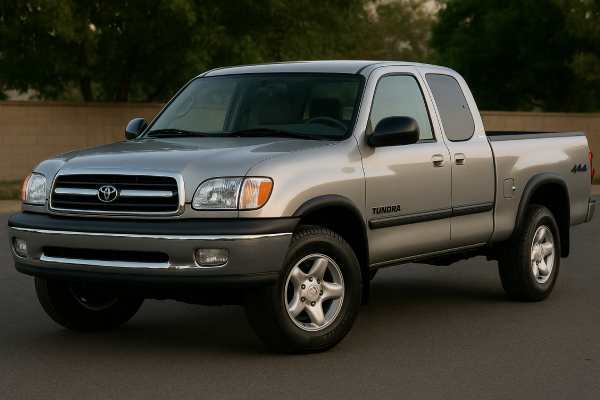

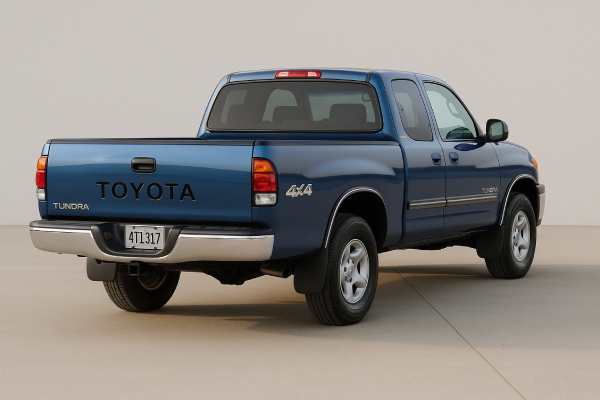
The facelift Toyota Tundra 4×4 (XK40) with the 5VZ-FE 3.4 litre V6 is one of the more interesting early-2000s half-ton pickups. It blends a compact, easy-to-place footprint with a drivetrain many owners already knew from the Tacoma and 4Runner. For buyers who do not need maximum towing numbers but care about reliability, frame strength, and all-weather traction, this combination is still worth a close look today.
This guide focuses on the facelift 2002–2004 4×4 V6 models. You will find detailed technical data, real-world performance, typical problem areas, and a clear maintenance roadmap. The goal is to help you understand what this truck can and cannot do, what it costs to keep in good condition, and how it compares to domestic rivals from the same era. Whether you are already an owner or shopping for a used example, use this as a practical reference, not just a spec sheet.
What to Know
- Proven 5VZ-FE 3.4 V6 with timing belt and a long reputation for durability when serviced on time
- 4×4 chassis offers solid off-pavement traction with a smooth ride compared to many leaf-spring rivals
- Mid-size exterior footprint makes parking and daily driving easier than larger contemporary full-size trucks
- Frame and underbody corrosion, especially around the rear crossmember, need careful inspection on 20+ year-old trucks
- Plan engine oil and filter changes every 5,000–7,500 miles (8,000–12,000 km) depending on use and climate
Guide contents
- Facelift Tundra XK40 background
- XK40 4×4 key specifications
- Trims, equipment and safety
- Reliability notes for XK40 V6
- Maintenance plan and buyer advice
- Driving performance and efficiency
- How XK40 4×4 compares
Facelift Tundra XK40 background
When Toyota facelifted the first-generation Tundra for 2002, it refined a platform that had already proven itself in North America. The XK40 4×4 V6 sits in an interesting spot: it shares much of its V6 engine architecture with smaller Toyotas of the time but rides on a dedicated full-size frame with serious payload and towing ability.
The 5VZ-FE 3.4 litre V6 is an iron-block, aluminium-head engine with a timing belt and multi-point fuel injection. In this application it is rated at 190 hp and about 220 lb-ft of torque. Output is modest by modern standards, but the torque curve is relatively flat and well suited to work at low and medium engine speeds. For owners who do regular but not extreme towing, or who drive mostly empty, it offers a good balance of performance, fuel use, and longevity.
The facelift brought styling tweaks (revised grille, bumpers, lights) and detail improvements in the cabin. Depending on trim, you could get bench or bucket seats, upgraded audio, and more power options. However, Toyota did not radically change the basic chassis formula: double-wishbone front suspension, leaf-spring rear, and a separate ladder frame.
In 4×4 form, the XK40 uses a part-time transfer case with high and low range. Most trucks pair the 3.4 V6 with a 4-speed automatic, though some markets and configurations received manuals. Compared to domestic half-tons of the same era, the Tundra is slightly smaller outside but still offers a full-size bed and respectable tow ratings, which makes it easier to park and maneuver without giving up utility.
If you are considering one today, the key attractions are the robust powertrain, generally strong build quality, and the availability of parts shared with many other Toyota models. The main trade-offs are absolute towing capacity, fuel economy that reflects early-2000s design, and age-related issues like frame corrosion that must be checked carefully.
XK40 4×4 key specifications
This section summarises typical specifications for a 2002–2004 Toyota Tundra 4×4 V6 (XK40), focusing on Access Cab 4×4 models with automatic transmission. Figures can vary slightly by year, trim, and market, but these are representative.
Engine and performance
| Item | Value |
|---|---|
| Engine code | 5VZ-FE |
| Type | 60° V6, iron block, aluminium heads |
| Valvetrain | DOHC, 4 valves per cylinder (24-valve) |
| Displacement | 3.4 l (3,378 cc) |
| Induction | Naturally aspirated |
| Fuel system | Multi-point fuel injection |
| Compression ratio | ~9.6:1 |
| Max power | 190 hp (approx. 142 kW) @ ~4,800 rpm |
| Max torque | ~298 Nm (220 lb-ft) @ ~3,600 rpm |
| Timing drive | Belt (interference-safe in most cases) |
| Recommended fuel | Unleaded, typically 87 AKI (regular) |
Real-world fuel consumption for a healthy truck is often around:
- City: 14–16 mpg US (16–17 mpg UK; 15–17 l/100 km)
- Highway (65–70 mph / 105–115 km/h): 17–19 mpg US (20–23 mpg UK; 12–14 l/100 km)
- Mixed driving: 15–17 mpg US (18–20 mpg UK; 14–16 l/100 km)
Transmission and driveline
| Item | Value |
|---|---|
| Transmission | 4-speed automatic (A340-series) in most markets |
| Drive type | Part-time 4×4, 2H / 4H / 4L |
| Transfer case | 2-speed, lever- or switch-operated by model year |
| Front differential | Open, independent front suspension (IFS) |
| Rear differential | Open; LSD available/market-dependent |
| Typical final drive | Around 4.10–4.30:1 on many V6 4×4 trucks |
Chassis and dimensions
Representative Access Cab 4×4 dimensions:
| Item | Value |
|---|---|
| Overall length | ~5,600 mm (220 in) |
| Width (without mirrors) | ~2,000 mm (79 in) |
| Height | ~1,800–1,850 mm (71–73 in) |
| Wheelbase (Access Cab) | ~3,260 mm (128 in) |
| Ground clearance | ~265–270 mm (10.4–10.6 in) |
| Turning circle (kerb to kerb) | ~13.4 m (44 ft) |
| Curb weight | ~1,850–1,950 kg (4,080–4,300 lb) |
| GVWR | Typically ~2,700–2,800 kg |
| Fuel tank capacity | Around 100 l (26–27 US gal) |
Suspension and brakes:
- Front: Double-wishbone IFS with coil springs and anti-roll bar
- Rear: Solid axle with leaf springs
- Brakes: Front ventilated discs, rear drums on most V6 trims
- Typical wheel/tyre: 16-inch rims with 245–265 section all-terrain or highway tyres
Performance and capability
| Item | Value (typical) |
|---|---|
| 0–100 km/h | Around 11–12 seconds (empty, automatic) |
| Top speed | Approx. 170–175 km/h (105–109 mph), limited by tune |
| Towing capacity | Roughly 2,000–2,300 kg (4,400–5,000 lb) by spec |
| Payload | Typically 600–800 kg (1,300–1,750 lb) |
| Roof load | Often around 75–100 kg (165–220 lb) with rack |
These numbers position the V6 4×4 Tundra as a capable light-duty tower and hauler rather than a heavy-duty workhorse. For moderate trailers (small campers, boats, utility trailers) and mixed family use, the V6 is usually adequate if you respect the limits and keep the drivetrain cool and well serviced.
Trims, equipment and safety
During the 2002–2004 facelift years, the 3.4 V6 4×4 XK40 was typically offered in work-oriented and mid-level trims, with the V8 reserved for higher tow ratings and more upscale configurations. Exact names vary by market (SR, SR5, Limited, etc.), but the structure is broadly similar.
On the lower trims, you are likely to find:
- Cloth seats (bench or 60/40 split)
- Manual air conditioning
- Basic audio and limited sound insulation
- Steel wheels and simpler interior trim
Mid-level trucks add:
- Power windows and locks
- Cruise control and better audio
- Alloy wheels and cosmetic upgrades
- Optional bucket seats and centre console
A key distinction for buyers is whether the truck has:
- 4-wheel anti-lock brakes (ABS)
- Traction control or stability control (earlier trucks often lack these)
- Limited-slip or locker options in the rear differential (market-dependent)
Access Cab 4×4 V6 models commonly come with rear-hinged back doors and a rear bench suitable for short to medium-length trips. The Double Cab was more frequently paired with the V8, but V6 Double Cabs exist in some markets.
From a safety perspective, the first-generation Tundra earned strong results in moderate-overlap frontal crash tests for its time, with a good structural cage and low injury measures in the driver seat. Side-impact protection is more basic on early trucks, especially those without side airbags. The facelift period still relies heavily on the truck’s basic frame strength and cab structure rather than sophisticated crumple zones and multi-stage airbags found on later generations.
Typical safety equipment on 2002–2004 V6 4×4 models includes:
- Dual front airbags
- 3-point belts in key seating positions
- Front disc / rear drum brakes with ABS on many trims
- Child seat anchor points (varies by market and rear seat type)
Advanced driver assistance systems such as autonomous emergency braking, lane-keeping assist, or blind-spot monitoring were not offered on these early Tundras. From a modern perspective, that means driver vigilance and good tyres matter even more.
When identifying trims:
- Look for badges on the tailgate and doors (SR5, etc.)
- Check interior details: steering wheel controls, seat fabrics, and trim finish often signal higher trims
- Verify axle and equipment codes on the build plate or with a dealer by VIN for differential type, tow package, and gear ratios
Year-to-year for 2002–2004, changes are mostly minor: appearance tweaks, small equipment shifts between packages, and regional differences. For most buyers the condition of the individual truck, maintenance history, and level of corrosion matter far more than model-year micro-differences.
Reliability notes for XK40 V6
The 5VZ-FE V6 and associated 4×4 driveline have a very strong reputation, but age and use patterns now matter more than factory design alone. It helps to think in terms of issue likelihood (common/occasional/rare) and cost impact.
Common, generally moderate-cost items (age and mileage related):
- Timing belt and front seals
- Symptoms: noisy idler/tensioner, oil seep at crank or cam seals, overdue belt by time or mileage.
- Remedy: Full timing belt kit with water pump, tensioner, and seals. This is a normal service item rather than a “failure,” but skipping it is risky on any belt-driven engine.
- Valve cover gasket leaks
- Symptoms: oil smell on hot shutdown, oil seep onto exhaust manifolds, damp rocker covers.
- Remedy: Replace gaskets, clean breather system, inspect for brittle PCV hoses.
- Exhaust manifold or Y-pipe leaks
- Symptoms: ticking sound on cold start, exhaust smell, small loss of low-rpm torque.
- Remedy: Replace cracked sections, studs, and gaskets; use quality hardware to ease future work.
- Front suspension wear
- Symptoms: clunks over bumps, vague steering, uneven tyre wear.
- Likely culprits: lower ball joints, control-arm bushings, sway-bar links, and strut top mounts.
Occasional but important issues:
- 4×4 system engagement problems
- Symptoms: 4H/4L light blinks, no engagement, or delayed engagement; front axle not locking.
- Root causes: sticky actuators, lack of use, dried grease, internal corrosion in ADD system.
- Remedy: Use 4×4 regularly, service actuators, and address wiring or vacuum problems as they arise.
- Automatic transmission behaviour under heavy towing
- Symptoms: shift flare, hunting between gears on hills, dark or burnt ATF.
- Remedy: Regular ATF changes with correct spec fluid, add auxiliary cooler if towing in hot climates, and avoid exceeding tow ratings.
- Frame and crossmember corrosion (high-priority)
- Symptoms: flaky rust on rear crossmember, spare tyre mount, leaf-spring hangers, and inside chassis rails; in advanced cases, perforation.
- Remedy: Thorough inspection, media-blast and treat early rust, weld repair or frame section replacement in severe cases.
Less common but high-impact concerns:
- Severe frame rust with structural compromise
- In heavy salt regions some Tundras suffered significant frame corrosion, especially at the rear. This can render a truck uneconomical to repair. Any candidate vehicle should be inspected on a lift, tapping and probing key areas, not just visually from outside.
- Steering rack leaks or play
- Symptoms: vague on-centre feel, fluid seep, uneven steering effort.
- Remedy: Rack rebuild or replacement and fresh fluid; check tie-rod ends at the same time.
Software updates on these early trucks are limited compared to modern vehicles, but ECU reflashes may exist to address drivability or emissions issues. A dealer or specialist with factory-level diagnostic tools can check for outstanding campaigns and the current calibration ID.
For pre-purchase checks, ask for:
- Complete service history, especially timing belt changes and fluid replacements
- Proof of recall and service campaign completion (frame, fuel system, etc.)
- Evidence of recent major work (suspension refresh, brakes, tyres) that would otherwise be upcoming costs
A well-maintained 5VZ-FE Tundra can comfortably exceed 300,000 km (and often far more) without major internal engine work, provided corrosion and abuse have not shortened its life.
Maintenance plan and buyer advice
For a 20-plus-year-old 4×4 truck, maintenance is as much about catching age-related issues as following the original schedule. The outline below is a practical starting point; always verify details against the exact service documentation for your VIN and market.
Core service intervals (typical, mixed use):
- Engine oil and filter: Every 5,000–7,500 miles (8,000–12,000 km) or 6–12 months. Use quality 5W-30 or 10W-30 meeting the required API spec.
- Engine air filter: Inspect annually, replace every 20,000–30,000 miles (32,000–48,000 km) or sooner in dusty use.
- Cabin air filter: If fitted, replace every 15,000–20,000 miles (24,000–32,000 km).
- Spark plugs: Typically every 60,000–100,000 miles (96,000–160,000 km) depending on plug type (copper vs. iridium).
- Fuel filter: Replace around 60,000–90,000 miles (96,000–145,000 km) if serviceable type is fitted.
- Timing belt, water pump, and tensioner: Roughly every 90,000 miles (144,000 km) or 7–9 years, whichever comes first.
- Accessory (serpentine) belt and hoses: Inspect yearly; replace around 60,000–90,000 miles or when cracked or glazed.
Fluids and capacities (typical values to confirm):
- Engine oil: Around 5–6 litres (5.3–6.3 US qt) incl. filter
- Coolant: Roughly 9–10 litres (9.5–10.5 US qt); use Toyota-approved long-life coolant mixed to the correct ratio
- Automatic transmission fluid: Varies by unit, often ~8–10 litres (including torque converter). Use the specified ATF type, not a generic universal fluid.
- Front and rear differentials / transfer case: Change every 30,000–50,000 miles (48,000–80,000 km) in 4×4 use, sooner if submerged or heavily loaded, using the correct gear oil viscosity and standard.
- Brake fluid: Flush every 2–3 years to maintain boiling point and corrosion protection.
Critical fasteners (wheel nuts, suspension components, drivetrain mounts) should always be tightened to the official torque values from the service manual; do not rely on generic tables.
Buyer’s inspection checklist:
When viewing a facelift XK40 4×4 V6:
- Frame and underbody:
- Inspect rails, rear crossmember, spring hangers, and bed mounts for heavy rust or repairs.
- Check brake lines and fuel lines along the frame for corrosion.
- 4×4 system:
- Confirm 2H/4H/4L engagement on a loose surface; listen for binding or grinding.
- Check for leaks at front differential and transfer case.
- Drivetrain and suspension:
- Feel for clunks on take-off (worn U-joints or slip yoke).
- Check steering play and look for fluid leaks at the rack.
- Inspect ball joints and control-arm bushings.
- Engine bay:
- Look for oil leaks at valve covers and front seals.
- Check coolant colour and level; avoid trucks with oily or rusty coolant.
- Verify timing belt replacement history; assume it is due if there is no proof.
- Interior and electrics:
- Test all power features (locks, windows, mirrors, A/C, heater blend doors).
- Inspect seat tracks and belts for wear or damage.
Which trucks to favour:
- Trucks with complete maintenance records, especially timing belt and fluid services
- Examples from dry, low-salt regions with clean frames
- Lightly modified or stock trucks; heavy lifts, oversize tyres, and tuning can accelerate wear
Which trucks to avoid or price very cautiously:
- Severe frame rust or patchwork repairs on structural sections
- Overheating history, sludged engines, or contaminated ATF
- Trucks used for repeated heavy towing beyond published limits
In short, a well-maintained XK40 3.4 4×4 can still be a very sensible, long-lived work and adventure truck, but the cost and feasibility of rust repair are now the main deciding factors.
Driving performance and efficiency
On the road, the facelift Tundra 4×4 V6 feels more “medium-duty” than many domestic half-tons of its era. The cab is roomy enough for long trips, the controls are straightforward, and visibility is good thanks to relatively thin pillars and a square-shouldered body.
Ride and handling
The IFS front and leaf-spring rear setup gives a firm but controlled ride. Unladen, you may notice some rear-end hop over sharp bumps, which is normal for a pickup tuned to carry load. Once there is a few hundred pounds in the bed, the truck tends to settle and ride more smoothly.
Steering effort is moderate with decent on-centre stability. Compared with some rivals, the Tundra feels lighter and more responsive, partly because of its slightly smaller overall size. Body roll is present, as expected from a tall body and softish anti-roll bars, but it remains predictable up to sensible speeds.
Braking performance is adequate for the truck’s mass when the system is in good order. Since the rear brakes are drums on many V6 trims, they react differently to heat than four-wheel disc systems. Regular inspection and adjustment of the rear drums, along with fresh fluid and good pads/shoes, keeps pedal feel consistent.
Powertrain character
The 5VZ-FE V6 is smooth and refined for a truck engine of its era. It is happiest in the mid-range; there is enough torque off idle to pull away cleanly, but meaningful acceleration requires a deeper throttle input and a downshift or two.
The 4-speed automatic shifts smoothly in normal driving. Under load or when towing, it may hold lower gears for longer and occasionally hunt on rolling highways. Good ATF and, if necessary, an auxiliary cooler help keep it in its comfort zone.
With a light foot and no trailer, performance is more than adequate for merging and overtaking, though it will not feel fast by modern standards. With a mid-size travel trailer or similar load, the V6 will do the job but will need revs and patience on long grades.
Real-world consumption
As noted earlier, expect approximately:
- Around town: 14–16 mpg US (16–17 mpg UK; 15–17 l/100 km)
- Highway cruising: 17–19 mpg US (20–23 mpg UK; 12–14 l/100 km)
- Mixed driving: 15–17 mpg US (18–20 mpg UK; 14–16 l/100 km)
4×4 hardware, all-terrain tyres, lifts, roof racks, and heavy aftermarket bumpers all increase drag and rolling resistance. It is common to see a 1–2 mpg penalty from such modifications. Cold climates and short trips can also push consumption up.
Traction, load and towing
Engaging 4H on slippery surfaces gives the truck very secure traction, particularly with quality tyres suited to conditions (all-terrain for gravel and light off-road, winter tyres for snow and ice). 4L offers good control at low speeds on steep tracks, launches on boat ramps, or backing heavy trailers.
When towing within its rated range, the Tundra feels stable as long as the trailer is properly loaded with adequate tongue weight and the truck’s suspension and tyres are in good condition. On long inclines you will hear the V6 working harder and see fuel use climb significantly; it is not unusual for towing consumption to increase by 30–50%.
Overall, as a driving tool, the 2002–2004 Tundra 4×4 V6 feels honest and predictable. It rewards smooth inputs and regular maintenance rather than aggressive driving, and it is at its best as a versatile mixed-use truck rather than a max-tow specialist.
How XK40 4×4 compares
When new, the facelift Tundra XK40 3.4 4×4 competed mainly with domestic half-ton pickups such as the Ford F-150, Chevrolet Silverado 1500, GMC Sierra 1500, and Dodge Ram 1500. Today, buyers cross-shopping used trucks in this age and price bracket are usually weighing trade-offs between size, capability, and reliability.
Versus domestic half-tons (same era)
- Size and manoeuvrability: The Tundra is slightly smaller outside than many rival extended-cab trucks, making it easier to park and thread through tight streets or trails.
- Power and towing: V6 Tundras do not match the V8 tow ratings of domestic competitors. If you need to tow heavy, long distances or up big grades, a V8 Tundra or domestic V8 may be more appropriate.
- Reliability and running costs: The 5VZ-FE and Toyota driveline components often age very gracefully if serviced correctly. Many owners report fewer major powertrain failures compared with some period domestic engines and transmissions. On the other hand, parts can be more expensive, and certain items (rust-related repairs, exhaust work) are not cheap.
- Interior and refinement: Cab quality and ergonomics are generally good, if simple. Even by modern standards, the controls are clear and the seats hold up well. Noise levels are acceptable, though wind and tyre noise increase with age and tyre choice.
Versus V8 Tundra of the same generation
- Performance: The 4.7 V8 offers stronger acceleration and higher tow ratings. If you frequently tow near the truck’s limits or drive in the mountains, the V8 feels noticeably more relaxed.
- Fuel economy: In gentle use, the V6 can be slightly more economical, but in many real-world cases the gap is smaller than expected, especially when the V6 is worked hard.
- Complexity and maintenance: Both engines are robust with belt-driven timing; cost differences in routine maintenance are small. Choosing between them is more about use case than reliability.
Who the 3.4 V6 4×4 Tundra suits best
- Owners who want a reliable, body-on-frame 4×4 truck for mixed commuting, light to moderate towing, and weekend use
- Drivers who value long-term durability and simpler electronics over the latest technology
- Buyers in regions where rust-free frames can still be found and where mid-size dimensions are a benefit
Who may be better off with another truck
- Regular heavy-duty towers who will spend much of their time near or above 2,500 kg trailer weights
- Buyers who prioritise the latest active safety and driver assistance features
- Those in high-salt regions where finding a structurally clean frame is difficult
In summary, the facelift Toyota Tundra 4×4 (XK40) with the 3.4 litre 5VZ-FE V6 is not the most powerful or feature-rich truck of its era, but it offers an appealing mix of manageable size, proven drivetrain, and straightforward engineering. For the right owner, a carefully chosen example can still deliver many years of dependable service.
References
<a href="https://www.iihs.org/ratings/vehicle/toyota/tundra-extended-cab-pickup/2003">2003 Toyota Tundra</a> 2024 (Safety Rating)<a href="https://static.nhtsa.gov/odi/rcl/2009/RCRIT-09V444-0035.pdf">Safety Recall C0A & 90M - 2000 Through 2003 Model Year Tundra Vehicles Rear Cross Member Corrosion</a> 2009 (Recall Bulletin)<a href="https://static.nhtsa.gov/odi/rcl/2010/RCRIT-10V176-4105.pdf">Safety Recall C0J - 2000 Through 2003 Model Year Tundra Vehicles Frame Corrosion</a> 2010 (Recall Bulletin)<a href="https://www.toyota-tech.eu/aimuploads/%7B5FDFBDE0-CECE-45E9-9F0C-5AD49A9FDFF8%7D/Tundra_2003_U.S.A._RM781U.pdf">Tundra 2003 Repair Manual</a> 2003 (Service Manual)
Disclaimer
This article is for informational purposes only and does not replace professional diagnosis, repair advice, or official service procedures. Specifications, torque values, fluid types, and maintenance intervals can vary by VIN, production date, market, and installed equipment. Always confirm critical data against the official owner’s manual, repair manual, and service bulletins for your specific vehicle, and follow all safety instructions when working on a vehicle.
If you found this guide useful, consider sharing it with other owners or enthusiasts on social media platforms such as Facebook or X/Twitter. It helps support the continued creation of detailed, independent content for xcar readers.