
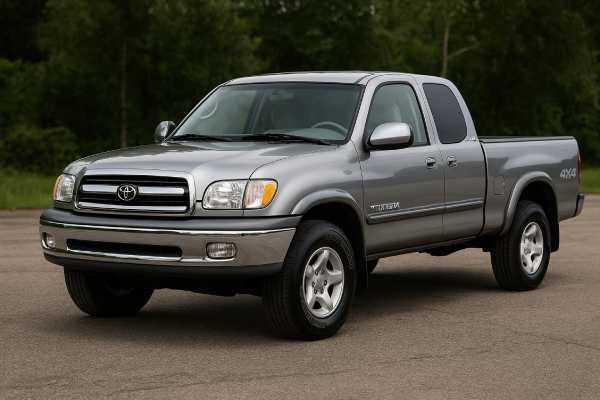
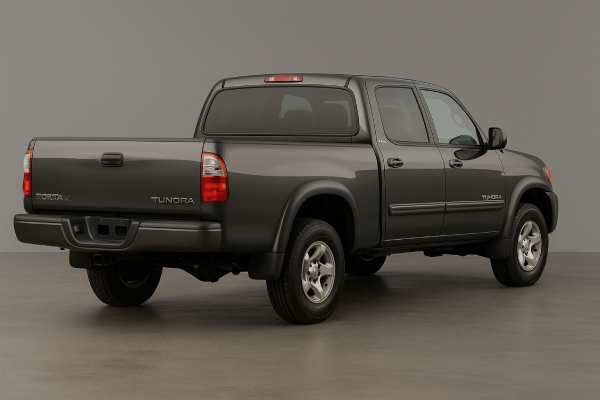
The facelifted 2002–2004 Toyota Tundra 4×4 (XK40) with the 2UZ-FE 4.7 litre V8 sits in a sweet spot for many truck buyers. It is old enough to avoid complex electronics, but new enough to feel refined, safe, and usable as a daily driver. The 2UZ-FE is well known for its durability, smoothness, and strong low-rpm torque, making this Tundra a capable tow vehicle and a relaxed long-distance cruiser.
Compared with domestic half-ton rivals of the same era, the first-generation Tundra is slightly smaller and easier to park, but it still offers a real full-frame chassis, genuine 4×4 hardware, and respectable payload and towing figures. Owners value the quiet cabin, simple controls, and long service life when maintenance and rust control are handled properly. This guide walks through the key specs, strengths, known weak points, and what to look for if you are shopping for a facelift 2002–2004 Tundra 4×4 V8.
Top Highlights
- 2UZ-FE 4.7 litre V8 with about 245 hp and strong low-rpm torque for towing and highway merging.
- Robust body-on-frame design, proper low-range 4×4, and available TRD Off-Road package for light to moderate trail use.
- Generally excellent long-term reliability if maintenance is kept up and frame corrosion is managed early.
- Known issues include frame rust, front lower ball joint wear, and ageing rubber components on higher-mileage trucks.
- Plan engine oil and filter changes every 5,000 mi / 8,000 km or 6 months under mixed use, and more often with heavy towing.
Navigate this guide
- Toyota Tundra XK40 V8 overview
- Toyota Tundra V8 specs
- Tundra 4×4 trims and safety
- Reliability and common issues
- Maintenance schedule and buyer guide
- Driving performance and towing
- V8 Tundra versus rivals
Toyota Tundra XK40 V8 overview
The facelift 2002–2004 Toyota Tundra 4×4 (XK40) with the 2UZ-FE V8 represents the mature version of the first-generation Tundra. Externally, the facelift brought a revised front end, updated lights, and detail trim changes that make these trucks look more modern than the 2000–2002 models, while retaining the same ladder frame and overall proportions. Under the hood is Toyota’s 4.7 litre all-aluminium V8 (with cast-iron block in most trucks) paired with a 4-speed automatic and part-time 4×4 with low range.
The 2UZ-FE is a 32-valve, DOHC V8 with a timing belt, sequential fuel injection, and a relatively conservative compression ratio. It produces about 245 hp at 4,800 rpm and around 315 lb-ft (≈427 Nm) of torque at 3,400 rpm in these years, prioritising reliability and low-end pulling power over peak output. Real-world driving character is relaxed and torquey rather than high-revving.
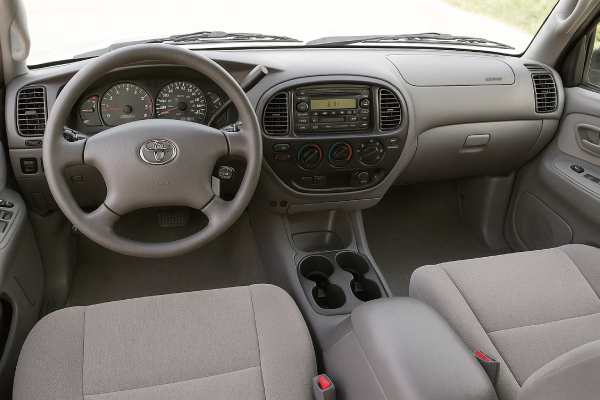
Inside, the Tundra sits between a midsize and a full-size truck in cabin space. Access Cab models provide usable rear jump seats for occasional passengers, while Double Cab versions (introduced for 2004 in some markets) offer proper rear doors and more legroom. The dashboard is simple, with large rotary controls and clear gauges.
From an ownership standpoint, this generation appeals to buyers who want a truck they can keep for many years without constant surprises. Parts availability is excellent, shared with other Toyota trucks and SUVs using the same engine and many common components. The main long-term concerns are rust on the frame and underbody hardware, plus age-related wear on suspension, steering, and rubber parts.
If you need a truck that can tow a medium-size boat or camper, handle winter conditions with low-range traction, and still drive comfortably every day, the facelift XK40 Tundra 4×4 V8 remains a compelling option on the used market.
Toyota Tundra V8 specs
This section focuses on the facelift 2002–2004 Toyota Tundra 4×4 with the 2UZ-FE 4.7 litre V8 and 4-speed automatic transmission. Exact figures can vary slightly by model year, cab, bed length, and market, but the tables below capture the typical specification for a North American-market truck.
Engine and performance
| Item | Specification |
|---|---|
| Engine code | 2UZ-FE V8 |
| Configuration | 90° V8, cast-iron block, aluminium heads |
| Valvetrain | DOHC, 4 valves per cylinder (32-valve) |
| Bore × stroke | ~94.0 × 84.0 mm (3.70 × 3.31 in) |
| Displacement | 4.7 L (4,663 cc) |
| Induction | Naturally aspirated |
| Fuel system | Sequential multi-port fuel injection |
| Compression ratio | Approx. 9.6 : 1 |
| Max power | ~245 hp @ 4,800 rpm |
| Max torque | ~315 lb-ft (≈427 Nm) @ 3,400 rpm |
| Recommended fuel | Unleaded petrol, typically 87 AKI (regular) |
| Timing drive | Belt-driven camshafts |
| Emissions standard | Tier 1 / LEV for most markets |
| Typical EPA rating (4×4 auto) | Around 13 mpg US city / 16 mpg US highway (≈18 / 14.7 L/100 km) |
Real-world consumption often sits slightly worse than the official numbers, especially with lift kits, larger tyres, roof racks, or frequent towing.
Transmission and driveline
| Item | Specification |
|---|---|
| Transmission | 4-speed automatic (A340F or similar) |
| Gear ratios (1st–4th) | Approx. 2.80 / 1.53 / 1.00 / 0.70 |
| Reverse | ~2.39 |
| Final drive ratio | Commonly 3.91 or 4.10 (varies by trim and tow package) |
| Drive type | Part-time 4×4 with transfer case |
| Transfer case | 2H / 4H / 4L, manual lever or electronic selector (market-dependent) |
| Centre differential | None (locked when in 4H/4L; use 2H on dry pavement) |
| Rear differential | Open; limited-slip on some trims; rear e-locker not offered on most Tundra models |
Chassis and dimensions
Figures below are representative for an Access Cab 4×4 with standard bed.
| Item | Specification |
|---|---|
| Frame | Ladder frame with boxed and open sections |
| Front suspension | Double wishbone / coil-over shock |
| Rear suspension | Solid axle with leaf springs |
| Steering | Rack-and-pinion, power-assisted |
| Front brakes | Ventilated disc |
| Rear brakes | Drum (disc in some later trims/markets) |
| Wheelbase | ≈ 140–145 in (3,550–3,680 mm) depending on cab/bed |
| Overall length | ≈ 217–230 in (5,510–5,840 mm) |
| Overall width | Around 79–80 in (≈2,010 mm) |
| Height | Around 71–73 in (≈1,800–1,850 mm) stock |
| Typical tyre sizes | 245/70 R16, 265/70 R16 or similar |
| Ground clearance | Around 10 in (≈255 mm) for 4×4 models |
| Curb weight | Roughly 4,500–5,000 lb (2,040–2,270 kg), cab/bed dependent |
| GVWR | Typically 6,000–6,600 lb (2,720–2,990 kg) |
Performance, fluids, and electrical basics
| Item | Specification |
|---|---|
| 0–60 mph (0–96 km/h) | Roughly mid-8 to low-9 seconds, unladen |
| Top speed | Limited to around 110–115 mph (175–185 km/h) where applicable |
| Max towing capacity | Up to about 7,000 lb (≈3,175 kg) when properly equipped |
| Max payload | Often 1,400–1,700 lb (≈635–770 kg), trim-dependent |
| Fuel tank | About 26.4 US gal (100 L) |
| Engine oil | Typically 5W-30 API SL or better; capacity around 6–7 L including filter |
| Coolant | Toyota Super Long Life Coolant (pink), premixed |
| ATF | Toyota Type T-IV for the 4-speed auto, capacity around 10 L for a full overhaul |
| Alternator output | Commonly in the 100–130 A range depending on equipment |
| Battery | 12 V lead-acid, group size 24F or similar, 550–700 CCA typical |
Exact fluids, capacities, and torque values should always be confirmed against the factory manual for the specific VIN and market.
Tundra 4×4 trims and safety
The facelift 2002–2004 Tundra 4×4 V8 was offered in several trims, typically including base, SR5, and Limited, with regional variations. The 4.7 litre V8 and 4×4 system were available mainly on SR5 and Limited grades, though in some markets basic work-oriented versions with manual features could be optioned with the V8 and 4×4.
Trim and equipment differences
- Base / work-oriented trims
Steel wheels, cloth seats, simpler audio, and fewer power features. Often vinyl or basic cloth upholstery, manual climate controls, and minimal cosmetic extras. Good choice if you prioritise simplicity and ease of cleaning. - SR5
The volume trim in many markets. Alloy wheels, upgraded cloth seats, better sound system, chrome exterior trim, and more power options (windows, locks, mirrors). Many SR5 trucks also have keyless entry and fog lamps. - Limited
More comfort and appearance features: leather seats (often heated), upgraded audio, power driver’s seat, body-colour bumpers, and more chrome. Some Limited trucks include special wheel designs and additional sound insulation.
The TRD Off-Road package, often combined with SR5 or Limited, typically adds skid plates, different shock tuning, specific wheels and tyres, and cosmetic badging. It does not usually bring locking differentials but improves damping and off-road durability compared with the base suspension.
Mechanical differences by trim
Mechanically, most 4×4 V8 trucks share the same engine and transmission. Differences typically relate to:
- Rear axle ratio (tow packages may receive numerically higher final drives for better pulling).
- Shock absorber valving (TRD vs standard).
- Wheel and tyre sizes (which affect real-world gearing and ride quality).
If towing is important, look for a truck with a factory tow package, which can include a heavy-duty receiver, larger transmission cooler, and wiring provisions.
Safety equipment and crash ratings
Safety equipment for 2002–2004 Tundra 4×4 V8 typically includes:
- Dual front airbags, with optional side airbags in some later trucks and markets.
- 3-point seat belts for all outboard seats, sometimes with pre-tensioners and force limiters.
- Anti-lock braking system (ABS) standard or optional depending on trim and market.
- Optional traction control and stability control on some higher-spec facelift trucks.
Crash-test results from independent bodies show that the first-generation Tundra performed well in frontal impact tests for its era, achieving strong ratings in moderate overlap frontal evaluations. Side-impact and rear-impact data are more limited, and these trucks pre-date many modern tests, but they were competitive against domestic full-size pickups of the same time.
Advanced driver assistance systems such as automatic emergency braking, adaptive cruise control, lane-keeping support, or blind-spot monitoring were not available on these model years. As a result, active safety depends heavily on the driver, tyres, brakes, and suspension condition, making a thorough pre-purchase inspection particularly important.
Reliability and common issues
The facelift 2002–2004 Tundra 4×4 V8 is generally considered one of the more robust full-size pickups of its era. The 2UZ-FE engine is capable of very high mileages when serviced properly. However, like any 20-plus-year-old truck, there are known failure points and age-related concerns that buyers should understand.
Engine and powertrain
- Timing belt and water pump
The 2UZ-FE uses a timing belt, not a chain. If the belt, tensioner, or water pump are neglected, failure can lead to breakdown and, in worst cases, internal engine damage. Symptoms include coolant leaks from the front of the engine, noise from the belt area, or unknown change history. Remedy is to replace the belt kit and water pump at the recommended interval or sooner if history is uncertain. - Oil leaks and consumption
Common leak points include valve cover gaskets, cam seals, and the front crank seal. On higher-mileage engines, minor oil consumption between changes can occur, often due to valve-stem seal wear. Monitoring oil level and addressing leaks prevents secondary issues like rubber bush degradation and dirt accumulation. - Exhaust manifold cracks
Some owners report ticking noises on cold start that fade as the engine warms up, often caused by small cracks or leaks at the exhaust manifolds or gaskets. While not usually catastrophic, they can affect emissions and cabin noise. Replacement with new manifolds or quality headers is the usual remedy.
Chassis, steering, and suspension
- Frame and underbody corrosion (high severity, common in rust belts)
The biggest structural concern is frame rust, especially around the rear crossmember supporting the spare tyre and the front control-arm mounts. In severe cases, perforation can affect towing safety and overall structural integrity. Trucks from dry climates are far less affected. Buyers should carefully inspect the frame with a hammer and pick, especially around welds and boxed sections. - Lower ball joints and steering components
Premature wear of front lower ball joints has been documented on early Tundra trucks. Symptoms include vague steering, clunking noises over bumps, or abnormal tyre wear. Replacement with updated or high-quality components and correct torque procedures is important. Outer tie-rod ends and rack bushings can also wear with age, leading to play in the steering. - Rear leaf springs and bushings
Sagging rear springs, broken leaves, or worn shackle and spring-eye bushings are common on trucks that have hauled heavy loads or tow regularly. This can reduce ride height and affect handling. Upgrading to quality replacement springs and bushings often restores stability and comfort.
Brakes and driveline
- Brake rotors and drums
Warped front rotors from heavy braking or corrosion can cause steering wheel vibration under braking. Rear drums or shoes may wear unevenly if the self-adjusters seize. Regular brake inspections and proper lubrication of hardware help prevent issues. - Front differential and transfer case
Overlooked fluid changes can lead to noise, bearing wear, or leaks from the front differential or transfer case. Symptoms include whining or howling at certain speeds, especially under load. Early fluid changes, using the correct gear oils, are cheap insurance.
Recalls and service campaigns
Over the years, first-generation Tundra models have been subject to recalls related to frame corrosion, lower ball joints, and, in later years, airbag inflators. Many of these may apply to facelift 2002–2004 trucks, depending on build date and region. A buyer should always run the VIN through the official recall lookup for their country and ask a dealer to confirm that any structural or safety-related actions have been completed.
Overall, when frame condition is good and maintenance history is solid, the 2UZ-FE Tundra 4×4 is capable of very high mileages with relatively predictable running costs.
Maintenance schedule and buyer guide
For a 20-year-old truck, having a clear and realistic maintenance plan is just as important as knowing the spec sheet. Below is a practical schedule for a facelift 2002–2004 Tundra 4×4 V8 under mixed use. Always adjust intervals for severe service (frequent towing, short trips, dusty conditions, or extreme climates).
Core maintenance intervals (typical guidance)
- Engine oil and filter – Every 5,000 mi / 8,000 km or 6 months. Use quality oil that meets or exceeds the original viscosity and specification.
- Engine air filter – Inspect every 10,000 mi / 16,000 km; replace every 30,000 mi / 48,000 km or sooner in dusty conditions.
- Cabin air filter (if fitted) – Replace every 15,000–20,000 mi / 24,000–32,000 km or annually.
- Spark plugs – Iridium plugs typically last ~90,000–120,000 mi (145,000–190,000 km), but age and conditions matter; consider replacement if misfires or rough idle appear.
- Fuel filter – In many markets it is integrated with the pump inside the tank; replacement is usually “lifetime” but may be advisable at high mileage or when diagnosing fuel-delivery issues.
- Timing belt, tensioner, and water pump – Commonly every 90,000–100,000 mi (145,000–160,000 km) or 8–10 years, whichever comes first. For a truck of this age, many owners pre-emptively replace these on purchase if there is no proof of recent work.
- Serpentine/accessory belt and hoses – Inspect at every service; usually replaced every 60,000–90,000 mi (100,000–145,000 km) or if cracks, glazing, or noise appear.
- Coolant – Toyota Super Long Life Coolant can last many years, but on older trucks a 5-year / 100,000 km replacement interval is a sensible baseline.
- Automatic transmission fluid – Drain and refill every 30,000–60,000 mi (50,000–100,000 km) depending on towing and heat. Full flushes should be done carefully using the correct fluid.
- Front and rear differential oils, transfer case – Replace about every 30,000–60,000 mi, more often if towing or frequent off-road use.
- Brake fluid – Flush every 2–3 years to maintain corrosion resistance and proper pedal feel.
- Brake pads and rotors/drums – Inspect at each service; towing and hills accelerate wear.
- Tyre rotation and alignment – Rotate every 5,000–7,500 mi (8,000–12,000 km); check alignment yearly or if you notice uneven wear or steering pull.
- Valve clearances – On this engine they rarely need adjustment, but any persistent ticking or misfire should be investigated.
- 12 V battery – Test yearly after 4–5 years of age; replace proactively to avoid no-starts.
Buyer’s inspection checklist
When viewing a facelift Tundra 4×4 V8:
- Frame and underbody – Look for heavy scale, perforation, or flaking on the frame rails, crossmembers (especially around the spare tyre), and suspension mounts. This is one of the most important checks.
- Front suspension and steering – Check for play in lower and upper ball joints, tie-rod ends, and control-arm bushings. Listen for clunks or knocks on a test drive over bumps.
- Driveline – Drive in 2H and 4H/4L, listening for whining, grinding, or binding. Engage 4×4 on loose surfaces only. Feel for vibrations on acceleration or deceleration that might indicate prop-shaft or differential issues.
- Engine health – From cold, listen for timing belt noises, unusual ticking, or knocking. Watch for blue smoke, excessive blow-by, or heavy oil use between changes.
- Cooling system – Look for crusted coolant traces around the water pump, radiator tanks, and hoses. Confirm the engine comes up to temperature and stays steady.
- Brakes and ABS – Ensure firm pedal feel, straight stopping, and that the ABS warning light cycles correctly.
- Interior and electrics – Test all windows, locks, HVAC modes, and 4×4 controls. Check for water leaks, especially in older Access Cab or Double Cab trucks.
From a durability standpoint, a rust-free, well-maintained Tundra 4×4 V8 can be a “buy and keep” truck. Favour examples with documented timing belt work, regular oil changes, differential and transfer-case services, and evidence of rust protection or life in a dry climate.
Driving performance and towing
The 2UZ-FE V8 defines the driving experience of this Tundra. It starts quickly, idles smoothly, and delivers strong, linear torque from low rpm. In everyday use, the engine feels relaxed, rarely needing to rev beyond 3,000–3,500 rpm for normal acceleration. The 4-speed automatic shifts early and gently, tuned more for smoothness and durability than for sportiness. Kickdown is decisive enough for passing, but you will not mistake this truck for a modern multi-speed automatic with tightly stacked ratios.
On the highway, the facelift Tundra 4×4 is quiet for its age, with modest wind noise and engine speed sitting in a comfortable range thanks to an overdrive fourth gear and appropriate final drive ratios. Straight-line stability is good, especially on stock-sized tyres and with suspension in good condition. Steering effort is light to moderate, and feedback is more precise than many same-era domestic trucks, helped by rack-and-pinion steering rather than a recirculating ball setup.
Ride quality is a clear strength. Unladen, the rear end is firmer than a car-based SUV but not punishing, especially when paired with SR5 or Limited suspension tuning. With some weight in the bed, the ride tends to settle even more. TRD Off-Road models, with slightly firmer shocks, can feel more tied down on rough roads and trails, at the expense of a bit more jiggle when empty.
In terms of real-world fuel consumption, many owners see low- to mid-teens mpg (US) in mixed driving, with highway figures in the mid-teens at 65–70 mph (105–115 km/h). Heavier tyres, lift kits, roof racks, and towing can push consumption into the high-single-digit mpg range. Winter use and short trips also hurt economy.
Where the 4.7 V8 shines is towing and load handling. With the right axle ratio and tow package, the Tundra 4×4 V8 can tow around 7,000 lb (≈3,175 kg). It maintains speed well on moderate grades, and the cooling system is generally robust if the radiator and fan clutch are healthy. Downshifts are predictable, and engine braking in 3rd gear helps control speed on descents. Stability when towing is good, though as with any half-ton truck, a proper weight-distributing hitch and correct tongue weight are important for heavier trailers.
Off-road, the part-time 4×4 system and low-range gearing provide solid capability for forest roads, snow, and moderate trails. Ground clearance is adequate in stock form, and the wheelbase offers a reasonable breakover angle. The limiting factors are usually tyre choice and, on rusty trucks, the robustness of skid plates and mounting points. For frequent off-road use, good all-terrain tyres and regular cleaning of the underbody are strongly recommended.
V8 Tundra versus rivals
When new, the first-generation Tundra V8 competed with domestic half-ton pickups such as the Ford F-150, Chevrolet Silverado 1500, GMC Sierra 1500, and Dodge Ram 1500. In the used market today, the facelift 2002–2004 4×4 V8 Tundra still has a distinct character compared with these rivals.
Size and practicality
The XK40 Tundra is slightly smaller than contemporary American full-sizes in key dimensions. This can be an advantage for owners who park in cities or older garages, as it is easier to manoeuvre and fits more comfortably in tight spaces. Bed sizes are competitive for light-duty work, though if you frequently haul very long loads, some domestic long-bed versions may offer more flexibility.
Performance and capability
In straight-line performance, the 4.7 litre V8 is roughly on par with many period small-block V8s from Detroit. Some rivals may feel quicker in unloaded acceleration, especially with larger-displacement engines, but the Tundra’s smooth torque delivery and gearing make it perfectly capable for real-world tasks. Towing ratings around 7,000 lb place it squarely in the light-to-moderate towing class; heavier domestic trucks may offer higher ratings, especially in particular tow-package configurations.
Off-road, the Tundra’s rack-and-pinion steering and relatively compact size make it easy to place on narrow trails. It lacks factory locking differentials and advanced traction modes found on some later pickups, though aftermarket solutions exist. For typical snow, gravel, and mild trail use, it performs confidently when fitted with suitable tyres.
Comfort and refinement
Toyota focused heavily on refinement, so the cabin is generally quieter and more tightly assembled than many domestic competitors of the same era. Materials are simple but often age better, with fewer squeaks and rattles if the truck has not been abused. Seat comfort is good, although some taller drivers may find the seating position slightly more “upright” than in newer trucks.
Reliability and long-term ownership
This is where the Tundra V8 often stands out. In many reliability surveys and owner reports, the 2UZ-FE engine and associated drivetrain components exhibit fewer major failures than some domestic V8/automatic combinations of the early 2000s. The main caveat is frame rust; in severe corrosion areas, even otherwise healthy Tundras can be compromised. Domestic trucks also suffer from rust, but the Tundra’s frame issues have been high-profile enough to warrant particular attention.
For buyers who prioritise long-term ownership with predictable maintenance, a rust-free facelift Tundra 4×4 V8 can be a more reassuring choice than some rivals. Those who need maximum tow ratings, the absolute largest cab and bed combinations, or heavy-duty diesel options may still prefer a domestic half-ton or three-quarter-ton truck.
References
- Toyota 2003 Tundra From Jul. 2003 Prod. Owner’s Manual (OM34430U) 2003 (Owner’s Manual)
- 2003 Toyota Tundra 2024 (Fuel Economy Data)
- 2003 Toyota Tundra extended cab pickup 2018 (Safety Rating)
Disclaimer
This article is intended for informational purposes only and is not a substitute for professional mechanical diagnosis, repair, or safety inspection. Specifications, torque values, maintenance intervals, and procedures can vary by VIN, production date, market, trim level, and installed equipment. Always confirm details against the official service information, owner’s manual, and technical bulletins for your specific vehicle, and consult a qualified technician when in doubt.
If you found this guide useful, please consider sharing it on social platforms such as Facebook or X (Twitter) to help other Toyota Tundra owners and support xcar’s work.