
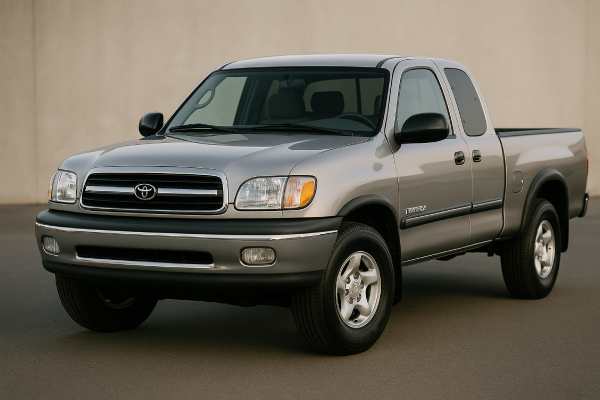
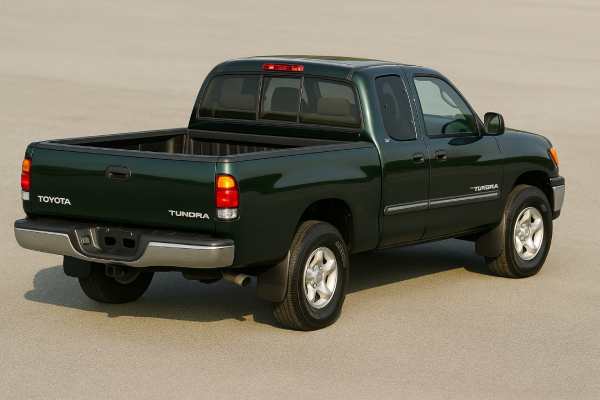
The first-generation Toyota Tundra RWD (XK30) with the 2UZ-FE 4.7 litre V8 is the configuration many shoppers picture when they think “early Tundra.” It delivers 245 hp, strong low-end torque, and a smooth, almost luxury-grade character that stood apart from some rougher domestic half-ton trucks of the time. Built mainly for the North American market, this rear-wheel drive V8 variant pairs a stout ladder frame and simple suspension with a refined powertrain, making it equally at home as a daily driver, light tow rig, or long-distance highway truck.
More than twenty years on, most surviving Tundra V8s are deep into high-mileage territory. That shifts the focus away from showroom numbers and toward real-world reliability, rust, parts availability, and what ownership actually looks like today. This guide concentrates on the 1999–2002 RWD XK30 with the 2UZ-FE, breaking down specs, performance, safety, maintenance strategies, common issues, and how it compares with rival V8 half-tons.
Fast Facts
- Refined 2UZ-FE 4.7 l V8 with timing belt, around 245 hp and roughly 315 lb-ft of torque, tuned for smooth low-end pull rather than high-rpm power.
- RWD XK30 rides and steers more like a large car than a work truck, while still offering useful payload and a tow rating in the 3,000–3,400 kg (6,500–7,500 lb) range when properly equipped.
- Main ownership caveat is frame and rear crossmember corrosion on trucks from heavy road-salt regions; any candidate should have a documented inspection and a very careful underside check.
- Typical oil change interval is 5,000–7,500 miles (8,000–12,000 km) or 6–12 months; timing belt and water pump service is usually due about every 90,000 miles (145,000 km) or 9 years.
- Real-world mixed fuel economy of 13–15 mpg US (18–21 l/100 km) is common, with highway runs slightly better and heavy towing dropping into the low teens mpg.
Navigate this guide
- Toyota Tundra XK30 V8 essentials
- Toyota Tundra 4.7 V8 data
- Tundra 2UZ-FE trims and safety
- V8 Tundra reliability and repairs
- Maintenance schedule and buying tips
- Driving impressions and real performance
- Tundra V8 rivals comparison
Toyota Tundra XK30 V8 essentials
The RWD XK30 Toyota Tundra with the 2UZ-FE 4.7 litre V8 represents the upmarket side of the first-generation Tundra lineup. Where the 3.4 V6 version mixes mid-size hardware with a full-size body, the V8 truck feels like a more complete full-size pickup package. It offers stronger towing, more relaxed performance with a load, and a quieter, more effortless character on the highway.
The 2UZ-FE is a 90° V8 with an iron block and aluminium DOHC cylinder heads, four valves per cylinder, and a timing belt. It traces its roots to Toyota’s global “UZ” V8 family, sharing architecture with engines used in Land Cruiser and Lexus models. In the Tundra, it is tuned for torque and longevity: official output is about 245 hp with torque in the low 300 lb-ft range, delivered in a broad, flat curve well-suited to towing and steady cruising.
In rear-wheel drive XK30 form, the 4.7 V8 typically comes with a 4-speed automatic transmission, a robust rear axle, and straightforward leaf-spring rear suspension. Up front, an independent double-wishbone layout helps give the Tundra a more car-like ride than some of its leaf-sprung rivals. The RWD configuration keeps curb weight lower and mechanical complexity down compared with 4×4 versions, which pays dividends in fuel economy, maintenance access, and parts costs.
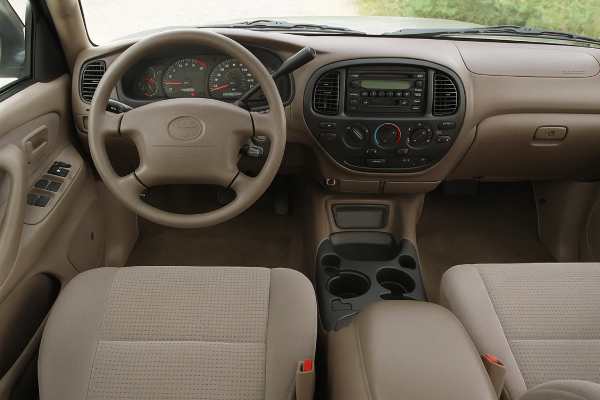
Cab and bed configurations depend on model year and trim but commonly include Access Cab layouts with rear-hinged back doors and either a short or standard bed. Interiors lean toward conservative, with clear instrumentation and hard-wearing plastics. Higher trims add comfort features such as power-adjustable seats, upgraded audio, and better upholstery, but even base V8 trucks tend to feel more refined than many same-era domestic competitors.
Ownership appeal often comes down to a combination of Toyota build quality and the easy-going character of the 2UZ-FE. Properly maintained, these engines have a reputation for high mileage, provided the timing belt is changed on schedule and cooling, lubrication, and fuel systems are kept in good order. The main non-powertrain concern is frame corrosion on trucks from severe winter climates, which can affect safety and long-term viability regardless of engine health.
Toyota Tundra 4.7 V8 data
This section focuses on the 1999–2002 rear-wheel drive XK30 Tundra with the 2UZ-FE 4.7 litre V8 and 4-speed automatic transmission. Figures may vary slightly by year, axle ratio, and regional specification, so always confirm against documentation for a specific VIN.
Engine and performance
| Item | Value |
|---|---|
| Engine code | 2UZ-FE V8 petrol |
| Layout and valvetrain | 90° V8, DOHC, 4 valves per cylinder |
| Displacement | 4.7 l (4,663 cc) |
| Bore × stroke | 94.0 mm × 84.0 mm |
| Induction | Naturally aspirated |
| Fuel system | Sequential multiport fuel injection |
| Compression ratio | Around 9.6 : 1 |
| Max power | Approx. 245 hp (183 kW) @ 4,800 rpm |
| Max torque | Approx. 315 lb-ft (426 Nm) @ 3,400 rpm |
| Firing order | 1–8–4–3–6–5–7–2 |
| Emissions/efficiency class | Petrol, low-emission design for its era |
| Rated consumption (combined) | Roughly 15–18 l/100 km (13–16 mpg US, 16–19 mpg UK) depending on configuration |
Real-world consumption often falls near 13–15 mpg US in mixed driving, with 16–18 mpg US possible on steady highway trips at moderate speeds. Heavy towing and urban stop-start use can push figures into the low teens mpg.
Transmission and driveline
| Item | Value |
|---|---|
| Transmission | 4-speed automatic with lock-up torque converter (A340-series) |
| Gear ratios (typical) | 1st 2.804, 2nd 1.531, 3rd 1.000, 4th 0.705, Rev 2.393 |
| Final drive ratio | Commonly around 3.91:1 or similar (varies by axle code) |
| Drive type | Rear-wheel drive (RWD, 4×2) |
| Differential | Open rear differential; some trucks equipped with limited-slip |
| Tow hardware | Optional receiver hitch, wiring harness; no factory integrated brake controller on this generation |
Chassis and dimensions
| Item | Value |
|---|---|
| Front suspension | Independent double wishbone with coil springs |
| Rear suspension | Solid rear axle with leaf springs |
| Steering | Rack-and-pinion, hydraulic power assist |
| Brakes | Front ventilated discs, rear drums; ABS widely available |
| Typical wheel/tyre sizes | 245/70 R16 on steel or alloy wheels; some trims with larger alloys |
| Overall length | Approx. 5,525–5,600 mm (217–220 in) depending on bed |
| Width | Around 1,910 mm (75 in) excluding mirrors |
| Height | Roughly 1,785–1,800 mm (70–71 in) |
| Wheelbase | About 3,260 mm (128.3 in) for common layouts |
| Ground clearance | Around 260–280 mm (10–11 in) unladen |
| Curb weight | Typically 1,950–2,050 kg (4,300–4,500 lb) |
| GVWR | Roughly 2,720–2,770 kg (6,000–6,100 lb) |
Performance and capability
| Item | Value |
|---|---|
| 0–100 km/h (0–62 mph) | Approximately 8.5–9.5 s (RWD, unloaded) |
| Top speed | Around 170 km/h (105 mph), limited by gearing and aerodynamics |
| Max trailer weight (braked) | Around 3,000–3,400 kg (6,500–7,500 lb) with tow package and correct equipment |
| Payload | Typically 700–900 kg (1,500–2,000 lb) depending on trim and options |
| Roof load | Adequate for typical roof racks when used within accessory limits |
Fluids, service capacities, and electrical
Exact capacities can vary slightly; consult a service manual for your model year.
- Engine oil: roughly 6.2–6.6 l (6.5–7.0 US qt) with filter; common viscosity 5W-30 or 0W-30 meeting current Toyota and API standards.
- Engine coolant: Toyota long-life coolant (red/pink); approximate capacity 10–12 l (10.5–12.7 US qt) depending on configuration.
- Automatic transmission fluid: Toyota ATF Type T-IV (or later-approved equivalent); total volume around 10 l, but only a portion is replaced with a typical drain and fill.
- Differential oil: hypoid gear oil, usually 75W-90 GL-5; capacity dependent on axle housing.
- Power steering fluid: ATF-type fluid specified by Toyota.
- A/C refrigerant: R134a with charge quantity and oil type specified on the underhood label.
- Alternator output: typically in the 100–130 A range for V8 trucks, depending on trim and equipment.
- Spark plugs: long-life plugs, often platinum or iridium, with manufacturer-specified gap; interval usually 60,000–100,000 miles depending on plug type.
Tundra 2UZ-FE trims and safety
The 2UZ-FE V8 was available across several trims of the first-generation Tundra, with the RWD XK30 representing the rear-wheel drive half-ton configuration. Trim names and equipment can vary slightly by model year, but three broad levels are commonly seen: base, SR5, and Limited.
Base V8 4×2
This is the entry point for the 4.7 V8:
- Cloth bench seats or simple split bench, fewer power features.
- Steel wheels and minimal exterior chrome.
- Manual air conditioning and a basic audio system.
- Often a work-focused truck with fewer comfort options but the full V8 drivetrain.
SR5 V8 4×2
The SR5 is the volume trim:
- Power windows and locks, keyless entry on many trucks.
- Alloy wheels, chrome bumpers and grille details.
- More seat and storage options, including split benches or buckets with centre console.
- Cruise control, upgraded audio, and additional interior trim.
Mechanically, SR5 V8 trucks may offer:
- Optional tow package with heavy-duty hitch, wiring, and sometimes an additional transmission cooler.
- Axle ratio and wheel/tire options that increase tow rating relative to base models.
Limited V8 4×2
The Limited trim is aimed at buyers who want near-Lexus levels of equipment in a pickup:
- Leather seating surfaces on many examples.
- Power adjustable driver’s seat, and sometimes passenger seat.
- Automatic climate control and premium audio.
- Additional body-colour and chrome exterior accents.
In many cases, Limited trucks came standard with equipment that was optional on SR5, such as the tow package, larger alloy wheels, fog lamps, and additional interior features.
Safety equipment and ratings
Safety hardware on 1999–2002 Tundra RWD V8 trucks is simple by modern standards but competitive for its era.
Passive safety
- Dual front airbags.
- Three-point seatbelts for outboard seating positions, with pretensioners and load limiters in some model years.
- Strong cab structure that performed well in independent frontal offset tests for similar body configurations.
Side airbags and curtain airbags were generally not available in these early trucks, and rear seats in Access Cab models can be more basic than front seats in terms of restraint and space.
Active safety
- Anti-lock brakes (ABS) widely available and standard on most V8 trims.
- Traction control and stability control were largely absent in this early generation.
- No factory electronic roll mitigation, trailer sway program, or hill-descent systems.
Child-seat provisions rely mainly on seat belt routing rather than modern ISOFIX/LATCH anchors in many markets. Owners should confirm the presence and condition of any tether anchors and consult the owner’s manual for placement and orientation guidance.
Safety-related options and service considerations
Because the Tundra XK30 predates modern ADAS systems, safety maintenance is focused on:
- Keeping brakes, tyres, and suspension in top condition.
- Ensuring ABS is functioning correctly (no warning lights, correct wheel speed sensor operation).
- Monitoring frame and crossmember condition, especially around mounting points for suspension, steering, and brake lines.
After structural repairs such as frame section replacements, crossmember repairs, or major crash repairs, it is critical to:
- Verify wheel alignment and steering geometry.
- Confirm correct routing and support of brake and fuel lines.
- Check for rattles, clunks, or unusual noises that could indicate incomplete or poor-quality repairs.
V8 Tundra reliability and repairs
The 2UZ-FE-powered Tundra has a strong reputation for durability, but age, mileage, and climate now overshadow almost everything else. Understanding typical issues helps prioritize inspections and repairs.
Engine and ancillaries
Timing belt and water pump
- The 2UZ-FE uses a timing belt, not a chain.
- Neglecting belt replacement beyond the recommended mileage and time interval risks sudden failure and possible collateral damage.
- Best practice is to replace the belt, tensioner, idlers, and water pump in one service, along with cam and crank seals if they are seeping.
Cooling system
- Original radiators may develop cracks at the plastic end tanks.
- Old coolant and clogged cores reduce cooling efficiency, particularly when towing or climbing long grades.
- Preventive replacement of radiator, hoses, thermostat, and cap after two decades of service is often wise, even if no obvious issue is present.
Oil leaks and gaskets
- Valve cover gasket seepage is common with age, sometimes causing a burnt oil smell on hot shutdown.
- Front crank and camshaft seals can leak, particularly if the engine has run with old or degraded oil.
- Addressing leaks during timing belt service can significantly reduce labour costs.
Starter motor and electrical
- On some 2UZ-FE engines, the starter motor lives in the “valley” under the intake manifold. Worn contacts and age-related issues can cause intermittent no-crank conditions.
- Replacement requires intake removal, so many owners combine this with other upper-engine work (such as knock sensor or harness replacement) to save labour.
Exhaust manifolds
- Cracks or leaks at the exhaust manifolds or manifold gaskets may develop, leading to ticking or ticking-like sounds on cold start that quieten as the metal expands.
- Replacement can be labour-intensive due to rusted fasteners, especially on trucks from salted-road regions.
Transmission, driveline, and chassis
The 4-speed automatic used with the 4.7 V8 is generally robust when serviced:
- Old or overheated ATF can lead to delayed shifts, shudder, or flare.
- Fluid exchange and inspection of the pan for debris provide a good window into transmission health.
- A well-maintained unit can cover high mileages, but trucks that towed near their limit without auxiliary cooling may show earlier wear.
Common driveline and chassis concerns include:
- Driveshaft clunk on take-off or stop, often improved by re-lubricating slip-yokes or replacing worn components.
- Rear differential whine at certain speeds, especially if gear oil was neglected or if the truck towed heavy loads.
- Worn front suspension bushings, ball joints, and tie rods, which can cause wandering or shimmy.
Frame corrosion and recalls
For many first-gen Tundras, frame condition is the single biggest reliability and safety question:
- Trucks from heavy road-salt regions may show severe corrosion at frame rails, crossmembers, spare tyre carrier mounts, and leaf spring hangers.
- Some model years and regions were covered by corrosion inspection and remediation campaigns, ranging from applying protective coatings to full frame replacement.
Even if a truck has recall paperwork, it is vital to:
- Inspect the frame visually, preferably on a lift, with a hammer and probe to test suspect areas.
- Check the spare tyre carrier, brake proportioning valve bracket, fuel tank strap areas, and rear crossmember for perforation or heavy scaling.
A structurally compromised frame is difficult and expensive to repair properly and can make an otherwise healthy truck effectively end-of-life.
Pre-purchase reliability checks
When evaluating a used RWD 4.7 V8 Tundra:
- Confirm the timing belt and water pump interval in service records.
- Look for evidence of regular oil, coolant, and ATF changes.
- Check for head gasket issues (coolant loss, overheating history, contamination).
- Listen for exhaust manifold leaks on cold start.
- Test-drive for transmission slip, harsh shifts, or driveline vibration.
- Perform a thorough frame inspection, prioritizing rust-prone areas.
A truck with good frame integrity and strong maintenance records is usually a safer bet than a lower-mileage example with questionable rust or incomplete service history.
Maintenance schedule and buying tips
Because these trucks are now 20+ years old, maintenance schedules should be interpreted as minimum baselines rather than maximum limits. Below is a practical approach for a 2UZ-FE RWD Tundra used for mixed driving and moderate towing; always cross-check with the owner’s manual and local conditions.
Practical maintenance schedule
Engine and cooling
- Engine oil and filter: every 5,000–7,500 miles (8,000–12,000 km) or 6–12 months, using quality oil and filters.
- Engine air filter: inspect every 15,000 miles (24,000 km); replace as needed or at least every 30,000 miles (48,000 km).
- Cabin air filter (if fitted): replace every 15,000–20,000 miles (24,000–32,000 km).
- Coolant: replace every 5 years or 60,000 miles (100,000 km), then inspect annually.
- Spark plugs: long-life plugs can often last 60,000–100,000 miles (100,000–160,000 km); shorter intervals are sensible on older engines.
- Fuel filter: if serviceable and external, replace around every 60,000 miles or as specified.
- Timing belt, tensioner, and water pump: about every 90,000 miles (145,000 km) or 9 years, whichever comes first.
Belts, hoses, and accessories
- Serpentine and accessory belts: inspect at least annually, replace around 90,000 miles or at first sign of cracking, glazing, or noise.
- Hoses: inspect for swelling, soft spots, and cracks; replace proactively after 10+ years if original.
- Battery: test annually once over 4–5 years old; replace proactively in harsh climates.
Driveline and brakes
- Automatic transmission fluid: drain and fill every 30,000–60,000 miles (50,000–100,000 km); more frequent changes for heavy towing or hot climates.
- Differential gear oil: replace every 60,000 miles or 5 years.
- Brake fluid: flush every 2–3 years regardless of mileage.
- Brake pads and rotors: inspect at least annually; more often if towing regularly or driving in mountains.
- Steering and suspension: check ball joints, tie rods, bushes, and shocks yearly; address any looseness or leaks.
- Tyre rotation and alignment: rotate every 5,000–7,500 miles (8,000–12,000 km); align after suspension work or if uneven wear appears.
Fluid specifications and torque considerations
- Use engine oil grades specified by Toyota for the climate, typically quality 5W-30 or 0W-30 meeting modern standards.
- Use Toyota-approved coolant formulations; mixing unknown coolants can cause sludge and corrosion.
- Always use gear oils that meet or exceed the GL-5 specification for hypoid axles.
- Critical fasteners (wheels, suspension arms, steering components, brake calipers) should be torqued to factory specifications using a calibrated torque wrench; over- or under-tightening can be dangerous.
Buyer’s guide and inspection tips
When shopping for a RWD 4.7 V8 Tundra:
- Frame and body
- Inspect frame rails, crossmembers, leaf spring mounts, bed supports, and cab mounts.
- Look for repair patches or welds; good repairs are possible, but poor ones are a red flag.
- Engine and drivetrain
- Check for oil leaks, coolant stains, and any evidence of overheating.
- Listen to the engine cold and hot for ticking, knocking, or belt noises.
- On the test drive, note transmission behaviour under light and heavy throttle, and at highway speeds.
- Interior and electrics
- Confirm that all gauges, warning lights, power windows, locks, and seat functions operate correctly.
- Try all HVAC modes and fan speeds; blend door issues can be time-consuming to fix.
- Paperwork
- Look for service records showing timing belt changes, fluid services, and recall or corrosion campaign work.
- Verify that the VIN on the frame, cab, and documents all match and that the title is clear.
A well-kept Tundra V8 with a sound frame and known maintenance history can be a long-lived and dependable truck, even if it needs some catch-up maintenance up front. Budgeting for a full fluid refresh, belt and hose inspection, and any overdue timing belt work is prudent when taking ownership.
Driving impressions and real performance
On the road, the RWD Tundra 4.7 V8 feels noticeably stronger and more relaxed than its V6 sibling, especially with passengers or cargo on board. The 2UZ-FE’s torque-rich delivery gives the truck a confident, unhurried character.
Ride, handling, and NVH
The independent front suspension and carefully tuned rear leaf springs provide a ride that is generally more settled than some same-era leaf-sprung competitors, especially on broken pavement. Unladen, the rear can still feel firm over sharp bumps, but the truck avoids the choppiness that some light-duty pickups suffer from.
Straight-line stability is good, helped by the relatively long wheelbase and modest ride height. The steering is light and predictable, with a hydraulic assist that keeps effort low when manoeuvring at low speeds while retaining decent weight on the highway. Body roll is present but not excessive; the Tundra feels composed and easy to place rather than sporty.
Cabin noise levels are relatively low for a truck of this age. Engine noise is muted at cruise, and wind noise is moderate, though tyre roar can increase with aggressive aftermarket tyres. Compared with older domestic pickups, many owners find the Tundra’s overall refinement closer to that of a large car or SUV.
Powertrain character and performance
The 2UZ-FE V8 produces its torque low in the rev range, so the truck pulls smoothly from low speeds without needing to rev hard. Throttle response is progressive and easy to modulate when parking or backing up to a trailer. The 4-speed automatic generally shifts early for economy, but it will downshift promptly when more throttle is applied.
In everyday driving:
- Acceleration to highway speeds feels confident and stress-free, even with a moderate load.
- Passing performance from 80–120 km/h (50–75 mph) is strong enough that the truck feels at ease merging and overtaking.
- There are no drive modes or complex transmission strategies to manage; the setup is simple and predictable.
Efficiency and real-world range
Owners commonly report:
- City driving: 12–14 mpg US (17–20 l/100 km) depending on traffic and driving style.
- Highway: 15–18 mpg US (13–16 l/100 km) at moderate speeds with a lightly loaded truck.
- Mixed use: 13–15 mpg US (16–18 l/100 km) is typical.
With a large fuel tank, range between fills can still be reasonable, but long-distance drivers should account for more frequent fuel stops than with a modern small-displacement turbo engine.
Towing and load behaviour
Towing is one of the 4.7 V8 Tundra’s main strengths:
- The V8 pulls trailers in the 2,000–3,000 kg (4,500–6,500 lb) range with confidence when properly equipped.
- On grades, the automatic transmission will downshift to hold speed, but the engine does not feel strained within its rated tow range.
- The chassis remains stable as long as tongue weight, trailer brakes, and load distribution are correctly set up.
However:
- Fuel consumption can climb into the low teens mpg (or worse) when towing near the rated maximum.
- Braking performance relies heavily on the condition of pads, rotors, fluid, and trailer brakes; regular maintenance is essential.
- RWD traction on slippery boat ramps or snowy roads is more limited than 4×4; good tyres and careful technique become important.
Overall, the driving experience of the RWD V8 Tundra is defined by smoothness, predictability, and a sense of mechanical honesty. It is not fast by modern truck standards, but it feels solid and competent, making long trips remarkably easy for a vehicle of its age.
Tundra V8 rivals comparison
When new, the Tundra 4.7 V8 RWD competed with V8 half-ton pickups such as the Ford F-150 (4.6 and 5.4 V8s), Chevrolet Silverado 1500 and GMC Sierra 1500 (4.8 and 5.3 V8s), and Dodge Ram 1500 (4.7 and 5.2/5.9 V8s). Each had its strengths; today, the comparison is as much about long-term reliability and rust as it is about raw specifications.
Strengths versus rivals
- Refinement and NVH
The Tundra’s 2UZ-FE V8 and chassis tuning offer a smooth, quiet driving experience that many owners feel is closer to an SUV or large car. Domestic rivals of the time often had coarser engines, more wind noise, or choppier rides, especially in basic trims. - Build quality and longevity
Toyota’s reputation for conservative engineering and robust components is a major selling point. With regular maintenance and a sound frame, it is common to see Tundra V8s with mileage figures that might retire other trucks. - Simplicity
Early-2000s Tundras lack the complex electronics and integrated infotainment systems that can be expensive to repair on newer trucks. For owners who value mechanical simplicity and easier DIY work, this is a plus.
Trade-offs and limitations
- Availability and variety
The first-gen Tundra was sold in smaller numbers than the big domestic trucks. That means fewer used examples on the market, less variation in configurations, and sometimes higher asking prices for clean, rust-free trucks. - Aftermarket support
While there is solid support for maintenance and mild upgrades, the domestic full-size platforms have a far larger aftermarket for engine swaps, heavy-duty drivetrain upgrades, and specialized accessories. - Interior and size
The early Tundra’s cabin and bed dimensions are closer to what many would now call “mid-size-plus” than truly full-size. Buyers needing massive rear-seat space or the largest beds might prefer later full-size trucks.
Where the RWD V8 Tundra fits today
For today’s buyer, the RWD XK30 4.7 V8 Tundra makes particular sense if:
- You value reliability, smoothness, and straightforward mechanicals.
- You need to tow moderate loads but not the heaviest trailers on the market.
- You prefer a truck that is easier to park and live with than some of the newest, oversized half-tons.
The main rival is often not another specific truck model, but the used market itself. A well-maintained Tundra V8 with a solid frame can be an excellent long-term work partner or adventure vehicle. A rusty or neglected example, by contrast, can quickly become a money sink. Focusing on condition, documentation, and rust status matters far more than the badge on the grille when comparing older V8 half-ton pickups.
References
- 2000 Toyota Tundra Owner’s Manual 2000 (Owner’s Manual)
- Toyota Technical Information System 2023 (Service Manual)
- Vehicle Detail Search – 2000 TOYOTA TUNDRA 2010 (Recall Database)
- 2000 Toyota Tundra 2005 (Safety Rating)
- Fuel Economy of 2000 Toyota Tundra 2020 (Fuel Consumption Data)
Disclaimer
This article is for informational purposes only and is not a substitute for professional diagnosis, repair, or official service documentation. Specifications, torque values, maintenance intervals, and procedures can vary by VIN, market, production date, and installed equipment. Always confirm details against your vehicle’s owner’s manual and factory service information, and consult a qualified technician before performing safety-critical work.
If you found this guide helpful, consider sharing it with other owners or enthusiasts on Facebook, X/Twitter, or your preferred forums to support xcar’s work and help more people keep their trucks on the road.