
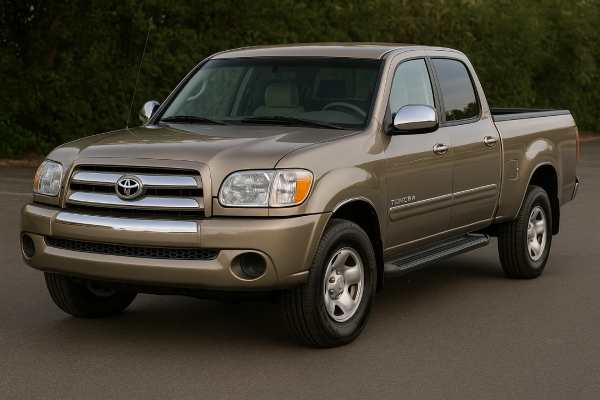
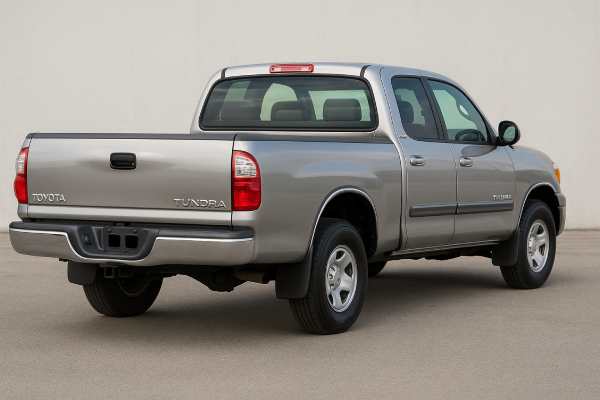
The 2005–2006 Toyota Tundra RWD (XK30) with the 2UZ-FE 4.7 litre V8 is one of the most balanced first-generation Tundra setups. It combines a robust iron-block V8, a relatively compact half-ton chassis, and the simpler running gear of rear-wheel drive. For buyers who do more highway miles and light–to–medium towing than off-road work, this layout often makes more sense than a heavier 4×4.
This article focuses specifically on the facelifted 2005–2006 RWD Double/Access Cab trucks with the VVT-i version of the 2UZ-FE rated at 271 hp. We will cover the technical data, known weak points, realistic maintenance planning, and how the truck compares to rivals of the era. The goal is to help you decide whether this generation of Tundra is worth buying now, and if you already own one, how to keep it reliable well beyond 200,000 miles (320,000 km).
Fast Facts
- Strong 2UZ-FE 4.7 V8 with timing belt and VVT-i, known for reaching 300,000+ km when serviced on time.
- RWD XK30 has fewer moving parts than 4×4 (no front diff or transfer case), reducing maintenance and wear.
- Watch for frame and underbody corrosion, especially in salty climates and on trucks that towed frequently.
- Timing belt, water pump and accessory drive components are best serviced together every 90,000 mi (144,000 km) or 9 years.
Quick navigation
- Toyota Tundra XK30 V8 overview
- Toyota Tundra 4.7 V8 data
- Tundra 2UZ-FE trims and safety
- Reliability and 2UZ-FE trouble spots
- Maintenance schedule and buying tips
- Driving experience and performance
- Toyota Tundra rivals comparison
Toyota Tundra XK30 V8 overview
The facelifted first-generation Tundra (XK30 for RWD) received meaningful updates for 2005, particularly the adoption of VVT-i (variable valve timing) on the 2UZ-FE V8. Power increased to around 271 hp, with a broader torque curve and improved drivability. In RWD form, the truck is lighter and mechanically simpler than its 4×4 siblings, which benefits fuel economy, braking and long-term ownership costs.
The XK30 chassis is sized between a contemporary Tacoma and the full-size “domestic” half-tons of the era. It is narrower than a same-year F-150 or Silverado, which makes parking and tight streets less stressful. At the same time, the Double Cab’s 5-seat cabin offers plenty of room for adults and child seats, and the long wheelbase gives good straight-line stability when towing.
Typical configurations for this engine in 2005–2006 include:
- Access Cab or Double Cab bodies.
- 5-speed A750E automatic transmission.
- RWD with an open differential on most trims; some trucks carry a limited-slip rear diff.
- Bed lengths of 6.5 ft (most Double Cabs) or 8 ft (some Access Cabs).
Key ownership advantages of the RWD 2UZ-FE Tundra:
- No front CV joints, front differential or transfer case to service.
- Slightly better fuel consumption vs. equivalent 4×4.
- Fewer components exposed to corrosion and off-road abuse.
The trade-off is reduced traction on snow, mud or steep wet grass compared with a 4×4 truck. Many owners mitigate this with good all-terrain or winter tyres and, where fitted, a limited-slip differential. For buyers mainly hauling and towing on paved roads, the XK30 is often the smarter, lower-friction choice.
Toyota Tundra 4.7 V8 data
This section focuses on the 2005–2006 facelift Toyota Tundra RWD (XK30) with the 2UZ-FE 4.7 litre V8 and 5-speed automatic.
Engine and performance (2UZ-FE VVT-i)
| Item | Specification |
|---|---|
| Engine code | 2UZ-FE (VVT-i) |
| Layout and cylinders | 90° V8, DOHC, 4 valves per cylinder |
| Displacement | 4.7 l (4664 cc) |
| Bore × stroke | 94.0 × 84.0 mm (3.70 × 3.31 in) |
| Induction | Naturally aspirated |
| Fuel system | Multi-port fuel injection |
| Compression ratio | ~10.0 : 1 (VVT-i version) |
| Rated power | ~271 hp (≈ 202 kW) @ 4,800 rpm |
| Rated torque | ~427 Nm (≈ 315 lb-ft) @ 3,400 rpm |
| Timing drive | Belt-driven camshafts, belt from crank |
| Firing order | 1-8-4-3-6-5-7-2 |
| Emissions standard (US) | Tier 2 / LEV II (varies by state) |
Real-world fuel consumption for RWD 4.7 V8 trucks tends to sit around:
- City: 16–18 l/100 km (13–15 mpg US; 16–18 mpg UK).
- Highway (100–120 km/h): 13–15 l/100 km (16–18 mpg US; 19–21 mpg UK).
- Mixed: roughly 15–16 l/100 km (15 mpg US; 18 mpg UK).
Transmission and driveline
| Item | Specification |
|---|---|
| Transmission | 5-speed automatic A750E (RWD) |
| Gears | 1st 3.52, 2nd 2.04, 3rd 1.40, 4th 1.00, 5th 0.72, Rev 3.22 (typical A750E values) |
| Final drive ratio | ~3.91 (varies slightly by axle/tow package) |
| Drive type | Rear-wheel drive (XK30) |
| Differential | Mostly open; LSD available on some trims and packages |
Chassis and dimensions (typical Double Cab RWD)
Values can vary slightly by body style and equipment, but for a 2005–2006 Double Cab 4.7 RWD:
| Item | Specification |
|---|---|
| Front suspension | Double wishbone, coil-over shock |
| Rear suspension | Leaf-spring solid axle |
| Steering | Rack and pinion, hydraulic assist |
| Front brakes | Ventilated discs |
| Rear brakes | Drums |
| Wheel and tyre | 265/65 R17 on 17×7.5 in rims (common fitment) |
| Length | ~5845 mm (230.1 in) |
| Width | ~2014 mm (79.3 in) |
| Height | ~1879 mm (74.0 in) |
| Wheelbase | ~3271 mm (128.8 in) |
| Ground clearance | ~277 mm (10.9 in) |
| Turning circle (kerb-to-kerb) | ~14.4 m (47.2 ft) |
| Kerb (curb) weight | ~2160 kg (4760 lb) |
| GVWR | ~2990 kg (6600 lb) |
| Fuel tank | ~100 l (26.4 US gal; 22 UK gal) |
Performance and capability
| Item | Approximate value (RWD 4.7 V8) |
|---|---|
| 0–100 km/h (0–62 mph) | About 8.0–8.5 s (unloaded, 2WD) |
| Top speed | Limited to around 175–180 km/h (108–112 mph) |
| Braking 100–0 km/h | In the 40–45 m range with good tyres |
| Towing capacity (braked) | Up to around 3080 kg (≈ 6800 lb) depending on configuration |
| Payload | ~830 kg (≈ 1800 lb) |
| Roof load | Typically 70–100 kg (150–220 lb); confirm for specific rack system |
Fluids, capacities and key torque values (typical)
Always verify for your VIN and market.
| System | Specification and capacity (approx.) |
|---|---|
| Engine oil | 5W-30 API SL or better; ~6.2–6.6 US qt (≈ 5.9–6.3 l) with filter; drain plug torque around 39 Nm (29 lb-ft) |
| Coolant | Toyota long-life or super long-life coolant; ~11–12 l total system capacity |
| Automatic transmission | Toyota WS ATF; total fill around 11 qt (≈ 10.4 l); a simple drain-and-fill replaces 3–5 qt |
| Rear differential | 75W-85 or 80W-90 GL-5 gear oil; roughly 3.8 l (≈ 4.0 US qt) capacity |
| Power steering | ATF-type fluid (check manual); fill to dipstick mark only |
| A/C refrigerant | R-134a; system charge roughly in the 20–22 oz range; verify label under bonnet |
Electrical basics:
- Alternator output: roughly 130 A (varies by trim and options).
- 12 V battery: typically 27F-size, ~600–700 CCA.
- Spark plugs: long-life iridium; gap usually around 1.1 mm (0.044 in).
Tundra 2UZ-FE trims and safety
For 2005–2006, the RWD 2UZ-FE Tundra was offered mainly in Access Cab and Double Cab form with several trim grades. Names vary slightly by market, but typical US-market trims include SR5 and Limited, with special packages layered on top.
Trims and options
Common trim and equipment themes for RWD V8 trucks:
- SR5
- Cloth seats, manual or basic power adjustment.
- 17-inch wheels, standard-duty tyres.
- Basic audio with CD, often with steering-wheel controls on later trucks.
- Optional tow package (larger tow hitch, wiring, upgraded cooling).
- Limited
- Leather or premium cloth upholstery, power driver’s seat.
- Alloy wheels, sometimes unique wheel designs.
- Additional sound insulation and interior trim upgrades.
- Fog lights, upgraded audio, possible sunroof on Double Cab.
Option packages can change hardware in ways that matter to buyers:
- Tow packages may bring different axle ratios, transmission coolers and higher tow ratings.
- Some trucks carry a limited-slip rear differential (look for “LSD” tag on the diff, codes on the VIN plate, or spin-test the rear wheels).
- Bed configurations include factory bed liners, tie-down systems and, in some markets, bed rail caps.
Quick identifiers:
- The VVT-i 4.7 V8 trucks (271 hp) from 2005–2006 often have “i-Force 4.7 V8” badging.
- Double Cab models have four full doors; Access Cabs use smaller rear doors and a shorter cab.
Safety ratings
Crash-test coverage for early Tundras is not as complete as for modern trucks, but several key points are known:
- IIHS moderate overlap frontal tests for 2000–2006 Access/Extended Cab Tundras earned a “Good” overall rating, indicating a stable cabin and good frontal protection for the driver.
- Rear-impact head restraint ratings were typically Acceptable to Good depending on seat configuration.
- Side-impact ratings depend heavily on the presence of side airbags; many early trucks lacked them, and protection is correspondingly more basic.
From NHTSA data, 2005 Tundras generally scored:
- Around four out of five stars for frontal protection.
- Up to five stars in some side-impact configurations.
- Rollover ratings around four stars, which is typical for body-on-frame pickups of the era.
Safety systems and available driver aids
These trucks pre-date modern ADAS, so expectations need to be realistic:
- Standard safety equipment
- Dual front airbags.
- Front seatbelt pre-tensioners and load limiters.
- 3-point belts in all main seating positions.
- Anti-lock brakes (ABS) with electronic brakeforce distribution (EBD).
- Available safety and stability features (varies by trim and year)
- Side torso airbags and curtain airbags on some higher trims or option packages.
- Traction control and Vehicle Stability Control (VSC) on certain configurations, more common near the end of the generation.
Child-seat provisions include lower anchors and tether points, but access and belt geometry differ between Access Cab and Double Cab. If you plan to use rear-facing seats or multiple child seats, the Double Cab is much more practical.
There is an important history of recalls on 2000–2006 Tundras for:
- Lower ball joint wear and potential separation.
- Frame and crossmember corrosion in high-salt regions.
- Airbag inflator issues.
Any candidate truck should be checked by VIN through official recall tools, and documentation of completed recall work is a strong positive in a service history.
Reliability and 2UZ-FE trouble spots
The 2UZ-FE itself is one of the truck’s strongest assets: a low-specific-output, iron-block V8 that is tolerant of heavy use if serviced on time. However, the truck is now approaching two decades old, so age-related issues matter just as much as mileage.
Engine and ancillaries
Common patterns:
- Timing belt and water pump
- Recommended replacement interval is about 90,000 miles (144,000 km) or 9 years.
- Aged belts, tensioners and idlers can lead to noise or, in extreme cases, failure. Although the 2UZ-FE is generally considered non-interference, a slipped belt can still leave you stranded and may damage accessories.
- Best practice is to replace belt, idlers, tensioner, water pump and drive belts together.
- Oil leaks
- Typical age points include valve cover gaskets, front crank seal and oil pan seepage.
- Symptom: burning oil smell on hot shutdown, oil mist on undertray or crossmember.
- Remedy: replace affected seals and gaskets; catching leaks early reduces mess and helps preserve rubber components.
- Cooling system
- Radiators, hoses and heater tees can age-crack, especially in hot climates.
- Early signs include slight coolant loss, sweet smell and pink deposits at hose joints.
- Replace hoses preventively at 10+ years, and inspect radiator tanks and seams at each major service.
- Sensors and fuel/air metering
- Mass air flow (MAF) sensors and oxygen sensors can slowly drift, causing rich or lean running and fault codes.
- Many owners see a noticeable improvement in fuel economy after replacing tired O2 sensors.
Transmission, driveline and chassis
The A750E 5-speed automatic is generally robust when fluid is kept clean and at the correct level.
- Automatic transmission
- Occasional complaints involve harsh shifting or flare when fluid is old or contaminated.
- A gentle drain-and-fill every 50,000–60,000 miles (80,000–100,000 km) is a safe preventative measure, especially for trucks that tow.
- Check for delayed engagement into Drive or Reverse when cold; this may indicate low fluid or internal wear.
- Rear differential
- Long-neglected gear oil can lead to bearing noise or whine under cruise.
- Change gear oil on schedule; inspect for metal on the drain plug and check axle seals for leaks.
- Front suspension and steering
- Control-arm bushings, ball joints and tie-rod ends naturally wear by 150,000+ miles (240,000+ km).
- Tundras of this era were subject to a lower ball joint recall; ensure this has been completed with documented parts.
- Listen for clunks over bumps and inspect tyre wear patterns.
- Brakes
- Rear drums and parking brake mechanisms can rust and seize in salt regions.
- Replacing hardware and backing plates may be necessary on neglected trucks.
- Frame and corrosion
- Perhaps the most serious long-term concern. In some climates the boxed frame can rust from the inside out, particularly near leaf-spring mounts and crossmembers.
- Toyota has previously launched campaigns and frame-inspection programmes on certain model years; check whether your truck was included and what was done.
Recalls, TSBs and service actions
For this generation of Tundra, the major safety-related service actions include:
- Front lower ball joint replacement on affected 2004–2006 trucks.
- Corrosion-related inspections and frame treatment or replacement in high-salt regions.
- Airbag inflator recalls affecting many mid-2000s vehicles.
Before purchase, ask the seller for:
- A printout from an official recall checker by VIN.
- Any paperwork showing recall completion, especially for ball joints and frame inspections.
Well-maintained trucks with recall work done, regular fluid changes and minimal rust can still be excellent long-term bets.
Maintenance schedule and buying tips
Because of its age, a Tundra XK30’s condition depends almost entirely on maintenance history and environment. The engine and gearbox are robust, but corrosion and neglect can undo that advantage. Below is a practical maintenance roadmap for typical use; always adjust to local conditions and official documentation.
Practical maintenance schedule (typical guidance)
Distances are approximate and assume normal mixed use:
- Engine oil and filter
- Every 5,000–6,000 miles (8,000–10,000 km) or 6 months.
- Use quality 5W-30 meeting or exceeding Toyota’s original specification.
- Engine air filter
- Inspect every 15,000 miles (24,000 km); replace about every 30,000 miles (48,000 km), sooner in dusty use.
- Cabin air filter
- Replace every 15,000–20,000 miles (24,000–32,000 km) or 1–2 years.
- Spark plugs (iridium)
- Every 90,000–120,000 miles (145,000–190,000 km). Replace as a full set.
- Timing belt, tensioner and idlers
- Every 90,000 miles (144,000 km) or 9 years.
- Combine with water pump, thermostat and coolant flush.
- Accessory (serpentine) belt and hoses
- Inspect at every oil change; replace around 90,000–120,000 miles or when cracked or noisy.
- Coolant
- For long-life or super long-life coolant: first change around 100,000 miles (160,000 km) or 7 years, then every 50,000 miles (80,000 km) or 4 years.
- Automatic transmission fluid (WS)
- Drain-and-fill every 50,000–60,000 miles (80,000–100,000 km), sooner if towing.
- Avoid aggressive “power flushes” on very high-mileage boxes; gentle, repeated drain-and-fills are safer.
- Rear differential oil
- Every 50,000–60,000 miles (80,000–100,000 km), or after severe towing duty.
- Use correct GL-5 gear oil; limited-slip units may require friction modifiers.
- Brake fluid
- Replace every 2–3 years regardless of mileage.
- Brake inspection
- Check pad/shoe thickness and rotor/drum condition at each tyre rotation; renew rusted hardware on drum brakes.
- Tyre rotation and alignment
- Rotate every 5,000–7,500 miles (8,000–12,000 km).
- Align when tyres are replaced, after suspension work, or if uneven wear appears.
- Steering and suspension
- Full inspection at least annually: ball joints, control-arm bushings, tie-rods and shocks/struts.
- 12 V battery
- Load-test annually after 4–5 years of age; plan replacement around 5–7 years.
Buyer’s checklist for a used XK30 2UZ-FE
Key areas to focus on:
- Frame and underbody
- Inspect inside frame rails, rear crossmember, leaf-spring mounts and the spare-tyre area.
- Look for flaking rust, perforation and poorly executed repairs.
- Suspension and steering
- Check for play in ball joints and tie-rods; ask specifically if the lower ball joint recall was completed.
- Uneven tyre wear can point to alignment or suspension component issues.
- Powertrain
- Cold start should be clean with no rattles, knocking or belt squeal.
- Gear changes should be smooth and predictable, with no delay engaging Drive or Reverse.
- Listen for differential whine at steady speeds (50–70 km/h / 30–45 mph).
- Cooling and HVAC
- Verify stable temperature gauge under load and that the cabin heater and A/C work properly.
- Any evidence of coolant crusting, especially at the water pump weep hole, suggests upcoming work.
- Electrics and interior
- Test all windows, locks, lights and gauge functions.
- Check that airbag warning lights illuminate on key-on and then extinguish.
- Paperwork
- Look for evidence of regular oil changes, timing belt replacement, and differential/ATF services.
- Confirm recall and service campaign completion via official channels.
Well-kept Tundras in this generation still have strong long-term durability prospects, particularly in moderate climates and with thorough rust proofing.
Driving experience and performance
The RWD 2UZ-FE Tundra XK30 feels different from many modern full-size pickups. It is somewhat smaller and lighter, and its naturally aspirated V8 has a linear, relaxed character rather than the explosive low-rpm torque of modern turbo engines.
Ride, handling and NVH
On the road, the Tundra’s chassis tuning is oriented toward comfort and control with a load:
- Ride quality
- Unladen, the rear can feel a little busy over sharp bumps due to the leaf-spring axle.
- With a moderate load in the bed or a trailer on the hitch, the ride settles noticeably and feels more planted.
- Steering and handling
- Steering is light and reasonably direct for a truck of this era.
- Body roll is present but predictable; the truck feels secure at normal road speeds when suspension is in good condition.
- Noise levels
- Wind noise is modest at highway speeds, though larger mirrors and roof accessories can add some whoosh.
- Road noise depends heavily on tyre choice; aggressive all-terrains will be louder than highway tyres.
- The V8 is quiet at cruise, with a subdued growl only when you ask for full throttle.
Powertrain character
The 2UZ-FE V8 with VVT-i is smooth and responsive:
- Strong low-to-mid-range torque makes urban driving easy; the engine rarely feels strained.
- The 5-speed automatic makes better use of the power band than the older 4-speed units, with more relaxed highway revs and quicker kickdown.
- Throttle response is progressive rather than snappy, which helps in slippery conditions and when towing.
With a healthy engine and transmission, real-world performance is more than adequate:
- Around eight seconds 0–100 km/h (0–62 mph) in RWD form is typical.
- Rolling acceleration from 80–120 km/h (50–75 mph) is strong enough for confident passing, even with a light trailer.
Efficiency and range
Fuel economy is not this truck’s strength, but it is predictable:
- Expect roughly 500–600 km (310–370 miles) per tank in mixed use, depending on driving style and load.
- Towing a medium-weight trailer (around 2,000–2,500 kg / 4,400–5,500 lb) can increase consumption by 30–50%, especially at motorway speeds.
Cold climates, short trips and oversized tyres can significantly worsen consumption. Regular maintenance (spark plugs, air filter, O2 sensors) and correct tyre pressures help keep numbers reasonable for a V8 truck.
Traction and towing behaviour (RWD)
Compared with 4×4 versions:
- Pros
- Lower curb weight and simpler driveline.
- Slightly better fuel economy and fewer driveline components to service.
- Less complexity when diagnosing vibrations or noises (no front diff/transfer case to worry about).
- Cons
- Traction on snow, mud or steep wet surfaces is more limited.
- A limited-slip rear diff and good tyres become more important.
Towing behaviour is generally very good:
- Long wheelbase and stout chassis provide stable trailer tracking when weight is distributed correctly.
- Temperature stability of the drivetrain under moderate towing is usually solid, especially on trucks with tow packages and auxiliary coolers.
- Braking confidence depends heavily on brake maintenance, pad choice and trailer brake setup.
For owners who rarely leave paved roads and who value lower running costs, the RWD XK30 strikes a sensible balance between capability and simplicity.
Toyota Tundra rivals comparison
When new, the 2005–2006 Tundra RWD 4.7 V8 competed with trucks such as:
- Ford F-150 4.6 and 5.4 V8.
- Chevrolet Silverado 1500 / GMC Sierra 1500 with 4.8 and 5.3 V8.
- Dodge Ram 1500 4.7 and 5.7 Hemi.
- Nissan Titan 5.6 V8.
Looking back with today’s used-market perspective, each has distinct strengths and weaknesses.
Size, packaging and comfort
- The first-gen Tundra is slightly smaller than most American half-tons of the same era.
- This makes it easier to manoeuvre and park but also means:
- Slightly less interior width.
- Bed and payload numbers that are competitive but not class-leading.
- Compared with the Nissan Titan or Ram 1500, some buyers feel the Tundra’s cabin design is simpler but more durable, with switchgear that ages well.
Power and towing
- The 4.7 V8’s 271 hp is competitive with the smaller V8s of the time but trails larger engines like the 5.4 Triton and 5.7 Hemi in outright numbers.
- In real-world use, the Tundra’s broad torque band and smooth gearbox make it feel strong up to the limits of its tow rating.
- If you regularly tow near maximum capacity or need the highest tow rating, a later-generation Tundra or a domestic half-ton with a heavier-duty tow package might be better suited.
Reliability and longevity
On long-term durability, the Tundra’s strengths are clear:
- The 2UZ-FE enjoys a reputation for very long life with minimal internal issues when serviced on schedule.
- The A750E automatic tends to outlast many contemporary automatics, particularly some Ford and Chrysler units of the era.
- Frame rust and suspension wear are the main threats, whereas some competitors combine engine, transmission and corrosion issues.
Domestic trucks of the same period often have cheaper parts availability and broader aftermarket support, but they may require more frequent major repairs as mileage climbs.
Safety and technology
- By modern standards, all mid-2000s trucks are basic on active safety and driver assistance.
- Compared with rivals, the Tundra’s crash performance is solid, but side-impact protection depends on airbag fitment, as it does in other brands of the time.
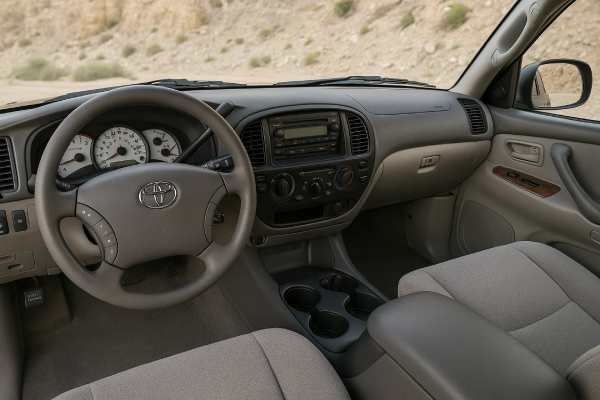
- In-cab technology is modest: simple audio systems and limited infotainment. This is comparable to rivals, though the aftermarket can easily modernise head units and add features like Bluetooth and reverse cameras.
Who the Tundra RWD 4.7 suits best
The 2005–2006 Toyota Tundra RWD (XK30) with the 2UZ-FE V8 is an excellent fit if you:
- Prioritise long-term mechanical reliability over maximum towing numbers.
- Mostly drive on road, with occasional gravel or light off-road use.
- Value a simpler driveline and lower maintenance demands than a 4×4 truck.
- Are willing to inspect and protect the frame against corrosion.
Against its rivals, the Tundra may not be the flashiest or the most powerful, but it is often one of the most dependable ways to own a V8 pickup for the long term.
References
- Gas Mileage of 2005 Toyota Tundra 2025 (Fuel economy data)
- Vehicle Detail Search – 2005 TOYOTA TUNDRA 2025 (Recall Database)
- 2005 Toyota Tundra 2005 (Safety Rating)
- Toyota Tundra I Double Cab (facelift 2002) SR5 4.7i V8 (282 Hp) Automatic – Full specifications 2025 (Technical Specs)
- Toyota-Club.Net – Fluids & capacities – Tundra (1999–2006) 2024 (Fluids and Capacities)
Disclaimer
This article is intended for general informational purposes only and does not replace professional diagnosis, repair advice or official service literature. Specifications, torque values, fluid types, capacities, service intervals and procedures can vary by VIN, market, model year, trim level and installed equipment. Always confirm critical data against your vehicle’s owner’s manual, official workshop documentation and current service bulletins before performing maintenance or repairs. When in doubt, consult a qualified technician or authorised Toyota service centre.
If you found this guide useful, you are welcome to share it with other owners and enthusiasts on social platforms such as Facebook or X/Twitter to help support xcar’s work and keep more of these trucks on the road.