
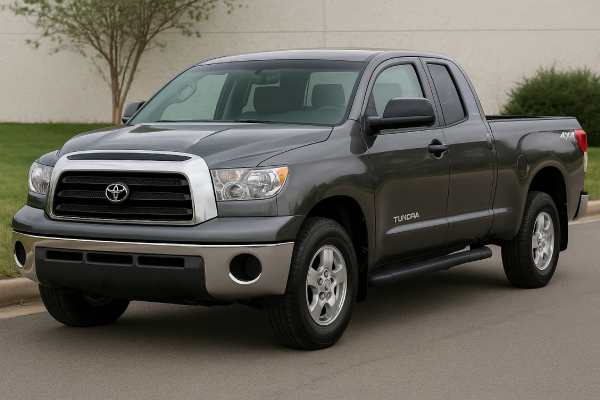
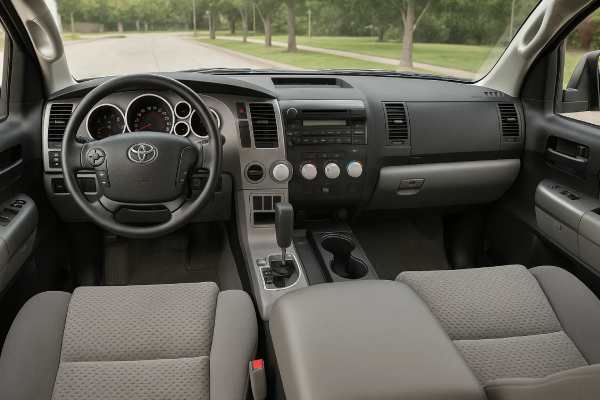
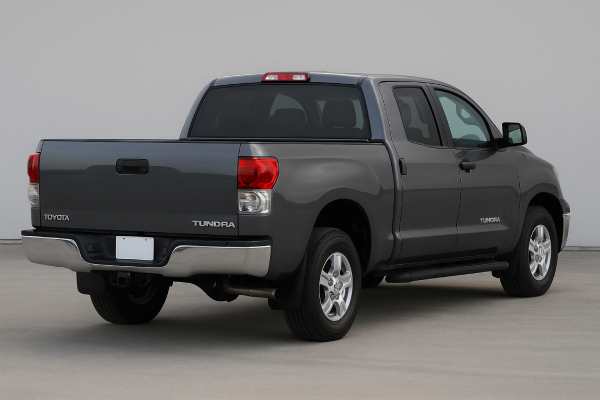
The 2007–2010 Toyota Tundra RWD with the 1GR-FE 4.0 litre V6 sits in an interesting spot in the full-size pickup market. It uses the second-generation XK50 chassis, which is larger, stronger, and safer than the earlier Tundra, but combines it with a simpler V6 instead of a thirsty V8. For many owners this creates a “right-sized” truck: full-size bed and cab capability, but with lower fuel and maintenance costs.
The 1GR-FE is a chain-driven, 24-valve V6 that appears in multiple Toyota trucks and SUVs, so parts and technical know-how are widely available. Paired with a 5-speed automatic and rear-wheel drive, it is not a performance hero, yet it tows and hauls reliably if you stay within its ratings. The RWD driveline reduces complexity, weight, and service costs, especially if you rarely need 4×4. This guide walks through specs, dimensions, performance, reliability patterns, maintenance needs, and how this Tundra compares to rivals so you can judge whether it fits your mix of work, commuting, and recreation.
Quick Specs and Notes
- Proven 1GR-FE 4.0 V6 with timing chain, designed for long service life with regular oil changes.
- Full-size XK50 frame and brakes shared with V8 models, giving strong payload and stability.
- Real-world fuel economy is acceptable for a full-size truck but still thirsty compared with midsize pickups.
- Be vigilant about frame and underbody rust, especially on trucks from high-salt regions.
- Typical engine oil change interval: around 8,000–10,000 km or 6 months, shorter for heavy towing or severe duty.
Section overview
- Toyota Tundra 4.0 RWD profile
- Tundra 1GR-FE specs and data
- Tundra RWD trims and safety
- Reliability issues and service actions
- Maintenance planning and buyer guide
- Driving dynamics and performance
- Tundra RWD versus competitors
Toyota Tundra 4.0 RWD profile
The RWD XK50 Toyota Tundra with the 1GR-FE 4.0 V6 is the entry petrol engine configuration for the second-generation Tundra in many markets. Sold primarily between 2007 and 2010, it targets owners who want a full-size truck for daily use, occasional towing, and weekend projects, without the fuel consumption and insurance costs of large V8 models.
Compared with the first-generation XK30/XK40 Tundra, the XK50 platform is significantly upsized. It offers more interior room, higher payload and towing potential, improved crash structure, and larger brakes. RWD models share much of that hardware with 4×4 variants but avoid the additional weight and maintenance associated with a transfer case, front differential, and CV joints. For drivers who mostly stay on tarmac in mild climates, that simplicity is appealing.
The 1GR-FE belongs to Toyota’s GR engine family and is widely used in the Tacoma, 4Runner, FJ Cruiser, Land Cruiser Prado, and Hilux in various tunes. In the Tundra, it is tuned for torque and durability rather than headline power. It uses an aluminium block with cast-iron liners, DOHC cylinder heads, four valves per cylinder, and variable valve timing on the intake side. The timing chain design avoids scheduled belt replacements but demands clean, correct oil to keep chain and VVT components healthy over high mileages.
For the right use case, this truck’s strengths are:
- Enough torque for light and moderate towing such as small boats, utility trailers, or a modest camper.
- A robust chassis capable of real work when needed.
- Straightforward mechanicals and strong parts availability, making long-term ownership less stressful.
Its main limitations are slower acceleration than V8 trucks, lower tow ratings, and the fact that, despite being the “economy” engine in this line, it still consumes more fuel than a modern midsize pickup or turbocharged gasoline engine under light load.
Tundra 1GR-FE specs and data
This section focuses on the 2007–2010 Toyota Tundra XK50 with the 1GR-FE 4.0 V6 and rear-wheel drive. Figures vary by cab, bed length, axle ratio, and market; treat them as typical ranges and confirm exact values from VIN-specific documentation.
Engine and performance (1GR-FE V6)
| Item | Specification |
|---|---|
| Engine code | 1GR-FE (Toyota GR-family V6) |
| Layout and cylinders | 60° V6, aluminium block with cast-iron liners |
| Valvetrain | DOHC, 4 valves per cylinder, VVT-i on intake cams |
| Displacement | 4.0 L (≈ 3,956 cc) |
| Bore × stroke | ≈ 94.0 mm × 95.0 mm |
| Compression ratio | Around 10.0:1 (market-dependent) |
| Induction | Naturally aspirated |
| Fuel system | Sequential multi-point fuel injection |
| Maximum power | 236 hp (≈ 176 kW) @ ~5,200 rpm |
| Maximum torque | ≈ 266 lb-ft (360 Nm) @ ~4,000 rpm |
| Timing drive | Chain (no fixed replacement interval) |
| Emissions standard | Roughly ULEV-II / Tier 2 Bin 5 equivalent in US applications |
The 1GR-FE tune in this truck prioritises mid-range torque and driveability with a load rather than peak horsepower.
Transmission and driveline
| Item | Specification |
|---|---|
| Transmission | 5-speed automatic, A750E (RWD) |
| Gear ratios (approx) | 1st 3.52, 2nd 2.04, 3rd 1.40, 4th 1.00, 5th 0.72 |
| Reverse | ~3.22 |
| Final drive ratio | Typically around 3.73 (varies with axle package) |
| Drive type | Rear-wheel drive (RWD) |
| Differential | Open rear differential; some trims may have LSD |
Chassis and dimensions (typical ranges)
Ranges below represent common RWD V6 Regular Cab and Double Cab configurations with standard bed lengths.
| Item | Approximate Range |
|---|---|
| Overall length | ~5,280–5,820 mm (208–229 in) |
| Overall width | ~2,030 mm (80 in) |
| Overall height | ~1,920–1,940 mm (76–77 in) |
| Wheelbase | ~3,200–3,700 mm (126–145.7 in) |
| Ground clearance | ≈ 260 mm (10.2 in) unloaded |
| Front suspension | Double wishbone with coilover shocks |
| Rear suspension | Solid axle with leaf springs |
| Steering | Rack-and-pinion, hydraulic assist |
| Brakes | Front ventilated discs; rear drum or disc (by trim) |
| Turning circle (kerb-to-kerb) | ~13.0–13.5 m (43–44 ft) |
| Curb weight | ≈ 2,050–2,250 kg (4,520–4,960 lb) |
| GVWR | ≈ 3,175–3,300 kg (7,000–7,275 lb) |
| Fuel tank capacity | ≈ 100 L (26.4 US gal) |
Performance and capability
| Item | Typical Figure (varies by configuration) |
|---|---|
| 0–100 km/h (0–62 mph) | Approx. 8.5–9.5 s |
| Top speed | ~180 km/h (112 mph), usually speed-limited |
| Maximum towing (braked) | Roughly 2,250–2,450 kg (5,000–5,400 lb) |
| Maximum payload | Often 730–900 kg (1,600–2,000 lb) |
Always check the door-jamb sticker and owner’s manual; tow and payload ratings depend on cab, bed, axle ratio, and options.
Fluids and service capacities (typical)
Exact specifications vary by year and region. Confirm against official service data.
| System | Specification and Capacity (approx.) |
|---|---|
| Engine oil | 5W-30, API SM/SN or later, ~5.5–6.0 L (5.8–6.3 US qt) |
| Engine coolant | Toyota Super Long Life Coolant (pink), ≈ 11–12 L total |
| Automatic transmission | Toyota ATF WS, ~10–12 L total (less for drain-and-fill) |
| Rear differential | SAE 75W-90 GL-5 gear oil, ~2.5–3.0 L |
| Power steering | ATF meeting Toyota specs |
| Brake fluid | DOT 3 or DOT 4 |
| A/C refrigerant | R-134a, charge quantity varies by cab size |
Electrical
| Item | Typical Specification |
|---|---|
| Alternator | ~130–150 A output (equipment-dependent) |
| 12 V battery | ~70–85 Ah, group size 24F/27F depending on model |
| Spark plugs | Long-life iridium, ~1.0–1.1 mm (0.039–0.043 in) gap |
Safety and driver assistance
The XK50 Tundra introduced a stronger cab structure and larger brakes than its predecessor. Typical safety features on RWD V6 models include:
- Front airbags plus seat-mounted side airbags and side curtain airbags on many configurations.
- ABS with electronic brakeforce distribution and brake assist.
- Vehicle Stability Control (VSC) and traction control.
- LATCH/ISOFIX child-seat anchors in rear outboard positions on Double Cab and CrewMax.
Active driver assistance systems such as autonomous emergency braking, lane-keeping assistance, or adaptive cruise control were not yet deployed on this generation; safety is primarily structural and based on the stability control and ABS systems.
Tundra RWD trims and safety
Trims and equipment for the RWD 4.0 V6 Tundra vary by market and year, but follow a clear pattern from basic work trucks to better-equipped mid-grade models. The V6 rarely appears in top luxury trims, which are usually paired with V8 engines.
Typical trim levels
- Base / Work Truck
- Often Regular Cab or basic Double Cab configurations.
- Vinyl or simple cloth upholstery, minimal chrome, black bumpers.
- Steel wheels, manual or basic power accessories depending on market.
- Ideal for fleets and trades where durability and easy cleaning matter more than appearance.
- SR5-type mid-level trims
- Cloth seats with additional adjustment and improved bolstering.
- Alloy wheels, body-colour trim, upgraded audio system.
- Power windows, locks, mirrors, and cruise control usually standard.
- Often offered with a factory towing package (receiver hitch, wiring harness, improved cooling).
- Higher-grade trims with V6 (less common)
- In some markets, the V6 can be ordered with nicer interior finishes and more comfort options, providing a “well-equipped but simple engine” combination.
- These may add dual-zone climate control, power driver’s seat, and more sound insulation.
Mechanically, the big trim differentiators are wheel/tyre packages, axle ratios, brakes on certain GVWR packages, and availability of the tow package. When shopping, verify the presence of the tow package if you plan to haul regularly, and match axle ratio and gross combined weight rating to your trailer needs.
Safety equipment by trim
Across most V6 RWD trims you will typically find:
- Front, side, and curtain airbags on many but not all configurations (especially check early base trucks).
- ABS and stability control as standard, which significantly improve control in emergency manoeuvres.
- Three-point belts in all seating positions, plus suitable anchors for child restraints in Double Cab and CrewMax.
- Larger brake hardware carried over from higher-rated Tundra versions.
Crash-test ratings for the XK50 Tundra are generally solid in frontal impact and acceptable in side and rollover tests, but they vary by cab type and year. Because many trucks have been modified (suspension changes, larger tyres, aftermarket bumpers), condition and modifications can influence real-world safety.
ADAS and calibration considerations
Advanced driver assistance features in the modern sense (radar cruise, automatic emergency braking, lane-keeping) were not fitted to this generation. That simplifies repairs after accidents, as there are no radar or camera modules to recalibrate. However, wheel-speed sensors, steering angle sensors, and yaw sensors still need proper diagnosis and calibration if stability control warning lights appear after repairs or alignment work.
Reliability issues and service actions
The Tundra XK50 with the 1GR-FE V6 is widely considered one of the more durable full-size trucks of its era. Even so, age, mileage, climate, and usage patterns create recurring patterns of wear and failure that buyers and owners should understand.
Common issues (frequent, medium-to-high impact)
- Frame and underbody corrosion
Trucks operated in regions with heavy road salt can develop significant rust on frame rails, cross-members, spring perches, and bed mounting points. - Symptoms: flaking rust, perforation, failed bed mounts, difficulty jacking on frame points.
- Risks: structural weakness, suspension alignment issues, compromised crash performance.
- Remedy: comprehensive inspection on a lift; sandblasting and rust treatment if caught early; frame repair or replacement in advanced cases, which can exceed the vehicle’s value.
- Front suspension wear
The weight of the XK50 chassis and typical loads mean front suspension components eventually loosen. - Symptoms: clunks over bumps, vague steering, wandering, and uneven tyre wear.
- Likely parts: lower ball joints, upper control arm bushes, sway bar links and bushes, and front struts.
- Remedy: regular inspection; plan for suspension refresh somewhere after high mileage, especially if used heavily or on rough roads.
- Cooling system ageing
Even with long-life coolant, hoses, clamps, and water pumps age. - Symptoms: coolant seepage, sweet smell, overheating in hot weather, or coolant stains on the timing cover or under the radiator.
- Remedy: cooling system inspection, proactive hose and clamp replacement, water pump replacement when seepage is noticed or alongside major service.
Occasional issues (moderate impact)
- Accessory belt and tensioner noise
- Symptoms: squeaks or chirps at start-up, especially in damp or cold conditions.
- Remedy: replace the serpentine belt and inspect tensioner and idlers for play or noise.
- Ignition coil or spark plug faults
- Symptoms: misfire under load, rough idle, reduced power, or check-engine light for cylinder misfire codes.
- Remedy: new spark plugs on schedule and coil replacement as needed; prompt repair helps protect catalytic converters.
- Rear differential seepage
- Symptoms: light oil film on differential housing or pinion seal.
- Remedy: monitor, clean, and reseal if seep becomes a leak; confirm fluid level and renew oil at recommended intervals.
Rare but high-impact issues
- Severe overheating and head gasket damage
Catastrophic overheating, usually from neglected cooling issues or heavy towing beyond ratings, can cause head gasket failure or warped heads. - Symptoms: unexplained coolant loss, white exhaust, oil contamination, recurring overheating, or misfire on cold start.
- Remedy: full diagnosis including pressure testing and combustion leak tests; repairs are labour-intensive, so prevention via good maintenance and sensible towing practices is crucial.
Recalls and service campaigns
This generation Tundra line has been subject to widely publicised safety campaigns, including those relating to accelerator pedal and floor mat interference. Many trucks will already have these updates completed, but you should not assume this. A VIN-based recall check via official tools or through a Toyota dealer is essential.
Technical service bulletins (TSBs) may also cover:
- Updated ECU or transmission software to refine shift patterns or resolve drivability complaints.
- Fixes for specific noises (for example, driveline clunks, spring noises, or steering column sounds).
- Seal and trim improvements to address minor leaks or wind noise.
When buying, ask for documentation of recall and TSB work and consider requesting a dealer print-out of the vehicle’s service and campaign history.
Maintenance planning and buyer guide
A clear maintenance strategy keeps the Tundra RWD 1GR-FE predictable and reduces the chance of costly surprises.
Practical maintenance schedule (typical pattern)
Always cross-check with official service schedules for your market and VIN.
- Engine oil and filter
- Every 8,000–10,000 km (5,000–6,000 miles) or 6 months, whichever comes first.
- Use the correct-spec 5W-30 oil; shorten intervals if you tow often, idle extensively, or drive in dusty or very hot environments.
- Engine air filter
- Inspect every 20,000 km and replace roughly every 30,000–40,000 km, sooner if you drive on unsealed or dusty roads.
- Cabin air filter
- Replace every 20,000–25,000 km or annually to keep HVAC performance and odours in check.
- Coolant
- Super Long Life Coolant typically has a long initial interval; for an older truck, changing coolant around every 5 years or 100,000 km is a safe rule of thumb.
- Spark plugs
- Long-life iridium plugs often have a 160,000 km (100,000 mile) design interval. If service history is unclear, replacing them is good insurance.
- Fuel filter
- Where the main filter is in-tank, it is usually not routine service; if your market uses an external inline filter, aim to replace it between 100,000–150,000 km or as the official schedule states.
- Timing chain and VVT
- No fixed replacement interval for the chain. Listen for chain rattle or harsh noises at cold start and watch for timing-related fault codes. Frequent oil changes with the correct grade are the best preventative measure.
- Serpentine belt and cooling hoses
- Inspect annually for cracks, glazing, or fraying. Expect belt replacement around 100,000–150,000 km; replace suspect hoses and clamps, especially on high-mileage trucks.
- Automatic transmission fluid
- Even where labelled “lifetime,” many owners choose to drain and refill ATF every 60,000–80,000 km, particularly if the truck tows or works hard.
- Differential and axle oils
- Rear differential oil change roughly every 60,000–80,000 km under severe service or 100,000 km under lighter use.
- Brake fluid and brake system
- Flush brake fluid every 2–3 years. Inspect pads, rotors, and flexible hoses at least once a year or around every 15,000–20,000 km.
- Steering, suspension, and alignment
- Annual inspection of ball joints, tie rods, control arm bushes, shocks, and struts. Perform wheel alignment after suspension work or if the truck pulls or wears tyres unevenly.
- Tyre rotation and balance
- Rotate tyres every 10,000–12,000 km to maintain even wear; rebalance as needed.
- 12 V battery
- Test annually after four or five years of age; many batteries benefit from replacement between years five and seven, depending on climate.
Buyer’s checklist
When assessing a used Tundra RWD 1GR-FE:
- Underbody and frame
- Inspect frame rails, cross-members, and spring hangers for rust, especially around the rear.
- Look at bed mounts and bumper brackets; advanced rust here is a red flag.
- Body and cab
- Check cab corners, rocker panels, door bottoms, and wheel arches for corrosion or poor-quality repairs.
- Look for uneven panel gaps suggesting accident damage.
- Engine and drivetrain behaviour
- Cold start should be clean, with no heavy rattles or smoke.
- On the road, the engine should pull smoothly; the transmission should shift without harshness or flare.
- Listen for driveline clunks on take-off or when shifting from drive to reverse.
- Suspension and steering
- Drive over speed bumps and rough patches, listening for knocks or rattles.
- Check for steering wander or vibration at highway speeds.
- Electrical and interior
- Test windows, locks, mirrors, HVAC functions, and all lights.
- Watch for warning lights, particularly ABS, airbag, and check-engine.
- Paperwork and history
- Ask for service records, especially oil changes, coolant changes, and any transmission or differential services.
- Confirm recall and campaign completion via official channels or a dealer.
- A pre-purchase inspection by a shop familiar with Toyota trucks is highly recommended.
A Tundra RWD 1GR-FE that passes these checks and has documented maintenance can offer many more years and hundreds of thousands of kilometres of service with predictable running costs.
Driving dynamics and performance
On the road, the Tundra RWD 1GR-FE feels like a traditional full-size pickup built primarily for work, but with decent refinement for its era. The XK50 platform brings improved ride and handling compared with earlier Tundras, while the V6 keeps weight slightly lower over the front axle than V8 models.
Powertrain character
The 4.0 V6 is smooth and reasonably quiet at idle and during gentle cruising. Its character is:
- Relaxed at low rpm, with enough torque for normal city and highway driving.
- Willing to rev when asked, with most of its useful thrust arriving in the mid-range.
- Less urgent than V8 rivals when towing or overtaking at highway speeds.
The 5-speed automatic shifts early to favour economy and reduced noise, though kickdown provides adequate passing performance when you press the throttle decisively. When climbing long grades or towing, expect the gearbox to hold lower gears at higher revs; that is normal, and it helps engine cooling and power delivery.
Ride, handling, and NVH
- Ride quality: Firm when unladen due to rear leaf springs tuned for payload, but predictable and more settled with some weight in the bed.
- Handling: Body roll is noticeable, as expected in a tall, heavy pickup, but steering response is progressive and stability control stands ready if you overstep.
- Steering feel: Light at parking speeds, firming up at highway speeds, with acceptable straight-line stability.
- Noise levels: Wind and tyre noise are moderate; the engine remains reasonably quiet at steady cruise and becomes more vocal when revved hard.
Compared with more recent half-ton trucks, the Tundra feels more “trucky” and less like a crossover, which some owners prefer. It communicates load and surface conditions clearly, which can be reassuring when towing.
Real-world fuel economy
Actual consumption depends heavily on configuration, driving style, and load, but ballpark figures for a healthy RWD V6 Tundra are:
- City driving: roughly 14–16 L/100 km (15–17 mpg US).
- Highway at 100–120 km/h: roughly 11–13 L/100 km (18–21 mpg US).
- Mixed use: around 12–14 L/100 km (17–20 mpg US).
Towing or hauling heavy loads can increase consumption by 25–40%, especially with large, tall trailers that create aerodynamic drag.
Towing and load behaviour
Within its rated limits, the Tundra RWD 1GR-FE tows in a stable and predictable way, provided:
- Tyres are correctly rated and inflated.
- Trailer weight and tongue weight stay inside published limits.
- Load distribution is appropriate, with a modest but healthy tongue weight.
On steep downgrades, downshifting early and using engine braking helps control speed and protects the brakes from overheating. In wet or loose conditions, the lack of 4×4 means you must be more deliberate with throttle inputs from a stop, particularly when towing; traction control helps but cannot fully compensate for improper technique or tyres.
For unsealed roads and light off-pavement use, the RWD Tundra copes well with appropriate tyres and sensible driving. For regular mud, deep snow, or serious trails, a 4×4 version remains the better tool.
Tundra RWD versus competitors
In the 2007–2010 period, the Tundra RWD 4.0 V6 competed with base and mid-level V6 petrol versions of the Ford F-150, Chevrolet Silverado/GMC Sierra 1500, Dodge Ram 1500, and Nissan Titan. Each has its own strengths and compromises.
Where the Tundra stands out
- Powertrain durability
The 1GR-FE engine has a strong reputation for longevity when maintained. Its timing chain, sturdy bottom end, and wide use across Toyota trucks make it a reassuring choice for long-term ownership. - Chassis strength
The XK50 frame and running gear are sized to handle heavier V8 loads, so the V6 RWD version benefits from that underlying robustness. For owners who seldom max out ratings, this translates into a comfortable margin of durability. - Ownership experience
Many owners appreciate the relatively low incidence of major engine or transmission failures compared with some domestic competitors of the same era, as well as strong resale values when the truck is kept rust-free and well maintained.
Areas where it may lag rivals
- Performance and ratings
Several competing models, especially in later model years, offered more advanced or more powerful V6 engines, sometimes with better on-paper fuel economy and higher tow ratings. Within the Tundra family, the 5.7 V8 outperforms the 4.0 V6 for heavy towing without a huge fuel penalty under load. - Interior technology
The Tundra’s cabin is straightforward and practical but lacks some of the infotainment and driver-assistance features that appeared in rivals toward the end of this period and in subsequent generations. - Ride sophistication
Some competitors developed more car-like ride and handling with specific suspension tuning and noise isolation packages. The Tundra remains honest and robust but feels more like a traditional pickup.
Who the Tundra RWD 1GR-FE suits best
This truck is especially well-suited to:
- Owners who want a full-size bed and cabin but rarely tow more than a mid-size trailer or camper.
- Drivers who prioritise long-term durability, straightforward mechanicals, and predictable running costs over maximum power or luxury features.
- Buyers who are willing to spend time finding a rust-free, well-documented example rather than chasing the cheapest advertised truck.
If that description matches you, the Toyota Tundra RWD (XK50) with the 1GR-FE 4.0 V6 can be an excellent long-term companion, provided you verify its condition carefully and keep up with maintenance.
References
<a href="https://toyota-club.net/files/faq/05-09-10_faq_gr-engine_en.htm">Toyota GR series engines (1GR-FE technical overview)</a> 2010 (Technical Article)<a href="https://pressroom.toyota.com/toyota-lexus-consumer-safety-advisory-potential-floor-mat-interference-with-accelerator-pedal/">Toyota/Lexus Consumer Safety Advisory: Potential Floor Mat Interference with Accelerator Pedal</a> 2009 (Safety Advisory)<a href="https://www.nhtsa.gov/resources-investigations-recalls">Resources Related to Investigations and Recalls</a> 2021 (Recall Guidance)<a href="https://en.wikipedia.org/wiki/Toyota_Tundra">Toyota Tundra</a> 2024 (Model Overview)
Disclaimer
This article is for informational purposes only and does not replace professional diagnosis, repair, or official service information. Specifications, torque values, fluid types, maintenance intervals, and procedures can vary by VIN, model year, market, and equipment level. Always confirm details using your vehicle’s owner’s manual, official service literature, and current manufacturer or regulatory guidance before performing any work.
If you found this guide useful, please consider sharing it on platforms such as Facebook or X/Twitter to help other owners and support xcar’s work.