
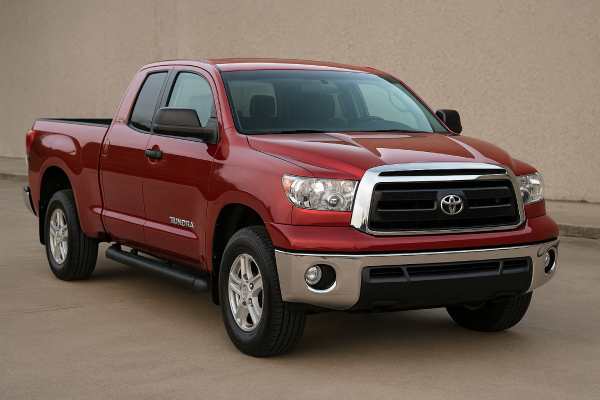
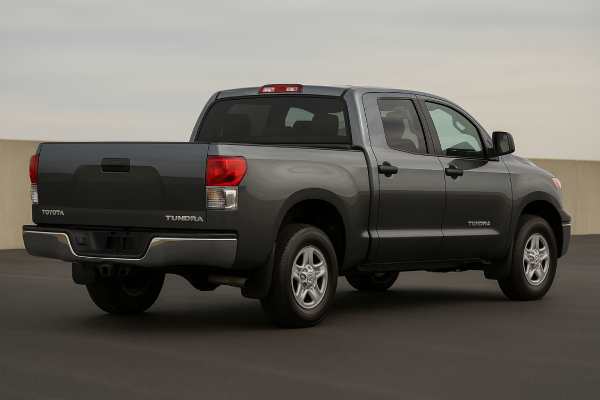
The 2010–2013 Toyota Tundra RWD with the 4.6-litre 1UR-FE V8 sits in a practical middle ground within the XK50 generation. It offers a smoother, slightly more efficient alternative to the 5.7-litre V8 while still delivering real half-ton capability and a long service life when maintained correctly. With 310 hp, a six-speed automatic gearbox, and rear-wheel drive, it suits owners who tow and haul regularly but do not need maximum tow ratings every day.
This guide focuses on this specific combination: 4.6-litre 1UR-FE V8, rear-wheel drive, and 2010–2013 model years. You will find detailed specifications, dimensions, performance and capability data, safety ratings, common reliability issues, and a clear maintenance and buyer’s checklist. The goal is to help you decide whether a Tundra 4.6 RWD fits your usage pattern and budget, and to give existing owners a reference for keeping their trucks dependable well beyond 200,000 miles.
Owner Snapshot
- 4.6-litre 1UR-FE V8 (310 hp) offers smooth power and lower fuel use than the 5.7 while still towing roughly 6,000–6,800 lb in many RWD configurations.
- Robust boxed frame, simple RWD driveline, and chain-driven V8 give excellent longevity with routine fluid changes and inspection.
- Watch for water-pump seepage, secondary air-injection faults, and frame or suspension rust in road-salt regions.
- Plan engine oil and filter changes every 5,000–7,500 miles (8,000–12,000 km) or 6–12 months, adjusted for towing and climate.
Navigate this guide
- Tundra 4.6 RWD ownership snapshot
- Specs and hardware for 4.6 RWD
- Trims, options and safety tech
- Reliability issues and service actions
- Maintenance planning and buyer guide
- Driving behaviour and performance feel
- How this Tundra 4.6 compares
Tundra 4.6 RWD ownership snapshot
For many owners, the 4.6-litre RWD Tundra is the “sensible” choice in the XK50 lineup. It is still a full-size pickup with a strong frame, large brakes, and meaningful payload capacity, but it avoids some of the fuel penalty that comes with the 5.7-litre V8 or four-wheel drive. The 1UR-FE engine is an all-aluminium, dual-overhead-cam V8 with chain-driven cams and dual variable valve timing. It is also used in various Lexus and Toyota applications, so parts and repair knowledge are widely available.
In everyday use, this configuration suits owners who mostly drive unladen or with moderate loads and tow trailers in the 3,000–6,000 lb range. It is less ideal if you routinely haul near maximum half-ton ratings or live in mountainous regions where the strongest possible torque is valuable. In those cases the 5.7 V8 gives more confident high-speed towing, especially with tall, heavy trailers.
The rear-wheel-drive layout keeps the truck mechanically simple. There is no transfer case, no front differential to service, and fewer universal joints. That can mean lower long-term maintenance costs and slightly better fuel economy. The trade-off is traction: on wet grass, gravel, or snow, a lightly loaded RWD truck will not match a 4×4, so tyres and driving technique matter.
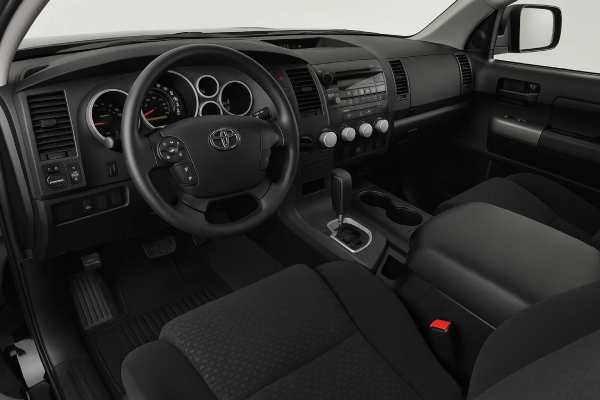
Cab and bed configurations are another strength. Regular Cab trucks suit fleets and tradespeople who prioritise bed length and turning room. Double Cab versions balance rear-seat space and overall length, while CrewMax models offer generous passenger space and comfort for long-distance use. Interiors are straightforward but durable, with large knobs and buttons that can be operated with gloves.
From an ownership viewpoint, the Tundra 4.6 RWD rewards regular service and early rust prevention. The powertrain is tolerant of high mileage, and most problems are predictable wear items rather than sudden, design-related failures. For buyers willing to stay ahead of maintenance, it can be a very low-drama truck that handles work and family duties for many years.
Specs and hardware for 4.6 RWD
The figures below represent typical values for 2010–2013 Toyota Tundra RWD trucks equipped with the 4.6-litre 1UR-FE V8 and six-speed automatic. Exact numbers vary with cab, bed, trim, and axle ratio, so always confirm against the labels and manuals for your particular truck.
Engine and performance
| Item | Specification |
|---|---|
| Engine code | 1UR-FE |
| Configuration | 90° V8, aluminium block and heads |
| Valvetrain | DOHC, 4 valves per cylinder, Dual VVT-i |
| Displacement | 4.6 L (4,608 cc) |
| Bore × stroke | 94.0 × 83.0 mm (3.70 × 3.27 in) |
| Compression ratio | approx. 10.2:1 |
| Induction | Naturally aspirated |
| Fuel system | Multi-port fuel injection |
| Maximum power | 310 hp around 5,600 rpm |
| Maximum torque | roughly 327–339 lb-ft (440–460 Nm) around 3,400 rpm |
| Firing order | 1–8–7–3–6–5–4–2 |
| Emissions class | Typically ULEV-II / comparable standards, market-dependent |
Economy and efficiency (typical RWD figures)
| Cycle | Approximate consumption |
|---|---|
| City | about 15 mpg US (15–16 L/100 km) |
| Highway | about 20 mpg US (11–12 L/100 km) |
| Combined | around 17 mpg US (~13–14 L/100 km) |
| Real-world highway at 75 mph (120 km/h) | roughly 18–20 mpg US (11–13 L/100 km) with light load |
These numbers change noticeably with lift kits, larger tyres, roof racks, and heavy accessories.
Transmission and driveline
| Item | Specification |
|---|---|
| Transmission | 6-speed automatic (A760 family) |
| Gear ratios (typical) | 1st 3.33, 2nd 1.96, 3rd 1.35, 4th 1.00, 5th 0.73, 6th 0.59, Reverse 3.06 |
| Final drive (common) | 3.91:1; some trucks fitted with 4.10:1, depending on tow package and trim |
| Drive type | Rear-wheel drive |
| Rear differential | Open, with electronic traction and stability control applying the brakes to simulate limited slip |
Chassis and dimensions (representative Double Cab / CrewMax RWD)
| Item | Specification |
|---|---|
| Front suspension | Double wishbone with coil-over shock absorbers |
| Rear suspension | Solid rear axle with leaf springs |
| Steering | Rack-and-pinion, hydraulic power assist |
| Brakes | 4-wheel disc, ventilated front and rear; ABS with EBD and brake assist |
| Common tyre sizes | 255/70 R18 or 275/65 R18 on aluminium or steel wheels |
| Overall length | roughly 5,809 mm (228.7 in) |
| Width (body) | about 2,029 mm (79.9 in) |
| Height | about 1,930–1,950 mm (around 76 in) |
| Wheelbase | roughly 3,700 mm (145.7 in) for many Double Cab and CrewMax trucks |
| Ground clearance | around 260 mm (10.2 in) |
| Turning circle | about 13–14 m (around 44–46 ft) curb-to-curb |
| Curb weight | about 2,300–2,450 kg (5,100–5,400 lb) |
| GVWR | typically 3,050–3,175 kg (6,700–7,000 lb), depending on configuration |
| Fuel tank | around 100 L (26.4 US gal) |
Performance and capability
| Item | Approximate figure |
|---|---|
| 0–60 mph (0–97 km/h) | roughly 8.0 seconds for many RWD Double Cab setups |
| Quarter mile | high 15 to mid 16 seconds |
| 100–0 km/h (62–0 mph) braking | roughly 40–45 m (130–150 ft), tyre-dependent |
| Conventional towing | often around 2,900–3,100 kg (6,400–6,800 lb) for RWD 4.6-trim combos |
| Payload | typically 650–750 kg (1,400–1,650 lb), trim-dependent |
| Roof load | commonly 75–100 kg (165–220 lb) with approved rack system |
Always verify towing and payload ratings on the certification label and in the owner’s manual for your exact VIN.
Fluids and service capacities (approximate)
| System | Capacity | Notes |
|---|---|---|
| Engine oil | about 7.5 L (7.9 US qt) with filter | 0W-20 full synthetic oil recommended |
| Engine coolant | about 12–14 L (12.7–14.8 US qt) | Use Toyota Super Long Life (pink) or equivalent |
| Automatic transmission | approximately 10.7–11.0 L total fill | Toyota ATF WS; drain-and-fill replaces part of this |
| Rear differential | about 1.5–2.0 L | GL-5 75W-85 or 75W-90 gear oil, depending on region |
| Power steering | As required | Typically ATF-type fluid where serviceable |
| A/C refrigerant | R-134a | Charge and oil amounts shown on under-hood label |
Electrical
| Item | Specification |
|---|---|
| Alternator output | typically around 100–130 A on 4.6 RWD models; higher with tow or heavy-duty packages |
| 12 V battery group | Often Group 24F or 27F, around 600–750 CCA |
| Spark plugs | Long-life iridium plugs, gap around 1.1 mm (0.043–0.044 in) |
Trims, options and safety tech
The 4.6-litre RWD Tundra was offered across several trims between 2010 and 2013, mainly differing in comfort, equipment, and styling rather than core mechanicals.
Trim and equipment overview
Typical trim structure (names vary by market) includes:
- Base / work models
Usually Regular Cab or Double Cab with vinyl or basic cloth upholstery, manual or simple power features, and steel wheels. Ideal for trades and fleets. - SR5
Often the volume trim, adding alloy wheels, upgraded cloth interior, improved audio, additional storage, and more convenience features. Many 4.6 RWD trucks fall in this category. - Limited / higher-line trims
Depending on region, some Limited or similar trims could be ordered with the 4.6-litre RWD configuration. Expect leather seats, larger wheels, more chrome, dual-zone climate control, and upgraded audio/navigation systems. In many markets, top luxury trims pair more commonly with the 5.7 V8.
Mechanical differences include axle ratio choices (3.91 vs 4.10), tow package content, wheel and tyre sizes, and in some cases slightly different suspension tuning. Tow-package trucks may add:
- Heavy-duty alternator
- Upgraded engine and transmission cooling
- Integrated hitch receiver and 7-pin trailer connector
- Pre-wiring or provisions for trailer brake controllers
You can usually confirm this by checking:
- Axle and option codes on the door-jamb label or build tag
- The presence of a factory hitch receiver and trailer connectors
- Cooling layout and, in some trucks, transmission temperature readings in the cluster or information display
Safety equipment
All 2010–2013 Tundra models share a solid base of passive and active safety features:
- Dual front airbags plus driver and passenger knee airbags
- Front seat side-torso airbags and full-length side curtain airbags
- Electronic stability control and traction control
- Four-channel ABS with electronic brake-force distribution and brake assist
- Tyre-pressure monitoring system
Upper trims may add:
- Rear parking sensors
- Backup camera (often integrated into the rear-view mirror or head unit)
Full driver-assistance suites seen on newer trucks—automatic emergency braking, lane-keeping assist, adaptive cruise control, blind-spot monitoring—were not yet fitted to this generation. Owners mainly rely on good visibility, mirrors, and careful driving rather than automated interventions.
Safety ratings
In standard crash tests for the period, the Tundra generally performs well:
- Frontal and side-impact tests for crew and extended-cab 2WD trucks reached strong scores, with good protection for front occupants in typical offset and side collisions.
- Roof-strength and head-restraint evaluations were competitive for the class.
These results apply to the underlying structure, so the 4.6 RWD model benefits in the same way as other Tundra variants with the same cab. Keep in mind that rating procedures evolve; a strong rating from 2010 does not automatically match the latest standards, but it is still reassuring for a used-truck buyer.
Child-seat installation works best in Double Cab and CrewMax versions, which offer ISOFIX/LATCH anchors and top tether points. The wide-opening rear doors and rear legroom in CrewMax trucks simplify fitting and adjusting larger child seats.
Reliability issues and service actions
The Tundra 4.6 RWD has a reputation for durability, particularly in its engine and basic driveline. However, there are still known patterns of wear and age-related problems to watch for.
Engine and cooling system
- Water pump seepage (common, medium cost)
Many owners eventually see coolant residue or minor leaks from the water-pump area, often between 60,000 and 120,000 miles. Early signs include a faint coolant smell, chalky deposits on the pump housing, or slight level loss over time. Preventive replacement of the pump and drive belt can avoid an inconvenient breakdown. - Secondary air injection system faults (occasional, potentially expensive)
The emissions air-injection pumps and valves can suffer from moisture and corrosion, especially in damp or salty environments. Typical symptoms include a check-engine light on cold start and reduced power or “limp” mode. The proper fix is replacing the affected pumps, valves, and in some cases updated hoses or control parts. - Oil consumption (occasional)
The 1UR-FE is usually stable, but some engines show increased oil use at higher mileage, particularly if oil-change intervals were stretched. Regular monitoring and using the correct 0W-20 oil help. Any sudden increase in consumption should be investigated. - Timing chain and tensioner issues (rare but serious)
The engine uses timing chains, not belts, and does not have a routine replacement interval. Chain or tensioner noise, especially at cold start, or cam/crank correlation trouble codes must be addressed promptly. Severe neglect can turn a minor issue into a major repair.
Driveline and chassis
- Prop-shaft and driveline clunks (common but usually minor)
Thumps when shifting from reverse to drive, or light vibration at certain speeds, often come from dry or worn slip yokes and U-joints. Proper greasing at services and timely joint replacement typically solve the issue. - Front suspension wear (common with age)
Ball joints, control-arm bushings, and tie-rod ends wear more quickly on trucks used off-road or with heavy front accessories. Symptoms are looseness in the steering, uneven tyre wear, or rattles over bumps. A front-end rebuild between roughly 90,000 and 125,000 miles is not unusual for hard-worked trucks. - Rear leaf springs and shocks
Sagging rear ride height, axle tramp, or harshness can indicate tired springs or shocks. Trucks used near maximum payload or with constant tongue weight from trailers will usually need rear suspension attention sooner. - Frame and underbody corrosion (region-dependent)
Any body-on-frame pickup in a winter-salt region is at risk. Focus on frame rails around the rear spring mounts, cross-members, brake lines, and the spare-tyre area. Surface rust can be cleaned and treated; significant scaling or perforation needs professional assessment and may be a reason to walk away from a used truck.
Electrical and interior
Typical age-related issues include:
- Power window regulators or door-lock actuators losing strength or failing intermittently.
- Steering-wheel buttons and audio controls wearing out or failing.
- Blower-motor resistors or HVAC actuators causing fan-speed or temperature-control problems.
These are usually medium or low-cost repairs and do not affect basic safety if handled promptly.
Recalls and service bulletins
Across the 2010–2013 range, notable actions include:
- Campaigns related to floor-mats and accelerator-pedal interference.
- Updates for stability-control and ABS behaviour under specific conditions.
- Emissions-system service bulletins for air-injection and evaporative components in some regions.
When evaluating a truck:
- Check the VIN in the official recall database for your country.
- Ask for dealer or service printouts showing completed campaigns and major repairs.
- During a pre-purchase inspection, have a technician scan for stored or pending fault codes even if no warning lights are on.
When maintained on schedule, most 4.6 RWD Tundras reach high mileage without engine or transmission overhauls, needing mainly predictable repairs such as water pumps, suspension components, and wear items.
Maintenance planning and buyer guide
A structured maintenance plan is the best insurance for enjoying a trouble-free Tundra 4.6 RWD. The intervals below are conservative guidelines for mixed use with some towing.
Suggested maintenance intervals
- Engine oil and filter
Every 5,000–7,500 miles (8,000–12,000 km) or 6–12 months. Use quality 0W-20 synthetic meeting the latest specifications. Choose the shorter interval if you tow, idle often, or drive in dust or extreme temperatures. - Engine air filter
Inspect every 15,000 miles (25,000 km); replace around 30,000–45,000 miles depending on dust exposure. - Cabin air filter
Replace every 15,000–20,000 miles (25,000–32,000 km) or once a year. - Spark plugs (iridium)
Typically up to 120,000 miles (192,000 km) under ideal conditions. Many owners choose 90,000 miles (145,000 km) as a preventive replacement point. - Coolant
First replacement around 100,000 miles (160,000 km) or 10 years for long-life coolant, then roughly every 50,000–60,000 miles (80,000–100,000 km). Always follow local manual guidance. - Automatic transmission fluid
Even if the fluid is labelled “lifetime,” a drain-and-fill every 50,000–60,000 miles (80,000–100,000 km) is sensible, especially with towing or hard use. - Rear differential oil
Change every 30,000–60,000 miles (50,000–100,000 km) depending on load, towing, and off-road use. - Brake fluid
Flush every 2–3 years regardless of mileage. - Brakes (pads and rotors)
Inspect at each oil change; change sooner if you tow or drive in hilly areas. - Serpentine belt
Inspect yearly from around 60,000 miles (100,000 km); replace if cracked, noisy, or contaminated with oil or coolant. - Hoses, vacuum lines, and PCV system
Inspect from 8–10 years onward; replace anything soft, brittle, or leaking. - Tyre rotation and alignment
Rotate tyres every 5,000–6,000 miles (8,000–10,000 km). Check alignment annually or when you see uneven wear or feel a pull. - 12 V battery
Test annually from year four onward. Many require replacement between five and seven years depending on climate and use.
Key fluid and torque information (check-specific manual before work)
- Engine oil: 0W-20, around 7.5 L with filter.
- Differential oil: GL-5 75W-85/75W-90, quantity varies with axle.
- Wheel nuts: commonly in the 150–160 Nm (110–120 lb-ft) range.
- Drain plugs and critical fasteners: always verify torque values in the workshop manual for your specific model year.
Buyer’s inspection checklist
When considering a used 2010–2013 Tundra 4.6 RWD:
- History
Look for documented, regular oil changes and at least one coolant and ATF service by around 100,000 miles. Gaps in maintenance records are a warning sign. - Engine and cooling
Inspect for coolant residue around the water pump and radiator. Check for oil leaks at cam covers, front and rear main seals, and oil cooler connections. - Frame and underbody
Examine frame rails, cross-members, and bed mounts for rust. Pay close attention in regions that use road salt. Check brake and fuel lines as well. - Suspension and steering
On a test drive, listen for clunks or rattles over bumps and note any wandering or vibration at highway speeds. On a lift, check ball joints, bushings, and steering components. - Driveline
Check for clunks when shifting between drive and reverse and for vibration under load. Inspect prop-shaft joints and the centre bearing on longer-wheelbase trucks. - Electrical and interior equipment
Test windows, locks, lights, audio, HVAC settings, and any steering-wheel controls. Make sure the instrument cluster lights cycle correctly on ignition and that warning lights go out after start. - Tyres and wheels
Uneven wear can signal alignment issues or worn suspension. Mismatched tyres on a truck may hint at budget maintenance.
Which trucks to prioritise
As a general rule:
- A well-maintained 2010 with full records is better than a later truck that missed services.
- Double Cab and CrewMax RWD versions are the most versatile for mixed work and family use.
- Trucks with the factory tow package are preferable if you tow regularly; the upgraded cooling and electrical capacity add useful margin.
With proper care, a Tundra 4.6 RWD can realistically deliver 200,000–300,000 miles (320,000–480,000 km) of service before any major drivetrain overhauls, making it a strong candidate for long-term ownership.
Driving behaviour and performance feel
On the road, the 4.6-litre Tundra feels steady and unhurried. The V8 runs smoothly, with its best pull in the mid-range between roughly 2,500 and 4,500 rpm. Throttle response is predictable, and the six-speed automatic typically holds lower gears long enough to make full use of the available torque without excessive revving.
Acceleration and passing
Unladen, many 4.6 RWD trucks reach 60 mph in around eight seconds, which is more than adequate for merging and overtaking. Passing on two-lane roads is straightforward if you plan ahead and let the gearbox downshift. With moderate trailers or heavy loads in the bed, acceleration naturally drops off, but the engine still feels willing rather than strained.
The gap to the 5.7 V8 is most obvious at higher speeds with heavy trailers or in steep terrain. If your routine use involves long grades, tall trailers, or frequent high-speed towing, the bigger engine gives a larger performance buffer. For lighter duty use, the 4.6 is usually sufficient.
Ride, handling and noise
Ride quality reflects the Tundra’s work-truck roots. Empty, the rear leaf springs can feel firm, especially over sharp bumps, but the suspension calms down with some weight in the bed. The long wheelbase and wide track give good highway stability, and the hydraulic steering offers a natural, consistent feel even if feedback is more “truck” than “car.”
Cabin noise at highway speeds is dominated by tyre and wind noise rather than engine sound. The V8 is quiet once in top gear and only makes itself heard during heavier acceleration. On long trips, the Tundra feels relaxed and capable, with a seating position that suits extended driving.
Braking and control
Braking performance is solid for a half-ton pickup. Large discs and a firm pedal inspire confidence, and the ABS and stability systems step in smoothly when needed. Under heavy braking with a load or trailer, the truck remains stable if the trailer is correctly set up with functioning brakes and proper tongue weight.
Traction and stability-control systems work well in most normal conditions, but physics still apply: an empty RWD truck with light rear-axle load has less grip than a loaded one or a 4×4 model. Winter tyres and sensible throttle use make a big difference.
Real-world efficiency and towing behaviour
In mixed use:
- City driving often returns 14–16 mpg US (around 15–17 L/100 km), depending on traffic and driving style.
- Highway cruising at 65–75 mph (105–120 km/h) usually sits in the 18–20 mpg US range (around 11–13 L/100 km) for stock-height trucks on standard tyres.
- Towing medium trailers can pull consumption down into the low-teens mpg or worse, depending on wind and terrain.
Under tow, the six-speed automatic’s tow/haul mode helps by holding gears longer, reducing unnecessary shifts, and improving engine braking. Temperatures usually remain within a safe range when the truck is used within its rated limits and maintained correctly.
Overall, the driving character of the Tundra 4.6 RWD is honest and predictable. It does not chase headline performance figures, but it provides the calm, robust feel many buyers want in a long-term pickup.
How this Tundra 4.6 compares
When you compare the 2010–2013 Tundra 4.6 RWD with its rivals and siblings, a clear pattern emerges: it trades outright performance for simplicity and long-term reassurance.
Versus Tundra 5.7 V8
- The 5.7 V8 pulls harder, tows more, and feels stronger at high speeds with heavy loads.
- The 4.6 usually returns slightly better fuel economy in everyday driving and runs a bit more quietly because it spends more time at lower throttle openings.
- Both share similar maintenance needs and underlying design, so the choice is more about your towing demands than reliability alone.
Versus contemporary Ford F-150
Ford’s later V8 and turbocharged V6 engines often outperform the Tundra 4.6 in power and sometimes in efficiency, but they introduce more complexity and potential failure points. The Tundra’s 1UR-FE is relatively simple for its output, favouring conservative engineering over advanced features. Interiors and available options on Ford trucks of the era may feel more modern, but long-term durability depends heavily on maintenance history.
Versus Chevrolet Silverado and GMC Sierra 1500
GM half-ton trucks with 4.8 and 5.3 V8 engines compete closely. Some versions use cylinder deactivation for better economy, which can bring its own set of lifter and oil-consumption concerns. The Tundra’s straightforward all-cylinders-all-the-time approach is less efficient on paper but often pays off in predictable reliability. Ride and handling comparisons depend heavily on specific suspension and wheel options.
Versus Ram 1500
Ram 1500 models with the 5.7 Hemi deliver strong performance and, on some trims, a very comfortable ride thanks to coil-spring rear suspension or air suspension options. However, some owners report cam and lifter issues that can be costly to fix. The Tundra feels a bit more utilitarian inside but has fewer commonly reported major engine failures when maintained.
Who should choose the Tundra 4.6 RWD
This configuration is a particularly good fit if:
- You use your truck for daily driving, commuting, and moderate towing rather than constant heavy hauling.
- You want a simpler rear-wheel-drive layout with fewer components to service and repair.
- You value a strong record of long-term reliability and are willing to follow a proactive maintenance schedule.
If you live in deep-snow regions, routinely tow near maximum half-ton ratings, or spend significant time off-road, a 4×4 Tundra or a higher-output engine may be the better choice. For mixed use and long ownership, however, the 2010–2013 Tundra RWD with the 4.6-litre 1UR-FE V8 remains a very appealing balance of capability and dependability.
References
- The 2010 Toyota Tundra: new more powerful 4.6 litre engine makes Tundra a fuel economy leader 2009 (Manufacturer Release)
- Vehicle Detail Search – 2010 TOYOTA TUNDRA CREW CAB 4 DR RWD | NHTSA 2010 (Safety Rating and Recall Database)
- TOYOTA-TECH.EU 2013 (Service Information Portal)
- Fuel Economy of 2010 Toyota Vehicles 2010 (Fuel Economy Data)
- Toyota Tundra crew cab pickup 2013 (Safety Rating)
Disclaimer
This article is for informational purposes only and is not a substitute for professional diagnosis, repair advice, or official service documentation. Specifications, torque values, fluid types, and maintenance intervals can vary by model year, market, equipment level, and individual VIN.
Always confirm critical details in your official owner’s manual, workshop manual, or technical information system before performing any work. If you are uncertain about a procedure or diagnosis, consult a qualified technician.
If this guide helped you, please consider sharing it on social platforms or owner communities to support xcar’s work and help other Tundra owners maintain their trucks correctly.