
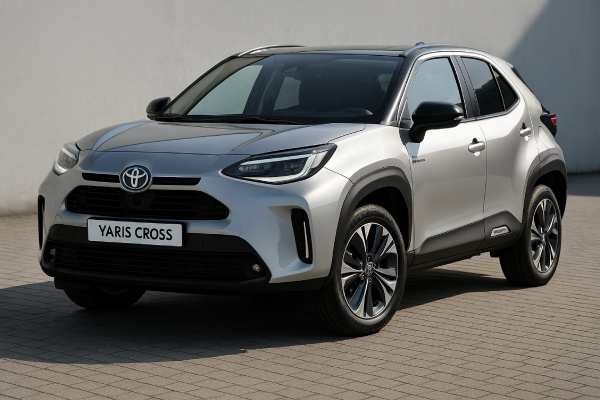
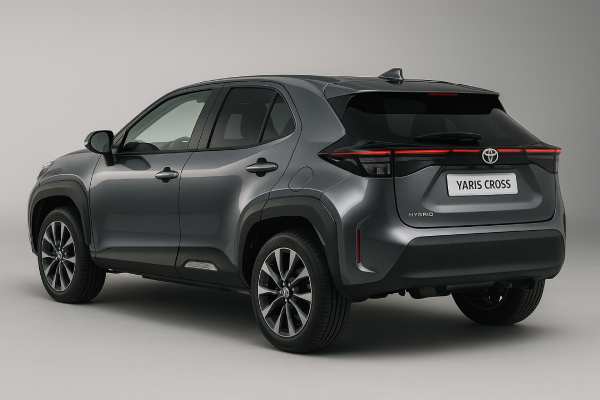
The Toyota Yaris Cross Hybrid 130 FWD is the more powerful version of Toyota’s smallest SUV, introduced together with the 2024 facelift. It keeps the same compact GA-B platform and practical cabin as the earlier model, but pairs them with an uprated hybrid system, refreshed infotainment, and updated safety technology. The “Hybrid 130” powertrain builds on the well-proven 1.5-litre M15A-FXE three-cylinder petrol engine, now working with a stronger electric motor and revised hybrid transaxle to deliver around 130 hp combined while remaining very efficient.
For buyers, the Hybrid 130 FWD sits above the carry-over Hybrid 115, targeting drivers who spend more time at motorway speeds or often travel loaded with people and luggage. It keeps the easy manners and low running costs of the original car but feels more relaxed during overtakes and on inclines. This guide focuses on the 2024-on facelifted FWD Hybrid 130 (MXPJ10), covering its specifications, real-world behaviour, reliability expectations, maintenance planning, and position in the small crossover market.
Owner Snapshot
- Noticeably stronger mid-range than the earlier 116 hp hybrid, with mixed-driving fuel use still around 4.7–5.2 l/100 km when driven sensibly
- Compact footprint and high driving position make city parking easy while still feeling stable and secure on the motorway
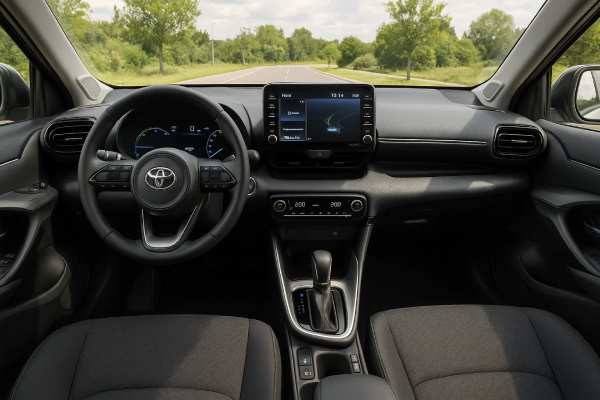
- Upgraded multimedia (up to 10.5-inch centre screen and 12.3-inch digital cluster) and expanded Toyota Safety Sense on higher trims
- As with other modern hybrids, reliable operation depends on correct fluid changes and software updates; early facelift cars may receive occasional software or campaign actions
- Typical Europe service rhythm: inspection and oil change every 15,000 km or 12 months, whichever comes first
Contents and shortcuts
- Yaris Cross Hybrid 130 overview
- Hybrid 130 technical specifications
- Trims, safety and equipment details
- Reliability issues and service actions
- Maintenance planning and buying advice
- Driving experience and performance
- Yaris Cross Hybrid 130 competitors
Yaris Cross Hybrid 130 overview
The 2024-on Yaris Cross Hybrid 130 is Toyota’s response to owners who liked the original Yaris Cross Hybrid 115 but wanted stronger performance without sacrificing efficiency. It shares the same basic body, platform, and interior packaging as the earlier car, yet adopts an uprated hybrid system with approximately 130 hp combined output. The M15A-FXE 1.5-litre three-cylinder engine remains, working on an efficient Atkinson cycle, but the front electric motor and e-CVT transaxle have been strengthened and retuned to provide more torque and cleaner response.
The facelift itself is evolutionary rather than radical. On the outside, you will typically notice a re-profiled front bumper, updated lighting signatures, and new alloy wheel designs. New paint colours and bi-tone roof options appear in many markets. Inside, the changes are much more visible: higher trims gain a 10.5-inch central touchscreen and a 12.3-inch fully digital instrument cluster, replacing the previous partly analogue setup. Menu structure, graphics, and response times are all improved, making everyday interactions smoother.
Noise and vibration were also targeted. Extra sound insulation in the firewall, floorpan, and doors, together with thicker glass on some grades, makes the Hybrid 130 feel more grown-up at speed than the original Yaris Cross. There is still some tyre and engine noise on coarse surfaces, but the cabin is calmer, especially on long motorway runs.
Within the broader Yaris Cross family, the Hybrid 130 FWD is typically positioned on mid and upper trims, while the Hybrid 115 remains available on entry and some mid-level grades. This reflects its role: it is still compact and easy to drive in town, but tailored to buyers who often carry passengers, use motorways, or simply prefer a brisker response. For many drivers, it is the sweet spot of the facelift range.
Hybrid 130 technical specifications
This section focuses on the 1.5 Hybrid 130 FWD (MXPJ10) as offered from the 2024 facelift onward. Figures vary slightly by market, wheel size, and emissions procedure, so always confirm with VIN-specific data.
Powertrain and efficiency – 1.5 Hybrid 130 FWD
| Item | Value |
|---|---|
| Engine code | M15A-FXE (Dynamic Force family) |
| Layout | Inline-3, DOHC, 4 valves per cylinder |
| Displacement | 1.5 l (1490 cc) |
| Bore × stroke | 80.5 × 97.6 mm (approximate) |
| Operating cycle | Atkinson cycle for efficiency |
| Induction | Naturally aspirated |
| Fuel system | Port fuel injection (market-dependent variations possible) |
| Approx. petrol engine power | Around 91 hp (~67 kW) |
| Approx. petrol engine torque | Around 120 Nm |
| Front electric motor type | Permanent magnet synchronous |
| Front electric motor output | Around 83 hp (~62 kW), circa 185 Nm |
| System power | 130 hp (96 kW) |
| Hybrid battery | Lithium-ion under rear seats; air-cooled |
| Emissions standard | Euro 6e or equivalent, depending on country |
| WLTP combined fuel use | Typically around 4.5–5.0 l/100 km, depending on trim/wheels |
| WLTP combined CO₂ | Commonly mid-90s g/km range |
In real driving, many owners can expect:
- Around 4.0–4.5 l/100 km in gentle city and suburban use
- Approximately 4.7–5.2 l/100 km in mixed routes
- Roughly 5.0–5.5 l/100 km on a steady 120 km/h motorway cruise
Cold weather, strong headwinds, and heavy loads will move these values upward.
Transmission and driveline
| Item | Value |
|---|---|
| Transmission | e-CVT hybrid transaxle (planetary gearset) |
| Drive type | Front-wheel drive (FWD) |
| Differential | Open front differential with brake-based traction aids |
| Parking brake | Electric, rear axle, with auto-hold on many trims |
| Drive modes | Eco, Normal, Power; separate EV mode for low-speed electric running |
There is no external charging. The high-voltage battery is charged by the petrol engine and regenerative braking, making the car simple to run for owners without home charging.
Chassis and dimensions
The Hybrid 130 shares its basic structure with other Yaris Cross variants.
| Item | Value |
|---|---|
| Platform | GA-B (Toyota New Global Architecture – B segment) |
| Front suspension | MacPherson strut with coil springs and anti-roll bar |
| Rear suspension | Torsion-beam axle with coil springs (FWD) |
| Steering | Electric power steering, rack-and-pinion |
| Approx. steering ratio | Just under 14:1, about 2.6 turns lock-to-lock |
| Front brakes | Ventilated discs (around 278 mm) |
| Rear brakes | Solid discs |
| Length | About 4,180 mm |
| Width | About 1,765 mm (without mirrors) |
| Height | Around 1,590–1,595 mm |
| Wheelbase | 2,560 mm |
| Ground clearance | Around 170 mm |
| Turning circle | Roughly 5.3 m kerb-to-kerb |
Weight, tank, and luggage
| Item | Value |
|---|---|
| Kerb weight | Roughly 1,230–1,290 kg depending on trim and equipment |
| Fuel tank | Around 36 litres |
| Roof load limit | Typically 50–75 kg with approved bars |
| Luggage volume | About 397 l seats up (VDA) and over 1,000 l seats folded, depending on floor setting |
Performance and capability
| Item | Value |
|---|---|
| 0–100 km/h | Around 10.7 seconds |
| Top speed | About 170 km/h |
| 80–120 km/h | Noticeably quicker than Hybrid 115; overtakes feel less strained |
| Braked towing | Often in the 750–1,300 kg range; confirm per market specification |
| Unbraked towing | Typically 450–750 kg, market dependent |
Fluids, capacities, and key torque ranges (indicative)
Exact figures and torque values must always be confirmed in the workshop manual or owner’s manual for your specific VIN.
- Engine oil: low-viscosity synthetic (often 0W-8, 0W-16, or 0W-20 depending on region), roughly 3.5–3.7 l with filter
- Engine coolant: Toyota Super Long Life Coolant, total system volume around 5–6 l
- Hybrid transaxle fluid: Toyota ATF WS, drained quantity around 3–4 l on a standard service
- Brake fluid: DOT 3 or DOT 4 as specified; change on a time basis
- Refrigerant: R-1234yf on most late-model EU cars, charge weight per underbonnet label
Typical torque ranges:
- Wheel nuts: usually around 100–110 Nm
- Engine oil drain plug: often about 30–40 Nm
- Spark plugs: low torque specified for aluminium heads and fine-thread plugs
Electrical
- 12 V battery: compact AGM/EFB type (around 35–45 Ah) feeding conventional systems
- Hybrid battery: lithium-ion pack under the rear seats, cooled by cabin air through a side intake grille
- Charging: no alternator; a DC–DC converter uses high-voltage energy to keep the 12 V battery charged
Safety and driver assistance snapshot
The Yaris Cross platform has performed strongly in independent crash testing, with a combination of robust passenger cell and extensive active safety features.
Typical safety elements include:
- Multi-stage front airbags, side and curtain airbags, and a central airbag between the front seats
- ISOFIX/LATCH points on the outer rear seats with top tether anchors
- Standard stability and traction control, ABS with brake assist, and hill-start assist
Toyota Safety Sense on Hybrid 130 facelift models usually includes:
- Pre-collision system with pedestrian and cyclist detection, often including junction support
- Lane Departure Alert with steering assist and Lane Trace Assist for gentle centring
- Adaptive Cruise Control, sometimes enhanced with stop-and-go where permitted
- Road Sign Assist and intelligent speed limiter integration
- Optional blind-spot monitoring, rear cross-traffic alert with auto-brake, and parking assist on higher trims
Trims, safety and equipment details
Exact trim names differ by market, but the pattern is similar across Europe: lower trims focus on value and tend to use the Hybrid 115, while the Hybrid 130 FWD is reserved for mid and upper trims. In many countries, names such as Icon, Design, Excel, GR Sport, or Premiere Edition are used.
Where Hybrid 130 FWD fits
The Hybrid 130 is generally offered:
- On mid-level trims where equipment is already fairly complete
- On “sporty” variants such as GR-branded grades with firmer suspension and unique styling
- On top-trim models with the most advanced infotainment and driver assistance features
Hybrid 115 usually powers base and some mid-range grades, providing a lower entry price and slightly lower insurance or taxation in some markets.
Equipment themes by trim band
Entry to mid trims (where Hybrid 130 is offered)
- 16″ or 17″ alloys with relatively high-profile tyres
- Fabric seats, often with driver’s height adjustment and split-fold rear bench
- Smaller or mid-size multimedia unit (often 9″ or 10.5″) with wired or wireless smartphone integration
- Automatic headlights, rain-sensing wipers, electric parking brake
- Toyota Safety Sense core set as standard
Upper trims and special editions
- 17″ or 18″ alloy wheels with specific designs, sometimes bi-tone
- Dual-zone climate control, enhanced interior trims, and ambient lighting
- 12.3″ digital instrument cluster and 10.5″ multimedia screen in many markets
- Upgraded audio (for example, branded systems), wireless phone charging, more USB-C ports
- Optional or standard panoramic glass roof or bi-tone paintwork
- GR Sport-specific details: sport seats, darker exterior trim, unique wheels, and slightly firmer suspension tuning
Safety ratings and features by trim
Regardless of trim, passive safety hardware is broadly similar, but active safety and driver assistance features can escalate with equipment level.
- Base Hybrid 130 trims usually include AEB, ACC, lane support, traffic sign recognition, and a reversing camera.
- Mid and high trims add front and rear parking sensors, blind-spot monitoring, rear cross-traffic alert, and automatic parking support.
- Headlights can range from halogen or basic LED units on lower trims to more advanced adaptive LED systems on higher grades. These differences can affect independent headlight rating outcomes in safety testing.
Child seats, practicality, and calibration
For family buyers, the Yaris Cross offers:
- ISOFIX/LATCH on the outer rear seats, with clearly marked anchors
- Rear doors that open reasonably wide, making it easier to manoeuvre child seats
- Fixed rear bench backrest angle, which is upright enough for good visibility but can make bulky seats tight if front occupants are tall
Any car with a modern ADAS suite relies on accurate calibration:
- Windscreen replacement or front bumper repairs should be followed by camera and radar recalibration using proper equipment
- Ride height changes (springs, lowering kits) can affect sensor alignment
- After any collision repair at the front or sides, it is wise to budget for calibration as part of the work rather than treating it as an optional extra
Reliability issues and service actions
The facelift Yaris Cross Hybrid 130 is still relatively new, so long-term data is limited. However, much of its mechanical hardware comes from the established M15A-FXE hybrid family used in the Yaris and earlier Yaris Cross Hybrid 115, which already has a strong reliability record.
Overall reliability picture
Most owner reports on related hybrid systems point toward:
- Very low rates of major engine or hybrid component failure when serviced correctly
- Isolated issues with auxiliary components such as 12 V batteries, sensors, or infotainment hardware
- Occasional software campaigns or recalls that refine drivability or address specific diagnostic scenarios
Given Toyota’s typical approach, it is reasonable to expect the Yaris Cross Hybrid 130 to follow this pattern, with any early teething issues handled through service campaigns.
Common or expected issues
1. 12 V battery and short-trip usage (common, low to medium impact)
Frequent short journeys and heavy accessory use can leave the 12 V battery under-charged. Symptoms include warning messages at start-up, random error lights, or outright failure to “ready” the hybrid system. Regular longer drives and, if necessary, an intelligent charger can prevent issues. For buyers, a load test of the 12 V battery is a smart pre-purchase step on used cars.
2. Brake noise and surface corrosion (common, low impact)
Because regenerative braking handles much of the deceleration, the friction brakes may be used less often. Over time, discs can develop surface rust, leading to squeaks or light judder. Periodic firm braking from moderate speeds and correct servicing of slide pins and pad supports helps keep the system clean.
3. Suspension wear items (occasional, medium impact)
Front drop links, lower arm bushes, and rear torsion-beam bushes can wear over high mileage or on harsh roads, causing knocks over bumps or vague rear-end feel. Parts costs are moderate, and this is typical small-SUV wear rather than a fundamental weakness.
4. Infotainment and digital cluster behaviour (occasional, low impact)
Modern large screens and digital clusters rely heavily on software. Glitches like frozen screens, slow boot-up, or intermittent camera images are usually fixed through software updates or, in rarer cases, module replacement under warranty or campaign.
Less common but important topics
Panoramic roof and body-related campaigns
On some markets and related models, panoramic roof bonding has been the focus of recalls. While such actions are generally precautionary, owners of Yaris Cross models with glass roofs should check recall status using their VIN and confirm that any campaign has been completed.
Hybrid system software updates
Occasionally, Toyota issues software updates for hybrid control units to improve:
- Start/stop smoothness
- Brake blending and low-speed feel
- Fault-handling strategies for sensors
These updates are generally applied during dealer services or campaign visits and can be important for long-term reliability and drivability.
Pre-purchase reliability checks
When assessing a used Yaris Cross Hybrid 130:
- Run the VIN through official recall and campaign portals in your region.
- Request print-outs of digital service history, looking for annual servicing at the correct intervals.
- Confirm there are no warning lights for hybrid, brake, or ADAS systems after a full warm-up and test drive.
- Listen for unusual bearing, tyre, or wind noises at motorway speeds that may point to damage or poor repairs.
- Inspect underbody and suspension for rust or signs of impact, especially on cars from regions with heavy winter salting.
Maintenance planning and buying advice
Toyota’s recommended maintenance pattern for the Yaris Cross Hybrid 130 FWD reflects its hybrid nature: simple in concept, but with some components that need regular inspection even if they do not wear out fast.
Practical maintenance schedule (guideline – confirm locally)
Every 15,000 km or 12 months (whichever comes first)
- Engine oil and filter change
- Visual inspection of brake pads, discs, hoses, lines, and parking brake operation
- Suspension and steering joints inspection
- Tyre condition and pressure check; rotation if uneven wear starts to appear
- Fluid level checks (coolant, brake fluid, washer fluid)
- Hybrid system health check where offered (often part of Toyota’s hybrid service plan)
Every 30,000 km or 24 months
- Cabin (pollen) filter replacement
- Brake fluid replacement in many markets (time-based)
- More detailed brake inspection and cleaning of slide pins and pad carriers
- Inspection of exhaust, underbody shields, and corrosion protection
Every 60,000 km
- Engine air filter replacement
- More thorough check of front and rear suspension bushings
- Four-wheel alignment check if abnormal tyre wear is seen
Around 90,000–100,000 km
- Spark plug inspection or replacement according to local schedule (often long-life Iridium)
- Coolant replacement for engine and hybrid system, depending on official interval
- Optional hybrid transaxle fluid change as preventive maintenance, even if not mandated
Time-based items
- Wiper blades: usually every 1–2 years depending on climate
- 12 V battery testing: annually after year four or five, with replacement as capacity falls
- A/C service: every few years to maintain cooling performance and ensure leak-free operation
Fluids, capacities, and torque values for owners
For decision-making and workshop discussions:
- Always use the low-viscosity oil grades Toyota specifies; incorrect oil can harm economy and chain life.
- When changing wheels or doing tyre rotations yourself, use a torque wrench and follow the wheel-nut torque figure in the owner’s manual.
- For any DIY work near high-voltage components, follow the safety warnings exactly or leave it to professionals. Hybrid components carry dangerous voltages.
Buyer’s guide: practical checks
When you inspect a Yaris Cross Hybrid 130 FWD:
- Exterior and structure
- Check panel gaps and paint for signs of accident repair or overspray.
- Inspect wheels for heavy kerb damage that could signal alignment problems or rough use.
- Interior and electronics
- Test the central screen, digital cluster, camera views, and audio system for glitches.
- Pair your phone to confirm stable Bluetooth and smartphone integration.
- Check all windows, mirrors, and door locks, including keyless entry if equipped.
- Safety and ADAS
- On a safe route, verify that Adaptive Cruise Control, Lane Trace Assist, and Road Sign Assist behave as expected.
- Confirm there are no persistent warning lights after starting and driving for several minutes.
- Road test feel
- Look for smooth transitions between EV and engine drive with minimal shudder.
- Listen for suspension knocks, wheel-bearing hum, or unusual whines from the e-CVT under load.
- Check that the car tracks straight without steering correction and that the steering wheel is centred.
- Paperwork and history
- Prefer cars with full main-dealer or specialist service history matching the mileage.
- Check for hybrid battery checks or health reports if offered in your region.
- Confirm all recall and service campaign actions are up to date.
Durability outlook
If serviced on time with correct fluids and not subjected to severe neglect or accident damage, the Yaris Cross Hybrid 130 FWD should provide many years and high mileage of service. Experience with earlier Toyota hybrids suggests that major hybrid components are likely to outlast typical ownership periods. Wear items will be brakes, suspension, tyres, and the 12 V battery rather than the engine or hybrid battery.
Driving experience and performance
The driving character of the Hybrid 130 is familiar if you know other Toyota hybrids, but with a little extra urgency when you ask for full power.
Ride and handling
The GA-B platform gives the car a solid, stable base. In everyday driving:
- The suspension is tuned for comfort first, with enough body control to feel secure on multi-lane roads.
- On 16″ or 17″ wheels, the ride is generally supple over speed bumps and patchy tarmac.
- On 18″ wheels, the car feels sharper and more responsive, but bumps are more noticeable and tyre noise is slightly higher.
The Yaris Cross turns in readily and maintains predictable, mild understeer when pushed. It is not a hot hatch in disguise, but it is safe, consistent, and easy to place. The high driving position and relatively large glass area give a confident view of traffic and junctions.
Steering and braking
Steering is light at parking speeds and weights up naturally as speed rises. Feedback is modest but sufficient for a small crossover aimed at comfort and ease of use. Straight-line stability on the motorway is good; the car does not feel nervous or twitchy.
Braking uses a combination of regenerative braking and friction brakes. You may feel a slight change in pedal resistance as the system transitions between the two, but once familiar, the pedal is consistent and easy to modulate. In heavy rain, ABS and stability control intervene smoothly, and the car stops in competitive distances for its class when fitted with quality tyres.
Powertrain character
The Hybrid 130 stands apart from the Hybrid 115 mainly when accelerating from medium speeds or climbing motorway gradients:
- From rest, the electric motor gives brisk initial response, especially in Power mode.
- From 60–120 km/h, the extra combined output means the car reaches speed more quickly and spends less time with the engine at high revs.
- The usual e-CVT behaviour—engine revs rising and then gradually dropping as speed catches up—is still present but less drawn-out.
In relaxed use, the hybrid system favours smoothness and economy. It glides in EV mode at low loads, then blends in the petrol engine as needed. Frequent start-stop events in traffic are normal, and the engine usually settles near idle quickly once the car is cruising.
Real-world economy and range
For most drivers, realistic numbers are:
- Urban and suburban loops with gentle driving: around 4.0–4.5 l/100 km
- Mixed A- and B-roads with some motorway: around 4.7–5.2 l/100 km
- Long motorway runs at 120 km/h with normal loads: around 5.0–5.5 l/100 km
With a 36-litre fuel tank, this translates into a comfortable range of 650–800 km between fills if you refuel before the tank is completely empty.
Traction, load, and towing
As a FWD crossover, the Yaris Cross Hybrid 130 is best viewed as an all-weather road car rather than an off-roader:
- Traction control and carefully managed electric torque help get moving on wet or slightly loose surfaces, provided tyres are appropriate.
- Modest off-asphalt use—such as gravel paths, light forest tracks, or snow-covered roads—is possible, but ground clearance and approach angles remain those of a light SUV.
- Towing within the rated limit is feasible, but performance and fuel economy suffer with heavy trailers. For occasional light trailers or bike carriers, it is perfectly adequate.
Yaris Cross Hybrid 130 competitors
The Yaris Cross Hybrid 130 FWD operates in a highly competitive small-SUV segment with both hybrid and non-hybrid rivals.
Key hybrid rivals
- Renault Captur E-Tech full hybrid
Offers more power and a slightly larger cabin, but uses a more complex multi-mode gearbox. Its fuel consumption can be very low, yet some drivers find the powertrain behaviour less predictable than Toyota’s e-CVT. - Honda HR-V e:HEV
Slightly larger and more spacious, with a refined hybrid system and flexible rear-seat packaging. Often more expensive to buy and insure, but a strong alternative for those prioritising interior room. - Hyundai Kona Hybrid and Kia small-SUV hybrids
Combine a petrol engine with dual-clutch transmissions. These can feel more conventional during motorway driving but introduce more moving parts that need correct maintenance and careful low-speed operation.
Mild-hybrid and petrol alternatives
Many small crossovers in the segment use 1.0–1.5-litre turbocharged petrol engines with or without mild-hybrid systems:
- They may offer similar 0–100 km/h times and sometimes feel punchy at low speeds.
- In steady motorway use and particularly in urban traffic, they usually cannot match the fuel economy of a full hybrid.
- Long-term running costs can be higher once you factor in fuel, potentially higher repair costs, and in some markets, taxes tied to CO₂ emissions.
Strengths of the Yaris Cross Hybrid 130
- Full-hybrid architecture with proven hardware and relatively simple mechanical layout
- Strong efficiency in city and mixed driving without the need to plug in
- Mature safety and driver assistance package across much of the range
- Compact size that still offers useful boot space and an easy-to-use cabin
- Typically strong residual values due to Toyota’s brand reputation and hybrid demand
Limitations and trade-offs
- Rear legroom and cabin width are adequate, but some rivals offer more space for rear passengers
- e-CVT sound under full acceleration will not appeal to everyone, particularly drivers used to multi-gear automatics
- High-spec Hybrid 130 trims can overlap in price with larger crossovers, making alternatives such as the Corolla Cross tempting for some buyers
For drivers who want a small SUV with genuine hybrid efficiency, predictable running costs, and enough performance to feel comfortable on motorways, the Toyota Yaris Cross FWD Hybrid 130 (MXPJ10) is a particularly well-balanced choice.
References
- New Yaris Cross: More Power and Technology with Added Style for Toyota’s Segment Leading Compact SUV 2023 (Press Release)
- YARIS – Specifications & Equipment 2024 (Technical Specifications)
- Official Toyota Yaris Cross 2021 safety rating 2021 (Safety Rating)
- Toyota Yaris Cross 2025 (Safety Rating)
- Owner’s Manual 2024 (Owner’s Manuals Portal)
Disclaimer
This article is for informational purposes only and is not a substitute for professional diagnosis, repair, or official service documentation. Specifications, torque values, maintenance intervals, and procedures can vary by VIN, market, model year, and equipment level. Always verify all critical data and instructions against the official owner’s manual, workshop manual, and technical bulletins for your specific vehicle, and consult a qualified technician when carrying out inspections or repairs.
If you found this guide helpful, please consider sharing it on platforms such as Facebook or X (Twitter). It helps other owners find reliable information and supports the effort involved in producing detailed, independent technical content.