
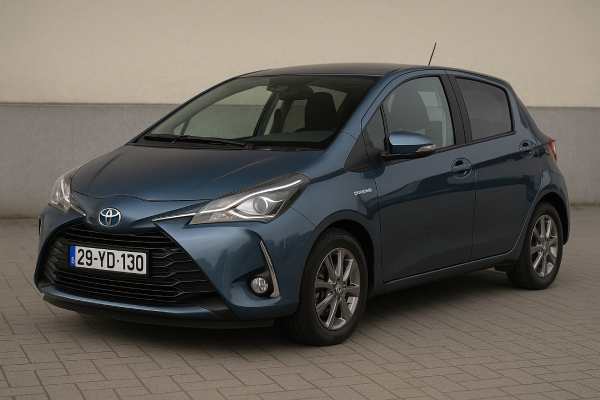
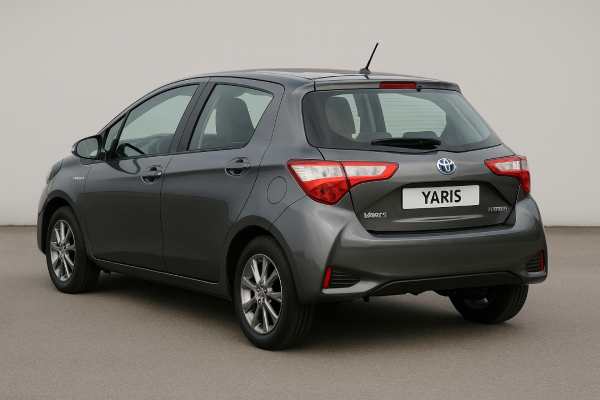
The Toyota Yaris Hybrid (NHP130) facelift combines a proven 1.5-litre Atkinson-cycle petrol engine with an electric motor and eCVT transmission in a compact, easy-to-park body. For many city and suburban drivers, it delivers full-hybrid efficiency and low running costs without the complexity of plugging in or managing charging stops. The 2014–2020 facelift brought updated styling, improved cabin refinement and, on many markets, Toyota Safety Sense driver-assistance features.
In daily use, the Yaris Hybrid feels simple and intuitive: select “D” and it decides when to run on electric power, the petrol engine, or both. Underneath that simplicity is a robust hybrid system shared with other high-volume Toyota models, which helps long-term parts availability and repair know-how. This guide walks through specifications, reliability patterns, maintenance planning and how the NHP130 compares to alternatives in the same segment.
Top Highlights
- Real-world mixed fuel use often around 4.5–5.0 L/100 km with calm driving.
- Proven 1NZ-FXE hybrid engine and eCVT, shared with other Toyotas, with generally strong reliability.
- Compact exterior with good visibility and quiet EV running at low speeds, ideal for city use.
- Owners should keep the hybrid battery cooling intake clean and monitor battery health after about 10–12 years.
- Typical oil and filter service interval is 15,000 km or 12 months (or as per local schedule).
Navigate this guide
- Hybrid Yaris NHP130 essentials
- Yaris Hybrid specs and systems
- Trims, equipment and safety tech
- Reliability and common NHP130 issues
- Maintenance schedule and buying advice
- Driving experience and real-world economy
- Yaris Hybrid versus rival small cars
Hybrid Yaris NHP130 essentials
The NHP130 Yaris Hybrid takes Toyota’s small-car platform and adds a full hybrid system similar in concept to the Prius, scaled for a light supermini. At its core is the 1NZ-FXE 1.5-litre petrol engine running an Atkinson-cycle combustion process, prioritising efficiency over outright power. It works together with an electric traction motor and a compact eCVT (planetary gearset) to provide a combined system output of 98 hp.
Unlike mild hybrids, the Yaris Hybrid can move off and cruise at low speeds on electric power alone when the battery is sufficiently charged. In urban use, this gives very smooth and quiet operation, especially in stop-start traffic where conventional automatics are less comfortable. Regenerative braking captures energy during deceleration and feeds it back into the nickel-metal hydride (NiMH) traction battery located under the rear seats.
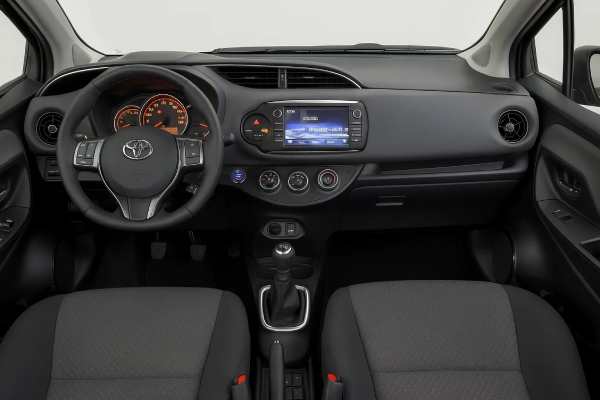
The facelift introduced in 2014 refined the package. Exterior styling was updated with a more assertive front end, revised lights and minor aero tweaks. Inside, Toyota focused on noise reduction, improving sound insulation around the firewall and floor, and updating materials and infotainment options. Later model years increasingly offered Toyota Safety Sense, bringing autonomous emergency braking and lane departure alert to many trims, which improved both crash avoidance and insurance perception.
Despite the relatively modest power figure, the Yaris Hybrid is not purely an economy special. In everyday traffic it feels responsive because the electric motor fills in low-rpm torque where a small petrol engine would normally struggle. The eCVT keeps the engine in its efficient band, so performance depends more on throttle position than traditional gear changes. For buyers prioritising reliability, fuel economy and low tax or congestion-charge costs over outright speed, the NHP130 is often a sweet spot.
Yaris Hybrid specs and systems
This section summarises key technical data for the 2014–2020 Yaris Hybrid (NHP130). Figures can vary slightly by market and trim, so treat them as typical values and confirm against documentation for a specific VIN.
Engine and hybrid system
| Item | Value |
|---|---|
| Engine code | 1NZ-FXE |
| Displacement | 1.5 L (1,497 cc) |
| Layout | Inline-4, DOHC, 16 valves, Atkinson cycle |
| Induction | Naturally aspirated |
| Fuel system | Multi-point electronic fuel injection |
| Compression ratio | ~13.0:1 |
| Max engine power | ~74 hp (55 kW) @ ~4,800 rpm |
| Max engine torque | ~111 Nm @ ~3,600 rpm |
| Electric motor type | Permanent-magnet synchronous |
| Electric motor output | ~60 hp (45 kW), ~169 Nm (typical spec) |
| System output | 98 hp (73 kW) combined |
| Hybrid battery | NiMH, ~0.9 kWh, ~144 V |
| Emissions standard | Euro 5 / Euro 6 depending on year |
| Official combined fuel use | approx. 3.3–3.6 L/100 km (mixed cycle) |
Transmission and driveline
| Item | Value |
|---|---|
| Transmission type | eCVT (planetary gearset) |
| Drive type | Front-wheel drive (FWD) |
| Final drive | ~3.4–3.7:1 depending on market |
| Differential | Open with electronic traction and stability aids |
Chassis, dimensions and weights
| Item | Value |
|---|---|
| Front suspension | MacPherson strut |
| Rear suspension | Torsion beam |
| Steering | Electric power steering |
| Brakes (front/rear) | Ventilated disc / solid disc (many hybrids) |
| Length | ~3,950 mm |
| Width (mirror-folded) | ~1,695 mm |
| Height | ~1,510 mm |
| Wheelbase | 2,510 mm |
| Ground clearance | ~140–145 mm |
| Turning circle (kerb-to-kerb) | ~10.6–10.8 m |
| Kerb weight | ~1,120–1,165 kg (equipment dependent) |
| Fuel tank | ~36 L |
| Luggage volume (seats up) | ~286 L (VDA) |
Performance and capability
| Item | Value |
|---|---|
| 0–100 km/h (0–62 mph) | ~11.5–12.0 s |
| Top speed | ~165 km/h (103 mph) |
| Typical roof load rating | ~50 kg (check bars and market) |
| Towing | Often not approved or very low rating – verify by market |
Service fluids and electrical
(Always verify capacities for the exact model year.)
| System | Specification (typical) | Approx. Capacity |
|---|---|---|
| Engine oil | 0W-20 (Toyota spec) | ~3.7–3.9 L with filter |
| Engine coolant (hybrid loop) | Toyota Super Long Life Coolant (SLLC) | ~5–6 L |
| Transaxle fluid | Toyota ATF WS | ~3–4 L |
| A/C refrigerant | R134a or R1234yf (by year/market) | label under bonnet |
| 12 V battery | ~35–45 Ah AGM/Flooded, compact form factor | — |
Safety equipment and assistance systems are covered in more detail in the trims and safety section.
Trims, equipment and safety tech
Across Europe and other markets, the facelift Yaris Hybrid was offered in several trim levels, typically starting with a basic or “Active” grade and rising through mid-spec “Icon/Comfort/Mid” trims to more richly equipped “Style/Sol/Selection” variants. The hybrid drivetrain itself remains the same across trims, so fuel economy and performance do not vary dramatically; differences are mainly in comfort, appearance and equipment.
Base-level cars usually bring manual air conditioning, basic audio with steering-wheel controls, steel wheels with hubcaps, cloth upholstery and a simple driver display. Mid-grade trims add alloy wheels, automatic climate control, upgraded infotainment with touchscreen, reversing camera, leather-wrapped steering wheel and more adjustable driver’s seat options. Higher trims may include LED headlamps, part-leather upholstery, privacy glass, automatic wipers and improved sound systems. Special editions can add cosmetic packs, different wheel designs and contrasting interior colours.
Useful identifiers when viewing a used car include wheel design and size, headlamp type (halogen vs projector/LED), steering wheel finish, and presence of keyless entry buttons on door handles. Inside, trims with Toyota Safety Sense usually display pre-collision and lane-departure indicators on the instrument cluster at start-up. Build plates, option codes in the service booklet and, in some countries, online dealer portals can confirm exact equipment.
Safety equipment is a strong point of the facelift Yaris Hybrid. All cars have at least front, side and curtain airbags, ABS with EBD, stability control (VSC), traction control and ISOFIX/LATCH anchors on the rear seats. Many markets also include a driver’s knee airbag. When Toyota Safety Sense is fitted, the car gains a Pre-Collision System (with autonomous emergency braking), Lane Departure Alert and Automatic High Beam; some regions also add Road Sign Assist. Calibrating these systems after windscreen replacement or major body work requires following the official procedures, so budget for alignment and calibration if a car has had front-end repairs.
Euro NCAP testing of this generation Yaris resulted in a five-star overall rating when equipped with the full safety pack. Active safety performance is particularly strong when Toyota Safety Sense is present, improving both real-world crash avoidance and the perceived value of higher-trim used cars. For family use, the combination of ISOFIX points, well-marked belt routing and stable child-seat performance is a major selling point.
Reliability and common NHP130 issues
The NHP130 Yaris Hybrid has a solid reputation for reliability, largely because it uses mature components from Toyota’s hybrid family rather than experimental hardware. Most owners report low repair frequency if maintenance is kept up. Still, age and mileage expose some recurring patterns that it is wise to understand before purchase.
On the internal-combustion side, the 1NZ-FXE engine is generally robust. Common age-related issues include minor coolant seepage from the water pump, slight oil sweating from rocker cover gaskets and, in high-mileage city cars, carbon build-up in the EGR passages and intake manifold. Symptoms can include rough idle, reduced fuel economy or occasional engine warning lights. Remedies range from gasket replacement to cleaning or replacing the EGR valve and associated pipework.
The hybrid system itself is designed for long life. NiMH batteries in Toyota hybrids often last well beyond 10 years, especially in temperate climates. However, prolonged operation in very hot environments, frequent short trips with little cooling airflow, or blocked battery-cooling intakes can accelerate wear of individual cells. Early signs include the engine running more often than usual, uneven state-of-charge swings on the display and stored diagnostic codes. Many markets offer reconditioning or module replacement services if the traction battery becomes weak, and Toyota has offered extended warranties or health-check programs in some regions.
Other known wear points include front suspension components (drop links, lower arm bushes) and rear axle beam bushes, particularly on cars frequently driven over speed bumps or rough urban roads. Noisy wheel bearings, rattling interior trim on poorer surfaces and aged shock absorbers are typical used-car issues rather than specific design faults. Brake wear is often lower than on non-hybrid Yaris models because regenerative braking handles much of the deceleration, but lack of heavy use can allow discs to corrode if the car mostly makes gentle city trips.
There have been recalls and service campaigns affecting this generation of Yaris (airbag systems, brake components and software updates among them). A prospective buyer should run the VIN through their region’s official recall database and ask a Toyota dealer to confirm that all field actions and software updates are complete. This is especially important for hybrid ECU and brake-system updates, which may improve drivability and fault resistance. A full service history, ideally with regular hybrid-system health checks, is a strong positive indicator when choosing between cars.
Maintenance schedule and buying advice
A well-maintained Yaris Hybrid can offer low total ownership cost, but it still needs regular servicing. The exact schedule depends on market, but the following pattern represents a sensible baseline for many owners:
- Engine oil and filter: every 15,000 km or 12 months, using the correct 0W-20 oil. In heavy city use or very hot climates, a shorter interval (10,000 km) may be beneficial.
- Engine air filter: inspect every 30,000 km, replace as required. Dusty environments may justify more frequent changes.
- Cabin (pollen) filter: every 15,000–30,000 km or 1–2 years; clogged filters hurt HVAC performance and can increase window misting.
- Spark plugs: iridium plugs typically every 90,000–100,000 km or around 6 years. Misfires or hard starting demand earlier inspection.
- Engine / hybrid coolant: first change often at around 160,000 km or 10 years, then at shorter intervals. Always use the specified Toyota SLLC.
- Brake fluid: every 2 years regardless of mileage to maintain boiling point and ABS/ESC performance.
- Transaxle (eCVT) fluid: many schedules class it as “lifetime,” but changing Toyota ATF WS at 90,000–120,000 km can be good insurance.
- Auxiliary (serpentine) belt and hoses: inspect at each service, replace if cracked, glazed or noisy.
- 12 V battery: test annually after year 5; many need replacement around the 7–10-year mark depending on climate and use.
The hybrid battery normally has no user-serviceable maintenance beyond ensuring the cooling intake (usually on a rear interior trim panel) is kept free of dust, pet hair and blocked items. During a pre-purchase inspection, ask for a recent hybrid health report if the dealer or previous owner has one.
From a buyer’s perspective, focus on:
- Service history: yearly stamps or invoices, with clear evidence of oil changes and brake-fluid replacement.
- Accident damage: check panel gaps, paint overspray and headlamp date codes; hybrids rely heavily on correctly aligned sensors and structure.
- Suspension and steering: listen for knocks over bumps, feel for wandering at speed and check tyre wear patterns for misalignment.
- Brakes: look for rusty discs and uneven pad wear; light hybrid braking can hide sticking calipers.
- Electrics: test all windows, central locking, infotainment, air conditioning and keyless systems where fitted.
Preferred cars are often mid-spec trims with Toyota Safety Sense, moderate mileage and a full dealer or specialist history. Very low-mileage examples that have spent years standing can need more reconditioning (tyres, brakes, 12 V battery) than a regularly used car. Overall durability is good, and many Yaris Hybrids deliver a long life with only routine work if looked after.
Driving experience and real-world economy
On the road, the Yaris Hybrid prioritises ease of use and comfort over excitement, but it is more capable than the numbers suggest. In town, initial response is brisk thanks to the electric motor delivering instant torque from a standstill. The eCVT keeps the petrol engine in a narrow efficient band, so the car accelerates smoothly without traditional shift shocks. Light steering and a tight turning circle make parking and narrow-street manoeuvres straightforward.
Ride quality is generally compliant for a small car. The torsion-beam rear axle is simple and space-efficient, and Toyota tuned the facelift models to reduce sharp-edge harshness compared with earlier versions. Road noise is well controlled at city speeds; at motorway pace, wind and tyre noise become more noticeable, but still acceptable for the class. Hybrid-specific sound insulation around the engine bay keeps the transition between EV mode and engine running relatively subtle when driven gently.
Cornering behaviour is safe and predictable. The car leans a little in bends, but grip levels are adequate, and stability control intervenes progressively if the driver oversteps the limits. Braking feel in hybrids can be different from conventional cars because the first part of pedal travel commands regenerative braking through the motor before the hydraulic system adds more stopping power. In the Yaris Hybrid this blend is usually smooth, though a short familiarisation period helps new owners build confidence.
Real-world fuel economy is one of the main reasons people choose this model. In mixed suburban driving it is realistic to see 4.5–5.0 L/100 km if speeds are moderate and acceleration is smooth. City-heavy usage with plenty of coasting and gentle braking can dip below that, especially in mild weather where neither heating nor air conditioning is working hard. Fast motorway running at 120–130 km/h pushes consumption higher, often into the mid-6 L/100 km range, as the petrol engine must do more work and opportunities for regeneration are fewer.
Cold weather, short trips and heavy use of cabin heating will also increase fuel use, because the engine must run simply to provide heat and keep the hybrid system at the right temperature. Even so, compared with a non-hybrid petrol supermini of similar performance, the Yaris Hybrid generally keeps a clear lead in efficiency, particularly in urban and stop-start conditions.
Yaris Hybrid versus rival small cars
When assessing the Yaris Hybrid against rivals, it is helpful to look at both conventional small cars and other hybrids or mild hybrids in the same price bracket. Against a standard petrol Yaris, Clio, Fiesta or Polo, the hybrid typically delivers significantly lower fuel consumption and, in many regions, reduced road tax or congestion-zone charges. The trade-offs are a higher purchase price on the used market and a slightly smaller boot due to the battery packaging, although Toyota did a good job keeping luggage space reasonable.
Compared with other full hybrids in the supermini and compact segment, such as some Honda and Hyundai models, the NHP130 stands out for its long production run and the wide pool of Toyota hybrid experience. Independent workshops are often familiar with Toyota’s hybrid architecture, which can help keep out-of-warranty servicing and repair costs predictable. The hardware is less powerful than some newer rivals, but in typical city and commuter use this matters less than refinement and economy.
Mild-hybrid and small turbo-petrol competitors can match or exceed the Yaris Hybrid’s performance while approaching its fuel economy on longer runs. However, in heavy city driving they rarely achieve the same real-world efficiency, because they cannot move on electric power alone and rely more on stop-start systems. Diesels in this size class have largely disappeared from many markets and can bring DPF and emissions-equipment complexity that the Yaris Hybrid avoids entirely.
Where the Yaris Hybrid may feel behind is in late-generation infotainment features and cabin tech compared with the newest rivals. Screen resolution, smartphone integration and driver-display graphics are serviceable but not cutting-edge. If the latest connectivity features are a priority, a buyer might prefer a newer-generation hybrid or a different brand. On the other hand, for drivers who value a simple interface, physical climate controls and mature mechanical systems over the very latest digital experience, the NHP130 is appealing.
Overall, the facelift Yaris Hybrid occupies a strong position as a reliable, efficient and city-friendly small car. Its main advantages are low running costs, a robust hybrid system and comprehensive safety equipment when specified with Toyota Safety Sense. Rivals may offer fresher interiors or sharper performance, but few combine the same blend of proven hybrid technology and compact practicality at similar ownership cost.
References
- Owner’s Manual | Toyota Europe 2017 (Owner’s Manual)
- Smart Safety Systems Help Toyota Yaris Gain Five-Star Euro NCAP Safety Rating 2017 (Safety Rating)
- Euro NCAP Official Site 2020 (Safety Rating Database)
- Toyota Online Owners Manuals and Warranty Information 2018 (Owner’s Manual Portal)
Disclaimer
This article is provided for general informational purposes only and does not replace professional diagnosis, repair advice or official service information. Specifications, torque values, fluid types, capacities, service intervals and safety-system details can vary by VIN, model year, market and installed equipment. Always confirm all data against the official owner’s manual, workshop manual, technical service bulletins and local regulations before carrying out any work or making a purchase decision.
If you found this guide useful, you are welcome to share it with other owners or buyers via social networks such as Facebook or X/Twitter to help support our work and make reliable information easier to find.