
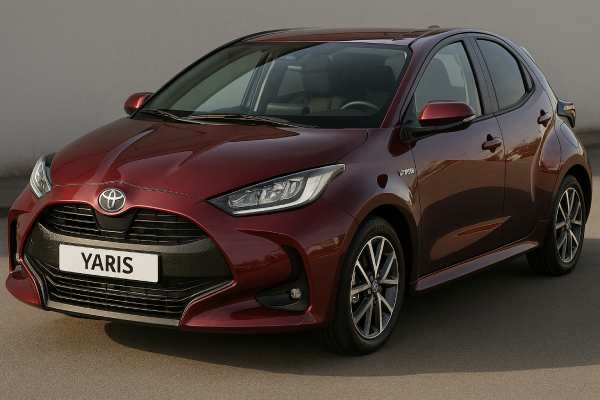
The 2024 facelift Toyota Yaris Hybrid 130 takes the already efficient MXPH11 platform and gives it more power, sharper technology, and a more upmarket feel without losing its core strengths: city-friendly size, low running costs, and strong safety credentials. Toyota’s 1.5-litre M15A-FXE Atkinson-cycle three-cylinder engine now works with an upgraded electric motor and control software to deliver a combined 130 hp, improving acceleration and mid-range response while keeping fuel consumption impressively low on standard test cycles.
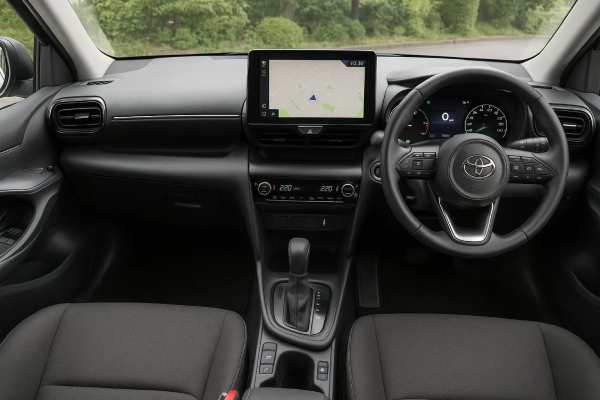
Inside, the facelift adds larger digital screens, more connected services, and an updated Toyota Safety Sense suite, along with revised materials that make the cabin feel less “basic” than earlier cars. For many buyers, this Yaris Hybrid is a genuine alternative to a small diesel or even a larger compact car, especially in dense European cities where its tight turning circle and compact footprint make daily use easy. The 130-hp version specifically targets drivers who liked the original hybrid’s efficiency but wanted a bit more punch for motorway ramps, overtakes, and fully loaded trips.
Fast Facts
- Strong combined output of 130 hp with clearly better mid-range than the earlier 116-hp Yaris Hybrid while retaining very low fuel consumption.
- GA-B platform gives the Yaris Hybrid 130 a stable, planted feel on the motorway relative to its size, with a robust safety structure and advanced driver-assistance systems.
- Cabin tech upgrade adds larger infotainment screens, a configurable digital cluster, and connected services on many trims, improving long-term usability.
- Hybrid system prefers regular use and correct coolant and inverter maintenance; neglecting fluid changes or using non-approved fluids can shorten component life.
- Typical service interval is 15,000 km or 12 months for oil and inspections in many European markets; always check the service booklet for local specifics.
Explore the sections
- Toyota Yaris Hybrid 130 overview
- Yaris Hybrid 130 technical data
- Yaris Hybrid trims and safety
- Hybrid 130 reliability and issues
- Maintenance and buyer guide insights
- On-road performance and efficiency
- Yaris Hybrid rivals and alternatives
Toyota Yaris Hybrid 130 overview
The facelift Toyota Yaris Hybrid 130 builds on the fourth-generation Yaris launched in 2020, using the same GA-B platform but with a more powerful version of Toyota’s fourth-generation hybrid system. The key change is the uprated electric motor and revised hybrid control software, lifting the combined system output from about 116 hp to roughly 130 hp while keeping the 1.5-litre M15A-FXE petrol engine largely unchanged mechanically.
In everyday driving, that means the car feels more eager from 40–100 km/h, where the previous hybrid could feel a bit strained when overtaking or climbing long motorway grades with passengers and luggage. The revised tune also sharpens throttle response in “Normal” and “Sport” modes without sacrificing the relaxed efficiency-focused behaviour in urban driving. The hybrid architecture still allows mostly electric running at lower speeds, especially in stop-start traffic, which helps both fuel economy and brake wear.
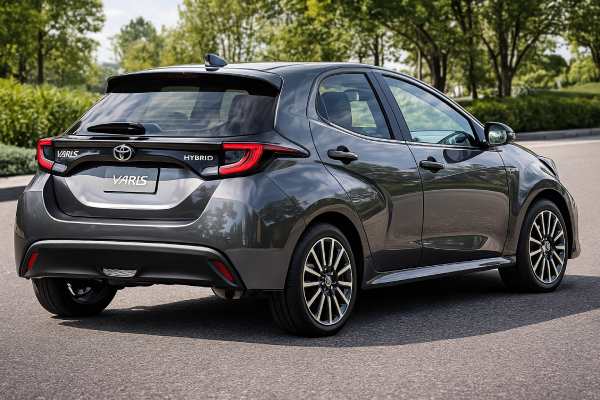
Outside, the facelift focuses on detail changes rather than a full redesign. You get new wheel designs, updated front and rear lighting signatures, and trim-specific styling tweaks such as contrast roof options on higher grades or sportier bumpers on GR Sport-inspired versions, depending on market. The basic Yaris proportions remain: short overhangs, tall cabin, and a low cowl that helps visibility.
Inside, Toyota has addressed earlier criticism around screen size and perceived material quality. Many 130-hp facelift cars are paired with a larger infotainment touchscreen and a digital instrument cluster, plus more soft-touch elements in high-contact areas. Connectivity improves with smartphone integration, over-the-air capable updates for some systems, and an expanded set of connected services such as remote status checks or cloud-based navigation, varying by region and trim.
From an ownership perspective, the Yaris Hybrid 130 is aimed at drivers who want a genuinely frugal B-segment hatchback but either live in hilly terrain, regularly use the motorway, or occasionally carry more passengers and cargo. It retains the compact footprint, tight turning circle, and easy parking manners of the standard Yaris, but the extra power makes it feel less compromised as an “only car” for a small household.
Yaris Hybrid 130 technical data
For the facelift Yaris Hybrid 130, Toyota continues with a non-plug-in hybrid layout: a 1.5-litre three-cylinder petrol engine, an e-CVT (planetary) transmission, an AC synchronous electric motor, and a compact lithium-ion traction battery mounted under the rear seats to preserve luggage space.
Powertrain and efficiency (hybrid system)
| Item | Specification |
|---|---|
| Engine code | M15A-FXE (1.5-litre Atkinson-cycle petrol) |
| Layout and valvetrain | Inline-3, DOHC, 4 valves per cylinder, variable valve timing on intake and exhaust |
| Displacement | Around 1.5 L (approx. 1,490 cc) |
| Bore × stroke | Long-stroke design favouring efficiency |
| Compression ratio | High (around 14.0:1) for Atkinson cycle |
| Induction | Naturally aspirated |
| Fuel system | Modern multi-point or blended direct injection depending on calibration |
| Max engine power | Roughly 91 hp (67 kW) near 5,500–5,700 rpm |
| Max engine torque | Around 120 Nm near 3,600–3,800 rpm |
| Electric motor type | AC synchronous (permanent magnet) |
| System output | 130 hp (96 kW) combined |
| Battery | Lithium-ion, mounted beneath rear seats |
| Emissions standard | Latest Euro 6d / Euro 6e equivalent (market dependent) |
| WLTP consumption | Typically in the 4.0–4.5 L/100 km combined range, depending on wheel size and spec |
Transmission and driveline
| Item | Specification |
|---|---|
| Transmission | e-CVT planetary gearset with integrated motor-generator units |
| Drive type | Front-wheel drive (FWD) in MXPH11 hybrid hatchback |
| Final drive | Short gearing for responsive low-speed performance |
| Differential | Open front differential with brake-based traction and stability control |
Chassis and dimensions
Dimensions vary slightly by trim and wheel size, but typical figures for European Yaris Hybrid 130 hatchback are:
| Item | Approximate value |
|---|---|
| Platform | GA-B (Toyota New Global Architecture) |
| Front suspension | MacPherson strut, coil springs, anti-roll bar |
| Rear suspension | Torsion beam with coil springs |
| Steering | Electric power steering, rack-and-pinion |
| Brakes | Ventilated front discs, solid rear discs; ABS, EBD, brake assist |
| Length | Around 3,940–3,950 mm |
| Width | About 1,745 mm |
| Height | Around 1,470–1,500 mm depending on wheels |
| Wheelbase | 2,560 mm |
| Turning circle | Roughly 10.2–10.4 m kerb-to-kerb |
| Kerb weight | Typically 1,150–1,250 kg depending on trim |
| Fuel tank | Around 36 L |
| Boot volume | Approximately 280–300 L (VDA) with seats up |
Performance
| Metric | Typical value for 130-hp hybrid |
|---|---|
| 0–100 km/h (0–62 mph) | About 9.0–9.3 s, depending on wheel/tyre and equipment |
| Top speed | Around 175 km/h |
| Braking 100–0 km/h | Competitive for the class; distance depends strongly on tyres and load |
Toyota does not publish every service-fluid capacity in public brochures, but engine oil is in the region of 3.5–4.0 L with filter, using a low-viscosity synthetic. The hybrid system uses dedicated coolant circuits for engine and inverter, which must be serviced with the correct long-life coolant. The transaxle uses a dedicated transmission fluid; sticking to Toyota specifications is important for long-term durability.
Yaris Hybrid trims and safety
Available trims for the Yaris Hybrid 130 vary by market, but the structure is similar across Europe: an entry or mid-grade where the 130-hp powertrain may be optional, upper trims where the stronger hybrid is standard, and sport-styled variants that pair the 130-hp system with unique wheels, suspension tuning, and visual tweaks.
Typical trim progression (example European structure)
- Core / Active / Icon-type grades
- Often still available with the 116-hp hybrid in some markets; the 130-hp system may be standard or optional depending on model year.
- Smaller wheels (15–16 inches), cloth seats, and a slightly smaller infotainment screen on base cars.
- Mid trims (Design, Style, similar names)
- 130-hp hybrid often standard.
- Larger alloy wheels (16–17 inches), upgraded audio, climate control, and more advanced digital displays.
- Top trims (Excel, Lounge, Premium, GR Sport variants)
- 130-hp hybrid essentially the default choice.
- Sportier or more premium styling cues, contrast roofs, specific seat fabrics or part-leather, and the full suite of Toyota Safety Sense features as standard in most regions.
Visual identifiers of the 130-hp facelift cars include badging and, in some markets, specific wheel designs and interior trims. A VIN check or build sheet from a dealer can confirm whether a car is fitted with the 130-hp hybrid calibration.
Safety ratings
The current-generation Yaris hatchback achieved a 5-star rating in Euro NCAP testing when introduced, with high adult occupant and safety-assist scores. That rating reflects the GA-B platform and body structure, which the facelift retains. Running changes mostly enhance technology and equipment rather than reducing safety performance.
Euro NCAP results for the GA-B Yaris highlight:
- Five-star overall rating.
- Strong adult-occupant protection scores.
- Solid child-occupant protection performance.
- Advanced safety-assist performance, thanks to a wide range of active systems.
Some markets also rely on local crash testing or insurance-based assessments, but the Euro NCAP result is the most widely recognised benchmark for this platform.
Safety systems and ADAS
Toyota Safety Sense on facelift Yaris Hybrid 130 typically includes:
- Autonomous emergency braking (AEB) with vehicle, pedestrian and often cyclist detection.
- Adaptive cruise control (ACC), sometimes with full-speed or stop-and-go capability.
- Lane departure alert with steering assist or lane-tracing functions.
- Road sign assist with integration into speed limiter or cruise control.
- Blind-spot monitoring and rear cross-traffic alert on higher trims.
- Automatic high beam or adaptive high-beam systems, depending on headlamp type and grade.
These systems rely on forward cameras, radar sensors, and sometimes ultrasonic sensors for parking. After windscreen replacement, front bumper repairs, or suspension geometry changes, correct calibration is important. On many Yaris models this requires dealer-level tools and calibration targets.
Child-seat installation is helped by ISOFIX / i-Size mounts and clearly marked top-tether anchor points on the rear bench. As with most small hatches, rear-facing seats may require careful front-seat positioning, especially for tall occupants.
Hybrid 130 reliability and issues
Toyota’s small hybrids have built up a strong reputation for durability, and the Yaris Hybrid 130 continues in that direction. The underlying engine family (M15A-FXE) and hybrid transaxle share architecture with earlier 1.5-litre Toyota hybrids used in the Yaris and other compact models, with incremental changes for power electronics and calibration.
Because the 130-hp variant is still relatively new, long-term data is limited, but experience from the 116-hp Yaris Hybrid and previous Toyota systems offers good guidance.
Common or expected issues (usually low severity)
- 12 V battery ageing
- Symptoms: slow unlocking, dim lights, warning messages, or difficulty getting the car into “Ready” after long periods parked.
- Cause: the small-capacity auxiliary battery is sensitive to frequent very short trips or long idle periods.
- Remedy: periodic battery health checks and timely replacement, often around the 5–7 year mark depending on climate and usage.
- Brake disc corrosion and pad glazing
- Symptoms: surface rust, squeal after standing, slightly reduced bite on initial stops.
- Cause: the hybrid system uses regeneration heavily, so friction brakes see less regular use and can rust more quickly.
- Remedy: occasional firm stops to clean the discs, regular inspections, and disc/pad replacement where corrosion or wear is significant.
- Trim and rattle issues
- Symptoms: minor creaks from dashboard or door panels on rough surfaces.
- Cause: light interior components, combined with firm suspension on some trims.
- Remedy: re-seating clips, adding damping tape, and in some cases warranty attention.
Occasional concerns (medium potential cost)
- Inverter and DC-DC cooling neglect
- If coolant is not changed on schedule or the wrong coolant is used, hybrid electronics can overheat or suffer premature wear.
- Owners should ensure hybrid-system coolant changes are done at the specified intervals, using the correct long-life coolant.
- Suspension bushings and links
- Hard urban use over speed bumps and potholes can accelerate wear of front lower-arm bushes and anti-roll-bar links.
- Signs include knocking noises and vague steering; parts are not unique to the 130-hp calibration and are typically affordable.
Rare but important issues
- High-voltage battery faults
- Toyota’s lithium-ion hybrid packs have shown good durability, and many markets back them with extended hybrid-battery warranties if services are carried out on schedule.
- Early signs of trouble include reduced electric-only operation, warning lights, or noticeable state-of-charge swings. Diagnosis needs proper high-voltage safety procedures and appropriate scan tools.
- Hybrid transaxle problems
- Mechanical issues are rare; when problems do occur, they are often linked to contamination, accidents, or incorrect fluid.
- Using the specified fluid and respecting service guidance is the best prevention.
Software updates may occasionally be issued to refine hybrid behaviour, improve drivability, or address specific diagnostic codes. These are usually applied during scheduled services and can resolve quirks without mechanical intervention.
For pre-purchase checks, prospective buyers should look for a complete service history, proof of recall or service-campaign completion, and evidence that hybrid-specific maintenance has been followed. A scan for stored fault codes and a test drive focusing on smooth transitions between EV and engine operation are advisable.
Maintenance and buyer guide insights
The Yaris Hybrid 130 is engineered to keep routine maintenance straightforward and relatively affordable, provided that hybrid-specific procedures and genuine or equivalent-quality parts are used.
Typical maintenance schedule (always verify locally)
- Engine oil and filter – Usually every 15,000 km or 12 months, whichever comes first, using the specified low-viscosity synthetic oil.
- Cabin air filter – Inspect at each service and replace roughly every 2 years or more often in dusty or urban environments.
- Engine air filter – Inspect regularly; replace about every 30,000–45,000 km or when contamination is visible.
- Coolant (engine and hybrid circuitry) – Long-life coolant with an initial long interval (often many years/over 100,000 km) followed by shorter intervals. Always use Toyota-approved coolant and avoid mixing types.
- Brake fluid – Replace approximately every 2 years regardless of mileage.
- Spark plugs – Long-life plugs typically replaced between 90,000 and 120,000 km, depending on official schedule.
- Hybrid transaxle fluid – Sometimes labelled “lifetime”, but many specialists recommend inspection and preventative changes around 120,000–150,000 km.
- 12 V battery – Test annually from around year 4; replace when capacity or cranking voltage drops below specification.
- Tyres and alignment – Rotate every 10,000–15,000 km and check alignment whenever uneven wear or steering pull occurs.
Timing is via a chain rather than a belt, so there is no fixed belt replacement interval. Instead, owners should listen for abnormal chain noise at start-up, watch for timing-correlation faults, and address oil-quality issues promptly.
Fluids and key torque considerations
- Always choose engine oil with the viscosity and specification listed in the owner’s manual; going significantly thicker can harm efficiency and hybrid smoothness.
- Use only the recommended coolant; hybrids are sensitive to corrosion and deposit formation in fine cooling passages.
- When swapping wheels (such as between summer and winter sets), use the correct wheel bolt/nut torque taken from the service information.
Buyer’s guide – inspection checklist
For new or nearly new Yaris Hybrid 130s (dealer stock, demos, or early used examples):
- Exterior and corrosion – Inspect door bottoms, sill edges, wheel arches, and underbody coatings, especially in regions with road salt.
- Panel alignment and paintwork – Look for mismatched colours, overspray, or unusual panel gaps hinting at accident repairs.
- Suspension and tyres – Check for uneven tyre wear, knocking over bumps, or vibration at speed. These can indicate alignment issues, worn components, or wheel damage.
- Hybrid behaviour – Ensure the car enters “Ready” promptly, transitions smoothly between EV and engine, and does not show warning messages. Electric-only operation should be frequent at low speeds with gentle inputs.
- Infotainment and electronics – Test all screens, audio, connectivity functions, climate controls, cameras, parking sensors, and ADAS functions (where road conditions permit).
Which trims to prioritise
For most buyers, mid-to-high trims that pair the 130-hp hybrid with the larger screens and full Toyota Safety Sense suite offer the best balance of usability and future desirability. Entry trims are excellent from a mechanical standpoint but may lack some creature comforts and technology that owners expect in a new car.
From a long-term durability perspective, any Yaris Hybrid 130 with a complete, documented service history and evidence of correct hybrid maintenance should deliver many years and high mileages of dependable service, especially in mixed city and suburban use.
On-road performance and efficiency
On the road, the Yaris Hybrid 130 retains the easygoing “point and go” character of the earlier 116-hp hybrid but with more authority when the driver asks for full power. The stronger electric motor and revised control software noticeably improve response when merging onto motorways or overtaking from 80–120 km/h, areas where the previous car could feel stretched with four adults and luggage.
Ride, handling, and noise
The GA-B platform gives the Yaris a low centre of gravity for its size. Suspension tuning balances urban comfort with confident high-speed behaviour:
- Around town, the car absorbs typical bumps and speed humps well, especially on sensible wheel sizes.
- On the motorway, it feels stable and grown-up for a B-segment hatchback, tracking straight and shrugging off crosswinds reasonably well.
- In corners, body roll is controlled and grip levels are secure, especially with quality tyres; GR Sport-style trims may have slightly firmer tuning for sharper responses.
Steering is light at parking speeds and firms up logically as speed increases. Feedback is adequate for the segment, helping the driver place the car precisely. Brake feel has been progressively refined over Toyota’s hybrid generations. In the Yaris Hybrid 130, the transition between regenerative and friction braking is generally smooth, though occasional mild inconsistencies after a cold start or heavy rain are normal for hybrids where discs can briefly rust.
Cabin noise is competitive, with particularly quiet operation in low-speed EV running. At higher speeds, engine noise rises during strong acceleration, but because the 130-hp system delivers more shove, the engine does not need to work as hard for the same result, so it settles more quickly once the target speed is reached.
Real-world efficiency
While official WLTP numbers are around the low-4 L/100 km mark, real-world figures typically look like:
- City / suburban driving – Approximately 3.5–4.5 L/100 km with smooth, anticipatory driving, where the hybrid spends large portions of time in EV mode.
- Mixed routes – Around 4.0–5.0 L/100 km depending on gradients, speeds, and climate.
- Motorway at 120 km/h – Usually about 5.0–5.5 L/100 km, reflecting steady high-speed operation where hybrids can’t exploit regeneration as much.
Cold weather, short journeys, and heavy use of climate control will raise consumption, as the engine must run more to provide heat and maintain battery temperature. Even so, the Yaris Hybrid typically beats equivalent non-hybrid petrols and many small diesels in urban and mixed use.
Performance snapshots
- 0–100 km/h in roughly low-nine seconds makes the car feel brisk and relaxed in modern traffic.
- Mid-range acceleration from 50–80 km/h and 80–120 km/h shows a clear improvement over the 116-hp model, with the car holding speed on inclines more easily.
- The modest kerb weight helps both agility and braking, and tight urban manoeuvres are easy thanks to the short wheelbase and compact overhangs.
The Yaris Hybrid 130 is not pitched as a performance hatch; that role belongs to dedicated models like the GR Yaris. Instead, it aims to make everyday driving smoother and less stressful while controlling fuel and maintenance costs—and the extra power of the facelift model noticeably helps it deliver on that brief.
Yaris Hybrid rivals and alternatives
In the European B-segment, the facelift Toyota Yaris Hybrid 130 faces competition from other full hybrids, efficient petrols, and emerging small battery-electric vehicles.
Key hybrid rivals
- Renault Clio E-Tech full hybrid
- Similar footprint and power output, using a multi-mode hybrid transmission.
- Offers impressive efficiency and a different feel, with more distinct gear phases under acceleration.
- Honda Jazz (Fit) Hybrid
- Prioritises space and practicality with a very flexible interior.
- Hybrid system often emphasises electric drive at low speeds and engine-driven operation at higher speeds, giving a smooth and quiet urban experience.
- Toyota Yaris Cross Hybrid
- Shares much of the hybrid hardware with the Yaris hatchback but adds SUV-like height and a more upright driving position.
- Better for those who value easier ingress/egress and extra boot height, at the cost of a modest efficiency penalty and higher price.
Compared with these, the Yaris Hybrid 130’s main strengths are Toyota’s long hybrid experience, the uprated performance for the facelift, and the broad availability of safety and driver-assistance technologies. Its weaker points are a smaller rear seat and boot than some rivals and a cabin that, while improved, still feels more functional than plush in lower trims.
Small BEVs and efficient petrols
- Small BEVs (e.g., Peugeot e-208, similar city EVs)
- Deliver very low energy costs and zero tailpipe emissions, but depend heavily on charging access and may carry a higher purchase price.
- For drivers without easy home or workplace charging, the Yaris Hybrid 130 can be more convenient for long trips and spontaneous usage.
- Modern turbo petrol or mild-hybrid hatches
- Can be competitive on motorway economy but usually lag behind in urban traffic, where hybrids exploit EV mode and regeneration.
- May feel more familiar to drivers used to conventional automatics or manuals, but often with higher CO₂ and fuel bills in stop-start conditions.
For many buyers, especially those in cities or mixed-use environments who want one compact car that feels competent on motorways as well as in tight streets, the Yaris Hybrid 130 facelift offers a compelling overall package: excellent fuel economy, strong safety credentials, proven hybrid hardware, and now the extra performance that early adopters of the 116-hp model sometimes wished for.
References
<a href="https://www.toyota.ie/models/yaris/specifications">Take a closer look at the specifications of Toyota Yaris</a> 2024 (Specifications)<a href="https://www.toyota.fr/vehicules-neufs/yaris/caracteristiques">Toyota | Découvrez les spécifications de la Yaris</a> 2024 (Specifications)<a href="https://cdn.euroncap.com/media/56772/official-toyota-yaris-2020-safety-rating.pdf">Official Toyota Yaris 2020 safety rating</a> 2020 (Safety Rating)<a href="https://www.toyota.bg/new-cars/yaris">New Toyota Yaris. Energise every day</a> 2024 (Model Overview)
Disclaimer
This article is for informational purposes only and is not a substitute for professional diagnosis, repair, or official service guidance. Specifications, torque values, maintenance intervals, and repair procedures can vary by VIN, production date, market, trim level, and installed equipment. Always confirm critical data and procedures against the official Toyota service documentation, owner’s manual, and technical bulletins for your specific vehicle, and consult a qualified technician when in doubt.
If you found this guide useful, you are welcome to share it on social platforms such as Facebook or X/Twitter to help other owners and support the continued creation of detailed, technically informed content.