
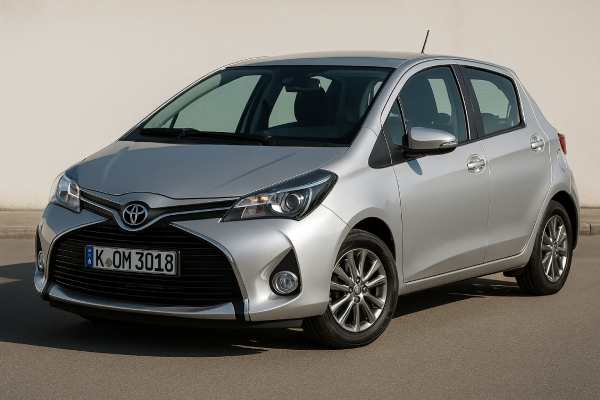
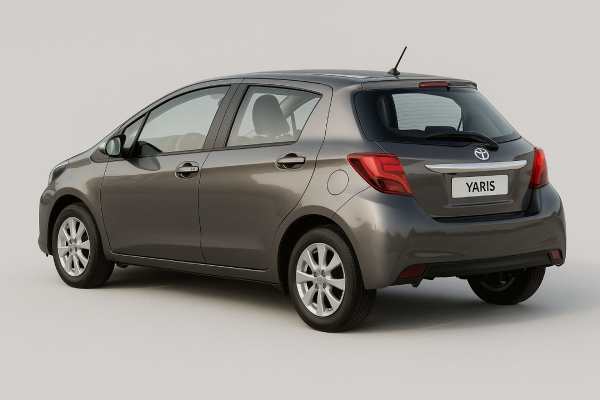
The facelifted Toyota Yaris (NLP130) 1.4 D-4D is one of the most sensible ways to run a small diesel hatchback. Between 2014 and 2017, Toyota refreshed the XP130 platform with sharper styling, better sound insulation and revised suspension tuning while carrying over the proven 1ND-TV 1.4-litre turbo-diesel. The result is a compact car that feels more mature than its size suggests, with long-legged gearing, low fuel consumption and a reputation for durability when serviced on time.
This engine was designed for high-mileage use: light on fuel, strong in the mid-range and robust under sustained motorway driving. The facelift brought improvements in interior materials, a more modern dashboard layout and upgraded infotainment on many trims. In some markets, later cars also gained active safety features such as autonomous emergency braking, further boosting appeal for family and fleet buyers.
For used buyers, the key questions are condition, maintenance history and whether the car has been driven in a way that keeps the diesel particulate filter healthy.
Top Highlights
- Proven 1ND-TV diesel with strong mid-range torque and very low consumption on long runs.
- Facelift Yaris gains better sound insulation, more refined suspension tuning and a more up-to-date cabin.
- Compact exterior but practical interior, with a useful boot and good visibility for city use.
- DPF and EGR systems can cause trouble on short-trip cars; regular hot runs and correct oil are essential.
- Treat 10,000 miles / 15,000 km or 12 months as a sensible maximum interval for oil and filter changes.
What’s inside
- Facelift Yaris 1.4 diesel overview
- NLP130 1ND-TV technical details
- Trims, options and safety gear
- Long-term reliability, faults and fixes
- Maintenance planning and used-buying tips
- Road manners, economy and performance
- Facelift diesel Yaris versus rivals
Facelift Yaris 1.4 diesel overview
The 2014 facelift arrived to keep the third-generation Yaris competitive in a crowded European supermini market. While the underlying XP130 platform remained the same, Toyota redesigned the nose and tail, introduced the now-familiar “X” front graphic and reworked the interior to feel less utilitarian. At the same time, engineers improved body sealing and insulation and retuned the suspension to deliver a more settled ride and lower cabin noise.
For the diesel NLP130 variant, the mechanical heart is unchanged: the 1ND-TV 1.4-litre four-cylinder turbo-diesel with common-rail injection and a variable-geometry turbocharger. Power remains around 90 hp with about 205 Nm of torque, but the way the facelift car uses that torque is slightly more refined. Longer gearing and better NVH control make motorway work calmer, while the basic mechanical layout prioritises durability and economy over complexity.
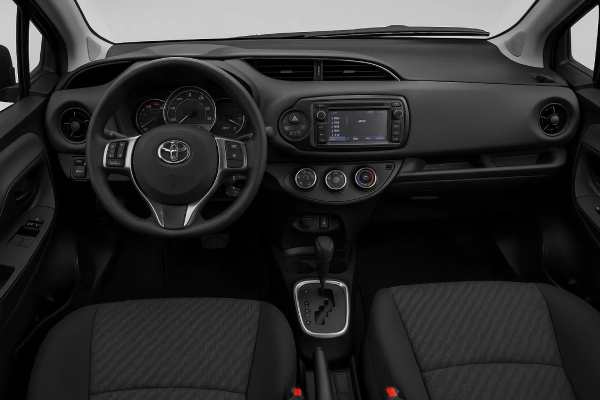
The Yaris’s compact size still suits city use. The turning circle is tight, visibility is good and the clutch and steering are light in traffic. Inside, the facelift brought a more cohesive dashboard with a central touchscreen on many trims, more convincing soft-touch materials in key contact areas and better sound-deadening around the firewall and floorpan. Rear-seat space remains adequate for adults on short to medium journeys, and the boot is large enough for weekly shopping or carry-on suitcases.
For many buyers, especially those covering 20,000 km or more per year, the diesel Yaris offers a very low total cost of ownership. Fuel consumption can sit in the 4.0–5.0 l/100 km range with careful driving, and the engine is capable of very high mileages if supplied with clean oil and decent diesel. Insurance classes and tax bands are usually favourable thanks to modest power and relatively low CO₂.
There are trade-offs. The DPF requires regular hot running to stay clean, so pure short-trip city use is not ideal. Performance is brisk enough rather than quick, especially when fully loaded or climbing long gradients. And as cities move away from older diesels, some emission zones may become less friendly to this engine. For drivers whose usage pattern fits, though, the facelift Yaris 1.4 diesel is still a rational, long-lived choice.
NLP130 1ND-TV technical details
Engine and performance
| Item | Detail |
|---|---|
| Engine code | 1ND-TV |
| Type and layout | Inline-4 turbo-diesel, transverse |
| Valvetrain | SOHC, 8 valves, 2 valves per cylinder |
| Bore × stroke | 73.0 × 81.5 mm |
| Displacement | 1.4 l (1,364 cc) |
| Induction | Variable-geometry turbocharger with intercooler |
| Fuel system | Common-rail direct injection |
| Compression ratio | Around 16.0–16.5:1 |
| Max power | ~90 hp (66 kW) @ ~3,800 rpm |
| Max torque | ~205 Nm (151 lb-ft) @ ~1,800–2,800 rpm |
| Emissions standard | Typically Euro 5 in this period |
| Official combined consumption | Around 4.0 l/100 km (roughly 71 mpg UK, 59 mpg US), depending on spec |
| CO₂ rating | Around 104 g/km, trim- and wheel-dependent |
The 1ND-TV is tuned for flexibility and economy rather than outright output. In real-world mixed driving, many owners see 4.0–5.0 l/100 km with calm motorway use, rising to 5.5–6.0 l/100 km in heavy urban traffic or with frequent cold starts.
Transmission and driveline
Most facelift diesel Yaris models pair the 1ND-TV with a six-speed manual gearbox.
| Item | Detail |
|---|---|
| Transmission | 6-speed manual, cable-operated |
| Gearbox family | EC65-series transaxle (typical) |
| Drive type | Front-wheel drive (FWD) |
| Differential | Open, integrated in transaxle |
| Approximate final drive | Mid-3s:1 (varies slightly by market and wheel size) |
Longer upper gears keep revs low on the motorway, helping noise and fuel consumption. There is no widely offered mainstream automatic diesel combination for this facelift generation in many European markets.
Chassis and dimensions
| Item | Detail |
|---|---|
| Platform | Toyota B-platform (XP130) |
| Front suspension | MacPherson strut, coil springs, anti-roll bar |
| Rear suspension | Torsion beam, coil springs |
| Steering | Electric power-assisted rack-and-pinion |
| Front brakes | Ventilated discs (around 258 mm diameter) |
| Rear brakes | Drums on most trims; some markets may see rear discs on top grades |
| Typical tyre sizes | 175/65 R15; 195/50 R16 on certain sportier trims |
| Length | ~3,950 mm (155.5 in) |
| Width | ~1,695 mm (66.7 in) |
| Height | ~1,510 mm (59.4 in) |
| Wheelbase | 2,510 mm (98.8 in) |
| Turning circle | Around 9.4–9.6 m kerb-to-kerb |
| Ground clearance | Roughly 140 mm |
| Kerb weight | About 1,090–1,150 kg depending on spec |
| GVWR | Around 1,540–1,560 kg |
| Fuel tank | 41–42 l diesel |
| Boot volume | ~286 l seats up, ~760–770 l seats folded (VDA) |
Performance and capability
| Metric | Value (typical 5-door 1.4 D-4D) |
|---|---|
| 0–100 km/h (0–62 mph) | Approx. 10.8–11.2 s (depending on trim and test) |
| Top speed | Around 175 km/h (109 mph) |
| Braking 100–0 km/h | Typically mid-30 m range on quality tyres |
| Rated towing capacity* | Often 700–900 kg braked, 400–450 kg unbraked |
| Roof load | Commonly around 50 kg |
*Always confirm towing limits on the VIN plate and in the owner’s manual for your specific car.
Fluids and service capacities
Figures vary slightly with market and year; use these as orientation and verify for your VIN.
| System | Typical specification | Approx. capacity |
|---|---|---|
| Engine oil (no DPF) | ACEA B3/B4, API CF/CF-4, 5W-30 or 5W-40 diesel oil | ~3.9 l (with filter) |
| Engine oil (with DPF) | Low-SAPS ACEA C2 5W-30 | ~3.7 l (with filter) |
| Engine coolant | Toyota Super Long Life Coolant (pink) or equivalent | ~4.5–4.9 l |
| Manual gearbox | GL-4 75W “low viscosity” manual gear oil | ~2.4 l |
| Fuel system | Ultra-low sulphur diesel | 41–42 l tank |
Key torque values (wheel bolts, sump plug, injector clamp bolts, cam and crank fasteners, suspension bolts) must be taken from the official workshop data, not guessed.
Electrical and safety basics
- 12 V battery typically 45–55 Ah in a compact casing.
- Conventional alternator output matched to normal accessory loads.
- Glow plugs assist cold starting; failed plugs or a faulty relay show up as long cranking and rough cold idle.
Safety equipment includes multiple airbags (front, side, curtain and often driver’s knee), ABS with EBD, stability control and ISOFIX child-seat mounts on the outer rear seats. Later facelift cars in some markets add a camera and radar hardware for Toyota Safety Sense, covered in more detail in the trims section.
Trims, options and safety gear
Exact trim names differ by country, but the facelift diesel Yaris tends to follow a clear pattern: a basic but well-equipped entry grade, mid-level trims with more comfort and convenience and high grades with cosmetic and technology upgrades. The 1.4 diesel is usually positioned as a more expensive, high-mileage choice rather than the base engine.
Commonly, the diesel is available from the mid-level trim upwards. A typical structure looks like this:
Entry / fleet-oriented trims
- 15-inch steel wheels with covers
- Manual air conditioning
- Front electric windows, central locking
- Basic audio with USB and Bluetooth
- Height-adjustable driver’s seat and split-folding rear bench
- Body-colour bumpers but simpler grille and trim details
Mid-level trims
- 15-inch alloy wheels
- Front fog lamps or LED daytime running lights
- Toyota Touch (or Touch 2) infotainment with colour touchscreen
- Leather-trimmed steering wheel, often with audio and phone controls
- Rear-view camera on many markets
- More attractive seat fabrics and extra cabin storage touches
High-spec trims
- 16-inch alloy wheels with lower-profile tyres
- Automatic climate control
- Upgraded fabrics or part-leather upholstery
- Dark-tinted rear glass
- Additional chrome or gloss-black exterior details
- Integrated navigation and enhanced audio on some versions
Mechanically, the trims share the same basic engine and gearbox. Differences that can affect ownership include:
- Wheel and tyre size, which influences ride comfort, noise and winter-tyre cost.
- Rear brake hardware (some markets and higher trims may have rear discs).
- Equipment relevant to convenience, such as cruise control, speed limiter and armrests, which matter on long commutes.
Safety systems and Toyota Safety Sense
The underlying structure and passive safety systems (airbags, seatbelts, ISOFIX points) are common across the range. The XP130 Yaris achieved strong crash performance in independent testing, and the facelift did not compromise that core protection.
Active safety equipment starts with ABS, EBD, brake assist, stability control and traction control, fitted to most if not all facelift diesels. As the years progress, many markets offer an optional or standard Toyota Safety Sense package on mid- and high-spec trims. Depending on specification, this may add:
- Pre-collision system with forward collision warning and low-speed autonomous emergency braking.
- Lane departure warning.
- Road sign assist (speed limit display).
- Automatic high beam.
Where fitted, these systems rely on a windscreen- or grille-mounted camera and, in some cases, radar. After windscreen replacement, accident repairs or major front-end work, correct calibration is essential. A car with a Safety Sense warning light, persistent beeps or unexplained disengagement of assistance functions may need diagnostic work and recalibration.
Year-to-year and market differences
- Early facelift years (around 2014) may lack the full latest infotainment packages and advanced safety options.
- Mid-cycle updates often standardise equipment such as reversing cameras or Bluetooth across more trims.
- Towards 2016–2017, more markets introduce safety packs as standard or low-cost options on popular grades.
When shopping used, focus less on trim names and more on actual equipment fitted. Confirm items such as:
- Cruise control or speed limiter (helpful for frequent motorway use).
- Reversing camera and parking sensors (valuable in tight cities).
- Safety Sense pack where available.
- Seat and steering-wheel adjustments that suit your driving position.
A mid- to high-spec diesel with good history and, ideally, Safety Sense will have the broadest and longest-lasting appeal.
Long-term reliability, faults and fixes
The 1ND-TV diesel and NLP130 platform are generally robust, but, like all modern diesels, they are sensitive to usage patterns and maintenance quality. Mapping the typical issues helps you judge an individual car.
Engine and emissions
EGR and intake soot build-up (common, low–medium severity)
Frequent short trips, extended idling and gentle driving at low rpm allow soot and oily vapour to accumulate in the EGR valve and intake manifold. Symptoms include rough idle, hesitation, reduced performance and fault codes relating to EGR flow. Remedies range from chemical cleaning to removal and mechanical cleaning of the EGR valve and intake runners; badly worn valves may need replacement.
DPF loading and regeneration faults (common in city-driven cars, medium–high severity)
DPF-equipped facelift diesels rely on regular hot running to complete regeneration cycles. Cars used mainly for short urban hops may show:
- Increased fuel consumption
- Cooling fans running after shutdown
- DPF or engine warning lights
- Limp-mode operation
Early intervention with a sustained motorway run at correct revs can sometimes clear moderate soot load. Heavily blocked filters may require forced regeneration using diagnostic equipment, professional off-car cleaning or replacement. The correct low-ash oil and avoiding chronic low-load operation are critical.
Turbocharger and boost control issues (occasional)
Variable-geometry turbo vanes can stick due to soot, particularly on engines that see a lot of stop-start work. Drivers may notice flat spots, sluggish acceleration or overboost/underboost codes. Sometimes careful driving and mild additive use can free lightly stuck vanes; more severe cases demand turbo cleaning or replacement. Ensuring proper warm-up and cool-down habits and frequent oil changes protects turbo longevity.
Injectors and fuel system (occasional, medium severity)
High-mileage engines may develop injector wear, leading to rough idle, excessive diesel knock, smoke or difficult hot starts. Diagnosis should include leak-off tests and rail-pressure monitoring. Injectors can sometimes be refurbished; in other cases replacement is required. Keeping fuel filters fresh and avoiding contaminated fuel is the main preventative measure.
Timing, driveline and chassis
Timing belt neglect (potentially severe)
Unlike many Toyota petrols, the 1ND-TV uses a timing belt, not a chain. Extending replacement far beyond the recommended mileage or time interval risks belt failure and severe engine damage. If the service history does not clearly show a belt change by around 150,000 km or about ten years, it is safest to treat it as overdue. A proper job includes belt, tensioner, idlers and usually the water pump.
Clutch and dual-mass flywheel wear (common on high-mileage cars)
City-driven and fleet cars often suffer clutch and, where fitted, dual-mass flywheel wear. Symptoms include slipping under load, judder when taking off and rattling at idle. Replacement is not cheap due to parts and labour, but a fresh clutch and flywheel can transform drivability and extend the car’s usable life.
Front suspension wear (common with age)
Anti-roll-bar drop links, lower-arm bushes and sometimes top mounts develop play, making knocks over bumps and vague steering. On inspection, look for split bushes, excessive movement and damp, leaking shock absorbers. Parts are reasonably priced; an alignment afterwards is essential.
Wheel bearings and brakes (occasional)
As mileage builds, front wheel bearings may begin to hum; rear drums can accumulate dust and corrosion, leading to reduced effectiveness or noise. Regular brake inspections and timely bearing replacement keep the car safe and quiet.
Corrosion, electrics and recalls
Underbody corrosion (climate-dependent)
In salt-heavy winter regions, pay close attention to:
- Rear axle beam
- Brake and fuel lines
- Front subframe and mounting points
- Sill seams and jacking points
Surface rust is normal; flaking, swelling or perforation is not. Protective treatments can slow progression if applied early.
Glow plugs and starting system (occasional)
Age and short trips can wear out glow plugs or their control relay. Hard starting, especially in cold weather, and glow-plug warning lights are typical signs. Replacing the full set of plugs is common practice, but care is needed to avoid seizure and thread damage.
Recalls and technical bulletins
Across the XP130 generation, recalls have covered items such as airbag inflators, electric window switches and other safety-related components. Diesel-specific service bulletins may address software updates for emissions, drivability or DPF behaviour. Always:
- Check the VIN against official recall databases.
- Ask for documentation of recall and service bulletin work.
A facelift diesel Yaris with documented timing-belt replacement, clutch work where needed and evidence of DPF and EGR care is a strong long-term proposition.
Maintenance planning and used-buying tips
Keeping the facelift Yaris 1.4 diesel healthy is mostly about disciplined, regular servicing and diesel-appropriate driving habits. The following schedule is a practical baseline; always adapt to local guidance and usage.
Practical maintenance schedule
Every 10,000 miles / 15,000 km or 12 months
- Engine oil and filter (correct diesel or low-SAPS oil depending on DPF).
- General inspection for leaks (oil, fuel, coolant) and perished hoses.
- Brake inspection: pads, discs, rear shoes/cylinders and handbrake operation.
- Tyre inspection, pressure adjustment and tread-depth check.
- Visual check of suspension joints, steering components and driveshaft boots.
Every 30,000 km or 2 years
- Engine air filter replacement.
- Cabin (pollen) filter replacement.
- Brake fluid change.
- More detailed underbody inspection, including brake/fuel lines and rear axle condition.
- Inspect auxiliary drive belt and tensioner.
Every 60,000 km or 4 years
- Fuel filter replacement.
- Proactive cleaning of EGR/throttle body where access is reasonable.
Every 6–8 years or 100,000–160,000 km
- Engine coolant replacement.
Timing belt
- Plan belt, tensioner, idlers and water-pump replacement at around 150,000 km or 10 years, whichever comes first, or earlier if service data for your market specify a shorter interval.
Ongoing checks
- Monitor DPF behaviour: unusually frequent regenerations or warning lights require prompt diagnosis.
- Test the 12 V battery from around five years old, especially ahead of winter.
- Rotate tyres every 10,000–15,000 km; check alignment if wear patterns are uneven.
Fluids and torque considerations
- Always use oil that meets or exceeds the manufacturer’s diesel and DPF specifications. The wrong oil can shorten DPF life.
- Use the recommended gear oil and coolant types; avoid mixing unknown coolants.
- Torque-sensitive fasteners such as wheel bolts, injector clamps, camshaft sprockets and suspension bolts must be tightened to the values in the official workshop information.
Used-buying checklist
- Paperwork and service history
- Look for consistent servicing, ideally yearly.
- Confirm timing-belt replacement if the car is older than about ten years or over 150,000 km.
- Check invoices for fuel-filter changes, coolant renewal and any major repairs.
- Cold start and warm-up
- Start the car from cold; it should fire promptly without excessive smoke.
- Listen for unusual knocks or rattles; light diesel clatter is normal, heavy knocking is not.
- Observe idle smoothness and watch for warning lights that stay on.
- Test drive
- Check clutch take-up, looking for slip or judder.
- Accelerate from low rpm in higher gears to assess turbo response and torque.
- Note any flat spots, limp-mode episodes or warning lights after hard acceleration.
- Evaluate brake feel and stability under firm stops.
- DPF and usage profile
- Ask where and how the car has been driven. Mostly motorway or A-road use is ideal.
- City-only cars with high mileage and no DPF or EGR work in the history deserve extra caution.
- Body and corrosion
- Inspect wheel arches, sills, door bottoms and the boot floor.
- If possible, view the underside or have a workshop put the car on a lift.
- Electrics and equipment
- Confirm all windows, locks, mirrors, lights and infotainment functions work.
- If the car has Safety Sense, verify that there are no persistent warnings related to the system.
Long-term outlook
A well-maintained facelift Yaris 1.4 diesel can comfortably run beyond 250,000–300,000 km without internal engine work. Major investments over that span are likely to include at least one timing-belt kit, a clutch (and possibly flywheel), a set of dampers and assorted suspension bushes. DPF health and underbody corrosion are the two main long-term risks; both are manageable with the right usage and preventative care.
Road manners, economy and performance
The facelift did more than change the Yaris’s face; it altered the way the car feels on the move. Extra sound insulation in the bulkhead, floor and doors, revised engine mounts and retuned suspension give the 2014–2017 diesel a more settled, grown-up character compared with early XP130 cars.
Around town, the 1ND-TV engine pulls cleanly once the turbo spools up, usually from about 1,700–1,800 rpm. The six-speed gearbox allows you to short-shift and ride the torque; the engine will lug in higher gears at low speeds if you are gentle with the throttle. This makes the car relaxed in urban traffic and roundabouts, where frequent shifts can quickly become tiresome in peaky petrol engines.
On the open road, the long gearing comes into its own. At 100–120 km/h in sixth, the engine spins at modest revs, keeping noise levels down and fuel economy up. The diesel hum is present but distant, and road noise from tyres and wind around the mirrors tends to dominate. A well-maintained car on sensible 15-inch tyres feels composed and quiet enough for long trips.
Straight-line stability is good for a short car. The steering is light in town but gains weight as speed increases, with an accurate if not especially communicative feel. On twisty roads, the Yaris turns in predictably and leans modestly; grip levels with quality tyres are more than adequate for its performance. The chassis tuning favours safety and comfort over sharpness, and the stability-control system steps in clearly but progressively if you overstep the limits.
Ride comfort is generally strong for the class. The suspension absorbs small and medium bumps well, especially on 15-inch wheels with higher-profile tyres. Larger potholes and broken urban surfaces can still make their presence felt, but the car is less fidgety than some rivals. Moving to 16-inch wheels improves steering response a little but can add harshness and noise, so regular long-distance drivers may prefer the more compliant setups.
In terms of raw numbers, the diesel Yaris is not a hot hatch, but it never feels painfully slow. The 0–100 km/h sprint in a little over 10 seconds is enough for safe joining of motorways and dual carriageways. Overtaking from 80–120 km/h is best done by dropping to fourth or fifth and letting the torque work; with good anticipation, the car copes fine even when loaded.
Economy is a highlight. Many owners achieve mid-4s l/100 km on extended gentle motorway runs and around 5.0–5.5 l/100 km in mixed use. Heavy city driving, cold climates and DPF regeneration raise consumption, but the car remains frugal compared with most petrol alternatives of similar size and age. Driving styles that keep the engine at efficient revs and avoid unnecessary stop-start behaviour pay off quickly at the pump.
Under towing loads within its rating—a small trailer, bikes, or camping gear—the Yaris remains stable if driven within sensible limits. Braking distances will increase and hill climbs require lower gears, but the engine’s torque and the chassis balance cope well as long as you respect the car’s size and specifications.
Facelift diesel Yaris versus rivals
In the 2014–2017 period, the Yaris 1.4 diesel competed with small diesels such as the Volkswagen Polo 1.4/1.6 TDI, Ford Fiesta 1.5 TDCi, Renault Clio and Nissan Note 1.5 dCi, Peugeot 208 and Citroën C3 1.4/1.6 HDi, and Hyundai i20 1.4 CRDi. Today, many of those rivals share the same used market space, alongside newer small petrol turbos and hybrids.
Strengths of the facelift diesel Yaris
Reliability and robustness
Toyota’s small diesels have a good record when maintained, and the 1ND-TV is a conservative design compared with some high-output competitors. While no modern diesel is bulletproof, this engine is less often associated with catastrophic failures than certain rival units. The Yaris’s gearbox, steering and suspension are also generally durable with routine care.
Running costs and fuel economy
Combined fuel consumption comfortably below 5.0 l/100 km in mixed driving is realistic with careful use. Service parts are widely available, and independent garages are familiar with the platform. Insurance and tax are typically modest thanks to the car’s size and emissions.
Practicality in a small footprint
The Yaris remains one of the more space-efficient superminis, offering decent rear seating for its length and a useful, square boot. For city dwellers who still need occasional family-hauling ability, this makes it easier to live with than some more style-focused rivals.
Refinement after the facelift
Earlier XP130 diesels could feel somewhat basic inside; the facelift narrows the gap to more upmarket-feeling competitors. Cabin noise is better controlled, and the updated dashboard plus improved infotainment help the car feel more current than its launch year suggests.
Areas where rivals may lead
Cabin materials and design
Certain trims of the Polo, Clio or Mazda2 may feel richer inside, with more soft-touch surfaces or more adventurous design. If cabin feel and perceived quality are top priorities, those models can hold an advantage, especially in their higher-spec versions.
Performance and flexibility
Some rivals with larger or more powerful diesels (or newer small turbo-petrols) deliver livelier acceleration, especially at higher speeds or under heavy load. Drivers who frequently tackle steep climbs with full passengers and luggage may prefer those extra reserves.
Connectivity and tech
While the facelift improved the Yaris’s infotainment, some competitors moved faster in areas like smartphone integration, high-resolution screens and configurable digital displays. If you prioritise cutting-edge connectivity, certain rivals will appeal more.
Future emissions-zone rules
Even a well-maintained Euro 5 diesel may face growing restrictions in some city centres over time. Petrol and hybrid alternatives—including Toyota’s own Yaris Hybrid—may be more future-proof for drivers who regularly enter strict low-emission zones.
Ideal buyer profile
The facelift diesel Yaris is particularly well-suited to:
- High-mileage commuters who value low fuel costs and reliability.
- Drivers who combine city use with regular longer runs, allowing the DPF to stay healthy.
- Owners who want a simple, rational car with good visibility and easy parking, without sacrificing motorway competence.
It is less suitable for:
- Very low-mileage users who mostly do short, cold journeys.
- Those wanting strong performance or especially plush interiors.
- Drivers facing rapidly tightening anti-diesel policies in their home city.
For many people, though, the 2014–2017 Yaris 1.4 diesel offers exactly what a small car should: dependable, economical and easy to live with, backed by a strong reliability reputation and widespread parts availability.
References
- Toyota Yaris 2014 Technical Specifications 2014 (Technical Data Sheet)
- Toyota Owners – Vehicle Manuals and Warranty Guides 2017 (Owner’s Manual)
- Toyota-Club – Yaris XP130 Fluids and Capacities (EU models) 2018 (Service Data)
- Euro NCAP – Toyota Yaris Results 2017 (Safety Rating)
- Toyota – Safety Recalls and Service Campaigns 2024 (Recall Database)
Disclaimer
This article is provided for informational purposes only and does not replace professional diagnosis, repair advice or official workshop documentation. Specifications, torque values, fluid capacities, service intervals and procedures can vary by VIN, model year, market and equipment level. Always verify critical data against your vehicle’s owner’s manual, official service literature and technical bulletins, and follow the guidance of a qualified technician or authorised Toyota service centre.
If you found this guide useful, please consider sharing it with other owners or enthusiasts on platforms such as Facebook or X/Twitter. Your support helps make it possible to create more detailed, independent technical content for drivers and technicians.