
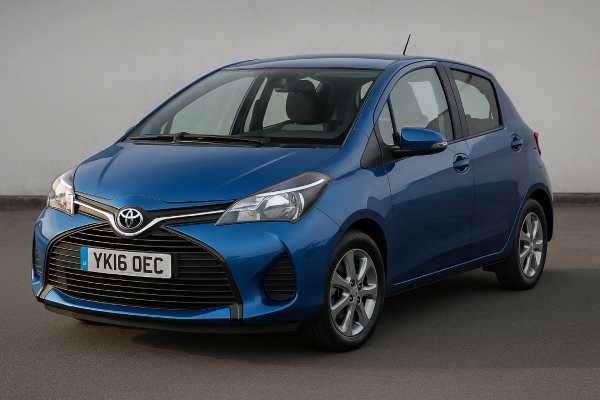
The facelifted Toyota Yaris (NSP130) with the 1NR-FE 1.33 Dual VVT-i engine is the “safe bet” choice in the 2014–2017 supermini class. It combines conservative but efficient engineering with a thorough facelift that sharpened styling, improved cabin quality and reduced noise. Toyota’s 1.3-litre petrol is a chain-driven, naturally aspirated unit with 98 hp (73 kW) and 125 Nm, designed to be light on fuel, low on emissions and easy to live with in town and on the motorway.
Suspension and steering were retuned for this facelift, while sound insulation and interior materials were upgraded, making the car feel more solid and refined than early XP130 models. Buyers could choose three- or five-door bodies, a six-speed manual or Multidrive S CVT, and trims ranging from simple commuter spec to well-equipped versions with touchscreen infotainment. In many markets, later cars introduced Toyota Safety Sense with autonomous emergency braking and lane departure warning, giving this small hatchback big-car safety credentials when properly specified.
For used buyers today, this Yaris offers low running costs, strong reliability and easy parts availability, provided routine servicing is kept up and minor age-related issues are handled promptly.
Owner Snapshot
- Light, chain-driven 1.3 Dual VVT-i engine is efficient, simple and proven when serviced on time.
- Facelift brings better noise suppression, improved ride tuning and a more modern interior than early XP130 cars.
- Later examples with Toyota Safety Sense add AEB and lane departure warning, boosting active safety.
- Watch for neglected servicing (oil changes, coolant, spark plugs) on high-mileage cars; chain rattle and oil use can follow prolonged poor maintenance.
- Aim for an annual or 10,000-mile / 15,000-km service interval, even if local schedules allow slightly longer.
Navigate this guide
- Toyota Yaris 1.3 facelift summary
- Yaris NSP130 specs and figures
- Yaris facelift trims and safety pack
- Reliability issues and service measures
- Maintenance guide and buying advice
- Driving impressions and performance data
- Yaris 1.3 facelift vs rivals
Toyota Yaris 1.3 facelift summary
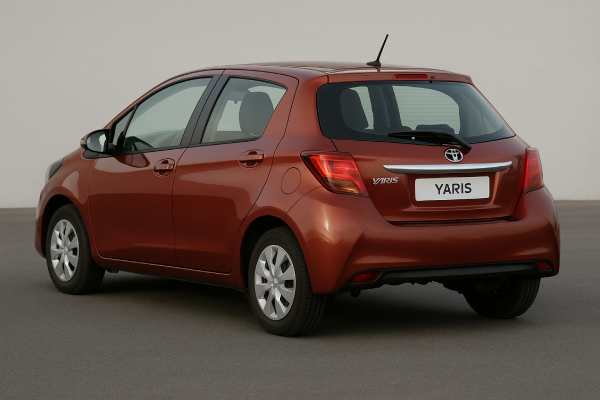
The 2014 facelift turned the third-generation Yaris into a much more mature and refined small car. Toyota reworked the front and rear styling with the X-shaped nose, redesigned lights and a more sculpted rear bumper, giving the car more presence without changing its compact footprint. Underneath, the basic XP130 platform remained, but suspension tuning, steering calibration and sound insulation all received attention, targeting a smoother ride and lower cabin noise.
The NSP130 code identifies the 1NR-FE 1.33 Dual VVT-i petrol engine with front-wheel drive. This is a naturally aspirated 1.3-litre four-cylinder with dual variable valve timing, 11.5:1 compression and chain-driven camshafts. It produces around 98 hp (73 kW) at 6,000 rpm and 125 Nm at 4,000 rpm, giving enough performance for mixed driving without sacrificing economy. Buyers could select a six-speed manual gearbox or Multidrive S CVT, both tuned to keep the engine in its efficient mid-range rather than high revs.
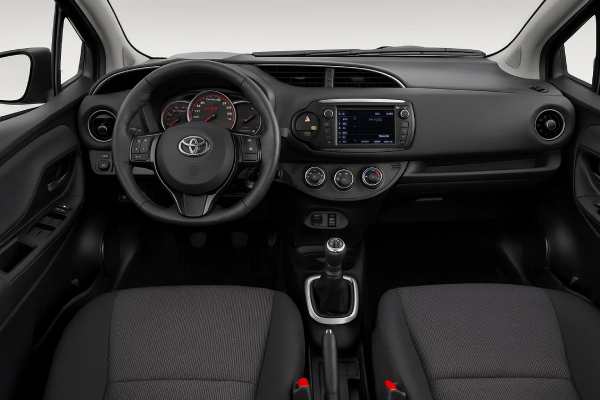
Inside, the facelift brought new soft-touch materials in key areas, revised door cards and a more cohesive dashboard layout, often with Toyota’s Touch 2 multimedia system and optional navigation on higher trims. Seating remains upright and space-efficient, with good headroom and acceptable rear legroom for a supermini. The 286-litre boot is unchanged but still competitive, expanding to over 700 litres with the rear seats folded.
In safety terms, the model builds on the earlier Yaris’s five-star Euro NCAP structure with multiple airbags and standard stability control. Later in this facelift run, Toyota Safety Sense became available in many European markets, adding autonomous emergency braking and lane departure warning on selected trims or as a pack.
Overall, the 2014–2017 Yaris 1.3 is aimed at buyers who want a compact car with a grown-up feel, very low running costs and the reassurance of Toyota reliability rather than cutting-edge performance. It works especially well as a city and suburban car that still feels calm on longer trips.
Yaris NSP130 specs and figures
Engine and performance (1NR-FE 1.33 Dual VVT-i)
| Item | Detail |
|---|---|
| Engine code | 1NR-FE |
| Type and layout | Inline-4 petrol, transverse |
| Valvetrain | DOHC, 16 valves, Dual VVT-i |
| Bore × stroke | 72.5 × 80.5 mm |
| Displacement | 1.3 l (1,329 cc) |
| Compression ratio | 11.5:1 |
| Induction | Naturally aspirated |
| Fuel system | Multi-point port injection |
| Max power | 98 hp (73 kW) @ 6,000 rpm |
| Max torque | 125 Nm (92 lb-ft) @ 4,000 rpm |
| Emissions class | Euro 5 or Euro 6, depending on market and year |
Official combined fuel consumption and CO₂ for the 1.33 Dual VVT-i are around 4.9–5.0 l/100 km (57–59 mpg UK, 48–50 mpg US) and 114–119 g/km CO₂, varying with wheel size and transmission.
Real-world mixed usage typically returns 5.5–6.5 l/100 km (43–51 mpg US; 52–62 mpg UK), depending on driving style, traffic and climate. Owners who focus on gentle acceleration, early upshifts and steady motorway speeds often see figures near or slightly above official numbers.
Transmission and driveline
| Item | Detail |
|---|---|
| Manual gearbox | 6-speed (EC60-series), cable shift |
| Automatic | Multidrive S CVT with stepped “ratios” in Sport/manual mode |
| Drive type | Front-wheel drive |
| Differential | Open |
| Approximate final drive | Mid-3s:1 (varies slightly by transmission and market) |
The six-speed manual uses quite long gearing in fifth and sixth, keeping revs low at highway speeds. The CVT is tuned to simulate stepped shifts under acceleration while aiming for a low-rpm cruise in Eco driving.
Chassis and dimensions
| Item | Detail |
|---|---|
| Platform | Toyota B-platform (XP130) |
| Body style | 3- or 5-door hatchback, 5 seats |
| Front suspension | MacPherson strut with coil springs, anti-roll bar |
| Rear suspension | Torsion beam with coil springs |
| Steering | Electric power-assisted rack-and-pinion |
| Front brakes | Ventilated discs (around 258 mm) |
| Rear brakes | Drums on most trims; rear discs on some higher-spec variants by market |
| Typical tyres | 175/65 R15; 195/50 R16 on sportier grades |
| Length | ~3,950 mm (155.5 in) |
| Width | ~1,695 mm (66.7 in) |
| Height | ~1,510 mm (59.4 in) |
| Wheelbase | 2,510 mm (98.8 in) |
| Turning circle | Around 9.4–9.6 m kerb-to-kerb |
| Ground clearance | Roughly 140 mm |
| Kerb weight | Approx. 1,090–1,150 kg depending on spec |
| GVWR | Around 1,490–1,500 kg |
| Fuel tank | 42 l petrol |
| Boot volume | 286 l seats up, ~768 l seats folded (VDA) |
Performance and capability
| Metric | Value (typical 1.33 Dual VVT-i) |
|---|---|
| 0–100 km/h (0–62 mph) | ~11.7 s (manual or CVT, depending on spec) |
| Top speed | ~175 km/h (109 mph) |
| Braking 100–0 km/h | Typically mid-30 m range on quality tyres |
| Rated towing capacity* | Often around 800–900 kg braked, 450 kg unbraked (check VIN plate) |
| Roof load | Commonly around 50 kg |
*Exact towing figures vary by market and homologation; always confirm against the vehicle’s documentation.
Fluids and service capacities (NSP130, 1NR-FE)
Values vary slightly by year and market; always confirm with official literature for your VIN.
| System | Specification (typical EU) | Approx. capacity |
|---|---|---|
| Engine oil | API/ILSAC petrol spec, typically 0W-20 or 5W-30 depending on climate and latest guidance | 3.4 l with filter |
| Engine coolant | Toyota Super Long Life Coolant or equivalent HOAT | 4.6–4.8 l |
| Manual gearbox | Toyota MT Gear Oil LV GL-4 75W | 2.4 l |
| CVT | Toyota CVT Fluid FE | ~7.5 l (service fill less) |
| Fuel type | Unleaded petrol, RON 95 recommended | 42 l tank |
Critical torque values (wheel bolts, spark plugs, drain plugs, suspension fasteners) should always be taken from the official workshop manual or manufacturer data rather than generic charts.
Electrical and safety basics
- 12 V battery typically 45–55 Ah, compact “Asian” casing.
- Alternator sized for normal accessory loads.
- Spark plugs are long-life iridium and usually scheduled around 90,000–100,000 km or by time, depending on market guidance.
Safety equipment on most facelift Yaris models includes front, side, curtain and driver’s knee airbags, ABS with EBD, stability control and ISOFIX mounts on the outer rear seats. Later cars with Toyota Safety Sense add forward collision warning, autonomous emergency braking, lane departure warning and sometimes automatic high beam, which improves active safety performance in independent tests.
Yaris facelift trims and safety pack
Trim names vary between markets, but the 2014–2017 facelift Yaris generally follows a similar pattern: a basic grade focused on value, mid-level trims with comfort and tech features, and higher-spec variants with more equipment and cosmetic enhancements. In markets such as the UK, line-ups in this period have included grades like Active, Icon, Sport/Design and Excel, each available with the 1.33 petrol and manual or CVT.
Entry trims usually offer:
- 15-inch steel wheels with covers
- Manual air conditioning
- Front electric windows
- Central locking and basic audio with USB and Bluetooth
- Split-folding rear bench and height-adjustable driver’s seat
Mid-level trims add items such as:
- 15-inch alloys
- Front fog lamps
- Toyota Touch 2 infotainment with colour touchscreen
- Leather-trimmed steering wheel and sometimes cruise control
- Rear-view camera in many markets
High trims bring:
- 16-inch alloys with lower-profile tyres
- Climate control, upgraded upholstery and more soft-touch cabin surfaces
- Additional chrome or gloss exterior details
- Optional navigation and more advanced infotainment packages
Mechanically, most trims share the same 1NR-FE engine and core chassis. Differences affecting driving feel include wheel/tyre packages and, on some higher grades, rear disc brakes instead of drums. Larger wheels sharpen turn-in slightly but can increase road noise and reduce ride comfort on poor surfaces.
Safety ratings and equipment evolution
The XP130 Yaris platform secured a five-star Euro NCAP rating in 2011, with strong adult and child occupant scores. The facelift retains the same core body structure and restraint layout, so passive safety performance remains competitive for its class and era. Multiple airbags (front, side, curtain and knee) and ISOFIX anchorages are common across trims, though exact airbag counts can vary by region.
A key change towards the end of this facelift cycle is the introduction of Toyota Safety Sense on many markets. Depending on year and grade, this pack can include:
- Forward collision warning with autonomous emergency braking (AEB)
- Lane departure warning
- Road sign assist (speed limit recognition)
- Automatic high beam
These systems significantly enhance active safety and can reduce the severity or likelihood of common types of collisions.
Quick identifiers and year-to-year notes
- 2014 models: first facelift year, with new front/rear styling and updated cabin; earlier cars may lack the latest multimedia hardware.
- 2015–2016 cars: incremental updates; some markets begin offering more standard equipment (for example, reversing camera or alloy wheels) on mid-grades.
- 2017 cars: late XP130s in some regions start to align with newer safety-pack expectations; check spec sheets carefully for Toyota Safety Sense inclusion.
Visual tells such as alloy design, grille finish and interior colour schemes can help differentiate trims at a glance, but the build plate and VIN decode are the most reliable sources for precise equipment and codes.
For a used buyer, the sweet spot is often a mid- or high-spec car with the 1.33 engine, six-speed manual and at least basic safety-pack features if available in your market. Those combinations balance reasonable purchase price with strong everyday usability and long-term appeal.
Reliability issues and service measures
The NSP130 Yaris with the 1NR-FE engine is generally reliable and capable of high mileage when serviced on time. However, certain age- and usage-related issues are worth understanding so you can spot weak examples early.
Engine and fuel system
Oil consumption and long-interval servicing (occasional, medium severity)
Some 1NR-FE engines can begin to use oil if services are stretched or low-quality oil is used, particularly on high-mileage urban cars. Early signs include the oil level dropping noticeably between services or blue smoke on cold start after long idling. The first step is to reset the service regime to annual / 10,000-mile intervals with correct oil and monitor usage; more serious cases may need ring or valve-stem work.
Timing chain wear indicators (rare but important)
The 1NR-FE uses a timing chain rather than a belt. Under ideal servicing, the chain should last the life of the engine, but it can stretch or its tensioner can wear if oil changes are neglected. Symptoms include rattling at startup, timing-related fault codes or poor running. Diagnosis requires experienced listening and sometimes cam/crank correlation checks. Replacement is labour-intensive, so catching issues early is wise.
EGR and intake deposits (occasional)
Although port injection reduces the risk of severe valve coking compared with direct injection, short trips and low-speed running can still lead to soot and oil mist deposits in the EGR passages and throttle body. Symptoms include unstable idle, flat spots and increased fuel consumption. Cleaning the throttle body, EGR passages and, where applicable, the intake manifold often restores smooth running.
Coil packs and oxygen sensors (occasional)
With age, individual ignition coils or oxygen sensors can fail, producing misfires, rough running and warning lights. These faults are typically straightforward to diagnose via stored codes and live data; replacement parts are widely available and not especially costly.
Cooling, driveline and chassis
Water pump seepage (occasional, low–medium severity)
Like many compact engines, the 1NR-FE’s water pump can develop slight leaks from the weep hole over time. Look for crusted pink or red residue around the pump area and listen for bearing noise. Replacing the pump proactively along with coolant changes can prevent roadside breakdowns.
Clutch wear and dual-mass flywheel concerns (common on high mileage manual cars)
Manual cars used heavily in city traffic or for learner-driver duties can wear clutches relatively quickly. Symptoms include slipping under load in higher gears, engagement near the top of the pedal travel or shudder pulling away. Some variants may also use a dual-mass flywheel that can rattle when worn. Testing on hills and in high gears at low rpm helps reveal marginal clutches.
Suspension bushes and drop links (common with age)
Front anti-roll-bar drop links and lower-arm bushes commonly develop play, causing knocks over small bumps and vague steering feel. Rear torsion beam bushes generally last longer but should be checked on high-mileage cars, especially in rough-road regions. Parts are inexpensive, but alignment afterward is essential.
Electric power steering and alignment
The electric power steering system is generally durable, but incorrect alignment or worn front components can lead to off-centre steering or a tendency to wander. Always assess steering behaviour alongside tyre condition and suspension health.
Body, corrosion and recalls
Underbody and brake-line corrosion (climate-dependent)
In areas with heavy winter salt use, pay attention to brake pipes, fuel lines, subframe mount points and the rear axle beam. Surface rust is normal; flaking, swelling or severe pitting needs attention. A well-timed rust treatment and line replacement can extend life significantly.
Recalls and technical service bulletins
Across the XP130 generation, various recall campaigns have addressed items such as airbag inflators, electric window switches and safety-system calibrations. Not every campaign affects every NSP130, so it is important to:
- Run the VIN through your national Toyota recall checker or contact a dealer.
- Ask for dealer printouts or invoices confirming completed recall or service actions.
Software updates for engine management and, where fitted, Toyota Safety Sense components can improve drivability, emissions robustness and sensor reliability. Dealers can check the current calibration level and apply updates if needed.
From a reliability standpoint, a Yaris with frequent oil changes, documented coolant and brake-fluid renewals, and evidence of recall completion is usually a safe bet, even at higher mileage.
Maintenance guide and buying advice
Practical maintenance schedule (1NR-FE Yaris, typical use)
Always align with your local Toyota schedule, but as a working baseline:
Every 10,000 miles / 15,000 km or 12 months (whichever comes first)
- Engine oil and filter (correct spec, e.g., 0W-20 or 5W-30 as specified locally).
- Visual inspection for leaks (oil, coolant, fuel), perished hoses and damaged wiring.
- Check brakes, steering, suspension joints and tyres.
- Top up washer fluid and check wiper condition.
Every 2 years
- Brake fluid replacement.
- Cabin (pollen) filter replacement.
- More detailed inspection of suspension bushes, exhaust mountings and underbody corrosion.
Every 30,000 miles / 45,000–50,000 km
- Engine air filter replacement (shorter interval in dusty conditions).
- Fuel filter inspection or replacement if service data calls for it.
Every 6–8 years (or as per manual)
- Engine coolant renewal (Toyota Super Long Life Coolant typically has extended life but should not be left indefinitely).
Around 90,000–100,000 km
- Spark plug replacement (long-life iridium).
- Consider preventative manual gearbox oil change if you plan long-term ownership.
Timing chain
There is no fixed mileage replacement interval, but the chain, guides and tensioner should be inspected if there is any rattle, timing-related fault codes or evidence of poor past servicing. Treat chain noise as a diagnostic priority.
Other periodic checks
- 12 V battery load test from around five years old, especially before winter.
- Tyre rotation every 10,000–15,000 km with alignment checks if uneven wear appears.
- Air-conditioning performance check; low output may indicate refrigerant loss or condenser damage.
Fluids and specifications for decision-making
- Engine oil: High-quality synthetic that meets the specified API/ILSAC standards and viscosity range for your climate (commonly 0W-20 in newer service guidance, sometimes 5W-30 in earlier documents).
- Gearbox oil (manual): Toyota LV GL-4 75W, typically about 2.4 litres at change.
- CVT fluid: Toyota CVT Fluid FE; CVT servicing is more sensitive and should follow manufacturer procedures.
- Coolant: Toyota Super Long Life Coolant or equivalent; mixing different coolant types is discouraged.
Torque values for safety-critical fasteners (wheel bolts, suspension, steering, brake calipers, spark plugs, sump plug) should always be taken from official workshop information.
Buyer’s checklist
When shopping for a used 2014–2017 Yaris 1.3:
- Service history
- Look for annual stamps or invoices, especially during the first 5–7 years.
- Confirm engine oil changes match the recommended time/mileage.
- Check for documented coolant, brake-fluid and spark plug changes.
- Cold start behaviour
- Start the car from cold if possible; it should start promptly without long cranking.
- Listen for timing-chain rattle in the first seconds; a brief hum is normal, prolonged rattling is not.
- Watch for exhaust smoke; blue suggests oil burning, persistent white steam with sweet smell may indicate coolant issues.
- Road test
- Verify smooth clutch take-up with no slip or judder.
- Check that the manual gearbox engages gears cleanly and quietly; CVT should accelerate smoothly without jolts.
- Note any flat spots, hesitation or misfires under light and heavy acceleration.
- Brakes and suspension
- Brake firmly from moderate speed (where safe) to feel for vibration or pulling.
- Listen for clunks over speed bumps that hint at worn drop links or bushes.
- Inspect tyre wear; inner-edge wear suggests alignment or suspension issues.
- Body and interior
- Check for colour mismatches or overspray that indicate prior accident repairs.
- Inspect rear wheel arches, door bottoms and the boot floor for rust or repair.
- Confirm all electrics, infotainment and controls function as intended.
- Safety equipment and options
- Confirm the presence of ISOFIX mountings if you use child seats.
- Determine whether Toyota Safety Sense is fitted (look for steering-wheel buttons, camera near the rear-view mirror and confirmation in the handbook).
Durability outlook
With sensible maintenance, the NSP130 Yaris 1.3 can easily reach 200,000–250,000 km or more without major internal engine work. Expect normal wear items—clutch, dampers, bushings, exhaust components and possibly a water pump—to need replacement along the way. Because fuel economy is strong and parts are widely available, total cost of ownership compares favourably with many turbocharged rivals, particularly once they age.
Driving impressions and performance data
On the road, the facelifted Yaris 1.3 feels more solid and refined than early XP130 cars. Steering weights up naturally with speed and is light enough for parking without feeling vague on the motorway. Toyota’s suspension revisions and stiffer body mounting points help the car ride bumps more confidently and reduce the hollow, echoing feel some owners noticed in pre-facelift versions.
In everyday driving, the 1NR-FE engine is smooth and quiet once warmed through. Being naturally aspirated, it does not deliver turbo-like low-end torque, but the combination of Dual VVT-i and modest weight makes the car responsive if you are willing to use revs. Around town, the engine pulls cleanly from roughly 1,500–2,000 rpm, and in typical 50–90 km/h traffic you can often stay in third or fourth gear without fuss.
The six-speed manual gearbox has a light, positive shift. Ratios are chosen to keep the engine near its torque peak around 4,000 rpm when accelerating briskly, yet allow relaxed cruising in sixth. At 120 km/h, the engine is turning at moderate revs and noise levels are acceptable for a small hatchback. The Multidrive S CVT keeps revs low in gentle driving but will raise them quickly if you ask for full acceleration; using its “manual” stepping mode can make responses feel more natural to drivers used to conventional automatics.
Officially, 0–100 km/h sits around 11.7 seconds, with a top speed of roughly 175 km/h. This places the Yaris firmly in the “willing but not fast” category. In practice, the car feels brisk enough in town and on A-roads, especially if you downshift to keep the engine in its mid-range. High-speed overtakes on single carriageways do require planning, particularly with passengers and luggage on board.
Real-world fuel economy is one of the Yaris’s strongest points. Many owners see 5.5–6.0 l/100 km in mixed driving, with figures in the low 5s on steady motorway runs at 100–110 km/h. Short city trips with lots of cold starts will push consumption towards 7 l/100 km, but it is still a frugal car by class standards.
Noise, vibration and harshness are well controlled for a supermini. Road noise from coarse asphalt and wind rustle around the mirrors are the dominant sounds at speed, but the engine remains subdued once in top gear. Fifteen-inch wheels with taller sidewalls generally give the best comfort/noise balance; 16-inch options sharpen steering feel slightly but may transmit more impact harshness into the cabin.
Under load—such as with five occupants, luggage or a small trailer—the car remains stable and predictable, though acceleration is noticeably reduced. Brakes cope well with everyday demands; for repeated mountain descents or heavy towing, it is wise to use engine braking in lower gears to prevent fade.
Overall, the facelift Yaris 1.3 delivers a calm, predictable and efficient driving experience that prioritises ease of use and low stress over raw performance.
Yaris 1.3 facelift vs rivals
The 2014–2017 Yaris 1.3 competes with a wide field of B-segment hatchbacks such as the Ford Fiesta 1.0 EcoBoost, Volkswagen Polo 1.2 TSI/1.0 MPI, Renault Clio 0.9 TCe/1.2, Peugeot 208 1.2 PureTech, Hyundai i20 1.2 and Mazda2 1.5. Each offers a slightly different blend of character, economy and equipment.
Where the Yaris stands out
Reliability and longevity
Toyota’s reputation for durability is one of the Yaris’s main selling points. While every brand has isolated issues, the Yaris 1.3 tends to age gently if serviced correctly, with fewer reports of major engine or gearbox failures than some small turbo-petrol rivals. The simple, port-injected, naturally aspirated engine avoids the combination of high boost and direct injection that can cause more expensive problems on some competitors.
Running costs and economy
Fuel consumption is very competitive—especially on longer runs—without the extra complexity of a turbocharger. Servicing is straightforward, and many independent garages are familiar with the platform. Insurance tends to be reasonable thanks to modest performance and strong safety credentials.
Practicality for size
The Yaris remains one of the more space-efficient cars in its class. Rear headroom and legroom are usable for adults on shorter trips, and the boot is a sensible, square shape. This makes it well suited to city families and those who regularly carry passengers.
Safety, especially with Safety Sense
Cars equipped with Toyota Safety Sense compare very well for active safety in this age group, thanks to AEB and lane departure warning systems that some rivals only offered on top trims or not at all at the time.
Where rivals may be stronger
Performance and flexibility
Small turbocharged engines such as Ford’s 1.0 EcoBoost or VW’s 1.2/1.0 TSI typically deliver more low-end torque and quicker acceleration. Drivers who often travel fully loaded or tackle steep gradients may find those cars feel stronger, especially at motorway speeds.
Cabin materials and image
Certain versions of the Polo, Clio or Mazda2 offer slightly richer cabin materials or a more overtly stylish design. If interior aesthetics and perceived material quality are top priorities, those models can have an edge.
Infotainment and connectivity
While later Yaris versions gained improved infotainment, some rivals moved faster in integrating smartphone mirroring and high-resolution screens. If you care deeply about the latest connectivity features, the Yaris’s system may feel one generation behind.
Emissions-zone friendliness (vs newer designs)
Although Euro 5/6 compliant, this generation of Yaris is still an older petrol design compared with very recent models optimised around the latest city-emission regulations. Depending on your city’s rules and future plans, an even newer hybrid Yaris or another Euro 6d petrol may have long-term advantages.
Best use cases for the Yaris 1.3
This car is particularly well suited to:
- Drivers wanting dependability and low running costs more than outright performance.
- Mixed city and suburban use with regular, but not extreme, motorway mileage.
- Owners planning to keep the car for many years, valuing simple, mature engineering.
It is less ideal for:
- Drivers who tow near the car’s maximum rating often.
- Those seeking hot-hatch performance or particularly sporty handling.
- Buyers who must have the very latest driver-assistance tech or luxury-level interiors.
For many owners, the Yaris 1.3 facelift strikes a sensible balance: it may not grab headlines, but it quietly does almost everything a small, practical petrol hatchback should do—with the bonus of Toyota’s long-term reliability record.
References
- TOYOTA YARIS TECHNICAL SPECIFICATIONS 2017 (Technical Data Sheet)
- THE TOYOTA YARIS 2014 (Press Pack)
- Toyota-Club.Net – Fluids & capacities – Yaris (2011-2020) eu 2018 (Maintenance Data)
- Toyota Yaris service intervals: all models covered 2022 (Service Intervals)
- Official Toyota Yaris safety rating 2017 (Safety Rating)
Disclaimer
This article is intended for informational purposes only and does not replace professional diagnosis, repair advice or official workshop documentation. Specifications, torque values, fluid capacities, service intervals and procedures can vary by VIN, model year, market and equipment level. Always verify critical data against your vehicle’s owner’s manual, official service literature and technical bulletins, and follow the guidance of a qualified technician or authorised Toyota service centre.
If you found this guide helpful, please consider sharing it with other drivers or enthusiasts on platforms such as Facebook or X/Twitter to support the creation of more detailed, independent technical content.