
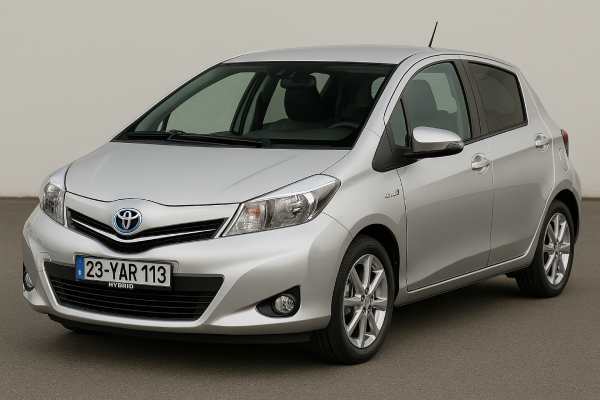
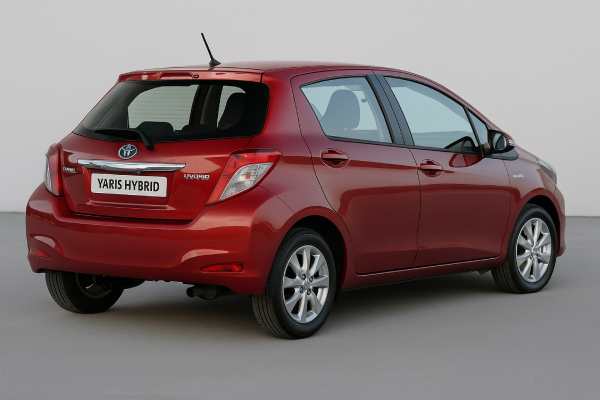
The 2012–2014 Toyota Yaris Hybrid (NHP130) takes Toyota’s proven Hybrid Synergy Drive from larger models like the Prius and packages it into a compact, city-focused hatchback. It combines a 1.5 litre 1NZ-FXE Atkinson-cycle petrol engine with an electric motor, NiMH battery and e-CVT to deliver about 98 hp of system output, very low CO₂ emissions, and impressive urban fuel economy. In everyday use it behaves like a smooth automatic, but with the ability to glide quietly on electric power in town and cut fuel consumption dramatically on stop-start journeys.
Because the high-voltage battery is packaged under the rear seat, the Yaris Hybrid keeps cabin and boot space close to that of the regular Yaris. That makes it a realistic single-car solution for many owners rather than a niche eco-special. The combination of reliability, low running costs and simple driving manners is the main appeal. This guide walks through specs, dimensions, performance, reliability patterns, maintenance, and how the 2012–2014 Yaris Hybrid compares with rivals.
At a Glance
- Very low urban fuel use is achievable, often around 4–5 L/100 km in city-heavy driving with smooth technique.
- Hybrid system hardware is closely related to Toyota’s most proven components, with a timing-chain engine and e-CVT reducing major wear items.
- Interior space and boot volume remain similar to non-hybrid Yaris models thanks to under-seat battery placement.
- Age-related issues to watch include 12 V battery condition, brake and suspension wear, and high-voltage battery health on older or high-mileage cars.
- Typical service interval is every 15,000 km or 12 months for oil, filters and inspection, with hybrid system checks carried out at the same time.
Quick navigation
- Toyota Yaris Hybrid NHP130 overview
- Yaris Hybrid NHP130 specs and data
- Yaris Hybrid trims and safety
- Reliability and known issues
- Maintenance schedule and buying tips
- Driving feel and performance
- Yaris Hybrid versus rivals
Toyota Yaris Hybrid NHP130 overview
The NHP130-generation Yaris Hybrid arrived in Europe in 2012 as Toyota’s first full hybrid in the small B-segment. It uses a downsized version of Hybrid Synergy Drive, pairing the 1.5 litre 1NZ-FXE Atkinson-cycle four-cylinder with a compact electric motor, reduction gear and nickel-metal hydride (NiMH) high-voltage battery. Combined system output is around 74 kW (98 hp), which gives adequate everyday performance rather than hot-hatch pace, but the focus is clearly on efficiency and everyday usability.
A key engineering achievement is packaging. The fuel tank and hybrid battery live under the rear seat bench, so cabin space and the roughly 286 litre boot remain similar to the non-hybrid Yaris. Rear seats still fold, so the car can handle typical family shopping, luggage for a weekend away or a folded pushchair. That makes the Yaris Hybrid one of the least compromised small hybrids of its time.
On the road, it behaves like a conventional automatic hatchback, but quieter and smoother in stop-start traffic. At low speeds and on gentle throttle, the car can run in EV mode with the petrol engine shut off. Short trips around town may see more than half the time spent with the engine off, reducing fuel use and local emissions. The driver does not need to plug the car in; the hybrid system recharges the battery automatically through regeneration and engine power when needed.
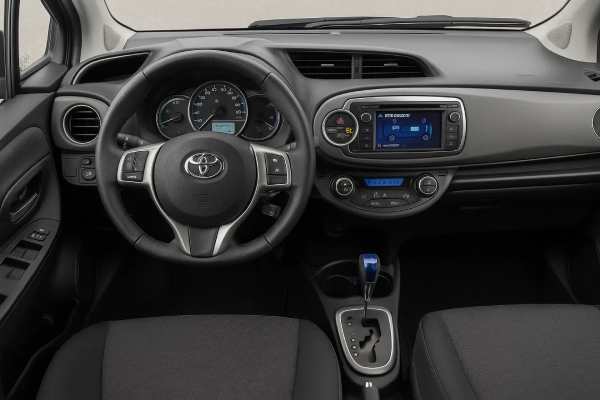
Inside, the 2012–2014 Yaris Hybrid shares most of its design with the regular third-generation Yaris but adds hybrid-specific details. There is a power/eco/charge gauge instead of a rev counter, an energy flow display on models with Toyota’s touchscreen infotainment, and a distinctive hybrid shift knob. Mid and high trims bring features such as a reversing camera, upgraded audio and, on some markets, partial leather trim.
From an ownership perspective, the Yaris Hybrid attracts buyers who want low fuel bills, easy manoeuvrability and high reliability. Compared with similar-age diesel superminis, it avoids issues such as diesel particulate filters and complex turbocharging, while still offering strong economy in real-world conditions. Insurance and tyre costs are generally modest, and with no clutch, alternator or traditional starter motor, several common failure points are simply absent.
Yaris Hybrid NHP130 specs and data
Powertrain and efficiency
Engine and hybrid system
| Item | Specification | Notes |
|---|---|---|
| Engine code | 1NZ-FXE | Atkinson-cycle inline-4 petrol |
| Displacement | 1.5 L (1497 cc) | Alloy block and head |
| Layout and valvetrain | Inline-4, DOHC, 16 valves | Variable valve timing on intake |
| Bore × stroke | 75.0 × 84.7 mm | Long-stroke design for efficiency |
| Compression ratio | Around 13.4:1 | High compression for Atkinson cycle |
| Induction | Naturally aspirated | No turbo or supercharger |
| Fuel system | Multipoint port fuel injection | Simpler than direct injection |
| ICE max power | About 55 kW (73–75 hp) | At moderate engine speed |
| ICE max torque | Around 111 Nm | Broad mid-range torque band |
| Electric motor | Permanent magnet synchronous | Integrated in hybrid transaxle |
| Motor output | Roughly 45 kW, 169 Nm | Strong low-speed assistance |
| Combined system output | 74 kW (98 hp) | Quoted total output |
| High-voltage battery | NiMH, about 144 V | Pack under rear seat |
| Timing drive | Chain | No scheduled replacement |
Efficiency (typical official and real-world figures)
| Measure | Value | Notes |
|---|---|---|
| CO₂ emissions | From roughly 79–85 g/km | Varies by trim and wheel size |
| Official combined fuel use | Around 3.5–3.7 L/100 km | NEDC values |
| Real-world combined | Commonly about 4.4–5.0 L/100 km | Depends on driving style |
| Emissions standard | Euro 5 to early Euro 6 | Varies by market and year |
| Aerodynamic drag coefficient | Approx. 0.28–0.29 | With underbody covers |
At steady motorway speeds around 120 km/h, drivers typically see consumption closer to 5–5.5 L/100 km. In urban use, with careful driving and good anticipation, the Yaris Hybrid can drop into the low-4 L/100 km range, especially in mild weather.
Transmission and driveline
| Item | Specification | Notes |
|---|---|---|
| Transmission | e-CVT (electronically controlled continuously variable transaxle) | Planetary gear power-split device |
| Gear ratios | Not fixed like a conventional gearbox | Software manages engine and motor speeds |
| Final drive ratio | Around 3.2:1 | Integrated in transaxle |
| Drive type | Front-wheel drive | No AWD variant in this generation |
| Differential | Open front differential | Stability and traction control assist |
Because the system has no conventional clutch or stepped ratios, there is no clutch wear and fewer internal clutches or bands than in a standard automatic, reducing potential wear points.
Chassis and dimensions
| Item | Value | Notes |
|---|---|---|
| Front suspension | MacPherson strut, coil springs | Hybrid-specific tuning of springs and dampers |
| Rear suspension | Torsion beam axle | Compact, space-efficient |
| Steering | Electric power-assisted rack and pinion | Light at low speeds, firmer at higher speeds |
| Front brakes | Ventilated discs | Work with regenerative braking |
| Rear brakes | Solid discs | Disc setup in many European markets |
| Typical tyre sizes | 175/65 R15 or 195/50 R16 | Low rolling resistance tyres commonly fitted |
| Length | About 3905 mm | Hatchback body |
| Width | About 1695 mm | Excluding mirrors |
| Height | About 1510 mm | Varies slightly with trim |
| Wheelbase | 2510 mm | Shared with non-hybrid Yaris |
| Turning circle | Roughly 4.7 m kerb radius | Excellent manoeuvrability |
| Kerb weight | Around 1085–1160 kg | Depending on trim and equipment |
| GVWR | Around 1560–1570 kg | Gross vehicle weight rating |
| Fuel tank | 36 L | Suits urban and commuting use |
| Boot volume | About 286 L seats up | VDA method, similar to non-hybrid |
Performance and capability
| Metric | Value | Notes |
|---|---|---|
| 0–100 km/h (0–62 mph) | Around 11.8 s | Manufacturer-range figure |
| Top speed | About 165 km/h (103 mph) | Limited by gearing and power |
| Braking | Class-typical stopping distances | Dependent on tyres and load |
| Towing capacity | Often not rated or very low | Check your market’s approval |
| Roof load | Typically around 50 kg | For roof bars and boxes |
While the performance figures are modest on paper, the strong low-speed electric torque and e-CVT help the Yaris Hybrid feel responsive at city speeds.
Fluids and service capacities
Values can vary slightly by market and model year; always confirm against the official manual for your VIN.
| System | Spec and capacity | Notes |
|---|---|---|
| Engine oil | 0W-20 meeting Toyota/ILSAC spec; roughly 3.7 L with filter | Low-viscosity oil supports economy |
| Engine coolant | Toyota Super Long Life Coolant, premixed; around 4–5 L engine loop | Long-life coolant with extended intervals |
| Inverter/e-motor coolant | Same type as engine coolant; around 1.5–2 L | Separate hybrid cooling loop |
| Transaxle (e-CVT) fluid | Toyota ATF WS; roughly 3.3 L | Long-life fluid, often changed preventively |
| Brake fluid | DOT 3 or DOT 4, as specified | Replaced typically every 2 years |
| A/C refrigerant | R134a, with charge around 400–450 g | Exact charge printed under bonnet |
Electrical and safety systems (summary)
The Yaris Hybrid replaces a conventional alternator with a DC–DC converter that charges the 12 V system from the high-voltage battery. The 12 V battery is relatively small and benefits from regular use or periodic conditioning if the car sits for long periods.
Safety equipment typically includes seven airbags (front, side, curtain and driver’s knee), ABS with electronic brake-force distribution, brake assist, traction control and vehicle stability control. ISOFIX child-seat mounts and top tethers are usually fitted to the outer rear seats, and most markets have seatbelt reminders for the front seats and sometimes the rear seats as well.
Yaris Hybrid trims and safety
Trim names vary by market, but the structure is similar across Europe. Using the UK as a reference, the 2012 Yaris Hybrid launched with T3, T4 and T Spirit trims, all with five doors and the same hybrid drivetrain.
The T3 is the entry hybrid grade. It typically includes dual-zone climate control, front electric windows, a basic audio system with steering wheel controls, remote central locking and the full hybrid powertrain. Steel wheels with covers are common, and infotainment is simpler, though Bluetooth may be present depending on market.
The T4 trim adds 15-inch alloy wheels, rear privacy glass and a more advanced infotainment unit, often called Toyota Touch. This brings a touchscreen, USB and Bluetooth connectivity, and commonly a reversing camera. Interior trim is slightly upgraded, with additional storage and cosmetic improvements.
The T Spirit sits at the top of the range. It usually includes 16-inch alloy wheels, extra exterior chrome or gloss elements, enhanced interior trim, and sometimes part-leather upholstery. The larger wheels slightly increase official CO₂ and fuel consumption compared with 15-inch versions, but they also sharpen steering response and give a more planted look.
In other European markets, trim names such as Life, Active, Style, Icon or Excel appear, but the pattern remains: base trims with steel wheels and basic audio; mid trims with alloys, touchscreen and reversing camera; top trims with more comfort features and larger wheels. The hybrid system remains mechanically the same across all trims.
Visual identifiers for hybrid models
- Blue-tinted Toyota emblems on the nose and tail.
- “Hybrid” badging on the front wings or tailgate.
- Hybrid-specific instrument cluster with a power/eco/charge gauge instead of a rev counter.
- Distinctive hybrid shift knob and, on some models, blue accent stitching or trim.
Safety ratings
The 2012–2014 Yaris Hybrid shares its structure and many safety systems with the third-generation Yaris that achieved a five-star Euro NCAP rating under the 2011 protocol. That rating includes high scores for adult and child occupant protection and strong performance in safety assist thanks to standard stability control and seatbelt reminders.
In Australasian markets, ANCAP tests of the related Yaris hatch also returned five-star scores, underlining the good structural performance of this generation. The hybrid variant benefits from the same basic crash structure and airbag layout.
Advanced driver-assistance systems such as autonomous emergency braking, adaptive cruise control and lane keeping arrived later with Toyota Safety Sense on facelifted models. For 2012–2014 cars, assistance is limited to ABS, stability control, traction control and, in some markets, optional features like a simple lane departure warning or hill-start assist. When shopping, do not assume modern ADAS features are present; check equipment lists and test cars individually.
Year-to-year changes
- 2012: Launch year for the Yaris Hybrid, with the full hybrid drivetrain introduced across several trims.
- 2013: Minor equipment reshuffles; infotainment and option packs can change slightly by market, but hybrid hardware remains the same.
- 2014: Facelift for many markets, bringing revised front and rear styling, interior updates and sometimes new trim names. The hybrid system stays essentially unchanged, but infotainment and cosmetic options improve.
When evaluating a used car, it is worth checking local brochures or dealer records for the exact trim and options, as safety and comfort features can vary even within the same model year.
Reliability and known issues
The Yaris Hybrid is widely regarded as a very reliable small car, benefiting from Toyota’s long experience with hybrid systems. Many examples cover high mileages with minimal issues if serviced correctly. However, age, mileage and climate always influence wear, so it is useful to understand typical patterns.
Hybrid system and high-voltage battery
The motor-generator unit, inverter and battery pack have a good record when cooling and ventilation are maintained. In most climates, the pack ages gradually over many years rather than failing abruptly. As cars approach 10–15 years old, some may show reduced EV range or more frequent engine cycling. Warning lights or diagnostic trouble codes can indicate cell imbalance or other faults.
In many markets, dealerships offer a hybrid health check that measures pack performance. A clean bill of health is reassuring, and some regions provide extended hybrid battery warranties if these checks are done regularly at the dealer. Where necessary, the battery can often be reconditioned or replaced module-by-module, though full pack replacement is sometimes the most practical long-term solution.
The HV battery cooling intake, usually located near the rear seat or side trim, must remain unobstructed. Pet hair, dust or debris can block airflow and increase cell temperatures, accelerating degradation. Keeping this intake clean is a simple but important reliability measure.
Transaxle (e-CVT)
The hybrid transaxle has fewer complex components than most conventional automatics. There is no torque converter or multi-clutch pack, and the planetary gearset is robust when fed clean fluid. Many official schedules treat the fluid as long-life or “filled for life”, but owners and independent specialists often choose to change ATF WS fluid around 100,000–150,000 km for additional peace of mind. Genuine failures are uncommon.
Engine and cooling system
The 1NZ-FXE engine uses a timing chain rather than a belt, so there is no routine replacement interval. Chain issues are rare; excessive noise, timing correlation fault codes or poor running would be warning signs worth investigating.
Oil consumption on high-mileage engines is possible but typically mild. The key is to use the correct oil grade, stick to annual changes and check levels periodically, especially before long trips. Cooling components such as water pump and thermostat can age; any coolant loss, staining or temperature instability deserves prompt attention, as overheating can damage both the engine and hybrid electronics.
Brakes and regeneration
Regenerative braking reduces wear on pads and discs, so many Yaris Hybrids run long intervals between brake replacements. However, cars that do mostly motorway miles or spend long periods parked can develop disc corrosion. This may cause vibration or noise when braking and will require disc and pad replacement.
Some Toyota hybrids from this broad era have experienced issues with brake boosters or actuators, sometimes addressed through recalls or extended coverage programmes. While such issues are more frequently associated with larger models, any Yaris Hybrid should be checked for open brake-related campaigns and inspected for consistent brake feel.
Electrical and recall-related items
The small 12 V battery can flatten if the car is left unused for weeks, especially in cold weather. Deep discharges shorten its life, so cars used infrequently benefit from a maintenance charger or more regular drives. Replacing the 12 V battery every 6–8 years is common.
Global safety campaigns such as Takata airbag recalls have affected many small Toyotas from this period. In some markets, Yaris models are subject to inflator replacements or related work. Other recalls have covered items such as power window switches or components in the electric power steering system. For any potential purchase, running the VIN through the official recall portal or local Toyota website is essential.
Pre-purchase reliability checklist
When assessing a used Yaris Hybrid:
- Confirm a full or at least consistent service history, ideally with annual hybrid system checks.
- Ask for any hybrid battery health reports.
- Check for warning lights on the dash before and after a test drive.
- Verify via official channels that all recalls and safety campaigns are complete.
- Inspect brakes, suspension and tyres for even wear.
- Listen for unusual noises from the transaxle or engine, particularly at cold start and low-speed manoeuvres.
Overall, the 2012–2014 Yaris Hybrid tends to age gracefully. Its main vulnerabilities are shared with most small cars: neglect, harsh environments and poor-quality repairs.
Maintenance schedule and buying tips
A structured maintenance plan keeps the Yaris Hybrid dependable and economical. The following schedule is a practical baseline; always cross-check with official documentation for your region.
Routine service intervals
- Every 15,000 km or 12 months (whichever comes first):
- Replace engine oil and filter with the specified 0W-20 grade.
- Inspect brakes, steering, suspension, lights, wipers and tyres.
- Check cabin air filter and replace if dirty.
- Carry out hybrid system health check if available.
- Every 30,000 km or 2 years:
- Replace engine air filter.
- Replace brake fluid.
- Inspect underbody and key corrosion points.
- Every 60,000–90,000 km (4–6 years):
- Replace engine coolant according to local schedule.
- Replace inverter/e-motor coolant if specified.
- Replace spark plugs (usually long-life iridium type).
- Around 100,000–150,000 km:
- Change transaxle (e-CVT) fluid with the correct ATF WS.
- Perform a thorough suspension check and renew worn bushings or dampers.
Other periodic checks
- Inspect auxiliary belts annually for cracks or glazing.
- Monitor timing chain noise; persistent rattling or misalignment codes warrant investigation.
- Rotate tyres every 10,000–15,000 km and check alignment to prevent uneven wear.
- Test the 12 V battery each year after about five years of age, and replace at signs of weakness.
Hybrid-specific care
- Keep the HV battery intake grille clean and unobstructed.
- Avoid leaving the car unused with a very low or very high battery state of charge for long periods.
- After any collision or underbody damage, have the HV system inspected by a qualified technician.
Buyer’s guide: inspection points
When viewing a Yaris Hybrid, start with a cold engine if possible. A healthy car should start promptly, settle quickly and switch between EV and petrol operation smoothly. During the test drive:
- Check that the e-CVT operates quietly, with no grinding or high-pitched whine.
- Confirm that the car accelerates cleanly without hesitation or jerking.
- Pay attention to brake feel; any sponginess, pulsing or ABS warning lights need investigation.
- Listen for clunks from suspension over bumps, which may indicate worn bushings or drop links.
Visually, check panel gaps, paint condition and signs of accident repair. Look for rust on underbody components, rear wheel arches, door sills and suspension mounts, especially in salt-treated regions. Inside, verify all electric functions (windows, mirrors, locks, infotainment) and test both keys or smart entry fobs if equipped.
Which years and trims to target
- Mid-level trims with 15-inch wheels often give the best balance of comfort, efficiency and equipment.
- Early 2012–2013 cars are perfectly viable if they show consistent servicing and completed recalls.
- 2014 facelift models offer fresher styling and sometimes improved infotainment, though they may carry a price premium.
Avoid cars with patchy history, signs of flood or major accident damage, or unresolved warning lights. A pre-purchase inspection by a hybrid-aware technician is worthwhile on higher-mileage examples.
Driving feel and performance
The Yaris Hybrid’s driving character is defined by its hybrid powertrain, compact footprint and urban focus. It is designed to reduce effort behind the wheel rather than provide high performance.
Ride, handling and refinement
The suspension aims for comfort on broken city roads while keeping body roll controlled enough for confident cornering. The car is light, and the use of high-tensile steel gives the body decent stiffness, reducing rattles over time. In town, the ride is generally smooth, with only the worst potholes making themselves strongly felt.
Electric power steering is tuned for very light effort at parking speeds. Combined with a tight turning circle, this makes the car extremely easy to place in narrow streets and tight parking spaces. At higher speeds, steering weight builds slightly, though feedback remains modest. On the motorway, the short wheelbase means crosswinds can be felt, but straight-line stability is adequate for the segment.
Noise levels are good for a small hatch. At lower speeds, the car can run in near silence in EV mode. When the engine starts, it is well isolated at light loads. Under heavy acceleration, the e-CVT allows revs to rise and hold, so engine sound becomes more prominent, but once up to speed it settles down again.
Powertrain behaviour
The combination of electric torque and petrol power gives the Yaris Hybrid a smooth, elastic response. From a standstill or low speed, the electric motor provides instant torque; the car feels nippy in city traffic and quick off the line at junctions. As speed builds, the petrol engine takes over more of the work.
The e-CVT does not shift gears in the traditional sense. Instead, it continuously adjusts the relationship between engine speed and road speed. At moderate throttle openings, modern control software limits engine flare and keeps revs reasonable, reducing the “rubber band” sensation that some older CVTs exhibit.
Drive modes usually include Normal, Eco and EV. Eco softens throttle response and tempers air-conditioning output, helping drivers maintain low consumption. EV mode allows short, low-speed electric-only running when battery charge and temperature permit; it is useful for creeping in traffic or through parking garages.
Performance and real-world economy
With a 0–100 km/h time just under 12 seconds and a top speed around 165 km/h, the Yaris Hybrid is clearly tuned for efficiency rather than speed. In city driving, the strong low-end electric assistance makes it feel more lively than the figures imply. On motorways, it keeps up with traffic but requires some forward planning for high-speed overtakes, especially when fully loaded.
Fuel economy is where the car shines:
- In urban driving with frequent stops, owners often report consumption around 4–5 L/100 km or even better.
- In mixed commuting with some motorway stretches, mid-4 to low-5 L/100 km is common.
- At a steady 120 km/h on the motorway, figures typically move into the mid-5 L/100 km range, depending on conditions and load.
Cold weather, short trips and heavy climate-control use increase consumption, but the hybrid still tends to outperform equivalent small petrol automatics and many diesel superminis in town.
Load, hills and towing
With passengers and luggage on board, the Yaris Hybrid remains composed, but gradients demand more from the petrol engine. On long hills, expect higher revs as the car maintains speed. Temperature management is generally good, but it is wise to use appropriate gear (drive mode) and avoid sustained full-throttle running with a heavy load.
In many markets, the Yaris Hybrid is not approved for towing, or its rated towing capacity is minimal. If towing is essential, it is important to confirm local approvals and consider a model specifically rated for regular towing.
Yaris Hybrid versus rivals
On the used market, the 2012–2014 Yaris Hybrid competes with other small hybrids, efficient diesels and later mild-hybrid petrols. Each alternative has its own strengths.
Honda Jazz Hybrid (2011–2015)
The Jazz Hybrid of the same era uses Honda’s IMA system, which provides electric assistance but limited pure EV running. It shares the normal Jazz’s excellent cabin space and “Magic Seats” that allow very versatile interior layouts. Reliability is strong, and the car is comfortable and easy to drive.
Compared with the Yaris Hybrid, the Jazz Hybrid usually offers slightly less EV time in town and may not match the very lowest fuel consumption figures in heavy urban use. However, it can feel roomier inside, especially for rear passengers, and is a good alternative if interior flexibility is your top priority.
Diesel superminis (Fiesta, Polo, 208, etc.)
Efficient diesel-powered superminis from the same period can deliver excellent motorway fuel economy and strong torque. However, they introduce complexity in the form of diesel particulate filters, high-pressure fuel systems and turbochargers. For drivers who mainly do short trips and city driving, DPF regeneration can be problematic, and long-term running costs may rise due to emissions-related maintenance.
The Yaris Hybrid trades some high-speed economy for simpler emissions hardware and cleaner local emissions in town. In many cities with low-emission zones, it will be more welcome than older diesels.
Later small hybrids and mild hybrids
Newer Toyota Yaris Hybrid generations and other small cars with mild-hybrid systems bring more modern interiors, updated infotainment and advanced safety suites. They may offer more power and slightly better efficiency but usually cost more on the used market.
For buyers focused on maximum value and proven reliability, the 2012–2014 Yaris Hybrid remains attractive. It delivers the core benefits of full hybrid technology in a simpler, more affordable package.
Who the 2012–2014 Yaris Hybrid suits
This generation of Yaris Hybrid is particularly well suited to:
- Urban and suburban drivers who want an automatic, low-stress car with strong fuel economy.
- Commuters who cover regular daily distances and value predictable running costs over performance.
- First-time hybrid owners who prefer a familiar driving experience without plug-in charging.
Drivers who prioritise overtaking power at motorway speeds, regular towing, or the latest driver-assistance technologies may prefer a newer or larger model. For many households, though, the NHP130 Yaris Hybrid is a sensible, low-risk choice that balances efficiency, reliability and practicality.
References
- Yaris hybrid, a pioneering offer for the b-segment 2012 (Press Release)
- Yaris-Hybrid-archive-press-pack 2012 (Press Pack)
- euroncap_toyota_yaris_2011_5stars 2011 (Safety Rating)
- Look up Safety Recalls & Service Campaigns by VIN 2025 (Recall Database)
- Toyota Yaris | Safety Rating & Report | ANCAP 2011 (Safety Rating)
Disclaimer
This article is for informational purposes only and is not a substitute for professional diagnosis, repair or official service documentation. Specifications, torque values, fluid capacities and maintenance intervals can vary by VIN, market, model year, emissions package and installed equipment. Always verify critical information against the official owner’s manual and workshop literature for your specific vehicle, and consult a qualified technician before performing repairs or modifications.
If you found this guide helpful, please consider sharing it with other owners or enthusiasts on platforms such as Facebook or X/Twitter to support accurate, independent automotive information.