
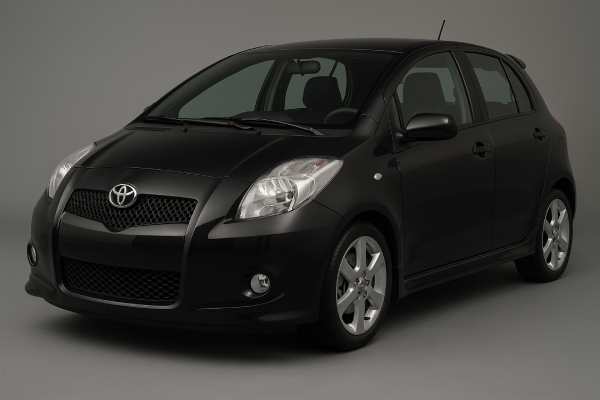
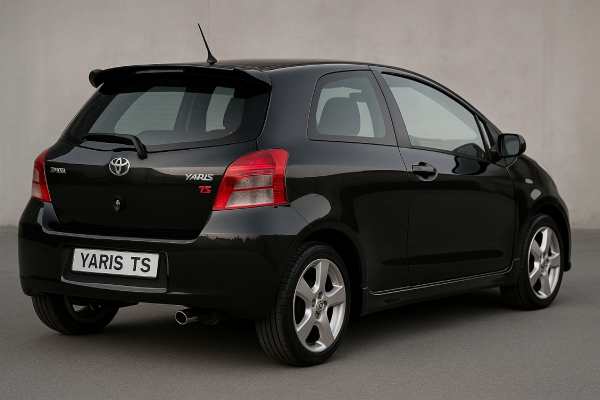
The Toyota Yaris TS (ZSP90) is the “warm hatch” version of the second-generation Yaris, aimed at drivers who like the footprint and running costs of a city car but want a stronger engine and sharper chassis. With the 1.8-litre 2ZR-FE petrol engine, 133 hp, a close-ratio 5-speed gearbox and firmer suspension, it feels noticeably more serious than the regular 1.0 and 1.3 models while staying easy to park and inexpensive to own.
Built mainly for European markets in 2007–2008, the Yaris TS combines Toyota’s reputation for durability with extra performance, bigger brakes, 17-inch wheels and more supportive seats. Safety equipment is strong for the time, and the basic Yaris platform carries a solid crash-test record. At the same time, age, recalls and normal wear mean buyers now need to pay attention to service history, corrosion and electrical details.
This guide walks through specs, real-world behaviour, known issues, maintenance and how it stacks up against rivals.
Essential Insights
- Lively 1.8 16-valve engine and short gearing make the Yaris TS much quicker than standard P90 models while remaining compact and easy to drive.
- Sport-tuned suspension, rear disc brakes and 17-inch tyres give more grip and stability, especially on fast A-roads and motorways.
- Strong passive safety and good crash-test history for the Yaris line, with multiple airbags and available stability control on many cars.
- Watch for completion of power window master switch and airbag recalls, plus age-related suspension wear and cosmetic corrosion on underbody components.
- Aim for engine oil changes every 10,000 miles / 15,000 km or 12 months (whichever comes first), with more frequent changes for hard or track-style use.
Navigate this guide
- Toyota Yaris TS 1.8 Character
- Yaris TS 1.8 Key Specifications
- TS 1.8 Equipment, Safety and Trims
- TS 1.8 Reliability and Known Issues
- Servicing Schedule and Buying Tips TS
- Road Behaviour and Performance Yaris TS
- Toyota Yaris TS Against Competitors
Toyota Yaris TS 1.8 Character
The Yaris TS sits at the top of the P90 Yaris range and is best thought of as a compact warm hatch. It is not as extreme as a full hot hatch like a Clio RS, but it feels significantly more urgent than the 1.3-litre Yaris and has a more serious chassis tune. The 1.8-litre 2ZR-FE engine brings 133 hp and 173 Nm, giving relaxed cruising and strong mid-range pull for overtakes.
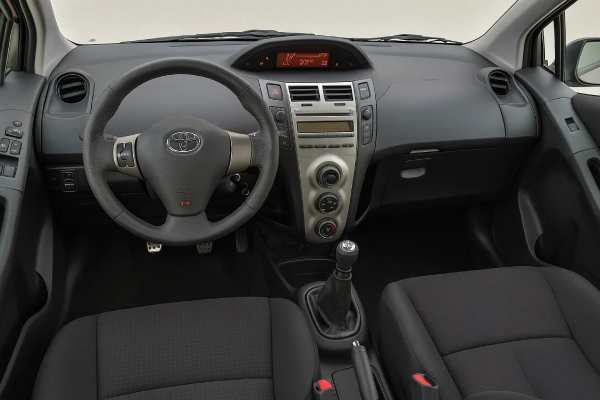
Visually, the TS is easy to spot. Most cars have deeper front and rear bumpers, a honeycomb grille, side skirts, subtle roof spoiler and 17-inch alloys. Lowered suspension and slightly wider tyres give it a more planted stance without making it awkward over speed bumps. Inside, you typically get sports seats with extra bolstering, a leather-trimmed steering wheel and small TS-specific trim details.
Unlike some performance models that sacrifice everyday comfort, the Yaris TS still behaves like a Yaris in town. Light steering, good visibility and compact dimensions make tight streets and parallel parking simple. The rear bench and boot remain usable for small-family duty or commuting with luggage.
Ownership appeal comes from the combination of Toyota reliability, reasonable insurance and fuel use that stays acceptable if you drive sensibly. Where it differs from a regular Yaris is mainly in consumable costs: 17-inch sport tyres, bigger brakes and firmer suspension mean replacement parts are a bit pricier, and the car rewards more attentive maintenance.
For an enthusiast, the main draw is how much pace you get without moving up to a larger, heavier hatchback. The TS feels at its best on twisty B-roads or short motorway hops, where the engine can rev, the chassis feels alert, and the car still fits in tight parking spots at the destination.
Yaris TS 1.8 Key Specifications
This section summarises the main technical data for the Toyota Yaris TS (ZSP90) 1.8 16V, 2007–2008, European-market specification. Figures can vary slightly by market, body style (3- vs 5-door) and equipment level.
Engine and Performance (2ZR-FE)
| Item | Specification |
|---|---|
| Engine code | 2ZR-FE, petrol |
| Layout and cylinders | Inline-4, transverse, DOHC, 16 valves, Dual VVT-i |
| Valves per cylinder | 4 |
| Displacement | 1.8 L (1798 cc) |
| Bore × stroke | 80.5 mm × 88.3 mm |
| Compression ratio | ~10.0 : 1 |
| Induction | Naturally aspirated |
| Fuel system | Multipoint fuel injection |
| Max power | 133 hp (approx. 98 kW) @ ~6000 rpm |
| Max torque | 173 Nm (approx. 128 lb-ft) @ ~4400 rpm |
| Timing drive | Chain-driven camshafts |
| Emissions standard | Typical Euro 4 for period |
| Official combined consumption | ~7.0 L/100 km (≈ 34 mpg US / 41 mpg UK) |
| Real-world motorway (120 km/h) | Around 7.0–7.5 L/100 km in mixed reports |
Transmission and Driveline
| Item | Specification |
|---|---|
| Gearbox | 5-speed manual |
| Final drive | Shorter ratio than standard Yaris for stronger acceleration |
| Drive type | Front-wheel drive |
| Differential | Open (no factory limited-slip) |
| Clutch | Single dry plate, cable or hydraulic actuation depending on market |
Chassis and Dimensions
| Item | Specification |
|---|---|
| Front suspension | MacPherson strut with coil springs, anti-roll bar; TS-specific tuning |
| Rear suspension | Torsion beam axle with coil springs |
| Steering | Electric power steering, rack-and-pinion |
| Brakes (front / rear) | Ventilated disc / solid disc; larger than non-TS Yaris |
| Typical wheel / tyre | 205/45 R17 alloy wheel package on most markets |
| Length | ~3750 mm (≈ 147.6 in) |
| Width (mirror excl.) | ~1695 mm (≈ 66.7 in) |
| Height | ~1530 mm (≈ 60.2 in) |
| Wheelbase | 2460 mm (≈ 96.9 in) |
| Ground clearance | ~130–135 mm (≈ 5.1–5.3 in) |
| Turning circle (kerb-to-kerb) | Around 9.4 m (≈ 30.8 ft) |
| Kerb weight | Roughly 1180–1200 kg (≈ 2600–2650 lb) depending on spec |
| Fuel tank | Approx. 42 L (≈ 11.1 US gal / 9.2 UK gal) |
| Boot volume | About 270 L seats up; significantly more with rear seats folded |
Performance and Capability
| Item | Value (typical EU spec) |
|---|---|
| 0–100 km/h (0–62 mph) | ≈ 9.3 s |
| Top speed | ≈ 194 km/h (≈ 121 mph) |
| Braking 100–0 km/h | Competitive with segment; depends heavily on tyre choice |
| Towing capacity | Often low or not type-approved; check local documentation |
| Roof load | Modest; suitable for small roof box or bike rack only |
Fluids and Service Capacities (typical)
Always confirm by VIN in the official service data, as values vary by market and gearbox.
| System | Specification and Capacity (approximate) |
|---|---|
| Engine oil | 5W-30 or 0W-30 ACEA A5/B5 or API SM/SN; ~4.0–4.2 L with filter |
| Engine coolant | Long-life ethylene glycol, pre-mixed pink Toyota Super Long Life Coolant; roughly 5–6 L |
| Manual transmission oil | API GL-4 75W-90; ~1.7–2.0 L |
| Brake fluid | DOT 3 or DOT 4; change by time not volume |
| A/C refrigerant | R134a; charge quantity varies by climate system |
| A/C compressor oil | ND-OIL type; only top up when servicing A/C components |
Electrical
| Item | Specification |
|---|---|
| Alternator | Typically around 100 A output (varies by equipment) |
| 12 V battery | ~45–55 Ah, conventional flooded lead-acid or AGM replacement |
| Spark plugs | Long-life iridium; gap around 1.0 mm |
Safety and Driver Assistance
| Item | Specification / Note |
|---|---|
| Airbags | Front, side and curtain airbags common; some markets with driver’s knee airbag |
| ABS | Standard with EBD and brake assist on TS |
| Stability control (VSC) | Standard or widely available on TS depending on market |
| Traction control | Often bundled with VSC |
| ISOFIX | Rear outer seats prepared for ISOFIX / top-tether child seats |
| Euro NCAP | Yaris platform achieved a five-star rating in the period, and Toyota later confirmed it maintained five stars under updated protocols for its class |
TS 1.8 Equipment, Safety and Trims
The Yaris TS was sold as a single performance-oriented grade rather than a broad trim ladder, but equipment could still differ by country and whether you chose a 3-door or 5-door body. Mechanically, the TS package is straightforward: the 1.8 2ZR-FE engine, shorter final drive, uprated front and rear brakes, firmer springs and dampers, and 17-inch wheels with lower-profile tyres.
Common exterior identifiers include:
- TS-specific bumpers with larger lower air intake.
- Mesh or honeycomb grille, often with TS badge.
- Side skirts and modest rear roof spoiler.
- 17-inch alloys (often dark or diamond-cut on some markets).
- Lower ride height compared to non-TS models.
Inside, look for:
- Deeply bolstered front sports seats with unique cloth.
- Leather steering wheel and gear knob.
- TS-specific instrument cluster graphics and trim accents.
- Optional automatic climate control and upgraded audio on higher equipment packs.
Safety equipment on the TS is broadly aligned with a well-specified regular Yaris, but with some extra emphasis on control. Front and side airbags are common, and most cars have full-length curtain airbags. ISOFIX child-seat mounts on the rear bench make the TS usable as a small family car.
ABS with electronic brake-force distribution and brake assist is standard. Vehicle stability control (VSC) and traction control are either standard or part of an equipment pack in many markets; they are highly recommended if you have a choice, especially for wet or winter driving. Seatbelt reminders for front seats are commonplace; rear reminders vary by market.
Advanced driver assistance systems in the modern sense (autonomous emergency braking, lane keeping, radar cruise) were not part of this generation. The closest equivalents are basic features such as:
- Simple trip computer with fuel range estimation.
- Optional tyre pressure monitoring in later production or some markets.
- Rear parking sensors or simple reversing aids, typically dealer-fitted.
Year-to-year changes over 2007–2008 are modest. You may see small updates to audio (e.g., Bluetooth availability), minor interior trim tweaks, or different standard wheel designs. The core mechanical and safety specification of the TS remains stable across its short production span.
When shopping, verify that airbags have not been disabled after repairs, that ABS and VSC warning lamps behave correctly on start-up, and that any optional equipment (climate control, upgraded audio, multi-function display) works as intended. Replacement parts for TS-specific trim and wheels can be more expensive and less common than standard Yaris components, so factor this into any cosmetic reconditioning plans.
TS 1.8 Reliability and Known Issues
The 2ZR-FE engine family has a generally good reputation for durability when serviced on time. Chain-driven camshafts, robust bottom-end design and conservative specific output mean that catastrophic engine failures are rare. However, the Yaris TS shares some age- and mileage-related issues with other Toyotas of this era.
Engine and powertrain
Common or occasional issues include:
- Oil consumption on higher-mileage engines, especially if oil changes were stretched. Symptoms: blue smoke on start-up or overrun, low oil level between services. Remedy: shorter oil intervals, PCV valve checks, and in severe cases, ring or valve-stem-seal work.
- Carbon build-up on intake valves and throttle body, leading to rough idle or hesitation. Regular quality fuel, occasional higher-rpm use and periodic intake cleaning help.
- Cooling system ageing (hoses, radiator, water pump) after many years. Watch for coolant loss, staining or crust on joints, and replace components preventively.
The timing chain rarely needs replacement if oil quality is kept high; chain stretch tends to show up as rattle on cold start and diagnostic trouble codes for cam timing correlation.
Driveline and chassis
Suspension and driveline issues are typical for a firm-riding small hatchback:
- Front suspension top mounts and drop links can knock over bumps.
- Rear axle bushings may wear, causing instability or rear-end steering feel.
- Wheel bearings can hum at motorway speeds, especially with larger TS wheels.
Gearboxes are generally tough. Occasional reports of notchy second-gear engagement or weak synchromesh usually trace back to old or incorrect transmission oil, or sustained aggressive shifting.
Electrical and body
The Yaris line was included in a large power window master switch recall campaign, where contamination and overheating could cause malfunction or, in rare cases, localised melting of the switch unit. The remedy is inspection, cleaning and application of special grease or replacement of the switch. Owners should confirm this recall has been carried out via official channels.
Other age-related problems include:
- Aging wiring and connectors in doors and tailgate, causing intermittent central locking or speaker faults.
- Instrument cluster and warning light glitches from poor grounds or aging bulbs.
- Surface corrosion on exhaust, subframes and rear axle beam on cars used in harsh winters or coastal environments.
Recalls, TSBs and extended coverage
In addition to the power window switch action, many cars of this era were caught up in airbag inflator (Takata) recalls and seatbelt-related campaigns, depending on market. These are essential for safety and are normally performed free of charge. Buyers should:
- Check the VIN against official Toyota or national recall databases.
- Ask for dealer printouts showing completion of all campaigns.
- Inspect the power window switch and steering wheel airbag module for recall marking stickers where applicable.
Overall reliability is strong if these items are addressed and if the car has a documented history of regular servicing with correct fluids.
Servicing Schedule and Buying Tips TS
A good Yaris TS is usually one that has been treated like a normal, sensible daily driver rather than a track toy. When maintained properly, the car can cover high mileages with few major issues. Below is a practical service outline; always cross-check with the official schedule for your market.
Core maintenance intervals (typical European usage)
- Engine oil and filter: every 10,000 miles / 15,000 km or 12 months, whichever comes first; 5,000–7,500 miles / 8,000–12,000 km if driven hard or mainly on short trips.
- Engine air filter: inspect every 20,000 km; replace every 40,000 km, sooner in dusty areas.
- Cabin pollen filter: replace every 1–2 years.
- Spark plugs (iridium): typically 90,000–100,000 km or 6 years; replace sooner if misfires or poor fuel economy appear.
- Coolant: long-life coolant usually lasts 7–10 years from new, then every 5 years; confirm interval in manual.
- Manual gearbox oil: renew around 90,000–120,000 km or 6–8 years, more often if driven hard.
- Brake fluid: every 2 years regardless of mileage.
- Aux/serpentine belt: inspect from 60,000 km; replace at first signs of cracking or glaze.
- Valve clearances: hydraulic or very stable on this engine; usually “inspect only” at long intervals unless noise suggests otherwise.
- 12 V battery: test annually after year 5; expect replacement window around 6–8 years depending on climate.
Chassis and tyres
- Tyre rotation: every 10,000–15,000 km if running a square tyre setup.
- Wheel alignment: check after any heavy pothole hit or uneven wear; TS suspension is more sensitive to toe settings.
- Brake pads and discs: inspect at each service; TS brakes may wear faster than standard Yaris items if the car is driven enthusiastically.
Fluids and torque values (decision-making level)
Because exact capacities and torques can change with production revisions, treat these as working figures rather than workshop instructions:
- Oil drain plug: commonly in the ~35–40 Nm range.
- Wheel nuts: typically around 100–110 Nm.
- Spark plugs: around 18–25 Nm with anti-seize guidance per plug manufacturer.
Always confirm with factory data before performing your own repairs.
Buyer’s checklist
When viewing a used Yaris TS:
- Service history: look for stamped book or invoices showing regular oil changes, at least to time, if not mileage.
- Recalls: ask for proof that airbag and power window switch recalls have been done; if in doubt, note the VIN and check with a Toyota dealer.
- Cold start: listen for chain rattle, misfires or hunting idle; confirm that the engine settles quickly.
- Test drive: check clutch bite point and smoothness, gearbox feel in all gears, and straight-line stability at 90–120 km/h.
- Suspension and brakes: drive over small bumps and listen for knocks; perform a few firm but safe stops to feel for vibration.
- Corrosion: inspect rear axle beam, front subframe, brake lines and exhaust, especially on cars from salty or coastal environments.
- Interior and electrics: test all window switches, central locking, audio, climate and instrument illumination.
From a durability perspective, a well-cared-for Yaris TS should comfortably exceed 200,000 km with only normal wear items. Poor maintenance, modified wiring or track abuse, however, can quickly erode its reliability advantage.
Road Behaviour and Performance Yaris TS
On the road, the Yaris TS feels noticeably stronger and more composed than lesser P90 models. The 2ZR-FE engine pulls eagerly from mid-range revs and continues to deliver useful power up towards 6,000 rpm. It does not have the dramatic top-end hit of some high-revving hot hatches, but in everyday use the broad torque band is more useful.
Straight-line performance is entirely adequate for modern traffic. A 0–100 km/h time in the low-9-second range and a top speed approaching 195 km/h mean motorway merges and overtakes are straightforward when you plan your gear selection. Short gearing in 2nd and 3rd helps with responsiveness, but does mean that motorway revs are a little higher than on economy-tuned models.
The steering is light at parking speeds, building modest weight as you move faster. Turn-in is quick for a small hatchback, and the front end resists understeer well when the tyres are in good condition. The torsion-beam rear axle is stable but can be persuaded to rotate slightly on lift-off, which some keen drivers will appreciate. Stability control (where fitted) tends to cut in gently rather than aggressively shutting down fun.
Ride quality is firmer than a standard Yaris, especially over sharp urban potholes, but still acceptable for long trips. On smooth tarmac the car feels tied down and composed. Cabin noise is dominated by tyre roar from the 17-inch tyres at high speeds; wind noise is moderate and engine noise is well contained at steady cruise.
Real-world fuel economy depends heavily on driving style. Treated gently, you can achieve figures close to the official combined consumption — around 7.0–7.5 L/100 km in mixed use. Spirited driving, short trips and heavy city traffic will push this into the 8–9 L/100 km region. For most drivers, the TS remains cheaper to fuel than larger hot hatches with similar performance.
Under load (passengers and luggage), the TS’s stiffer suspension and stronger brakes help it feel secure, although you are still working within the limits of a small, relatively light platform. It is not designed as a heavy tow vehicle; if towing is a priority, confirm local approvals and consider a different model.
Overall, the Yaris TS strikes a pleasant balance: much more engaging than a regular Yaris, yet not so highly strung that it becomes tiring or fragile in everyday driving.
Toyota Yaris TS Against Competitors
When new, the Yaris TS competed with a wide range of small performance hatches such as the Ford Fiesta ST150, Renault Clio 2.0 RS (197), Suzuki Swift Sport and VW Polo GTI. Each offers a slightly different take on the fast-supermini formula.
Performance and character
- Compared with genuine hot hatches like the Clio RS, the Yaris TS is softer and less focused. It is slower on paper and lacks features such as track-oriented seats or big-bore brakes, but it is easier to live with day to day.
- Against warm rivals (Swift Sport, early Polo GTI), the TS sits comfortably in the middle: more power and torque than some, but without turbocharged surge or high-rev violence. Its naturally aspirated response and linearity appeal to drivers who value predictability.
Handling and ride
- Ford’s Fiesta ST of the era usually feels sharper at the limit, with more steering feedback but a harsher ride.
- The Yaris TS trades ultimate track speed for a more compliant suspension tune that copes better with poor surfaces and daily grind.
- The car’s compact size makes it feel nimble in city traffic and easy to place on tight roads.
Running costs and reliability
- Insurance and fuel usage are often lower than full hot hatches.
- Toyota’s reputation and component sharing with other models make routine parts readily available, although TS-specific body and trim pieces can be pricier and rarer.
- Many enthusiasts regard the powertrain as more robust than some turbocharged alternatives, provided fluids are changed on time.
Safety and practicality
- The underlying Yaris platform has a strong crash-test history, and the TS benefits from the same structure and airbag configuration.
- Some rivals offer similar safety but with less rear-seat headroom or smaller boots. The Yaris TS remains one of the more practical “fun” superminis, especially in 5-door form.
Used-market positioning
Today, the Yaris TS is relatively rare compared with mainstream trims. This cuts in both directions:
- Well-maintained examples often hold their value better than standard cars, particularly unmodified ones with full history.
- On the other hand, the small pool means you may have to travel or wait longer to find a car that meets your standards.
For buyers wanting a compact, reliable, engaging petrol hatch without the insurance and fuel cost of a full-blown hot hatch, the Yaris TS remains an attractive niche choice.
References
<a href="https://newsroom.toyota.eu/2007-toyota-yaris-ts/">2007 Toyota Yaris TS</a> 2007 (Press Release)<a href="https://www.toyota-europe.com/download-centre/owner-manuals">Owner’s Manual | Toyota Europe</a> 2024 (Owner’s Manual)<a href="https://mag.toyota.co.uk/what-is-my-toyotas-service-schedule/">What is my Toyota’s service schedule?</a> 2016 (Service Information)<a href="https://www.euroncap.com/en/press-media/press-releases/fading-stars/">Euro NCAP | Fading Stars</a> 2017 (Safety Rating)<a href="https://www.nhtsa.gov/vehicle/2007/TOYOTA/YARIS/4%20DR/FWD">Vehicle Detail Search - 2007 TOYOTA YARIS 4 DR FWD</a> 2024 (Recall Database)
Disclaimer
This article is for informational purposes only and is not a substitute for professional diagnosis, repair advice or official workshop procedures. Specifications, torque values, fluid types, service intervals and available equipment can vary by VIN, production date, market and individual vehicle configuration. Always confirm all technical data and procedures against the official Toyota service literature, owner’s manual and local regulations before carrying out any work.
If you found this guide useful, you are welcome to share it on platforms such as Facebook or X/Twitter to help other owners and enthusiasts and to support our work.