
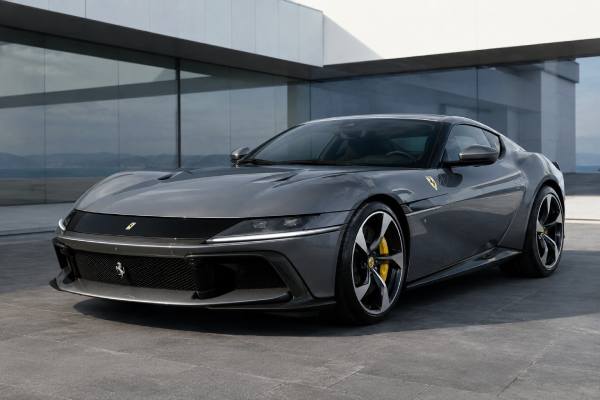
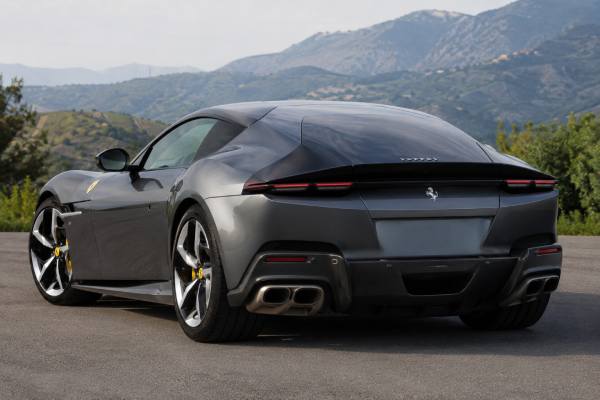
The Ferrari 12Cilindri (F167 ABA) is Ferrari’s 2024–present front-mid-engine V12 grand tourer, powered by the F140HD 6.5-liter naturally aspirated V12 with 830 cv, or about 819 hp. It replaced the 812 Superfast as Ferrari’s main two-seat V12 berlinetta, but it is not simply a faster 812 with new bodywork. It is Ferrari’s answer to a difficult modern question: how to keep a large, high-revving, non-hybrid V12 alive while emissions rules, noise rules, software systems, and buyer expectations keep changing.
The car matters because it carries one of Ferrari’s oldest ideas into the current era. A naturally aspirated V12 ahead of the cabin, rear-wheel drive, a long hood, two seats, and grand touring usability have been part of Ferrari’s identity since the company’s earliest road cars. The 12Cilindri keeps that layout, adds modern chassis electronics, brake-by-wire, four-wheel steering, active aero, and a very digital cabin. It is both traditional and highly technical, which is why collectors, owners, and enthusiasts pay close attention to it.
Quick Take
The Ferrari 12Cilindri’s strongest appeal is its 9,500-rpm F140HD V12, which gives it a sound and response that turbocharged and hybrid rivals cannot copy in the same way. Its identity is clear: a modern Ferrari V12 grand tourer with serious performance, sophisticated electronics, and a design that looks back to classic GT proportions without becoming retro. The tradeoff is that it is complex, expensive, allocation-sensitive, and too new for long-term reliability patterns to be fully known. Buyers should focus less on headline mileage alone and more on build specification, Ferrari warranty coverage, seven-year maintenance status, option documentation, recall completion, and a clean specialist inspection.
Table of Contents
- Model History and V12 Significance
- F140HD Engine, Chassis, and Specifications
- Production, Variants, and Factory Options
- Design, Engineering, and Special Features
- Driving Experience and Performance
- Reliability, Maintenance, and Service Risk
- Market Value, Buying Guide, and Rivals
Model History and V12 Significance
The 12Cilindri is important because it is Ferrari’s modern flagship expression of the front-engine V12 two-seater. It follows the 812 Superfast, but its role is broader than being the next fast Ferrari coupe: it is a statement that the naturally aspirated V12 still has a place in Ferrari’s range.
Ferrari revealed the 12Cilindri in May 2024 at Miami Beach, timed with the brand’s 70th anniversary in the American market. The location mattered because the United States has long been one of Ferrari’s most important V12 GT markets. The car was launched as a berlinetta, with the 12Cilindri Spider joining it as the open-top version.
The name is unusually direct. “12Cilindri” simply means “12 cylinders” in Italian. That tells the reader what Ferrari wants the car to be remembered for. Many modern performance cars are defined by hybrid systems, lap-time packages, or limited-edition branding. This Ferrari is defined by its engine layout.
The 12Cilindri sits in Ferrari’s “Range” model line rather than as an Icona, Special Series, or limited-run hypercar. That does not make it common. Ferrari production remains controlled, and V12 two-seat models are naturally lower-volume cars than more accessible sports cars. But it means the 12Cilindri is a regular production model in Ferrari terms, not a numbered collector edition from launch.
Its historical thread runs through cars such as the 275 GTB, 365 GTB/4 Daytona, 550 Maranello, 575M, 599 GTB Fiorano, F12berlinetta, and 812 Superfast. Those cars all share the basic idea of a high-performance V12 GT with the engine ahead of the driver and power sent to the rear wheels. Each generation reflects its own era. The Daytona was a muscular analog icon. The 550 helped revive the front-engine V12 berlinetta after the mid-engine flat-12 era. The F12 and 812 pushed power and electronics far beyond older GT expectations. The 12Cilindri continues that line with more digital control and cleaner design.
Its significance also comes from timing. By the mid-2020s, most exotic-car makers were moving deeper into electrification. Ferrari itself sells V6 and V8 hybrid models, and its future range includes electric vehicles. Against that background, a new non-hybrid, naturally aspirated 6.5-liter V12 feels deliberate. It is not old technology left untouched. Ferrari reworked the engine, emissions equipment, chassis systems, and aerodynamics to keep the concept viable.
The 12Cilindri is therefore collectible for more than power. It may become important as one of the last new-era Ferrari V12 GT cars without hybrid assistance. That does not guarantee future value, but it does explain why buyers care about specification, provenance, and originality from the start.
F140HD Engine, Chassis, and Specifications
The 12Cilindri’s core specification is a 6,496 cc naturally aspirated V12, rear-wheel drive, an 8-speed dual-clutch gearbox, and an aluminum chassis. The official performance figures put it among the fastest front-engine road cars Ferrari has built.
| Category | Specification |
|---|---|
| Production period | 2024–present |
| Model code | F167; F167 ABA used in some identification contexts |
| Body style | Two-seat berlinetta; Spider offered separately |
| Engine | F140HD 65-degree naturally aspirated V12, dry sump |
| Displacement | 6,496 cc |
| Bore x stroke | 94 mm x 78 mm |
| Power | 830 cv at 9,250 rpm, about 819 hp |
| Torque | 678 Nm at 7,250 rpm, about 500 lb-ft |
| Maximum engine speed | 9,500 rpm |
| Compression ratio | 13.5:1 |
| Transmission | 8-speed dual-clutch automatic |
| Drivetrain | Rear-wheel drive |
| Chassis | New aluminum structure |
| Steering | Electric power steering with independent four-wheel steering |
| Brakes | Carbon-ceramic discs with brake-by-wire control |
The V12 is the main event, but the details matter. The engine uses titanium connecting rods, lighter pistons, a lighter rebalanced crankshaft, and sliding finger followers with a Diamond-Like Carbon coating. That means Ferrari worked to reduce friction, mass, and inertia inside the engine. In plain language, the internal parts are designed to move with less wasted effort, which helps the V12 rev cleanly to its high limit.
The F140HD also uses 350-bar gasoline direct injection, ceramic catalytic converters, and a particulate filter to meet modern emissions requirements. That makes it very different from older Ferrari V12s, even though it keeps natural aspiration. It is a modern emissions-compliant V12, not a simple throwback.
| Item | Ferrari 12Cilindri |
|---|---|
| Length | 4,733 mm |
| Width | 2,176 mm |
| Height | 1,292 mm |
| Wheelbase | 2,700 mm |
| Dry weight | 1,560 kg with optional lightweight content |
| Weight distribution | 48.4% front / 51.6% rear |
| Fuel tank | 92 liters |
| Boot capacity | 270 liters |
| Front tires | 275/35 R21 |
| Rear tires | 315/35 R21 |
| Front brakes | 398 x 223 x 38 mm |
| Rear brakes | 360 x 233 x 32 mm |
| 0–100 km/h | 2.9 seconds |
| 0–200 km/h | Under 7.9 seconds |
| Top speed | Over 340 km/h |
| 100–0 km/h braking | 31.4 meters |
| 200–0 km/h braking | 122 meters |
The chassis is new rather than a simple carryover from the 812. Ferrari shortened the wheelbase by 20 mm compared with the 812 Superfast and increased torsional rigidity. Torsional rigidity is the body’s resistance to twisting. More stiffness lets the suspension work more accurately, especially during fast direction changes.
The electronic systems are also central to the car’s character. The 12Cilindri uses Side Slip Control 8.0, ABS Evo, a 6D sensor, electronic differential control, adaptive damping, four-wheel steering, and brake-by-wire. These systems do not make the car slow or soft. They allow a very powerful front-engine, rear-drive V12 to feel precise rather than intimidating all the time.
Production, Variants, and Factory Options
The 12Cilindri family includes the berlinetta coupe and the 12Cilindri Spider. Ferrari has not presented the model as a numbered limited edition, so production totals are not published in the same way they would be for a special-series car.
The coupe is the purer body style for buyers who want the cleanest roofline, highest structural focus, and classic Ferrari V12 berlinetta identity. The Spider is aimed at drivers who want open-top V12 sound and a more dramatic touring experience. Both use the same basic V12 concept and sit in the same family, but buyers should not treat them as identical collector objects. The coupe will usually appeal more to drivers who favor design purity and high-speed structure. The Spider will appeal to buyers who put sound, occasion, and open-air usability first.
Production ramp-up matters. Early cars are often the most discussed because they reach collectors, media, and high-profile clients first. They can also carry early-build updates, recall work, or software revisions that a buyer should verify. Later cars may benefit from small running changes that are not always obvious from the outside.
Factory options are central to Ferrari buying. The base specification only tells part of the story. Many cars are ordered through Ferrari’s personalization system, and final value can depend heavily on color, trim, wheels, carbon-fiber parts, seat choice, stitching, interior materials, audio, and special-order details.
Specification items that affect desirability
Buyers and collectors should pay close attention to:
- Exterior color, especially historic Ferrari colors, launch colors, and rare special-order shades.
- Interior color, seat style, stitching, piping, and material combinations.
- Carbon-fiber exterior and interior trim.
- Wheel design and finish.
- Brake caliper color and condition.
- Lift system availability, where fitted.
- Burmester high-end audio, if ordered.
- Glass roof and roof-related interior presentation on the coupe.
- Passenger display and digital cabin configuration.
- Full option printout, invoice, and Ferrari build documentation.
For a car this new, originality usually means factory-correct specification rather than old-fashioned “matching numbers” language. The engine, gearbox, body, and VIN still need to match records, but modern Ferrari collectors also want proof that options, colors, interior trim, and software/recall history are documented.
Identification and documentation
A serious buyer should ask for:
- VIN and market specification.
- Original sales invoice or official option list.
- Warranty start date.
- Confirmation of Ferrari Genuine Maintenance coverage.
- Recall and campaign completion record.
- Service history from an authorized Ferrari dealer or recognized specialist.
- Paint-protection-film and bodywork records.
- Evidence of no accident damage or structural repair.
- All keys, books, manuals, charger, tools, and accessories supplied with the car.
The 12Cilindri is too new for restored-versus-unrestored debate in the classic-car sense. Instead, the main questions are whether the car has been altered, repaired, poorly protected, exported across markets, or used in a way that creates hidden cost.
Design, Engineering, and Special Features
The 12Cilindri is visually distinctive because Ferrari avoided simply updating the 812’s shape. The design is cleaner, flatter, and more geometric, with a strong link to classic Ferrari GT proportions but a more futuristic surface treatment.
The work was led by Flavio Manzoni and the Ferrari Styling Centre. The most obvious historical reference is the Daytona-like front graphic, especially the dark band across the nose and the long-hood stance. Yet the 12Cilindri is not a retro design. It uses sharp light signatures, a controlled rear shape, and active aerodynamic parts that are hidden within the form.
The front end moves away from the traditional open grille look. The headlights are integrated into a wide visual band, with daytime running lights cutting through the shape. The hood is long, clean, and front-hinged, with vents to manage heat from the V12. The side view keeps the grand touring formula: long hood, cabin set back, strong rear haunches, and a short tail.
At the rear, Ferrari used active flaps integrated near the rear screen rather than a conventional fixed rear wing. The system has low-drag and high-downforce settings. At lower speeds, downforce matters less, so the flaps can remain visually flush. At higher road and track speeds, the system can add stability without ruining the design.
The underbody is equally important. Modern supercars do not rely only on visible wings. The 12Cilindri uses vortex generators, cooling exits, a managed underbody flow path, and a rear diffuser. The goal is to create stability and cooling without making the car look like a track special.
Cabin and interface
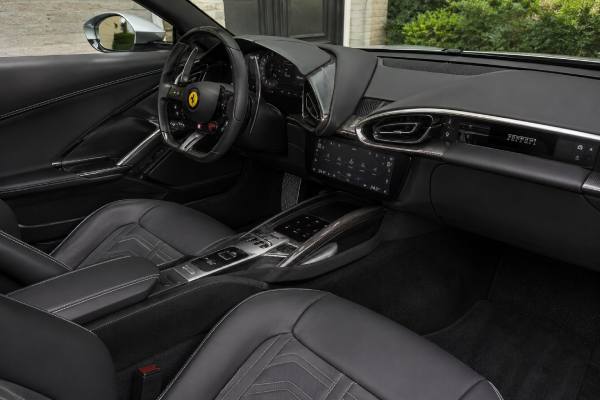
The interior follows Ferrari’s newer dual-cockpit layout. The driver and passenger have separate visual zones, which gives the passenger a more involved role than in older GTs. The 12Cilindri uses three main screens: a large driver display, a central touchscreen, and a passenger display.
This cabin is more digital than earlier V12 Ferraris. That is both an advantage and a caution. The displays give the car a modern feel and allow more functions to be integrated. But some buyers may prefer the more tactile cabins of older Ferraris. The steering wheel uses capacitive controls, which can feel less intuitive than physical buttons until the driver is used to them.
The glass roof is an important coupe feature. It gives the cabin more light and makes the car feel less closed-in on long journeys. Ferrari also highlights sustainable material use, including Alcantara containing recycled polyester in some applications.
Sound and packaging
The 12Cilindri’s sound is engineered, but not fake. The V12 uses equal-length exhaust tracts, 6-into-1 manifolds for each cylinder bank, and careful intake tuning. The goal is to keep the classic Ferrari V12 character while meeting current noise and emissions rules.
That is one of the car’s biggest engineering achievements. Older V12s could rely on less restrictive regulations. The 12Cilindri has to deliver drama through a more controlled exhaust and emissions system. Its sound is therefore a product of hardware, airflow, combustion order, and cabin acoustic tuning.
Driving Experience and Performance
The 12Cilindri is fast enough to feel supercar-quick, but its real character comes from response, sound, and balance. It is not just a straight-line acceleration machine; it is a front-engine V12 GT with modern chassis control.
The engine dominates the experience. A naturally aspirated V12 does not deliver torque like a turbocharged engine. It builds power with revs, and the reward grows as the needle climbs. Ferrari says a large share of torque is available from low rpm, so the car is not weak at normal speeds. Still, the 12Cilindri’s personality is strongest when the engine is allowed to rev.
The 8-speed dual-clutch gearbox is a major part of the performance. Compared with older Ferrari V12 berlinetta applications, it uses shorter lower ratios and faster shift behavior. The eighth gear helps relaxed cruising, which matters in a GT. Around town or on the highway, the gearbox should feel smooth and easy. In sportier driving, it lets the engine stay in the upper rev range where the V12 feels most alive.
Steering and chassis behavior are shaped by four-wheel steering. At lower and medium speeds, rear-wheel steering can make a long, powerful car feel more agile. At higher speeds, it can improve stability. The 12Cilindri’s short wheelbase compared with the 812 Superfast also helps it feel more alert.
Brake feel is an important question because the car uses brake-by-wire. In a conventional system, pedal pressure is mechanically linked more directly to hydraulic braking. In brake-by-wire, electronics interpret pedal input and control braking force. Done well, it improves precision and allows advanced ABS strategies. Done poorly, it can feel artificial. Ferrari’s system is designed for high-speed performance, but buyers coming from older hydraulic-brake Ferraris should test the feel carefully.
The 12Cilindri is also tire-sensitive. Its 21-inch Michelin Pilot Sport S5 or Goodyear Eagle F1 Supersport tires were developed for this application. Tire age, temperature, and pressure will affect steering, braking, noise, ride, and grip. On cold tires or poor surfaces, the car should be treated with respect. With heat in the tires and the correct setup, it has the tools to feel stable and extremely fast.
Road and track character
On the road, the 12Cilindri is best understood as a very high-performance grand tourer, not a stripped track car. It has serious acceleration, strong braking, and advanced aero, but it also has luggage space, a glassy cabin, a refined interior, and long-distance intent.
On a mountain road, the pleasure should come from the engine’s reach, the fast gearbox, and the way the chassis manages weight transfer. On a highway, the eighth gear and cabin comfort should make it easier to cover distance than in more aggressive mid-engine supercars. On a track, it will be very quick, but its size, value, tire cost, brake cost, and GT mission mean it is not the most logical dedicated track tool.
Visibility and usability are better than many mid-engine exotics, but width is still a real-world issue. The published width is over two meters, so narrow streets, parking garages, curbs, and ramps require care. A front lift system, if fitted, is valuable for owners who drive the car often.
Reliability, Maintenance, and Service Risk
Long-term reliability data for the 12Cilindri is still limited because the model is new. The right ownership approach is to treat it as a complex modern Ferrari with a proven V12 family background but new electronics, new body systems, and early-production details that must be checked by VIN.
The F140 V12 lineage has a strong reputation when maintained properly, but the 12Cilindri’s F140HD version is a very high-output, high-revving engine with modern emissions hardware. It should not be maintained like an ordinary performance car. Correct fluids, software updates, dealer-level diagnostic tools, and warm-up discipline all matter.
Ferrari’s seven-year Genuine Maintenance program is a major advantage. It covers scheduled regular maintenance for the first seven years, with intervals described as annual or every 20,000 km. That does not mean ownership is cost-free. Tires, damage, wear items, insurance, paint protection, cosmetic repair, and warranty-excluded problems can still be expensive.
Areas to inspect carefully
A pre-purchase inspection should focus on:
- Engine fault codes, oil leaks, misfires, emissions-system warnings, and abnormal cold-start behavior.
- Gearbox operation at low speed, during reverse, and under full-throttle upshifts.
- Brake-by-wire system health, carbon-ceramic disc condition, pad thickness, and brake history.
- Tire date codes, even on low-mileage cars.
- Suspension lift function, if fitted.
- Four-wheel steering and electronic chassis system fault history.
- Battery condition and charging habits.
- Infotainment, displays, steering-wheel controls, and passenger-screen function.
- Paint thickness, front-end stone chips, underside scrape marks, and carbon-trim damage.
- Cooling system condition and evidence of leaks or impact damage near front radiators.
- Recall and service campaign completion.
The carbon-ceramic brakes deserve special attention. They can last a long time in normal road use, but replacement is costly. Track use, poor washing habits, impact damage, or heavy abrasive contamination can change the picture. A visual check is not enough; a Ferrari dealer or qualified specialist should assess wear and condition.
Tires are another hidden cost. A car with low mileage can still need tires if they are aged, damaged, flat-spotted, or mismatched. Because the 12Cilindri’s electronics and handling were developed around specific tire sizes and approved tire types, fitting random alternatives can damage the driving feel and may affect warranty or inspection outcomes.
Known campaigns and early issues
As of the current recall record, a U.S. safety recall affected certain 2025–2026 Ferrari 12Cilindri vehicles because rear and side windows had less than the required light transmittance under U.S. glazing rules. The remedy is replacement with compliant glass. This is not an engine or gearbox fault, but it matters for legality, registration, and resale. Any U.S.-market buyer should check the VIN for open recalls before purchase.
Electronic usability is another area to watch. Modern Ferrari cabins rely heavily on screens, haptic controls, modules, and software. These systems are part of the ownership experience, and minor annoyances can become expensive if parts or programming are needed outside warranty. Buyers should test every cabin function, not just the engine and gearbox.
Because the car is new, “restoration” is not yet the main issue. Preservation is. Avoid cars with poor paint protection installation, non-factory carbon parts, careless wheel refinishing, unrecorded accident repairs, or aftermarket electronic changes. On a modern Ferrari, undocumented modification can hurt value more than it helps performance.
Market Value, Buying Guide, and Rivals
The 12Cilindri is positioned as a top-tier Ferrari GT, so its market is driven by allocation, specification, mileage, condition, and buyer access as much as by list price. Early cars can trade differently from later cars because some buyers value immediate availability.
For a new or nearly new 12Cilindri, the most useful price question is not only “what was MSRP?” Ferrari options can add a large amount to the final invoice, and two cars with the same model year can sit far apart in desirability. A subtle, elegant specification with strong documentation may appeal to one buyer, while another may pay more for a launch-style color, carbon-heavy build, or rare Tailor Made detail.
What drives value
The main value factors are:
- Market and delivery history.
- Coupe versus Spider body style.
- Exterior and interior color combination.
- Factory option list and original invoice.
- Mileage relative to age.
- Ferrari warranty and maintenance coverage.
- Dealer service history.
- Recall completion.
- Accident-free body and clean paintwork.
- Interior wear, especially on bolsters, steering-wheel controls, screens, and trim.
- Original accessories, books, keys, charger, and documentation.
- Ownership history and whether the car stayed within an official dealer network.
A low-mileage car is not automatically the best car. A delivery-mile car that sat unused with a weak battery, old fuel, or no proper preparation can create problems. A carefully driven car with complete service records can be a safer buy than a neglected garage queen.
Buyer inspection checklist
Before committing, a serious buyer should:
- Confirm the VIN, market specification, and warranty start date.
- Request the factory option list and original invoice.
- Check for open recalls and service campaigns.
- Have a Ferrari dealer or recognized specialist scan all control modules.
- Inspect carbon-ceramic brakes, tires, wheels, underside, lift system, and front cooling pack.
- Verify paint condition with paint-depth readings and body-panel inspection.
- Test every display, switch, steering-wheel control, camera, audio function, and phone connection.
- Review storage, charging, and maintenance habits with the seller.
- Confirm all books, keys, manuals, accessories, and service records are present.
- Compare the asking price against similar current listings, not only against original list price.
Examples to seek or avoid
Seek cars with a documented, attractive factory specification, clean paint, no warning lights, fresh tires, correct recalls, and full Ferrari service records. A good 12Cilindri should feel tight, smooth, and drama-free at low speed before it feels spectacular at high speed.
Avoid cars with unresolved warning lights, weak batteries, missing documents, unclear import history, accident repairs, heavy track use without disclosure, non-factory modifications, mismatched tires, damaged carbon, or unclear warranty status. Also be cautious with heavily marked-up early cars unless the specification, timing, and availability justify the premium to you.
Closest rivals and alternatives
The most direct current rival is the Aston Martin Vanquish, another front-engine V12 grand tourer. The Aston uses twin turbocharging and delivers huge torque, so it offers a different feel from the Ferrari’s naturally aspirated, high-revving response. It is the natural comparison for buyers who want a modern two-seat V12 GT but prefer British luxury and turbocharged muscle.
The Lamborghini Revuelto is a V12 rival in price and drama, but not in layout or philosophy. It is a mid-engine plug-in hybrid supercar with all-wheel drive and a much more futuristic performance mission. It is faster and more extreme in some ways, but it is not a front-engine GT.
Within Ferrari’s own world, the 812 Superfast and 812 Competizione are the key alternatives. The 812 Superfast is older and may feel more analog in some areas, while the 812 Competizione has special-series status and a more focused collector profile. The Purosangue is another Ferrari V12 choice, but its four-door, four-seat layout makes it a different kind of ownership proposition.
The 12Cilindri’s long-term collectability will depend on how many are built, how the V12 market changes, and whether future Ferrari GTs keep this kind of engine. Its strongest case is simple: it is a new-era Ferrari V12 without hybrid assistance, wrapped in a modern GT body with serious technical depth. That gives it a clear identity from day one.
References
- Ferrari 12Cilindri – Ferrari.com 2024 (Official Model Page)
- FERRARI 12CILINDRI: FOR THE FEW 2024 (Official Technical Press Kit)
- Ferrari NV Annual Report 2024 (AFM Filing) 2025 (Annual Report)
- Part 573 Safety Recall Report 26V152 2026 (Recall Database)
Disclaimer
This article is for informational purposes only and is not a substitute for professional diagnosis, repair, inspection, or valuation. Specifications, torque values, service intervals, software requirements, recall status, and procedures can vary by VIN, market, model year, equipment, and production update. Always verify details against official Ferrari service documentation and have any vehicle inspected by a qualified Ferrari dealer or specialist before purchase or repair.
If you found this guide useful, please consider sharing it on Facebook, X/Twitter, or your favorite automotive community to support our work.