
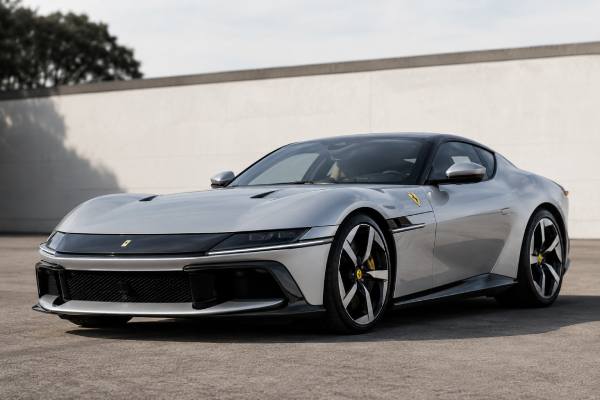
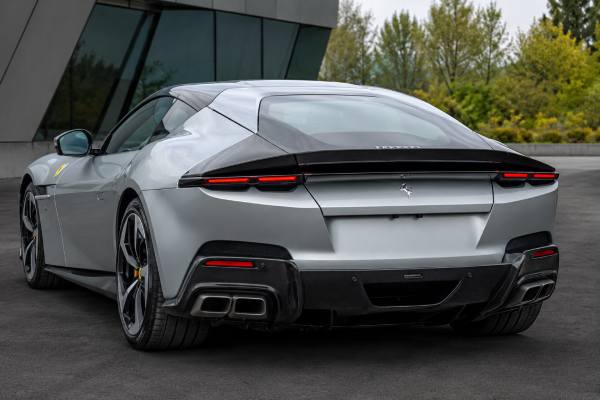
The Ferrari 12Cilindri Spider is the open-top version of Ferrari’s front-mid-engine V12 grand tourer, launched for the 2024 model year and powered by the F140HD 6.5-liter naturally aspirated V12. In U.S. output terms, it makes 819 hp, while Ferrari’s metric rating is 830 cv. It is not a hybrid, not turbocharged, and not a limited-series track special. Its importance comes from something simpler and harder to replace: a high-revving, front-mounted Ferrari V12 in a two-seat spider built during an era when emissions rules, electrification, weight, and software have changed the shape of nearly every modern performance car.
The 12Cilindri Spider replaces the emotional space once occupied by cars such as the 812 GTS, but it takes a cleaner and more futuristic direction. It uses a retractable hardtop, an eight-speed dual-clutch gearbox, rear-wheel drive, rear-wheel steering, advanced brake-by-wire control, active aerodynamics, and a cockpit built around multiple screens. It is a luxury GT first, but one with supercar pace: under three seconds to 100 km/h, over 340 km/h, and a 9,500 rpm redline.
Quick Take
The 12Cilindri Spider’s strongest appeal is the combination of open-air driving and a naturally aspirated Ferrari V12 that revs like a special-series engine. Its identity is technical as much as emotional: a modern, software-managed grand tourer with no hybrid system and no turbochargers, yet with active aero, rear-wheel steering, and a highly developed F140HD engine. The tradeoff is complexity, cost, and spec sensitivity. Buyers should focus less on headline mileage alone and more on factory options, warranty status, service continuity, brake and tire condition, roof operation, software updates, and whether the car’s specification will remain desirable in a collector market that rewards originality and tasteful configuration.
Table of Contents
- History and Significance
- Engine, Chassis and Specifications
- Production, Variants and Options
- Design, Engineering and Features
- Driving Experience and Performance
- Reliability, Maintenance and Restoration
- Market Value, Buying Guide and Rivals
History and Significance
The 12Cilindri Spider matters because it keeps Ferrari’s front-engine V12 spider tradition alive without electrification or forced induction. It is a modern flagship GT, not a nostalgic remake, but it clearly carries the bloodline of Ferrari’s grand touring V12s into a much stricter technical era.
Ferrari revealed the 12Cilindri and 12Cilindri Spider in Miami Beach in 2024, a launch setting tied to the brand’s long relationship with the American market. The timing was important. By the mid-2020s, Ferrari already had plug-in hybrid supercars, turbocharged V8s, and the V12-powered Purosangue SUV. Against that backdrop, a new two-seat, front-mid-engine V12 spider was a statement: the traditional Ferrari twelve-cylinder GT was not being retired.
The car sits above the Roma Spider in character and price, and it plays a different role from mid-engine cars such as the 296 GTS or SF90 Spider. The 12Cilindri Spider is about long-distance pace, open-air theatre, and the old Ferrari idea that a large-displacement V12 can be both a luxury-car engine and a racing-bred centerpiece.
Its predecessor in spirit is the 812 GTS, itself a major car because it brought a regular-production front-engine V12 spider back into Ferrari’s catalog. The 12Cilindri Spider moves that formula forward with a sharper design language, a more digital interior, updated vehicle dynamics, and the F140HD engine tune shared with the 12Cilindri coupe.
The model also sits in a historically sensitive moment. Ferrari’s naturally aspirated V12 has become one of the company’s most valuable identity markers. Enthusiasts care because the engine is increasingly rare. Collectors care because non-hybrid V12 Ferraris may become more significant as regulation and technology shift the market toward smaller engines and electrified systems.
The 12Cilindri Spider is not collectible because it is old, scarce, or hand-built in the classic coachbuilt sense. Its early collectability comes from being a modern expression of a format that may not exist indefinitely: two seats, front-mounted V12, rear-wheel drive, open roof, and a Ferrari badge.
Its reputation will likely depend on three things over time. First, whether the F140HD proves durable in normal exotic-car use. Second, how well the electronic systems, roof mechanism, and digital interfaces age. Third, whether buyers continue to value the cleaner design and GT identity, or whether the market favors louder, more aggressive special-series Ferraris.
Engine, Chassis and Specifications
The heart of the 12Cilindri Spider is the F140HD, a 6,496 cc naturally aspirated 65-degree V12 with dry-sump lubrication and a 9,500 rpm maximum speed. The rest of the car is built around making that engine usable in a fast, modern open-top GT.
| Category | Specification |
|---|---|
| Model | Ferrari 12Cilindri Spider |
| Platform code | F167 ADA |
| Production period | 2024–present |
| Body style | Two-seat retractable-hardtop spider |
| Engine code | F140HD |
| Engine layout | Front-mid-mounted 65-degree V12 |
| Displacement | 6,496 cc |
| Induction | Naturally aspirated |
| Maximum power | 819 hp / 830 cv at 9,250 rpm |
| Maximum torque | 678 Nm / 500 lb-ft at 7,250 rpm |
| Maximum engine speed | 9,500 rpm |
| Transmission | Eight-speed dual-clutch automatic |
| Drivetrain | Rear-wheel drive |
| Steering | Electric power steering with rear-wheel steering |
| Roof | Retractable hardtop |
The F140HD is part of Ferrari’s long F140 V12 family, but it is not a lazy carryover. The engine uses lightweight internal parts, high-rev breathing, dry-sump oiling, and detailed electronic control to keep a large V12 responsive and emissions-compliant. Peak power arrives very high in the rev range, which tells you a lot about the car’s character. This is not an engine tuned only for low-speed shove. It wants rpm.
The eight-speed dual-clutch gearbox is mounted as part of the rear transaxle layout, helping weight distribution and shift speed. Compared with older Ferrari dual-clutch units, the eight-speed gearbox offers closer ratios and a more flexible spread. Around town, it can behave smoothly. In fast driving, it can keep the engine in the upper third of the rev range, where the V12 feels most alive.
| Item | Ferrari 12Cilindri Spider |
|---|---|
| 0–100 km/h | Under 3.0 seconds |
| 0–200 km/h | Under 8.3 seconds |
| Top speed | Over 340 km/h / over 211 mph |
| Length | 4,733 mm |
| Width | 2,176 mm including mirrors |
| Height | About 1,290 mm |
| Wheelbase | 2,700 mm |
| Dry weight | About 1,620 kg with lightweight options |
| WLTP combined fuel consumption | 15.9 l/100 km |
| WLTP combined CO2 | 360 g/km |
The chassis uses a front-mid-engine layout, meaning the engine is set back behind the front axle line as much as practical. This gives the car a more balanced feel than a traditional front-heavy layout. Ferrari pairs that with rear-wheel steering, Side Slip Control, advanced traction management, brake-by-wire, and large carbon-ceramic brakes.
The suspension is tuned for GT use, but not softness in the ordinary luxury-car sense. The 12Cilindri Spider has to handle high speed, rapid weight transfer, and the extra structural demands of an open body. The retractable roof adds complexity and some weight compared with the coupe, but Ferrari designed the Spider as a core model, not an afterthought.
Production, Variants and Options
The 12Cilindri family is offered as a coupe and as the 12Cilindri Spider, with the Spider adding open-air use through a retractable hardtop. The most important buyer differences are not engine output, but body style, roof mechanism, specification, market equipment, and personalization.
Unlike numbered limited-series Ferraris, the 12Cilindri Spider is a regular-production model. That does not mean supply is easy or values are simple. Ferrari production is allocation-led, and early cars usually reflect the tastes of first owners. On a car like this, the factory build can have a major effect on long-term desirability.
The Spider’s basic mechanical package mirrors the coupe closely: F140HD V12, eight-speed dual-clutch gearbox, rear-wheel drive, rear-wheel steering, active aero, digital cockpit, and carbon-ceramic braking. The roof is the defining change. It gives the car a different emotional profile and a different ownership checklist.
Body and roof choice
The coupe is the purer shape and may appeal to buyers who want maximum structural simplicity. The Spider is the more theatrical car. It lets the driver hear the V12 and exhaust more directly, and that is a major part of the appeal. For many owners, the small tradeoff in weight and roof complexity is worth it.
A buyer comparing the two should think about use rather than just collectability. If the car will be driven on scenic roads, at coastal homes, or in fair-weather touring, the Spider makes obvious sense. If it will be stored as a design object or used mainly for high-speed road trips, the coupe may feel more cohesive.
Personalization and factory options
Ferrari options can transform the feel and future value of the car. The 12Cilindri Spider can be specified through Ferrari’s usual personalization channels, including paint, leather, Alcantara, carbon-fiber trim, wheels, brake calipers, seat styles, stitching, carpets, shields, audio, luggage, and exterior detailing.
Options that usually matter most to buyers include:
- exterior paint color and whether it suits the car’s geometric shape
- interior color contrast, leather quality, and stitching taste
- forged wheels and wheel finish
- carbon-fiber exterior details
- carbon-fiber interior trim
- Daytona-style or racing-inspired seats, depending on market availability
- front suspension lift
- premium audio and technology options
- passenger display
- Apple CarPlay and connectivity features where fitted
- special-order Tailor Made details with clear documentation
Taste matters more here than maximum option count. A heavily optioned car with a confused color combination may be harder to resell than a simpler car in a strong historic Ferrari color. Classic reds, silvers, dark blues, greys, and tasteful greens can all work, but the 12Cilindri’s design is very sensitive to contrast. The black front graphic, sharp body lines, and clean surfaces mean poor color choices stand out.
Documentation and authenticity
Because the 12Cilindri Spider is new, most cars should have complete records. That makes missing documentation a warning sign. A serious buyer should expect:
- original order specification
- window sticker or market equivalent
- Ferrari dealer service history
- warranty and maintenance-plan records
- option codes and invoices
- recall and campaign completion records
- paint-protection-film documentation if applied
- any repair invoices, even minor cosmetic work
On modern Ferraris, originality includes software and dealer records as much as paint and leather. A car modified with aftermarket exhaust tuning, non-factory carbon parts, lowered suspension, or altered electronics may be exciting, but it will not appeal to every collector.
Design, Engineering and Features
The 12Cilindri Spider is distinctive because it mixes a clean, retro-influenced Ferrari GT idea with very modern surfaces and systems. It is not a soft remake of the Daytona, but the black front panel, long hood, compact cabin, and abrupt rear proportions clearly echo earlier front-engine Ferrari V12s.
The design was created under Ferrari’s Centro Stile direction during the Flavio Manzoni era. The goal was not to make a visually busy supercar. Instead, the 12Cilindri uses smooth body volumes, sharp lighting, blade-like details, and carefully hidden aerodynamic work. That makes it quite different from the more aggressive 812 Superfast and 812 GTS.
At the front, the full-width dark panel gives the car its most debated design cue. Some buyers see it as a clever nod to the 365 GTB/4 Daytona. Others find it stark. Either way, it defines the car. The front lighting is narrow and technical, while the long hood reinforces the front-mid-engine layout.
The side profile is more restrained. The cockpit sits rearward, the hood appears long, and the rear deck is compact. On the Spider, the roof mechanism has to disappear cleanly without making the car look bulky. Ferrari’s solution gives the open car a different personality from the coupe while keeping the same basic proportions.
Aerodynamics and cooling
The 12Cilindri Spider does not rely on a giant fixed wing. Its aero work is integrated into the body. Airflow management supports cooling, stability, and drag control without turning the car into a track-special caricature. Active rear aero elements help balance the car at high speed, while underbody management and body shaping do much of the quiet work.
Cooling is critical because the V12 sits in front and produces serious heat. The car has to manage engine cooling, brake temperatures, cabin comfort, and roof-down airflow. That is one reason modern Ferrari GTs have complex ducting and carefully shaped exits rather than simple decorative vents.
Cockpit and controls
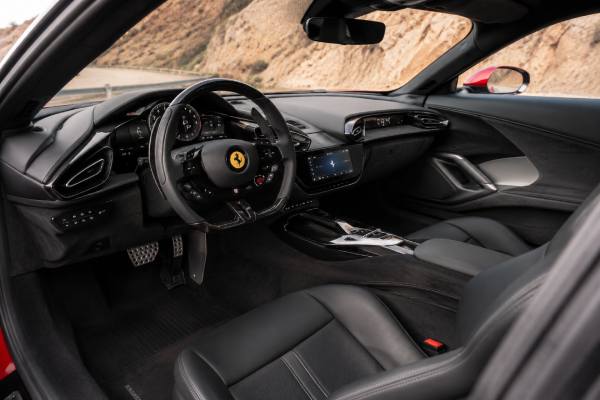
Inside, the 12Cilindri Spider is more digital than older front-engine V12 Ferraris. The driver gets a large digital instrument display, while the central area and passenger side use screen-based interfaces depending on specification. This gives the car a modern Ferrari feel, but it also divides opinion.
The steering wheel uses Ferrari’s current control philosophy, with many functions placed close to the driver’s hands. Some owners appreciate the race-car logic. Others prefer physical buttons and simpler controls. For buyers, the key point is to test the interface before committing. A car can be mechanically wonderful and still feel frustrating if the driver dislikes the controls.
The seating position is low and sporty, but the 12Cilindri Spider remains a GT. It is meant to handle longer drives, not just short bursts. Cabin noise, wind management, seat comfort, storage space, and infotainment usability matter more here than in a stripped track car.
The sound as a feature
The sound is not an accessory on this car. It is central to the reason the 12Cilindri Spider exists. A naturally aspirated V12 with a 9,500 rpm ceiling gives the driver a rising, mechanical character that turbocharged engines rarely copy. With the roof down, induction, exhaust, and gearshift sound become part of the experience.
Modern noise regulations mean the car may not sound as raw as older V12 Ferraris in every market or drive mode. Even so, the engine’s rev range and throttle response give it a special feel. The sound builds with rpm rather than arriving as one low-frequency blast.
Driving Experience and Performance
The 12Cilindri Spider drives like a very fast grand tourer with a supercar engine, not like a lightweight track toy. Its defining trait is the way the V12 turns speed into an event, especially above mid-range rpm with the roof open.
At low speeds, the car should feel smoother and more usable than its numbers suggest. The dual-clutch gearbox can shift cleanly in automatic mode, the steering is light enough for city use, and the suspension has enough control range for real roads. Visibility is better than many mid-engine supercars because of the front-engine GT layout, though the long hood and wide body still demand care in tight spaces.
The engine’s personality changes with rpm. Below the middle of the tachometer, it is flexible and polished. It has enough torque to move the car easily without drama. Above that, it becomes sharper and more urgent. Peak torque arrives high, and peak power arrives near the top, so the driver is rewarded for using the rev range. That is part of the point. A turbocharged rival may feel more forceful at low rpm, but the Ferrari builds intensity in a more linear way.
The eight-speed gearbox is central to the experience. In relaxed driving, it helps the car feel calm. In manual mode, it lets the driver keep the V12 on boil, with fast shifts and tightly spaced ratios. This matters because a high-revving naturally aspirated engine can feel less dramatic if the gearing is too long. Ferrari avoids that problem by matching the gearbox to the engine’s upper-rpm character.
Steering feel is quick and precise, as expected from a modern Ferrari, though it is filtered compared with older hydraulic systems. Rear-wheel steering helps the car feel shorter and more agile than its size suggests. At parking speeds and on tight roads, it reduces the sense of mass. At higher speeds, it supports stability.
The carbon-ceramic brakes are powerful, but buyers should understand that modern brake-by-wire systems can feel different from older hydraulic setups. The pedal can be consistent and effective, yet less organic to some drivers. For road use, the system’s predictability matters more than old-school pedal romance. For track use, brake temperature, pad life, tire condition, and fluid service become more important.
With the roof down, the car gains emotional depth. The sound is more present, the sense of speed is stronger, and the V12 feels more connected to the driver. With the roof up, it becomes a more serious long-distance GT. That dual character is the Spider’s main advantage over a fixed-roof supercar.
Track driving is possible, but it is not the car’s natural home. The 12Cilindri Spider is heavy, expensive, and fitted with costly consumables. It can deliver huge pace, but repeated track use will increase wear on tires, brakes, fluids, and suspension components. Owners who want regular track work may be better served by a mid-engine Ferrari or a special-series model.
Reliability, Maintenance and Restoration
The 12Cilindri Spider is too new for a long independent reliability record, so ownership judgment should focus on known exotic-car risk areas and Ferrari V12 maintenance discipline. The engine itself comes from a mature family, but the car around it is complex and must be maintained by specialists.
The F140 V12 family has a strong reputation compared with many exotic engines, but “reliable” in this context does not mean inexpensive. A front-engine Ferrari V12 still needs careful fluid service, proper warm-up, correct oil, dealer diagnostics, and fast attention to warning lights. Cars that sit unused can develop more problems than cars that are warmed and driven regularly.
Important maintenance areas include:
- engine oil and dry-sump system service
- coolant condition and hose inspection
- gearbox software and fluid service requirements
- brake fluid replacement
- carbon-ceramic brake inspection
- tire age, tire match, and tire pressure monitoring
- battery condition and charging habits
- roof mechanism operation and seals
- suspension lift function if equipped
- wheel alignment and rear-steer calibration
- software updates and dealer campaigns
The retractable hardtop adds a major inspection point. It should open and close smoothly, without hesitation, unusual noise, warning messages, or uneven panel movement. Roof seals should be checked for water leaks, wind noise, and proper alignment. A small roof issue on an exotic spider can become expensive if ignored.
The carbon-ceramic brakes should not be judged by pad thickness alone. Disc condition, surface damage, heat checking, sensor readings, and service history matter. Replacing carbon-ceramic components can be very expensive, so a pre-purchase inspection should include actual brake wear data where available.
Tires are another major ownership cost. The 12Cilindri Spider’s performance depends heavily on correct high-performance tires in good condition. Old tires with plenty of tread are still a problem. On a 340 km/h-capable car, age, heat cycles, puncture repairs, sidewall condition, and proper specification matter.
Battery management is a common modern exotic issue. Even though the 12Cilindri Spider is not a hybrid, it has many electronic systems. A weak 12-volt battery can trigger confusing faults, warning messages, or module behavior. Owners should use the correct battery maintainer when the car is stored.
Known recalls and campaigns
Because the model is new, recall history is still developing. In the U.S., 2025–2026 12Cilindri recall documentation has identified a glazing issue involving black rear and side windows with insufficient light transmittance on certain cars. That is a compliance and visibility matter, not an engine or gearbox defect. Buyers should still check the VIN with an authorized Ferrari dealer or the official recall database.
Service campaigns may not appear as public recalls. Ferrari dealers can check for software updates, control-module campaigns, roof-related adjustments, infotainment revisions, or market-specific equipment corrections. A car advertised as “fully serviced” should have campaign status confirmed, not assumed.
Restoration is the wrong word, for now
For a current-production Ferrari, the more useful term is preservation. Restoration will become relevant decades later. Today, buyers should protect originality, avoid poor aftermarket changes, keep dealer records complete, and repair small issues properly.
Paint-protection film is common, but it should be inspected. Poor film installation can leave cut marks, lifted edges, trapped dirt, or paint damage. A wrapped or partially repainted car needs careful review, especially around the front panel, bumper edges, mirrors, sills, and rear quarters.
Market Value, Buying Guide and Rivals
The 12Cilindri Spider sits at the top of the modern open Ferrari GT market, with new-car pricing and early resale values shaped by allocation, options, mileage, and timing. The smartest purchase is not always the cheapest car; it is the car with the right specification, clean history, warranty support, and no stories.
As a new or nearly new exotic, the Spider’s market is still forming. Early cars can trade above or near original transaction price in some markets if supply is tight and the specification is strong. As more cars arrive, values may normalize. Highly personalized cars can be either very desirable or hard to sell, depending on taste.
The biggest value drivers are:
- factory color combination
- desirable options
- low but credible mileage
- clean paint and interior condition
- complete Ferrari service history
- remaining factory warranty
- Ferrari maintenance program status
- no accident history
- no questionable modifications
- no unresolved campaigns or recalls
- strong dealer provenance
- original accessories, books, tools, and keys
A good Spider should feel tight, clean, and consistent. The roof should work perfectly. The gearbox should shift without hesitation. The brakes should feel strong and even. The steering should be straight, with no vibration. The interior screens and controls should behave correctly. The exhaust should be stock unless the buyer knowingly accepts modification risk.
Avoid cars with unclear ownership history, missing invoices, unexplained repainting, non-factory tuning, warning lights, roof faults, mismatched tires, or sellers who cannot confirm campaign status. On a car this expensive, small mysteries are rarely worth accepting.
| Area | What to check | Why it matters |
|---|---|---|
| Documentation | Build sheet, invoices, warranty, campaigns | Confirms originality and service continuity |
| Engine | Leaks, warning history, service records, cold start | V12 repairs are specialist and costly |
| Gearbox | Shift quality, software status, fault codes | Dual-clutch issues can be expensive |
| Roof | Operation, seals, alignment, water leaks | Spider-specific repairs can be complex |
| Brakes | Carbon-ceramic disc and pad condition | Replacement costs are high |
| Tires | Age, specification, wear pattern, repairs | Grip and stability depend on correct tires |
| Body | Paint depth, film quality, panel gaps | Accident or poor cosmetic work hurts value |
| Electronics | Screens, steering controls, lift, sensors | Modern Ferrari faults need dealer diagnostics |
Main rivals and alternatives
The closest emotional rival is the Aston Martin Vanquish Volante, another front-engine V12 open grand tourer. The Aston uses a different philosophy, with turbocharged torque and a more traditional luxury-GT character. It may feel more muscular at low rpm, while the Ferrari is sharper, higher-revving, and more exotic in engine response.
The Bentley Continental GTC Speed is not a direct supercar rival, but it competes for wealthy buyers who want open-air speed and luxury. It is heavier, more comfort-led, and less focused on engine theatre. It makes sense for daily grand touring, but it does not offer the Ferrari’s V12 drama.
Within Ferrari’s own range, the Roma Spider is more elegant and less extreme, with a turbocharged V8 and a softer price point. The 296 GTS is quicker in a different way, with hybrid torque and mid-engine balance. The SF90 Spider is more technologically extreme and far more complex. The 812 GTS is the obvious used alternative, offering a more aggressive older design and a related V12 experience.
For long-term collectability, the 12Cilindri Spider has a strong foundation. It is a Ferrari V12 spider, it is naturally aspirated, and it belongs to a shrinking category. But future value will not be automatic for every car. The best examples will be tasteful, original, well documented, lightly but properly used, and maintained through official or highly respected Ferrari specialists.
References
- Ferrari 12Cilindri Spider: for the few 2024
- Ferrari Official Car Configurator 2024
- Part 573 Safety Recall Report 26V152 2026 (Recall Database)
- Ferrari Genuine: Ferrari 12Cilindri Spider – Ferrari.com 2024
- Ferrari 12Cilindri & 12Cilindri Spider 2025
Disclaimer
This article is for informational purposes only and is not a substitute for professional diagnosis, maintenance, repair, valuation, or pre-purchase inspection. Specifications, torque values, service intervals, software procedures, recall status, and repair methods can vary by VIN, market, model year, equipment, and campaign history. Always verify details against official Ferrari service documentation and an authorized Ferrari dealer or qualified Ferrari specialist.
If you found this guide useful, please consider sharing it on Facebook, X/Twitter, or your favorite car community to support our work.