
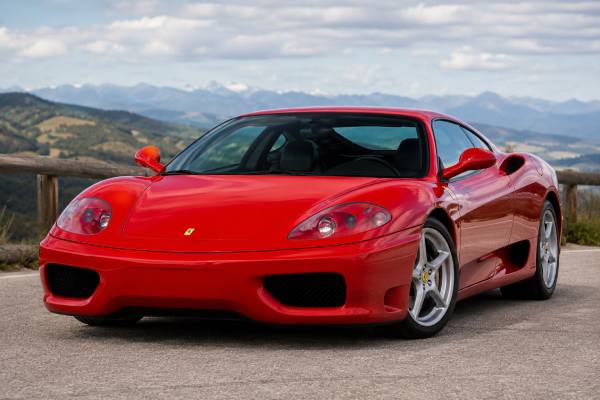
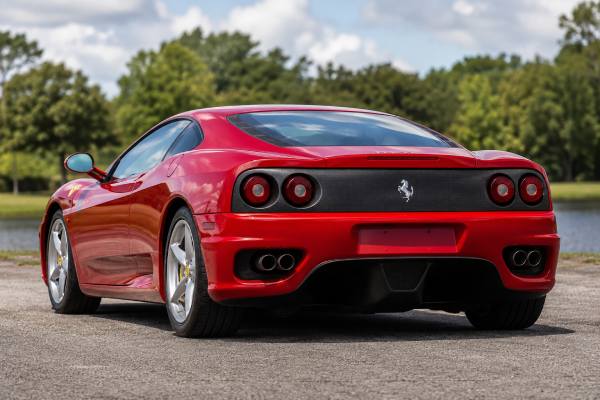
The Ferrari 360 Modena (F131) is the mid-engined V8 berlinetta that moved Ferrari from the last compact, steel-and-aluminum era of the F355 into a wider, lighter, more modern aluminum-supercar age. Built around the 3.6-liter Tipo F131B naturally aspirated V8, rated at 400 hp, the 360 Modena arrived in 1999 and carried Ferrari’s entry-level supercar line through the early 2000s, with production and model-year overlap extending into 2005 for the wider 360 family.
Its appeal is not only speed. The 360 Modena combined a high-revving flat-plane-crank V8, Pininfarina bodywork, a new aluminum spaceframe, rear-wheel drive, and the choice of a gated six-speed manual or Ferrari’s early F1 automated manual. It is also one of the most approachable modern classic Ferraris because timing-belt service can be done with the engine in the car, parts support remains reasonable by exotic-car standards, and the market still offers a wide spread of usable driver-quality cars and highly prized manual examples.
Quick Take
The Ferrari 360 Modena is strongest as a pure, naturally aspirated V8 Ferrari that still feels analog, sounds mechanical, and looks modern enough to use regularly. Its all-aluminum chassis, 8,500-rpm engine, and choice of manual or F1 gearbox make it historically important as the bridge between the F355 and F430. The main caution is condition sensitivity: deferred belt service, worn F1 clutch hardware, sticky interior parts, cracked mounts, tired suspension, accident history, and incomplete documentation can turn an attractive price into a costly ownership experience. Manual coupes with clean history and original specification carry the strongest collector pull, while well-maintained F1 cars can still be compelling drivers when bought with a specialist inspection.
Table of Contents
- History and Collector Significance
- Engine, Chassis, and Key Specifications
- Production, Variants, and Factory Options
- Design, Engineering, and Special Details
- Driving Experience and Real Performance
- Maintenance, Reliability, and Restoration Risks
- Values, Buying Advice, and Rivals
History and Collector Significance
The 360 Modena matters because it was Ferrari’s first clean-sheet aluminum mid-engined V8 road car and the direct successor to the F355. It kept the classic rear-mid-engine, rear-drive Ferrari layout but changed the structure, packaging, aerodynamics, and usability enough to define the brand’s V8 supercar direction for the next decade.
Ferrari named the Modena after the city closely tied to Enzo Ferrari’s life and the company’s roots. The car replaced the F355 berlinetta and arrived at a moment when Ferrari needed a more modern platform, not just a restyled version of an older chassis. The F355 had been loved for its noise, compact size, and five-valve V8, but it also carried older construction methods and maintenance realities. The 360 moved the formula forward with an aluminum spaceframe and a body designed around smoother airflow, larger cooling openings, and a flatter underbody.
The result was a Ferrari that felt more spacious, more stable, and more usable than the F355, while still keeping a hard-edged engine character. It was not a limited-production halo car like the F50 or Enzo. It was the core V8 Ferrari, which made its engineering choices especially important. The 360 set expectations for the F430, 458 Italia, and later mid-engined V8 and V6 models: more chassis stiffness, more everyday usability, better cabin space, stronger electronics, and more aerodynamic management without losing the visual drama of a Ferrari berlinetta.
Pininfarina’s design also marked a break from the pop-up-headlamp era. The 360 used fixed headlights under clear covers, a rounded nose, large side intakes, a glass engine cover, and twin rear outlets integrated into the rear fascia. It looked softer than the F355, but it was not merely decorative. The wider body and underbody aero helped give the car stability at high speed without relying on a large rear wing.
For collectors, the 360 Modena now sits in an interesting middle ground. It is old enough to feel mechanical and collectible, but new enough to have modern diagnostics, strong brakes, good air conditioning, and reasonable ergonomics. It is also the last Ferrari V8 coupe generation where the gated manual was still a normal factory choice rather than an ultra-rare exception from the start. That makes original manual cars especially desirable.
The 360’s reputation today comes from four main factors:
- It was a major construction shift from Ferrari’s earlier steel-intensive V8 cars.
- It kept a naturally aspirated, high-revving, five-valve-per-cylinder V8.
- It offered both a traditional manual gearbox and an early F1 paddle-shift system.
- It remains usable enough to drive often, yet special enough to feel like a proper exotic.
The car is not rare in the way a 288 GTO or F40 is rare, but that is part of its appeal. There are enough cars to compare, inspect, and buy carefully, yet the best examples are becoming more clearly separated from ordinary driver cars. Provenance, originality, gearbox type, mileage, color combination, service history, and body condition now matter much more than they did when the 360 was simply a used exotic.
Engine, Chassis, and Key Specifications
The 360 Modena’s headline specification is a 3,586 cc naturally aspirated V8 producing 400 hp at 8,500 rpm and 373 Nm of torque at 4,750 rpm. The bigger story is the way Ferrari paired that engine with a much lighter and stiffer aluminum structure than the F355 had used.
| Category | Specification |
|---|---|
| Model code | F131 |
| Engine | Tipo F131B 3.6-liter naturally aspirated 90-degree V8 |
| Displacement | 3,586.2 cc |
| Bore x stroke | 85 mm x 79 mm |
| Compression ratio | 11.0:1 |
| Valvetrain | Dual overhead camshafts per bank, five valves per cylinder |
| Fuel and ignition | Bosch Motronic ME7.3 electronic injection and ignition |
| Lubrication | Dry sump |
| Maximum power | 400 hp at 8,500 rpm |
| Maximum torque | 373 Nm at 4,750 rpm |
| Drive layout | Rear mid-engine, rear-wheel drive |
| Gearboxes | Six-speed manual or six-speed F1 electrohydraulic automated manual |
The engine is closely related in spirit to the F355’s five-valve V8, but enlarged and updated. It uses a flat-plane crankshaft, which gives the car its sharp exhaust rhythm and fast throttle response. A dry-sump oil system helps maintain oil supply during hard cornering and allows the engine to sit lower in the chassis. The V8 is mounted longitudinally behind the cabin and ahead of the rear axle line, feeding power to a rear transaxle.
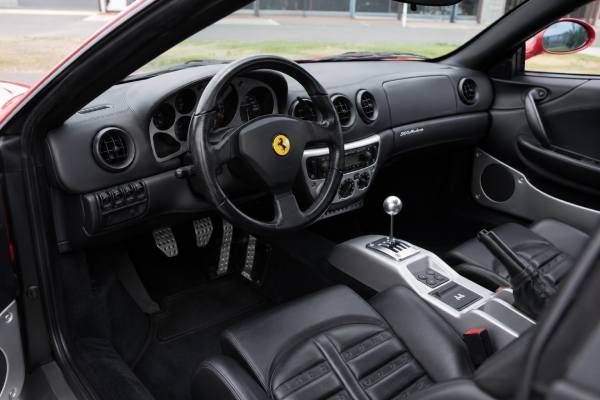
The manual gearbox is the classic open-gate Ferrari arrangement, with a metal shift gate and a mechanical lever. The F1 gearbox is not a torque-converter automatic or a dual-clutch transmission. It is an automated version of the manual transaxle, using electrohydraulic actuators to operate clutch and gear selection through steering-column paddles. This distinction matters for buyers because the F1 system still has a conventional clutch, clutch wear readings, hydraulic components, and setup requirements.
| Area | Detail |
|---|---|
| Structure | Aluminum spaceframe with aluminum body panels |
| Suspension | Independent double wishbones front and rear |
| Damping | Electronically controlled adaptive dampers |
| Steering | Power-assisted rack and pinion |
| Brakes | Ventilated steel discs with ABS |
| Standard tires | 215/45 ZR18 front, 275/40 ZR18 rear |
| Length | 4,477 mm |
| Width | 1,922 mm |
| Height | 1,214 mm |
| Wheelbase | 2,600 mm |
| Fuel capacity | 95 liters |
The 360 is physically larger than the F355, especially in wheelbase and cabin width, yet its aluminum construction helped control weight. Ferrari’s use of aluminum was not a small detail. It gave the 360 a different feel: less old-car flex, more stability in fast corners, and a more modern ride structure. The chassis also made the Spider version more feasible without simply turning the open car into a compromised flexing shell.
Performance figures vary by test conditions, gearbox, tires, and measurement method. Ferrari quoted a top speed of about 295 km/h and 0–100 km/h in the mid-four-second range. Independent tests typically placed 0–60 mph around the low-to-mid fours and the quarter mile around the low 13-second range for standard cars. By modern supercar standards, the numbers are no longer shocking. The engine response, sound, steering, and balance remain the real reason the car still matters.
Production, Variants, and Factory Options
The 360 Modena coupe was the original road version, followed by the 360 Spider, the race-focused 360 Challenge, and the road-legal Challenge Stradale. For buying and collecting, the key split is usually coupe versus Spider, manual versus F1, and standard Modena versus Challenge Stradale.
The 360 family was built in much higher numbers than older limited-production Ferraris, which helps explain why buyers can still be selective. Commonly cited production estimates put total 360-family road production at roughly the high-teens in thousands, with around 8,800 Modena coupes, more than 7,500 Spiders, and about 1,288 Challenge Stradales. Exact market-specific counts vary by source and definition, but the important buying point is clear: standard F1 cars are much easier to find than original gated-manual cars, and manual coupes command a strong premium.
| Variant | Role | Buyer relevance |
|---|---|---|
| 360 Modena | Berlinetta coupe and core model | Most relevant to collectors seeking the cleanest original 360 shape |
| 360 Spider | Open-top road car | More sensory and popular, but heavier and more complex around roof hardware |
| 360 Challenge | Factory-built race car for one-make competition | Track history and condition matter more than road usability |
| Challenge Stradale | Lightweight, sharper road car derived from Challenge thinking | The most collectible regular-production 360 derivative |
The Modena could be ordered with a conventional six-speed manual or the F1 paddle-shift gearbox. Early in the 360’s life, the F1 gearbox was a technology statement. Today, the manual is the collector favorite because it is more engaging, rarer, easier to understand mechanically, and tied to the classic Ferrari open-gate experience. The F1 car should not be dismissed, though. A well-set-up F1 360 can be quick, entertaining, and less expensive to buy. The problem is that neglected F1 systems can become costly.
Factory and dealer options can strongly affect desirability. Commonly discussed features include:
- Daytona-style seats
- Carbon-fiber racing seats
- Scuderia Ferrari fender shields
- Challenge-style rear grille
- Modular wheels
- Colored brake calipers
- Leather headliner
- Contrasting stitching and piping
- Fire extinguisher
- Hi-fi audio upgrades
- Carbon interior trim
- Special-order paint and leather combinations
The Challenge-style rear grille is popular because it helps the car visually and can assist heat evacuation from the engine bay. Fender shields are also widely desired, though buyers should distinguish factory shields from later add-ons. Factory shields sit in proper recessed panels, while aftermarket badges may simply be attached to the fender surface.
Color has a large effect on buyer interest. Rosso Corsa over tan remains the familiar Ferrari look and is easy to sell. Giallo Modena, Argento Nürburgring, Nero, Tour de France Blue, Grigio Alloy, and other period colors can be very appealing when matched with the right interior. Overly personalized interiors, heavy aftermarket audio, poor carbon wrap, or non-factory body additions can narrow the buyer pool.
Documentation matters more as the car ages. A strong file should ideally include the original books, tool kit, service invoices, clutch readings for F1 cars, belt-service records, ownership history, paintwork notes, and evidence that recalls or service campaigns were addressed. Ferrari Classiche certification may not be essential for every 360, but originality and correct specification are increasingly important for top-market examples.
Design, Engineering, and Special Details
The 360 Modena’s design is distinctive because its shape was driven by Ferrari’s new aluminum structure, cooling needs, and underbody aero rather than by nostalgia for earlier V8 cars. It looks smoother than the F355, but it is also more technically deliberate.
The nose has no traditional central Ferrari grille. Instead, large openings at each front corner feed the radiators. Air management is part of the visual identity: the front intakes, side scoops, underbody, rear diffuser area, and rear deck all serve the car’s packaging. The side intakes are not decorative; they feed the mid-mounted V8 and help define the car’s wide-hipped stance. The rear glass cover turns the engine into a visible feature, making the mechanical layout part of the design.
The aluminum spaceframe is one of the car’s most important engineering features. Compared with older construction, it improved stiffness and reduced weight. It also allowed Ferrari to create a larger cabin and wider tracks without making the car feel like a heavy grand tourer. The 360 is a relatively usable exotic because the cockpit has more room, the view forward is good, and the controls are less cramped than in many earlier Ferraris.
Inside, the Modena mixes old and new Ferrari traits. The manual car has the famous metal gate and polished shift knob. The F1 version replaces the lever with paddles and a more open center tunnel. The dashboard is simple by modern standards, with analog instruments, an 8,500-rpm redline area, and a driver-focused layout. Many cars now suffer from sticky switches and shrinking leather, but the basic cabin design is clean and purposeful.
The sound is central to the 360’s identity. The five-valve V8 is not as bass-heavy as later turbocharged engines and not as smooth as a V12. It has a hard metallic edge, especially above 5,000 rpm, and becomes urgent near the top of the rev range. Exhaust choice makes a big difference. Stock systems are still sharp and civilized. Tubi, Capristo, and other aftermarket systems can make the car more dramatic, but buyers should consider noise, drone, emissions legality, and originality.
The 360 also introduced a more mature electronic layer without making the car feel digital. It has adaptive damping, traction control, ABS, engine management that can be diagnosed with modern tools, and F1 gearbox control on paddle-shift cars. Yet it does not have a dual-clutch transmission, electric power steering, hybrid boost, or complex active aerodynamics. That is why many enthusiasts see it as a sweet spot: modern enough to use, old enough to feel mechanical.
Compared with the F355, the 360 is roomier, faster, stiffer, and easier to service in some key areas. Compared with the F430, it is less powerful, less polished, and less electronically integrated. That slightly raw character is part of the appeal. It feels like a modern classic rather than a current supercar.
Driving Experience and Real Performance
The 360 Modena feels fast because of its response, sound, and balance, not because it overwhelms the road with modern horsepower. Its 400 hp output is now matched by many performance cars, but few deliver it with the same high-revving urgency and mid-engined Ferrari feel.
At low speed, the car is more usable than its exotic shape suggests. The cabin is reasonably airy, forward visibility is good, and the controls are not punishing. The ride is firm but not brutal when the suspension is healthy and the car is on correct tires. Worn dampers, old tires, incorrect alignment, or tired suspension bushings can make a 360 feel nervous or loose, so driving impressions depend heavily on condition.
The engine is the main event. Below about 3,500 rpm, it is tractable rather than explosive. From the midrange upward, it sharpens quickly. The last few thousand rpm deliver the classic Ferrari reward: more sound, more urgency, and a sense that the engine is happier the harder it works. Throttle response is immediate compared with turbocharged cars, and the flat-plane V8 gives the car a clean, hard-edged note.
Manual cars offer the richest interaction. The gated shift is mechanical, deliberate, and satisfying when warm. Like many Ferraris of this era, it can feel stiff when cold, especially into second gear. A patient driver lets the gearbox warm through before rushing shifts. A good manual 360 feels special even at moderate speed because every shift is part of the experience.
The F1 gearbox is more complicated to judge. In period, it felt advanced. Today, it feels clearly like an early automated manual. In gentle driving it can be jerky if poorly set up or if the driver treats it like a modern automatic. It works best when driven with mechanical sympathy: lift slightly during low-speed shifts, use decisive throttle when pressing on, and keep the system calibrated. In Sport mode and under hard driving, it can feel much more natural than it does in stop-start traffic.
Steering is one of the car’s strongest qualities. It is lighter than some older Ferraris but still communicates well. The front end is responsive, and the car changes direction with more precision than its rounded body suggests. Mid-corner balance is stable, with the rear giving strong traction if the tires are fresh and properly sized. Old tires are a major problem on these cars. A low-mileage 360 on aged rubber can feel far worse than a higher-mileage car on modern, correct performance tires.
Braking performance is strong for road use, but the standard steel brakes need proper pads, fluid, and cooling for repeated track work. The pedal should feel firm and progressive. Vibration, pulling, or long pedal travel points to inspection needs. Many cars spend more time sitting than driving, so brake condition should be judged by age, corrosion, and use pattern, not mileage alone.
On a mountain road, a sorted 360 Modena feels light, alert, and vocal. On a motorway, it is more comfortable than many expect, though road noise and engine presence are always part of the experience. In town, the clutch, low nose, heat, and attention from other drivers remind you it is still an exotic. The best use case is regular weekend driving, touring on open roads, and occasional spirited use rather than daily commuting or heavy track abuse.
Maintenance, Reliability, and Restoration Risks
The 360 Modena can be one of the more manageable modern classic Ferraris, but only when it is maintained on time by people who know the model. It is not a normal used sports car, and the cheapest example usually becomes expensive for predictable reasons.
The biggest scheduled-maintenance topic is the timing-belt service. Unlike the F355, the 360 does not normally require engine removal for belt replacement, which reduces labor compared with earlier mid-engined V8 Ferraris. That does not make the job cheap or optional. Belt age, tensioner condition, cam seals, accessory belts, water pump condition, and related “while you are there” work should all be considered.
Common ownership issues include:
- Timing belts and tensioners overdue by time, not just mileage
- F1 clutch wear, pump weakness, accumulator issues, or poor calibration
- Worn engine and gearbox mounts
- Cracked exhaust manifolds or failing exhaust components
- Sticky interior switches and soft-touch coatings
- Leather dash shrinkage and airbag-cover lifting
- Suspension ball joints, bushings, and tie rods
- Radiator, hose, and coolant leak issues
- Oil leaks from cam covers, seals, or lines
- Weak batteries causing strange electronic faults
- Alarm siren battery failure
- Slow window regulators or electrical switch problems
The F1 system deserves a careful inspection. Buyers should ask for clutch wear readings, PIS setup information, service history for the F1 pump and actuator, and evidence that the gearbox shifts cleanly when warm. A jerky F1 car is not automatically broken, but poor behavior can point to worn clutch parts, bad setup, hydraulic pressure issues, or a driver unfamiliar with the system.
Manual cars avoid F1 hydraulic complexity but are not maintenance-free. Clutches still wear, shift cables need correct adjustment, engine mounts affect drivetrain feel, and abused synchros can be costly. A manual conversion may be enjoyable, but it does not carry the same collector value as an original factory manual car. Documentation of conversion parts and workmanship is essential if considering one.
Interior restoration is a major ownership reality. Sticky buttons are so common that many owners treat refinishing as normal maintenance. Leather shrinkage can affect the dashboard, instrument binnacle, airbag cover, and rear shelf. Poor trimming work is easy to spot and can hurt value. A clean original interior is now a meaningful value factor.
Body and chassis inspection is critical because the 360’s aluminum construction requires specialist repair knowledge. Accident damage, poor paintwork, incorrect panel gaps, damaged undertrays, and bent mounting points should be treated seriously. Aluminum repairs are not the same as ordinary steel body repairs, and a car with poorly documented crash history should be priced accordingly.
A sensible pre-purchase inspection should include:
- Compression or leak-down test when history is unclear
- Belt-service date and invoice verification
- F1 clutch wear and hydraulic system check where applicable
- Suspension joint and bushing inspection
- Engine and gearbox mount inspection
- Radiator, hose, and cooling-system pressure check
- Exhaust manifold and catalyst inspection
- Diagnostic scan using Ferrari-capable equipment
- Paint-depth readings and accident-history review
- Tire date-code check
- Brake disc, pad, and fluid condition check
- Verification of books, tools, keys, immobilizer fobs, and service records
The best 360s are not necessarily the lowest-mileage cars. They are the cars that have been used enough to stay healthy, serviced often enough to avoid catch-up work, and stored carefully enough to avoid cosmetic decay. A car with 30,000 miles and excellent records may be a better buy than a 5,000-mile car with old belts, flat-spotted tires, sticky controls, and no recent specialist attention.
Values, Buying Advice, and Rivals
The 360 Modena market is now split between collectible manual cars, usable F1 drivers, special variants, and modified or story cars. The smartest buy is rarely the cheapest car; it is the best-documented car in the right specification at a price that leaves room for immediate maintenance.
As of 2026, public market data shows a clear premium for factory manual Modenas over F1 Modenas. Broadly, driver-quality F1 coupes often sit in the lower part of the 360 market, while clean manual coupes can reach well into six figures. Exceptional low-mileage cars, rare colors, highly original interiors, and complete documentation can push values higher. The Challenge Stradale is in a different market tier and should not be used as a direct pricing guide for a standard Modena.
| Value factor | Why it matters |
|---|---|
| Factory manual gearbox | Rarer, more engaging, and more collectible than the F1 gearbox |
| Service history | Shows whether belts, fluids, clutch, and age-related work were handled properly |
| Original paint and panels | Important because aluminum body repair quality varies widely |
| Color combination | Classic Ferrari colors sell easily, while rare tasteful colors can attract collectors |
| Mileage | Low mileage helps only when maintenance and storage quality are also strong |
| Interior condition | Sticky parts, leather shrinkage, and poor retrimming reduce appeal |
| Factory options | Shields, Daytona seats, racing seats, and Challenge grille can improve desirability |
| Accident history | Story cars can be good drivers but should be priced well below clean examples |
For most buyers, the sweet spot is a well-maintained car with complete records, fresh tires, recent belts, no major accident history, and a specification they genuinely like. A factory manual coupe is the strongest collector choice, but it costs more up front. A good F1 coupe can make sense for an owner who wants the sound, looks, and chassis experience without paying the manual premium. The key is to buy the best F1 car available, not merely the cheapest.
Cars to seek include:
- Factory manual Modenas with original books, tools, and documented service
- F1 cars with recent clutch data, smooth operation, and specialist maintenance
- Cars with tasteful factory options and no irreversible modifications
- Examples with recent belt service, fresh tires, and sorted suspension
- Clean, original interiors without major leather shrinkage
Cars to avoid or heavily discount include:
- Cars with missing service history
- Overdue belt-service cars sold as “low mileage, no needs”
- F1 cars with no clutch reading or poor shifting behavior
- Cars with vague accident repairs or inconsistent paintwork
- Heavy aftermarket body kits, poor exhaust work, or non-reversible modifications
- Cars with warning lights dismissed as “minor sensor issues”
- Examples missing keys, alarm fobs, books, tools, or import documents
Rivals depend on the buyer’s goal. A Porsche 996 Turbo is faster in many real-world situations, more practical, and often less expensive to maintain, but it does not offer the same mid-engined Ferrari theater. A Lamborghini Gallardo is more aggressive, newer in feel, and available with a V10, but early e-gear cars bring their own clutch and actuator concerns. The Ferrari F355 is prettier to some eyes and more compact, but it is usually more demanding to maintain. The F430 is faster and more developed, with a stronger 4.3-liter V8 and improved F1 behavior, but it has a different market position and a less delicate early-2000s feel.
The 360 Modena is most satisfying for a buyer who wants a usable modern classic Ferrari rather than a museum object or a numbers-first supercar. It rewards careful buying, regular use, and preventive maintenance. The right car feels alive, mechanical, and special without being so rare that every mile feels like a financial event. That balance is why the 360 remains one of the most important entry points into modern Ferrari ownership.
References
- Ferrari 360 Modena (1999) – Ferrari.com 1999 (Manufacturer Specifications) ([Ferrari][1])
- Fuel Economy of the 2003 Ferrari 360 Modena/Spider 2003 (Official Fuel Economy Data) ([fueleconomy.gov][2])
- Vehicle Detail Search – 2001 FERRARI 360 MODENA | NHTSA 2001 (Recall Database) ([NHTSA][3])
- Ferrari 360 Modena – Manual Market – CLASSIC.COM 2026 (Market Data) ([Classic.com][4])
- Ferrari 360 Modena – F1 Market – CLASSIC.COM 2026 (Market Data) ([Classic.com][5])
Disclaimer
This article is for informational purposes only and is not a substitute for professional diagnosis, repair, inspection, valuation, or restoration advice. Specifications, torque values, service intervals, procedures, recall status, and parts requirements can vary by VIN, market, production date, and equipment. Always verify details against the official Ferrari service documentation for the specific car and consult a qualified Ferrari specialist before purchase or repair.
If this guide helped you, please consider sharing it on Facebook, X/Twitter, or your favorite car community to support our work.