
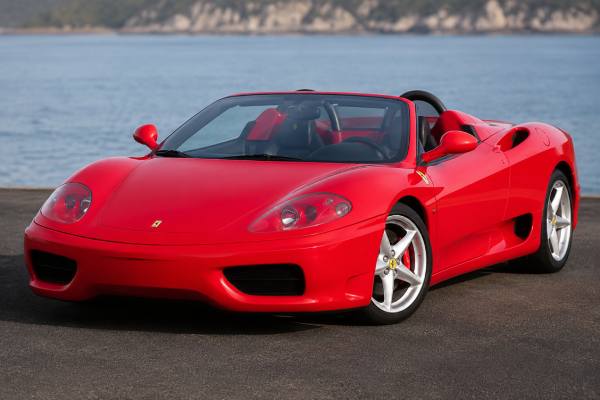
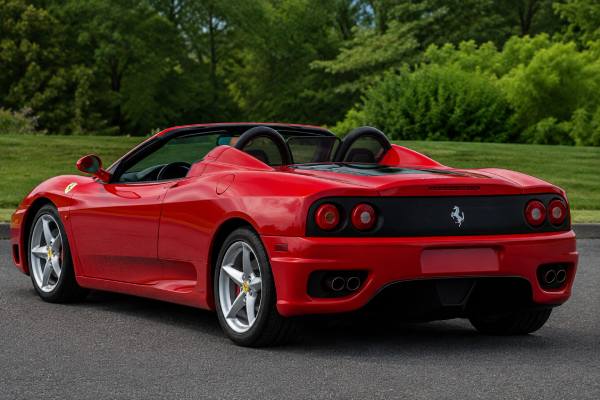
The Ferrari 360 Spider (F131) is the open-top version of Ferrari’s early-2000s mid-engine V8 sports car, powered by the naturally aspirated Tipo F131B 3.6-liter V8 with 400 hp and produced for the 2000–2005 period. It replaced the F355 Spider as Ferrari’s modern V8 convertible and moved the brand into a new aluminum-chassis era, with sharper packaging, more predictable handling, and a design that put the engine on display beneath glass.
Its appeal still comes from a rare mix: classic Ferrari sound, visible mechanical drama, a usable cabin, and the choice of a traditional gated manual or the electrohydraulic F1 paddle-shift gearbox. The 360 Spider is not the rarest modern Ferrari, but condition, service history, originality, and transmission type make a large difference to value and ownership risk.
Quick Take
The Ferrari 360 Spider is most attractive because it combines an 8,500-rpm naturally aspirated V8 with open-air driving and a chassis that feels far more modern than the F355 it replaced. Its aluminum space-frame construction, Pininfarina body, and exposed engine bay give it real historical identity, while the main caution is ownership sensitivity: belts, clutch wear, aging electronics, soft-top hydraulics, suspension joints, and sticky interior trim can turn a cheaper car into an expensive one. The best buys are original, well-documented examples with recent major service, clean paint and chassis history, healthy roof operation, and a specification that matches the buyer’s long-term goals.
Table of Contents
- History and Significance
- Engine, Chassis and Key Specifications
- Production, Variants and Factory Options
- Design, Engineering and Special Features
- Driving Experience and Performance Character
- Reliability, Maintenance and Restoration Risks
- Market Value, Buying Guide and Rivals
History and Significance
The 360 Spider matters because it was Ferrari’s first mid-engine V8 convertible built around the brand’s new aluminum space-frame architecture. It kept the emotional layout of the F355 Spider but replaced much of the older car’s steel-era feel with a wider, lighter, stiffer, and more aerodynamic platform.
Ferrari introduced the 360 Modena first, then followed with the Spider as the open model. The car arrived at a turning point for Ferrari road cars. Earlier mid-engine V8 Ferraris had a more compact, angular, and sometimes demanding character. The 360 was larger and more flowing, with fixed headlights, a glass engine cover, a flatter underbody, and a cleaner aerodynamic shape.
The Spider was not an afterthought. Ferrari designed the 360 structure with a convertible in mind, adding reinforcement where the open body needed strength. That helped the Spider retain much of the Modena’s handling precision while giving buyers the open-air experience that had become central to Ferrari’s V8 line.
Its place in the model line is simple but important:
- It succeeded the Ferrari F355 Spider.
- It sat below the larger V12 grand tourers in price and size.
- It preceded the F430 Spider, which evolved the same basic layout with more power and sharper electronics.
- It represented Ferrari’s move away from the old steel-framed V8 era.
- It helped normalize the F1 paddle-shift gearbox among Ferrari road-car buyers.
The 360 Spider also marked a change in usability. It was still an exotic car with expensive service needs, but it was easier to see out of, easier to drive at low speed, and more forgiving than many older Ferraris. The cabin was not luxurious in the modern sense, but it felt more practical than the F355’s tighter cockpit.
Collectors care about the 360 Spider today because it sits in a useful middle ground. It is modern enough to be driven regularly with proper care, yet old enough to offer analog steering feel, a naturally aspirated flat-plane-crank V8, and available gated manual shifting. It also came before the later era of dual-clutch gearboxes, turbocharging, and heavier driver-assistance systems.
The car’s reputation has changed over time. For years, the 360 was viewed as an accessible entry into modern Ferrari ownership. That kept prices lower than more limited or older models. More recently, buyers have become more selective. Manual Spiders, unusual colors, low-mileage cars, and highly original examples have become more sought after, while tired F1 cars with deferred maintenance remain risky.
Engine, Chassis and Key Specifications
The heart of the 360 Spider is a 3,586 cc naturally aspirated V8 mounted longitudinally behind the cabin. It is a high-revving, dry-sump Ferrari engine with five valves per cylinder, 400 hp, and a sharp top-end character that defines the car more than its raw numbers.
| Item | Specification |
|---|---|
| Model code | F131 |
| Engine | Tipo F131B 90-degree V8 |
| Displacement | 3,586 cc / 3.6 liters |
| Induction | Naturally aspirated |
| Valvetrain | DOHC, five valves per cylinder |
| Power | 400 hp at 8,500 rpm |
| Torque | 373 Nm / 275 lb-ft at 4,750 rpm |
| Fuel system | Bosch Motronic electronic fuel injection |
| Drive layout | Mid-engine, rear-wheel drive |
| Transmissions | 6-speed manual or 6-speed F1 automated manual |
The engine uses a flat-plane crankshaft, which helps explain the sound. It does not have the deep rumble of a cross-plane American V8. Instead, it has a hard-edged, rising pitch that becomes much more intense near the upper half of the tachometer. The car rewards revs. Around town, it is flexible enough, but the real performance arrives when the engine is kept alive above the midrange.
The transmission choice is one of the most important technical and market differences. The 6-speed manual uses Ferrari’s famous open metal shift gate. It is slower than a modern dual-clutch gearbox, but it gives the car much of its collector appeal. The F1 gearbox uses the same basic manual transaxle architecture, but clutch and shift actuation are handled electrohydraulically through paddles. It was advanced for its time, though it feels slow and mechanical compared with later dual-clutch systems.
| Area | Specification |
|---|---|
| Structure | Aluminum space frame with aluminum body panels |
| Suspension | Independent double wishbones, coil springs, anti-roll bars |
| Steering | Power-assisted rack and pinion |
| Brakes | Ventilated steel discs with ABS |
| Front tires | 215/45 ZR18 |
| Rear tires | 275/40 ZR18 |
| Wheelbase | 2,600 mm |
| Length | 4,477 mm |
| Width | 1,922 mm |
| Fuel capacity | 95 liters |
Official performance figures put the 360 Spider in serious early-2000s exotic territory. A healthy car is capable of roughly 0–100 km/h in the mid-4-second range and a top speed around 180 mph, depending on market specification, conditions, and measurement method. More important than the stopwatch is how the car delivers speed: light flywheel feel, quick throttle response, strong induction noise, and a power curve that encourages the driver to chase the redline.
The chassis is a major part of the car’s identity. Ferrari’s aluminum construction reduced weight compared with a conventional steel structure and improved rigidity. For the Spider, the structure includes extra reinforcement to compensate for the missing fixed roof. That makes it heavier than the Modena coupe, but not so much heavier that the character is lost.
Production, Variants and Factory Options
The 360 Spider was the open-road version of the 360 family, offered alongside the Modena coupe and followed by the more focused Challenge Stradale coupe. For buyers, the key differences are body style, gearbox, market specification, color, interior trim, and factory equipment rather than major engine variations.
The main 360 road-car family included:
- 360 Modena: the fixed-roof coupe and first 360 road model.
- 360 Spider: the convertible model with an electrically operated fabric roof.
- Challenge Stradale: the lighter, sharper, track-focused road coupe based on the 360 platform.
The Spider’s most important choice was transmission. Early-2000s Ferrari buyers increasingly chose the F1 gearbox, so original gated manual Spiders are more desirable today. A well-sorted F1 car can still be rewarding, especially for buyers who like the period paddle-shift experience, but the manual is the stronger collector configuration.
Factory options and specification details can make a meaningful difference. Common areas to check include:
- Daytona-style seat inserts
- electric seats or carbon-backed sport seats, depending on market and availability
- colored brake calipers
- Scuderia Ferrari fender shields
- modular wheels
- leather color and stitching combinations
- rear Challenge grille
- stereo upgrades
- exterior color outside the usual Rosso Corsa
- contrasting soft-top color
- luggage and tool kit completeness
Color matters more than some buyers expect. Rosso Corsa remains the recognizable Ferrari choice and is easy to sell, but Argento Nürburgring, Grigio Titanio, Nero, Blu Tour de France, Giallo Modena, and other less common colors can be attractive when paired with the right interior. Very unusual specifications may appeal strongly to collectors, but only when originality and documentation are clear.
Documentation is critical. A strong 360 Spider should have service invoices, books, tools, tire-inflator kit where applicable, alarm fobs, radio code information, and records that connect the car’s mileage and maintenance history. Ferrari Classiche certification is not essential for every 360 Spider, but factory documentation and originality become more valuable as the model ages.
Market-specific details also matter. U.S., European, Japanese, and other-market cars can differ in lighting, emissions equipment, speedometer units, bumper compliance, and paperwork. Imported cars are not automatically bad, but buyers should confirm legal import status, federalization work where relevant, and whether parts or diagnostic support differ from the local-market version.
A final point is manual conversion. Some F1 cars have been converted to gated manual specification. A high-quality conversion can improve the driving experience, but it is not the same as an original factory manual in collector terms. Buyers should separate three categories clearly: original manual, professionally converted manual, and original F1.
Design, Engineering and Special Features
The 360 Spider is distinctive because it makes its engineering visible. The glass engine cover, open rear buttresses, wide side intakes, and low nose all serve the car’s mechanical layout rather than simply decorating it.
Pininfarina’s shape marked a clear break from the F355. The older car had sharper edges and retractable headlights. The 360 moved to a smoother body with fixed headlamps and larger surfaces shaped around airflow. The nose has prominent corner intakes, while the rear uses a broad stance and exposed engine presentation to create drama without relying on a large fixed wing.
The aluminum space frame was the engineering story beneath the design. Compared with Ferrari’s older V8 construction, the 360’s chassis allowed a larger body and better stiffness without a simple weight penalty. This mattered even more for the Spider, because open cars lose the roof as a structural member. Ferrari compensated with reinforced sills, floorpan changes, a stronger windscreen frame, rear bulkhead work, roll-over structures, and additional bracing.
The roof is a key feature and a key inspection area. It is an electrically operated fabric soft top that folds beneath the rear deck area. The mechanism gives the car a clean profile when open, but it adds complexity. Hydraulic rams, elastic straps, microswitches, linkages, fabric condition, and alignment all matter. A roof that operates slowly, unevenly, or only with assistance can be a warning sign.
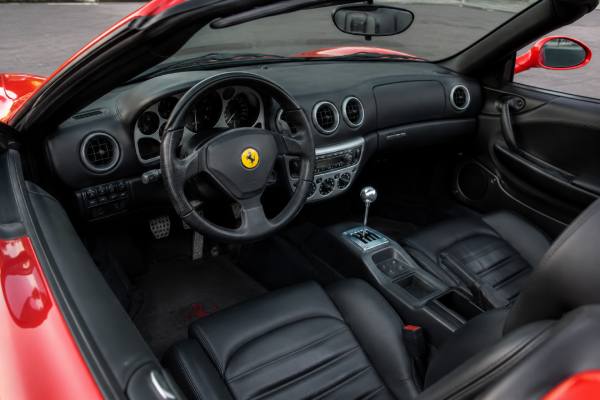
The cockpit is driver-focused but not minimalist. The dashboard is simple by modern standards, and many interior surfaces are leather-covered. The 360 still has physical controls and a conventional driving position, but it also shows typical Ferrari wear points. Sticky switches, shrinking leather, worn seat bolsters, and damaged air vents are common age-related issues.
The sound design is mostly mechanical. The flat-plane V8, intake routing, and exhaust layout create a sharp tone that becomes more metallic with revs. Many cars have aftermarket exhaust systems, especially Tubi or Capristo-style setups. These can sound excellent, but originality matters. A buyer should check whether the original exhaust parts are included, whether emissions equipment is intact, and whether drone becomes tiring on longer drives.
Cooling and airflow are also central to the design. The front intakes feed radiators, while the side openings and rear deck help manage engine-bay heat. Because the engine is visible, poor detailing, missing panels, incorrect fasteners, heat damage, or neglected fluids are easier to spot than on some exotics. That visibility is part of the car’s charm, but it also exposes neglect.
Driving Experience and Performance Character
A good 360 Spider feels light, vocal, and more approachable than its exotic looks suggest. It is fast enough to feel serious today, but its main pleasure is the connection between throttle, engine note, steering, gearbox, and open-air visibility.
The engine is the centerpiece. Below about 3,000 rpm, it is tractable rather than explosive. The car can cruise and move through town without constant drama. As the revs rise, the V8 becomes sharper, louder, and more urgent. Near the top of the tachometer, the 360 delivers the kind of high-revving Ferrari character that later turbocharged cars cannot exactly copy.
The manual gearbox gives the car a more deliberate rhythm. The open-gate shift rewards clean inputs and patience when cold. It is not a gearbox to rush clumsily. Once warm, a good manual 360 Spider has a mechanical feel that makes ordinary road speeds enjoyable.
The F1 gearbox is different. It shifts best when the driver understands it as an automated manual, not as a modern automatic. At low speed it can feel jerky, especially if the clutch is worn or the system is poorly adjusted. On open roads, with firm throttle and clean paddle inputs, it feels much more natural. The system has period charm, but buyers expecting seamless dual-clutch behavior may be disappointed.
Steering is one of the car’s strengths. The 360 is wider and more stable than the F355, but it still has clear front-end feedback. It does not feel isolated like many newer supercars. The front tires are relatively narrow by modern standards, which helps steering feel and turn-in, though tire age and tire model make a huge difference.
Ride quality is firm but not punishing when the suspension is fresh. Worn dampers, tired bushings, old tires, or incorrect alignment can make the car nervous, crashy, or vague. A properly set up 360 Spider should feel stable at speed and responsive on a winding road.
Braking performance is strong for the period, but standard steel brakes need proper inspection. Track use, old fluid, worn discs, tired pads, or sticky calipers can reduce confidence. Unlike later carbon-ceramic systems, steel brake replacement is more manageable, but not cheap.
Open-top driving changes the character. With the roof down, the engine and exhaust become more central to the experience. The car feels dramatic even when not being driven hard. With the roof up, noise and refinement are acceptable for an early-2000s exotic, but not luxury-car quiet. Wind noise, roof condition, and seal alignment vary strongly by example.
The 360 Spider is usable, but not carefree. It has low ground clearance, wide rear bodywork, expensive tires, limited luggage space, and a cabin that dislikes neglect. In city driving, clutch wear is a real issue for F1 cars. On mountain roads, it feels alive. On track, it can be enjoyable, but cooling, brakes, tires, and maintenance costs make it better suited to careful occasional use than repeated hard abuse.
Reliability, Maintenance and Restoration Risks
The 360 Spider can be reliable by exotic-car standards, but only when maintained on schedule by people who know the model. The biggest ownership mistake is buying a low-priced car with old belts, weak clutch readings, roof faults, sticky interior parts, tired suspension, and incomplete records.
The engine is generally strong when serviced properly. The 360 has timing belts, and belt service is one of the core maintenance items. Unlike some older Ferraris, the engine does not normally need to be removed just to perform belt service, which helps control cost. Still, a proper major service may include belts, tensioners, fluids, filters, accessory belts, cam-cover gasket checks, spark plugs, and inspection of leaks or worn mounts.
Common mechanical and age-related concerns include:
- timing-belt age and tensioner condition
- cam-cover and oil leaks
- worn engine mounts
- cooling-system leaks or weak fans
- radiator condition and debris buildup
- exhaust manifold or header problems
- cracked exhaust brackets
- F1 pump, actuator, relay, and accumulator issues
- clutch wear, especially on F1 cars used in traffic
- gearbox leaks or poor shift adjustment
- suspension ball joints and bushings
- worn shock absorbers
- sticky interior switches and trim
- roof hydraulic or microswitch faults
- alarm immobilizer and key-fob issues
- shrinking leather on dashboard or airbag covers
For F1 cars, a diagnostic clutch reading is essential. It is not the only measure of health, but it gives useful context. A car with low clutch life remaining, poor engagement, warning lights, or rough low-speed behavior needs specialist attention before purchase. A manual car avoids the F1 hydraulic system, but it still has a clutch, shift linkage, gearbox oil, mounts, and possible synchro wear.
The soft top deserves a full test. It should open and close smoothly, latch correctly, and sit evenly. Slow movement, uneven folding, warning lights, fluid leaks, or manual assistance can mean expensive troubleshooting. Roof problems can be simple, but they can also involve multiple small faults that take time to diagnose.
Suspension refresh is often overlooked. Many 360 Spiders are now old enough to need ball joints, bushings, tie-rod ends, alignment correction, and shock inspection. A car can look excellent and still feel loose because the suspension has aged gradually.
Interior restoration is another cost driver. Sticky buttons are common on Ferraris of this era. Poor refinishing can look worse than the original problem. Leather shrinkage, worn seat bolsters, damaged carpets, and cracked vents are all fixable, but a high-quality cabin restoration can become expensive.
Originality versus upgrades needs careful thought. Sensible upgrades such as improved exhaust brackets, better relays, updated F1 components, quality tires, or professionally refinished sticky parts can improve ownership. Heavy modifications, poor aftermarket wheels, non-original paint colors, missing emissions equipment, or untidy audio installations usually hurt value.
A pre-purchase inspection should be done by a Ferrari specialist, not a general used-car mechanic. The inspection should include lift inspection, diagnostic scan, clutch data for F1 cars, roof operation, compression or leak-down testing where concerns exist, paint-depth readings, service-record review, tire date codes, brake measurements, and confirmation that all warning lights behave correctly.
Market Value, Buying Guide and Rivals
The 360 Spider market is now split between collectible examples and driver-grade cars. Original gated manuals, rare colors, low-mileage cars, and complete-history examples bring the strongest money, while F1 cars with average mileage remain more affordable but can carry higher repair risk if neglected.
Current market data shows a wide spread. Driver-quality F1 Spiders often trade well below the best manuals. Excellent manual Spiders can bring a large premium, especially when mileage is low, colors are desirable, and the car has clean documentation. Ultra-low-mile cars are not automatically the best ownership choice, because long storage can create rubber, hydraulic, fuel-system, and electronic issues.
Value is driven by:
- original factory manual gearbox
- documented mileage
- recent belt and major service
- clutch life and F1 system health
- clean roof operation
- original paint or high-quality paint history
- accident-free chassis
- complete books, tools, fobs, and service records
- desirable color combination
- unmodified exhaust and emissions equipment, or included original parts
- specialist ownership history
- interior condition
- tire age and correct tire specification
A strong buyer checklist should include the following:
| Area | What to verify | Why it matters |
|---|---|---|
| Service history | Belts, fluids, annual care, invoices | Deferred maintenance can exceed the apparent price saving |
| Transmission | Manual originality or F1 clutch data | Transmission type strongly affects value and repair risk |
| Soft top | Smooth operation, no leaks, correct latching | Roof faults can be time-consuming to diagnose |
| Chassis and paint | Paint meter, panel gaps, underbody damagetd>Paint meter, panel gaps, underbody damage | Accident repair affects safety, value, and resale |
| Suspension | Ball joints, bushings, dampers, alignment | Tired suspension ruins the car’s handling feel |
| Interior | Sticky trim, leather shrinkage, switchgear | Cosmetic restoration is expensive when done correctly |
Examples to seek are original, well-used but not abused cars with consistent care. A 360 Spider with 20,000–40,000 miles, excellent records, recent major service, fresh tires, healthy clutch, and clean cosmetics may be a better ownership car than a very low-mile example that has been stored for years.
Examples to avoid include cars with missing history, unclear import paperwork, roof warning lights, poor paint repairs, accident damage around suspension pick-up points, heavy aftermarket changes, unresolved gearbox warnings, and sellers who cannot explain service status clearly.
Rivals and alternatives depend on what the buyer wants. The Ferrari F355 Spider is more compact and more old-school, with a beautiful sound and higher maintenance demands. The F430 Spider is faster, more powerful, and more developed, but less analog and usually more expensive. The Porsche 911 Turbo Cabriolet of the same era is more usable and robust, but it does not offer the same mid-engine Ferrari theater. The Lamborghini Gallardo Spyder brings V10 drama and all-wheel-drive traction, but it belongs to a later and different generation. The Aston Martin DB9 Volante is more of a grand tourer than a sharp mid-engine sports car.
For long-term collectability, the 360 Spider has several strengths: it is the first aluminum Ferrari V8 Spider, it has a naturally aspirated high-revving engine, it offers a factory gated manual, and it has a design that has aged well. Its weakness is supply. Ferrari built enough 360 Spiders that ordinary F1 cars are unlikely to become rare in the same way as limited-production Ferraris. The best cars, however, are already separating from average examples.
References
- Ferrari 360 spider (2000) – Fer([Ferrari][1])ial Specifications) citeturn934064search0
- Ferrari Genuine: Ferrari 360 Spider – Ferr([Ferrari][2])cturer Accessories) citeturn934064search1
- Vehicle Detail Search – 2001 FERRARI 36([NHTSA][3])026 (Recall Database) citeturn419537view2
- Fuel Economy of the 2003 Ferrari 360([fueleconomy.gov][4])6 (Fuel Economy Data) citeturn584625view0
- Ferrari 360 Sp([Classic.com][5]) 2026 (Market Data) citeturn546587search7
Disclaimer
This article is for informational purposes only and is not a substitute for professional diagnosis, repair, valuation, or inspection. Specifications, torque values, service intervals, repair procedures, and parts compatibility can vary by VIN, market, production date, and equipment. Always verify details against the official Ferrari service documentation for the specific car.
If you found this guide useful, please consider sharing it on Facebook, X/Twitter, or your preferred car community to support our work.