
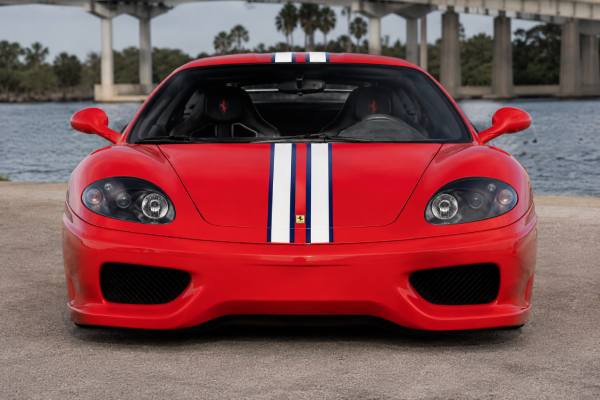
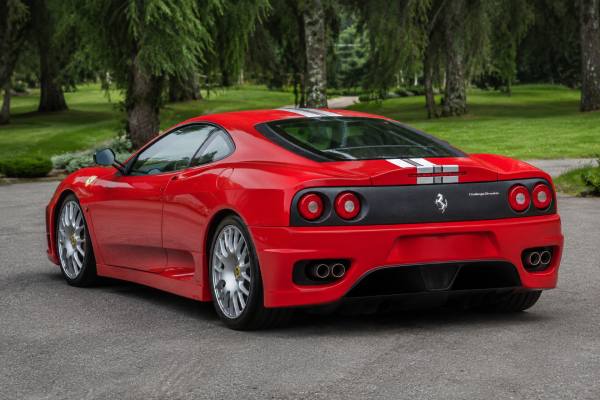
The Ferrari 360 Challenge Stradale is the lightweight, road-legal, track-focused version of the Ferrari 360, built around the Tipo F131F 3.6-liter naturally aspirated V8 and sold for the 2003–2005 model-year period. It sits above the regular 360 Modena and below Ferrari’s pure competition 360 Challenge and 360 GT cars, with 425 hp, a sharper F1 paddle-shift transmission, carbon-ceramic brakes, reduced weight, and a much more intense character than the standard road car.
Its importance is not just its speed. Later Ferrari V8 specials are faster, easier to drive hard, and more technically advanced. The Challenge Stradale matters because it helped establish the modern Ferrari formula for a focused mid-engined V8 special: less weight, louder sound, faster responses, stronger brakes, more aggressive aero tuning, and a cabin stripped back just enough to feel close to a race car. That line later continued through the F430 Scuderia, 458 Speciale, 488 Pista, and newer track-focused Ferrari models.
Collectors still search for the 360 Challenge Stradale because it combines analog-era feel with modern usability. It has hydraulic steering, a high-revving flat-plane-crank V8, a simple cockpit, and real motorsport influence, but it also has electronic engine management, carbon-ceramic brakes, and a factory F1 automated manual gearbox. The strongest examples today are not simply the lowest-mileage cars. They are the cars with original specification, clean history, correct equipment, verified service records, healthy clutch and brake condition, and no vague stories about paintwork, track use, or modifications.
Quick Take
The 360 Challenge Stradale’s strongest appeal is its raw, high-revving V8 personality combined with a genuine factory lightweight package. It is historically important as the first modern Ferrari V8 special to clearly set the pattern for later Scuderia, Speciale, and Pista models, but it is also condition-sensitive and expensive to correct. Buyers should focus on originality, factory stripe documentation, F1 gearbox health, clutch wear, carbon-ceramic brake condition, service history, and evidence of careful use rather than judging by mileage alone.
Table of Contents
- Why the Challenge Stradale Matters
- Engine, Chassis and Core Specifications
- Production, Variants and Factory Options
- Design, Engineering and Special Features
- Road and Track Driving Character
- Maintenance, Reliability and Restoration Risks
- Market Values, Buying Advice and Rivals
Why the Challenge Stradale Matters
The 360 Challenge Stradale matters because it turned the 360 Modena into a sharper, lighter, more race-influenced Ferrari without making it a pure racing car. It was built for drivers who wanted the sound, braking, response, and sense of occasion of a track Ferrari in a car that could still be registered and used on the road.
Ferrari introduced the Challenge Stradale after the 360 Modena and 360 Spider had already established the F131 platform. The regular 360 was an important step for Ferrari’s mid-engined V8 line because it moved away from the F355’s steel-heavy structure and used a much more modern aluminum spaceframe. The Challenge Stradale took that same base and pushed it toward Ferrari’s customer-racing world.
The name tells the story. “Challenge” connects it to the Ferrari Challenge one-make racing series. “Stradale” means road-going. It was not a race car with number plates, but it was heavily influenced by the 360 Modena Challenge and 360 GT. Ferrari’s aim was to give drivers the feel of a competition car while keeping enough road equipment for real-world use.
This gives the car an unusual place in Ferrari history. The F40 and F50 were already famous for putting performance ahead of luxury, but the Challenge Stradale applied a similar idea to Ferrari’s smaller V8 road-car line. It showed that a series-production Ferrari could be made more valuable and more desirable by removing refinement, not adding it.
The car’s reputation has grown with time. When new, some buyers saw it as expensive, loud, stiff, and limited compared with a normal 360 Modena. Today, those qualities are exactly why collectors want it. It arrived before dual-clutch transmissions became the norm, before turbocharged Ferrari V8s, and before modern digital interfaces filled supercar cabins. It still feels mechanical, narrow-focused, and special.
Its influence is easy to see in later models. The F430 Scuderia made the concept faster and more sophisticated. The 458 Speciale added a more polished dual-clutch drivetrain and one of Ferrari’s greatest naturally aspirated V8s. The 488 Pista brought turbocharged speed and advanced aero. Yet the Challenge Stradale remains the starting point for many collectors who want the rawest version of the modern Ferrari V8 special formula.
Production is generally cited at about 1,288 cars worldwide, although buyers should verify exact claims through factory records, registries, and documentation. That number is small enough to support collectability but large enough that buyers can compare examples. Because the market has choices, details matter: original paint, factory stripe, correct carbon trim, complete books and tools, clean accident history, and documented service work all affect value.
Engine, Chassis and Core Specifications
The Challenge Stradale uses a 3,586 cc naturally aspirated V8 related to the 360 Modena’s engine, but with changes that sharpen response and raise output to 425 hp. Its performance comes from the whole package: less weight, faster shift logic, carbon-ceramic brakes, aggressive tires, lower suspension, and more focused calibration.
| Item | Specification |
|---|---|
| Model | Ferrari 360 Challenge Stradale |
| Chassis code | F131 |
| Engine code | Tipo F131F |
| Engine layout | Rear-mid-mounted, longitudinal 90-degree V8 |
| Displacement | 3,586 cc / 3.6 liters |
| Bore x stroke | 85 mm x 79 mm |
| Compression ratio | 11.2:1 |
| Induction | Naturally aspirated |
| Valvetrain | DOHC, five valves per cylinder |
| Engine management | Bosch Motronic 7.3 |
| Maximum output | 425 hp at 8,500 rpm |
| Maximum torque | 38 kgm at 4,750 rpm |
| Transmission | 6-speed F1 electrohydraulic automated manual |
| Drive | Rear-wheel drive |
| Body and chassis | Aluminum body over aluminum spaceframe structure |
| Front tires | 225/35 ZR19 |
| Rear tires | 285/35 ZR19 |
| Fuel capacity | 95 liters |
| Dry weight | 1,180 kg |
| Kerb weight | 1,280 kg |
| Measure | Figure |
|---|---|
| Top speed | 300 km/h / 186 mph |
| 0–100 km/h | 4.1 seconds |
| 0–200 km/h | 13.9 seconds |
| 0–400 m | 12.1 seconds |
| 0–1,000 m | 22.0 seconds |
| Length | 4,477 mm |
| Width | 1,922 mm |
| Height | 1,199 mm |
| Wheelbase | 2,600 mm |
| Front track | 1,669 mm |
| Rear track | 1,617 mm |
The V8 is a dry-sump, flat-plane-crank Ferrari engine that rewards revs. Compared with the 360 Modena, the Challenge Stradale received changes to breathing, intake flow, exhaust back pressure, compression, and calibration. The power increase is modest on paper, but the car feels more alive because the engine is paired with less mass and more aggressive control settings.
The F1 gearbox is central to the car’s character. It is not a torque-converter automatic or a modern dual-clutch transmission. It is a single-clutch automated manual using electrohydraulic actuation. Ferrari developed the Challenge Stradale around this system, with paddle operation only, Sport and Race shift logic, and very quick shift times for its period. There was no normal automatic mode in the same sense as a comfort-oriented road car.
The chassis uses the 360’s aluminum structure, but the suspension, brakes, tires, and electronic settings were made more serious. Carbon-ceramic brakes were a major feature at the time, not just because they were powerful but because they helped repeated hard driving. The tire sizes, ride height, and damper logic all contribute to a car that feels more alert than the standard 360.
Weight figures deserve careful reading. Ferrari’s dry-weight number does not include fluids, and actual road weight depends on market equipment and options. Cars with leather, audio equipment, normal glass, and comfort features will not feel quite as stripped as more focused examples with Alcantara, lightweight seats, and Lexan sliding windows. For buyers, the real specification of the individual car matters more than a single brochure number.
Production, Variants and Factory Options
The Challenge Stradale was built as a focused coupe-only special, so the most important differences between cars are specification, market version, documentation, color, trim, and originality. There was no factory Spider version and no factory gated manual Challenge Stradale.
Every original Challenge Stradale used Ferrari’s F1 paddle-shift transmission. Some cars have since been converted to manual, and those conversions can be enjoyable for drivers who want a gated shift. For collectors, though, a manual conversion is a modification. It should be priced and judged differently from a factory-correct F1 car.
The most desirable factory details vary by buyer, but several items receive close attention:
- factory tricolor racing stripe;
- original exterior color and paint condition;
- Alcantara interior trim;
- carbon-fiber racing seats in the correct size;
- Lexan sliding side windows where fitted;
- radio delete or original audio specification;
- fire extinguisher where optioned;
- original Challenge-style 19-inch wheels;
- carbon-fiber mirrors and door panels;
- books, tools, tire inflator, car cover, keys, and pouch;
- original service booklet and dealer documentation.
Factory stripe and paint identity
The factory stripe is one of the strongest value factors. A stripe added later may look similar in photos, but it does not carry the same collector weight. Buyers should ask for factory option records, early photos, dealer paperwork, or other proof before paying a premium for a striped car.
Paint condition also needs careful inspection. Many Challenge Stradales were driven hard, and some saw track use. Stone chips, lower bumper damage, rocker-panel marks, undertray scrapes, and front-end repainting are common. Repaint is not automatically bad, especially on a car that has been used, but unexplained paintwork is a reason to slow down and inspect more deeply.
Interior options and lightweight details
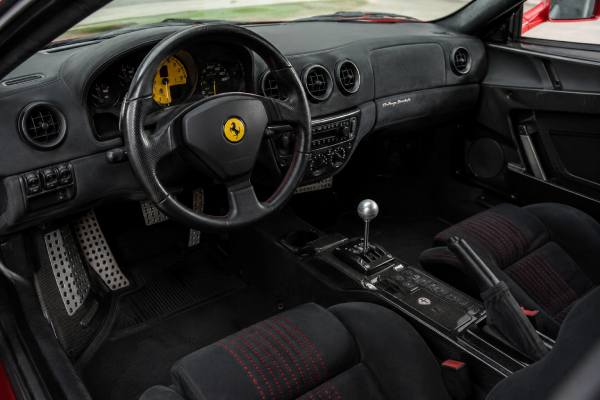
The most purposeful cabins use Alcantara, exposed carbon, racing seats, and minimal equipment. A leather-heavy or comfort-optioned car may be easier to live with, but it does not feel quite as raw. That does not make it wrong; it simply changes the car’s personality and buyer audience.
Seat condition matters. Carbon seat shells can be scratched, Alcantara can become shiny, bolsters can wear, and poor retrims can reduce originality. The correct seat size is also important because these cars are bought to be driven. A beautiful car with seats that do not fit the owner is less usable than it appears.
Market versions and documentation
U.S., European, U.K., Japanese, and other market cars can differ in compliance details, lights, emissions equipment, odometer units, and paperwork. Imported cars can be excellent, but the import path should be clear. A buyer should be able to trace ownership, service, registration, and any federalization or market-conversion work.
Documentation is part of the car’s value. A complete file should show regular service, belt history, clutch readings, brake inspections, recalls where applicable, and any paint or body repairs. Missing books, missing tools, and long service gaps do not always make a car bad, but they change the risk profile and should affect the price.
Design, Engineering and Special Features
The Challenge Stradale looks close to a 360 Modena, but the details are functional and carefully judged. Ferrari did not turn it into a winged race replica; it sharpened the shape, cooling, aerodynamics, braking, weight, and cockpit while preserving the clean Pininfarina body.
The 360’s design marked a major shift from the F355. It replaced the older car’s sharper lines and pop-up-headlight era with a smoother, wider, more open shape. The Challenge Stradale built on that with a deeper front bumper, revised side sills, carbon mirrors, a Challenge-style rear grille, a more purposeful rear lip treatment, and 19-inch wheels that give the car a lower, more planted stance.
Aerodynamics were improved without making the car visually heavy. The front bumper, underbody work, and rear detailing were designed to improve stability and downforce balance. The car still looks elegant, but when parked beside a regular 360 Modena, the lower stance and track-focused pieces are obvious.
The engineering changes can be understood in four main areas.
First, weight reduction. Ferrari removed sound insulation, used lighter body and interior pieces, fitted carbon-fiber components, and made the cabin more focused. The exposed carbon door panels are not decoration; they are part of the lightweight identity.
Second, braking. The carbon-ceramic brake system was advanced for the early 2000s. It reduced unsprung weight compared with conventional steel brakes and gave the car stronger fade resistance during repeated hard use. On the road, the brakes are powerful. On track, they are one of the main reasons the car feels more serious than a standard 360.
Third, sound. The Challenge Stradale is famous for its exhaust note. At low speed it has a hard metallic edge. At high rpm it becomes one of the sharpest and most recognizable modern Ferrari V8 sounds. The exhaust is not just louder; it helps define the entire driving experience.
Fourth, calibration. The throttle, F1 shift strategy, damper behavior, traction control, and Race mode logic make the car feel more alert. Race mode is especially important because it changes how the gearbox and chassis systems respond. The car is electronically managed, but it still feels mechanical compared with newer supercars.
The cockpit is simple by modern standards. There is no large screen and no heavy layer of driver-assistance technology. The driver sees a low dashboard, fixed paddles, lightweight trim, carbon parts, and a cabin that feels narrower and more intimate than many modern exotics. Noise, vibration, and heat are part of the appeal rather than flaws to be engineered away.
Road and Track Driving Character
The Challenge Stradale feels faster than its numbers suggest because it is loud, light-feeling, immediate, and full of mechanical feedback. It is not the easiest Ferrari in traffic, but on the right road or circuit it delivers the rawness that made the model collectible.
At low speed, the F1 transmission shapes the experience. It does not creep like a modern automatic and it does not shift with dual-clutch smoothness. Parking, reversing, and crawling through traffic require patience. A careful driver lifts slightly during low-speed shifts, avoids riding the clutch, and gives the system time to engage.
Once the car is moving quickly, the gearbox makes much more sense. In Race mode, shifts are fast, physical, and dramatic. The car pauses, grabs the next gear, and fires forward with a mechanical punch. It is not as smooth as a later dual-clutch Ferrari, but it has more theater.
The engine is flexible enough for road use, but it comes alive above the middle of the rev range. The V8 wants to rev, and the final few thousand rpm are where the car earns its reputation. Throttle response is crisp, the intake and exhaust harden, and the cabin fills with a sound that is more motorsport than grand touring.
The steering is one of the car’s great strengths. The hydraulic rack gives useful information through the wheel, especially compared with many newer electronically assisted systems. The front end feels eager, and the car responds well to small inputs. A healthy Challenge Stradale feels precise rather than nervous.
Tire condition has a major effect. Old tires, incorrect tire types, poor alignment, or tired suspension can make the car feel skittish. Fresh, correct performance tires and a proper alignment can transform the car. Buyers should not judge the model based on a neglected example.
The ride is firm but not brutal when the suspension is right. A car with worn bushings, tired dampers, damaged wheels, or incorrect ride height can feel harsh and unstable. A good car feels taut, controlled, and communicative.
On track, the Challenge Stradale’s brakes and tire package allow it to work harder than a standard road-biased 360. It is still an early-2000s Ferrari, not a modern track weapon with endless cooling and software support, so mechanical sympathy matters. Warm the fluids, build tire temperature gradually, manage brake condition, and inspect the car afterward.
As a road car, it is usable in a limited but real way. Visibility is better than in many later mid-engined supercars, the size is manageable, and the engine will tolerate normal driving. The compromises are noise, low ride height, costly consumables, and the need to treat the drivetrain carefully. It is not a relaxed commuter. It is a special-occasion car that rewards the driver most when the road opens up.
Maintenance, Reliability and Restoration Risks
A 360 Challenge Stradale can be dependable by exotic-car standards if it is serviced by specialists and used correctly. The expensive cars are the ones with deferred belt work, tired F1 systems, worn carbon brakes, neglected suspension, sticky interiors, accident history, or missing documentation.
The V8 uses timing belts, so belt-service history is a core inspection item. On the 360 platform, the belts can be serviced with the engine in place, which helps compared with some earlier Ferraris. Still, a proper major service should include more than belts. Tensioners, seals, fluids, filters, accessory belts, spark plugs, coolant hoses, mounts, and general inspection all matter.
The F1 gearbox system needs careful evaluation. A diagnostic scan can show clutch wear and system data, but those numbers must be interpreted by someone who knows the platform. A car can show a reassuring clutch reading and still shift poorly if the system is out of adjustment, the pump is weak, or the actuator has problems.
Important inspection areas include:
- timing belts, tensioners, cam seals, and date of last major service;
- clutch wear percentage and F1 system calibration;
- F1 pump, relay, actuator, hydraulic lines, and shift behavior;
- carbon-ceramic disc condition, pad life, chips, cracks, and wear measurement;
- suspension ball joints, bushings, dampers, and alignment;
- engine mounts and gearbox mounts;
- radiators, fans, coolant hoses, and expansion tank condition;
- exhaust valves, manifolds, heat shielding, and mounting points;
- sticky interior switches and soft-touch trim;
- battery, alarm, immobilizer, and warning-light behavior;
- undertray, front splitter, rocker-panel, and floor damage.
Carbon-ceramic brakes are a major cost driver. They should not be judged by a quick glance through the wheels. A proper inspection looks for damage, heat stress, remaining usable life, pad condition, and whether the car has been tracked heavily. Replacing carbon-ceramic components can change the economics of a purchase quickly.
Age matters as much as mileage. A low-mileage car that sat unused for years may need tires, fluids, belts, battery work, seals, sticky-button correction, and recommissioning. A higher-mileage car with regular specialist service may be healthier. Buyers should value evidence of care, not just odometer numbers.
Restoration can be difficult because many Challenge Stradale-specific parts are expensive or hard to source. Correct seats, carbon door panels, mirrors, wheels, exhaust parts, Lexan windows, and factory trim details affect both value and authenticity. Upgrades may improve usability, but they should be reversible and documented.
U.S. cars should be checked by VIN for recall completion. Recall records for the period include issues such as wheel-securing bolts and a hydraulic power-steering delivery hose campaign on affected cars. A dealer or qualified Ferrari specialist can confirm status and record completion.
The best maintenance strategy is preventive. Keep the car on a battery tender, warm it properly before high-rpm use, change fluids regularly, exercise it often enough to keep systems healthy, and use a specialist who understands the Challenge Stradale rather than only the standard 360.
Market Values, Buying Advice and Rivals
The Challenge Stradale is now an established collector Ferrari, not just a used 360 variant. Values depend on originality, factory specification, condition, provenance, mileage, service history, and whether the car still presents as an unspoiled factory special.
At the time of writing, public market trackers place the model’s benchmark around the high-$300,000 to low-$400,000 area, while actual asking prices and auction results vary widely. Exceptional low-mileage, factory-stripe, highly original cars can bring far more than average examples. Cars with stories, modifications, missing equipment, weak service history, or heavy track wear should trade at a meaningful discount.
The strongest value factors are:
- factory-applied stripe;
- original F1 gearbox;
- original paint or fully documented paintwork;
- complete service file;
- verified clutch and brake condition;
- correct carbon-fiber and interior components;
- desirable color combination;
- low but believable mileage;
- clean accident history;
- original books, tools, keys, and accessories;
- Ferrari Classiche documentation where available.
| Area | What to check | Why it matters |
|---|---|---|
| Identity | VIN, market version, factory options, build records | Confirms the car is represented correctly |
| Paint and body | Paint depth, stripe originality, panel gaps, front-end repairs | Accident and repaint history strongly affect value |
| Engine service | Timing belts, tensioners, leaks, mounts, fluids | Deferred maintenance can become expensive quickly |
| F1 system | Clutch wear, shift quality, pump cycling, actuator operation | Drivability and repair cost depend on system health |
| Brakes | Carbon-ceramic discs, pads, measurements, heat damage | Replacement costs can be very high |
| Suspension | Bushings, ball joints, dampers, ride height, alignment | Worn parts ruin the car’s precision |
| Interior | Seats, Alcantara, carbon panels, sticky switches | Correct cabin details are important to collectors |
| Documentation | Invoices, books, recalls, ownership records, tools | Paperwork supports provenance and resale value |
The cars to seek are honest, original, documented, and mechanically fresh. A perfect-looking car with no paperwork can be risky. A car with minor cosmetic wear but strong records may be a better driver. The cars to avoid are those with unexplained repaint, missing records, bad F1 behavior, worn carbon brakes, heavy modifications, or unclear import history.
Buyers should budget beyond the purchase price. Tires, annual service, belt service, clutch work, brake inspection, sticky trim, suspension refresh, and paint correction can add up. A pre-purchase inspection by a Ferrari specialist is not optional on a car like this. It is part of the buying process.
The closest rivals depend on what the buyer values. The Porsche 996 GT3 RS is a natural period comparison, with manual-shift motorsport purity and strong collector appeal. The Lamborghini Gallardo Superleggera offers V10 sound and a more dramatic shape, but it feels like a different kind of car. The Ferrari F430 Scuderia is faster and more developed, while the 458 Speciale is more polished, more powerful, and much easier to drive quickly. A standard 360 Modena manual gives a wonderful gated-shift experience, but it does not have the Challenge Stradale’s factory lightweight identity, rarity, braking system, or sound.
Long-term collectability looks strong because the car has the right ingredients: limited production, clear model significance, naturally aspirated engine, motorsport connection, distinctive sound, and a direct link to later Ferrari special-series cars. The market will continue to separate the best cars from average ones. Original, documented, factory-correct examples should remain the safest place to be.
References
- Ferrari Challenge Stradale (2003) – Ferrari.com 2003 (Manufacturer Specifications)
- Geneva 2003 2003 (Manufacturer Brochure)
- 2004 FERRARI 360 CHALLENGE STRADALE 2026 (Recall Database)
- Ferrari 360 Challenge Stradale Market – CLASSIC.COM 2026 (Market Data)
- 2004 Ferrari 360 Challenge Stradale | Miami 2025 2025 (Auction Listing)
Disclaimer
This article is for informational purposes only and is not a substitute for professional diagnosis, repair, appraisal, or pre-purchase inspection. Specifications, torque values, maintenance intervals, recall status, and procedures can vary by VIN, market, model year, and equipment, so owners and buyers should verify details against official Ferrari service documentation and a qualified Ferrari specialist.
If you found this guide useful, please consider sharing it on Facebook, X/Twitter, or your favorite automotive community to support our work.