
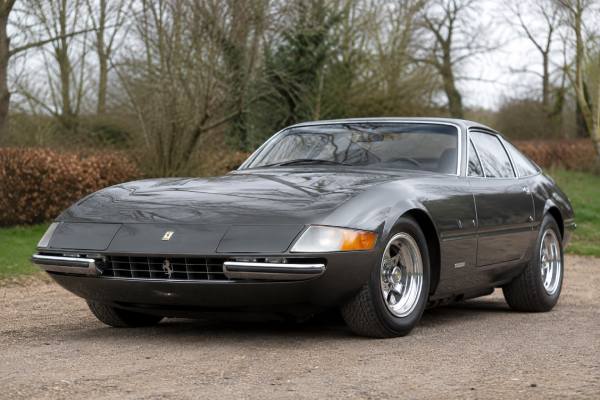
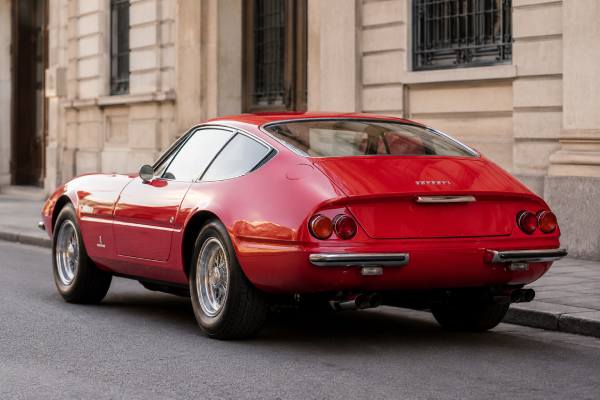
The Ferrari 365 GTB/4, built from 1968 to 1973, is the front-engine V12 berlinetta most people know by its unofficial “Daytona” nickname. Under its long bonnet sits the Tipo 251 4.4-liter Colombo-derived V12, rated at 352 hp in European specification, mounted in a Tipo 605 chassis with a rear transaxle and classic Ferrari grand-touring proportions. It replaced the 275 GTB/4, arrived just as the Lamborghini Miura made mid-engine supercars fashionable, and still matters because it proved the traditional front-engine Ferrari formula could remain brutally fast, elegant, and deeply usable.
This was not a soft luxury coupe. It was a serious high-speed grand tourer with dry-sump lubrication, six Weber carburetors, four camshafts, independent suspension, and a five-speed transaxle. Today, the 365 GTB/4 attracts two very different groups: drivers who want one of Ferrari’s great road cars, and collectors who care about matching numbers, factory colors, early Plexiglas-nose cars, right-hand-drive rarity, Spider authenticity, and Ferrari Classiche documentation.
Quick Take
The Ferrari 365 GTB/4 is most appealing as a fast, muscular, front-engine V12 Ferrari that combines old-world mechanical feel with genuine 170-mph-period performance. Its identity rests on the Tipo 251 quad-cam V12, Pininfarina design, Scaglietti construction, and its status as the last classic two-seat front-engine Ferrari flagship before the Berlinetta Boxer era. The main caution is that values are extremely sensitive to originality, accident history, corrosion, engine and transaxle identity, and restoration quality; buying the wrong Daytona can turn a famous Ferrari into a very expensive recovery project.
Table of Contents
- History and Collector Significance
- Engine, Chassis and Key Specs
- Production, Variants and Options
- Design, Engineering and Special Details
- Road Feel, Performance and Usability
- Maintenance, Restoration and Known Risks
- Values, Buying Advice and Rivals
History and Collector Significance
The 365 GTB/4 matters because it closed one chapter of Ferrari history while becoming one of the strongest arguments for the front-engine V12 grand tourer. It was launched at the 1968 Paris Motor Show as the successor to the 275 GTB/4 and became Ferrari’s last classic-era two-seat front-engine flagship before the mid-engine 365 GT4 Berlinetta Boxer arrived.
The “Daytona” name was not the formal factory model name. The official designation was 365 GTB/4: “365” for the approximate displacement of each cylinder in cubic centimeters, “GTB” for Gran Turismo Berlinetta, and “4” for four overhead camshafts. The Daytona nickname came from Ferrari’s 1-2-3 finish at the 1967 24 Hours of Daytona and was quickly adopted by the press and public.
Its timing is important. Lamborghini had already shocked the market with the mid-engine Miura. Many expected Ferrari to respond with a road car that moved the engine behind the driver. Instead, Ferrari delivered a more developed version of its proven front-engine formula: a huge V12 up front, a transaxle at the rear, a long bonnet, short tail, and serious long-distance pace.
That choice made the 365 GTB/4 look conservative on paper, but not on the road. Period testers treated it as one of the fastest production cars of its day. Its top-speed reputation, muscular styling, and V12 soundtrack helped it become a benchmark for the 1970s super-GT class.
The body design is credited to Leonardo Fioravanti at Pininfarina, with construction by Scaglietti. Compared with the rounded 275 GTB, the 365 GTB/4 looked sharper, lower, wider, and more modern. Early cars used a clear Plexiglas headlamp cover across the nose; later cars used retractable pop-up headlights to satisfy changing regulations, especially for the U.S. market.
For collectors, the Daytona is important for several reasons:
- It is a direct descendant of the 275 GTB/4, one of Ferrari’s most admired front-engine berlinettas.
- It represents the final evolution of the classic Colombo-based road-car V12 in a two-seat front-engine Ferrari of that period.
- It combines serious road performance with handmade coachbuilt character.
- It has strong concours relevance, especially when original colors, trim, tools, books, and factory documentation remain intact.
- It sits in a sweet spot: rarer and more special than many later production Ferraris, but generally more usable than earlier 1950s and early-1960s V12 cars.
The 365 GTB/4 also gained extra cultural weight through endurance-racing derivatives and high-speed road use. Competition Daytonas were successful in GT racing, including strong showings at Le Mans. The road car’s long-legged personality also made it famous in cross-country speed lore. That blend of real engineering, racing association, and popular mythology explains why the Daytona remains more than a pretty classic Ferrari.
Engine, Chassis and Key Specs
The 365 GTB/4 is defined by its 4.4-liter Tipo 251 V12 and Tipo 605 tubular chassis. The basic layout is traditional Ferrari, but the details are serious: dry-sump lubrication, six twin-choke Weber carburetors, a rear-mounted five-speed transaxle, independent suspension, and four-wheel ventilated disc brakes.
| Item | Specification |
|---|---|
| Production years | 1968–1973 |
| Body style | Two-seat berlinetta coupe |
| Chassis type | Tipo 605 tubular steel chassis |
| Engine | Tipo 251 60-degree V12 |
| Displacement | 4,390.35 cc |
| Bore x stroke | 81 mm x 71 mm |
| Valve gear | Double overhead camshafts per bank, two valves per cylinder |
| Fuel system | Six Weber 40 DCN twin-choke carburetors |
| Lubrication | Dry sump |
| Maximum power | 352 hp at 7,500 rpm |
| Torque | About 431 Nm at 5,500 rpm |
| Transmission | Five-speed manual rear transaxle |
| Drivetrain | Front engine, rear-wheel drive |
The engine is often described as a Colombo V12, but by the Daytona period it was a heavily developed descendant rather than a small early Ferrari engine simply enlarged. It retained the classic 60-degree V12 layout, but the 4.4-liter capacity, quad-cam heads, dry-sump lubrication, and carburetion made it a powerful and sophisticated road-car unit for the late 1960s.
The transaxle layout is central to the car’s balance. The engine sits ahead of the cabin, but the gearbox is mounted at the rear with the final drive. This helped weight distribution and gave the car greater stability than a front-engine, front-gearbox layout would have allowed.
| Area | Detail |
|---|---|
| Front suspension | Independent wishbones, coil springs, telescopic dampers, anti-roll bar |
| Rear suspension | Independent wishbones, coil springs, telescopic dampers, anti-roll bar |
| Brakes | Servo-assisted ventilated discs front and rear |
| Steering | Rack and pinion |
| Wheelbase | 2,400 mm |
| Length | 4,425 mm |
| Width | 1,760 mm |
| Height | 1,245 mm |
| Wheels | 15-inch alloy wheels; wire wheels seen on some cars |
Period performance figures vary because testing conditions, tire condition, gearing, market specification, and measurement methods differed. A healthy European-spec car is generally associated with a top speed around 280 km/h, or about 174 mph. The 0–60 mph figure is usually quoted in the low-six-second range, though some period tests recorded quicker times.
The U.S.-market cars received changes for emissions and lighting regulations. These details can affect power delivery, exhaust layout, appearance, and collector preference. Buyers should never assume every Daytona has the same specification simply because the badge is the same.
Production, Variants and Options
The standard 365 GTB/4 berlinetta is the core Daytona model, but production details matter enormously for value and authenticity. Small differences such as early Plexiglas headlights, pop-up headlights, right-hand drive, U.S. specification, factory air conditioning, original colors, and matching-number drivetrain components can materially change desirability.
Most production estimates put 365 GTB/4 coupe output at roughly 1,280 cars. Ferrari also built the 365 GTS/4 Spider in much smaller numbers, commonly cited at 122 factory Spiders. The Spider is a separate open version, not just a coupe with its roof removed. This distinction is crucial because many Daytona coupes were later converted into open cars.
Plexiglas nose and pop-up headlight cars
Early Daytonas are best known for the Plexiglas-covered headlamp treatment. The clear front cover gives the nose a clean, blade-like appearance and is one of the most desirable visual signatures of the model. Later cars adopted pop-up headlights, partly because of regulatory needs in important export markets.
Neither version is automatically “better” as a driving car. The difference is mainly collector preference, market identity, and visual character. Plexiglas cars tend to attract extra attention because they represent the original design idea more clearly and were built in smaller numbers.
Berlinetta, Spider and conversions
The coupe is the most common form of the 365 GTB/4 and the one that best represents the high-speed grand-touring mission. The factory Spider, officially 365 GTS/4, is far rarer and generally much more valuable.
Spider conversions require careful handling in any buying guide. A converted coupe may be enjoyable, attractive, and professionally built, but it is not the same as a factory 365 GTS/4. A conversion should be valued as a conversion, with the original coupe identity, conversion date, workmanship, and documentation clearly understood.
A serious buyer should confirm:
- Original chassis number and body identity
- Engine and transaxle numbers
- Original delivery market
- Factory body style
- Color and trim at delivery
- Whether it has Ferrari Classiche certification
- Whether the car has been rebodied, converted, or heavily restored
- Whether books, tools, jack, warranty card, and historical invoices remain
Competition Daytonas
Ferrari and private teams developed competition versions of the Daytona for GT racing. These cars are a different collector category from road berlinettas. They can carry major historic-event eligibility and much higher values, but they also require deeper authentication. Period racing history, chassis continuity, body changes, engine specification, and event documentation are all critical.
For most buyers, a road 365 GTB/4 is the realistic target. For major collectors, a genuine Competizione car belongs in the same conversation as important historic racing Ferraris rather than ordinary road Daytonas.
Factory options and trim
The Daytona could be ordered in a wide range of colors and interior combinations. Air conditioning is a desirable feature for usability, especially in warmer climates, though condition and originality matter more than the mere presence of the option. Cromodora alloy wheels are commonly associated with the model, while Borrani wire wheels appear on some cars and can affect the look and value depending on originality.
Original color is a major issue. A red Daytona may be easier to sell, but a rare factory color with documentation can be more interesting to sophisticated collectors. Interior materials, dashboard details, carpets, instruments, switchgear, and even small trim pieces should be checked carefully because correct Daytona parts are expensive and not always easy to source.
Design, Engineering and Special Details
The 365 GTB/4 looks dramatic because its design is both simple and tense: a very long bonnet, low cabin, short rear deck, and sharp front end. It is not decorated heavily, and that restraint is part of why the car has aged so well.
The Pininfarina shape marked a clear break from earlier rounded Ferrari berlinettas. The 275 GTB had flowing curves; the Daytona brought harder edges, a more horizontal stance, and a sense of forward pressure. The early Plexiglas nose made it look especially futuristic for a front-engine car.
The body was built by Scaglietti using traditional coachbuilding methods. This means individual cars can have small differences in panel fit, trim alignment, and restoration details. Buyers should not judge a Daytona like a modern mass-produced car, but they also should not excuse poor gaps, uneven repairs, or distorted panels as “handbuilt character.” Accident repair and low-quality restoration work can hide beneath attractive paint.
Packaging and weight balance
The Daytona’s long bonnet is not just styling theatre. The V12 sits up front, while the gearbox and final drive are at the rear. A torque tube links the engine to the transaxle. This layout helps the car feel more balanced than its proportions suggest.
The cabin is set back, giving the driver a view over a long expanse of bonnet. The driving position feels more like a classic GT than a modern supercar. Visibility forward is part of the experience; rear visibility and low-speed maneuvering require more care.
Cooling, airflow and durability
The Daytona was built for sustained speed, not short bursts. Cooling airflow, oil capacity, and dry-sump lubrication all support high-speed use when the car is properly maintained. That does not mean it tolerates neglect. A tired radiator, weak fans, old hoses, poor carburetor tuning, or ignition faults can turn a robust design into a hot-running, difficult car.
Heat management is also part of the cabin experience. Daytonas can transmit warmth, noise, and mechanical smell into the cockpit. Good insulation, correct exhaust routing, a healthy cooling system, and properly operating ventilation make a large difference.
Interior character
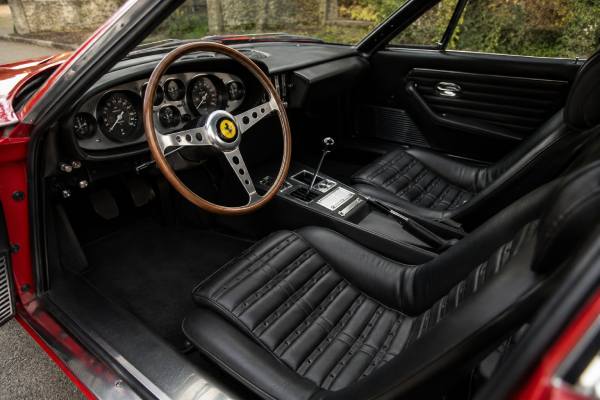
The cabin is functional and serious. Large instruments, a gated manual shifter, slim pillars, leather trim, and a low seating position create a very different feel from a later luxury GT. The Daytona is not filled with convenience features. Its appeal comes from mechanical connection, not insulation from the machine.
Correct interior restoration is expensive. Seats, leather grain, stitching, gauges, switches, carpeting, and steering wheels all matter to originality. A beautifully retrimmed cabin can still reduce collector confidence if it uses incorrect materials or patterns.
Road Feel, Performance and Usability
A good 365 GTB/4 feels fast, heavy in the right ways, and deeply mechanical. It is not delicate at low speed, but it becomes more fluid as speed rises, which is exactly what a 1970s front-engine V12 Ferrari GT was built to do.
The engine dominates the experience. The Tipo 251 V12 has a wide operating range, but it is happiest when warm and properly tuned. At low revs, it can feel smooth and muscular. Higher in the rev range, the carburetors, intake noise, exhaust, and valvetrain build into the hard-edged V12 sound that defines the car.
The gearbox is part of the ritual. Like many classic Ferraris, it should not be rushed when cold. Once warm, a properly adjusted transaxle has a precise, mechanical shift. A baulky second gear, grinding, noisy bearings, or vague linkage should be investigated rather than dismissed as normal old-car behavior.
Steering effort is high at parking speeds. On the move, the rack-and-pinion setup gives strong feedback and a clear sense of the front tires. The Daytona is not as nimble as a small sports car, and it will not hide its mass in tight city traffic. On open roads, fast sweepers, and long-distance routes, it feels planted and confident.
Braking performance is strong for the period when the system is fresh. The ventilated discs and servo assistance were serious equipment, but buyers should judge them by classic-car standards. Old brake fluid, tired hoses, worn discs, sticking calipers, or incorrect pads can make a Daytona feel far worse than it should.
Ride quality depends heavily on condition. Correct dampers, bushings, tires, alignment, and ride height are essential. A restored car with poor setup may look perfect and drive badly. A well-sorted car should feel firm, controlled, and stable rather than harsh or nervous.
City, highway and mountain-road behavior
In city use, the Daytona asks for patience. The clutch can be heavy, the nose is long, the engine needs proper temperature, and the car does not enjoy stop-start traffic as much as a modern GT. Heat soak and carburetor behavior become more noticeable in slow traffic.
On the highway, the car makes much more sense. The gearing, engine character, and chassis stability suit sustained speed. This is where the Daytona’s reputation was made. It is a car for covering distance quickly, not merely posing outside a cafe.
On mountain roads, it rewards smoothness. The driver must manage weight transfer, use the torque, and avoid treating it like a modern mid-engine car. It can be very fast, but it prefers measured inputs over abrupt corrections.
Restored versus tired cars
The difference between a tired Daytona and a well-sorted one is huge. A neglected car can feel hot, heavy, noisy, loose, and intimidating. A properly restored and maintained example can feel cohesive, stable, and surprisingly usable.
For a test drive, pay attention to:
- Cold-start behavior without excessive smoke
- Oil pressure when hot
- Coolant temperature in traffic
- Smooth carburetor progression
- Clean gear engagement when warm
- Steering free play
- Brake pull or vibration
- Differential or transaxle noise
- Suspension knocks
- Exhaust fumes in the cabin
A Daytona should feel mechanical, not crude. There is a big difference.
Maintenance, Restoration and Known Risks
The Daytona is not fragile when maintained correctly, but it is an expensive, specialist classic Ferrari. The biggest ownership risks are not ordinary wear; they are corrosion, accident damage, poor restoration, incorrect parts, drivetrain identity problems, and deferred mechanical work.
The Tipo 251 V12 is a strong engine, but rebuilding it properly is costly. The same applies to the transaxle, suspension, brakes, cooling system, and carburetion. A cheap Daytona rarely stays cheap.
Mechanical priorities
The engine needs proper oil, valve adjustment knowledge, ignition health, carburetor synchronization, and cooling-system integrity. Six Weber carburetors can deliver wonderful response when right, but they punish poor tuning. Ignition components, fuel pumps, lines, filters, and old wiring should be treated as safety and reliability items, not cosmetic details.
Common mechanical areas to inspect include:
- Timing chain condition and tensioner health
- Camshaft, valve-clearance, and top-end wear
- Oil leaks from the engine, dry-sump lines, and tanks
- Carburetor wear, linkage play, and incorrect jetting
- Fuel hose age and fuel smell
- Radiator condition and cooling fan operation
- Water pump condition
- Exhaust manifold leaks
- Clutch wear and release behavior
- Transaxle synchros, bearings, and limited-slip differential noise
The car’s service history should show regular specialist attention. Long periods of storage can be as harmful as high mileage if seals dry out, fuel varnishes, coolant corrodes internal passages, and brake hydraulics deteriorate.
Body, chassis and corrosion
Body and chassis condition are critical. The Daytona’s value can support proper restoration, but structural repair is still expensive and should be priced into the car before purchase.
Inspect carefully for corrosion in:
- Lower door sections
- Sills and rocker areas
- Floor pans
- Wheel arches
- Front and rear valances
- Suspension pickup areas
- Battery area
- Windscreen and rear-window surrounds
- Boot floor
- Inner structure beneath previous repairs
Accident damage is another major concern. Daytonas were powerful cars, and many were used hard when they were simply old exotic cars rather than blue-chip collectibles. Look for asymmetrical panel gaps, uneven chassis measurements, repaired suspension mounts, inconsistent welds, and signs that the nose or tail has been rebuilt.
Originality and documentation
Originality is not just a concours obsession. It directly affects value and confidence. A Daytona with its original engine, transaxle, body, factory colors, books, tools, and clear ownership history is much easier to understand than one assembled from uncertain parts.
Important documentation includes:
- Ferrari Classiche certification, where available
- Factory build information
- Original warranty card or delivery documents
- Old registration records
- Import paperwork
- Service invoices from known specialists
- Restoration photographs and invoices
- Ownership history
- Tool roll, jack, manuals, and spare wheel details
A high-quality restoration can be a positive, especially if the car was tired or corroded before. But undocumented restoration work creates risk. Buyers should know who restored the car, what was replaced, what was repaired, and whether the original drivetrain and body numbers remain.
Upgrade versus originality
Some Daytonas have been upgraded for cooling, ignition reliability, air conditioning performance, or drivability. Sensible reversible improvements can make the car easier to use. Permanent changes, incorrect interiors, modified bodywork, non-original colors without documentation, or engine swaps can reduce collector appeal.
The safest approach is simple: preserve original parts, document every change, and avoid modifications that cannot be reversed.
Values, Buying Advice and Rivals
The 365 GTB/4 sits in the upper tier of usable classic Ferraris, below the most valuable 1950s and 1960s competition icons but well above ordinary vintage GTs. As of the mid-2020s, public sales often place driver-to-excellent berlinettas broadly in the high-six-figure range, while exceptional early cars, rare specifications, right-hand-drive examples, factory Spiders, and genuine Competizione cars can move far higher.
Price depends less on the badge than on the individual car. Two Daytonas that look similar in photos can be hundreds of thousands of dollars apart in real value once originality, numbers, corrosion, restoration quality, history, and specification are examined.
What drives value
The strongest Daytona examples usually have:
- Matching engine and transaxle
- Original body identity
- Desirable factory colors
- Early Plexiglas nose, where applicable
- Clear factory documentation
- Ferrari Classiche certification
- Known long-term ownership
- Complete books, tools, and records
- High-quality specialist maintenance
- No serious accident or corrosion history
- Correct interior, wheels, trim, and equipment
The weakest examples often have unclear history, missing numbers, old cosmetic restorations, structural corrosion, neglected mechanical systems, incorrect trim, or unresolved conversion history.
Buyer inspection checklist
A Daytona should be inspected by a specialist who knows the model, not just by a general classic-car mechanic. The inspection should include identity, structure, drivetrain, cosmetics, and road behavior.
| Area | What to Confirm |
|---|---|
| Identity | Chassis, engine, transaxle, body, and delivery specification |
| Body | Corrosion, accident repair, panel fit, correct nose and lighting details |
| Engine | Compression, leak-down, oil pressure, smoke, leaks, tuning quality |
| Fuel and ignition | Weber setup, fuel hoses, pumps, distributors, wiring condition |
| Transaxle | Synchros, bearing noise, clutch behavior, differential operation |
| Suspension and brakes | Bushings, dampers, discs, calipers, hoses, alignment, wheel condition |
| Interior | Correct materials, gauges, switches, seats, carpets, dashboard condition |
| Documentation | Service records, ownership chain, restoration invoices, tools, books |
Avoid buying only on color, shine, or auction description. A Daytona is valuable enough that sellers usually know what they have. A bargain often means the expensive questions have not been answered yet.
Cars to seek and cars to avoid
Seek a car with a coherent story. It does not need to be a time-warp museum piece, but it should make sense. The numbers should align, the documents should support the claims, and the condition should match the restoration and service history.
Be cautious with cars that have:
- Missing or inconsistent identity numbers
- Unclear Spider conversion history
- Fresh paint over unknown metalwork
- No recent specialist service
- Poor hot running
- Heavy gearbox noise
- Incorrect interior materials
- Long storage with minimal recommissioning
- “Restoration” invoices that lack detail
- Seller reluctance to allow specialist inspection
Rivals and alternatives
The Daytona’s closest period rival is the Lamborghini Miura. The Miura is more exotic in layout and more visually radical, while the Daytona is usually the better long-distance GT. Buyers also compare it with the Maserati Ghibli, Iso Grifo, Aston Martin DBS V8, and later Ferrari 365 GT4 BB.
Within Ferrari, the 275 GTB/4 is more delicate, rarer, and generally more valuable. The 365 GT4 BB and 512 BB offer mid-engine drama but a different personality. The 550 Maranello is the spiritual modern successor: front-engine V12, manual gearbox, long-distance pace, and more modern usability at a much lower entry cost.
The Daytona remains special because it is not merely an investment object. It is a car with a clear mechanical identity: a large naturally aspirated V12, a manual transaxle, a coachbuilt body, and the confidence to stay front-engined when the market was chasing the mid-engine future. Buy the right one, and it is one of the great Ferrari road cars. Buy the wrong one, and the restoration bills can quickly outrun the romance.
References
- Ferrari 365 GTB4 (1968) 1968 (Official Model Page)
- The 365 GTB4 ‘Daytona’ Turns 50 2018
- FERRARI 365 GTB/4 OPERATING AND SERVICE MANUAL Pdf Download | ManualsLib 1973 (Operating and Service Manual)
- 1972 Ferrari 365 GTB/4 Daytona Berlinetta by Scaglietti | London 2025 | RM Sotheby’s 2025 (Auction Record)
- 1973 Ferrari 365 GTB/4 Daytona VIN 16863 | Hagerty Valuation Tools 2026 (Auction Result)
Disclaimer
This article is for informational purposes only and is not a substitute for professional diagnosis, inspection, repair, restoration, valuation, or legal advice. Specifications, torque values, service intervals, parts, procedures, and market details can vary by VIN, market, production date, equipment, and restoration history. Always verify details against official service documentation, factory records, and a qualified Ferrari specialist before buying, servicing, or restoring a 365 GTB/4.
Please share this article on Facebook, X/Twitter, or your preferred car community if it helped you. Your support helps us keep producing detailed enthusiast and buyer guides.