
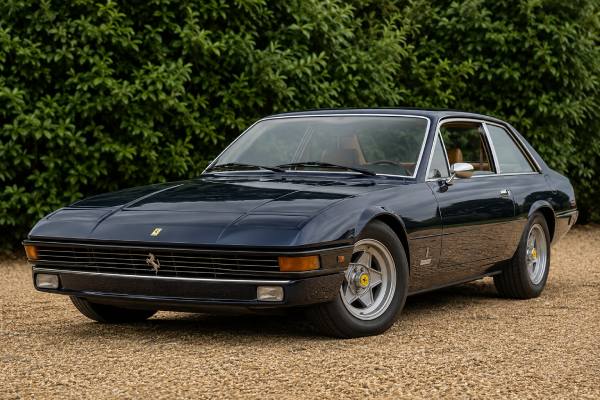
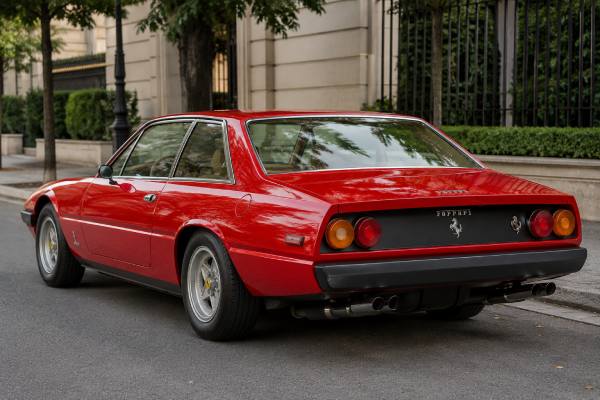
The Ferrari 365 GT4 2+2 Tipo F101 AL is the sharp-edged, V12-powered four-seat grand tourer Ferrari built from 1972 to 1976, using the F101 AC 000 4.4-liter quad-cam Colombo V12 rated at 340 hp. It replaced the softer, more rounded 365 GT 2+2 and sat at the refined, expensive end of Ferrari’s early-1970s road-car range, aimed at buyers who wanted a fast, discreet, front-engine Ferrari with real long-distance ability.
Its appeal is not the same as a Daytona, Dino, or Berlinetta Boxer. The 365 GT4 2+2 is about a different Ferrari idea: a low, elegant Pininfarina coupé with room for two adults and occasional rear passengers, a manual gearbox, six Weber carburetors, a long wheelbase, and a V12 that can cover ground quickly without shouting for attention. Today, people search for it because it remains one of the more usable classic Ferrari V12s, but also because buying one well requires knowledge. Condition, originality, carburetion, corrosion, documentation, and restoration quality matter far more than headline mileage.
Quick Take
The Ferrari 365 GT4 2+2 is strongest as an understated classic V12 grand tourer: hand-built, Pininfarina-designed, manual-only, and powered by a 4.4-liter Colombo-derived engine with six Weber carburetors. Its identity is more collector GT than raw sports car, with comfort, torque, and long-distance pace as its strengths. The main caution is ownership complexity: corrosion, old restorations, carburetor setup, cooling, electrical aging, and the cost of correct Ferrari V12 work can turn a cheap-looking car into an expensive one. The best examples are documented, matching-numbers cars with sound structure, known ownership history, correct details, and evidence of recent specialist maintenance.
Table of Contents
- History and Ferrari Significance
- Engine, Chassis and Key Specifications
- Production, Variants and Factory Details
- Pininfarina Design and Engineering Features
- Driving Character and Period Performance
- Maintenance, Restoration and Known Risks
- Market Values, Buying Guide and Rivals
History and Ferrari Significance
The 365 GT4 2+2 matters because it carried Ferrari’s front-engine V12 grand touring tradition into a more angular, modern 1970s form. It was not a race-bred lightweight; it was Ferrari’s answer to the wealthy driver who wanted speed, refinement, four-seat practicality, and a hand-built mechanical character in one car.
Ferrari introduced the model at the Paris Salon in 1972. The naming followed Ferrari tradition: “365” referred to the approximate displacement of each cylinder in cubic centimeters, “GT4” referred to the four overhead camshafts, and “2+2” identified the seating layout. The internal chassis type was F101 AL, while the engine type used for this 4.4-liter version is commonly identified as F101 AC 000.
The car’s historical position is often misunderstood. It did not replace the Daytona as a sports car, and it was not meant to behave like one. It followed the 365 GTC/4 and effectively continued the line of front-engine V12 Ferrari grand tourers for buyers who wanted a more usable car than the sharper two-seat models. It also laid the foundation for the later 400, 400i, and 412 family, which kept the same basic front-engine, four-seat Ferrari GT concept alive into the late 1980s.
Pininfarina designed and built the body, with Leonardo Fioravanti usually associated with the shape. Compared with the curvier 365 GT 2+2 and 365 GTC/4, the 365 GT4 2+2 looked cleaner, lower, and more architectural. Its long hood, low glasshouse, crisp beltline, and squared-off tail made it feel more restrained than flamboyant. That restraint is a major reason the car has aged better than some period critics expected.
In its day, the 365 GT4 2+2 was expensive, fast, and technically serious. It used a 60-degree V12, a five-speed manual gearbox, independent suspension, four-wheel disc brakes, power steering, leather trim, electric windows, and air conditioning. It was a Ferrari for high-speed European travel, not for track-day theater.
Its reputation today sits between undervalued and quietly collectible. For many years, front-engine 2+2 Ferraris were treated as less desirable than two-seat berlinettas. That kept prices relatively low and encouraged deferred maintenance. As the market has matured, buyers have begun to appreciate the 365 GT4 2+2 for what it is: a low-production, carbureted, manual V12 Ferrari with strong design pedigree and genuine usability.
Its collectability rests on four main points:
- It is a carbureted front-engine V12 Ferrari from the classic era.
- It was built in limited numbers compared with mainstream luxury GTs.
- It has a clean Pininfarina shape that is distinct from the later 400 and 412.
- It remains more usable than many older two-seat Ferraris, while still feeling fully mechanical.
It has no major motorsport identity, and that is part of its character. This is not a homologation special or a competition derivative. It is a Ferrari road car for covering long distances with pace and style. For collectors, that means originality, condition, documentation, and correct presentation matter more than racing history.
Engine, Chassis and Key Specifications
The heart of the 365 GT4 2+2 is its 4.4-liter quad-cam V12, fed by six Weber carburetors and paired only with a five-speed manual gearbox. The chassis and suspension were tuned for high-speed stability and comfort rather than the quick reactions of a smaller sports car.
| Category | Specification |
|---|---|
| Production years | 1972–1976 |
| Chassis type | Tipo F101 AL |
| Engine type | F101 AC 000, front-mounted 60-degree V12 |
| Displacement | 4,390.35 cc |
| Bore x stroke | 81 mm x 71 mm |
| Valve gear | Four overhead camshafts, two valves per cylinder |
| Fuel system | Six twin-choke Weber side-draft carburetors |
| Maximum power | 340 hp at 6,200 rpm |
| Transmission | Five-speed manual, rear-wheel drive |
| Steering | Power-assisted recirculating-ball |
| Brakes | Four-wheel disc brakes |
| Front suspension | Independent wishbones, coil springs, telescopic dampers, anti-roll bar |
| Rear suspension | Independent wishbones with self-leveling system, coil springs, dampers, anti-roll bar |
| Wheelbase | 2,700 mm |
| Length | 4,810 mm |
| Width | 1,796 mm |
| Height | 1,310 mm |
| Fuel tank | 102 liters |
| Tyres | 215/70 VR 15 front and rear |
| Top speed | About 245 km/h |
The engine belongs to Ferrari’s long-running Colombo V12 family, but the 365 GT4 2+2 unit is not simply a decorative old-world engine under a long hood. It has dry Ferrari manners when set up properly: crisp throttle response, a cultured mechanical sound, and strong upper-range pull. The six Weber carburetors are central to the car’s feel. They add texture and immediacy, but they also require correct balancing, clean fuel delivery, good ignition health, and patient warm-up.
The five-speed manual gearbox is part of the car’s value story. Later 400 models introduced an automatic option, but the 365 GT4 2+2 stayed manual-only. That makes it more appealing to many collectors who want the full classic Ferrari V12 experience. The gearbox is not light and modern in feel, especially when cold, but it suits the car’s grand touring role once warm.
The chassis uses a tubular steel frame with steel bodywork. The wheelbase is long by Ferrari sports-car standards, which gives the car better cabin room and high-speed stability. Independent suspension at each corner was sophisticated for a large GT of the period, and the self-leveling rear suspension helped maintain stance and control with passengers or luggage.
Power steering was standard because the 365 GT4 2+2 is a substantial car, not a stripped sports machine. The steering system gives useful assistance at lower speeds, but it does not have the fingertip precision of a lighter two-seat Ferrari. The brakes are discs all round and are suitable for fast road use when rebuilt and correctly adjusted, but buyers should not expect modern anti-lock behavior, short pedal travel, or contemporary fade resistance.
Production, Variants and Factory Details
The 365 GT4 2+2 was a single main model rather than a family of separate trims. Its most important identification points are the early F101 AL chassis, the F101 AC 000 4.4-liter carbureted V12, the manual gearbox, and the pre-400 exterior details.
Production is generally cited at about 524 cars, including prototypes, built between 1972 and 1976. Some sources and specialists separate production cars from prototypes, which is why small differences in quoted totals appear. For buying purposes, the key point is simple: this is a low-volume Ferrari, but not so rare that every car should be treated as exceptional regardless of condition.
There was no automatic 365 GT4 2+2. That came later with the Ferrari 400 Automatic, which used a larger 4.8-liter engine and different badging. The 365 GT4 2+2 also predates the fuel-injected 400i and the later 412. This matters because the 365 is the purest early form of the series: carbureted, manual, and visually simpler.
Useful visual identifiers include:
- Three round tail lights on each side, rather than the later twin-light layout.
- Five-spoke alloy wheels on knock-off hubs.
- A cleaner nose without the later 400-style front spoiler treatment.
- A simple, elegant rear treatment before the later visual updates.
- A carbureted 4.4-liter V12 rather than the larger 400 or 412 engines.
Body and trim details can vary because these were hand-finished cars, and many have been repainted, retrimmed, updated, or repaired over five decades. A buyer should not judge authenticity by one photograph or one sales description. The correct approach is to compare the chassis number, engine number, body number, original colors, factory records, handbook, warranty card, service invoices, and any Ferrari Classiche documentation.
Matching-numbers status is especially important. On a front-engine V12 Ferrari, the original engine and gearbox add value and confidence. A replacement engine does not automatically make a car undesirable, but it should be priced accordingly and documented clearly. A vague claim such as “believed original” is not the same as verified matching numbers.
Factory options and equipment were more limited than on modern Ferraris, but buyers still care about original exterior color, interior leather, air conditioning, wheel type, tools, books, and delivery-market details. Unusual period colors can be more interesting than resale-red repaints, especially when supported by records. A car returned to its original color after a high-quality restoration can be more appealing than a superficially shiny car in a fashionable but incorrect shade.
For documentation, look for:
- Original handbook and pouch.
- Warranty or service book.
- Old registration documents.
- Period sales or import documents.
- Ferrari specialist invoices.
- Restoration photographs and parts records.
- Ferrari Classiche certification, where available.
- Evidence tying the engine, gearbox, and body to the chassis.
Ferrari Classiche certification is not a substitute for a physical inspection, but it is useful when it confirms the car’s key components and specification. It can also clarify originality questions that ordinary sales descriptions leave open.
Pininfarina Design and Engineering Features
The 365 GT4 2+2 is distinctive because its design is calm, geometric, and almost formal, while its mechanical package is deeply traditional Ferrari. That contrast between restrained styling and a carbureted quad-cam V12 gives the car much of its charm.
The exterior marked a clear move away from the softer curves of earlier Ferrari 2+2s. The hood is long and flat, the cabin is set back, and the side profile has a crisp line that visually lowers the car. The proportions are not compact, but the low roof and long nose keep the car elegant rather than bulky. It looks like a luxury GT drawn by someone who understood speed, not like a limousine trying to look sporty.
Pininfarina’s three-box shape also made the car more practical. The trunk is usable, the cabin has proper front-seat comfort, and the rear seats are more believable than in many small 2+2 coupés. They are still best for children, smaller adults, or short trips, but the 365 GT4 2+2 is genuinely more accommodating than Ferrari’s two-seat models.
The engineering layout is traditional but carefully judged. The V12 sits up front, driving the rear wheels through a manual transmission. The engine is not placed behind the front axle as aggressively as in some modern front-mid-engine cars, so the 365 GT4 2+2 has a grand touring weight distribution and feel. It is stable, planted, and comfortable at speed, rather than nervous or ultra-responsive.
The self-leveling rear suspension is one of the more important special features. In period, it helped the car maintain correct attitude with luggage or passengers. Today, it is also a maintenance point. A functioning system supports the car’s intended ride and stance, while neglected or incorrectly converted systems can affect both handling and originality.
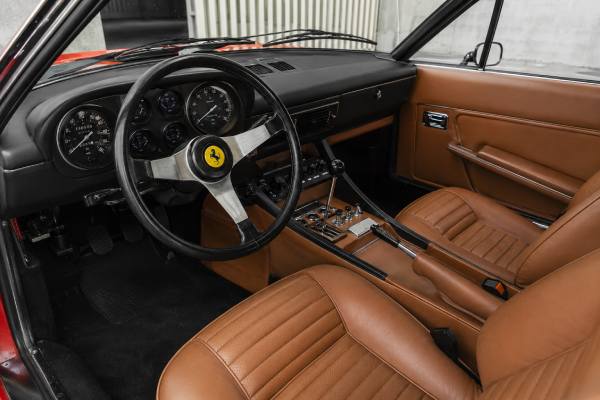
Inside, the cockpit reflects Ferrari’s early-1970s GT priorities. The driver gets clear instruments, a traditional steering wheel, leather trim, and a low seating position. The cabin is not minimalist in the way a competition car is, but it also lacks the digital complexity of later luxury cars. Most controls are simple, mechanical, and direct.
The sound is a major part of the experience. The V12 is smoother and more cultured than a big American V8, but it is not silent. At low revs it has a layered mechanical hum, with intake noise from the Webers becoming more obvious as the throttle opens. The exhaust note is more refined than brutal. A correct exhaust system matters because overly loud aftermarket systems can make the car tiring and can hide the original character.
Cooling and airflow were important engineering concerns. A large front-engine V12 in a low Italian GT creates heat, especially in traffic or warm climates. Correct fans, radiator condition, coolant flow, hoses, thermostat behavior, and ignition tune all affect whether the car behaves well. Many “temperamental” examples are simply neglected examples.
The 365 GT4 2+2 also stands apart from the later 400 and 412 visually. The later cars are related, but the 365 has the cleanest early detailing. For many collectors, the six-tail-light rear and knock-off wheel arrangement give it a more classic look than its successors.
Driving Character and Period Performance
A good 365 GT4 2+2 feels like a fast, relaxed, mechanical V12 express rather than a sharp-edged sports car. Its best work is done on open roads, where the engine, gearing, ride, and stability come together.
The 4.4-liter V12 is smooth but not lazy. Below the midrange, it pulls cleanly when properly tuned, but the car feels most alive as revs build and the carburetors start to breathe. Throttle response depends heavily on tune. A well-set-up car feels crisp and progressive. A poorly adjusted one can feel flat, hesitant, or uneven, especially when cold.
Warm-up matters. This is a carbureted classic Ferrari, not a modern injected GT. It should be allowed to come up to temperature before being worked hard. Cold gear oil can make the gearbox reluctant, and the engine will not show its best manners until the ignition, carburetors, and fluids are at proper operating conditions.
Period performance is strong rather than shocking by modern standards. A top speed of about 245 km/h made it a serious high-speed car in the 1970s. Acceleration varies by test source, condition, gearing, and measurement method, but the car is quick enough to feel effortless once moving. It is not about launch-control-style starts. It is about sustained pace.
The gearbox has a deliberate feel. It rewards clean timing and mechanical sympathy. Heavy-handed shifting when cold is a bad habit, and baulky shifts may point to adjustment issues, worn synchros, clutch problems, or simply cold oil. Once warm, a healthy gearbox should feel positive rather than obstructive.
Steering effort is manageable because of the power assistance. The tradeoff is that feedback is more filtered than in smaller Ferraris. At parking speed, the car still feels large. On the highway, that size turns into calmness. The long wheelbase helps it settle into fast cruising, and the suspension gives it a composed ride when everything is fresh.
Braking feel is period-correct. A properly maintained system should stop the car confidently, but the pedal feel, assistance, and fade resistance are not comparable to a modern performance car. Old hoses, tired calipers, contaminated fluid, or unevenly rebuilt brakes can make the car feel much older than it should.
In corners, the 365 GT4 2+2 prefers smooth inputs. It is not a car to throw into bends like a small mid-engine Ferrari. The front end needs time, the body moves more, and tire choice matters. Modern tires in the correct size and rating can improve confidence, but overly aggressive rubber may change steering feel and load suspension components differently than intended.
The cabin experience is part of the appeal. Visibility is generally good for a low classic coupé, and the driving position suits long-distance use. Cabin heat, air-conditioning performance, wind noise, and smell vary greatly by car. A restored example with fresh seals, sorted ventilation, and correct insulation can feel surprisingly refined. A tired one can be hot, noisy, fuel-smelling, and tiring.
Maintenance, Restoration and Known Risks
The 365 GT4 2+2 is not unreliable in a simple sense, but it is highly condition-sensitive. Most problems come from age, deferred maintenance, corrosion, poor repairs, incorrect tuning, and the high cost of doing Ferrari V12 work properly.
The engine itself is robust when cared for, but it is expensive to neglect. Valve clearances, timing, ignition health, carburetor synchronization, fuel pressure, cooling condition, and oil quality all matter. A car that has sat unused can need extensive recommissioning before it is safe to drive hard.
Common mechanical and ownership concerns include:
- Carburetors out of balance or leaking.
- Old fuel hoses, clogged filters, weak pumps, or contaminated tanks.
- Ignition faults causing rough running or overheating.
- Cooling system weakness from blocked radiators, tired fans, old hoses, or poor bleeding.
- Oil leaks from seals and gaskets.
- Clutch wear or hydraulic issues.
- Gearbox synchro wear, especially if abused when cold.
- Worn suspension bushings, dampers, ball joints, and steering components.
- Brake calipers sticking after storage.
- Aging electrical connections, switches, relays, and fuse-box issues.
- Air-conditioning systems that are incomplete, weak, or converted poorly.
Rust is one of the biggest buying risks. The car has steel bodywork over a tubular structure, and many examples have lived in damp climates, been repaired after accidents, or received cosmetic repainting without deep metalwork. Inspect the sills, floor sections, wheel arches, lower doors, front valance, rear quarters, trunk floor, windshield and rear-window surrounds, suspension pickup areas, and jacking points. Bubbling paint is only the visible part; hidden corrosion can be far more serious.
Accident damage is another concern. A hand-built Ferrari body can be made to look attractive from several meters away while hiding poor panel alignment, filler, incorrect welds, or distorted structure. Check door gaps, hood fit, trunk fit, glass sealing, suspension alignment, and evidence of old repairs. A pre-purchase inspection by a Ferrari classic specialist is not optional on a serious car.
Restoration quality varies widely. Some cars were restored when values were too low to justify proper work. That often means incorrect materials, poor leather work, generic carpets, non-original switches, wrong finishes, missing underhood details, and paint over weak metal. A thick invoice file is useful, but only if the work was done by people who understood the model.
Parts availability is mixed. Many service parts can be sourced through specialists, but body trim, interior details, correct wheels, original tools, and model-specific items can be difficult or expensive. Missing small parts are not small problems if originality matters.
The self-leveling rear suspension deserves special attention. Confirm whether it works, leaks, has been rebuilt, or has been converted. A conversion may make a car easier to maintain, but it can reduce originality and affect value. The right answer depends on the buyer’s goal, but the wrong answer is buying a car without knowing what has been changed.
A sensible maintenance approach includes:
- Annual fluid checks and regular oil changes, even with low mileage.
- Brake fluid changes on a time basis, not only mileage.
- Cooling system inspection before summer use.
- Fuel hose and fuel-system renewal if age is unknown.
- Carburetor and ignition tuning by a specialist familiar with Weber-fed Ferrari V12s.
- Regular driving after recommissioning, because long storage creates its own failures.
- Careful records of every service, adjustment, and replacement part.
Originality versus upgrades is a real decision. Electronic ignition improvements, better cooling fans, discreet fuel-system updates, and modern tire choices can improve usability. However, visible modifications, non-original interiors, incorrect wheels, and engine changes can reduce collector value. The best upgrades are reversible, documented, and aimed at reliability rather than reinvention.
Market Values, Buying Guide and Rivals
The 365 GT4 2+2 remains cheaper than Ferrari’s most famous two-seat V12s, but good cars are no longer throwaway bargains. Market value depends heavily on condition, originality, documentation, color, provenance, and whether the car needs hidden structural or mechanical work.
Recent public auction and valuation data show a wide spread. Project-grade or poorly presented cars can trade far below strong examples because restoration costs are high. Good usable cars often sit in a middle range, while exceptional examples with rare provenance, matching numbers, strong history, and attractive original colors can command much more. A famous-owner car or unusually original car can distort normal price expectations.
The most important value drivers are:
- Matching-numbers engine and gearbox.
- Original color combination or documented return to original colors.
- Ferrari Classiche certification or strong factory documentation.
- Rust-free structure and high-quality metalwork.
- Correct interior materials and trim.
- Complete books, tools, jack, and records.
- Recent specialist service, not just old restoration invoices.
- Correct carburetor, ignition, cooling, brake, and suspension setup.
- Known ownership history.
- Absence of poor modifications or accident damage.
Mileage matters less than condition and history. A low-mileage car that has sat for years may need more work than a higher-mileage car used and maintained correctly. On a 50-year-old Ferrari, “recently serviced” should mean detailed invoices from a credible specialist, not a seller’s phrase.
A practical inspection checklist should include:
- Verify chassis, engine, and body numbers.
- Confirm original colors and trim through records.
- Inspect the car on a lift for corrosion and previous repairs.
- Check compression and leak-down where appropriate.
- Confirm cold-start behavior, warm idle, oil pressure, and cooling performance.
- Assess gearbox behavior cold and warm.
- Inspect fuel lines, tanks, pumps, filters, and carburetors.
- Check brake condition, hose age, caliper function, and fluid history.
- Inspect suspension bushings, dampers, steering joints, and rear self-leveling equipment.
- Test all electrical items, including lights, windows, fans, instruments, and air conditioning.
- Review restoration records for photographs, not just invoices.
- Confirm that imported cars have clean registration and tax history.
Cars to seek are structurally excellent, mechanically sorted, and honestly presented. A car with older paint but strong metal, original trim, correct numbers, and a thick maintenance file may be better than a glossy restoration with missing records. Cars to avoid are those with fresh paint over unclear metalwork, non-matching engines without explanation, missing documentation, hot-running behavior, vague import history, or long storage with no recommissioning.
The closest Ferrari alternatives include the 365 GTC/4, 400 GT, 400i, 412, and later 456 GT. The 365 GTC/4 is sportier and often more valuable, with a different body style and shorter production life. The 400 GT is closely related but has a larger engine and later styling, with both manual and automatic versions. The 400i and 412 are more modern in some ways but less appealing to buyers who specifically want carburetors.
Non-Ferrari rivals include the Aston Martin V8, Lamborghini Espada, Maserati Indy, Jensen Interceptor, and high-end Mercedes-Benz SLC models. The Aston offers muscular British GT character, the Espada gives dramatic V12 four-seat styling, the Maserati feels more delicate and Italian, and the Mercedes is more practical but less exotic. The Ferrari sits apart because of its quad-cam V12, Pininfarina body, manual-only early specification, and Maranello identity.
Long-term collectability looks stable for the best cars. The 365 GT4 2+2 has the ingredients collectors increasingly like: low production, manual gearbox, carbureted V12, known designer, elegant shape, and usable road manners. It is unlikely to match the market status of a Daytona or 275 GTB, but that is not the point. Its future strength will belong to documented, correct, structurally excellent cars. Average cars will remain expensive to fix and harder to sell.
References
- Ferrari 365 GT4 2+2 (1972) 1972 (Manufacturer Specifications)
- Ferrari Classiche – Ferrari.com 2024 (Certification)
- 1975 Ferrari 365 GT4 Base | Hagerty Valuation Tools 2026 (Valuation Tool)
- 1973 Ferrari 365 GT4 2+2 by Pininfarina | Munich 2025 | RM Sotheby’s 2025 (Auction Result)
- Ferrari Classic Car Auction Results – Collector Car Auction Prices – Glenmarch 2026 (Auction Results)
Disclaimer
This article is for informational purposes only and is not a substitute for professional diagnosis, repair, inspection, valuation, or restoration advice. Specifications, torque values, service intervals, procedures, and correct components can vary by VIN, market, production date, and equipment. Always verify details against official Ferrari service documentation, factory records, and a qualified Ferrari classic specialist before buying, repairing, or restoring a Ferrari 365 GT4 2+2.
If this guide helped you, please share it on Facebook, X/Twitter, or your favorite enthusiast community to support our work.