
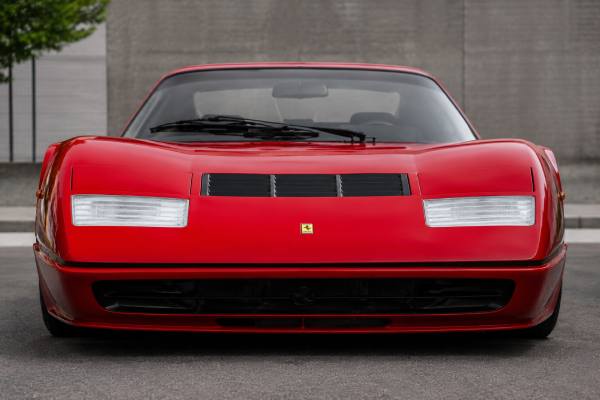
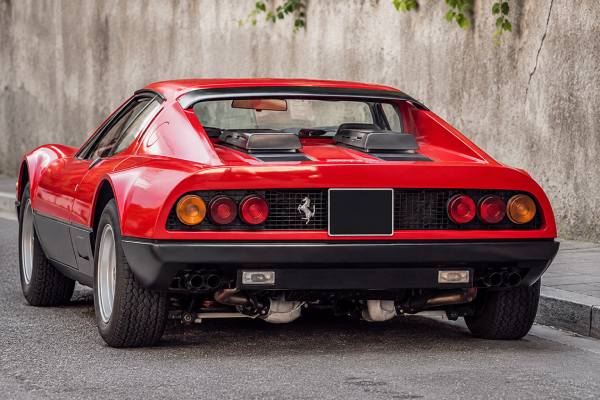
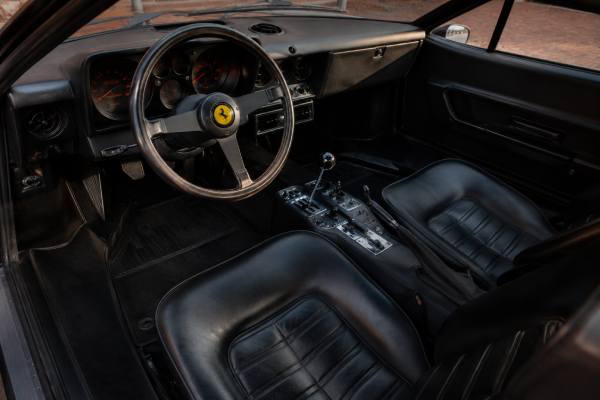
The Ferrari 365 GT4 BB was Ferrari’s first production road car to place a 12-cylinder engine behind the cabin, and the 1973–1976 Tipo F102 AB 100 version is the original Berlinetta Boxer. It used a 4.4-liter flat-12, a five-speed manual gearbox, rear-wheel drive, and a low Pininfarina body built by Scaglietti. Ferrari quoted 265 kW, commonly rounded to 360 metric horsepower, and a claimed 300 km/h top speed, making it one of the most serious road cars of the mid-1970s.
This was not simply a Daytona replacement with a new shape. The 365 GT4 BB moved Ferrari’s flagship road-car thinking from the classic front-engine grand tourer toward the mid-engine supercar formula that later produced the 512 BB, BB 512i, Testarossa, 512 TR, and F512 M. It is rare, technically important, visually sharp, and demanding to own correctly. Buyers still search for it because it combines early mid-engine Ferrari history with carbureted flat-12 character and much lower production numbers than later Boxers.
Quick Take
The Ferrari 365 GT4 BB is the purest and rarest of the Berlinetta Boxer road cars: a carbureted, dry-looking wedge with a high-revving 4.4-liter flat-12, early Pininfarina supercar proportions, and real collector significance. Its strongest appeal is the combination of first-series status, mechanical drama, and scarcity, but the main caution is ownership complexity. Correct maintenance, timing-belt history, carburetor setup, originality, corrosion condition, and Ferrari Classiche-style documentation matter as much as mileage or paint color.
Table of Contents
- History and Collector Importance
- Engine, Chassis and Key Specifications
- Production, Variants and Originality
- Design, Engineering and Special Features
- Road Feel, Performance and Character
- Maintenance, Reliability and Restoration Risks
- Values, Buying Advice and Rivals
History and Collector Importance
The 365 GT4 BB matters because it changed Ferrari’s flagship road-car layout from front-engine tradition to mid-engine supercar architecture. It replaced the 365 GTB/4 Daytona at the top of the range, but it did so with a completely different idea of balance, packaging, styling, and performance.
The BB prototype appeared in 1971, while production cars reached customers from 1973. The name follows Ferrari’s old naming logic: “365” refers to the approximate displacement of one cylinder, “GT4” points to grand touring and four camshafts, and “BB” stands for Berlinetta Boxer. The “Boxer” label has become part of Ferrari folklore, although the engine is more accurately described as a flat-12 rather than a true boxer with opposing paired crankpins.
Ferrari had already built mid-engine sports racers, and the Dino 206/246 had brought mid-engine balance to a smaller six-cylinder road car. The 365 GT4 BB was different because it moved Ferrari’s main 12-cylinder flagship into that layout. This was a large symbolic change. For years, Enzo Ferrari had favored front-engine road cars for customers, while mid-engine layouts were more closely associated with racing machinery and newer rivals.
The Lamborghini Miura had already shown how exotic a mid-engine road car could be. The Countach, also introduced in the early 1970s, pushed the wedge-shaped supercar image even harder. The 365 GT4 BB was Ferrari’s answer, but it was not a copy of either Lamborghini. It kept Ferrari’s own identity through a naturally aspirated 12-cylinder engine, a gated manual gearbox, a hand-built body, and a cabin that still felt like a serious road car rather than a concept-car escapee.
Pininfarina designed the shape, and Scaglietti built the bodies. The result was low, sharp, and compact by flagship Ferrari standards. The 365 GT4 BB also established the visual and mechanical base for the later 512 BB and fuel-injected BB 512i. Those later models are more numerous and often easier to use, but the 365 is the first and most delicate in appearance.
For collectors, the 365 GT4 BB’s importance comes from four main points:
- It is the first production Ferrari road car with a mid-mounted 12-cylinder engine.
- It is the first Berlinetta Boxer series model.
- It was produced in very small numbers from 1973 to 1976.
- It retains carburetion, early styling details, and a high-revving 4.4-liter engine.
It was not officially federalized for the United States when new. Many cars later entered the U.S. through gray-market import channels, often with modifications for emissions, lighting, bumpers, or safety compliance. That history makes documentation especially important today. A European-delivery car with clean import records, original identity, matching numbers, and careful maintenance will usually be much more appealing than a poorly converted example with gaps in its paperwork.
The 365 GT4 BB is now viewed as a cornerstone Ferrari supercar rather than just an early Boxer. It sits between two major Ferrari eras: the classic front-engine V12 grand tourer period and the dramatic mid-engine 12-cylinder supercar period. That position is why collectors treat the best examples as historically important cars, not merely beautiful 1970s exotics.
Engine, Chassis and Key Specifications
The 365 GT4 BB’s defining mechanical feature is its 4.4-liter flat-12 mounted behind the cabin and ahead of the rear axle line. It was paired with a five-speed manual gearbox and a tubular steel chassis, giving the car a very different feel from the front-engine Daytona.
| Item | Specification |
|---|---|
| Model | Ferrari 365 GT4 BB |
| Internal type | Tipo F102 AB 100 chassis family |
| Engine code family | F102 AB / F102 A flat-12 family |
| Production period | 1973–1976 |
| Layout | Mid-engine, rear-wheel drive |
| Body style | Two-seat berlinetta coupe |
| Displacement | 4,390.35 cc |
| Bore x stroke | 81 mm x 71 mm |
| Valve gear | Double overhead camshafts per bank, two valves per cylinder |
| Fuel system | Four Weber carburetors |
| Maximum output | 265 kW, commonly quoted as 360 PS |
| Transmission | Five-speed manual |
| Claimed top speed | 300 km/h |
Period power figures can be confusing because sources quote metric horsepower, DIN figures, SAE figures, or later rounded numbers. Ferrari’s 265 kW figure converts to about 360 metric horsepower. Some English-language sources quote higher brake-horsepower figures, while others quote lower net figures. For buying and identification, the important point is not the marketing number alone. It is the correct 4,390 cc carbureted flat-12 specification for the first-series 365 GT4 BB.
The engine is mounted longitudinally, with the gearbox placed beneath and behind it in a compact package. This arrangement helped keep the wheelbase short, but it also created a high center of mass compared with some later supercar layouts. The flat-12 is wide, and the car’s rear structure has to manage engine, gearbox, exhaust, cooling, and suspension packaging in a tight space.
The chassis is a tubular steel structure with independent suspension. Ferrari used double wishbones, coil springs, telescopic dampers, and anti-roll bars. Braking is by ventilated discs, with servo assistance. Steering is rack and pinion, unassisted, and the car rides on period high-performance tires that strongly affect steering feel and breakaway behavior.
| Area | Details |
|---|---|
| Chassis | Tubular steel frame |
| Body construction | Scaglietti-built bodywork with steel and aluminum panels |
| Front suspension | Independent double wishbones, coil springs, dampers, anti-roll bar |
| Rear suspension | Independent double wishbones, coil springs, dampers, anti-roll bar |
| Brakes | Servo-assisted ventilated discs |
| Steering | Rack and pinion |
| Wheelbase | 2,500 mm |
| Length | About 4,360 mm |
| Width | About 1,800 mm |
| Height | About 1,120 mm |
The 365 GT4 BB was a very fast car in its day, but performance claims need context. Factory top-speed claims were ambitious, road-test conditions varied, and tire technology has changed greatly since the 1970s. A healthy, correctly tuned car feels strong and urgent, but it is not a modern point-and-shoot supercar. It rewards mechanical sympathy, warm fluids, deliberate shifts, and respect for old tires, old brakes, and old visibility standards.
Production, Variants and Originality
The 365 GT4 BB was built in small numbers, with 387 examples commonly cited for the full production run. That makes it the rarest member of the Berlinetta Boxer family and a much scarcer car than the later BB 512i.
There was no wide range of factory variants in the modern sense. The 365 GT4 BB was offered as a two-seat coupe with the 4.4-liter carbureted flat-12 and manual gearbox. The key distinctions today are original delivery market, left- or right-hand drive, original colors, matching-number status, and whether the car has been modified, federalized, restored, or certified.
Right-hand-drive cars are especially notable. A small number were produced for right-hand-drive markets, with UK-delivered examples forming a desirable subset. These cars can carry special interest, but condition and documentation still matter more than steering position alone.
The 365 GT4 BB is easy to confuse with later Boxers at a glance, especially for casual observers. Important first-series identifiers include the early rear treatment, the smaller 4.4-liter identity, and details that changed on the 512 BB. The later 512 BB arrived with a larger 4.9-liter engine, visual changes, and a different performance character. The BB 512i then added fuel injection for improved drivability and emissions compliance.
| Model | Years | Key identity | Collector note |
|---|---|---|---|
| 365 GT4 BB | 1973–1976 | 4.4-liter carbureted flat-12 | First and rarest Boxer road model |
| 512 BB | 1976–1981 | 4.9-liter carbureted flat-12 | More torque, revised look, higher production |
| BB 512i | 1981–1984 | 4.9-liter injected flat-12 | More usable, cleaner-running, less raw |
Originality is a major value driver. A car that still carries its original engine, gearbox, body identity, colors, books, tools, service records, and delivery documents will usually command stronger interest than a car restored with missing history. Ferrari Classiche certification can be valuable because it gives buyers a recognized framework for confirming major components and factory configuration. It does not automatically make a poor car excellent, but it can reduce uncertainty.
The buyer should pay special attention to:
- Chassis number, engine number, and gearbox number records.
- Original exterior color and interior trim.
- Evidence of past federalization or later reversal.
- Accident repairs around the nose, sills, rear structure, and suspension pickup points.
- Correct wheels, lights, instruments, seats, trim, and exhaust layout.
- Ownership chain, old registration documents, service invoices, tool roll, books, and warranty material.
Paint and trim choices also matter. Rosso over black is familiar and marketable, but unusual original colors can be very attractive when supported by documentation. A rare color is only a benefit if it is original or correctly returned to original specification. A fashionable repaint that hides corrosion, poor panel fit, or earlier accident damage should not be rewarded like a properly documented factory shade.
Because these cars were hand-built, small variations are normal. The challenge is separating hand-built character from later repair shortcuts. Panel gaps, door fit, headlamp operation, engine-cover alignment, and sill condition all deserve careful inspection by someone who knows early Boxers.
Design, Engineering and Special Features
The 365 GT4 BB looks distinctive because Pininfarina translated Ferrari’s 1970s racing and concept-car thinking into a usable road berlinetta. Its low nose, pop-up headlights, wedge profile, rear buttresses, and wide tail give it a cleaner and more restrained shape than many later supercars.
The car has a strong horizontal split in its body side, often emphasized by two-tone paint with a darker lower section. This helps reduce the visual mass of the body and makes the car look lower than it already is. The front is sharp but not as extreme as the Countach. The rear is broad and functional, with vents and openings needed to manage heat from the mid-mounted flat-12.
Cooling is one of the car’s defining engineering challenges. The engine sits behind the cabin, but the front of the car still has to manage radiator airflow. Coolant pipes, oil lines, ducting, fans, and airflow paths all have to work properly. A neglected BB can suffer from heat soak, poor fan performance, aging hoses, blocked radiators, or incorrect bleeding after service. A sorted car is far more confidence-inspiring.
The cockpit is low, simple, and more intimate than the Daytona’s. The driver sits ahead of a classic Ferrari instrument layout, with a gated manual shifter nearby and a wide rear structure behind. Visibility is better forward than the car’s dramatic shape might suggest, but rear three-quarter vision is limited. The cabin also places the driver close to mechanical heat, intake noise, and driveline vibration. That is part of the appeal, but it means refinement is not modern.
The flat-12 is central to the car’s personality. It is smooth, complex, and dramatic without needing turbochargers or electronic drive modes. Four Weber carburetors give it a mechanical intake character that later injected Boxers do not quite match. When tuned well, the engine responds cleanly and builds speed with a hard-edged, layered sound. When out of tune, it can feel flat, rich, hesitant, or difficult at low speed.
Several engineering choices define the car:
- A mid-mounted 12-cylinder engine for better mass centralization than Ferrari’s earlier front-engine flagships.
- A compact engine-and-transmission package that helps packaging but complicates service.
- A tubular steel chassis suited to low-volume production and repair by specialists.
- Carbureted fuel delivery that gives strong period character but requires expert setup.
- A low, aerodynamic body that balances style with cooling and access needs.
The 365 GT4 BB’s specialness is not based on a single gimmick. It comes from the way its design, engine layout, coachbuilt construction, and analog controls work together. Later Ferraris became faster, safer, and easier. Few feel as clearly connected to the moment when Ferrari redefined its flagship road-car formula.
Road Feel, Performance and Character
A good 365 GT4 BB feels fast, low, wide, and mechanical, but it needs patience before it gives its best. It is a carbureted 1970s Ferrari with a large mid-mounted engine, not a modern supercar that can be driven hard from cold.
The warm-up period matters. Oil, gearbox fluid, tires, brakes, and carburetors all need temperature. Cold shifts can feel heavy, especially into second gear, and forcing the gearbox is poor practice. Once warm, the gated shift becomes part of the experience: measured, metallic, and satisfying when the driver uses deliberate timing.
Throttle response depends heavily on carburetor condition and synchronization. A properly tuned car is crisp and progressive, with a strong upper-range pull. A tired or badly adjusted car can stumble, smell rich, foul plugs, or feel much less powerful than the specification suggests. This is why a test drive is so valuable. The engine should not merely start and idle; it should pull cleanly, return to idle properly, and run evenly through the rev range.
The steering is heavy at parking speeds and much more alive once moving. There is no modern filter between the front tires and the driver’s hands. Road camber, tire age, alignment, and bushing condition can all change the feel dramatically. A sorted car should feel stable and communicative, not nervous or vague.
The chassis balance is more demanding than modern mid-engine cars. The engine is behind the driver, the tires are period-sized by modern standards, and there are no electronic stability systems. Driven smoothly, the 365 GT4 BB is fluent and rewarding. Driven clumsily, especially on old tires or damp roads, it can become intimidating. Lift-off behavior and mid-corner corrections deserve respect.
Braking performance is good for the period when the system is fresh, but expectations should stay realistic. Old hoses, tired fluid, rebuilt calipers of uneven quality, worn discs, or incorrect pads can make a huge difference. Buyers should not accept long pedal travel, pulling, vibration, or weak braking as “normal old Ferrari” behavior.
On the road, the car’s appeal is more about rhythm than raw numbers. It likes flowing routes, clear sight lines, and drivers who understand weight transfer. It can cruise, but cabin heat, noise, heavy controls, and limited luggage space make it more intense than a front-engine grand tourer. The Daytona feels like a fast, long-legged GT. The 365 GT4 BB feels like an early supercar with Ferrari grand-touring roots still visible.
The sound is one of the great reasons to own one. The flat-12 does not sound exactly like a front-engine Colombo-derived V12. It has its own layered mechanical note, with intake, exhaust, valvetrain, and gearbox sounds all close to the cabin. The best examples feel expensive and precise rather than merely loud.
Maintenance, Reliability and Restoration Risks
The 365 GT4 BB can be reliable when maintained by specialists, but neglect is extremely expensive. The car’s age, carburetors, timing belts, cooling system, body structure, and parts costs make condition far more important than odometer reading.
This is not a car for general classic-car servicing. It needs technicians who understand early Berlinetta Boxers, flat-12 Ferrari engines, Weber carburetors, and the access challenges of the chassis. A cheap car with deferred maintenance can quickly become more costly than a better car bought at a premium.
The major maintenance areas include:
- Timing belts, tensioners, cam timing, and related seals.
- Carburetor synchronization, jetting, fuel hoses, and fuel pumps.
- Cooling system hoses, radiators, fans, thermostat, and coolant pipes.
- Ignition components, wiring, fuse boxes, relays, and grounds.
- Clutch condition, gearbox synchros, shifter adjustment, and driveshaft joints.
- Brake calipers, master cylinder, hoses, discs, pads, and servo assistance.
- Suspension bushings, dampers, wheel bearings, ball joints, and alignment.
- Exhaust condition, heat shielding, and manifold integrity.
Timing-belt history is critical. Factory-era mileage intervals are only part of the story because these cars now spend long periods parked. Age matters as much as distance. A buyer should look for dated invoices from recognized specialists, not vague statements such as “belts done.” A proper belt service is also a chance to inspect tensioners, cam seals, valve clearances, water hoses, fuel lines, and surrounding hardware.
Carburetors are another major dividing line between a satisfying car and a frustrating one. Poor setup can cause hot-start problems, rough running, fuel smell, hesitation, and uneven power delivery. Old fuel hoses are a fire risk, especially in a mid-engine car. Ethanol-blended fuel can accelerate deterioration in older rubber components, so fuel-system renewal should be taken seriously.
Corrosion can be hidden. The body includes steel and aluminum panels, and the tubular chassis must be checked carefully. Look closely at sills, lower door areas, wheel arches, suspension pickup points, front structure, rear frame sections, battery areas, and any place where moisture can sit. Rust repair on a coachbuilt Ferrari is not ordinary bodywork. Poor repairs can affect panel fit, strength, value, and future restoration cost.
Accident damage is another major risk. The 365 GT4 BB is low, wide, and old enough that many examples have had paintwork, nose repairs, or rear-end work. A professional inspection should include measurements, paint-depth readings, underbody review, panel alignment, weld quality, and evidence of replaced structural tubes.
Restoration quality varies widely. Some cars were restored when values were lower, and those jobs may have focused on appearance rather than correctness. A shiny repaint with incorrect trim, missing details, weak mechanicals, and poor records is not a top-tier car. A slightly older but honest restoration by a known Ferrari specialist can be much more desirable.
Parts availability is possible but not casual. Some service items can be sourced through Ferrari specialists and established suppliers, while rare trim, body, glass, and model-specific components can be expensive or slow to locate. Rebuilding original components is often better than replacing them with incorrect parts.
| Area | What to verify |
|---|---|
| Identity | Chassis, engine, gearbox, body records, and factory configuration |
| Engine | Compression, leaks, belt history, cam timing, oil pressure, carburetor tune |
| Cooling | Radiator condition, fans, hoses, coolant pipes, temperature stability |
| Body and chassis | Corrosion, accident repairs, panel fit, underbody structure |
| Driveline | Clutch, synchros, differential noise, driveshafts, mounts |
| Documentation | Ownership chain, service invoices, books, tools, import records, certification |
A correctly maintained 365 GT4 BB is usable in the classic exotic sense. It can be driven, enjoyed, and kept healthy with regular exercise. A neglected one can consume large sums before it feels right. The smartest ownership approach is preventive: maintain fuel, cooling, belts, brakes, and electrical systems before they fail.
Values, Buying Advice and Rivals
The 365 GT4 BB occupies a strong collector position because it is rare, historically important, beautiful, and still less common than later Berlinetta Boxers. Market values in 2025 and 2026 show a wide spread, with condition, documentation, steering side, certification, and recent specialist maintenance making a large difference.
As a broad guide, ordinary or needy examples can trade well below the best cars, while excellent, documented, matching-number examples with desirable colors and recent major service can move into much stronger territory. Recent public results and listings have often clustered around the mid-six-figure range in U.S. dollar terms, with European auction results commonly appearing in the €300,000–€500,000 band for good cars. Exceptional history or rare specification can push higher, while poor restoration quality, missing history, or major needs can pull a car down sharply.
The main value drivers are:
- Matching engine and gearbox.
- Original color combination or well-documented return to original colors.
- Ferrari Classiche certification or equivalent high-quality documentation.
- Recent major service by a recognized Ferrari specialist.
- Sound chassis and body with no hidden corrosion.
- Correct interior, instruments, wheels, lighting, books, tools, and trim.
- Clean import history, especially for cars now in the United States.
- Honest mileage supported by records, not simply a low odometer reading.
Mileage is often overvalued by casual buyers. A very low-mile car that has sat unused may need extensive recommissioning. A higher-mile car with strong records, regular exercise, and expert care can be a better ownership proposition. For a 50-year-old Ferrari, condition and evidence matter more than odometer drama.
Cars to seek include documented European-delivery examples, carefully preserved original cars, high-quality older restorations with full records, and cars that have had recent belt, fuel-system, cooling-system, brake, and suspension work. Cars to approach carefully include examples with missing engine numbers, unclear import histories, cheap cosmetic restorations, heavy modifications, non-original interiors, overheating behavior, weak gearbox synchros, or vague maintenance claims.
A sensible buying process should include:
- Confirm the car’s identity against factory-style records and specialist knowledge.
- Review the ownership chain, import documents, service invoices, books, tools, and certification.
- Commission a Boxer-specialist inspection before negotiating final price.
- Drive the car from cold to full temperature and check hot-start behavior.
- Budget for immediate recommissioning even if the seller describes the car as serviced.
The closest Ferrari alternatives are the 512 BB and BB 512i. The 512 BB has more displacement and torque, but it is less rare and visually revised. The BB 512i is easier to live with because of fuel injection, but it lacks some of the early carbureted sharpness. The Daytona remains the obvious front-engine Ferrari comparison: more classic GT, less mid-engine supercar. The Testarossa offers more 1980s presence, easier parts support in some areas, and a very different market personality.
Period rivals include the Lamborghini Countach, Lamborghini Miura, Maserati Bora, De Tomaso Pantera, and Porsche 911 Turbo. The Miura is older, more valuable, and more fragile in market terms. The Countach is more theatrical and often more expensive in desirable early forms. The Bora is more usable and usually less costly, but it does not carry the same Ferrari collector weight. The Pantera offers mid-engine drama at a different price level, with less exclusivity and a very different ownership culture.
The 365 GT4 BB’s long-term collectability looks secure because it has the right ingredients: first-series status, limited production, Ferrari flagship history, Pininfarina design, carbureted flat-12 power, and a clear place in the supercar timeline. The main risk is not desirability. It is buying the wrong car. A poor example can be financially painful, while a correct one is one of the most rewarding 1970s Ferraris to understand, preserve, and drive.
References
- Ferrari 365 GT4 BB (1971) 2026 (Manufacturer Model Page)
- 1974 Ferrari 365 GT4 BB by Scaglietti | The Monaco Auction 2026 | RM Sotheby’s 2026 (Auction Record)
- Ferrari 365 GT/4 BB Market – CLASSIC.COM 2026 (Market Data)
- 1973 Ferrari 365 GT4 BB Base | Hagerty Valuation Tools 2026 (Valuation Guide)
- Ferrari 365GT4 BB vs 512BB vs 512BBi: boxing clever | Classic & Sports Car 2026 (Model Comparison)
Disclaimer
This article is for informational purposes only and is not a substitute for professional diagnosis, repair, appraisal, or restoration advice. Specifications, torque values, service intervals, procedures, parts, and correct finishes can vary by VIN, market, production date, equipment, and later modification history. Always verify details against the official service documentation and consult a qualified Ferrari specialist before buying, repairing, restoring, or valuing a Ferrari 365 GT4 BB.
If this guide helped you, please consider sharing it on Facebook, X/Twitter, or your favorite car community to support our work.