
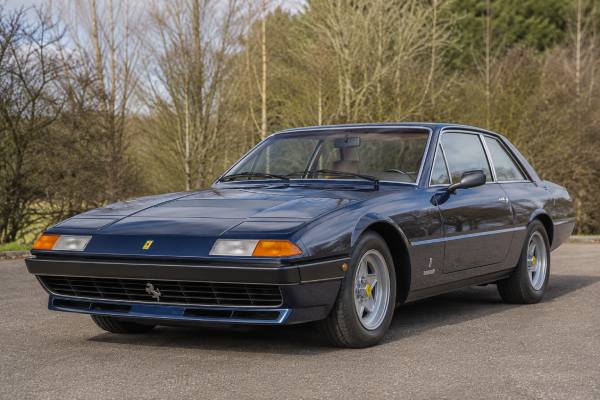
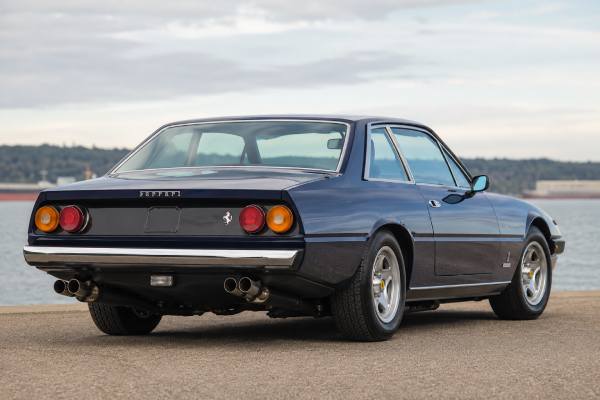
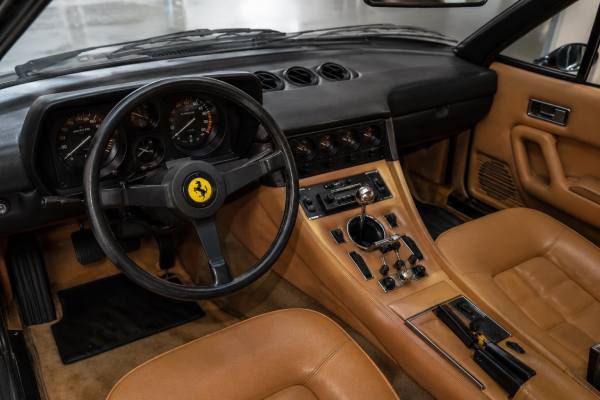
The Ferrari 400 GT (F 101 CL 100) is the five-speed, carbureted version of Ferrari’s front-engine V12 2+2 grand tourer built from 1976 to 1979. Powered by the F 101 C 000 4.8-liter V12, it kept the elegant Pininfarina shape of the 365 GT4 2+2 but added more displacement, revised details, and a broader grand-touring brief. With 340 hp, six Weber carburetors, rear-wheel drive, and a manual gearbox, it sits in an unusual place: more discreet than the mid-engine Berlinetta Boxer, more practical than a two-seat Ferrari, and far rarer in manual form than many people expect.
Its appeal today is not about drama at first glance. The 400 GT is a long, low, understated Ferrari for people who like old-school engineering, usable cabins, and a front-mounted Colombo-family V12. It also asks more from an owner than a casual buyer may expect. Rust, carburetor setup, suspension condition, old electrical repairs, trim originality, and documentation can matter more than the headline purchase price. For the right buyer, a sorted 400 GT offers one of the most distinctive ways into classic V12 Ferrari ownership.
Quick Take
The Ferrari 400 GT is strongest as a refined, manual, carbureted V12 grand tourer rather than as a sharp sports car. Its identity comes from the rare five-speed specification, the 4.8-liter F 101 C 000 engine, Pininfarina’s formal 2+2 body, and a production run of only 147 manual GT examples. The main caution is condition sensitivity: a cheap car with corrosion, tired self-leveling rear suspension, neglected Webers, weak cooling, or missing history can become far more expensive than a better example bought at a higher price. Originality, matching mechanical components, factory documentation, specialist service records, and correct body and interior details are the key buying factors.
Table of Contents
- History and Significance
- Engine, Chassis and Specifications
- Production, Variants and Options
- Design, Engineering and Special Features
- Driving Experience and Performance
- Reliability, Maintenance and Restoration
- Market Value and Buying Guide
History and Significance
The Ferrari 400 GT matters because it was the traditional enthusiast version of Ferrari’s late-1970s luxury V12 2+2: carburetors, a five-speed manual gearbox, and a full-size grand-touring cabin. It was not built to replace the company’s sports cars. It was built for fast, long-distance travel with four seats, leather, air conditioning, and a front-engine layout that still felt connected to Ferrari’s classic road-car tradition.
The 400 range followed the 365 GT4 2+2, which had introduced the long, angular Pininfarina body style in 1972. By the mid-1970s, Ferrari needed a more muscular version of that concept. The answer was the 400, launched in 1976 with an enlarged V12. The displacement rose to 4,823 cc, bringing the model name in line with Ferrari’s habit of using approximate single-cylinder displacement. A 12-cylinder engine of about 400 cc per cylinder became the Ferrari 400.
The 400 was offered in two forms. The 400 Automatic used a three-speed automatic transmission, a first for Ferrari production cars. The 400 GT retained the five-speed manual gearbox. That split is central to the car’s collector identity today. The automatic suited the model’s luxury mission and sold in much larger numbers. The manual GT is the rarer, more driver-focused version, and it is the one most closely tied to the traditional idea of a front-engine V12 Ferrari.
The 400 GT also arrived at a complicated time for the marque. Ferrari was balancing several identities at once: mid-engine supercars, racing heritage, emissions rules, luxury clients, and changing buyer expectations. In the showroom, the 400 sat apart from the 308 and the Berlinetta Boxer. It was not compact, extroverted, or visually aggressive. Its long bonnet, formal roofline, and large glass area made it look closer to a high-speed Italian express than a poster car.
That understated character hurt it for many years. For a long period, the 365 GT4 2+2, 400, 400i, and 412 family was among the least celebrated V12 Ferrari lines. Collectors often chased Daytonas, 275s, 330s, Boxers, and later Testarossas instead. The 400 GT’s practicality and reserved styling made it seem less exotic, even though its mechanical specification was serious.
Today, that view has changed. The 400 GT is increasingly appreciated because it offers a rare mix of features: carbureted V12 power, manual transmission, Pininfarina design, four seats, and relatively low production. It is not the cheapest Ferrari to restore, but it is one of the more interesting classic V12 Ferraris for buyers who prefer subtlety over theatre.
Its significance is also tied to the long life of the platform. The 365 GT4 2+2, 400, 400i, and 412 line lasted from the early 1970s to the end of the 1980s. The 400 GT sits near the start of the 4.8-liter period, before fuel injection changed the character of the engine. That makes it especially appealing to buyers who want the response, sound, and mechanical feel of six side-draft Weber carburetors.
Engine, Chassis and Specifications
The 400 GT’s technical appeal is built around its F 101 C 000 V12, a 4.8-liter, naturally aspirated, carbureted engine rated at 340 hp. The rest of the car follows a classic Ferrari grand-touring formula: tubular steel chassis, front engine, rear-wheel drive, manual gearbox, independent suspension, and disc brakes.
| Item | Specification |
|---|---|
| Model | Ferrari 400 GT |
| Factory type | F 101 CL 100 |
| Production period | 1976–1979 |
| Body style | 2-door 2+2 coupé |
| Engine code | F 101 C 000 |
| Engine layout | Front longitudinal 60-degree V12 |
| Displacement | 4,823.16 cc |
| Bore x stroke | 81 mm x 78 mm |
| Compression ratio | 8.8:1 |
| Fuel system | Six Weber 38 DCOE twin-choke carburetors |
| Maximum power | 340 hp / 250 kW |
| Transmission | 5-speed manual plus reverse |
| Drivetrain | Rear-wheel drive |
The V12 used twin overhead camshafts per cylinder bank, two valves per cylinder, wet-sump lubrication, twin ignition coils, and distributors mounted at the rear of the engine. In plain language, it is a large, complex, old-school Ferrari V12 that rewards correct setup. The Webers are central to the car’s character. When clean, synchronized, and fed by a healthy ignition system, they give the 400 GT a crisp, layered response that later injected versions do not quite duplicate.
The five-speed manual gearbox is also a major part of the car’s appeal. The automatic version is important historically because it introduced a factory automatic transmission to Ferrari, but the 400 GT is the model for buyers who want the more traditional mechanical interaction. The clutch is a single-plate unit, and the transmission drives the rear axle through a conventional front-engine layout rather than a transaxle.
| Area | Ferrari 400 GT Detail |
|---|---|
| Frame | Tubular steel chassis |
| Front suspension | Independent unequal-length wishbones, coil springs, telescopic dampers, anti-roll bar |
| Rear suspension | Independent unequal-length wishbones with self-leveling system, coil springs, telescopic dampers, anti-roll bar |
| Steering | Power-assisted recirculating-ball steering |
| Brakes | Disc brakes |
| Tyres | 215/70 VR 15 front and rear |
| Length | 4,810 mm |
| Width | 1,796 mm |
| Height | 1,310 mm |
| Wheelbase | 2,700 mm |
| Dry weight | 1,700 kg |
| Fuel capacity | 120 liters |
The size numbers explain much of the driving character. At 4.81 meters long and with a 2.7-meter wheelbase, the 400 GT is a large Ferrari by classic standards. It is not a light, short-wheelbase sports car. It was engineered to cover distance at speed, remain stable on motorways, and carry passengers and luggage more comfortably than Ferrari’s two-seat models.
Factory performance data listed a top speed of about 245 km/h, a standing 400 meters in 14.8 seconds, and a standing kilometer in 25.3 seconds. Those are strong figures for a late-1970s four-seat GT, especially one with leather, air conditioning, and a large fuel capacity. Period 0–100 km/h and 0–60 mph figures vary by source and test conditions, so they are best treated as approximate rather than as a single fixed number.
Production, Variants and Options
The key production fact is simple: only 147 Ferrari 400 GT manual examples were built. That makes the five-speed carbureted GT much rarer than the automatic 400 and gives it a different position in the collector market.
The 400 series was produced from 1976 until the fuel-injected 400i replaced it in 1979. Across the carbureted 400 range, total production was 502 cars. Most were automatics, while the manual GT accounted for the smaller share. The manual cars are usually identified by their five-speed gearbox, carbureted F 101 C 000 engine, and F 101 CL 100 factory type reference.
| Version | Transmission | Engine/Fuel System | Approximate Production |
|---|---|---|---|
| 400 GT | 5-speed manual | 4.8-liter V12, six Weber carburetors | 147 |
| 400 Automatic | 3-speed automatic | 4.8-liter V12, six Weber carburetors | 355 |
| 400 total | Manual and automatic | Carbureted 4.8-liter V12 | 502 |
The chassis-number range commonly associated with the 400 GT runs from the high 19000s into the 28000s, and factory records are important when verifying any individual car. Because these cars are now old enough to have passed through many owners, countries, restorations, and partial rebuilds, the number stamped on the chassis should be checked against the engine number, gearbox identity, import papers, service invoices, and any Ferrari Classiche or heritage documentation available.
The 400 GT also differs from the earlier 365 GT4 2+2 in several useful identification areas. The engine is larger, the wheels changed from earlier center-lock style arrangements to five-stud alloys, the interior was revised, the front spoiler treatment was updated, and the rear lights moved to a cleaner paired-round-light look rather than the earlier triple-light layout.
The later 400i, introduced for the 1979 model period, changed the character again. It replaced the six Weber carburetors with Bosch K-Jetronic fuel injection. That made the car more emissions-friendly and generally easier to live with in some conditions, but early injected cars had lower quoted power than the carbureted 400 GT. For buyers focused on sound, throttle feel, and traditional specification, the carbureted manual car usually carries the strongest appeal.
Factory options and equipment on these cars should be understood in period context. The 400 GT was a luxury Ferrari, so items such as leather upholstery, air conditioning, electric windows, and high-quality cabin trim were part of the ownership experience. Buyers could specify colors and interior combinations, and many cars were built with restrained exterior shades that suited the formal body shape. Bright colors exist, but dark blues, silvers, greys, blacks, and elegant metallics often match the car’s personality.
Special-order details matter because restoration costs are high. A car that still has its correct interior color, original-style leather, proper instruments, correct wheels, factory books, tool kit, jack, and matching documentation will usually be more desirable than a cosmetically shiny car with missing small parts. On a rare Ferrari, small missing pieces can become large problems.
There were also aftermarket conversions. Some 400-series cars were converted into convertibles or other special bodies by outside coachbuilders. These can be interesting in their own right, but they are not the same thing as a standard factory 400 GT coupé. For the collector focused on originality, altered bodywork usually needs careful valuation, even when the conversion is attractive or historically known.
Design, Engineering and Special Features
The 400 GT’s design is important because it shows Ferrari in a formal grand-touring mode rather than a racing or supercar mode. Its Pininfarina body is clean, long, and restrained, with enough visual tension to look expensive without shouting.
The shape came from the same design language as the 365 GT4 2+2. Leonardo Fioravanti’s influence is visible in the straight beltline, crisp surfaces, large glasshouse, and balanced three-box proportions. The car has a long bonnet because the V12 sits ahead of the cabin. It has a real roofline because it was intended to carry rear passengers. It has a broad boot because grand touring still meant luggage, not just weekend theatrics.
The pop-up headlights give the front a low, clean appearance when closed. The grille and bumper treatment are more formal than aggressive. The front spoiler lip added to the 400 helps distinguish it from the 365 GT4 2+2 and gives the nose a little more visual weight. At the rear, the paired round taillights on each side create a simpler, more modern look than the earlier triple-light arrangement.
The body was steel over a tubular chassis, with Pininfarina responsible for the coachwork. Like many coachbuilt or semi-hand-built cars of the era, panel fit and detail consistency can vary. That is not automatically a flaw, but it does mean buyers should understand what original construction looks like before judging a car. Over-restored shut lines, excessive filler, incorrect seams, or non-factory repairs can hide accident damage or corrosion.
Inside, the 400 GT is more lounge-like than race-like. The dashboard, leather seats, wide center area, and generous glass make it feel like a proper long-distance GT. The rear seats are not limousine-like, but they are more useful than the token rear seats in many 2+2 coupés. The driving position can feel period-specific, with a long reach, relatively low seat, and a sense that the car was designed for relaxed speed rather than tight urban work.
The engineering choices support that mission. The long wheelbase helps stability. The self-leveling rear suspension helps the car maintain its stance when passengers or luggage are added. The large fuel tank supports long-range touring. The assisted steering reduces effort in a heavy front-engine car, and the disc brakes were appropriate for the weight and performance when properly maintained.
The engine bay is one of the car’s main emotional features. Six side-draft Webers across a V12 create a mechanical presence that later injected engines cannot fully imitate. The intake sound is layered and complex, especially when the throttles open. The exhaust note is smoother and more mature than a smaller Ferrari V8. It is not just loudness that matters; it is the combination of induction, cam timing, long bonnet, and cabin insulation that makes the car feel like a large-displacement classic GT.
The 400 GT is also notable for what it does not have. There is no turbocharging, no electronic drive mode, no carbon-ceramic brake system, and no computer-controlled differential. Its special features are mechanical and physical: engine, gearbox, chassis balance, suspension geometry, body shape, and cabin ambience. That simplicity is appealing, but it does not make the car cheap or easy to restore. A simple system built in low volume can still be very expensive when parts, labor, and originality matter.
Driving Experience and Performance
A good Ferrari 400 GT feels like a fast, confident, old-world grand tourer, not like a lightweight sports car. Its best driving moments come on open roads, where the V12 can breathe, the chassis settles, and the manual gearbox adds involvement without making the car feel nervous.
The engine is the center of the experience. At low speed, a correctly tuned carbureted V12 should pull smoothly, though it may need proper warm-up before it feels clean and responsive. Cold starts, idle quality, and low-rpm behavior are useful clues to the health of the carburetors, ignition, fuel delivery, and general setup. A rough-running car may only need tuning, but it can also be signaling deeper neglect.
Once warm, the 4.8-liter engine gives the car easy midrange strength. It is not a peaky engine that demands constant high revs. The charm is in the way the power builds smoothly and the way the intake and exhaust notes become richer as the throttle opens. The 340 hp rating was strong for the time, but the car’s weight and size mean it does not feel explosive by modern standards.
The manual gearbox changes the personality compared with the automatic. The five-speed gives the driver control over the V12’s sound and response, and it makes the car feel more connected to older Ferrari road cars. The gearbox should feel mechanical and deliberate. A reluctant shift when cold is not unusual in many classic Ferraris, but grinding, jumping out of gear, severe baulking when warm, or a noisy transmission should be treated seriously.
The steering is assisted and suits the car’s role. It is not razor-sharp in the way a smaller sports car can be. Instead, it gives the 400 GT a calm, stable feel. On fast roads, that is part of the pleasure. The car tracks with authority and feels built for distance. In tight city streets, its length, long bonnet, and turning circle make it feel large.
The ride quality depends heavily on suspension condition. A properly maintained 400 GT should feel composed, with enough compliance for long trips and enough control to avoid float. A tired car can feel heavy, loose, uneven, or unstable over bumps. Rear self-leveling problems, worn bushings, tired dampers, old tyres, and poor alignment can transform the driving experience from elegant to disappointing.
Braking should be judged with period expectations. The disc brakes are capable when fresh, but the car is heavy and old. Pedal feel, straight-line braking, brake balance, fluid condition, flexible hoses, caliper health, and pad choice all matter. A 400 GT is not a modern supercar, and it does not have modern stability systems or modern crash structures. It rewards planning, smooth inputs, and mechanical sympathy.
Tyres also have a large influence. The original 215/70 VR 15 sizing gives the car a tall-sidewall feel. Correct high-speed-rated tyres help preserve the steering, ride, and stance. Oversized or incorrect modern replacements can make the car look wrong and drive worse. For a collector car, the tyre choice should balance originality, safety, availability, and actual road use.
The 400 GT is at its least convincing when it is expected to behave like a track car. Its size, weight, and luxury equipment are part of the package. It is at its best when driven like a powerful long-distance coupé: warm it properly, use the torque, let the chassis settle, and enjoy the sound and balance over flowing roads. That is where the car makes the most sense.
Reliability, Maintenance and Restoration
The 400 GT can be durable when maintained correctly, but neglect is expensive. The engine itself has a strong basic architecture, yet the surrounding systems—carburetors, ignition, cooling, suspension, electrics, fuel lines, and body structure—need specialist attention.
The first rule is to buy condition, not just a badge. A low entry price can be misleading because a 400 GT has the running costs of a low-volume V12 Ferrari, not a normal 1970s coupé. It may be one of the more affordable classic V12 Ferraris to buy, but it is not one of the cheapest cars to make right.
Engine and Fuel System
The F 101 C 000 V12 uses timing chains rather than rubber cam belts, which removes one famous Ferrari service anxiety but does not make the engine maintenance-free. Valve adjustment, ignition condition, carburetor synchronization, oil leaks, cooling health, and correct fluids all remain important.
Six Weber carburetors require knowledge and patience. Poor tuning can cause hard starting, flat spots, fuel smell, uneven idle, plug fouling, and disappointing performance. Before blaming the carburetors, a specialist should confirm ignition timing, distributor condition, coil output, fuel pressure, compression, and absence of vacuum leaks. Many carburetor problems are actually ignition or fuel-delivery problems.
Cooling-system condition is another major inspection area. Old hoses, blocked radiator cores, weak fans, tired water pumps, corroded pipes, and poor wiring can all cause hot running. A large V12 produces a lot of heat, and a marginal cooling system can turn a short test drive into a misleadingly expensive ownership story.
Suspension, Steering, and Brakes
The rear self-leveling suspension is one of the most important 400 GT ownership areas. When working correctly, it helps the car carry passengers and luggage without sagging. When neglected, it can leak, lose effectiveness, or be replaced with non-original conventional parts. Some owners accept conversion for usability, but originality-minded buyers should understand exactly what has been changed.
Suspension bushings, ball joints, dampers, wheel bearings, steering joints, and engine mounts are all age-sensitive. A car that has covered little mileage but sat for years can still need extensive rubber and hydraulic renewal. Heavy steering effort, knocking, uneven ride height, wandering, vibration, or braking instability should be investigated before purchase.
Brake work should not be delayed. Calipers can stick, hoses can swell internally, discs can corrode, and old fluid can damage components. Because the car is heavy and fast enough for modern traffic, the brake system needs to be better than merely “working.”
Body, Rust, and Interior
Corrosion is one of the largest cost drivers. The 400 GT has a steel body and a complex structure, so rust repair can become expensive very quickly. Areas to inspect include:
- Sills and lower body sections
- Door bottoms and lower front wings
- Wheel arches and inner arch lips
- Floor areas and jacking points
- Boot floor and fuel-tank surroundings
- Windscreen and rear-window surrounds
- Headlight pods and front panel seams
- Bumper mounts and hidden structural sections
Paint quality deserves close attention. Cracking near headlamp areas, bubbling under trim, thick filler, poor panel gaps, and mismatched paint texture can indicate old repairs. A magnet, paint-depth readings, underside inspection, and photographic restoration records are useful, but a specialist who knows these cars is more valuable than any single tool.
Interior restoration can also be costly. Leather, carpets, switchgear, gauges, air-conditioning components, window motors, and trim pieces may look simple, but many are model-specific or difficult to source. A complete, worn original interior is often a better starting point than a partly missing one.
Electrical and Parts Reality
Electrical problems are common on many low-volume Italian cars of this era, and the 400 GT is no exception. Age, heat, added alarms, stereo installations, grey-market modifications, and poor repairs can create difficult faults. Check lights, window lifts, fans, gauges, charging, ignition wiring, fuse boxes, relays, and earthing points.
Parts availability is mixed. Mechanical parts can often be sourced through Ferrari specialists, classic suppliers, rebuilders, and donor networks. Body trim, interior pieces, correct wheels, badges, lenses, and small hardware can be harder. Before buying a car missing important items, price the missing parts as if they will be difficult to find—because they may be.
Market Value and Buying Guide
The 400 GT remains a relatively undervalued classic V12 Ferrari compared with more famous two-seat models, but the best manual carbureted cars are no longer bargain curiosities. The market now separates tired automatics, usable driver-quality cars, restored examples, rare manual GTs, and exceptional provenance cars more sharply than it once did.
Values vary widely by country, history, condition, gearbox, and originality. Public auction results for the 400-series family often show driver-quality cars at approachable classic-Ferrari levels, while rare manual cars with strong documentation, desirable colors, and high-quality restoration can sit much higher. The 400 GT’s low production gives it long-term collector support, but condition remains more important than rarity alone.
The most valuable examples usually have several of these traits:
- Factory five-speed 400 GT identity confirmed by records
- Matching engine and gearbox where documentation supports it
- Original or factory-correct color combination
- Complete books, tools, jack, manuals, and service file
- Known ownership history
- No serious corrosion or accident damage
- Correct wheels, trim, lights, interior, and instruments
- Properly functioning carburetors, cooling, electrics, and suspension
- Specialist maintenance by shops familiar with classic Ferrari V12s
- Ferrari Classiche or comparable heritage documentation where available
The cars to avoid are usually the opposite: incomplete projects, cars with unclear identity, poor repaint quality, missing interior parts, rusty structure, non-working self-leveling suspension, rough-running engines, overheated history, and import paperwork that does not match the car. A 400 GT that “just needs finishing” can be a serious financial trap if the missing work involves body structure, trim sourcing, carburetor rebuilding, or sorting years of electrical shortcuts.
Pre-Purchase Inspection Priorities
A proper inspection should be done by a Ferrari specialist, not only by a general classic-car mechanic. The buyer should ask for a written report covering the following areas:
| Area | What to Check | Why It Matters |
|---|---|---|
| Identity | Chassis number, engine number, gearbox, factory records, import papers | Manual GT originality drives value |
| Body | Rust, filler, panel gaps, window surrounds, sills, underside | Body restoration can exceed the value gap between cars |
| Engine | Compression, oil leaks, smoke, cooling, ignition, chain noise | V12 repairs are specialist and costly |
| Carburetors | Starting, idle, synchronization, throttle response, fuel leaks | The Webers define the driving character |
| Gearbox and clutch | Cold and warm shifts, synchros, clutch take-up, noises | The manual gearbox is central to desirability |
| Suspension | Rear self-leveling function, bushings, dampers, ride height | Neglect changes both value and road behavior |
| Electrics | Windows, lights, fans, gauges, charging, old modifications | Electrical sorting can be time-consuming |
| Interior | Leather, dash, switches, carpets, air conditioning, instruments | Correct trim can be difficult to source |
Mileage should be considered carefully. Very low mileage is attractive only if the car has been maintained and exercised. A car that sat for years may need hoses, seals, tyres, brakes, fuel-system work, suspension renewal, and carburetor rebuilding before regular use. A higher-mileage car with excellent maintenance may be more satisfying than a static museum piece.
Originality versus upgrades is another decision point. Sensible hidden improvements to cooling, ignition reliability, fuel hoses, and electrical connections may make a car better to use. Visible changes, engine swaps, incorrect wheels, altered interiors, non-factory bodywork, or removed self-leveling suspension can reduce collector appeal. The best approach depends on the buyer’s purpose: driving, preserving, showing, or investing.
The 400 GT is best bought with a clear budget after purchase. Even a good car may need immediate work once used regularly. Fluids, tyres, brake service, carburetor adjustment, battery, fuel lines, cooling hoses, alignment, and minor electrical repairs are common first-year items. The safest financial choice is usually the car with the best history and strongest inspection report, not the car with the lowest asking price.
Long-term collectability looks favorable for the manual carbureted GT because it combines rarity with a desirable specification. It is still less universally loved than Ferrari’s famous two-seat icons, and that keeps values more grounded. But the qualities that once made it overlooked—formal styling, four seats, understated character—now make it stand out. For a buyer who understands the maintenance reality, the Ferrari 400 GT is one of the most interesting classic V12 grand tourers of its era.
References
- Ferrari 400 GT (1976) – Ferrari.com 1976
- Ferrari 400 Automatic (1976) – Ferrari.com 1976
- Valuation Verdict: Ferrari 400/412 2025
- Ferrari 400 – Automatic Market 2026
- Price Guide: Ferrari 400 GT [UPDATED 2026] 2026
Disclaimer
This article is for informational purposes only and is not a substitute for professional diagnosis, repair, valuation, or inspection. Specifications, torque values, service intervals, parts, procedures, and equipment can vary by VIN, market, production date, and individual vehicle history. Always verify details against official Ferrari service documentation, factory records, and a qualified marque specialist before buying, repairing, restoring, or modifying a Ferrari 400 GT.
If this guide helped you, please consider sharing it on Facebook, X/Twitter, or your favorite enthusiast community to support our work.