


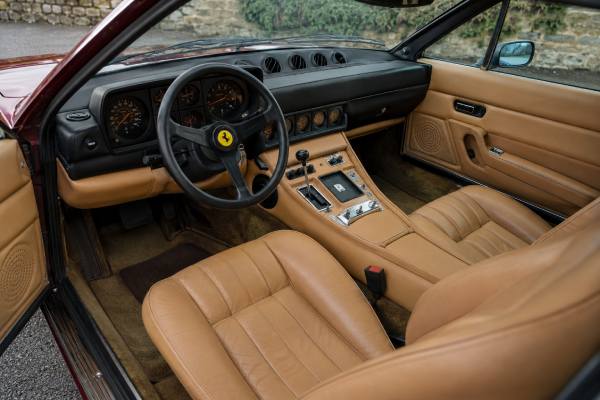
The Ferrari 400 Automatic i, identified here as F 101 DL 170 with the F 101 D 070 4.8-liter V12, was the fuel-injected automatic version of Ferrari’s angular grand touring 2+2 built from 1979 into the early 1980s. It kept the long-bonnet Pininfarina shape and relaxed high-speed character of the carbureted 400 Automatic, but replaced the six Weber carburetors with Bosch K-Jetronic injection, giving the car cleaner running, easier emissions compliance, and a factory rating of 310 hp.
This is not the loudest, sharpest, or most visually dramatic Ferrari of its era. That is exactly why it remains interesting. The 400 Automatic i was built for fast continental travel rather than track-day heroics: a front-mounted V12, a spacious four-seat cabin, a three-speed automatic transmission, power steering, air conditioning, and a restrained body that looked more like a tailored Italian suit than a poster car. It also sits in an unusual part of Ferrari history as one of the company’s most serious attempts at a refined automatic grand tourer before the later 412 and, eventually, the 456 GT.
Quick Take
The Ferrari 400 Automatic i is most appealing as a discreet V12 grand tourer with real Ferrari engineering, four-seat usability, and elegant Pininfarina restraint. Its identity is tied to the fuel-injected 4.8-liter Colombo-family V12 and GM-sourced three-speed automatic, a combination that makes it more relaxed than a manual 400i but also less valuable to purist collectors. The main caution is condition sensitivity: a cheap neglected car can become far more expensive than a strong, documented one. Originality, corrosion condition, service history, matching engine and chassis data, and a proper Ferrari specialist inspection matter more than mileage alone.
Table of Contents
- History and Significance
- Engine, Chassis, and Specifications
- Production, Variants, and Options
- Design, Engineering, and Features
- Driving Experience and Performance
- Reliability, Maintenance, and Restoration
- Market Value and Buying Guide
History and Significance
The 400 Automatic i matters because it shows Ferrari building a serious luxury GT around a front-mounted V12 at a time when the brand’s mid-engine cars were getting most of the attention. It was not a replacement for the 308 or Berlinetta Boxer; it was a different kind of Ferrari, aimed at long-distance buyers who wanted speed, refinement, luggage space, and four seats.
The story begins with the 365 GT4 2+2, launched in the early 1970s as a sharp-edged Pininfarina grand tourer. The 400 followed in 1976 with a larger 4.8-liter V12 and the option of a three-speed automatic transmission. That automatic version was significant because it made Ferrari ownership less intimidating for buyers who wanted a powerful V12 without the effort of a heavy clutch in traffic.
The 400 Automatic i arrived in 1979 as the injected successor. The “i” was important. It marked the move from carburetors to Bosch mechanical fuel injection, which helped the car meet tighter emissions expectations and made cold starts and everyday running more predictable when the system was in good condition. Power fell from the carbureted 400’s higher rating to 310 hp, but the car remained a fast, expensive, and rare grand tourer.
The 1979–1982 version covered here is the early 400i Automatic before the late-1982 update. Later 400i cars received detail changes, a revised interior, exterior updates, and a slightly higher power rating. The early cars are cleaner in appearance and closer in spirit to the original 400, with only subtle visual clues separating them from the carbureted model.
The 400 Automatic i also has an unusual market identity. It was never the obvious collector choice. Manual V12 Ferraris traditionally carried stronger enthusiast appeal, and the 400’s formal shape was long misunderstood beside Daytona coupes, Boxers, 308s, and later Testarossas. That has changed gradually. Collectors now value the 400i for what it is: a hand-built, front-engine Ferrari V12 with real usability, low production numbers, and a style that has aged far better than many expected.
Its significance is not based on racing wins or supercar drama. It comes from its role as a high-speed gentleman’s express and from its place in Ferrari’s long-running 2+2 bloodline. It links the 365 GT4 2+2 to the 412, then spiritually to the 456 GT and 612 Scaglietti. For buyers today, that makes the 400 Automatic i both appealing and risky: it is one of the more accessible classic V12 Ferraris to buy, but not always one of the cheapest to own.
Engine, Chassis, and Specifications
The 400 Automatic i used a 4.8-liter front-mounted V12, Bosch K-Jetronic fuel injection, rear-wheel drive, and a three-speed automatic transmission. Its specification was built around effortless high-speed travel rather than lightweight agility.
The engine belonged to Ferrari’s long-running Colombo-family V12 tradition, with a 60-degree layout, four overhead camshafts, two valves per cylinder, and wet-sump lubrication. In this F 101 D 070 automatic application, it displaced 4,823.16 cc and was rated at 310 hp at high revs. The torque delivery was broad enough to suit the automatic gearbox, although the injection system made the car less sharp-sounding than the earlier carbureted 400.
| Item | Specification |
|---|---|
| Model | Ferrari 400 Automatic i |
| Internal identification | F 101 DL 170 chassis family; F 101 D 070 automatic engine type |
| Production focus | 1979–1982 early 400i Automatic |
| Body style | Two-door 2+2 coupe |
| Engine | Front longitudinal 60-degree V12 |
| Displacement | 4,823.16 cc |
| Bore x stroke | 81 mm x 78 mm |
| Fuel system | Bosch K-Jetronic mechanical fuel injection |
| Maximum power | 310 hp at 6,500 rpm, commonly quoted as 228 kW / 310 CV |
| Transmission | Three-speed automatic |
| Drive | Rear-wheel drive |
| Top speed | About 240 km/h, or 149 mph |
The automatic transmission is a major part of the car’s identity. Ferrari used a robust GM Turbo-Hydramatic three-speed automatic, adapted for the 400’s grand touring mission. That may sound unexotic, but it suited the car’s weight and character. The gearbox is not quick by modern standards, and it does not give the same involvement as the five-speed manual, yet it gives the V12 an easy, muscular feel in relaxed driving.
The chassis was a tubular steel structure with steel bodywork. Suspension was independent at both ends, using unequal-length wishbones, coil springs, telescopic dampers, and anti-roll bars. The rear suspension used self-leveling equipment, valuable for a loaded long-distance GT but expensive to restore when neglected.
| Area | Details |
|---|---|
| Frame | Tubular steel chassis |
| Front suspension | Independent unequal-length wishbones, coil springs, telescopic dampers, anti-roll bar |
| Rear suspension | Independent unequal-length wishbones with self-leveling system |
| Steering | Power-assisted steering |
| Brakes | Four-wheel disc brakes with servo assistance |
| Typical early tire size | 215/70 VR15 |
| Wheelbase | 2,700 mm |
| Length | About 4,810 mm |
| Width | About 1,798 mm |
| Height | About 1,314 mm |
| Fuel capacity | About 120 liters |
| Quoted weight | About 1,830 kg, depending on source, market, and equipment |
Performance figures vary by source, test condition, market equipment, and whether the car was manual or automatic. A healthy automatic 400i is usually described as a roughly seven-second-to-100-km/h car, with the top speed near 240 km/h. The bigger point is how it delivers speed: not with a hard launch, but with smooth V12 pull once moving.
Production, Variants, and Options
The 400 Automatic i was part of the larger 400i family, which ran from 1979 to 1985, but the 1979–1982 cars are best understood as the early injected series. They are especially important to identify correctly because later 400i cars received visual, interior, tire, and engine-detail changes.
Ferrari offered the 400i in manual and automatic forms. The manual was called the 400 GTi, while the automatic carried the 400 Automatic i name. Across the full 400i production run, automatics were more common than manuals, but the manual cars are usually more valuable because they suit enthusiast expectations of a classic Ferrari V12.
The early injected cars retained much of the carbureted 400’s appearance. The most obvious change was the “i” badge and the mechanical shift to fuel injection. Late in 1982, Ferrari revised the model with changes that included a different cabin layout, updated switchgear, different exterior details, and a small power increase. Buyers should be careful because registration year, model year, and build specification can overlap.
Key Identification Points
A correct early 400 Automatic i should be checked by chassis number, engine type, gearbox type, body details, and documentation. Visual appearance alone is not enough, because many cars have been repainted, retrimmed, converted, imported, or updated over the decades.
Important checks include:
- F 101-series chassis identity and correct paperwork.
- F 101 D 070 engine identification for the automatic injected version.
- Bosch K-Jetronic injection hardware, not Weber carburetors.
- Three-speed automatic transmission, not a later conversion.
- Early-style body and interior details for 1979–1982 cars.
- Evidence of original color, trim, and market delivery specification.
The 400i was sold in both left-hand-drive and right-hand-drive form depending on market. It was not officially a mainstream U.S.-market Ferrari in the way later models were, so cars in North America often have grey-market import history. That can be perfectly acceptable, but buyers should inspect federalization work, lighting changes, emissions equipment, and paperwork carefully.
Factory equipment commonly reflected the car’s luxury GT role. Leather upholstery, air conditioning, electric windows, and a well-appointed cabin were central to the model’s appeal. Optional or market-dependent features could include audio equipment, rear-seat comfort features, and special-order color and trim combinations.
Non-factory body conversions deserve special caution. A small number of 400-series cars were converted into convertibles, shooting brakes, or other specials by outside coachbuilders or independent workshops. Some are interesting in their own right, but they are not standard factory 400 Automatic i coupes. For most collectors, an unmodified coupe with clear factory documentation will be easier to value, insure, maintain, and resell.
Originality carries real weight. A color change is not always fatal, but it affects value if it hides poor bodywork or breaks the link to the car’s factory build record. Interior retrims can be acceptable when done correctly, yet cheap leather, incorrect stitching, wrong carpets, non-original switchgear, and modern audio cut into original panels can all reduce desirability.
Documentation is especially valuable on these cars. The strongest examples come with old service invoices, ownership history, import documents where relevant, tool roll, books, jack, spare wheel, and any available Ferrari heritage or Classiche material. A 400i without paperwork can still be a good car, but the price should reflect the risk.
Design, Engineering, and Features
The 400 Automatic i looks formal because it was designed as a fast luxury 2+2, not as a mid-engine exotic. Its clean Pininfarina shape, long hood, low roof, crisp beltline, and square rear deck give it a restrained confidence that has become more attractive with age.
The design traces back to the 365 GT4 2+2 and is often associated with Leonardo Fioravanti’s work at Pininfarina. It moved away from the rounded 1960s Ferrari language and toward the sharper, flatter surfaces of the 1970s. The 400i’s styling is not decorative. The car has thin pillars, a strong horizontal profile, and a practical cabin shape that supports real grand touring use.
At the front, pop-up headlights gave the car a clean nose when closed. The grille and lower intake supplied cooling air to the big V12, while the long hood made the front-engine layout clear from the first glance. At the rear, twin round lamps on each side kept a clear Ferrari link, even though the body shape was more conservative than the brand’s two-seat sports cars.
The engineering was also deliberately traditional. Ferrari placed the V12 up front, drove the rear wheels, and used a strong steel chassis. The layout gave the car the balance and refinement expected of a classic grand tourer. It was not trying to minimize weight at all costs. It was trying to make a powerful V12 Ferrari comfortable at high speeds for long periods.
The cockpit is one of the 400i’s most important features. The driving position is low, the dashboard is wide, and the cabin feels more like a private express than a sports car. The rear seats are usable compared with many 2+2 coupes, especially for shorter trips or smaller passengers. The luggage area is also more practical than expected from a classic Ferrari.
Why Fuel Injection Changed the Car
Bosch K-Jetronic injection made the 400i more civilized when properly adjusted. It helped with emissions, cold starting, and consistency, but it also changed the engine’s character. A carbureted 400 has a more old-school intake sound and can feel more vivid when tuned well. The injected 400i is smoother, cleaner, and better suited to the automatic gearbox’s calm personality.
That difference matters to buyers. The 400 Automatic i is not the model to choose if the goal is maximum mechanical theater. It is the model to choose if the goal is a discreet Ferrari V12 that can cover distance with less fuss.
The automatic gearbox is also part of the special-feature story. It makes the car less desirable to some collectors, but it makes sense in context. The 400 Automatic i was a luxury GT for owners who might drive from Milan to Geneva, Paris to the Riviera, or London to the Continent. In that use, smooth torque and relaxed cruising mattered more than heel-and-toe downshifts.
The self-leveling rear suspension was another proper GT feature. It helped the car sit correctly with passengers and luggage, preserving ride height and stability. Today, that system is both a strength and a maintenance concern. A working system adds to the car’s originality and comfort. A failed or poorly converted one should be priced accordingly.
Driving Experience and Performance
A good 400 Automatic i feels smooth, heavy, stable, and quietly powerful rather than nervous or aggressive. It is a car for covering long distances quickly, not for chasing lightweight sports cars on tight roads.
The V12 is the central attraction. It does not have the raw carburetor bark of the earlier 400, but it still has the cultured sound and turbine-like pull expected from a classic Ferrari twelve-cylinder engine. Throttle response is progressive rather than razor sharp. The injection system and automatic gearbox make the car feel relaxed at low speed, then increasingly confident as the road opens.
The three-speed automatic changes the whole mood of the car. It shifts smoothly when in good condition, and the V12 has enough torque to make the limited number of ratios less of a problem in normal driving. Push hard, and the gearbox feels dated. It cannot match the control or involvement of the five-speed manual. But in traffic, on open highways, and during gentle touring, it suits the 400i’s purpose very well.
Steering effort is moderate because of power assistance. Feedback is not as delicate as in smaller Ferraris, and the car’s size is always present. The long wheelbase gives stability, but the driver must respect the weight. The 400i is best driven with smooth inputs: brake early, guide it into corners, let the chassis settle, and use the V12’s mid-range pull on exit.
Ride quality is one of the model’s strengths when the suspension is healthy. The car was built to travel quickly over real roads, not just perfect pavement. Worn dampers, tired bushings, incorrect tires, and a failed self-leveling system can make a 400i feel vague or floaty, so a poor drive often says more about the condition of the example than the design itself.
Braking expectations should be period-correct. The discs are adequate when properly rebuilt and used with good pads, fresh fluid, sound hoses, and functioning calipers. They do not feel like modern carbon-ceramic brakes, and a heavy 2+2 Ferrari will expose a tired brake system quickly. Any pulling, sinking pedal, vibration, or uneven response should be treated as a repair item, not as “normal old Ferrari” behavior.
Visibility is good for a car of this type. The squared-off shape helps the driver place it on the road, although the long nose requires attention in tight spaces. Cabin heat, air conditioning performance, window operation, and ventilation vary widely by condition. A sorted example can feel surprisingly usable; a neglected one can feel hot, noisy, and tiring.
The best driving environment is a fast secondary road or highway, where the car can build speed smoothly and hold it without stress. In city use it feels large, thirsty, and expensive to exercise. On tight mountain roads it can be enjoyable, but only if the driver accepts its GT nature. It is not a 308 with rear seats. It is a V12 express.
Reliability, Maintenance, and Restoration
The 400 Automatic i can be durable when maintained by specialists, but neglect is expensive. Its biggest ownership risks are not only engine failure; they are corrosion, old fuel-injection components, tired suspension, weak electrical systems, poor previous repairs, and missing model-specific trim.
The V12 is strong in basic architecture, but it must not be treated like an ordinary used-car engine. It has a large oil capacity, many ignition and fuel-system parts, and a service appetite that reflects its complexity. Regular fluid changes, valve checks, ignition tuning, cooling-system care, and fuel-system maintenance are central to keeping it healthy.
A useful point for buyers is that this engine does not carry the same cam-belt service issue as later belt-driven Ferraris. That does not make it cheap. Timing chains, tensioners, valve gear, distributors, injection tuning, hoses, and cooling components still require expert attention. A poorly running 400i may only need careful setup, or it may need a very expensive sequence of repairs.
The Bosch K-Jetronic system is reliable when clean, sealed, and adjusted correctly. Problems appear when cars sit for long periods. Old fuel can gum up fuel distributors, injectors, warm-up regulators, pumps, accumulators, and lines. Vacuum leaks can create poor idle, hot-start problems, hesitation, or uneven running. Diagnosis requires someone who understands mechanical injection, not just modern plug-in diagnostics.
The automatic gearbox is one of the simpler major components. The GM three-speed unit is generally robust and more familiar to transmission specialists than a rare Ferrari manual. Even so, the installation, mounts, cooling lines, shift linkage, kickdown function, and leaks must be inspected. A lazy or harsh shift can mean adjustment, old fluid, or deeper wear.
Common Inspection Areas
A pre-purchase inspection should focus on the whole car, not just whether the engine starts.
| Area | What to Check |
|---|---|
| Engine | Oil leaks, compression, smoke, hot idle, cooling behavior, ignition condition, timing-chain noise |
| Fuel injection | Cold start, hot restart, fuel pumps, accumulators, injectors, vacuum leaks, fuel distributor condition |
| Cooling system | Radiator, fans, water pump, thermostat, hoses, expansion tank, overheating in traffic |
| Transmission | Shift quality, leaks, kickdown, fluid condition, mounts, cooler lines |
| Suspension | Self-leveling rear system, bushings, dampers, ball joints, ride height, uneven tire wear |
| Brakes | Calipers, hoses, master cylinder, servo, discs, fluid age, pedal feel |
| Body | Sills, lower doors, wheel arches, boot floor, screen surrounds, front valance, previous accident repair |
| Electrical | Fuse panels, relays, windows, lights, gauges, fans, HVAC controls, charging system |
| Interior | Leather, dashboard, carpets, switches, headliner, correct trim, signs of water ingress |
Corrosion is one of the most serious concerns. These cars are steel-bodied, and many lived in damp European climates or spent years stored in less-than-ideal conditions. Rust can appear in the lower doors, sills, wheel arches, front and rear valances, boot floor, battery area, windscreen surrounds, and hidden structural sections. A shiny repaint can hide a large restoration bill.
Interior restoration is also costly. The cabin has large areas of leather, specific trim, period switchgear, and model-correct details that are not always easy to source. A retrim can look attractive at first glance but still hurt value if the grain, stitching, color, or pattern is wrong.
Parts availability is mixed. Some mechanical items are manageable because the gearbox, Bosch injection principles, ignition components, bearings, and general service items can be sourced or rebuilt. Ferrari-specific body panels, glass, trim, lights, badges, self-leveling parts, and interior details are harder and more expensive. Labor is the real cost driver, especially when a car needs sorting across several systems at once.
Restoration should be approached with caution. A low purchase price can be misleading because the value ceiling of an automatic 400i is not unlimited. It is easy to spend more on paint, trim, suspension, and mechanical work than the finished car is worth. The sensible buyer usually pays more for a documented, running, rust-free, regularly used car than for a cheaper project with unknown needs.
Market Value and Buying Guide
The 400 Automatic i remains one of the more accessible classic Ferrari V12 models, but that does not make it a budget car. Values are strongest for original, documented, rust-free examples with correct mechanical specification and recent specialist maintenance.
As of the mid-2020s, automatic 400i values generally sit below manual 400i values. That gap is logical: collectors often prefer a gated manual V12 Ferrari, and manual cars were produced in smaller numbers. The automatic should not be dismissed, though. It has its own appeal as the more relaxed, historically important GT, and good examples have become harder to find.
Market data in recent years shows a wide spread. Tired projects and poorly documented cars can trade at prices that look tempting, while exceptional low-mileage, highly original, celebrity-owned, or unusually well-documented cars can sell far above the average. A realistic buyer should focus less on the cheapest asking price and more on total cost after repairs.
The strongest value factors are:
- Original engine, gearbox, chassis identity, and documentation.
- Correct early 400 Automatic i specification for 1979–1982 cars.
- Dry, straight body with no hidden corrosion or poor accident repair.
- Healthy Bosch fuel injection with good cold and hot starting.
- Working self-leveling rear suspension or properly documented correct repair.
- Strong cooling system and stable temperature in traffic.
- Complete interior with correct leather, switches, instruments, and trim.
- Service records showing regular specialist attention, not just occasional oil changes.
- Factory books, tools, jack, spare, import papers, and ownership history.
- Attractive original color combination or high-quality factory-correct repaint.
Cars to avoid include those with missing history, visible rust, fresh paint over unknown metalwork, non-running injection problems, badly modified wiring, incomplete interiors, damaged glass, incorrect wheels, and vague import paperwork. A non-running 400i may look like a bargain, but recommissioning can quickly consume the difference between a project and a sorted car.
A good pre-purchase inspection should be done by a specialist familiar with vintage front-engine Ferraris. The inspection should include lift time, road test, compression or leak-down testing if warranted, fuel-system evaluation, cooling-system check, underside corrosion inspection, body filler assessment, brake and suspension review, and verification of engine and chassis identifiers.
For ownership, the best mindset is preventive care. These cars dislike neglect more than mileage. A regularly driven 400i with fresh fluids, clean fuel, exercised electrics, and maintained cooling will usually be a better companion than a low-mileage car that spent years dormant. Storage history matters. So does the person who maintained it.
The long-term collectability picture is positive but selective. The 400 Automatic i has several things collectors increasingly appreciate: a front-mounted Ferrari V12, Pininfarina design, limited production, analog engineering, and real touring usability. Against that, the automatic gearbox and understated styling limit demand compared with more famous models.
The right buyer is someone who wants a refined classic Ferrari GT and understands that purchase price is only one part of the equation. Buy the best documented, most structurally sound, most complete example you can justify. A sorted 400 Automatic i is elegant, rare, and deeply satisfying. A neglected one can be an expensive lesson in why affordable V12 Ferraris are rarely cheap.
References
- Ferrari 400 Automatic i (1979) – Ferrari.com 1979 (Manufacturer Specifications)
- Ferrari 400 GTi (1979) – Ferrari.com 1979 (Manufacturer Specifications)
- Ferrari 400 i Owner’s Manual 1979 (Owner’s Manual)
- Ferrari 400i – Automatic Market 2026 (Market Data)
- Tested: 1982 Ferrari 400i Is the Grown-Up Choice 2025 (Road Test Archive)
Disclaimer
This article is for informational purposes only and is not a substitute for professional diagnosis, repair, valuation, or inspection. Specifications, torque values, service intervals, procedures, market equipment, and parts details can vary by VIN, market, production date, and individual vehicle history. Always verify critical information against official Ferrari service documentation and consult a qualified Ferrari specialist before buying, repairing, or restoring a Ferrari 400 Automatic i.
If this guide helped you, please consider sharing it on Facebook, X/Twitter, or your favorite automotive community to support our work.