
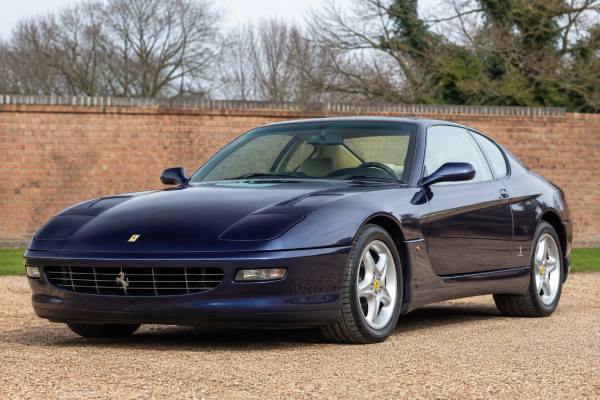
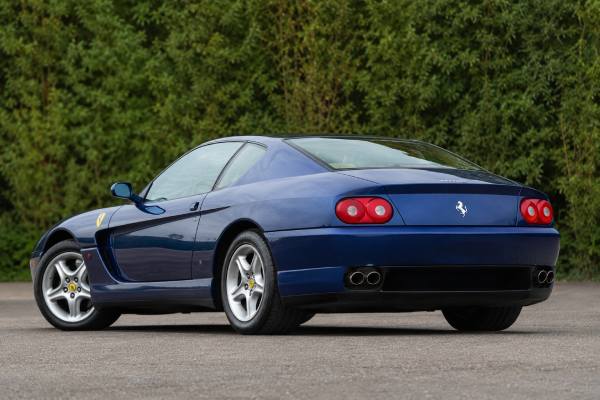
The Ferrari 456 GT (F116 CL) with the F116C 5.5-liter V12 is the late original-series manual version of Ferrari’s elegant front-engine 2+2 grand tourer, built before the 456M update arrived in 1998. It kept the clean Pininfarina body, pop-up headlights, six-speed rear transaxle, and naturally aspirated V12 character of the early 456, but later cars from the 1996–1998 period are commonly associated with the updated Bosch Motronic M5.2 engine management and the F116C engine code.
This is not the loudest or most aggressive Ferrari of the 1990s. Its appeal is more subtle. The 456 GT was made for fast road use, long-distance comfort, and discreet V12 performance rather than track-day drama. It replaced the older 412 tradition with a far more modern car: aluminum body panels over a steel tubular structure, a rear-mounted manual gearbox for better weight distribution, adaptive damping, ABS, power assistance, and a cabin trimmed for grand touring rather than stripped-out speed.
Today, the 456 GT sits in an interesting part of the Ferrari market. It is still one of the more usable V12 Ferraris, yet it is also condition-sensitive, expensive to recommission, and far less forgiving of deferred maintenance than its understated shape suggests. The best examples are bought on history, originality, and specialist inspection, not simply mileage or color.
Quick Take
The 1996–1998 Ferrari 456 GT F116C is a refined manual V12 Ferrari for buyers who value long-distance pace, elegant Pininfarina design, and a traditional front-engine grand touring layout. Its strongest appeal is the combination of a 442 hp naturally aspirated V12 with a gated six-speed transaxle and real 2+2 usability, while its main caution is ownership cost: window sealing, suspension actuators, cooling, sticky interior trim, clutch condition, and age-related electrical issues can turn a cheap-looking car into an expensive one. The cars worth stretching for are original, well-documented, dry, complete, and maintained by specialists who know the 456.
Table of Contents
- Model History and Collector Significance
- F116C V12, Chassis, and Specifications
- Production, Variants, and Factory Options
- Design, Engineering, and Special Features
- Driving Character and Real-World Performance
- Reliability, Maintenance, and Restoration
- Market Value and Buying Advice
Model History and Collector Significance
The Ferrari 456 GT matters because it revived the front-engine V12 2+2 Ferrari as a genuinely modern grand tourer. It replaced the angular 400 and 412 lineage with a smoother, faster, more sophisticated car that still felt traditional in the best ways: naturally aspirated V12, rear-wheel drive, manual gearbox, and a long bonnet.
Ferrari introduced the 456 GT in the early 1990s, with European deliveries beginning before the model reached the U.S. market. By the middle of the decade, it occupied a rare position in Ferrari’s range. The mid-engine F355 was the sharper sports car, the F512 M represented the end of the flat-12 Testarossa family, and the 550 Maranello soon brought back the two-seat front-engine V12 Berlinetta. The 456 GT sat between them as the elegant, adult, high-speed Ferrari for people who wanted distance ability and four-seat practicality.
The “456” name follows Ferrari’s old single-cylinder displacement tradition. Each cylinder displaced roughly 456 cc, giving the car its name. That detail matters because the 456 was one of the last modern Ferraris to use that classic naming logic before later model names became more brand-led and less mechanically literal.
The original 456 GT was designed by Pininfarina, with a restrained shape that avoided the visual excess of many period supercars. Its long bonnet, short rear deck, slim roofline, covered-looking rear haunches, and pop-up headlights gave it a clean grand touring profile. It looked expensive without looking theatrical. That quietness partly explains why the model was overlooked for years, but it is also why interest has strengthened among collectors who prefer elegant, usable Ferraris.
The 1996–1998 F116C manual cars are especially interesting because they belong to the later part of the original pre-Modificata series. They keep the purer exterior design of the first 456 GT but are tied to later running changes, including updated engine management. In simple terms, they offer much of the early car’s visual charm with some later-series mechanical development.
The 456 GT also marked a turning point for Ferrari’s V12 road cars. It helped prove that a front-engine Ferrari could be modern, fast, and desirable again. That idea carried directly into the 550 Maranello, 575M Maranello, 612 Scaglietti, FF, GTC4Lusso, Roma, and modern 12-cylinder grand tourers. The 456 was not just a replacement for the 412; it was part of Ferrari rediscovering the grand touring formula for the modern era.
For collectors, the car’s significance is tied less to racing history and more to configuration. A manual V12 Ferrari with a gated shifter, Pininfarina bodywork, limited production, and genuine usability is a strong long-term recipe. However, the 456 GT is not a simple old car. It is a complex 1990s Ferrari with expensive trim, electronics, adaptive suspension, and body sealing issues that must be inspected carefully.
The car’s reputation today is mixed in a useful way. Enthusiasts admire the V12, styling, comfort, and manual gearbox. Owners respect the engine’s strength but know that neglected examples can be financially brutal. Buyers should treat the 456 GT as a high-end collector Ferrari that happens to be less expensive than many two-seat V12 models, not as a bargain exotic to run casually.
F116C V12, Chassis, and Specifications
The core identity of the late 456 GT is its 5.5-liter naturally aspirated V12, mounted in front and paired with a six-speed manual transaxle at the rear. This layout gives the car its character: smooth torque, a long-legged top end, and better balance than an older front-engine Ferrari with the gearbox mounted directly behind the engine.
| Category | Specification |
|---|---|
| Model | Ferrari 456 GT |
| Chassis type | F116 CL |
| Engine code | F116C |
| Production focus | 1996–1998 late original-series manual GT |
| Body style | 2-door 2+2 coupé |
| Engine layout | Front longitudinal 65-degree V12 |
| Displacement | 5,473.91 cc |
| Bore x stroke | 88 mm x 75 mm |
| Compression ratio | 10.6:1 |
| Maximum power | 325 kW / 442 hp at 6,250 rpm |
| Maximum torque | 550 Nm at 4,500 rpm |
| Fuel and ignition management | Bosch Motronic electronic management |
| Lubrication | Dry sump |
| Transmission | 6-speed manual rear transaxle |
| Drivetrain | Rear-wheel drive with limited-slip differential |
The engine is a quad-cam, 48-valve V12 with a wide, flexible power band. It does not need to be worked hard to feel special, which suits the car’s grand touring purpose. The 550 Nm torque figure is just as important as the 442 hp headline because it lets the 456 GT pull cleanly in higher gears and cover distance without constant shifting.
The six-speed manual is mounted at the rear in a transaxle arrangement, combining the gearbox and differential. This helps weight distribution and gives the car a more balanced feel than its size suggests. The shift action is mechanical and deliberate rather than light and modern. When the gearbox oil is cold, second gear can feel reluctant; this is common with many Ferraris of the era and should improve as the car warms.
| Area | Specification |
|---|---|
| Structure | Steel tubular frame with aluminum body panels |
| Front suspension | Independent double wishbones with coil springs and adaptive dampers |
| Rear suspension | Independent double wishbones with coil springs and self-leveling/adaptive damping features |
| Steering | Power-assisted rack and pinion |
| Brakes | Ventilated discs with ABS |
| Front tires | 255/45 ZR17 |
| Rear tires | 285/40 ZR17 |
| Length | 4,730 mm |
| Width | 1,920 mm |
| Height | 1,300 mm |
| Wheelbase | 2,600 mm |
| Dry weight | About 1,690 kg |
Period performance is still strong. Ferrari quoted the 456 GT as a 300 km/h-class grand tourer, with 0–100 km/h in roughly 5.2 seconds. Some road tests recorded slightly different acceleration figures, depending on conditions, test method, tires, and whether the car was a manual GT or automatic GTA. For buying purposes, the exact tenth of a second matters less than the car’s ability to cruise at high speed with stability and refinement.
The body construction is a key part of the 456 story. The car uses aluminum panels attached to a steel structure. This helped weight and refinement, but it also means accident repair quality matters. Poor repairs, corrosion at dissimilar-metal interfaces, uneven panel gaps, paint bubbling, and past filler work deserve close attention.
Production, Variants, and Factory Options
The 1996–1998 456 GT belongs to the original 456 family, before the 456M “Modificata” facelift. Buyers should separate four main versions: 456 GT manual, 456 GTA automatic, 456M GT manual, and 456M GTA automatic.
The manual 456 GT is the purist’s version of the original design. It has the gated six-speed transaxle and the cleaner early body. The GTA, introduced later in the original-series run, used a four-speed automatic and appealed to buyers who wanted a more relaxed luxury GT. The 456M arrived in 1998 with revised styling, interior changes, cooling and aerodynamic updates, and detail mechanical improvements.
| Variant | Years | Transmission | Buyer relevance |
|---|---|---|---|
| 456 GT | 1990s original series to 1998 | 6-speed manual | Most traditional and generally most desirable original 456 configuration |
| 456 GTA | Introduced during the original series | 4-speed automatic | More relaxed but usually less valuable than manual cars |
| 456M GT | 1998–2003 | 6-speed manual | Facelifted manual, rarer in many markets and often highly sought after |
| 456M GTA | 1998–2003 | 4-speed automatic | Facelifted automatic, often more affordable than manual equivalents |
Production figures for the 456 family are commonly cited as 3,289 cars across GT, GTA, M GT, and M GTA versions. The original manual 456 GT is usually listed at 1,548 units, with 403 original-series GTA automatics. The later 456M production is often cited at 688 manual M GTs and 650 M GTAs. Exact market-specific breakdowns can vary by source, especially for right-hand-drive cars and special-order examples, so buyers should verify individual cars through factory records and specialist databases.
Identification points
A late original 456 GT should have the pre-Modificata body style, pop-up headlights, the early-style bonnet treatment, and the six-speed manual gate. The chassis type F116 CL identifies the manual coupé, while automatic versions use a related automatic designation. The F116C engine code is tied to later engine-management specification and is an important detail for buyers trying to confirm the exact mechanical identity of a 1996–1998 car.
Important identification checks include:
- chassis number and engine number consistency
- gearbox type and original transmission specification
- market version, especially U.S., European, and right-hand-drive cars
- factory paint and interior color
- original books, pouch, tools, keys, alarm fobs, and service booklet
- evidence of Classiche certification or factory documentation where available
Options and special-order choices can affect desirability. The 456 was a luxury Ferrari, so many cars were ordered with high-quality leather, electric seats, premium audio, fitted luggage, special paint, contrast piping, and market-specific equipment. Color matters, but not always in the simple “red is best” way. Many collectors prefer elegant shades such as dark blue, silver, grey, green, or black because they suit the car’s grand touring shape. Rosso Corsa cars exist, but the 456’s design often looks more natural in understated colors.
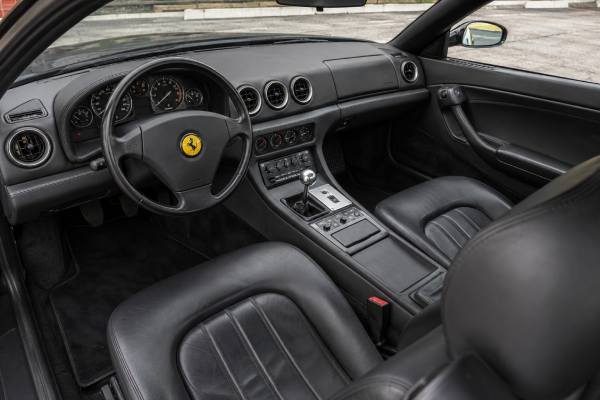
Interior condition is a major originality issue. The cabin uses leather generously, and replacement or retrimming can be expensive. A beautifully preserved original interior is a value factor, while poorly repaired leather, sticky plastics, shrinking trim, warped panels, and missing original audio equipment can hurt collectability.
Special-bodied Brunei-related 456 derivatives, including sedans, estates, and open cars, are separate collector stories and should not be confused with normal production 456 GTs. They show the flexibility of the platform and Pininfarina’s coachbuilding reach, but they do not define the standard F116 CL manual coupé market.
Design, Engineering, and Special Features
The 456 GT’s design works because it hides serious engineering under a restrained shape. It is a 300 km/h-class V12 Ferrari, but it looks more like a tailored grand tourer than a poster supercar.
Pininfarina’s exterior is built around classic proportions: long bonnet, cabin set back, clean sides, and a short rear deck. The pop-up headlights keep the nose low, while the rear buttresses and wide tail give the car visual strength without exaggeration. The 456 also has a softer, more mature surface treatment than the F355 or 512 TR. It does not rely on huge wings, exposed scoops, or aggressive vents.
That restraint was not laziness. It was part of the car’s job. The 456 had to look elegant outside a hotel, stable on an autostrada, and modern enough to replace the old 412. The result is one of Ferrari’s most understated modern designs.
Body and structure
The combination of a steel tubular frame and aluminum body panels gave Ferrari a strong base with relatively light outer panels. The construction also means body condition needs careful inspection. The panels are expensive, alignment must be correct, and poor paintwork can hide difficult repairs.
Common inspection concerns include:
- bubbling or paint defects around panel edges
- uneven door, bonnet, and boot gaps
- signs of previous front-end or rear-quarter accident repair
- corrosion where different materials meet
- poorly repaired jacking points or underbody damage
- water leaks around windows and seals
The 456 is also known for window fit problems. The frameless side glass must seal properly against the roof and door aperture. If the regulator, glass alignment, or seals are wrong, wind noise and water leaks follow. This is not just an annoyance; moisture can damage trim, electronics, carpets, and leather.
Cabin and packaging
Inside, the 456 GT is more luxurious than many Ferraris of its era. It has a low driving position, a traditional dashboard, clear instruments, and a large central tunnel. The rear seats are usable for children or smaller adults over short distances, but the car is best understood as a 2+2 rather than a full four-seater.
The luggage area and cabin space make it more usable than a two-seat Ferrari, and that usability is one reason owners often keep these cars for long periods. A 456 GT can do weekends away, long motorway drives, and relaxed touring in a way that a harder mid-engine car cannot.
Mechanical layout
The front V12 and rear transaxle are central to the car’s engineering. This layout helps balance the car and gives it a more composed feel than older front-engine GTs. The dry-sump lubrication system supports the engine’s performance role and keeps oil control more consistent under load.
The adaptive suspension was advanced for the period. It helps the 456 combine ride comfort with body control, but age now makes the system an ownership concern. Dampers, actuators, warning lights, and control components need specialist diagnosis. Some cars have been converted or repaired with non-original solutions, which may suit drivers but can affect originality.
The sound is another special feature. The 456 does not have the hard-edged scream of a smaller mid-engine Ferrari, but it has a deep, smooth, expensive V12 voice. With a standard exhaust it is refined at cruise and richer under load. Modified exhausts can add drama, but buyers should be careful: too much noise can spoil the car’s long-distance purpose and reduce originality.
Driving Character and Real-World Performance
The 456 GT drives like a fast, heavy, beautifully balanced grand tourer, not like a lightweight sports car. Its best moments come on open roads where the V12 can stretch, the chassis can settle, and the car can use its long gearing and stability.
At low speed, the 456 feels wide and substantial. The steering is assisted but still has weight, and the long bonnet is always part of the experience. It is not difficult to drive, but it is not small. In tight city streets, modern hatchbacks feel easier and less stressful. Parking sensors were not part of the original character, and visibility demands attention.
Once moving, the car becomes more natural. The V12 is smooth from low revs and builds power with a cultured, linear pull. It does not deliver a sudden turbo-style hit. Instead, it gathers speed quickly and calmly, which can make the car feel less dramatic than it really is. This is one of the 456’s defining traits: it is extremely fast, but not frantic.
The gated manual gearbox is a major part of the appeal. The shift requires patience when cold, especially into second gear, but becomes more satisfying as the drivetrain warms. A good car should shift cleanly when hot, without crunching, baulking, or jumping out of gear. Clutch take-up should be progressive, not slipping or grabbing.
Ride quality is better than many expect from a Ferrari. The 456 was built to cover distance, and its adaptive damping helps it feel composed on uneven roads. However, tired dampers, old tires, worn suspension bushes, or incorrect alignment can make the car feel loose, floaty, or nervous. A properly sorted 456 GT should feel planted and fluid.
The cornering balance is secure rather than razor sharp. There is real grip from the wide tires, and the rear transaxle helps the car rotate more naturally than its size suggests. Still, this is a front-engine V12 2+2 weighing around 1.7 tonnes dry, so it rewards smooth inputs. It prefers flowing roads to tight, bumpy switchbacks.
Braking performance was strong for the period, with ventilated discs and ABS, but buyers should judge brakes by condition. Old hoses, tired fluid, worn discs, uneven pad deposits, and seized calipers can make the pedal feel worse than it should. A well-maintained car should stop confidently, but it will not feel like a modern carbon-ceramic supercar.
Tires have a huge influence on the driving experience. Old premium tires can be worse than newer correct-spec rubber, even if tread depth looks fine. Because many 456s cover low annual mileage, tire age is a common problem. Flat spots, cracking, vibration, and poor wet grip are signs that the car needs fresh tires before any serious driving assessment.
On a long highway drive, the 456 GT makes the most sense. It is stable, quiet enough for conversation, powerful enough to overtake effortlessly, and special without being exhausting. That is why many owners see it as a “real use” Ferrari rather than a display piece. The trick is finding one maintained well enough to deliver that experience.
Reliability, Maintenance, and Restoration
The 456 GT can be a durable Ferrari when maintained correctly, but neglected examples are expensive and rarely become cheap to fix. The engine itself has a good reputation by exotic-car standards, yet the surrounding systems, age-related trim issues, suspension, cooling, and electrical details require serious attention.
The timing belt service is one of the most important ownership items. Unlike some later chain-driven Ferraris, the 456 uses belts that must be replaced on time. Many specialists recommend belt service based on both mileage and age, because low-mileage cars still age while parked. A buyer should not accept “it has barely been driven” as a substitute for service records.
Common mechanical and ownership issues
Key areas to inspect include:
- timing belts, tensioners, cam seals, and service history
- cooling system condition, including radiators, hoses, fans, and thermostat behavior
- oil leaks from cam covers, front seals, and dry-sump plumbing
- clutch wear, release bearing noise, and hydraulic leaks
- gearbox shift quality when cold and hot
- adaptive suspension warning lights, actuators, and damper condition
- power steering leaks or pump noise
- brake discs, pads, calipers, hoses, and ABS function
- fuel lines, pumps, filters, and tank-related age issues
- engine mounts, gearbox mounts, and exhaust mounts
Cooling deserves special respect. A front-engine V12 generates heat, and an older Ferrari cooling system must be clean and efficient. Temperature creep in traffic, fans not cutting in, coolant smell, old hoses, or signs of previous overheating are serious warning signs.
The suspension can become costly because the 456 combines performance hardware with electronically controlled damping. A car with tired suspension may still look presentable, but it will not drive properly. Rebuilding the suspension correctly can include dampers, actuators, bushes, ball joints, steering components, mounts, and alignment.
Body, glass, and interior problems
The best-known 456 ownership issue is side-window sealing and alignment. The frameless windows can fail to meet the seals correctly, leading to wind noise or water entry. Repair may involve regulators, adjustment, seals, and patient specialist labor.
Other body and trim concerns include:
- shrinking leather on dashboard and rear parcel shelf
- sticky interior switches and plastic coatings
- warped trim panels
- sagging headliner
- cracked or hardened rubber seals
- damaged seat bolsters
- non-working seat motors or switches
- failing alarm fobs or immobilizer-related issues
- air-conditioning faults
Interior restoration is expensive because the 456 uses large amounts of leather and model-specific trim. A tired cabin can be more costly to put right than buyers expect. Originality matters too: correct leather grain, stitching, audio components, tools, books, and small trim pieces can influence value.
Restoration difficulty
The 456 GT is not an ideal first restoration project. Mechanical parts availability is generally better than for some older coachbuilt Ferraris, but prices are high, labor is specialist, and some trim or body parts can be difficult. A cheap car needing paint, suspension, interior work, belts, clutch, tires, and window repairs can easily exceed the cost of buying a better example.
Originality versus upgrades is a real decision. Some owners fit improved window solutions, updated suspension components, modern audio hidden behind original-looking trim, or stainless exhaust sections. Sensible reversible upgrades can improve usability. Irreversible modifications, poor aftermarket wheels, loud exhausts, non-original interiors, or questionable engine tuning usually hurt collector appeal.
A pre-purchase inspection should be done by a Ferrari specialist familiar with the 456, not just a general exotic-car shop. The inspection should include a cold start, hot restart, compression or leak-down testing if concerns exist, diagnostic checks, underbody review, suspension assessment, paint-depth readings, window function, air-conditioning test, and a review of every invoice.
Market Value and Buying Advice
The 456 GT market has become more selective: manual cars, strong history, original specification, and excellent condition command the most attention. Automatic cars and tired examples remain cheaper, but the gap often reflects real future spending rather than a simple bargain.
As of 2026, public market trackers show a wide spread for Ferrari 456 values. Manual 456 GTs generally sit above comparable automatic GTAs, while exceptional low-mileage, rare-color, highly original, or fully documented cars can ask much more than average examples. Auction results and asking prices vary sharply because condition differences are huge.
The most important buying rule is simple: buy the best maintained car, not the cheapest car. A 456 GT with recent belts, clutch documentation, sorted windows, fresh tires, working suspension, clean paint, original books and tools, and specialist history is worth a premium. A neglected car can consume that premium quickly.
What drives value
The main value factors are:
- manual six-speed specification
- original colors and desirable interior combination
- full service history with known Ferrari specialists
- recent major service with belts and related work
- correct books, tools, keys, alarm fobs, and records
- clean body with no poor accident repair
- working windows, suspension, air conditioning, and electronics
- low but believable mileage supported by records
- Classiche certification or strong provenance where available
- originality of wheels, exhaust, trim, stereo, and interior materials
Mileage should be judged carefully. Very low mileage can help value, but only when the car has been maintained despite lack of use. A higher-mileage car with excellent care can be a better driver than a garage queen with old belts, old tires, leaking seals, and dried-out rubber.
Cars to seek
The best 456 GTs usually share a pattern. They have long-term ownership, thick documentation, specialist servicing, original equipment, and evidence that expensive jobs were done before sale rather than postponed for the next owner. They start cleanly, idle smoothly, run cool, shift properly when warm, stop straight, and feel tight over rough roads.
A strong buyer target would be:
- late original-series manual GT
- verified F116C specification
- attractive factory color
- complete factory accessories
- no water-damaged interior
- recent belt service
- documented clutch condition
- functioning adaptive suspension
- no warning lights
- clean underside and straight body
Cars to avoid
Avoid cars that are cheap for unclear reasons. Warning signs include missing history, repeated auction appearances, non-working windows, damp carpets, sticky warning lights, poor repainting, aftermarket modifications, incomplete tools, hot-running behavior, weak air conditioning, or sellers who describe major Ferrari work as “easy.”
A 456 GT should also be avoided if the seller cannot explain:
- when the belts were last changed
- who serviced the car
- whether the clutch has been measured or replaced
- why any warning lights are on
- whether the windows seal properly
- whether the suspension system works correctly
- whether the car has accident history
- whether the alarm and immobilizer equipment is complete
Safety expectations should be period-correct. The 456 has ABS and market-dependent airbags or safety equipment, but it is not a modern crash-tested GT with today’s driver-assistance systems. Imported cars, especially non-U.S. examples brought into the United States, should be checked for proper federalization, documentation, and compliance history.
Long-term collectability looks strongest for manual cars in excellent, original condition. The 456 GT has the right ingredients: naturally aspirated V12, gated manual, Pininfarina design, limited production, and a usable grand touring mission. Its market may never behave like a rare lightweight Ferrari, but the best cars are increasingly understood as elegant modern classics rather than forgotten used exotics.
References
- Ferrari 456 GT (1992) – Ferrari.com 1992 (Manufacturer Specifications)
- Ferrari 456M GT (1998) – Ferrari.com 1998 (Manufacturer Specifications)
- Vehicle Detail Search – 1997 FERRARI F456 | NHTSA 2026 (Recall Database)
- Decision That Nonconforming 1997 and 1998 Ferrari 456 GT and GTA Passenger Cars Are Eligible for Importation 2004 (Federal Register)
- 1996 Ferrari 456 GT | Hagerty Valuation Tool® 2026 (Market Valuation)
Disclaimer
This article is for informational purposes only and is not a substitute for professional diagnosis, repair advice, or a qualified pre-purchase inspection. Specifications, torque values, service intervals, procedures, parts, and compliance details can vary by VIN, market, model year, equipment, and prior repairs. Always verify details against the official Ferrari service documentation for the specific car and consult a Ferrari specialist before buying, repairing, or restoring a 456 GT.
If this guide helped you, please consider sharing it on Facebook, X/Twitter, or your favorite car community to support our work.