
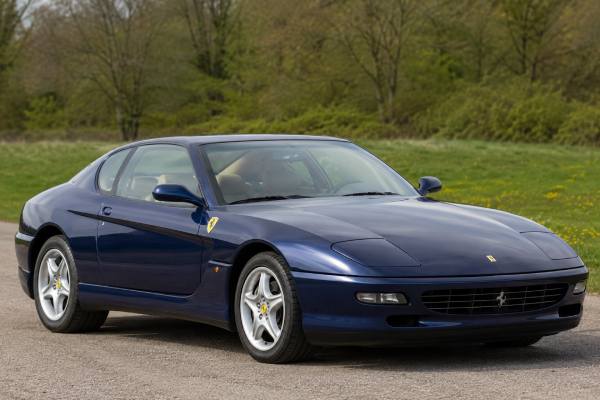
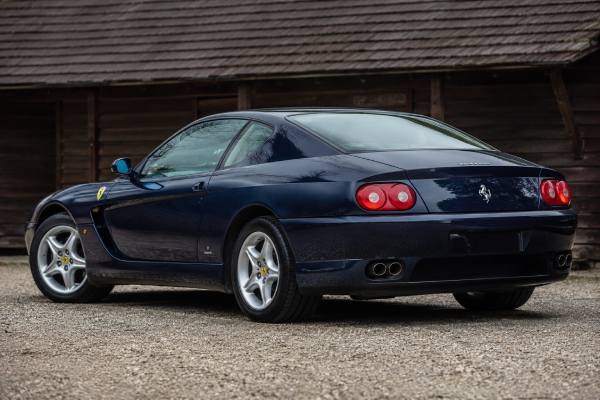
The Ferrari 456 GTA is the automatic-transmission version of Ferrari’s F116-generation front-engine V12 grand tourer, built for the 1996–1998 period with the F116C 5.5-liter naturally aspirated V12 rated at 442 hp. It matters because it took the elegant 456 GT formula — a Pininfarina-styled 2+2 coupe with a rear transaxle, aluminum bodywork, and serious high-speed ability — and made it easier to use in traffic and long-distance touring.
This is not the manual 456 GT, and it is not the later 456M GTA, although the cars are closely related. The 456 GTA sits in a narrow window before the Modificata update, so buyers tend to search it for three reasons: V12 Ferrari ownership at a lower entry price than many two-seat models, the practicality of a four-seat cabin, and the ownership risks that come with a complex, low-volume Ferrari now approaching 30 years old.
Quick Take
The Ferrari 456 GTA is most appealing as a restrained, usable V12 Ferrari with real grand-touring manners, a handsome Pininfarina body, and a torque-converter automatic that suits relaxed high-speed travel better than track-focused driving. Its identity is tied to the F116C-era 5.5-liter V12, rear transaxle layout, aluminum-over-steel construction, and 2+2 usability. The tradeoff is that the automatic version is usually less valuable and less engaging than the gated manual, while maintenance condition, window fit, suspension health, fuel-line recall status, documentation, and originality matter more than mileage alone.
Table of Contents
- History, Purpose, and Collector Significance
- Engine, Chassis, and Key Specifications
- Production, Variants, and Factory Options
- Design, Engineering, and Special Features
- Driving Experience and Real Performance
- Reliability, Maintenance, and Restoration Reality
- Market Value and Buying Guide
History, Purpose, and Collector Significance
The 456 GTA is important because it brought Ferrari’s traditional front-engine V12 2+2 formula into a modern era without turning it into a luxury sedan or a softened badge exercise. It replaced the older 400/412 lineage with a far more advanced, cleaner, faster, and more cohesive grand tourer.
Ferrari introduced the 456 GT in the early 1990s as a return to the idea of a fast, elegant, long-legged V12 coupe with room for occasional rear passengers. The automatic GTA followed for buyers who wanted the same engine and design with easier urban use. In period, that made sense. A large share of Ferrari’s 2+2 customers were not looking for a raw sports car. They wanted speed, prestige, comfort, and the ability to cover serious distance without making every journey feel like an event of endurance.
The 456 was styled by Pininfarina, with the exterior commonly credited to Pietro Camardella under Lorenzo Ramaciotti’s design leadership. Its form was deliberately understated by Ferrari standards. The long hood, short rear deck, slim roofline, covered headlamps, and broad rear haunches gave it a classic GT proportion without copying the Daytona or 365 GT 2+2 too directly.
The GTA arrived during a period when Ferrari was modernizing fast. The F355, 550 Maranello, and later 360 Modena were changing expectations for usability, electronics, and build quality. The 456 GTA belongs to that transition. It still feels hand-built and old-world in places, but it is not a vintage car. It has ABS, power steering, electronic engine management, adjustable suspension behavior, climate control, airbags in many markets, and a cabin intended for real journeys.
Collectors now view the 456 GTA differently from the manual 456 GT. The manual usually attracts stronger enthusiast demand because of the gated shifter and more direct driver involvement. The GTA is often judged as the more relaxed, more affordable, and more touring-focused version. That does not make it unimportant. It simply means its value depends heavily on whether a buyer understands what it is: a fast automatic Ferrari GT, not a substitute for a 550 Maranello or a manual 456.
Its significance today rests on four points:
- It is a naturally aspirated front-engine Ferrari V12 with a traditional grand-touring layout.
- It offers four-seat packaging, luggage space, and long-distance comfort that many Ferraris cannot match.
- It was built in small numbers compared with mass-market performance cars.
- It remains condition-sensitive, so the best examples can feel deeply special while neglected cars can become expensive quickly.
The 456 GTA is not a concours default like a 275 GTB, nor is it a modern collectible darling like a manual 550. Its appeal is quieter. It rewards buyers who like subtle design, mechanical substance, and a Ferrari that can be used without needing to shout about itself.
Engine, Chassis, and Key Specifications
The 456 GTA uses a 5,473.91 cc naturally aspirated 65-degree V12, mounted ahead of the cabin and paired with a rear-mounted four-speed automatic transaxle. Its most useful technical story is not just the 442 hp output, but the way Ferrari combined a big front V12 with rear transaxle balance and a proper grand-touring chassis.
| Item | Specification |
|---|---|
| Model years covered | 1996–1998 pre-Modificata 456 GTA |
| Factory type family | F116-series 2+2 coupe |
| Engine code | F116C V12 |
| Engine layout | Front longitudinal, 65-degree V12 |
| Displacement | 5,473.91 cc |
| Bore x stroke | 88 mm x 75 mm |
| Compression ratio | 10.6:1 |
| Maximum power | 325 kW / 442 hp at 6,250 rpm |
| Maximum torque | 550 Nm at 4,500 rpm |
| Induction | Naturally aspirated, electronic fuel injection |
| Lubrication | Dry sump |
| Transmission | Four-speed automatic transaxle |
| Drivetrain | Rear-wheel drive |
| Frame | Tubular steel structure |
| Body style | Two-door 2+2 coupe |
| Front tires | 255/45 ZR 17 |
| Rear tires | 285/40 ZR 17 |
| Fuel tank | 110 liters |
The engine is oversquare, meaning the bore is larger than the stroke. In plain terms, that helps the V12 rev cleanly while still producing strong torque. The dry-sump lubrication system is a performance-car feature that helps oil control under sustained acceleration, braking, and cornering. It also allows more flexible engine packaging than a large conventional wet sump.
The automatic gearbox is central to the GTA identity. It is a conventional torque-converter automatic, not an F1-style paddle-shift transmission and not a modern dual-clutch gearbox. That gives the car a smoother, more relaxed character, but it also changes the way the engine feels. The V12 still pulls hard, yet the automatic softens the mechanical connection compared with the six-speed gated manual.
| Measure | Figure |
|---|---|
| Length | 4,730 mm |
| Width | 1,920 mm |
| Height | 1,300 mm |
| Wheelbase | 2,600 mm |
| Front track | 1,585 mm |
| Rear track | 1,606 mm |
| Dry weight | 1,770 kg |
| 0–100 km/h | About 5.5 seconds |
| Top speed | Over 298 km/h |
The suspension uses independent layouts with unequal-length wishbones, coil springs, telescopic dampers, and anti-roll bars. The rear suspension includes self-leveling behavior, which suits a GT that may carry luggage and rear passengers. Brakes are ventilated discs with ABS, and steering is rack-and-pinion with power assistance.
The 456 GTA’s engineering balance is unusually thoughtful for a four-seat Ferrari of its time. The big V12 sits up front, but the gearbox is at the rear, helping weight distribution. The chassis is not a pure sports-car shell, yet the basic architecture gives the car better balance than its size and luxury equipment might suggest.
Production, Variants, and Factory Options
The 456 GTA is a low-volume automatic variant within the early 456 range, and correct identification matters because values differ sharply between GT, GTA, 456M GT, and 456M GTA versions. The most important distinction is simple: GT means manual, GTA means automatic, and 456M means the later Modificata update.
The early 456 family ran before the 456M refresh. The 456M, introduced for the late 1990s, brought revised styling, cooling, interior details, and mechanical refinements. Buyers should not assume parts, trim, values, or inspection priorities are identical between a 1996–1998 GTA and a later 456M GTA.
Commonly cited production figures place the early automatic 456 GTA at around 403 units, making it much rarer than most modern performance cars. Exact counts can vary depending on source, market definitions, and whether right-hand-drive cars are separated, so documentation on a specific car is more important than quoting a number in isolation.
GT, GTA, and 456M differences
The standard 456 GT uses the six-speed manual gearbox and usually commands stronger enthusiast interest. The 456 GTA uses the four-speed automatic, giving up some involvement but adding smoothness and convenience. The later 456M GTA keeps the automatic theme but adds the Modificata body and interior changes.
Key identification points include:
- 456 GT: early body, six-speed manual, most sought after by traditional enthusiasts.
- 456 GTA: early body, four-speed automatic, lower market value but very usable.
- 456M GT: facelifted Modificata body and cabin, six-speed manual.
- 456M GTA: facelifted Modificata body and cabin, four-speed automatic.
On a buyer inspection, the VIN, engine number, gearbox type, body details, market specification, and service records should all agree. A car advertised casually as a “456 automatic” may be a GTA or a 456M GTA, and that difference affects value.
Factory options and originality
The 456 GTA was a high-end Ferrari GT, so many cars were ordered with rich leather interiors, premium paint colors, power seats, fitted luggage, special stitching, and market-specific equipment. Ferrari personalization in this period was less extreme than later Tailor Made programs, but color and trim still matter.
Originality is especially important in these areas:
- Factory paint color and evidence of repainting.
- Correct leather color, stitching, carpets, and seat pattern.
- Factory wheels rather than later aftermarket wheels.
- Correct exhaust system and catalytic equipment for the market.
- Original books, tools, spare keys, alarm fobs, invoices, and warranty book.
- Matching chassis, engine, and gearbox identity where documentation supports it.
Ferrari Classiche certification can help confirm authenticity, but it does not erase poor maintenance, accident history, sticky trim, bad paint, or worn mechanical systems. A Classiche file is best viewed as one part of the record, not a substitute for a specialist inspection.
Design, Engineering, and Special Features
The 456 GTA’s design works because it hides serious engineering under a calm, almost conservative shape. It is not a wedge-shaped poster car; it is a long-hood Ferrari GT built around proportion, surface control, and high-speed function.
The exterior is one of Pininfarina’s cleaner 1990s Ferrari designs. The front is low and smooth, with pop-up headlamps that preserve the hood line when closed. The side profile has a long, rising shoulder and a compact greenhouse. The rear is broad but not aggressive, with round lamps set into a restrained tail.
The body construction is one of the car’s most interesting features. Ferrari used a tubular steel frame with aluminum body panels. Joining aluminum panels to a steel structure is not as simple as welding steel to steel, so repair quality matters enormously. Accident repairs, corrosion at joints, bubbling around seams, and poor paintwork can turn a tempting car into a costly restoration project.
The hood is large and light for its size, giving easy visual drama whenever the V12 is exposed. Cooling is a major part of the design, because a 5.5-liter V12 in a low grand-touring body needs careful airflow management. The front opening, underbody airflow, radiator condition, fan performance, and ducting all matter in real-world use.
One signature feature is the active rear spoiler integrated into the lower rear bodywork. It is subtle rather than theatrical. The purpose is stability at higher speed, not visual drama in a parking lot. A buyer should confirm it operates correctly, because non-working aerodynamic and body systems often point to wider neglect.
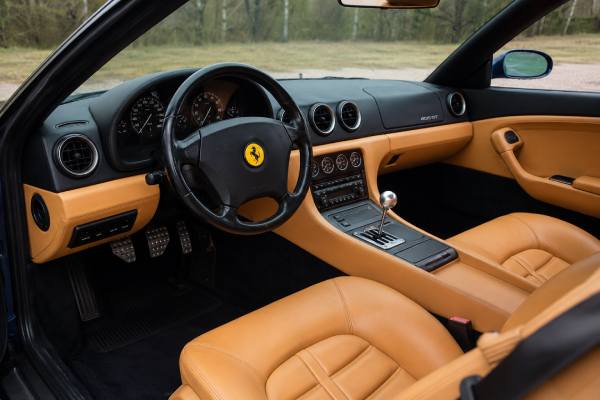
Inside, the 456 GTA has a classic Ferrari GT feel: leather, clear instruments, a low seating position, a wide center console, and a sense that the car was built for fast travel rather than short bursts of excitement. The rear seats are best for children or small adults, but they are useful. The trunk is also more practical than expected, especially compared with mid-engine Ferraris.
The automatic selector is less romantic than the manual’s open gate, but it suits the car’s character. In a healthy GTA, the gearbox should shift smoothly, respond predictably, and not flare, bang, hesitate, or leak. A harsh automatic can be expensive to diagnose because the transmission, electronics, driveline mounts, throttle adjustment, and fluid history all need to be considered.
The 456’s special character comes from this mix: understated body, big V12, quiet cabin, long-range gearing, rear transaxle balance, and just enough Ferrari edge to remind the driver that this is not a normal luxury coupe.
Driving Experience and Real Performance
A sorted 456 GTA feels like a fast, heavy, refined V12 express rather than a sharp-edged sports car. Its best use is open-road driving, long-distance touring, and flowing routes where the engine’s torque and the chassis balance can work naturally.
The V12 is the main event. It is smooth at low speed, muscular in the middle of the rev range, and more cultured than explosive. The engine note has a deep mechanical richness that becomes cleaner and more urgent as revs rise. It does not have the frantic character of a smaller mid-engine Ferrari V8. Instead, it gathers speed with authority and calm.
Throttle response is good for a large naturally aspirated engine, but the automatic transmission filters some immediacy. In the manual 456 GT, the driver feels more directly connected to the V12. In the GTA, the car feels more like an aristocratic high-speed coupe. That is not a flaw if the buyer wants the automatic for the right reason.
The steering is another strong point when the suspension, tires, and alignment are correct. The car is wide, and it feels wide on narrow roads, but it does not feel clumsy. The rear transaxle helps the car rotate more naturally than a nose-heavy layout would suggest. On old tires, tired dampers, worn bushings, or incorrect alignment, the same car can feel vague and heavy.
Ride quality is one of the GTA’s strengths. Ferrari intended the 456 to cover distance, so it has more compliance than a focused sports car. The self-leveling rear suspension helps when the car is loaded, but it is also a maintenance concern. A sagging rear, fluid leaks, uneven stance, or warning signs from suspension controls deserve attention before purchase.
Braking performance is strong for road use, but expectations should be set for a 1990s GT. Pedal feel and stability should be confidence-inspiring, not wooden or uneven. Vibration, pulling, old brake hoses, tired fluid, warped discs, or sticking calipers are common age-related issues on cars that sit.
The cabin experience is more usable than many exotic cars of the same era. Visibility is decent, the seats are comfortable, and the car is not unbearably loud at cruising speed. Heat management, air-conditioning performance, window sealing, and interior electrics make a major difference. A 456 GTA with weak climate control, wind noise, sticky switches, and poorly sealing windows feels far older than a well-kept one.
Performance remains serious. A 0–100 km/h time around the mid-five-second range and a top speed above 298 km/h were exceptional for a four-seat automatic GT in the 1990s. Today, many modern performance cars are quicker, but few deliver speed with this combination of V12 sound, long-distance composure, and classic Ferrari atmosphere.
Reliability, Maintenance, and Restoration Reality
The 456 GTA can be a usable Ferrari if it has been maintained properly, but neglected cars are expensive because age affects nearly every system. The engine itself has a solid reputation, yet ownership costs are driven by access, parts prices, specialist labor, hydraulics, electrical items, trim, and the automatic driveline.
The first rule is to avoid buying on mileage alone. A low-mile car that has sat for years may need more recommissioning than a higher-mile car with regular specialist servicing. Rubber hardens, fuel systems deteriorate, seals dry, suspension components age, and electrical contacts suffer whether the odometer moves or not.
Common inspection areas
A pre-purchase inspection should focus on model-specific systems, not just general condition. Important checks include:
- Fuel supply and return lines, including recall or campaign history where applicable.
- Timing belt and major service history, with dates as important as mileage.
- Cooling system condition, radiator health, hoses, fans, and temperature stability.
- Oil leaks from cam covers, front seals, dry-sump plumbing, and ancillary areas.
- Automatic gearbox shift quality, fluid condition, mounts, leaks, and cooler lines.
- Differential, driveshaft, and transaxle noise under load and on overrun.
- Rear self-leveling suspension function, leaks, warning lights, and ride height.
- Shock absorber behavior in comfort and sport settings.
- Window fit, drop function, regulators, seals, and wind noise.
- Sticky interior plastics, shrinking leather, dash condition, and switchgear.
- Air-conditioning temperature, fan speeds, and climate-panel operation.
- Door bottoms, panel joints, paint bubbling, repaired aluminum panels, and accident evidence.
- Pop-up headlamp function, spoiler operation, and electrical grounding issues.
The fuel-line recall is especially worth verifying. Documentation should show whether applicable work has been completed. A seller saying “it was probably done” is not enough on a V12 Ferrari with aging fuel-system parts.
The window system is one of the best-known 456 ownership topics. The frameless door glass must seal correctly against the body. Poor adjustment can create wind noise, water leaks, and visible gaps. Repairs may involve regulators, glass adjustment, seals, hinges, and careful specialist setup. Cheap fixes often do not last.
The automatic transmission can be durable when serviced and treated correctly, but failures are not trivial. Any slip, delayed engagement, harsh shift, abnormal noise, or warning sign should be investigated before purchase. A specialist familiar with the model should inspect the car hot and cold.
Restoration is possible, but it is rarely cheap. The 456 GTA is not valuable enough to justify unlimited spending on a poor car unless the buyer has a personal attachment. Paintwork, leather, engine-out service work, suspension hydraulics, air-conditioning, and rare trim can quickly exceed the apparent discount on a tired example.
A good maintenance file should include annual service entries, belt services, brake and suspension work, tire age records, battery and charging-system history, campaign completion, and invoices from recognized Ferrari specialists or main dealers. The best cars feel consistent: the mileage, condition, service history, ownership story, and inspection results all support each other.
Market Value and Buying Guide
The 456 GTA usually trades below manual 456 GT values because the automatic gearbox reduces enthusiast demand. That makes it tempting, but the cheapest car is often expensive in disguise if maintenance, trim, suspension, windows, or paint have been neglected.
Recent market data places many usable 456 GTA examples in the broad mid-$40,000 to mid-$60,000 range in the United States, with excellent, low-mileage, highly original, or unusually well-documented cars moving higher. A current Classic.com benchmark has been around the low-$50,000s for the 456 GTA market, while a 2025 Hagerty valuation report for a 1997 456 GTA showed condition-based values from the mid-$40,000s for fair cars to around $80,000 for concours-level examples. Those numbers are guides, not guarantees. Color, mileage, country, taxes, service history, and buyer confidence can move the price significantly.
The best purchase is usually not the cheapest car. It is the car with the clearest history, strongest mechanical inspection, correct specification, and fewest deferred needs. A $55,000 car with recent belt service, sorted windows, fresh tires, working suspension, good paint, and proper books may be cheaper to own than a $40,000 car needing all of those things.
| Priority | What to look for | Why it matters |
|---|---|---|
| Documentation | Books, tools, service invoices, campaign records, ownership file | Supports authenticity and reduces uncertainty |
| Major service | Recent timing belt service and annual maintenance | Deferred service can erase any purchase discount |
| Fuel system | Recall completion and renewed aging hoses | Fuel leaks are a serious safety and repair concern |
| Transmission | Smooth shifts, no slipping, no harsh engagement | Automatic repairs require specialist knowledge |
| Suspension | Correct ride height, no leaks, working damping modes | Self-leveling and electronic components can be costly |
| Body condition | Good panel fit, no bubbling, no poor aluminum repair | Body restoration is expensive and value-sensitive |
| Interior | Good leather, working controls, minimal sticky trim | Cabin condition strongly affects ownership enjoyment |
Cars to seek
Look for a 456 GTA that starts easily hot and cold, idles smoothly, reaches stable operating temperature, shifts cleanly, tracks straight, brakes without vibration, and has working windows, spoiler, lamps, climate control, and suspension settings. The paint should measure consistently unless documented repair work explains differences. The interior should look like careful ownership, not short-term cosmetic preparation.
Strong colors help, but condition is more important. Traditional Ferrari colors may attract attention, yet darker metallics often suit the 456’s shape beautifully. Interior color should be judged for originality, condition, and compatibility with the exterior rather than trend alone.
Cars to avoid
Be cautious with cars that have incomplete service records, repeated auction appearances, cheap resprays, warning lights, poor window sealing, damp carpets, overheating, harsh automatic behavior, missing tools, aftermarket wiring, non-original wheels, or vague seller explanations. A car that “just needs adjustment” may need thousands in parts and labor.
Imports deserve extra care. Market-specific equipment, emissions components, lighting, bumpers, door beams, and paperwork can affect legality and value. For U.S. buyers, non-U.S.-market 1997 and 1998 456 GT/GTA cars have an import-compliance history, so paperwork should be reviewed carefully.
The long-term collectability of the 456 GTA looks stable rather than explosive. It has a V12, rarity, Pininfarina design, and genuine usability. Against that, the automatic gearbox limits top-tier enthusiast demand. The most likely winners are original, well-documented, excellent-condition cars bought by owners who maintain them properly and use them enough to keep them healthy.
References
- Ferrari 456 GTA (1996) 1996 (Manufacturer Specifications)
- Federal Register :: Decision That Nonconforming 1997 and 1998 Ferrari 456 GT and GTA Passenger Cars Are Eligible for Importation 2004 (Regulatory Notice)
- Ferrari North America Technical Information 2019 (Technical Information)
- FERRARI 456GTA 1996 FUEL SYSTEM, GASOLINE:DELIVERY Recall NHTSA Campaign ID Number: 99V167000 | Justia 1999 (Recall Database)
- Ferrari 456 GTA Market 2026 (Market Data)
Disclaimer
This article is for informational purposes only and is not a substitute for professional diagnosis, repair, inspection, valuation, or legal import advice. Specifications, torque values, service intervals, recall applicability, procedures, and equipment can vary by VIN, market, model year, and individual vehicle history. Always verify details against official Ferrari service documentation, recall records, and a qualified Ferrari specialist before buying, servicing, or restoring a Ferrari 456 GTA.
If this guide helped you, please consider sharing it on Facebook, X/Twitter, or your favorite car community to support our work.