
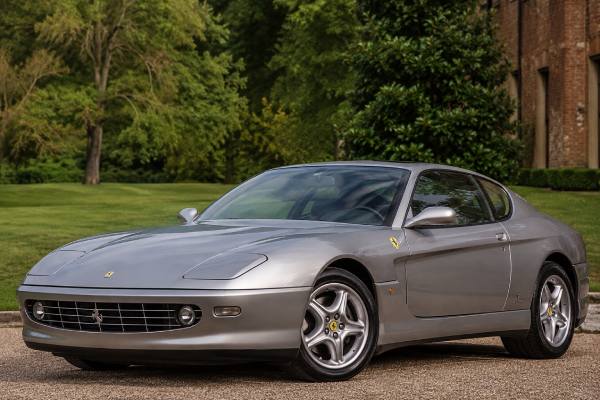
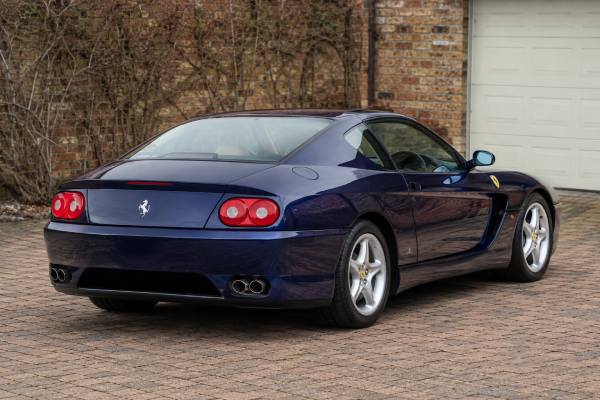
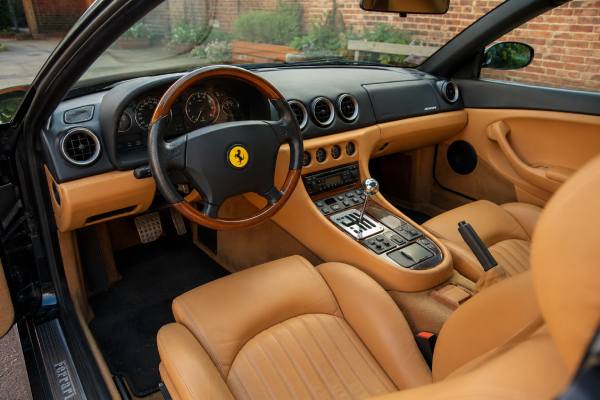
The Ferrari 456M GT (F116 CL) is the facelifted manual-transmission version of Ferrari’s front-engine V12 2+2 grand tourer, built from 1998 to 2003 and powered by the F116C 5.5-liter naturally aspirated V12. It sits in an interesting part of Ferrari history: modern enough to have Bosch engine management, ABS, power steering, and real long-distance comfort, yet old enough to keep a gated six-speed manual, pop-up headlights, and the discreet Pininfarina proportions that defined Ferrari grand touring in the 1990s.
The “M” stands for Modificata, meaning modified, and the changes were more than cosmetic. Ferrari cleaned up the body, improved cooling and aerodynamics, revised the interior, and sharpened the chassis without turning the 456 into a hard-edged sports car. The 456M GT remained a fast, elegant, four-seat V12 coupé for owners who wanted a Ferrari that could cross countries, carry luggage, and still feel special every time the engine came alive.
Today, the manual 456M GT attracts buyers for three reasons: it is rarer than many people realize, it has a naturally aspirated front-mounted Ferrari V12, and it offers a gated manual gearbox in a usable 2+2 body. The main challenge is not performance, but condition. A good one can feel refined, muscular, and deeply satisfying. A neglected one can become expensive very quickly.
Quick Take
The Ferrari 456M GT is most appealing as a subtle, fast, V12 grand tourer with a proper six-speed manual gearbox and a cabin designed for real distance driving rather than weekend theatre only. Its identity comes from the F116C 65-degree V12, Pininfarina styling, rear-wheel-drive balance, and low-production manual specification. The tradeoff is age: window mechanisms, cooling systems, suspension wear, leather shrinkage, sticky interior parts, deferred belt service, and incomplete records can turn a tempting car into a costly project. Buy the best-documented, most original, specialist-maintained example you can find, and treat mileage as less important than condition, service history, and authenticity.
Table of Contents
- History and Significance of the 456M GT
- Engine, Chassis and Key Specifications
- Production, Variants and Factory Options
- Design, Engineering and Special Features
- Driving Experience and Real-World Performance
- Reliability, Maintenance and Restoration Reality
- Market Value and Buying Guide
History and Significance of the 456M GT
The 456M GT matters because it was Ferrari’s last manual V12 2+2 before the larger 612 Scaglietti era, and one of the last Ferrari road cars to combine traditional grand touring elegance with a gated manual gearbox. It followed the original 456 GT and refined the formula without changing its basic personality.
Ferrari launched the original 456 GT in the early 1990s as a successor to the long-running 400 and 412 family. Those earlier cars had a loyal following, but by the late 1980s their shape, cabin, and engineering felt dated. The 456 was Ferrari’s answer to a different kind of buyer: someone who wanted the pace and drama of a V12 Ferrari, but in a car that could be used for long journeys and formal occasions.
The 456M arrived for 1998 as the updated version. Ferrari did not make it look radically new because the original shape was already clean and balanced. Instead, the Modificata brought detailed changes to the nose, grille, underbody airflow, interior layout, suspension tuning, and everyday usability. It was still unmistakably a 456, but it looked smoother and felt more mature.
The 456M GT occupied a narrow and important space in Ferrari’s lineup. The mid-engine cars, such as the F355 and later 360 Modena, served the more focused sports-car role. The 550 Maranello gave Ferrari buyers a front-engine V12 two-seat berlinetta. The 456M GT was different: a refined 2+2 coupé with serious speed, rear seats for occasional use, and enough luggage space for touring.
Its significance has grown with time. For many years, the 456 series sat in an awkward market position. It was more expensive to maintain than a normal luxury coupé, but less visually dramatic than a mid-engine Ferrari. As collector tastes changed, the manual 456M GT started to make more sense. It offers a naturally aspirated V12, a classic front-engine layout, limited production, handsome Pininfarina design, and enough usability to enjoy rather than simply store.
The 456M GT is not a motorsport homologation car and does not have the competition aura of a 288 GTO, F40, or Challenge Stradale. Its appeal is quieter. It represents Ferrari’s grand touring tradition: Daytona-like proportions, a long hood, a rear transaxle layout, a sophisticated V12, and a cabin trimmed for comfort rather than lap records.
Collectors now look at it as one of the more understated modern-classic Ferraris. It is rare enough to be interesting, but not so rare that ownership becomes purely museum-like. Its market also separates sharply by transmission. The 456M GTA automatic can be a fine grand tourer, but the GT manual is the version that attracts the strongest enthusiast attention.
The car’s reputation today depends heavily on condition. Well-kept examples feel expensive, relaxed, and special. Poorly maintained examples remind buyers that a 1990s Ferrari with a V12, complex electrics, aging trim, and bespoke parts is never a cheap used car. That split is central to understanding the 456M GT as a collector car.
Engine, Chassis and Key Specifications
The 456M GT uses a front-mounted 5.5-liter F116C V12 and a rear-mounted six-speed manual transaxle, giving it the classic Ferrari formula of a long hood, rear-wheel drive, and balanced weight distribution. Its headline output is commonly quoted as 442 metric horsepower, or 325 kW, with strong torque rather than peaky race-car behavior.
Core mechanical specification
| Category | Specification |
|---|---|
| Model | Ferrari 456M GT |
| Chassis family | F116 |
| Production years | 1998–2003 |
| Body style | Two-door 2+2 coupé |
| Engine code | F116C |
| Engine layout | Front longitudinal 65-degree V12 |
| Displacement | 5,473.91 cc |
| Bore x stroke | 88 mm x 75 mm |
| Compression ratio | 10.6:1 |
| Valvetrain | Double overhead camshafts per bank, four valves per cylinder |
| Fuel and ignition management | Bosch Motronic M5.2 |
| Maximum power | 325 kW, commonly quoted as 442 PS, at 6,250 rpm |
| Maximum torque | 550 Nm at 4,500 rpm |
| Transmission | Six-speed manual transaxle |
| Driven wheels | Rear-wheel drive |
| Top speed | Over 300 km/h, often listed at about 302 km/h |
| 0–100 km/h | About 5.2 seconds |
The F116C engine is a large-capacity, naturally aspirated V12 with a character that suits the car’s grand touring purpose. It is not a high-strung, small-displacement engine that needs constant revs to feel alive. It pulls cleanly from low speeds, builds forcefully through the middle of the tachometer, and gives the car a relaxed high-speed rhythm.
The 65-degree V angle is unusual compared with the more common 60-degree V12 layout. The engine uses light-alloy construction, dry-sump lubrication, four valves per cylinder, and electronic injection. The 456 name itself comes from the approximate displacement of each cylinder, a traditional Ferrari naming method that links the car to older V12 models.
The six-speed manual gearbox is mounted at the rear as part of a transaxle layout. This helps weight distribution and gives the 456M GT a more balanced feel than its front-engine shape might suggest. The gated shifter is a major part of the car’s appeal. It is mechanical, deliberate, and more satisfying when warm than when rushed from cold.
Dimensions, chassis and running gear
| Item | Ferrari 456M GT |
|---|---|
| Wheelbase | 2,600 mm |
| Length | 4,763 mm |
| Width | 1,920 mm |
| Height | 1,300 mm |
| Front tires | 255/45 ZR17 |
| Rear tires | 285/40 ZR17 |
| Brakes | Ventilated discs with ABS |
| Steering | Power-assisted rack and pinion |
| Fuel capacity | 110 liters |
The body is built around a steel tubular structure with aluminum outer panels. The bonnet is a large composite piece on the 456 family, and panel fit is important when inspecting a car because repairs can be expensive and poor alignment is easy to spot once you know where to look.
The suspension layout uses independent suspension with electronically controlled damping. The 456M revisions improved composure and braking stability, helping the car feel more settled under heavy deceleration than the earlier 456 GT. It is still a heavy grand tourer, not a stripped sports car, but the chassis has enough balance to make the car enjoyable on a fast road.
Braking performance is strong when the system is fresh, the fluid is clean, the discs are healthy, and the tires are modern. The car uses conventional steel brakes, which are less intimidating than later carbon-ceramic systems but still expensive when bought from high-quality suppliers.
Production, Variants and Factory Options
The 456M GT is the manual version of the facelifted 456M, while the 456M GTA is the automatic version. For collectors, that single letter matters because the manual GT is rarer, more engaging, and generally more desirable in the current market.
The full 456 family includes four main production versions: the original 456 GT manual, the original 456 GTA automatic, the facelifted 456M GT manual, and the facelifted 456M GTA automatic. The 456M cars are easy to distinguish once you know the details. The hood vents of the earlier 456 were removed, the nose was smoothed, the grille and front intake treatment changed, and the interior received a more modern layout.
Commonly cited production totals place the 456M GT manual at about 688 cars, with the 456M GTA automatic close behind. Exact market-specific counts can vary depending on source and classification, but the important buying point remains clear: the manual 456M GT is a low-volume Ferrari by modern standards.
| Version | Years | Transmission | Collector note |
|---|---|---|---|
| 456 GT | 1992–1998 | Six-speed manual | Original version, clean early design, strong manual appeal |
| 456 GTA | 1996–1998 | Four-speed automatic | More relaxed driving style, usually lower value than manual cars |
| 456M GT | 1998–2003 | Six-speed manual | Facelifted manual version, often the most sought-after regular 456 |
| 456M GTA | 1998–2003 | Four-speed automatic | Facelifted automatic, comfortable but less collectible than GT manual |
The 456M was offered with Ferrari’s normal range of paint, leather, carpets, and trim combinations, along with special-order personalization. Many cars are finished in restrained colors that suit the shape: silver, blue, black, grey, and dark red all work well on the 456M body. Red cars exist, but the model’s character often feels more natural in quieter shades.
Interior specification matters. The 456M cabin used large areas of leather, including areas that can shrink, pull, or lift with heat and age. Seat condition, dashboard leather, rear parcel shelf trim, door panels, switches, and headlining should all be inspected closely. A low-mileage car that has spent years in a hot climate can have worse interior condition than a higher-mileage car kept properly.
Documentation is a major value factor. A strong car should ideally have:
- Original books and pouch
- Service book with consistent specialist or Ferrari dealer entries
- Invoices showing timing-belt work and annual maintenance
- Tool kit, jack, keys, alarm fobs, and immobilizer items
- Evidence of window, cooling, suspension, and electrical repairs where needed
- Matching identification numbers and clear ownership history
- Ferrari Classiche certification when originality and collector value are priorities
The 456M GT was also available through personalization routes, and some cars have unusual color combinations or special trim details. These can add interest, but only if they are documented. A rare color is not automatically valuable if the car lacks records or has poor repair history.
Buyers should also understand the distinction between factory-correct, period-correct, and simply modified. An upgraded stereo, modern tires, or improved sticky-switch refinishing may make the car easier to use. Non-original wheels, questionable exhaust changes, poor repainting, or removed factory equipment can hurt value.
Design, Engineering and Special Features
The 456M GT’s design is special because it avoids the visual drama many people expect from a Ferrari, yet the proportions are pure classic grand tourer. The long hood, compact cabin, short rear deck, and clean sides give it a quiet confidence that has aged better than many louder 1990s shapes.
Pininfarina’s design work gave the 456 a clear link to earlier Ferrari front-engine V12 cars without making it look retro. The car has some Daytona spirit in its stance, but it is smoother, calmer, and more aerodynamic. The 456M update made the front end cleaner by removing the hood vents and revising the air intake layout. These changes gave the car a more polished appearance.
One of the most memorable features is the pop-up headlight design. The 456M was among the last Ferrari production cars to use pop-up lamps, and that detail now gives it period charm. At the time, pop-up lights were already fading because of changing safety, packaging, and aerodynamic priorities. Today, they make the car feel unmistakably from its era.
The engineering layout is equally important. The 456M GT places its V12 ahead of the cabin but uses a rear transaxle to improve balance. That gives the car a more neutral feel than a simple front-engine, front-gearbox layout would. It also helps explain why the car can feel composed at speed despite its size and weight.
Cooling and airflow were central to the Modificata changes. The revised front intake and underbody treatment helped the car manage heat and improve stability. That matters because a 5.5-liter V12 in a luxury 2+2 body creates plenty of heat, especially in slow traffic or warm climates.
Inside, the 456M cabin is more useful than the cabins of many Ferraris from the same period. The driving position is low but not extreme. Visibility is decent for a long-nose GT. The rear seats are best for children or short trips with adults, but they make the car more versatile than a two-seat berlinetta. The luggage area is also practical for touring, which was the point of the model.
The dashboard and console design are more restrained than exotic. That is not a weakness. A 456M GT should feel like a serious long-distance machine, not a cockpit full of gimmicks. The gated shifter, analog gauges, leather surfaces, and broad center tunnel provide the mechanical and visual character.
The sound is another defining feature. The V12 is smooth at idle, cultured at cruising speed, and more urgent as revs rise. It does not shout constantly like some later performance exhaust cars. Instead, it has a layered mechanical tone: intake, valve gear, exhaust, and driveline all become more present as the car wakes up.
Special features worth noting include:
- Naturally aspirated V12 with dry-sump lubrication
- Rear-mounted six-speed manual transaxle
- Pop-up headlights
- Electronically controlled damping
- ABS and traction-related electronic assistance for the period
- Full leather grand touring cabin
- Long-range fuel capacity
- Pininfarina 2+2 proportions
- Subtle facelift details unique to the 456M
The 456M GT is best understood as an engineering compromise in the positive sense. It is not the lightest Ferrari, not the sharpest Ferrari, and not the most dramatic Ferrari. It is a car designed to blend speed, comfort, mechanical quality, and elegance. That balance is exactly why it has become more interesting with age.
Driving Experience and Real-World Performance
The 456M GT drives like a fast, refined V12 grand tourer rather than a track-focused sports car. Its performance is still serious, but the lasting impression is the way the engine, gearbox, steering, and long-legged chassis work together on open roads.
The V12 is the center of the experience. It starts with a cultured idle and responds cleanly once warm. Low-speed torque makes the car easy to move around without drama, while the middle of the rev range gives strong, smooth acceleration. The engine does not need to be wrung out to feel special, but it rewards revs with a sharper sound and greater urgency.
Acceleration to 100 km/h in around 5.2 seconds was very quick for a four-seat grand tourer of its period. More important is the way the car accelerates from higher speeds. The 456M GT feels built for fast motorway and autostrada running, where the V12 can settle into a powerful stride and cover ground with little effort.
The manual gearbox is one of the main reasons to choose the GT over the GTA. From cold, the shift can feel stiff, especially into second gear. That is normal for many Ferraris of the era, but excessive resistance, grinding, or baulking is not normal and needs investigation. Once warm, a good gearbox has a precise, mechanical action through the metal gate.
The steering is power assisted but still communicative enough to place the car confidently. It does not have the nervous immediacy of a mid-engine Ferrari, and that is appropriate. The 456M GT prefers smooth inputs. Rush it, and its weight becomes clear. Drive it with rhythm, and the balance improves.
Ride quality is one of the car’s underrated strengths. The electronically controlled dampers help the car feel comfortable over distance, though worn dampers, tired bushings, old tires, or incorrect alignment can make a 456M feel loose or harsh. A well-sorted car should not crash over bumps or wander at speed.
The brakes are strong for road use when maintained properly. Pedal feel should be firm and confidence-inspiring. Vibration, pulling, long pedal travel, or ABS warning lights all need attention. Because the car is heavy and fast, brake condition matters more than it might on a lighter classic.
Cornering balance is best described as stable and progressive. The front end is accurate for a grand tourer, and the rear follows cleanly when the tires are fresh and the suspension is healthy. The 456M GT is not a car that begs to be thrown into tight corners. It is better on flowing roads, where the engine can stretch and the chassis can settle.
In city driving, the car feels large, low, and expensive. The clutch should be manageable, but heavy traffic is not its natural environment. Heat management, battery condition, and cooling-system health become more important in urban use. Visibility is reasonable, but the long hood and low nose require care around ramps and parking blocks.
On long trips, the 456M GT makes the most sense. It has the range, seating position, luggage capacity, and engine character to turn distance into part of the pleasure. That is the difference between a true grand tourer and a sports car with leather seats.
Reliability, Maintenance and Restoration Reality
The 456M GT can be a dependable exotic when maintained correctly, but it is never a low-cost car to run. Age, deferred maintenance, and model-specific parts are the real risks, not a single fatal design flaw.
The F116C V12 is generally respected when serviced properly. It uses timing belts, so belt service history is essential. Buyers should look for dated invoices, not vague claims. A car that has covered little mileage still needs time-based maintenance because belts, seals, fluids, hoses, and rubber components age even when the odometer barely moves.
Common maintenance and reliability concerns include:
- Timing belts, tensioners, and related front-engine service items
- Cooling hoses, radiator condition, fans, and thermostat behavior
- Oil leaks from cam covers, seals, and aging gaskets
- Engine mounts and gearbox mounts
- Clutch wear and hydraulic issues
- Rear transaxle leaks or shift-quality problems
- Worn suspension bushings, ball joints, and dampers
- Brake disc, pad, hose, and ABS-related faults
- Sticky interior switches and trim coatings
- Leather shrinkage on dashboard, console, and rear shelf areas
- Slow or misaligned side windows
- Electrical problems caused by age, battery weakness, or poor previous repairs
The window issue is one of the best-known 456 ownership topics. Side glass alignment and sealing can be troublesome, and poor adjustment can lead to wind noise, water leaks, and slow operation. A proper fix can require specialist knowledge rather than a quick adjustment.
Cooling-system condition is critical. The V12 produces heat, and any old Ferrari that spends time idling in traffic needs a healthy radiator, fans, coolant, hoses, and sensors. Temperature creep, coolant smell, stains, or evidence of repeated overheating should be treated seriously.
The suspension deserves close inspection because worn components can make the car feel far older than it is. Bushings, dampers, steering joints, and alignment all affect the 456M’s high-speed stability. A sorted car feels planted. A tired one can feel vague, floaty, or nervous.
Interior restoration can be surprisingly expensive. The cabin uses large leather surfaces, and shrinking leather around the dashboard or rear shelf is common in cars exposed to heat. Sticky plastics are also typical of Ferraris from this era. Refinishing them properly improves usability and appearance, but poor DIY fixes can look worse than the original problem.
Parts availability is mixed. Normal service items are usually manageable through Ferrari specialists and established suppliers. Model-specific trim, glass, electronic modules, and certain body parts can be difficult or expensive. Accident damage is especially important to avoid because aluminum-panel repair and correct paintwork require skill.
A pre-purchase inspection should be done by a Ferrari specialist familiar with the 456 series, not just a general exotic-car shop. The inspection should include:
- Compression or leak-down testing if engine condition is uncertain
- Timing-belt and service-record verification
- Cooling-system pressure check
- Inspection for oil and coolant leaks
- Clutch and gearbox assessment
- Suspension and steering inspection on a lift
- Brake system inspection
- Window operation and seal check
- Electrical scan and warning-light check
- Paint-depth readings and accident-repair assessment
- Underside inspection for corrosion, damage, and poor repairs
- Confirmation of books, tools, keys, and factory identification
Restoration decisions require care. Some upgrades improve usability, such as modern tires, better battery maintenance, professionally refinished switches, and high-quality hose replacement. But changes that alter the car’s character, such as cheap exhaust systems, non-original wheels, aftermarket interior work, or poor audio installations, can reduce collector appeal.
The best ownership pattern is regular use with regular servicing. Cars that sit for years often develop more issues than cars driven carefully and maintained annually. A 456M GT likes fresh fluids, a strong battery, correct warm-up, and attention before small issues become large ones.
Market Value and Buying Guide
The manual Ferrari 456M GT now sits in a stronger collector position than the automatic 456M GTA, mainly because gated manual V12 Ferraris have become more desirable. Prices vary widely, but condition, documentation, mileage, color, and originality matter more than model year alone.
As of 2026, good manual 456M GT examples commonly occupy a broad six-figure or near-six-figure market in the United States, with exceptional low-mileage or highly documented cars selling higher. Automatic 456M GTA values are typically much lower, which creates a visible transmission premium. European and UK pricing can differ because of right-hand-drive rarity, local taxes, and auction mix.
The value gap is not only about driving involvement. Manual Ferrari production from this era is now finite and increasingly collectible. The 456M GT offers a gated manual, V12 engine, 2+2 usability, and lower production than many later models. That combination gives it a clearer identity than it had as a used exotic 15 years ago.
Value is driven by:
- Manual GT specification
- Original paint or high-quality documented paintwork
- Desirable color combination
- Complete service records
- Recent timing-belt service
- Excellent interior condition
- Properly functioning windows and electrics
- Low but believable mileage
- Long-term ownership history
- Books, tools, keys, and accessories
- Ferrari Classiche certification or strong originality proof
- No accident history
- No poor modifications
The cars to seek are not always the lowest-mileage ones. A 6,000-mile car with old belts, flat-spotted tires, dried seals, weak battery history, and shrinking leather may need expensive recommissioning. A 30,000-mile car with annual servicing, recent belts, repaired windows, fresh suspension work, and a clean interior may be the better purchase.
Cars to approach carefully include:
- Recently imported cars with thin documentation
- Cars with repeated auction appearances and no clear reason
- Examples with warning lights hidden or dismissed
- Cars advertised as “needs minor sorting”
- Cars with old belt service despite low mileage
- Cars with water leaks or poor window sealing
- Cars with non-original wheels and missing factory parts
- Cars with uneven panel gaps or unclear paint history
- Cars that have sat unused for many years
- Bargain cars priced far below the market
A buyer should budget beyond the purchase price. Even a good 456M GT may need tires, fluids, battery, belts, trim refinishing, suspension work, or small electrical repairs soon after purchase. A cheap car can quickly become the expensive one if it needs major catch-up maintenance.
Buying checklist
| Area | What to check | Why it matters |
|---|---|---|
| Service history | Timing belts, annual servicing, invoices | Deferred V12 maintenance is costly |
| Engine | Leaks, overheating signs, smooth idle | Major engine work can exceed the apparent discount |
| Gearbox | Warm shift quality, clutch bite, transaxle leaks | The manual gearbox is central to value |
| Windows | Speed, sealing, alignment, wind noise | 456 window repair is a known specialist job |
| Interior | Leather shrinkage, sticky switches, trim condition | Restoration is expensive and affects value |
| Suspension | Dampers, bushings, steering joints, alignment | A tired chassis ruins the GT character |
| Body | Panel gaps, paint depth, corrosion, accident repair | Correct body repair is difficult and costly |
| Documentation | Books, tools, keys, options, ownership chain | Completeness strongly affects collector confidence |
Long-term collectability looks positive for the best manual cars, but not every 456M GT will appreciate equally. The market is becoming more selective, not less. Buyers want originality, documented care, attractive specification, and evidence that expensive known issues have been addressed correctly.
The 456M GT is also usable enough to enjoy, which may help its future appeal. It is not so fragile or extreme that it only makes sense as static inventory. It can be driven to events, used for weekends, and taken on long trips. That usability gives it a broader emotional case than a car bought only for rarity.
Safety expectations should stay period-correct. The 456M GT has useful features for its era, including ABS and a strong structure by 1990s exotic-car standards, but it does not offer the driver-assistance systems, crash electronics, or modern passive safety package of a contemporary GT. Buyers should view it as a modern classic, not a new car.
The best advice is simple: do not buy the cheapest 456M GT unless you are prepared to fund the difference. Buy the car with the best story, the cleanest inspection, the most complete records, and the fewest excuses. A properly maintained manual 456M GT is one of Ferrari’s most elegant modern-classic grand tourers. A neglected one is a reminder that V12 Ferraris do not become inexpensive just because they become older.
References
- Ferrari 456M GT (1998) – Ferrari.com 1998
- Ferrari 456M GTA (1998) – Ferrari.com 1998
- Ferrari 456 GT (1992) – Ferrari.com 1992
- Vehicle Detail Search – 2001 FERRARI 456M | NHTSA 2001 (Recall Database)
- FERRARI 456M OWNER’S MANUAL Pdf Download | ManualsLib 2000 (Owner’s Manual)
Disclaimer
This article is for informational purposes only and is not a substitute for professional diagnosis, repair, inspection, or valuation. Specifications, torque values, maintenance intervals, service procedures, and equipment can vary by VIN, market, production date, and individual vehicle history. Always verify details against official Ferrari service documentation and consult a qualified Ferrari specialist before buying, repairing, or restoring a 456M GT.
If this guide helped you, please consider sharing it on Facebook, X/Twitter, or your favorite enthusiast community to support our work.