

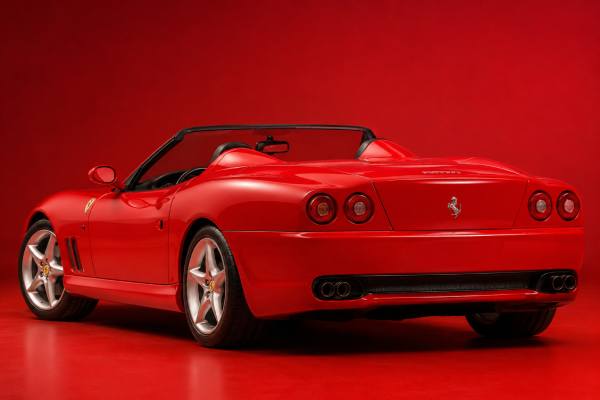

The Ferrari 550 Barchetta Pininfarina is the limited open-top version of the front-engined 550 Maranello, built around the F133C 5.5-liter naturally aspirated V12 and a six-speed manual gearbox. Produced for the 2000–2001 period and created to celebrate Pininfarina’s 70th anniversary, it took the serious, long-legged 550 grand tourer and turned it into a roofless collector car with a much more emotional brief.
Its appeal is easy to understand: a gated manual, a front-mounted Ferrari V12, rear-wheel drive, Pininfarina design, and production limited to 448 numbered cars. But the Barchetta is not simply a 550 Maranello with the roof removed. It has a cut-down windscreen, twin roll hoops, a reworked rear deck, model-specific wheels, and a very particular ownership compromise: the emergency fabric roof is not a normal convertible top. This is a fair-weather Ferrari, not a daily-use spider.
Today, the 550 Barchetta Pininfarina sits at an interesting point in the Ferrari market. It is modern enough to be fast, usable, and electronically fuel injected, but old-school enough to feel mechanical and analog. Collectors value it for rarity and specification, while drivers value it for the same basic ingredients that make the 550 Maranello so respected: balance, torque, steering feel, and a V12 that sounds better the harder it works.
Quick Take
The Ferrari 550 Barchetta Pininfarina is most desirable as a numbered, open-air, manual V12 Ferrari with direct links to Pininfarina and the 550 Maranello’s excellent chassis. Its strongest identity is not outright speed, although it is very quick, but the rare mix of front-engine Ferrari drama, limited production, and analog controls. The main caution is practicality: the roof arrangement is for emergency use, not all-weather touring, and condition, documentation, originality, service history, and included accessories can make a large difference to value.
Table of Contents
- History and Collector Significance
- Engine, Chassis and Key Specifications
- Production, Variants and Factory Details
- Design, Engineering and Special Features
- Road Feel, Performance and Character
- Maintenance, Reliability and Restoration Risks
- Market Values and Buying Advice
History and Collector Significance
The 550 Barchetta Pininfarina matters because it is one of Ferrari’s clearest modern links between the classic open V12 sports car and the usable front-engined grand tourer. It was based on the 550 Maranello, but its limited production, Pininfarina anniversary connection, and uncompromising open body gave it a separate collector identity.
Ferrari had returned to the front-engine V12 two-seat formula with the 550 Maranello in the mid-1990s. That was important. For years, Ferrari’s flagship two-seat road cars had been mid-engined, from the Berlinetta Boxer through the Testarossa family. The 550 Maranello proved that Ferrari could make a front-engined V12 car that was not merely traditional, but genuinely fast, balanced, and modern.
The Barchetta arrived late in the 550’s life. Rather than creating a fully engineered convertible with a folding roof, Ferrari and Pininfarina produced a more romantic and purist car. The word “barchetta” means “little boat,” and in Ferrari history it points to open sports racers and road cars with minimal weather protection. The 550 Barchetta followed that idea closely. It was not designed as a relaxed luxury cabriolet. It was a limited, dramatic, open-air V12 made for committed owners.
The car was shown in 2000 and built in numbered form for 448 customers. That production number is central to its appeal. The 550 Maranello coupe is relatively rare by normal car standards, but the Barchetta is scarce even in Ferrari terms. Most examples are carefully held, and buyers often focus on low mileage, factory accessories, original paint, books, tools, luggage, helmets, and Ferrari Classiche certification.
Its historical role is also tied to Pininfarina. The relationship between Ferrari and Pininfarina shaped some of the most famous road cars in Ferrari history. The 550 Barchetta was created as a tribute to that design house, not just as another body style. That gives it emotional weight beyond the mechanical specification.
The Barchetta’s reputation today is built on several qualities:
- It is one of the last analog-era limited Ferraris with a naturally aspirated front V12 and manual gearbox.
- It has a strong connection to the well-regarded 550 Maranello platform.
- It is rarer and more visually special than the coupe.
- It offers a very direct, exposed driving experience.
- It carries a meaningful Pininfarina anniversary story.
- Its value is highly sensitive to completeness and originality.
This is not a motorsport special, and it was not built as a stripped track car. Its significance is different. It represents the collector-car side of Ferrari’s modern V12 history: elegant, limited, mechanically serious, and intentionally impractical in a way that makes it memorable.
Engine, Chassis and Key Specifications
The 550 Barchetta Pininfarina uses the same basic front-engine, rear-drive layout that made the 550 Maranello respected, with a 5.5-liter naturally aspirated V12 and a six-speed manual transaxle. The F133C engine code identifies the Barchetta application, while the performance character remains classic Ferrari V12: smooth, flexible, and strongest at high rpm.
| Item | Specification |
|---|---|
| Model | Ferrari 550 Barchetta Pininfarina |
| Factory series | F133 family |
| Engine code | F133C |
| Engine layout | Front-mounted 65-degree V12 |
| Displacement | 5,474 cc |
| Induction | Naturally aspirated |
| Power | 485 hp at about 7,000 rpm |
| Torque | About 568 Nm at about 5,000 rpm |
| Transmission | Six-speed manual transaxle |
| Drivetrain | Rear-wheel drive |
| Body style | Two-seat open barchetta |
| Production | 448 numbered examples |
The engine is a major part of the car’s appeal. A 65-degree V12 is smoother than it needs to be, and the 550’s unit is known for combining torque with a strong top-end pull. It is not a peaky racing engine that only wakes up near the redline. It can move the car cleanly from low revs, then becomes much more urgent as the revs rise.
The six-speed manual transaxle helps weight distribution because the gearbox is mounted at the rear. This layout gives the 550 family a more balanced feel than many people expect from a large front-engined V12. It also makes the Barchetta more valuable today, because later Ferrari V12 models increasingly moved toward automated manual and dual-clutch transmissions.
| Area | Details |
|---|---|
| Chassis | Steel tubular chassis with aluminum body panels |
| Front suspension | Independent double wishbones |
| Rear suspension | Independent double wishbones |
| Damping | Electronically controlled adaptive dampers |
| Steering | Power-assisted rack and pinion |
| Brakes | Ventilated steel discs with ABS |
| Wheels | Model-specific 19-inch alloy wheels |
The Barchetta is sometimes described as mechanically close to the 550 Maranello, and that is broadly true. The important differences are in the body, roof concept, windscreen, rear structure, wheels, and limited-edition details. From a driving and maintenance point of view, much of the underlying car remains 550, which is helpful because specialists understand the platform well.
| Measure | Figure |
|---|---|
| 0–100 km/h | About 4.4 seconds |
| Top speed | About 300 km/h |
| Power-to-weight character | Strong grand-tourer acceleration rather than lightweight track-car response |
The numbers still look serious, but they do not fully explain the car. The 550 Barchetta’s appeal is not only acceleration. It is the combination of speed, open-air V12 sound, manual shifting, and the feeling of a large Ferrari that still communicates through its steering, pedals, and chassis.
Production, Variants and Factory Details
The 550 Barchetta Pininfarina was not a broad model range; it was a single limited-production derivative of the 550 Maranello. For buyers, the important differences are not trim levels, but production number, market specification, color, accessories, documentation, originality, and whether the car still has its correct limited-edition details.
Ferrari produced 448 numbered examples. Each production car has a numbered plaque, and that plaque is an important part of the car’s identity. Buyers should confirm that the plaque, chassis number, engine number, books, service records, and any Ferrari Classiche documentation all tell a consistent story.
The Barchetta was offered with the six-speed manual gearbox. That is central to the car’s desirability. Unlike some later Ferraris, there is no need to choose between manual and paddle-shift versions. The car’s identity is tied to the open gate, metal lever, and traditional clutch pedal.
Key production identifiers
Important identification points include:
- Numbered plaque showing the car’s place in the 448-car production run.
- F133C V12 engine application.
- Cut-down windscreen compared with the 550 Maranello.
- Twin roll hoops behind the seats.
- Reworked rear deck and open barchetta body.
- Model-specific 19-inch wheels.
- Emergency roof arrangement rather than a normal convertible system.
- Pininfarina anniversary identity and related factory presentation details.
Because the Barchetta is now a collector car, completeness matters. A car missing its books, tools, roof parts, luggage, helmets, original accessories, or early ownership records can still be desirable, but it should not be valued the same as a complete, well-documented example.
Colors, interiors and special-order appeal
Rosso Corsa is the most familiar Ferrari color and appears often on 550 Barchettas, but many collectors pay close attention to rarer factory colors. Silver, blue, black, yellow, and special-order combinations can be more interesting when they are original and well documented. Interior color matters too, especially if it complements an unusual exterior.
A rare color does not automatically make a car better. It helps most when the car also has:
- Factory confirmation of the original color and trim.
- Original paint or high-quality documented repaint work.
- A tasteful interior combination.
- Low or believable mileage.
- Complete accessories and records.
- No major accident or structural repair history.
Ferrari Classiche certification can be valuable because it confirms important originality details. It is not a substitute for a physical inspection, but for a limited Ferrari it gives buyers a stronger basis for judging engine, gearbox, chassis, body, and specification authenticity.
Market-specific details
Cars may differ slightly depending on market. Lighting, emissions equipment, warning labels, instruments, and paperwork can vary. For a buyer, the key point is not whether one market is automatically better. The priority is that the car is correctly documented for its market and legally usable where it will be registered.
A European-delivery car with excellent records may be more attractive than a U.S. car with gaps in history, and the reverse can also be true. Condition and provenance usually matter more than the badge on the original dealer invoice.
Design, Engineering and Special Features
The 550 Barchetta’s design is special because it turns the sober, muscular 550 Maranello into a more theatrical open car without losing the basic proportions of a front-engined V12 Ferrari. Its most distinctive features are the low windscreen, exposed cabin, twin roll hoops, long rear deck, and the absence of a true folding roof.
Pininfarina’s work on the 550 Maranello was restrained compared with some earlier Ferraris. The coupe has a long hood, compact cabin, and short rear, with clean surfaces rather than heavy decoration. The Barchetta keeps that foundation but changes the emotional message. Removing the fixed roof makes the hood look even longer and makes the rear deck more important visually.
The cut-down windscreen is one of the car’s defining details. It helps the Barchetta avoid looking like a normal coupe conversion. The cabin feels more exposed, and the car has a lower, more purposeful profile. Behind the seats, the twin hoops give some visual structure and help balance the long rear section.
The roof is the main engineering compromise
The temporary fabric roof is one of the most important things to understand before buying or driving a 550 Barchetta. It is not a normal convertible top. It is an emergency cover intended for poor weather at low speeds, not a refined touring roof for fast motorway use.
That affects ownership in several ways:
- The car should be stored carefully and kept out of bad weather.
- Long trips require planning around weather.
- The roof equipment should be complete and in good condition.
- Water leaks, worn seals, and damaged trim can be expensive to correct.
- Buyers should not expect the usability of a 360 Spider or later Ferrari California.
This limitation is not a flaw in the usual sense. It is part of the Barchetta concept. But it does separate the car from more practical open Ferraris.
Cabin and sensory character
Inside, the Barchetta is recognizably 550. The layout is driver-focused but not stripped bare. The seating position is low, the dashboard is simple by modern standards, and the gated shifter is a major part of the experience. The cabin has enough luxury to feel like a flagship Ferrari of its period, but it is not dominated by screens, drive modes, or electronic interfaces.
The open body changes the sound dramatically. In the coupe, the V12 is cultured and distant at low speed, then more urgent as the revs build. In the Barchetta, induction noise, exhaust tone, and mechanical texture are more present. The car feels less like a high-speed grand tourer and more like a special-occasion machine.
Engineering continuity with the 550 Maranello
The Barchetta’s best engineering decision may be that it did not move far away from the 550 Maranello. The platform already had the right ingredients: front-mid V12 placement, rear transaxle, independent suspension, adaptive damping, strong brakes, and enough chassis stiffness to handle real performance.
That continuity is helpful for owners. Specialists familiar with the 550 Maranello can usually service much of the Barchetta’s mechanical package. The limited-production parts are mainly the concern: body trim, roof components, Barchetta-specific interior pieces, wheels, and accessories.
Road Feel, Performance and Character
The 550 Barchetta drives like a more exposed, more emotional version of the 550 Maranello rather than a razor-edged track special. It is fast, torquey, and balanced, but its greatest pleasure comes from the open V12 sound, the manual gearbox, and the sense that the car has enough compliance for real roads.
Acceleration is strong from low revs because the V12 has meaningful torque. The car does not need to be driven aggressively to feel special. In a higher gear, it can gather speed smoothly and quickly, which suits its grand touring roots. Push harder, and the engine becomes sharper, louder, and more urgent as it moves toward the upper end of the tachometer.
The gated manual gearbox is central to the experience. When cold, the shift can feel heavy and deliberate, especially into second gear. That is normal for many Ferraris of this era. Once warm, the shift quality improves, and the process of clutch, lever, throttle, and engine response becomes one of the car’s main pleasures.
Steering is another strength. The 550 family is known for clear front-end feel and confidence at speed. The Barchetta is not a lightweight sports car, so it does not dart around like a small mid-engine Ferrari. Instead, it feels planted and measured. The driver gets the sense of a substantial car that can cover ground very quickly without becoming nervous.
Ride quality is better than many people expect. The adaptive dampers help the car deal with uneven roads, and the grand-tourer base means it is not punishing for the sake of sharpness. Wheel and tire condition, alignment, damper health, and bushing condition make a major difference. A tired car can feel loose, heavy, or vague; a properly maintained one feels composed and expensive.
The brakes are steel rather than carbon-ceramic. For road use, that is not a disadvantage. Steel brakes are easier to service and more predictable when cold. On a hard mountain road they should feel strong, but age, fluid condition, hose condition, pad choice, and caliper health matter. A car that has spent years sitting may need brake work before it feels right.
Best use case
The Barchetta is at its best on dry roads, with the roof off, after the mechanicals are warm. It suits fast cross-country drives, early-morning mountain roads, coastal routes, and special events. It is less suited to rain, heavy traffic, outdoor parking, and long trips where secure weather protection is essential.
Owners who understand that tend to enjoy it more. The car is not trying to be a practical convertible. It is a limited open Ferrari that rewards the right conditions.
What changes with condition
Two 550 Barchettas can feel very different. Mileage is part of the story, but maintenance quality matters more. A very low-mileage car on old tires, old fluids, sticky controls, and tired seals may drive worse than a higher-mileage car that has been serviced properly.
Before judging one on a test drive, check:
- Tire age and type.
- Suspension bushing condition.
- Damper operation.
- Clutch feel and take-up.
- Gearshift quality when cold and warm.
- Brake pedal feel.
- Cooling performance in traffic.
- Warning lights and electrical behavior.
- Evidence of water leaks or cabin dampness.
A good Barchetta should feel solid, smooth, and expensive. It should not feel fragile, smoky, unstable, or reluctant to idle cleanly.
Maintenance, Reliability and Restoration Risks
The 550 Barchetta is generally regarded as one of the more usable modern classic Ferraris, but it is still an exotic V12 with age-sensitive systems and limited-production body parts. The biggest ownership risks are deferred maintenance, poor storage, accident repairs, missing Barchetta-specific parts, and cars bought on mileage alone without a proper specialist inspection.
The F133 V12 is a strong engine when serviced correctly. It does not have the same engine-out belt-service reputation as some earlier mid-engined Ferraris, but timing belt service, fluid changes, cooling-system care, and careful inspection remain essential. A long gap between services is a warning sign even if the car has covered little mileage.
Common ownership attention areas include:
- Timing belts, tensioners, and related service items.
- Cooling hoses, radiator condition, fans, and thermostat behavior.
- Oil leaks from age-hardened gaskets and seals.
- Fuel hoses and vapor lines.
- Engine mounts and gearbox mounts.
- Clutch wear and hydraulic operation.
- Sticky interior switches and trim coatings.
- Electrical connectors, warning lights, and battery-related issues.
- Suspension bushings, ball joints, dampers, and alignment.
- Brake hoses, calipers, discs, pads, and old fluid.
- Roof seals, cabin dampness, and weather-related trim damage.
Because many Barchettas have low mileage, lack of use can be as damaging as hard use. Rubber parts age. Fluids absorb moisture. Tires become unsafe by age long before tread disappears. Batteries go flat and create electronic faults. Fuel systems can suffer if the car sits for long periods.
Barchetta-specific concerns
The limited body and roof details make the Barchetta more sensitive than a standard 550 Maranello. Mechanical parts may be available through specialists and Ferrari channels, but unique trim and body pieces can be difficult and expensive.
Pay close attention to:
- Emergency roof completeness and fit.
- Roof frame, fabric, fasteners, and storage bag.
- Windscreen and surrounding trim.
- Roll hoop trim and rear deck condition.
- Model-specific wheels.
- Seat, dashboard, and plaque condition.
- Luggage, helmets, tools, books, and manuals.
- Signs of water entry behind seats, under carpets, and in electrical areas.
A missing or damaged emergency roof may not matter to someone who never intends to use it, but it matters to value. A collector-grade Barchetta should have its special equipment.
Restoration and repair difficulty
Full restoration is not usually the goal with these cars. Most are modern enough that buyers prefer preservation and documented maintenance over a ground-up rebuild. Repainting, retrimming, or replacing original parts can reduce value if the work is not necessary or not documented.
Accident damage is a major concern. The car’s value depends heavily on body integrity and originality. A specialist should inspect panel fit, paint depth, chassis points, suspension mounting areas, underbody condition, and the front and rear structures. Open cars can be less forgiving of poor repairs because small changes in alignment may create leaks, wind noise, trim fit issues, and handling problems.
Maintenance mindset
A sensible owner treats the 550 Barchetta as a high-value collector Ferrari that still needs to be driven. The best examples usually have:
- Regular annual servicing, even at low mileage.
- Belt service at age-based intervals.
- Fresh tires from a suitable performance brand.
- Clean brake fluid and coolant history.
- A strong battery kept on a maintainer.
- Climate-controlled storage.
- Careful use of the temporary roof.
- Detailed invoices from recognized Ferrari specialists or dealers.
The wrong approach is to buy the lowest-mileage car available and assume it needs nothing. A car that has been static for years may need a major recommissioning before it is safe or enjoyable.
Market Values and Buying Advice
The 550 Barchetta Pininfarina is now firmly a collector Ferrari, and values are driven by rarity, manual V12 appeal, condition, mileage, color, completeness, provenance, and originality. Current asking prices and recent auction results generally place good cars in the high six-figure range, with exceptional low-mileage or unusually specified examples capable of bringing more.
The market is not perfectly uniform. A driver-quality car with higher mileage, missing accessories, or needs may trade well below a time-capsule example. A delivery-mileage car with complete accessories, original paint, strong documentation, and Ferrari Classiche certification can command a large premium.
Value is usually shaped by these factors:
| Factor | Why it matters |
|---|---|
| Originality | Collectors prefer factory paint, trim, drivetrain, wheels, and correct equipment. |
| Documentation | Books, tools, invoices, ownership history, and certification support authenticity. |
| Mileage | Low mileage helps value, but only when maintenance and condition are also strong. |
| Color | Rosso Corsa is classic; rare original colors can bring extra interest. |
| Accessories | Roof equipment, luggage, helmets, tools, and manuals affect collector appeal. |
| Condition | Paint, leather, trim, wheels, suspension, and mechanical health are crucial. |
| Provenance | Long-term ownership, known dealers, and careful storage can support stronger prices. |
What to seek
The best 550 Barchetta for most collectors is not simply the lowest-mileage car. It is the car with the cleanest story. Look for a complete, original, well-serviced example with a clear ownership chain and no excuses around missing parts.
A strong candidate should have:
- Matching and documented chassis, engine, and gearbox identity.
- Ferrari Classiche certification or documentation suitable for certification.
- Complete books, tools, roof equipment, luggage, and accessories where applicable.
- Detailed service invoices from known specialists or Ferrari dealers.
- Recent belt service or a clear plan for immediate service.
- Correct wheels and original-style equipment.
- No unexplained paintwork or accident history.
- Clean interior trim without heavy shrinkage, stickiness, dampness, or damage.
- Tires that are correct in size and not aged out.
- A cold start and warm test drive with no warning lights or overheating.
What to avoid
Avoid cars that look cheap for unclear reasons. On a limited Ferrari, a discount can disappear quickly if the car needs rare trim, roof parts, body correction, or major mechanical recommissioning.
Be cautious with:
- Missing numbered-plaque clarity or inconsistent records.
- Incomplete roof equipment.
- Water-damaged interiors.
- Long periods with no service history.
- Old tires presented as “like new” because the tread is deep.
- Sticky switches used as evidence of “normal Ferrari aging” without repair estimates.
- Non-original wheels or modifications.
- Poor-quality repainting.
- Imported cars with incomplete registration or emissions paperwork.
- Cars sold without a proper pre-purchase inspection.
Inspection priorities
A pre-purchase inspection should be done by a Ferrari specialist who understands the 550 platform and the Barchetta’s unique parts. A normal used-car inspection is not enough.
The inspection should include:
- Verification of chassis, engine, gearbox, and production-number details.
- Paint-depth readings and body alignment checks.
- Underside inspection for accident repair, corrosion, leaks, and damaged undertrays.
- Timing belt, tensioner, and major-service history review.
- Cooling-system pressure and fan operation checks.
- Clutch wear assessment and hydraulic inspection.
- Suspension, steering, brake, and tire evaluation.
- Electrical scan and warning-light check.
- Roof, seals, carpets, and cabin moisture inspection.
- Review of books, tools, accessories, certification, and invoices.
The long-term collectability looks strong because the Barchetta has the right ingredients: limited production, manual gearbox, naturally aspirated V12, Pininfarina connection, and a clear difference from the standard 550 Maranello. The main risk is buying the wrong example. A complete, original, carefully maintained car should remain desirable; a needy car with missing parts can become expensive very quickly.
References
- Ferrari 550 Barchetta Pininfarina (2000) – Ferrari.com 2000
- Ferrari 550 Barchetta Pininfarina: Ferrari History 2000
- Vehicle Detail Search – 2001 FERRARI 550 BARCHETTA | NHTSA 2001 (Recall Database)
- FERRARI 550 BARCHETTA PININFARINA OWNER’S MANUAL Pdf Download | ManualsLib 2001 (Owner’s Manual)
- 2001 Ferrari 550 Barchetta Pininfarina 2026 (Auction Result)
Disclaimer
This article is for informational purposes only and is not a substitute for professional diagnosis, inspection, repair, or valuation. Specifications, torque values, service intervals, parts compatibility, and procedures can vary by VIN, market, equipment, and production details. Always verify important information against official Ferrari service documentation and consult a qualified Ferrari specialist before buying, repairing, or restoring a 550 Barchetta Pininfarina.
If you found this guide useful, please consider sharing it on Facebook, X/Twitter, or with other Ferrari enthusiasts to support our work.