
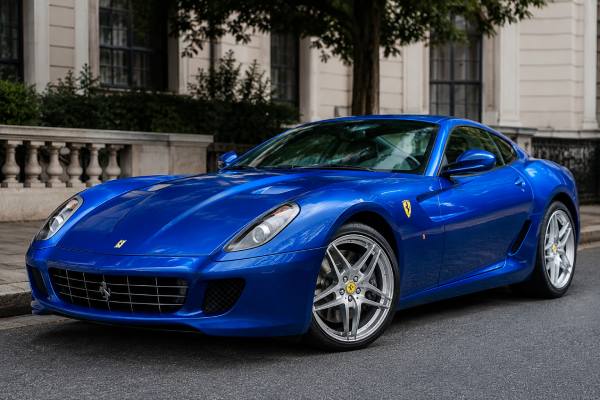
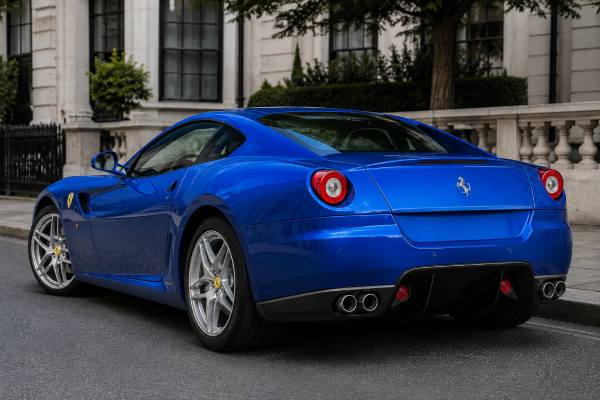
The Ferrari 599 GTB Fiorano HGTE is the sharper, more focused version of Ferrari’s front-engined V12 grand tourer, built around the F141 platform and the F140 C 6.0-liter naturally aspirated V12. Introduced for the 2009 model year, the HGTE package did not turn the 599 into a stripped track car. Instead, it tightened the chassis, quickened the F1 gearbox behavior, added a more purposeful exhaust note, and made the 599 feel more alert without losing its long-distance GT identity.
That balance is why the 599 HGTE still attracts attention. It sits between the regular 599 GTB Fiorano and the harder, rarer 599 GTO, giving buyers much of the big V12 drama and a more disciplined road feel without the full price and intensity of the GTO market. For collectors, the key questions are originality, factory HGTE specification, service history, carbon-ceramic brake condition, clutch wear, and whether the car has the right documentation to support its spec.
Quick Take
The Ferrari 599 GTB Fiorano HGTE is most appealing as a naturally aspirated V12 super-GT with real Ferrari flagship status and a noticeably sharper chassis than the standard GTB. Its identity comes from the F140 C engine, aluminum structure, F1-derived controls, and HGTE handling package rather than from extra horsepower. The caution is ownership cost: clutch condition, carbon-ceramic brakes, suspension wear, sticky interior parts, and incomplete records can turn a tempting car into an expensive one. The best buys are original, well-documented factory HGTE cars with regular specialist maintenance, clean diagnostic reports, and no questionable manual conversions or cosmetic shortcuts.
Table of Contents
- Where the 599 HGTE Fits
- F140 V12, Chassis and Specs
- Production, Variants and Options
- Design, Engineering and HGTE Features
- Road and Track Driving Character
- Maintenance, Reliability and Restoration Costs
- Values, Inspection and Buying Advice
Where the 599 HGTE Fits
The 599 HGTE matters because it is the most polished driver-focused version of the regular 599 GTB Fiorano. It keeps the standard car’s grand touring comfort and 612 hp V12, but it adds the chassis precision many early 599 buyers wanted from the start.
Ferrari launched the 599 GTB Fiorano in 2006 as the replacement for the 575M Maranello. It was a major step forward from the older Maranello line. The 575M was still closely tied to the 550 architecture, while the 599 brought an aluminum chassis, a much more powerful Enzo-derived V12 family engine, modern electronic controls, and styling by Pininfarina under Jason Castriota’s direction.
The name explained the car clearly. “599” referred to the engine’s displacement, “GTB” meant Gran Turismo Berlinetta, and “Fiorano” linked the car to Ferrari’s private test circuit. It was not a mid-engined supercar like the F430 or later 458 Italia. It was Ferrari’s two-seat V12 flagship, the car for buyers who wanted massive front-engined power, luggage space, luxury, and real cross-country speed.
The HGTE version arrived later, at a point when Ferrari had already proven the 599’s speed but wanted to sharpen its response. HGTE stands for Handling Gran Turismo Evoluzione. The package focused on suspension tuning, ride height, tires, gearbox calibration, throttle response, exhaust character, and trim. It was available as a factory option and also through Ferrari Genuine as a retrofit package for suitable cars, which makes documentation especially important today.
The 599 HGTE also sits in an interesting historical space. It came near the end of Ferrari’s era of single-clutch automated manuals and before the dual-clutch F12berlinetta that replaced the 599. It is old enough to feel mechanical, loud, and dramatic, yet modern enough to offer stability control, F1-Trac traction management, magnetorheological dampers, carbon-ceramic brakes on many examples, and usable cabin equipment.
For collectors, the HGTE is desirable because it is more special than a normal F1-equipped GTB but not as limited or extreme as the 599 GTO. For drivers, it is desirable because it makes the 599 feel less floaty, more tied down, and more confident when the road opens up. That is the core of its appeal: a big V12 Ferrari that still feels like a grand tourer, but with a sharper edge.
F140 V12, Chassis and Specs
The 599 HGTE uses the same basic powertrain as the standard 599 GTB Fiorano: a front-mid-mounted F140 C V12 producing 456 kW, 620 CV, or about 612 hp. The HGTE package changes the car’s response and handling, not the peak engine output.
| Item | Specification |
|---|---|
| Model years covered | 2009–2012 HGTE-equipped 599 GTB Fiorano |
| Platform code | F141 |
| Body style | Two-door, two-seat berlinetta grand tourer |
| Engine code | F140 C |
| Engine type | 65-degree naturally aspirated V12, dry-sump lubrication |
| Displacement | 5,999 cc, commonly described as 6.0 liters |
| Bore x stroke | 92.0 mm x 75.2 mm |
| Compression ratio | 11.2:1 |
| Maximum power | 456 kW / 620 CV / about 612 hp at 7,600 rpm |
| Maximum torque | 608 Nm / 448 lb-ft at 5,600 rpm |
| Transmission | Six-speed F1 SuperFast automated manual |
| Drivetrain | Front-mid engine, rear-wheel drive |
| Structure | Aluminum chassis and body structure |
| Suspension | Double wishbones with SCM magnetorheological damping |
| Official 0–100 km/h | About 3.7 seconds |
| Top speed | Over 330 km/h / about 205 mph |
The F140 C engine is the centerpiece. It is related to the V12 family used in the Enzo, but adapted for a front-engined GT layout. It has four valves per cylinder, a high rev limit, dry-sump lubrication, and a wide, urgent powerband. Unlike later turbocharged supercars, the 599 depends on displacement, revs, gearing, and intake sound. It builds power cleanly and becomes much more intense as it moves past the middle of the rev range.
The six-speed F1 SuperFast gearbox is a single-clutch automated manual, not a torque-converter automatic and not a modern dual-clutch transmission. It uses electrohydraulic actuation to operate a conventional clutch and gearset. In the HGTE, Ferrari recalibrated the system for quicker, harder shifts in the sportier driving modes. It can feel dramatic and involving when driven properly, but it does not creep or shift as smoothly as a modern dual-clutch gearbox in traffic.
| Measurement | Figure |
|---|---|
| Length | 4,665 mm / 183.7 in |
| Width | 1,962 mm / 77.2 in |
| Height | 1,336 mm / 52.6 in |
| Wheelbase | 2,750 mm / 108.3 in |
| Fuel capacity | About 105 liters / 27.7 US gallons |
| Standard wheel and tire pattern | Staggered Ferrari fitment, commonly 19-inch front and 20-inch rear on standard GTB specification |
| HGTE wheel and tire theme | 20-inch HGTE-style wheels with a more focused tire specification, depending on market and equipment |
The chassis is just as important as the engine. The 599 was Ferrari’s first V12 GT of this line to use a modern aluminum structure rather than the older tubular steel approach of earlier front-engined models. This helped stiffness, weight control, and suspension precision. The car remained large and powerful, but it was a major leap over the 575M in response, grip, and electronic control.
Production, Variants and Options
The HGTE is best understood as a high-value handling specification within the 599 GTB Fiorano range, not as a separate limited-production model like the 599 GTO. That distinction matters because two cars advertised as HGTE can differ sharply in originality, factory paperwork, and retrofit history.
The main 599 family included the standard 599 GTB Fiorano, the HGTE-equipped GTB, the track-only 599XX, the road-going 599 GTO, and the open SA Aperta. The HGTE package sat in the middle. It gave owners a more sporting GTB without the rarity, price, and sharper temperament of the GTO.
Factory HGTE versus retrofit HGTE
A factory HGTE car is generally the most desirable form for collectors because the build specification supports the car’s identity from new. Retrofit HGTE packages can still be excellent to drive, especially if installed correctly through Ferrari channels, but buyers should not value them exactly the same without documentation.
Important documents include:
- original window sticker or order sheet
- Ferrari dealer invoice showing HGTE equipment
- service book and stamped maintenance history
- Ferrari Genuine retrofit paperwork, if applicable
- option code printout or build specification
- diagnostic reports showing clutch wear and stored faults
- invoices for major work such as brakes, tires, suspension, clutch, and F1 system service
The 599 was offered with a traditional gated manual gearbox in tiny numbers, but most cars used the F1 automated manual. For HGTE buying, the F1 gearbox is the normal expectation. Manual 599s live in a separate collector market, and manual-converted cars require careful treatment. A conversion may be satisfying for a driver, but it can reduce originality unless fully reversible and carefully documented.
Important options and desirability
Ferrari options can change the character and value of a 599 HGTE. Some options are mainly cosmetic, while others affect how the car feels, ages, or sells.
Commonly desirable equipment includes:
- carbon-fiber racing seats or carbon-backed seats
- carbon-fiber driving zone
- carbon-fiber lower cabin trim
- Scuderia Ferrari fender shields
- parking sensors
- Bose or upgraded audio, depending on market
- contrasting stitching and special leather colors
- Daytona-style seats on more comfort-oriented cars
- factory luggage
- yellow or red tachometer
- carbon-ceramic brakes, especially on later cars where buyers expect them
- original HGTE wheels and trim pieces
Color also matters. Rosso Corsa, Nero Daytona, Grigio Silverstone, Grigio Titanio, Blu Pozzi, Tour de France Blue, and other Ferrari colors can all work, but unusual factory colors need paperwork. A rare color can lift value if the car is otherwise correct. A repaint or color change usually hurts collector appeal unless it was done for a clearly documented reason.
Design, Engineering and HGTE Features
The 599 HGTE is distinctive because its design serves both high-speed stability and grand touring presence. It is not small or delicate, but the long hood, rear-set cabin, flying buttress rear pillars, and muscular surfaces give it a clear front-engined Ferrari identity.
Pininfarina’s shape was a clean break from the 550 and 575M. The older cars were elegant and restrained; the 599 looked more technical and aggressive. The side vents, sculpted body sides, and rear flying-buttress treatment were not just decoration. The buttresses helped manage airflow around the rear of the car, while the underbody and rear diffuser contributed to stability at speed.
The HGTE package sharpened the engineering rather than changing the basic shape. Its main mechanical changes centered on:
- lower ride height
- stiffer springs
- revised rear anti-roll bar
- recalibrated SCM magnetorheological dampers in sportier Manettino settings
- optimized tire specification
- quicker F1 shift programming under hard use
- sharper throttle response
- more pronounced exhaust sound
- HGTE-specific wheels and trim details
These changes made the 599 feel more compact than it really was. The standard GTB can feel slightly relaxed in vertical motion on uneven roads, which suits grand touring but can make it feel large when driven hard. HGTE tuning reduces that softness. It brings better body control, quicker reactions, and more confidence in fast direction changes.
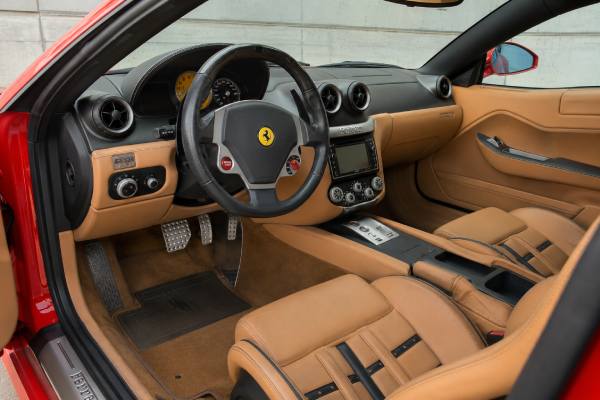
The cockpit is classic late-2000s Ferrari. It has a steering-wheel Manettino switch, a red engine start button, large column-mounted shift paddles, an analog tachometer, and a mix of leather, carbon fiber, metal, and early infotainment hardware. It feels more modern than a 575M but more analog than a contemporary dual-clutch Ferrari.
The sensory character is a major part of the car. The F140 C V12 does not need artificial drama. It has a deep, mechanical idle, a hard-edged intake note, and a soaring top-end sound. The HGTE exhaust calibration adds more presence under load while keeping the car usable at cruising speed. That dual nature is the point: a 599 HGTE should be able to cross countries quickly, then come alive when the driver asks for more.
Road and Track Driving Character
A good 599 HGTE feels fast, stable, and serious rather than nervous. It is a front-engined V12 GT with supercar performance, so the pleasure comes from torque, sound, high-speed balance, and the feeling of a large car being controlled with precision.
At low speed, the 599 does not hide its size. The hood is long, the car is wide, and the single-clutch F1 gearbox needs sympathy. Drivers used to dual-clutch cars may find it abrupt in town. Smooth progress requires clean throttle inputs, avoiding unnecessary creeping, and letting the gearbox complete its shifts rather than fighting it.
Once moving, the car makes more sense. The V12 has enough torque for easy road speed, but the upper rev range is where the engine becomes special. It pulls hard past the midrange and keeps building with a sound that feels increasingly urgent. The HGTE calibration makes throttle response feel more direct, so the car reacts more eagerly to small inputs.
The F1 gearbox is part of the experience. In gentle driving it can feel old-fashioned, but in fast driving it becomes more satisfying. Full-throttle upshifts in the correct mode have a hard mechanical snap that suits the car’s personality. Downshifts are dramatic, especially when the exhaust and rev-matching are working as intended.
Steering feel is weighty and direct for a large GT. The HGTE setup gives the front axle more confidence, helped by the more focused tire and suspension settings. The car still rewards measured inputs. It is not a lightweight mid-engined car that darts into every bend. It prefers commitment, clean braking, a settled entry, and strong drive out of corners.
Ride quality is firmer than a standard 599 GTB. On smooth roads this is an advantage because the car feels tied down and controlled. On rough city streets, the lower ride height and stiffer setup can make the car feel less relaxed. Buyers should test drive the car on the kind of roads they actually use, because the HGTE character is a feature only if it suits the owner’s expectations.
Braking performance is very strong when the carbon-ceramic system is healthy and warm enough. Pedal feel can vary between cars, and old tires or glazed pads can make the brakes feel worse than they are. A proper inspection should measure brake disc wear by the correct method, not just by appearance.
On track, the 599 HGTE is capable but still heavy. It can run very fast laps in the right hands, yet it will consume tires, brakes, and fluids quickly compared with smaller track-focused cars. It is better viewed as a road-biased super-GT that can handle occasional circuit use, not as a low-cost track toy.
Maintenance, Reliability and Restoration Costs
The 599 HGTE can be durable when maintained properly, but it is still a complex V12 Ferrari with expensive wear items. The safest ownership strategy is to buy the best-documented car, inspect it deeply, and budget for age-related work even when mileage is low.
The engine itself has a strong reputation when serviced correctly. It uses timing chains rather than cambelts, which removes one famous older Ferrari maintenance burden. That does not make it cheap to own. Fluids, plugs, coils, gaskets, cooling parts, mounts, sensors, and labor are still Ferrari-grade costs.
The biggest ownership risks usually come from the systems around the engine: F1 gearbox hardware, clutch wear, suspension, brakes, electronics, interior materials, and old tires.
| Area | What to check | Why it matters |
|---|---|---|
| F1 clutch | Diagnostic clutch wear reading, engagement quality, service history | A worn clutch or poorly set F1 system can become expensive quickly |
| F1 hydraulic system | Pump operation, actuator leaks, pressure behavior, warning lights | Slow shifts, missed gears, or pump faults may point to costly repairs |
| Carbon-ceramic brakes | Disc condition, pad life, surface damage, correct wear measurement | Replacement costs are high, and visual checks alone are not enough |
| Suspension | Magnetic dampers, ball joints, bushings, alignment, tire wear | HGTE cars put more emphasis on precise chassis condition |
| Cooling system | Radiators, hoses, expansion tank, fan operation, coolant history | Heat and age can damage parts even on low-mile cars |
| Electrical system | Battery health, control modules, warning lights, charger use | Low voltage can trigger confusing faults and expensive diagnosis |
| Interior | Sticky switches, leather shrinkage, dash condition, carbon trim | Cosmetic restoration can be surprisingly costly |
| Body and underside | Front splitter, undertrays, wheel wells, accident repairs | Low ride height and high speeds make underside damage common |
Annual servicing is wise even if the car covers little mileage. Long gaps in maintenance are not acceptable just because the odometer is low. In fact, ultra-low-mile examples can have their own problems: flat-spotted or aged tires, old fluids, weak batteries, sticky seals, and F1 components that have not been exercised regularly.
Tires deserve special attention. A 599 HGTE on old tires is not really a 599 HGTE. The chassis tuning depends on grip, sidewall control, and correct sizes. Check date codes, matching specification, alignment, and whether the car tracks cleanly under braking and acceleration.
Restoration is usually not like restoring a classic 1960s Ferrari, but costs can still be severe. Re-trimming a dashboard, replacing carbon parts, correcting accident repair, rebuilding suspension, or sorting a neglected F1 system can erase any saving from buying a cheaper car. The best 599 HGTE is normally the one that looks expensive at purchase but has fewer hidden needs.
Values, Inspection and Buying Advice
The 599 HGTE sits in a strong but condition-sensitive market: more special than a standard F1 599, less extreme than a GTO, and very dependent on specification. The right car is worth paying more for because deferred maintenance can cost more than the apparent discount.
Current market behavior generally separates 599s into several groups. Standard F1 cars with ordinary mileage and average colors sit at the entry point. Factory HGTE cars with good colors, low-to-moderate mileage, carbon options, and full records bring a premium. Manual cars, 599 GTOs, and SA Apertas are separate collector categories and should not be used as direct value comparisons for an HGTE F1 car.
What drives value
The strongest value factors are:
- factory HGTE specification rather than undocumented retrofit claims
- full Ferrari or recognized specialist service history
- clean diagnostic report with clutch and gearbox data
- low but usable mileage, not long-term storage without maintenance
- original paint or documented paintwork
- desirable factory colors and interior combinations
- original wheels, books, tools, charger, and accessories
- healthy carbon-ceramic brakes
- no accident history
- no questionable manual conversion or aftermarket tuning
- recent major maintenance by a known specialist
Mileage needs context. A 5,000-mile car with old tires, weak fluids, and minimal use may need more recommissioning than a 20,000-mile car that has been serviced every year and driven regularly. For a car like this, condition and records are often more important than the lowest possible odometer reading.
Cars to seek
The best 599 HGTE examples usually have a simple story. They were ordered with the HGTE package, maintained by Ferrari dealers or respected specialists, kept on a battery tender, driven enough to stay healthy, and preserved without heavy modification. A car with original paint, full records, correct tires, strong clutch data, and fresh servicing is the kind of example that should remain desirable.
Cars to avoid
Be cautious with cars that show:
- missing service records
- vague HGTE claims without paperwork
- clutch wear near the end of its usable range
- F1 gearbox warnings or inconsistent engagement
- old or mismatched tires
- carbon-ceramic brake damage
- suspension knocks, leaks, or uneven ride height
- sticky interior controls throughout the cabin
- aftermarket exhaust or ECU tuning without original parts
- accident repair around the nose, suspension pickup points, or rear quarters
- long storage with no recommissioning invoices
A pre-purchase inspection is not optional. It should be done by a Ferrari dealer or a specialist who knows the 599 platform, has the right diagnostic equipment, and understands how to inspect carbon-ceramic brakes and F1 clutch data. A normal used-car inspection is not enough.
The 599 HGTE’s long-term collectability looks solid because it combines several desirable traits: naturally aspirated V12 power, front-engined Ferrari flagship status, Pininfarina design, limited HGTE desirability, and a driving character that later dual-clutch cars do not fully copy. It is not the rarest 599, but it may be one of the most satisfying to use.
The practical buying answer is straightforward: buy on documentation, mechanical condition, and correct specification before color, mileage, or price. A cheaper 599 HGTE with weak records can quickly become the most expensive car in the market. A sorted, original, well-documented example is the one that delivers the car’s real promise: a 612 hp V12 Ferrari GT with sharper handling, real drama, and enough usability to be enjoyed rather than only stored.
References
- 599 GTB Fiorano (2006) – Ferrari.com 2006 (Manufacturer Specifications)
- 599 GTB Fiorano: Ferrari History 2006 (Manufacturer History)
- 599 HGTE styling enhancement kit 2009 (Factory Option)
- NHTSA Datasets and APIs | NHTSA 2026 (Recall Database)
- 2011 Ferrari 599 GTB Fiorano | Hagerty Valuation Tool® 2026 (Valuation Tool)
Disclaimer
This article is for informational purposes only and is not a substitute for professional diagnosis, repair, appraisal, or inspection. Specifications, torque values, service intervals, procedures, software versions, and equipment can vary by VIN, market, production date, and option package. Always verify details against the official Ferrari service documentation for the specific car and consult a qualified Ferrari specialist before purchase or repair.
If this guide was useful, please consider sharing it on Facebook, X/Twitter, or your preferred automotive community to support our work.