
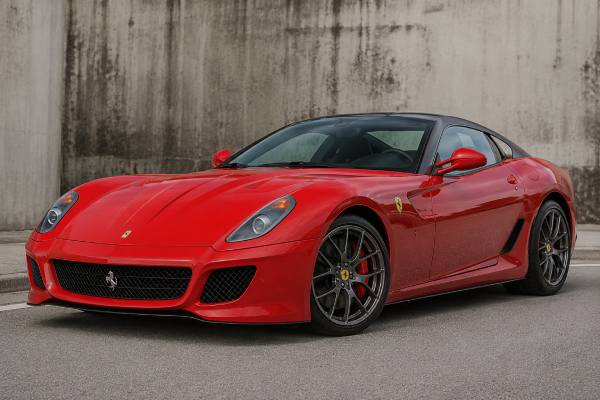
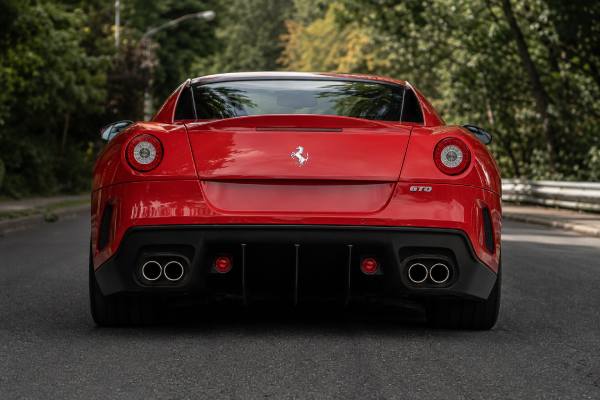
The Ferrari 599 GTO (F141) is the limited-production, road-legal peak of the 599 family, built from 2010 to 2012 with the F140 CE 6.0-liter naturally aspirated V12 and 661 hp. It sits between two worlds: the front-engined Ferrari grand tourer tradition and the more focused, track-developed thinking of the 599XX program. That mix is why the car still attracts collectors, drivers, and Ferrari historians.
Unlike the regular 599 GTB Fiorano, the GTO was not mainly about long-distance comfort. It used the same basic front-mid-engine layout, but Ferrari cut weight, sharpened the gearbox, revised the aerodynamics, added more aggressive electronics, and gave the engine a more urgent top-end character. Production was limited to 599 cars, which makes originality, service history, specification, and provenance central to buying one today.
Quick Take
The 599 GTO is most appealing because it combines a front-mounted, naturally aspirated Ferrari V12 with rare-series status and a much sharper chassis than the standard 599 GTB. Its identity comes from the 599XX-derived engineering, the limited run of 599 units, and the fact that it revived the GTO badge for a modern road car. The main caution is that it is highly condition-sensitive: carbon-ceramic brakes, F1 gearbox wear, sticky interior parts, accident history, tire age, and incomplete records can change the real ownership cost dramatically. The best cars are original, documented, well-serviced, and inspected by a Ferrari specialist before purchase.
Table of Contents
- History and Significance
- Engine, Chassis and Specifications
- Production, Variants and Options
- Design, Engineering and Special Features
- Driving Experience and Performance
- Reliability, Maintenance and Restoration
- Market Value and Buying Guide
History and Significance
The 599 GTO matters because it turned Ferrari’s 599 platform into a harder, rarer, and more track-focused front-engined V12 car. It was not just a trim package; it was a special-series model developed with lessons from the track-only 599XX.
The standard 599 GTB Fiorano arrived as Ferrari’s flagship front-engined two-seat grand tourer after the 575M Maranello. It was already a serious machine, using an Enzo-derived V12 architecture, aluminum construction, a rear-mounted transaxle, and Ferrari’s F1-style automated manual gearbox. The GTO took that base and shifted the emphasis away from luxury GT polish and toward response, lap time, weight saving, and emotional intensity.
The name mattered just as much as the engineering. Before the 599 GTO, Ferrari had used the GTO badge on two of its most famous road cars: the 250 GTO and the 288 GTO. The 599 GTO was different because it was not created to homologate a race car for a racing class. Still, Ferrari used the name to signal something more serious than a normal special edition. It was a road car with a clear technical link to an experimental track program.
The 599 GTO was presented in 2010, during the final years of the naturally aspirated, single-clutch, front-V12 Ferrari era. That timing gives it extra significance now. Later V12 Ferraris became quicker, more refined, and more electronically advanced, but the 599 GTO has a rawer edge. The gearbox shifts with mechanical drama rather than dual-clutch smoothness, the engine needs revs to show its full character, and the car still feels wide, loud, and physical.
Its production run of 599 cars also created instant collectability. It was never a common sight even when new, and today many examples live in collections rather than being used regularly. That limited use can be good or bad. A preserved low-mileage car may be highly valuable, but a car that has sat for long periods can still need serious recommissioning.
The 599 GTO’s reputation today rests on four pillars:
- It is one of Ferrari’s rare modern GTO-badged road cars.
- It has a naturally aspirated 6.0-liter V12 with a high-revving, motorsport-influenced character.
- It links the road-going 599 family to the 599XX track-development program.
- It marks a transition point before dual-clutch gearboxes became the norm in Ferrari supercars.
For collectors, that combination makes the GTO more than a faster 599. It is a defined moment in Ferrari history: front engine, rear drive, V12, automated manual, limited production, and a badge with enormous weight.
Engine, Chassis and Specifications
The 599 GTO uses the F140 CE 65-degree V12, a 5,999 cc naturally aspirated engine rated at 670 CV, or about 661 hp, at 8,250 rpm. It drives the rear wheels through a six-speed F1 automated manual transaxle.
The numbers are impressive, but the layout is just as important. The engine sits behind the front axle line, while the gearbox is mounted at the rear. This front-mid-engine transaxle layout helps the car achieve a rear-biased weight distribution compared with a normal front-engine layout.
| Category | Specification |
|---|---|
| Model code | F141 |
| Engine code | F140 CE |
| Engine type | 65-degree naturally aspirated V12 |
| Displacement | 5,999 cc / 6.0 liters |
| Power | 670 CV / 661 hp at 8,250 rpm |
| Torque | 620 Nm / 457 lb-ft at 6,500 rpm |
| Transmission | Six-speed F1 automated manual |
| Drivetrain | Rear-wheel drive |
| Body style | Two-seat berlinetta coupe |
The F140 CE is not simply the regular 599 GTB engine with a new badge. The GTO version was developed for higher output and sharper response. Compared with the GTB, it gained a more aggressive intake and exhaust character, reduced internal friction, and calibration aimed at high-rpm power. The torque peak arrives high at 6,500 rpm, which tells you how this car wants to be driven. It is flexible enough for road use, but its personality lives in the upper half of the tachometer.
| Area | Detail |
|---|---|
| Construction | Aluminum chassis and body structure |
| Suspension | Independent suspension with magnetorheological damping |
| Brakes | Carbon-ceramic CCM2 brakes |
| Front tires | 285/30 ZR20 |
| Rear tires | 315/35 ZR20 |
| Wheelbase | 2,750 mm / 108.3 in |
| Overall length | 4,710 mm / 185.4 in |
| Overall width | 1,962 mm / 77.2 in |
| Overall height | 1,326 mm / 52.2 in |
| Kerb weight | About 1,605 kg / 3,538 lb |
The official performance figures place the 599 GTO among the great naturally aspirated front-engined supercars of its period. Ferrari quoted 0–100 km/h in 3.35 seconds, 0–200 km/h in 9.8 seconds, and a top speed above 335 km/h, or more than 208 mph. Those figures are still quick today, but they only tell part of the story. The GTO’s appeal is the way it reaches those numbers: with a long hood, a screaming V12, rear-drive traction management, and an F1 gearbox that makes every shift feel like an event.
Fuel economy is not a buying reason, but it matters for registration, emissions rules, and expectations. In U.S. data, the 2011 599 GTO is listed at 11 mpg city, 15 mpg highway, and 12 mpg combined on premium gasoline. European-cycle figures list high fuel consumption and CO2 output, which is normal for a naturally aspirated V12 of this output and age.
Production, Variants and Options
Ferrari built the 599 GTO as one limited coupe series, with total production capped at 599 cars. There was no separate Spider or later factory evolution of the GTO itself, although the closely related SA Aperta used the same basic high-output V12 family in an open-top limited model.
For identification, the key points are simple: a genuine 599 GTO should be documented by VIN, factory build records, Ferrari Classiche material when available, original books, service invoices, and the correct body, interior, drivetrain, and option configuration. Because values are high, paperwork is not a bonus. It is part of the car.
The 599 GTO was available through Ferrari’s normal and special-order personalization channels. Many cars have two-tone paint, carbon-fiber exterior details, Alcantara-heavy interiors, colored brake calipers, racing seats, contrast stitching, special tachometer colors, audio upgrades, parking sensors, luggage, and additional carbon trim. Some were ordered in classic Rosso Corsa with a contrasting roof, while others wear more discreet or unusual colors.
Commonly seen or desirable equipment includes:
- Carbon-fiber exterior lower trim and aerodynamic pieces
- Carbon-fiber driving zone and steering wheel with LEDs
- Alcantara interior trim
- Racing seats
- Scuderia Ferrari shields
- Colored brake calipers
- Two-tone roof or roof buttress treatment
- Bose audio system
- Navigation and parking sensors
- Fire extinguisher
- Schedoni luggage or factory accessory items
- Battery conditioner, books, tool kit, and original manuals
Options can affect value, but condition and provenance usually matter more. A rare color is attractive only if the car is well-kept and properly documented. A launch-style color combination can be very desirable, but it does not overcome accident history, missing records, or neglected servicing.
The GTO is also different from the 599 GTB HGTE. The HGTE package improved the standard GTB with sharper handling, revised suspension settings, and sportier trim, but it did not make the car a GTO. The GTO has its own engine calibration, bodywork, weight-reduction measures, brake specification, aerodynamic treatment, electronics tuning, and limited-series identity.
The same distinction applies to cars modified with GTO-style parts. Ferrari offered genuine accessories for some 599 models, and aftermarket conversions also exist. A GTB with a GTO-style grille, wheels, or trim is not a 599 GTO. For buyers, the safest rule is to treat factory identity as VIN-based, document-based, and confirmed by Ferrari expertise.
Documentation that matters
A top-tier 599 GTO should have more than a clean appearance. The strongest examples usually include:
- Original window sticker or build sheet when available
- Owner’s manuals and folio
- Stamped service book
- Invoices from Ferrari dealers or respected specialists
- Battery tender and tool kit
- Factory accessories originally supplied with the car
- Ferrari Classiche certification where applicable
- Clear ownership chain
- Paint-meter readings and accident-history review
- Confirmed engine, gearbox, and body identity
For a modern limited Ferrari, documentation protects value. It also protects the buyer from paying collector-car money for a car with stories attached.
Design, Engineering and Special Features
The 599 GTO looks related to the 599 GTB, but its bodywork is more functional and more aggressive. The design changes exist to move air, cool hardware, reduce lift, and visually separate the car from the standard grand tourer.
The base 599 shape was designed by Pininfarina, with the long hood, rear-set cabin, and flying-buttress-style rear pillars giving it a strong front-engine Ferrari profile. The GTO keeps that silhouette but adds sharper details. The front fascia has larger openings, the hood uses vents for heat extraction, the side treatment is more purposeful, and the rear diffuser and spoiler treatment help high-speed stability.
The 599 GTO also has a more technical surface language than earlier front-engined Ferraris such as the 550 and 575M. It is less delicate, wider in stance, and more visibly shaped by aerodynamic and cooling demands. That makes sense for the car’s role. It was not meant to be the prettiest possible grand tourer. It was meant to be the most focused roadgoing 599.
599XX influence
The GTO’s most important engineering story is its link to the 599XX. The 599XX was a track-only development car used to explore performance ideas outside normal road-car limits. The GTO brought some of that thinking back to a road-legal package.
That influence shows in:
- Faster gearbox shift strategy
- More aggressive engine response
- Revised exhaust and intake behavior
- Weight reduction compared with the GTB
- Carbon-ceramic brake development
- Aerodynamic changes for stability
- Chassis tuning aimed at corner entry and response
- Electronic systems calibrated for performance driving
The car still has road-car equipment, sound insulation, a finished interior, emissions compliance, and usability features. But compared with the standard 599, it feels more single-minded.
Interior and sensory character
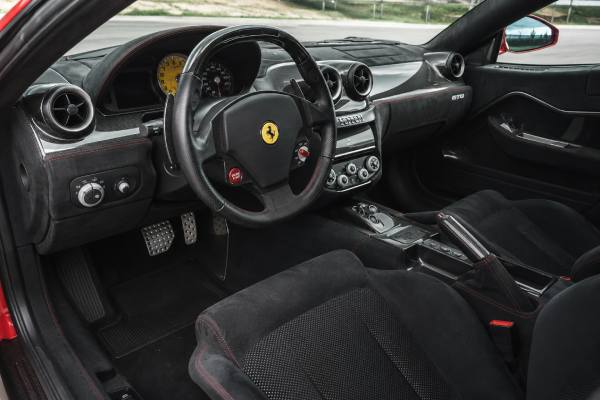
Inside, the GTO mixes Ferrari luxury with a track-minded mood. Alcantara, carbon fiber, racing seats, shift lights, and exposed performance details make it feel more serious than a normal GTB. The steering wheel carries key controls, including the manettino drive-mode selector, which changes the behavior of the gearbox, traction control, stability control, dampers, and throttle mapping.
The sound is one of the car’s defining traits. The V12 has a deep mechanical voice at lower rpm, then hardens into a metallic, high-rpm howl. The exhaust is not merely loud; it gives the car much of its emotional identity. Combined with the single-clutch shift action, the GTO feels more mechanical and dramatic than later dual-clutch Ferraris.
This is why some buyers prefer it even when later cars are objectively quicker. The 599 GTO does not hide its machinery. It makes the engine, gearbox, brakes, tires, and electronics part of the experience.
Driving Experience and Performance
The 599 GTO feels fast, wide, loud, and serious, with a driving character built around its V12 and sharp front-end response. It is more demanding than a modern dual-clutch Ferrari, but that is part of its appeal.
Acceleration is immediate once the engine is in its power band. At low and medium revs, the V12 has enough torque to move the car easily, but the GTO is not lazy. It wants rpm. The engine becomes more urgent above the midrange and feels most alive near the top. The 8,250 rpm power peak gives the driver a reason to hold gears, and the sound rewards doing so.
The F1 automated manual gearbox is central to the experience. It is not as smooth as a modern dual-clutch unit in traffic, and it can feel abrupt if driven without mechanical sympathy. Driven correctly, however, it is part of the theater. Lift slightly at the right moment or drive hard in the appropriate mode, and the shifts feel fast, physical, and memorable.
Steering is quick and direct, especially for a large front-engined car. The long hood and wide body never disappear completely, but the car feels more agile than its size suggests. The rear-biased balance and electronic traction systems help it put power down, though old tires, cold weather, or poor road surfaces can quickly expose the limits of a 661 hp rear-wheel-drive car.
The carbon-ceramic brakes are powerful and resistant to fade when healthy. On the road, they may need temperature before they feel their best, and pedal feel can vary depending on pad condition, rotor condition, and maintenance. A proper inspection of the brake system is essential before any serious driving or purchase.
Ride quality is firm but not unusable. The magnetorheological dampers help the car cope with normal roads, but the GTO is still more focused than a GTB. It can cruise, but it is not a quiet luxury GT in the old sense. Tire roar, exhaust sound, gearbox behavior, and the low seating position all remind the driver that this is the serious version.
Road versus track
On a flowing road, the GTO is at its best when the driver gives it space. It is not a small car, so narrow lanes can make it feel large. On wider mountain roads or fast open routes, the chassis starts to make sense. The car has real front-end bite, strong braking, and a V12 that makes every straight feel special.
On track, the GTO is capable but expensive to use properly. Tires, brakes, fluids, and heat management all matter. A car that has been tracked is not automatically bad, but it should have service records to match. A car that has been tracked hard on old tires, worn brakes, or deferred maintenance is a different risk entirely.
The GTO’s performance figures remain impressive:
| Measure | Figure |
|---|---|
| 0–100 km/h | 3.35 seconds |
| 0–200 km/h | 9.8 seconds |
| Top speed | Over 335 km/h / 208 mph |
| Fiorano lap time | About 1 minute 24 seconds |
The key point is that the 599 GTO is not just fast in a straight line. It was built to feel sharper, lighter, and more responsive than the GTB, while still keeping the front-V12 drama that defines Ferrari’s great grand touring berlinettas.
Reliability, Maintenance and Restoration
The 599 GTO is not fragile in the way an old carbureted exotic can be, but it is a complex, expensive limited Ferrari that needs specialist care. Maintenance history, correct storage, and proper use matter more than simple mileage.
The F140 V12 is generally respected, but that does not mean neglect is harmless. Old fluids, weak batteries, heat cycles, oil leaks, misfires, sensor faults, and deferred annual servicing can all create expensive problems. A car that has covered very few miles may still need belts, fluids, tires, batteries, seals, and careful recommissioning.
The F1 gearbox and clutch system deserve close attention. The gearbox itself can be durable when maintained, but clutch wear depends heavily on use. Slow maneuvering, hill starts, reversing, and stop-start traffic can wear the clutch faster than highway miles. A buyer should request a diagnostic readout showing clutch wear, gearbox fault history, and related system status.
Carbon-ceramic brakes are another major cost area. The rotors can last a long time in careful road use, but they are expensive if damaged or worn. Track use, incorrect pads, stone damage, heat cracking, and rough handling can change the picture. A visual inspection is not enough; a Ferrari specialist should measure and evaluate the system properly.
Common ownership concerns include:
- F1 clutch wear and actuator-related issues
- Carbon-ceramic brake rotor and pad condition
- Aging tires, even on low-mileage cars
- Battery drain and electrical faults from long storage
- Sticky interior switches and trim coating deterioration
- Suspension damper wear or warning lights
- Engine oil leaks or coolant seepage
- Exhaust valve or sensor issues
- TPMS faults
- Scraped front splitters and lower aero pieces
- Paintwork repairs from road rash or minor damage
- Heat-related wear around the engine bay
The battery is more important than many new owners expect. Modern Ferraris dislike weak voltage. A weak or repeatedly discharged battery can trigger confusing warning lights and control-module issues. Cars stored in collections should live on a correct battery conditioner, but even then the battery should be age-checked.
Service expectations
A 599 GTO should be serviced by a Ferrari dealer or a specialist who knows the platform. Annual servicing is normal even if mileage is low. Brake fluid, gearbox and F1 system checks, coolant condition, auxiliary belts, filters, tires, battery health, and diagnostic scans should be part of the ownership routine.
A sensible maintenance mindset includes:
- Annual inspection and fluid service based on time, not only mileage
- Brake fluid changes at proper intervals
- Regular battery testing and replacement when aged
- Tire replacement based on date code and condition
- Diagnostic scans before and after major services
- Clutch wear measurement
- Suspension and damper inspection
- Cooling-system pressure checks
- Paint protection and underside inspections
- Careful storage in a dry, climate-stable environment
Restoration is a different topic. A 599 GTO is modern enough that a full restoration should rarely be needed, but accident repair, paint correction, interior refinishing, and carbon-fiber replacement can be costly. Originality is valuable, so heavy cosmetic modification can hurt the car unless all original parts are retained and the changes are reversible.
For buyers, the best approach is simple: do not buy a 599 GTO on mileage and color alone. Buy the car on condition, records, inspection results, and authenticity.
Market Value and Buying Guide
The 599 GTO sits firmly in modern collectible Ferrari territory, with values strongly influenced by mileage, specification, originality, provenance, and recent auction momentum. Current public market data shows a wide spread because ultra-low-mileage cars can sell far above regularly driven examples.
As of 2026, market trackers and recent auction results show many 599 GTOs trading or being offered around the high six-figure to low seven-figure range in U.S. dollars, while exceptional ultra-low-mileage examples can reach much higher. This is not a normal used-car market. It is a collector market where two cars with the same badge can differ dramatically in value.
The strongest value factors are:
- Very low mileage with proof that storage was correct
- Desirable original color combination
- Complete books, tools, folio, charger, and accessories
- Ferrari dealer or recognized specialist service history
- Clean paintwork and no accident stories
- Ferrari Classiche certification or strong factory documentation
- Original interior condition
- Confirmed brake and clutch condition
- Rare but tasteful factory options
- Clear ownership history
- Market-specific desirability, especially U.S.-spec cars in the U.S.
Cars to approach carefully include those with missing service records, unclear import history, paintwork inconsistencies, incomplete accessories, deferred maintenance, unknown clutch wear, old tires, or signs of track use without matching maintenance. A car that looks cheap may not be cheap after brakes, clutch, tires, sticky interior work, fluids, and sorting.
Pre-purchase inspection checklist
A proper inspection should be performed by someone who knows modern V12 Ferraris. The checklist should include:
| Area | What to verify |
|---|---|
| Identity | VIN, build data, model authenticity, market specification |
| Engine | Leaks, misfires, service history, cooling condition, diagnostic faults |
| Gearbox | F1 operation, clutch wear reading, actuator function, shift quality |
| Brakes | Carbon-ceramic rotor condition, pad life, cracking, service records |
| Suspension | Damper function, warning lights, bushings, alignment, tire wear |
| Body | Paint depth, panel fit, carbon trim, underside scrapes, accident evidence |
| Interior | Sticky switches, Alcantara wear, carbon trim, seat bolsters, electronics |
| Documents | Books, tools, service invoices, warranty history, Classiche records |
The safest examples are usually not the cheapest ones. They are the cars with no mystery. A properly documented GTO with healthy brakes, low clutch wear, recent tires, current service, and complete accessories may cost more upfront but can be easier to own and easier to sell later.
For long-term collectability, the 599 GTO has several strengths: limited production, a historic badge, a naturally aspirated V12, a clear link to the 599XX, and a place near the end of the single-clutch Ferrari supercar era. Its risks are also clear: high parts costs, specialist labor, carbon-ceramic brake expense, electronics age, and market sensitivity to originality.
A good 599 GTO should feel special before it even moves, but the paperwork should be just as convincing as the sound. In this segment, the right car is not only the one with the best color or lowest odometer reading. It is the car whose story, condition, and maintenance can survive close inspection.
References
- Ferrari 599 GTO (2010) 2010 (Manufacturer Specifications)
- 2011 Ferrari 599 GTO | DriveClean 2011 (Fuel Economy Data)
- Check for Recalls: Vehicle, Car Seat, Tire, Equipment | NHTSA 2026 (Recall Database)
- Ferrari 599 GTO Market – CLASSIC.COM 2026 (Market Data)
- 2011 Ferrari 599 GTO | Monterey 2025 | RM Sotheby’s 2025 (Auction Listing)
Disclaimer
This article is for informational purposes only and is not a substitute for professional diagnosis, repair, appraisal, or pre-purchase inspection. Specifications, torque values, service intervals, procedures, recall status, and equipment can vary by VIN, market, model year, and individual configuration. Always verify details against official Ferrari service documentation and have any specific car inspected by a qualified Ferrari specialist.
If you found this guide useful, please consider sharing it on Facebook, X/Twitter, or your favorite automotive community to support our work.