

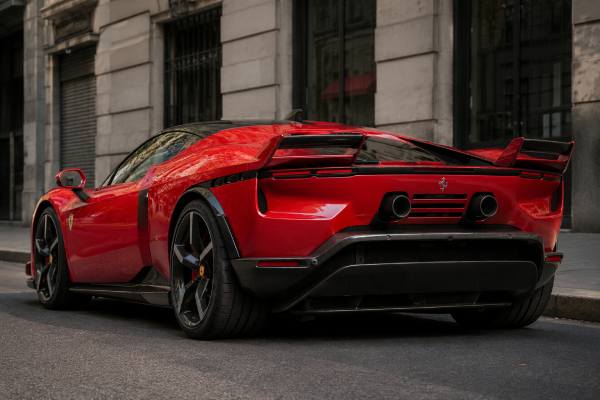

The Ferrari 849 Testarossa is the mid-rear-engine plug-in hybrid berlinetta that replaces the SF90 Stradale at the top of Ferrari’s regular production sports-car range. It brings back the Testarossa name, but not as a retro V12 tribute. Instead, it uses a heavily revised F154FC 4.0-liter twin-turbo V8, three electric motors, all-wheel drive, active aerodynamics, and Ferrari’s latest control software to create one of the most technically dense road Ferraris yet.
Ferrari quotes 1050 cv of total system output, which is often rounded in English-language coverage as 1050 hp, though it is about 1036 mechanical horsepower. The important point is not only the number. The 849 Testarossa is designed to make hypercar-level acceleration repeatable, usable, and manageable through hybrid torque, brake-by-wire control, e4WD traction, and a chassis tuned for both road and track use.
Quick Take
The 849 Testarossa’s strongest appeal is its mix of historic Ferrari naming, extreme V8 hybrid output, and modern control technology in a car that is still part of the main production range rather than a numbered limited series. Its identity is tied to the transition from the SF90 era into a more mature plug-in hybrid Ferrari generation, with more power, more downforce, better brake control, and a more ergonomic cabin. The caution is complexity: battery health, software status, carbon-ceramic brakes, tires, lift systems, option choices, and official service history will matter far more than on a simpler Ferrari. For buyers, the most important factor is not just allocation or mileage, but whether the car has the right specification, complete dealer documentation, and continued coverage through Ferrari’s hybrid warranty and maintenance programs.
Table of Contents
- Why the 849 Testarossa Matters
- Powertrain, Chassis, and Key Specs
- Variants, Production, and Factory Options
- Design, Aero, and Special Engineering
- Driving Character and Performance
- Maintenance, Reliability, and Ownership Risk
- Market Value and Buying Advice
Why the 849 Testarossa Matters
The 849 Testarossa matters because it turns Ferrari’s plug-in hybrid flagship from a breakthrough idea into a more developed formula. The SF90 Stradale proved that Ferrari could build a range-topping road car around a V8 hybrid system; the 849 Testarossa refines that idea with more power, more cooling, more downforce, and a stronger focus on driver confidence.
The name carries real weight. “Testa Rossa” first referred to red-painted cylinder heads on Ferrari racing engines in the 1950s. Later, the 1984 Testarossa became one of the most recognizable road cars of its era. The 849 Testarossa does not copy that flat-12 icon. It uses the name to connect Ferrari’s racing past with its hybrid present.
The model code F173M also gives a clue to its role. This is not a clean-sheet hypercar like the F80, and it is not a lower-series V6 hybrid like the 296 GTB. It sits as the direct successor to the SF90 Stradale, sharing the same broad concept: a mid-rear twin-turbo V8 supported by three electric motors and on-demand all-wheel drive.
Ferrari’s strategy is clear. The 849 Testarossa is meant to offer extreme performance without moving the regular flagship car to a V12 or full electric drivetrain. It keeps a combustion engine at the center of the experience, but uses electrification where it helps most: launch traction, torque fill, front-axle vectoring, low-speed electric running, and sharper control of the car near the limit.
For collectors and owners, its significance will depend on three things:
- It is the first modern Ferrari road car to revive the Testarossa name.
- It replaces the SF90 Stradale, Ferrari’s first plug-in hybrid production supercar.
- It introduces Ferrari’s latest electronic control stack, including FIVE and ABS Evo, into the regular flagship range.
It is also important that the 849 Testarossa is not presented as a numbered limited edition. That does not make it common. Ferrari allocation, specification, market timing, and production pacing will still keep supply controlled. But its long-term collectability will probably be shaped less by total rarity and more by exact configuration, early build status, Assetto Fiorano specification, color choice, and documented ownership history.
Powertrain, Chassis, and Key Specs
The 849 Testarossa uses a 3990 cc F154FC twin-turbocharged V8 combined with three electric motors for a total output of 1050 cv. Its official dry weight figure of 1570 kg applies to a car with optional lightweight content, so buyers should read weight figures carefully when comparing specifications.
Hybrid powertrain
The combustion engine is the latest development of Ferrari’s F154 V8 family. In the 849 Testarossa, it uses dry-sump lubrication, new turbochargers, revised cylinder heads, updated intake and exhaust systems, titanium fasteners, and other weight-saving measures. The engine alone produces 830 cv at 7500 rpm and 842 Nm at 6500 rpm, with an 8300 rpm maximum engine speed.
The electric side of the powertrain has three motors. Two are on the front axle, forming Ferrari’s RAC-e system for electric all-wheel drive and torque vectoring. The third electric motor sits at the rear and works with the engine and gearbox. The battery is a 7.45 kWh lithium-ion unit mounted low in the car to help the center of gravity and weight balance.
| Item | Specification |
|---|---|
| Model code | F173M |
| Engine code | F154FC |
| Engine | 3990 cc twin-turbo V8, dry sump |
| Combustion-engine output | 830 cv at 7500 rpm |
| Combustion-engine torque | 842 Nm at 6500 rpm |
| Total hybrid output | 1050 cv |
| Battery capacity | 7.45 kWh |
| Electric-only range | Up to 25 km in eDrive |
| Transmission | 8-speed F1 dual-clutch |
| Drivetrain | Mid-rear engine, plug-in hybrid, on-demand all-wheel drive |
The four main hybrid modes are eDrive, Hybrid, Performance, and Qualify. eDrive allows quiet short-distance electric running. Hybrid mode balances efficiency and response. Performance keeps the system ready for spirited driving. Qualify prioritizes maximum power delivery for short, hard use.
Dimensions, tires, brakes, and performance
The official figures place the 849 Testarossa among the quickest regular production Ferraris. Ferrari quotes 0–100 km/h in under 2.3 seconds, 0–200 km/h in 6.35 seconds, and a top speed above 330 km/h. The Fiorano lap time is quoted at 1 minute 17.500 seconds.
| Item | Official figure |
|---|---|
| Length | 4718 mm |
| Width | 2304 mm |
| Height | 1225 mm |
| Wheelbase | 2650 mm |
| Dry weight | 1570 kg with optional lightweight content |
| Weight distribution | 45% front / 55% rear |
| Front tires | 265/35 R20 |
| Rear tires | 325/30 R20 |
| Fuel capacity | 68 liters |
| Luggage capacity | 74 liters |
| 0–100 km/h | Under 2.3 seconds |
| 0–200 km/h | 6.35 seconds |
| Top speed | Over 330 km/h |
| Fiorano lap time | 1’17.500 |
The braking hardware is equally serious, with large carbon-ceramic discs, brake-by-wire control, ABS Evo, and cooling changes aimed at repeated high-speed use. Ferrari also quotes 100–0 km/h braking in 28.5 meters and 200–0 km/h braking in 108 meters, which shows how much of the car’s performance is tied to braking stability, not only acceleration.
Variants, Production, and Factory Options
The 849 Testarossa family starts with the berlinetta and Spider, with Assetto Fiorano available as a more focused factory configuration. At launch, the car is not described as a numbered limited edition, so desirability will depend heavily on allocation, specification, mileage, condition, and documentation.
Berlinetta and Spider
The closed berlinetta is the purest expression of the model. It offers the lowest body complexity, the clearest aerodynamic package, and the specification most likely to attract buyers who plan to use the car on track.
The 849 Testarossa Spider adds a retractable hardtop while keeping the same basic hybrid powertrain. It is aimed at buyers who want open-air use without moving away from the top Ferrari PHEV platform. The Spider will usually appeal to owners who prioritize touring, visual drama, and occasional roof-down driving. The coupe will likely remain the sharper choice for buyers focused on weight, rigidity, and long-term track use.
Assetto Fiorano
Assetto Fiorano is the most important performance option. It is not just a stripe package. It groups hardware that cannot be ordered separately and is designed to improve dynamics, aerodynamics, and weight.
Key Assetto Fiorano features include:
- About 30 kg of weight reduction through carbon fiber and titanium content.
- A lightweight tubular seat trimmed in black Alcantara, saving about 18 kg versus the standard seats.
- 20-inch carbon-fiber wheels that reduce unsprung mass.
- More aggressive front aero with extra vortex generators.
- Rear twin wings replacing the standard twin-tail elements.
- Rigid Multimatic suspension for the most focused setup.
- Michelin Pilot Sport Cup 2 tires developed for the package.
- Exclusive livery options in Bianco Cervino or Rosso Corsa with a gradient double-stripe theme.
A useful detail for real buyers: Ferrari allows Assetto Fiorano with a front lift system, but choosing the lift retains semi-active Magneride suspension rather than the fixed Multimatic setup. That means an owner must choose between maximum track focus and better real-world clearance.
Personalization and specification sensitivity
Ferrari buyers can personalize the 849 Testarossa extensively. The important new exterior colors include Rosso Fiammante and Giallo Ambra. The cabin also introduces a Giallo Siena Alcantara trim designed to pair with Giallo Ambra paint.
Options that will likely matter most in the secondary market include:
- Assetto Fiorano package.
- Carbon-fiber wheels.
- Racing seats versus comfort seats.
- Front suspension lift.
- Exterior carbon-fiber details.
- Special paint or Tailor Made specification.
- Passenger display and connectivity features.
- Factory livery or historically relevant color combinations.
- Complete original books, tools, charging equipment, window sticker, and build documentation.
Collectors should avoid assuming that the most expensive specification is automatically the best. A heavily optioned Spider in a fashionable color may suit one buyer perfectly, while a lightly used Assetto Fiorano berlinetta in a rare launch color may attract a more focused enthusiast. The best specification is the one that matches the car’s intended use and has clear factory documentation.
Design, Aero, and Special Engineering
The 849 Testarossa’s design is not a nostalgic remake; it is a technical shape built around cooling, downforce, and hybrid packaging. Its surfaces refer to Ferrari history, but the real story is how air is moved through the body, brakes, intercoolers, front floor, rear deck, and active spoiler.
Ferrari’s Styling Centre, under Flavio Manzoni, gave the car a sharper and more architectural look than the SF90. The nose has a horizontal graphic that connects it visually with newer Ferraris such as the 12Cilindri and F80. The rear uses a twin-tail idea inspired by Ferrari sports prototypes from the 1970s, especially the 512 S and 512 M era.
Aerodynamics and cooling
Ferrari quotes 415 kg of downforce at 250 km/h, an increase of 25 kg over the SF90 Stradale. Cooling performance also improves by 15 percent, which matters because the car has to manage a more powerful V8, electric motors, inverters, brakes, and a high-voltage battery.
The front floor is especially important. Ferrari says it is responsible for 35 percent of the total load, with three pairs of vortex generators helping manage airflow under the car. The active rear spoiler can move from Low Drag to High Downforce in under one second and can contribute up to 100 kg of downforce at 250 km/h.
The side bodywork is not just styling. Air is directed toward larger side intercoolers, rear brake ducts, and engine intake paths. The doors and side intakes are shaped to feed the lower part of the intercooler, while the rear arches and bumper outlets help extract hot air from the engine bay and wheel areas.
Electronics as engineering hardware
The most interesting special feature may be Ferrari’s FIVE system, short for Ferrari Integrated Vehicle Estimator. It creates a real-time digital model of the car using sensor data. That allows the control systems to estimate values that are difficult to measure directly, such as vehicle speed and attitude angle, then use those estimates to improve traction control, e-differential behavior, e4WD delivery, and ABS Evo braking.
This matters because a 1050 cv plug-in hybrid all-wheel-drive Ferrari is too fast to rely only on simple mechanical balance. The electronics do not replace the chassis. They allow the chassis, tires, brakes, motors, and engine to work as one system.
Cabin and controls
The interior moves away from some of the touch-heavy habits of recent Ferraris by bringing back more mechanical steering-wheel controls, including a physical start button. The cabin layout combines a horizontal berlinetta dashboard with a more driver-focused cockpit. The central “sail” and gated-style control area take influence from the F80.
Comfort and usability are also part of the design. Ferrari offers comfort seats and carbon-fiber racing seats, smartphone wireless charging, Apple CarPlay, Android Auto, and MyFerrari Connect for remote vehicle monitoring. None of that turns the 849 Testarossa into a practical daily car, but it does make it more usable than the raw performance figures suggest.
Driving Character and Performance
The 849 Testarossa is designed to feel brutally fast but not wild or loose in the old-fashioned sense. Its performance comes from combustion power, electric torque, front-axle vectoring, fast dual-clutch shifts, active aero, and control software that tries to make huge speed repeatable.
The V8 remains central to the character. Ferrari worked on exhaust flow, sound quality, shift calibration, and high-rpm response so the car would not feel like a silent electric assist machine with a combustion engine added. The flat-plane-crank V8, 8300 rpm limit, and revised exhaust are all meant to preserve a Ferrari sound signature, even with turbocharging and emissions equipment.
Acceleration and throttle response
The headline numbers are extreme: under 2.3 seconds to 100 km/h and 6.35 seconds to 200 km/h. But the more important driving point is how the hybrid system fills gaps. The electric motors help cover turbo response, support the front axle during launch, and help pull the car out of corners with less waiting than a pure turbocharged engine would allow.
In eDrive, the car can move quietly for short distances. In Hybrid, it can behave more calmly around town. Performance and Qualify modes keep the battery and motor strategy focused on response and power. Qualify is the serious short-burst mode, best understood as a maximum-attack setting rather than a normal road mode.
Steering, braking, and cornering
The 849 Testarossa should feel more controlled than its power figure suggests because Ferrari has focused heavily on braking consistency and lateral response. ABS Evo works with FIVE to improve wheel-slip targets, brake force distribution, and repeatability. That matters on track, where a very fast car can feel inconsistent if braking response changes after a few hard laps.
The chassis changes include revised spring and damper tuning, new tire development, and a 10 percent reduction in roll gradient. That should make the car feel flatter and more immediate than the SF90 while still relying on tire temperature and correct mode selection. Like most modern high-performance Ferraris, it will reward a driver who understands the Manettino settings rather than someone who simply floors the throttle.
Road and track personality
On the road, the car’s width, low seating position, limited luggage space, and tire sensitivity will define its limits more than its speed. The front lift option is important for owners who deal with steep driveways, parking ramps, or rough urban roads. The Spider will add drama and open-air enjoyment, but the berlinetta remains the cleaner choice for serious performance driving.
On track, the car’s strengths should be acceleration, braking stability, traction out of corners, and aero confidence at high speed. The main constraint will be consumables. Tires, brake discs, brake pads, fluids, and cooling cycles will matter. A poorly warmed-up tire or a tired carbon-ceramic brake system can change the feel of a car like this dramatically.
Maintenance, Reliability, and Ownership Risk
The 849 Testarossa is too new for a mature reliability record, so ownership risk should be judged through its complexity and service requirements rather than forum folklore. The safest approach is to treat it as a high-voltage, carbon-ceramic-braked, software-dependent Ferrari that must stay inside the official maintenance ecosystem.
Ferrari includes its seven-year Genuine Maintenance program on the 849 Testarossa. That is important because routine servicing, original parts, diagnostics, and dealer records will strongly affect long-term value. The car also benefits from Ferrari’s hybrid warranty structure, with additional Warranty Extension Hybrid and Power Hybrid programs available for owners who want longer protection.
Areas to monitor closely
The most important ownership checks are not the same as on an ordinary used car. Buyers and owners should focus on systems that are expensive, difficult to inspect casually, or essential to value.
Key inspection areas include:
- High-voltage battery state of health and charging behavior.
- Hybrid motor and inverter fault history.
- Software version and dealer update record.
- Brake-by-wire system status.
- Carbon-ceramic brake disc condition and pad wear.
- Tire age, tire type, tread depth, and heat-cycle history.
- Front lift operation, if equipped.
- Suspension dampers, especially if the car has track use.
- Cooling-system leaks, blocked ducts, or damaged aero surfaces.
- Underbody, splitter, diffuser, and carbon-fiber impact damage.
- Paint-meter readings and evidence of repaired accident damage.
- Complete Ferrari dealer history and warranty transfer status.
Because the car uses extensive aero and cooling management, even small damage can matter. A cracked duct, damaged underfloor panel, or poorly repaired bumper may affect more than appearance. It can influence cooling, brake temperature, and high-speed stability.
Track use and consumables
Track use is not a problem by itself. Ferrari built the car for serious performance driving. The problem is undocumented track use combined with worn consumables and no inspection record.
A buyer should ask for:
- Service invoices before and after track events.
- Brake wear measurements.
- Tire replacement records.
- Alignment history.
- Evidence of fluid changes under severe-use conditions.
- Dealer diagnostic scans showing no unresolved hybrid or chassis faults.
Carbon-ceramic brakes can last a long time in gentle road use, but hard track use changes the equation. Replacement costs can be very high, and visual inspection alone is not enough. The same is true of high-performance tires. A low-mile car on old, heat-cycled tires may drive worse than a higher-mile car on fresh, correct tires.
Originality versus upgrades
For long-term value, factory originality is the safer path. Paint protection film, reversible cosmetic protection, and Ferrari-approved accessories are usually less concerning than aftermarket exhausts, ECU tuning, lowered suspension, non-factory wheels, or modified hybrid software.
The 849 Testarossa’s systems are tightly integrated. Changing one part can affect warranty status, emissions compliance, battery strategy, drivability, and resale confidence. The best examples will remain close to their original factory specification, with every update and service recorded by an authorized Ferrari dealer.
Market Value and Buying Advice
The 849 Testarossa’s market is still forming, so early values will be driven by allocation, delivery timing, options, and buyer demand rather than a deep used-sales history. European launch pricing was reported around €460,000 for the coupe and €500,000 for the Spider, but real transaction prices will vary widely by market, tax, import duty, options, and availability.
This is not a car to buy by base price. Options can change the total cost dramatically, and the specification can change future desirability just as much as mileage. A carefully chosen Assetto Fiorano coupe may appeal to a different buyer pool than a highly personalized Spider. Both can be desirable, but for different reasons.
What will drive value
Long-term value will likely depend on the same factors that shape modern collectible Ferraris, with extra attention to hybrid condition.
The strongest value factors are likely to be:
- First-year or early-production status with clear documentation.
- Assetto Fiorano specification on cars aimed at performance buyers.
- Desirable launch or special-order colors.
- Rare but tasteful Tailor Made configuration.
- Low mileage with regular use, not long-term neglect.
- Complete authorized Ferrari service history.
- Active warranty or transferable hybrid coverage.
- No accident history or structural carbon-fiber repair.
- Original paint where possible.
- Complete accessories, charger, books, tools, and factory paperwork.
Buyers should be cautious with cars that have very high option prices but poor color harmony, unclear service history, aftermarket modifications, or signs of repeated hard use without documentation. A Ferrari like this can look perfect in photos while hiding expensive issues in brakes, tires, battery condition, underbody panels, or software history.
Pre-purchase inspection checklist
A proper inspection should be done by an authorized Ferrari dealer or a specialist with current diagnostic access. This is not a car for a basic visual inspection.
| Area | What to verify |
|---|---|
| Identity | VIN, build sheet, model code, original specification, market version |
| Hybrid system | Battery health, charging function, fault codes, warranty status |
| Service history | Dealer records, updates, annual checks, maintenance program compliance |
| Brakes | Carbon-ceramic disc condition, pad life, brake-by-wire operation |
| Tires | Correct tire model, date codes, tread, heat-cycle wear, alignment signs |
| Body and aero | Splitter, diffuser, ducts, underfloor, carbon trim, paintwork, impact evidence |
| Options | Assetto Fiorano content, lift system, seats, wheels, carbon, factory livery |
| Electronics | Infotainment, MyFerrari Connect, sensors, FIVE/ABS-related stored faults |
The best car to buy is the one that has the clearest story. A delivery-mile car with no use may be attractive to collectors, but a lightly driven car with perfect service history can be a better ownership prospect. For drivers, the ideal example is not necessarily the lowest-mile car; it is the car with the right options, fresh tires, clean diagnostics, and no unresolved warranty questions.
Long-term outlook
The 849 Testarossa has strong ingredients for long-term attention: a revived historic name, a record-setting production Ferrari output figure, a direct link to the SF90 lineage, and a major role in Ferrari’s hybrid era. Its challenge is that modern high-performance cars are complex and specification-sensitive. Future buyers will not simply ask whether it is a Testarossa. They will ask which version, which options, which color, which warranty, which service history, and how the hybrid system has aged.
For an owner who wants to drive it, the 849 Testarossa should be seen as a serious machine that rewards disciplined maintenance. For a collector, it should be bought with the same care as a limited-production Ferrari, even if it is not officially numbered. Originality, paperwork, condition, and Ferrari network support will be the difference between a merely expensive car and a truly desirable one.
References
- Ferrari 849 Testarossa – Ferrari.com 2025
- 849 Testarossa 2025 (Press Release)
- Ferrari 849 Testarossa Spider – Ferrari.com 2025
- Warranties And Official Ferrari Maintenance 2026
- Ferrari evokes spirit of 1980s with new 849 Testarossa hybrid 2025
Disclaimer
This article is for informational purposes only and is not a substitute for professional diagnosis, repair advice, or a Ferrari pre-purchase inspection. Specifications, torque values, service intervals, software procedures, warranty terms, and repair methods can vary by VIN, market, equipment, and production update. Always verify details against official Ferrari service documentation and an authorized Ferrari dealer or qualified specialist.
If this guide helped you, please consider sharing it on Facebook, X/Twitter, or your preferred car community to support our work.