
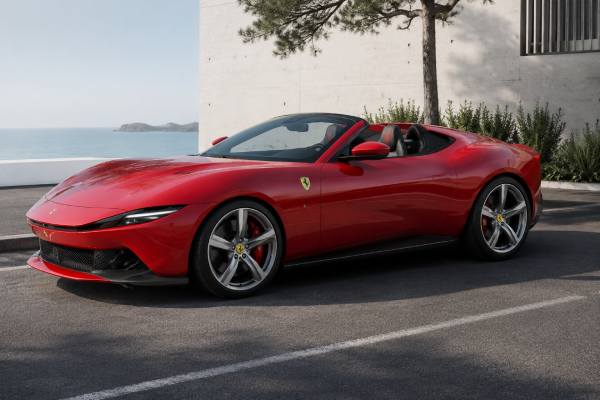

The Ferrari Amalfi Spider is the open-top grand tourer version of Ferrari’s F169M Amalfi family, using the latest development of the F154 twin-turbo V8 in a front-mid-engine, rear-wheel-drive layout. It replaces the Roma Spider as Ferrari’s elegant 2+2 soft-top GT, but it is not just a styling update. The Amalfi Spider brings sharper engine calibration, more modern driver-assistance electronics, active aerodynamics, a more usable cabin control layout, and a fabric roof designed to keep the car’s clean fastback profile intact.
This is a modern Ferrari for buyers who want speed, theatre, and long-distance usability rather than a stripped-out track special. It sits below Ferrari’s more extreme mid-engine and flagship models, yet its 640 hp output, 320 km/h top speed, and sophisticated chassis systems make it a serious performance car. Its appeal is partly technical and partly emotional: a compact front-engined V8 Ferrari with an open roof, proper grand-touring manners, and enough usability to be driven often.
Quick Take
The Ferrari Amalfi Spider’s strongest appeal is its blend of open-air GT elegance and serious V8 performance: it keeps the front-mid-engine Ferrari character, adds a fast-operating fabric roof, and still delivers the acceleration and top-speed figures expected from Maranello’s modern twin-turbo V8 cars. Its main identity is as the Roma Spider’s more polished successor, with improved controls, sharper electronics, active aero, and the F154 BH 3.9-litre V8 producing 640 hp. The key tradeoff is that the Spider adds weight and complexity compared with the coupé, so buyers should focus on roof operation, carbon-ceramic brake condition, tire age, service-plan history, factory options, and warranty coverage rather than simply chasing the lowest-mileage car.
Table of Contents
- Grand Touring Role and Model Significance
- F154 BH Engine, Chassis, and Specifications
- Production, Variants, and Factory Options
- Design, Engineering, and Special Features
- Driving Experience and Real Performance
- Reliability, Maintenance, and Repair Reality
- Market Value and Buying Guide
Grand Touring Role and Model Significance
The Amalfi Spider matters because it continues Ferrari’s modern front-engined V8 GT line at a time when much of the supercar world is moving toward heavier hybrid systems, sharper track bias, and more complex powertrains. It is a petrol V8 Ferrari with the roof down, compact 2+2 packaging, and a clear brief: make high performance feel elegant, usable, and emotional.
The F169M Amalfi family succeeds the Ferrari Roma, which itself revived the idea of a cleaner, more restrained Ferrari grand tourer. The Roma was admired for its shape and balance, but some owners and reviewers criticised parts of its haptic-control-heavy interior. The Amalfi responds directly to that criticism. The Spider version carries the same more mature cabin philosophy into a convertible body, with a greater emphasis on physical controls, easier daily interaction, and less distraction.
The Amalfi Spider was introduced as the open version of the Amalfi coupé and takes the place of the Roma Spider in Ferrari’s regular-production range. It is not a limited-edition collector special in the way an Icona or track-focused special series Ferrari might be. Its importance is different. It is the front door to modern Ferrari open-top V8 ownership for many buyers, especially those who want a car that can handle city driving, long weekends, coastal roads, and occasional fast road use without feeling like a race car with number plates.
Ferrari’s modern GT line has always had a slightly different purpose from its mid-engine cars. A 296 GTB, 296 GTS, or 849 Testarossa is about maximum performance technology and sharper supercar drama. The Amalfi Spider is about speed with polish. It offers the classic Ferrari idea of a long bonnet, low seating position, rear drive, and a responsive engine, but with modern electronics helping the driver manage its power.
The car also has historical resonance. Ferrari has a long tradition of front-engined open cars, from early V12 spiders and California models to the Portofino and Roma Spider. The Amalfi Spider belongs to that softer-edged but still very fast side of the brand. It is not trying to be a raw 458 Speciale A or a lightweight track car. It is closer in spirit to a refined open GT that can cover distance quickly and make ordinary drives feel special.
For collectors, its significance will depend on how the model ages. Early examples with strong specifications, desirable colours, careful ownership, complete records, and clean factory options will be more attractive than heavily used, oddly specified, or modified cars. As with most regular-production modern Ferraris, long-term value will not be driven only by production numbers. It will be shaped by condition, provenance, originality, option selection, service continuity, and whether later Ferrari models make the non-hybrid V8 Spider formula feel more desirable.
F154 BH Engine, Chassis, and Specifications
The Amalfi Spider uses Ferrari’s 3.9-litre twin-turbocharged F154 BH V8, tuned for 640 hp at 7,500 rpm and 760 Nm of torque from 3,000 to 5,750 rpm. The headline is simple: this is a front-mid-mounted V8 Spider with supercar-level performance, but its technical package is tuned around grand-touring control rather than track-only aggression.
Ferrari’s European material often uses “cv” or metric horsepower, while some markets report the output as about 631 bhp. For this guide, the model is treated by its headline Ferrari figure of 640 hp, matching the vehicle identity above.
| Item | Ferrari Amalfi Spider specification |
|---|---|
| Engine code | F154 BH |
| Engine layout | 90-degree twin-turbocharged V8 |
| Displacement | 3,855 cc |
| Bore x stroke | 86.5 mm x 82.0 mm |
| Maximum power | 640 hp at 7,500 rpm |
| Maximum torque | 760 Nm from 3,000–5,750 rpm |
| Maximum engine speed | 7,600 rpm |
| Compression ratio | 9.4:1 |
| Transmission | 8-speed dual-clutch F1 DCT |
| Drive layout | Front-mid-engine, rear-wheel drive |
The engine’s character is shaped by turbo response, electronic boost control, and Ferrari’s flat-plane-crank V8 architecture. Compared with older naturally aspirated Ferraris, it has much more low- and mid-range torque. Compared with softer luxury GT engines, it still feels sharp near the top of the rev range. That dual character is central to the Amalfi Spider’s appeal.
The chassis uses an aluminium structure derived from Ferrari’s modern front-engined GT architecture. The Spider’s roof mechanism and open body require extra reinforcement compared with the coupé, which explains the higher dry weight. Ferrari quotes a dry weight of 1,556 kg when specified with lightweight options, with a 48:52 front-to-rear weight distribution. That rear bias helps traction and corner-exit stability, especially because all 760 Nm goes to the rear axle.
| Item | Specification |
|---|---|
| Length | 4,660 mm |
| Width | 1,974 mm |
| Height | 1,305 mm |
| Wheelbase | 2,670 mm |
| Front track | 1,652 mm |
| Rear track | 1,679 mm |
| Dry weight | 1,556 kg |
| Weight distribution | 48% front / 52% rear |
| Fuel tank capacity | 80 litres |
| Boot capacity | 255 litres roof closed / 172 litres roof open |
The suspension and braking systems are also central to the car’s identity. The Amalfi Spider uses magnetorheological adaptive dampers, electric power steering, carbon-ceramic brakes, brake-by-wire hardware, and Ferrari’s latest integrated stability systems. These include Side Slip Control 6.1, E-Diff3, F1-Trac, ABS Evo, and related body-motion control logic. In plain language, the car constantly coordinates steering, braking, torque delivery, damping, differential locking, and traction management to make the car feel more natural near the limit.
| Item | Specification |
|---|---|
| 0–100 km/h | 3.3 seconds |
| 0–200 km/h | 9.4 seconds |
| Top speed | 320 km/h |
| Front tires | 245/35 R20 |
| Rear tires | 285/35 R20 |
| Brakes | Carbon-ceramic discs with brake-by-wire and ABS Evo |
| Roof operation | 13.5 seconds, operable up to 60 km/h |
The figures put the Amalfi Spider in a rare space. It is not the lightest or most extreme Ferrari, but a 3.3-second 0–100 km/h time and 320 km/h top speed make it far quicker than a traditional luxury convertible. It also stays close to the coupé’s performance despite the weight penalty of the folding roof and body strengthening.
Production, Variants, and Factory Options
The Amalfi Spider is the convertible member of the F169M Amalfi line, offered alongside the coupé rather than as a separate limited model. The key identification points are its soft-top roof, 2+2 cabin layout, F154 BH V8, 8-speed dual-clutch transmission, and modernized Amalfi front and rear design treatment.
As a regular-production Ferrari, exact long-term production totals will depend on demand, market allocation, emissions rules, and the life cycle of the Amalfi family. Early cars will be important to collectors mainly if they combine desirable specification, low ownership complexity, clean paintwork, no accident history, and complete dealer documentation.
The main variants are straightforward:
- Amalfi coupé: fixed-roof GT body, lighter weight, same general powertrain family.
- Amalfi Spider: fabric soft-top body, added chassis reinforcement, lower boot capacity with the roof open, and open-air driving character.
- Market-specific cars: equipment, lighting, emissions calibration, safety equipment, and certification details can vary by region.
- Tailor Made or heavily personalized examples: potentially more valuable when tastefully specified, but harder to value if the colour or trim choices are unusual.
Factory options will matter. On modern Ferraris, two cars with the same base model can feel very different because of paint, wheel, carbon-fibre, interior, audio, driver-assistance, and personalization choices. A highly optioned car may have a much higher original invoice, but not every option returns its cost on resale.
The most important option areas for buyers are:
- Exterior colour, especially launch colours, historic Ferrari shades, and elegant metallics that suit the Amalfi’s GT shape.
- Roof colour and fabric choice, because the Spider’s roof is a major visual feature.
- Wheels and tire specification, which affect stance, ride, replacement cost, and resale appeal.
- Carbon-fibre exterior trim, which can increase visual drama but may make repair costs higher after minor damage.
- Interior leather, contrast stitching, seat style, carbon trim, and passenger display.
- Front suspension lift, if offered in the buyer’s market, because it can be valuable for urban use.
- Premium audio and comfort options, especially for buyers using the car as a true GT.
- Driver-assistance equipment, where available, because calibration and sensor repairs can be costly after bumper or windshield work.
Originality and documentation
For a modern Ferrari, originality means more than “no modifications.” A strong car should have its factory build sheet, original specification, books, service invoices, recall and campaign records, warranty information, spare keys, battery tender, tool kit, and clear ownership history. Cars that remain within Ferrari’s authorized service network are usually easier to sell.
Aftermarket exhausts, lowered suspension, non-factory wheels, paint protection film of unknown quality, and non-original carbon trim can reduce value unless the original parts are included and the work is reversible. Some buyers like tasteful upgrades, but Ferrari collectors usually pay more confidently for cars that can be verified as factory-correct.
Design, Engineering, and Special Features
The Amalfi Spider’s design is built around clean surfaces, a long bonnet, a compact rear deck, and a roof system that does not spoil the car’s GT proportions when closed. Its engineering focus is not just speed; it is the ability to combine open-top comfort, high-speed stability, and everyday usability in a shape that still looks distinctly Ferrari.
The exterior design moves away from the Roma’s more delicate front treatment toward a sharper, more horizontal look. The nose is cleaner and more technical, with lighting and air-management elements integrated into a wider visual graphic. The body sides stay relatively pure, avoiding excessive vents or decorative cuts. That restraint is important because the Amalfi Spider is meant to look elegant rather than aggressive.
The fabric soft top is one of the car’s defining features. It opens or closes in 13.5 seconds and can be operated while moving at up to 60 km/h. That matters in real use. A driver can raise the roof when weather changes without needing to stop immediately, and the car remains more practical on long trips. When folded, the roof packaging is compact enough to preserve useful luggage room for a weekend away.
The roof is also designed as a premium component, not a simple cloth cover. It uses a multi-layer construction aimed at reducing noise and heat transfer. That gives the car a more refined character with the roof up, closer to a closed GT than an old-style convertible. Roof colour and material choices also become part of the car’s specification identity.
Aerodynamics are handled through both fixed body shaping and an active rear spoiler. The rear spoiler can work in different positions, balancing low drag with added downforce when the car is driven harder. In high-downforce mode, the system can add meaningful rear stability at speed without turning the car into a visually winged track special. This is a typical modern Ferrari solution: hide the aerodynamic work until it is needed.
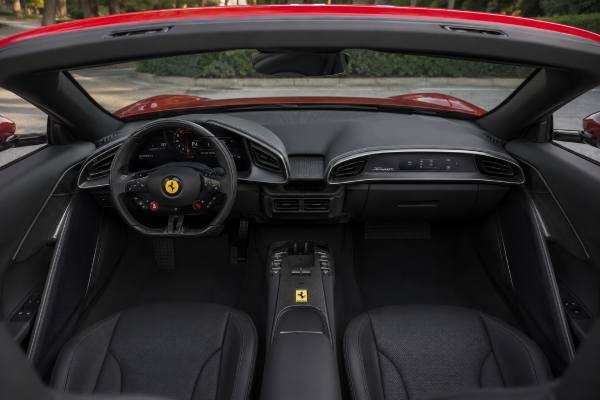
The cockpit reflects a major usability improvement over some earlier Ferrari interiors. The driver gets a digital instrument display, a central touchscreen, and an available passenger display, but the key story is the return of more physical controls on the steering wheel. The start button and main driving controls are easier to use by feel, which matters in a fast car. Touch-sensitive controls may look futuristic, but physical controls are often better when the driver is focusing on road position, braking points, and traffic.
The rear seats are best viewed honestly. They are part of the 2+2 identity, but they are not generous adult seats. They are useful for small children, soft bags, jackets, or extra cabin storage. For many buyers, that flexibility is still valuable because it makes the car easier to live with than a strict two-seater.
Sound and sensory character
The F154 BH V8 does not sound like an older naturally aspirated Ferrari V8, and buyers should understand that before judging it. The twin turbos reduce some of the raw mechanical scream, but Ferrari tunes the exhaust, intake, and shift behaviour to keep a clear sense of drama. With the roof down, the driver hears more turbocharged V8 texture, exhaust pulses, and gearbox events than in the coupé.
The Amalfi Spider’s character is therefore not vintage Ferrari theatre. It is modern Ferrari theatre: fast boost response, sharp gearshifts, controlled body movement, and enough sound to make the open roof feel worthwhile.
Driving Experience and Real Performance
The Amalfi Spider should feel fast, composed, and easier to use than its numbers suggest. The combination of 760 Nm of torque, rear-wheel drive, adaptive damping, and advanced stability systems gives it a broad driving range: relaxed in town, urgent on open roads, and very rapid when the driver starts using the upper rev range.
Acceleration is one of the first things a driver will notice. The engine pulls strongly from the middle of the rev range, so the car does not need to be wrung out to feel quick. At the same time, peak power arrives high enough to reward using the paddles and letting the V8 rev. The 8-speed dual-clutch gearbox should deliver quick shifts without the harsh low-speed behaviour associated with older single-clutch Ferrari transmissions.
The car’s 0–100 km/h time of 3.3 seconds tells only part of the story. For road use, the more important point is how easily it gathers speed from 60 to 160 km/h. That is where the engine’s torque plateau and fast transmission make the car feel effortless. It is a GT that can overtake with very little planning, which is both part of the pleasure and something that demands restraint.
Steering feel in modern Ferraris is usually quick and light compared with older hydraulic systems. The Amalfi Spider is expected to feel alert rather than heavy. That suits its mission. It should make the car easy to place on mountain roads, but buyers coming from older analogue Ferraris may find the steering less textured. The electronic systems are designed to support the driver, not disappear completely.
Ride quality depends heavily on tires, road surface, and drive mode. On 20-inch wheels and performance tires, the car will never ride like a luxury sedan, but the adaptive dampers should make it usable for long drives. The Spider body may introduce slightly more structural movement than the coupé on broken roads, though Ferrari’s chassis reinforcement should keep the car tight by convertible standards.
Braking is a major strength when the system is healthy and warm. Carbon-ceramic brakes resist fade well and reduce unsprung weight, but they can feel different from conventional steel brakes at low speed. The brake-by-wire system and ABS Evo are designed to improve consistency and stopping performance across different Manettino modes. Buyers should test for smooth pedal feel, straight stopping, and warning lights, because brake-system faults can be expensive.
With the roof down, the Amalfi Spider’s personality changes. The engine feels closer, the speed feels more vivid, and the car becomes more about the road than the cabin. The integrated wind management helps reduce turbulence, but it will still be an open car. Tall drivers, passengers with long hair, and people planning frequent motorway use should test the car with the roof down before buying.
On track, the Amalfi Spider will be quick, but it is not the natural choice for repeated hard lapping. Weight, tire wear, brake cost, and convertible heat management all matter. It can handle occasional track use, yet a buyer who wants regular circuit days should consider a more focused Ferrari or budget carefully for consumables.
Reliability, Maintenance, and Repair Reality
The Amalfi Spider is a new, complex Ferrari, so ownership risk is less about old-fashioned unreliability and more about maintenance discipline, electronic systems, roof hardware, tires, brakes, and warranty coverage. A well-cared-for car should be usable, but neglect, accident damage, poor storage, or skipped dealer updates can become expensive quickly.
The F154 engine family has a strong reputation across several Ferrari models, but each new calibration and installation has its own details. On the Amalfi Spider, the buyer should focus on oil service history, coolant condition, turbocharger behaviour, engine warning lights, exhaust condition, and evidence that all factory software updates or campaigns have been completed.
Ferrari’s 7-Year Genuine Maintenance programme is especially relevant for early owners. It can cover scheduled routine maintenance during the first seven years of service life, but it should not be confused with unlimited repair coverage. Consumables, wear items, damage, tires, brakes, and warranty exclusions still matter. A car with complete official maintenance history will be more attractive than one serviced casually outside the network, even if the mileage is low.
Important inspection areas include:
- Roof mechanism: check smooth opening and closing, alignment, fabric wear, seals, noises, hydraulic or electric faults, and warning messages.
- Water sealing: inspect carpets, rear trim, boot area, roof drains, and any smell of dampness.
- Carbon-ceramic brakes: measure disc condition, pad life, surface damage, chips, and uneven wear.
- Tires: check age, brand, correct sizes, tread depth, sidewall damage, and whether all four tires match the factory-approved type.
- Suspension lift and adaptive dampers: look for leaks, slow operation, uneven ride height, and warning lights.
- Battery condition: modern Ferraris are sensitive to low voltage, so tender use and battery health matter.
- Software and control modules: confirm updates, scan for stored faults, and check all screens, sensors, cameras, and driver-assistance systems.
- Cooling system: inspect radiators and front intakes for stone damage and debris.
- Paint and carbon trim: check for poor paint protection film installation, overspray, panel mismatch, and cracked carbon parts.
- Underside condition: look for scrape damage, jacking damage, diffuser cracks, and signs of kerb contact.
The roof makes the Spider more complex than the coupé. This does not mean it should be avoided, but it does mean roof operation should be tested repeatedly during a pre-purchase inspection. A convertible Ferrari that has lived outside, sat unused for long periods, or been washed carelessly can develop sealing and drain problems that are not obvious during a short showroom visit.
Ownership habits that protect value
The best-owned Amalfi Spiders will usually have modest but regular use, annual servicing, correct tire replacement, clean storage, battery tender use, and careful cosmetic protection. Very low mileage can be attractive, but a car that has barely moved may still need tires, fluids, battery work, software updates, and attention to seals.
Avoid assuming that low mileage equals low risk. A 2,000-km car with poor storage, flat-spotted tires, and no annual records may be less appealing than a 10,000-km car with perfect documentation and regular authorized service.
Market Value and Buying Guide
The Amalfi Spider is too new for a settled used-market pattern, so early values should be judged by allocation, specification, delivery timing, market taxes, and Ferrari dealer relationships. The strongest cars will be desirable-colour, well-optioned, documented examples with clean ownership and no stories.
As a new Ferrari Spider, its initial market position is likely to sit above the Amalfi coupé and in the same general luxury-performance space previously occupied by the Roma Spider. In some markets, early cars may trade close to or above list price if allocations are tight. In others, values may soften once supply normalizes and more examples reach the market. Options can add a large amount to the invoice, but the used market will reward only the options buyers actually want.
The most important value drivers are:
- Specification: elegant colours, desirable roof choices, tasteful interiors, and useful options.
- Mileage: low mileage helps, but only with proper maintenance and storage.
- Condition: paint, roof fabric, wheels, carbon trim, brake condition, and interior wear matter.
- Documentation: factory order sheet, service records, warranty status, campaign completion, and ownership history.
- Originality: factory wheels, exhaust, trim, and reversible protection are safer than modifications.
- Market region: taxes, import rules, emissions certification, and local Ferrari supply can change values.
- Dealer relationship: cars sold through official Ferrari channels may command stronger trust.
- Warranty and service plan: remaining coverage can make a meaningful difference.
Buyer inspection checklist
Before buying an Amalfi Spider, a serious buyer should complete a Ferrari-specialist inspection rather than relying only on a visual check. The inspection should include:
- Confirm the VIN, model identity, market specification, and build sheet.
- Compare the car’s current configuration with the factory options list.
- Scan all control modules for stored and pending faults.
- Test the roof several times, both stationary and at permitted low speed if safe.
- Inspect roof seals, drains, boot trim, carpets, and rear interior panels for water signs.
- Measure brake wear and inspect carbon-ceramic discs properly.
- Check tire date codes and confirm correct Ferrari-approved tire specification.
- Inspect front radiators, underbody panels, wheels, suspension arms, and lift system.
- Review annual service records, software updates, recalls, and campaigns.
- Road test the car from cold and fully warm, checking gearbox, brakes, steering, suspension, and warning lights.
Cars to seek are those with clean factory specifications, regular dealer service, excellent cosmetic condition, unmodified mechanical parts, and remaining warranty or service-plan support. Cars to avoid include those with accident history, missing records, inconsistent paint readings, roof faults, aftermarket tuning, warning lights, suspiciously cheap asking prices, or unclear import history.
Long-term collectability is still uncertain. The Amalfi Spider has ingredients that could age well: a non-hybrid twin-turbo V8, elegant proportions, open-roof Ferrari character, and a role as the Roma Spider’s successor. But regular-production modern Ferraris usually reward careful buying more than speculation. The safest purchase is the car you would be happy to own, maintain, and drive even if short-term values move sideways.
References
- Ferrari Amalfi Spider – Ferrari.com 2026 (Manufacturer Model Page)
- FERRARI AMALFI SPIDER 2026 (Official Press Release)
- Ferrari Official Car Configurator 2026 (Manufacturer Configurator)
- Warranties And Official Ferrari Maintenance 2026 (Maintenance Program)
- Check for Recalls: Vehicle, Car Seat, Tire, Equipment 2026 (Recall Database)
Disclaimer
This article is for informational purposes only and is not a substitute for professional diagnosis, repair advice, valuation advice, or a Ferrari-authorized inspection. Specifications, torque values, service intervals, repair procedures, software updates, recalls, and equipment details can vary by VIN, market, production date, and option package. Always verify details against the vehicle’s official service documentation, factory records, and an authorized Ferrari service centre or qualified Ferrari specialist.
If this guide was useful, please consider sharing it on Facebook, X/Twitter, or your preferred car community to support our work.