

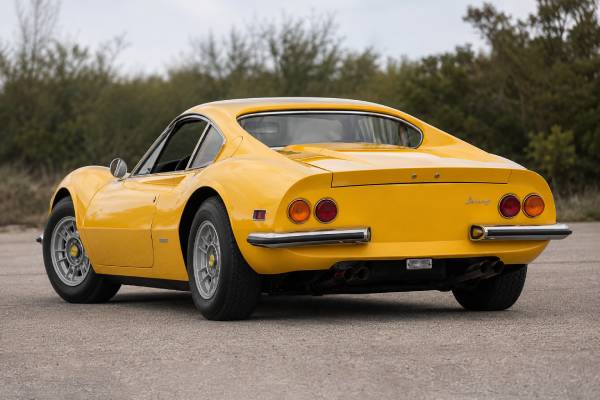

The Ferrari Dino 246 GT L-series is the earliest and purest 2.4-litre Dino road car. Built from 1969 into 1970, it kept many delicate 206 GT details while adding the stronger Tipo 135 CS V6, a longer wheelbase, more torque, and a more usable steel-bodied chassis. It is small, elegant, mechanically serious, and very different from the front-engined V12 Ferraris that defined Maranello in the 1960s.
Quick Take
The 1969–1970 Dino 246 GT Tipo 607 L is a rare early-series Dino with the 2.4-litre V6, 195 hp output, center-lock wheels, and several 206-style details that later M- and E-series cars lost. It is not the fastest classic Ferrari by numbers, but it is one of the most rewarding because of its mid-engine balance, compact size, vivid engine note, and unusually graceful Pininfarina design. For buyers, the main concerns are originality, corrosion, accident repair, engine and gearbox identity, carburetion, cooling, suspension condition, and the quality of any restoration.
Table of Contents
- Why the L-Series Dino 246 GT Matters
- Tipo 135 CS V6, Chassis, and Specifications
- L-Series Production Changes and Authenticity
- Pininfarina Shape and Mid-Engine Engineering
- How the 246 GT L-Series Drives
- Maintenance, Restoration, and Known Weak Points
- Market Values and Buying Advice
Why the L-Series Dino 246 GT Matters
The Dino 246 GT L-series matters because it captures Ferrari’s first mature road-going mid-engine formula at the moment it became genuinely usable. It replaced the lighter, rarer 206 GT with more displacement, more torque, and a longer wheelbase, while still keeping the fragile early styling details that make the first 246s so collectible.
The Dino name came from Alfredo “Dino” Ferrari, Enzo Ferrari’s son, whose association with compact V6 engine development gave the model its emotional weight. In period, Ferrari did not market the car as a full Ferrari-badged V12 grand tourer. It was sold under the Dino marque, partly because Enzo Ferrari had long associated the Ferrari badge with twelve-cylinder cars. That distinction once made the Dino seem like the smaller, junior relation. Today, it is a major part of the car’s appeal.
The 246 GT followed the 206 GT, which had introduced the dramatic two-seat mid-engine layout in road-car form. The 206 was lighter, more delicate, and powered by a 2.0-litre aluminium-block V6. The 246 GT kept the same basic idea but made it more practical. Its 2.4-litre engine used a cast-iron block with aluminium cylinder heads. The wheelbase grew by 60 mm, and the body construction moved largely to steel. The result was heavier, but it was also more robust and better suited to regular road use.
The L-series, also known as Tipo 607 L, is the earliest 246 GT production form. It was built before the better-known M- and E-series cars. That timing gives it a special place in the Dino line. It has the stronger 2.4-litre performance of the later cars but preserves many details from the 206 GT, including knock-off center-lock wheels and several early trim and body features.
Pininfarina’s design is central to the car’s reputation. The Dino does not rely on aggression. Its appeal comes from proportion: low nose, curved wings, a tucked cabin, muscular rear haunches, and a short tail wrapped around a transverse V6. The shape made the mechanical layout understandable at a glance. This was not a traditional long-hood Ferrari. It was compact, balanced, and modern.
The Dino also helped establish a template that would shape later Ferrari road cars. Mid-engine V8 Ferraris such as the 308 GTB, 328, 348, F355, and beyond did not appear from nowhere. The Dino proved that a smaller, mid-engined Ferrari-family sports car could be desirable, beautiful, and commercially successful. That makes the 246 GT more than a pretty classic. It is a turning point.
For collectors, the L-series sits in a desirable niche. The 206 GT is rarer and more jewel-like, but expensive and less powerful. Later E-series Dinos are more numerous and easier to find, especially in U.S.-market form. The L-series offers early-car purity with the more satisfying 2.4-litre engine. That is why serious buyers pay attention to details such as chassis sequence, center-lock wheels, original engine and gearbox, factory colors, and documented restoration work.
Tipo 135 CS V6, Chassis, and Specifications
The 246 GT L-series used Ferrari’s Tipo 135 CS 2.4-litre V6, mounted transversely behind the cabin and driving the rear wheels through a five-speed manual gearbox. Its headline output was 195 hp at 7,600 rpm, but the more important change over the 206 GT was stronger mid-range torque.
| Item | Specification |
|---|---|
| Model | Dino 246 GT L-series, Tipo 607 L |
| Production period covered | 1969–1970 |
| Body style | Two-seat berlinetta coupe |
| Engine code | Tipo 135 CS |
| Engine layout | Rear-mid-mounted, transverse 65-degree V6 |
| Displacement | 2,419.20 cc |
| Bore x stroke | 92.5 mm x 60 mm |
| Compression ratio | 9.0:1 |
| Valve gear | Twin overhead camshafts per bank, two valves per cylinder |
| Fuel system | Three twin-choke Weber carburetors |
| Maximum power | 195 hp at 7,600 rpm |
| Transmission | Five-speed manual |
| Drive | Rear-wheel drive |
| Chassis | Tubular steel frame |
| Body construction | Mostly steel body panels with aluminium closures on many cars |
The Dino V6 is a compact, high-revving engine with a wide 65-degree bank angle. It uses chain-driven camshafts and a wet-sump lubrication system. The 2.4-litre unit has more relaxed road manners than the 2.0-litre 206 engine because it does not need to be worked quite as hard to feel alive. It still rewards revs, but it is not all top end.
The gearbox is a five-speed manual transaxle. On a healthy car, it gives the Dino much of its character. The linkage should feel mechanical and precise once warm, though cold second-gear stiffness is common in many classic Ferraris of this era. A slow, patient first few miles are part of proper Dino use.
| Area | Detail |
|---|---|
| Front suspension | Independent wishbones, coil springs, telescopic dampers, anti-roll bar |
| Rear suspension | Independent wishbones, coil springs, telescopic dampers, anti-roll bar |
| Steering | Rack and pinion, unassisted |
| Brakes | Four-wheel disc brakes |
| Wheelbase | 2,340 mm |
| Length | 4,235 mm |
| Width | 1,700 mm |
| Height | About 1,120–1,135 mm, depending on source and measurement method |
| Dry weight | About 1,080 kg |
| Fuel capacity | About 65 litres |
| Period top speed | About 235 km/h |
The longer wheelbase is one of the main differences from the 206 GT. A 60 mm increase may not sound dramatic, but on a small mid-engine car it affects stability, cabin packaging, and road manners. The 246 GT feels slightly less nervous than the 206, while still being compact by modern standards.
The braking system is conventional by today’s standards but effective when properly rebuilt and correctly set up. Buyers should not judge the car by modern carbon-ceramic or ABS-equipped supercar expectations. A good Dino should stop straight, give consistent pedal feel, and inspire trust. A tired one may feel wooden, pull under braking, or show signs of old hoses, seized calipers, or contaminated fluid.
L-Series Production Changes and Authenticity
The L-series is the rare early 246 GT series, with about 357 examples generally cited. Its importance comes from a mix of rarity, early styling details, and its position between the aluminium-bodied 206 GT and the more developed later 246 GT variants.
The Dino 246 GT production story is usually divided into L, M, and E series. These are not just casual collector nicknames. They help identify meaningful changes in wheels, wipers, trim, mechanical details, and market specification. The L-series is the first 2.4-litre version and the one most closely related in appearance and detail to the 206 GT.
Key L-series identifiers include:
- Center-lock “knock-off” wheels, rather than the later five-bolt wheel arrangement.
- Early-style wiper layout often described as “clapping hands.”
- Several 206-style trim and body details.
- A more delicate early cabin feel compared with later production cars.
- European-market focus, as full U.S.-market Dino 246 production became more important later.
These details matter because many Dinos have been restored, repaired, repainted, retrimmed, or modified over more than five decades. A car that looks correct at first glance may have later wheels, later trim, replacement body panels, a non-original engine, or interior details from another series. None of those issues automatically makes a car bad, but they strongly affect value.
Matching numbers and documentation
For a Dino 246 GT L-series, matching engine and gearbox identity is a major value factor. Buyers should verify the chassis number, engine number, gearbox number, body number where visible, and any factory or expert documentation. Ferrari Classiche certification can help, but it should not replace a detailed physical inspection by a Dino specialist.
Useful documentation includes:
- Original books and pouch.
- Factory data or Ferrari Classiche documents.
- Historic registration records.
- Long-term service invoices.
- Restoration photographs.
- Specialist reports.
- Ownership history.
- Records of engine, gearbox, suspension, brake, and body work.
A thick history file does more than reassure a buyer. It can explain why a car has certain features, whether a color change was reversible, whether an engine replacement is period-correct, and whether a restoration was cosmetic or genuinely structural.
Colors, interiors, and factory character
Dinos are strongly affected by color. Rosso Corsa is familiar, but many early cars look especially good in subtler period shades such as silver, blue, grey, green, yellow, and orange-red tones. Original color matters because a return to factory specification can add desirability, especially on a rare L-series car.
Interior materials also deserve careful review. Many cars have been retrimmed in leather even when they may have had vinyl or cloth combinations originally. A beautifully retrimmed cabin can be enjoyable, but a buyer paying top money should know whether the materials, stitching, seat pattern, carpets, instruments, switches, and steering wheel are correct for the car.
How the L-series differs from later cars
Later M-series and E-series Dinos introduced changes that made production easier and, in some cases, improved usability. Later cars are not inferior; many owners prefer them for regular driving. But the L-series has a distinctive collector appeal because it feels closer to the original 206 GT concept.
| Series | General period | Collector notes |
|---|---|---|
| L-series | 1969–1970 | Earliest 246 GT, center-lock wheels, many 206-style details, lowest 246 GT series production |
| M-series | 1971 | Transitional cars with five-bolt wheels and detail changes |
| E-series | 1971–1974 | Most numerous, includes later GTs and GTS production, more U.S.-market presence |
Because the L-series is so detail-sensitive, authenticity should be checked before purchase, not after. A buyer should not rely only on a seller’s description or auction catalog language. The right approach is to inspect the car against known L-series features and compare its numbers and details with specialist records.
Pininfarina Shape and Mid-Engine Engineering
The Dino 246 GT works visually because its beauty is tied directly to its engineering. The cabin, rear haunches, air intakes, low nose, and short tail all express the packaging of a compact transverse V6 placed behind the seats.
The design was created by Pininfarina, with coachwork by Scaglietti. Unlike some grand touring Ferraris, the Dino does not use length to create drama. It uses tension. The front wings rise gently over the wheels, the roofline flows into the buttressed rear, and the side intake gives a functional break to the body side. The rear is broad enough to signal mid-engine power but not so wide that the car looks heavy.
The L-series is especially prized because it has a clean early appearance. The center-lock wheels give the car a competition-like delicacy. The early details also make the car feel closer to the show-car and 206 GT origins of the design. Later Dinos are still beautiful, but the L-series has a particular lightness of presentation.
Packaging and cooling
The transverse V6 layout allowed Ferrari to keep the wheelbase short while placing the engine behind the cabin. This created a very different mass distribution from the front-engined Ferraris of the period. The radiator remained at the front, with coolant pipes running through the chassis. That arrangement is common in mid-engine cars but creates maintenance issues as the car ages.
Cooling condition is critical. A Dino that runs hot in traffic may have a tired radiator, blocked passages, failing fans, old hoses, poor bleeding, incorrect thermostat behavior, or years of sediment in the system. Because the engine is valuable and aluminium heads are sensitive to overheating, cooling problems should never be dismissed as “normal old car behavior.”
Body materials and construction
The move from the 206 GT to the 246 GT brought more steel into the body construction. This helped production and durability but also introduced corrosion risk. The tubular frame and steel panels need specialist inspection, especially around lower body areas, suspension pickup points, sills, floor sections, wheel arches, front structure, rear structure, and areas that may trap moisture.
The hand-built nature of the car also matters. Panel gaps, shut lines, and surface finish should be judged by classic Ferrari standards, not modern mass-production standards. Still, uneven gaps, heavy filler, distorted chassis tubes, or doors that do not close cleanly can point to accident history or poor restoration.
Sound and sensory character
The Dino’s sound is one of its defining features. It is not a deep V12 noise. It is sharper, more metallic, and more urgent. The V6 has a hard-edged intake and exhaust note that builds as revs rise. With properly tuned Webers, the engine feels alive under small throttle changes and becomes genuinely exciting near the upper part of the rev range.
That sound is also a diagnostic tool. Hesitation, spitting through the carbs, uneven idle, popping on overrun, or a flat response may point to carburetor imbalance, ignition problems, air leaks, tired plug leads, fuel delivery issues, or cam timing concerns. A good Dino sounds clean and eager, not merely loud.
How the 246 GT L-Series Drives
A sorted Dino 246 GT L-series feels light, precise, and intimate rather than brutally fast. Its performance figures are respectable for the period, but the real appeal is the way the steering, engine, gearbox, and chassis work together on a flowing road.
The driving position is low and close to the front axle line compared with many modern cars. Visibility is good by exotic-car standards, helped by the slim pillars and compact body. The car feels narrow, which makes it usable on smaller roads where modern supercars can feel too wide.
At low speeds, the unassisted steering has some weight, especially when parking. Once rolling, it becomes one of the car’s best features. There is a clean connection through the front tires, and the driver can sense small changes in grip. This is a major reason enthusiasts still rate the Dino so highly. It communicates without needing extreme speed.
The engine prefers mechanical sympathy. It should be warmed properly before hard use. Oil temperature matters, not just water temperature. The carburetors may need a little patience when cold, and the gearbox is usually happier after a few miles. Owners who understand this rhythm tend to enjoy the car more and spend less money fixing avoidable problems.
Acceleration and power delivery
The 2.4-litre V6 does not deliver modern turbocharged shove. Instead, it builds power cleanly and rewards revs. The extra displacement over the 206 GT gives the car better flexibility, so it can pull from moderate revs without feeling weak. Above the middle of the tachometer, the engine becomes sharper and more urgent.
Period top speed is around 235 km/h, but that number is less important today than the way the car covers real roads. The Dino is quick enough to feel special without demanding reckless speeds. Its compact size and chassis balance make 80 km/h to 140 km/h roads more enjoyable than straight-line displays.
Gearbox and brakes
The five-speed manual is part of the ritual. It should not be rushed when cold. Once warm, the shift should feel deliberate and satisfying. A baulky gearbox after warm-up may indicate worn synchros, linkage issues, clutch drag, incorrect oil, or deeper transaxle wear.
Braking performance depends heavily on condition. Properly rebuilt calipers, fresh hoses, good fluid, correct pads, and properly set wheel bearings make a large difference. A Dino should not feel frightening, but it also will not have modern anti-lock braking. The driver needs to brake with feel and leave sensible margins.
Ride, cornering, and road use
The suspension is supple when correctly set up. Many poor-driving Dinos suffer from old bushings, incorrect dampers, tired springs, poor alignment, wrong tires, or over-restoration that makes the car too stiff. The original character is not harsh. It should flow.
Good tires are essential. The Dino was designed around period-sized tires with taller sidewalls. Modern tire choices can improve grip, but excessive width or unsuitable compounds can spoil steering feel and ride quality. Buyers should see tire choice as part of the car’s setup, not just a consumable.
In city use, the Dino needs patience. Cabin heat, fuel smell, heavy low-speed steering, and carburetor behavior can all be part of the experience. On an open road, those compromises make more sense. The car feels alive in a way that many heavier classics do not.
Maintenance, Restoration, and Known Weak Points
A Dino 246 GT is not a simple used sports car; it is a hand-built, high-value classic Ferrari-family car that needs specialist care. The biggest risks are corrosion, poor accident repair, engine and gearbox wear, cooling problems, carburetor and ignition faults, and restorations that look attractive but hide structural or mechanical shortcuts.
The engine is strong when maintained, but neglect is expensive. Timing chain condition, valve clearances, oil leaks, coolant health, carburetor setup, ignition condition, and compression should all be checked. A proper pre-purchase inspection should include leak-down and compression testing, review of oil pressure, cooling behavior, and inspection for smoke, crankcase pressure, and abnormal mechanical noise.
Carburetor tuning is a specialist skill. The three Weber carburetors must be clean, correctly jetted, synchronized, and matched with a healthy ignition system. Many running problems blamed on “Italian temperament” are simply the result of old fuel lines, dirty jets, weak spark, air leaks, worn throttle shafts, or poor adjustment.
Common mechanical concerns
Important inspection areas include:
- Cooling system condition, including radiator, fans, hoses, pipes, thermostat, and bleeding.
- Oil leaks from the engine, cam covers, sump, and transaxle.
- Timing chain noise or uncertain service history.
- Carburetor wear, fuel seepage, and poor synchronization.
- Ignition system condition, including distributor, leads, plugs, and electronic components where fitted.
- Gearbox synchro wear, especially if shifts are poor when warm.
- Clutch operation and evidence of drag or slipping.
- Driveshaft joints and boots.
- Suspension bushings, ball joints, dampers, springs, and wheel bearings.
- Brake calipers, master cylinder, hoses, discs, and fluid condition.
A car that has sat unused can need as much work as a car that has covered mileage. Long storage often damages fuel systems, brake hydraulics, coolant passages, seals, tires, and electrical contacts. Regular, documented use is usually a positive sign.
Corrosion and body structure
Rust is one of the most serious Dino issues. The body may look excellent from above while hiding problems underneath. Sills, floors, lower doors, wheel arches, front valance, rear lower panels, suspension mounting areas, and chassis tubes should be inspected carefully. Paint thickness readings can help, but they are not enough on their own.
Accident repair is another major concern. Many Dinos were used hard when they were less valuable. Nose damage, rear impacts, and poorly repaired chassis sections are not rare. A proper inspection should include underside access and ideally a specialist who knows how these cars were built.
Signs of concern include:
- Heavy filler in lower panels.
- Uneven door, bonnet, or engine-cover gaps.
- Distorted suspension pickup areas.
- Poor welds or non-original tube repairs.
- Cracking paint around stress points.
- Misaligned wheels or unusual tire wear.
- Evidence that panels were replaced without proper documentation.
Restoration quality
A Dino restoration can be excellent, average, or dangerous. Cosmetic restorations may make the car look fresh while leaving old wiring, tired suspension, weak brakes, and corroded structure untouched. A high-quality restoration should be supported by photographs, invoices, specialist names, and a clear description of what was rebuilt or preserved.
Originality is not always the same as quality. A highly original car may need mechanical recommissioning. A restored car may drive better but lose value if incorrect details were used. The best cars combine correct identity, careful preservation where possible, and properly documented mechanical work.
Parts availability is generally better than for many obscure classics, but that does not make the car cheap to maintain. Trim, body, and series-specific components can be difficult or costly. L-series-specific details deserve special care because replacing them with later parts can reduce authenticity.
Market Values and Buying Advice
The Dino 246 GT L-series sits near the top of the 246 GT hierarchy because it is rare, early, beautiful, and detail-rich. As of the mid-2020s, good Dino 246 GT values commonly sit in the high six-figure range in U.S. dollars for strong cars, with L-series examples often commanding premiums when they have matching numbers, excellent history, factory colors, and high-quality restoration or preservation.
Market guides and auction records show wide variation because condition and identity matter enormously. A tired or modified 246 GT project is a very different purchase from a restored, Classiche-certified, matching-numbers L-series car. Buyers should focus less on a single headline price and more on the cost of reaching the desired standard after purchase.
The strongest value factors are:
- Verified L-series identity.
- Matching original engine and gearbox.
- Desirable factory color combination.
- Original body and chassis integrity.
- Ferrari Classiche or respected specialist documentation.
- Known ownership history.
- High-quality restoration by recognized specialists.
- Correct center-lock wheels and early-series details.
- Complete books, tools, jack, and records.
- Excellent driving condition, not just show presentation.
Cars to approach carefully include freshly painted examples with thin documentation, cars with unclear engine identity, cars missing L-series-specific parts, cars with heavy underseal, cars with inconsistent panel fit, and cars that have been restored by shops without Dino experience.
Pre-purchase inspection priorities
A serious inspection should be structured, not casual. The buyer should confirm identity first, then condition, then driving quality.
| Area | What to verify |
|---|---|
| Identity | Chassis number, engine number, gearbox number, body number where applicable, and L-series features |
| Documents | Ownership history, factory data, service records, restoration invoices, specialist reports |
| Body | Corrosion, filler, panel fit, prior accident repair, quality of paint and metalwork |
| Chassis | Tube condition, suspension mounts, alignment evidence, underside repairs |
| Engine | Compression, leak-down, oil pressure, leaks, smoke, noise, cooling behavior |
| Fuel and ignition | Weber condition, fuel lines, pump, distributor, plug leads, cold and hot starting |
| Gearbox | Cold and warm shift quality, synchros, clutch action, transaxle noise |
| Suspension and brakes | Bushings, dampers, bearings, calipers, discs, hoses, straight-line braking |
| Interior | Correct seats, instruments, switches, trim materials, steering wheel, carpets |
| Road test | Temperature stability, steering feel, tracking, brake confidence, throttle response |
A buyer should budget for immediate sorting even on a good car. Fluids, hoses, tires, brake service, carburetor tuning, alignment, battery, fuel lines, and minor electrical work are common needs. On a poor car, the numbers climb quickly because body and mechanical work overlap. Removing the engine, correcting corrosion, rebuilding suspension, retrimming the cabin, and painting the body to a high standard can become a major restoration.
The best Dino to buy is not always the cheapest or the most polished. It is the one with the clearest identity, the best structure, the strongest documentation, and the fewest unanswered questions. A slightly worn but honest car can be a better purchase than a shiny car with vague history.
Long-term collectability looks strong because the Dino has several durable advantages: landmark mid-engine importance, Pininfarina beauty, usable size, Ferrari-family engineering, strong club and specialist support, and a driving experience that still feels special at real road speeds. The L-series adds rarity and early-series character. That combination should keep it desirable, provided the car’s authenticity and condition are protected.
References
- Ferrari Dino 246 GT (1969) – Ferrari.com 1969 (Manufacturer Specifications)
- Ferrari Dino 246 GT: Ferrari History 1969 (Manufacturer History)
- 1970 Ferrari Dino 246 GT ‘L-Series’ by Scaglietti 2025 (Auction Record)
- 1970 Ferrari Dino 246 GT ‘L-Series’ by Scaglietti 2025 (Auction Listing)
- Dino 246 GT Market 2026 (Market Data)
Disclaimer
This article is for informational purposes only and is not a substitute for professional diagnosis, repair, appraisal, or restoration advice. Specifications, torque values, service intervals, procedures, and correct components can vary by chassis number, market, production change, and equipment. Always verify details against official service documentation, factory records, and a qualified Ferrari or Dino specialist before buying, repairing, or restoring a car.
If you found this guide useful, please consider sharing it on Facebook, X/Twitter, or your favorite car community to support our work.