
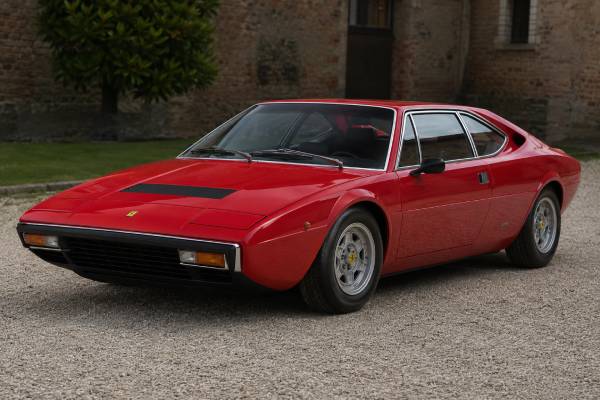
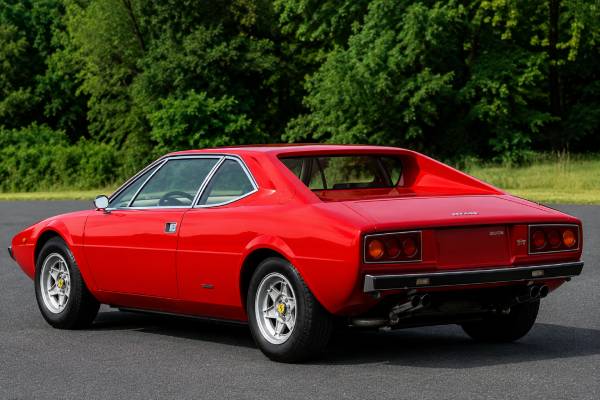
The Ferrari Dino 308 GT4 is one of the most important “misunderstood” Ferraris of the 1970s. It was the first production Ferrari road car powered by a V8, the first mid-engined 2+2 from the company, and the only regular-production Ferrari styled by Bertone rather than Pininfarina. Its sharp Marcello Gandini wedge shape, compact rear seats, transverse 2.9-liter V8, and Dino badging made it controversial when new. Today, those same traits make it distinctive, usable, and historically valuable.
Quick Take
The Dino 308 GT4 is not the easiest classic Ferrari to explain in one sentence, but it is easy to appreciate once understood: it combines a carbureted Ferrari V8, mid-engine balance, real touring ability, and unusual Bertone styling in a car that remains more approachable than many two-seat Ferraris of the same era. The best examples are charming, fast enough for modern roads, and full of character, but poor cars can be expensive traps because corrosion, deferred belt service, tired carburetors, weak electrics, and low-quality restorations can quickly cost more than the car’s apparent discount.
Table of Contents
- Why the Dino 308 GT4 Matters
- F106 V8, Chassis, and Key Specs
- Production Changes, Badging, and Factory Details
- Bertone Design and Mid-Engine Packaging
- How the 308 GT4 Drives
- Maintenance, Reliability, and Restoration Risk
- Market Values and Buyer Inspection Guide
Why the Dino 308 GT4 Matters
The 308 GT4 matters because it introduced the layout that would define Ferrari’s smaller sports cars for decades: a mid-mounted V8 behind the cabin. Before this car, the Dino line had already made mid-engine Ferrari road cars acceptable, but the 308 GT4 added two extra cylinders, two small rear seats, and a more practical grand-touring mission.
Ferrari launched the Dino 308 GT4 in 1973, during a difficult period for high-performance cars. Fuel prices, emissions rules, and changing safety requirements were reshaping the market. Against that background, the GT4 was a bold product. It replaced the curvier Dino 246 GT/GTS in spirit, but it did not copy its formula. Instead of a V6 two-seater with flowing Pininfarina lines, it used a V8, a longer wheelbase, a 2+2 cabin, and a sharply folded Bertone body.
That made the car controversial. Some buyers did not know what to make of a Ferrari-built car wearing Dino badges. Others struggled with the angular shape, especially compared with the beautiful 246 Dino and the later 308 GTB. Yet the car was technically important. The later 308 GTB, 308 GTS, 328, 348, F355, 360, F430, 458, 488, F8 Tributo, and 296 GTB all belong to a line of mid-engined Ferrari sports cars that began, in production-road-car terms, with this V8 architecture.
The Dino name also needs context. Ferrari used Dino branding to honor Alfredo “Dino” Ferrari and to separate smaller V6 and V8 cars from the traditional V12 Ferrari image. Early 308 GT4s carried Dino badges rather than the Ferrari script most buyers expected. From the mid-1970s, Ferrari badging became more prominent, and the market gradually accepted the car as a real Ferrari. Today, that old identity problem is part of the model’s appeal.
The GT4 also has collector importance because it is a one-off in Ferrari design history. It was styled by Marcello Gandini at Bertone, not by Pininfarina. Gandini’s work gave the car a strong wedge profile, a low nose, a clean glasshouse, and a practical cabin layout. It does not look like the Ferraris before or after it, which once hurt its popularity but now helps it stand apart.
Production of the 308 GT4 ran from 1973 to 1980, with 2,826 examples of the 308 GT4 built. Ferrari also produced the smaller-engined 208 GT4 for markets where displacement-based taxation made a 2.0-liter version attractive. The 308 GT4 discussed here is the 2.9-liter model, commonly associated with the F106 family of chassis and engine identifiers and the early 255 hp European specification.
For today’s buyer, the car sits in a useful middle ground. It is more spacious and practical than a 246 Dino or 308 GTB, less expensive than many classic two-seat Ferraris, and still unmistakably mechanical. It has carburetors, a gated manual gearbox, unassisted steering, compact dimensions, and a high-revving V8. That combination gives it a kind of honesty that modern performance cars cannot copy.
F106 V8, Chassis, and Key Specs
The heart of the 308 GT4 is its transverse rear-mid-mounted 2.9-liter V8, paired with a five-speed manual transaxle and a tubular steel chassis. In early European form, the engine is generally quoted at 255 hp, though output varied by market and emissions equipment.
| Category | Specification |
|---|---|
| Model | Ferrari Dino 308 GT4 |
| Production years | 1973–1980 |
| Body style | Two-door 2+2 coupé |
| Layout | Rear-mid engine, rear-wheel drive |
| Engine | 2.9-liter naturally aspirated V8 |
| Displacement | 2,926.90 cc |
| Bore x stroke | 81 mm x 71 mm |
| Induction and fuel system | Naturally aspirated, four Weber 40 DCNF carburetors |
| Output | 255 hp / 188 kW at 7,700 rpm in early high-output specification |
| Transmission | Five-speed manual transaxle |
| Chassis | Tubular steel spaceframe |
| Front suspension | Independent wishbones, coil springs, telescopic dampers, anti-roll bar |
| Rear suspension | Independent wishbones, coil springs, telescopic dampers, anti-roll bar |
| Brakes | Disc brakes front and rear |
| Steering | Rack and pinion |
| Tyres | 205/70 VR14 |
| Wheelbase | 2,550 mm |
| Length | 4,300 mm in standard European form |
| Width | 1,800 mm |
| Height | 1,180 mm |
| Dry weight | 1,150 kg |
| Fuel capacity | 80 liters |
| Top speed | 250 km/h |
The engine is compact and highly characterful. It uses a 90-degree V8 layout with four camshafts and two valves per cylinder. The 81 mm bore and 71 mm stroke give it a short-stroke nature, so it likes revs rather than lazy low-speed torque. The quoted 255 hp figure belongs to the early, less-restricted specification; later emissions-controlled and market-specific cars, especially U.S.-market examples, may have lower quoted outputs.
The carburetor setup is a major part of the car’s personality. Four Weber 40 DCNF carburetors give the engine sharp response when properly tuned, a rich induction sound, and a mechanical feel that later injected cars do not quite match. They also require knowledgeable setup. A 308 GT4 that starts cleanly, idles evenly, pulls without flat spots, and does not smell heavily of fuel is usually a car that has seen proper recent attention.
The gearbox sits with the engine as part of a compact transaxle package. Like many classic Ferraris, the shift quality depends heavily on temperature, adjustment, oil condition, and wear. A cold gearbox may feel reluctant, especially before the oil has warmed. Once warm, a healthy shift should feel precise, metallic, and deliberate rather than vague or crunchy.
The chassis is a tubular steel structure rather than a modern monocoque. This construction helps explain the car’s light official dry weight and its direct road feel. It also means accident damage and corrosion around structural areas deserve careful inspection. The body, chassis, suspension pickup points, and repairs must be considered together, not separately.
The suspension is conventional on paper but effective in practice: independent wishbones, coil springs, dampers, and anti-roll bars at both ends. With the engine behind the cabin and the gearbox mass low and central, the GT4 has good balance. It was never meant to be a stripped track car, but it has the steering precision and chassis response expected of a serious Ferrari.
Ferrari’s current model data does not list an official 0–100 km/h time for the 308 GT4. Period test figures vary because cars differed by market, tune, equipment, and testing method. The more useful point is that a healthy early car feels genuinely quick by classic standards, with its strongest performance arriving as the engine climbs toward the upper half of the tachometer.
Production Changes, Badging, and Factory Details
The 308 GT4’s production story is especially important because badging, market specification, emissions equipment, and documentation can affect both value and authenticity. Buyers should not judge these cars only by paint color and mileage; the details matter.
The earliest cars were sold as Dinos, not as conventional Ferrari-branded models. This is a major reason the model spent years underappreciated. Many period buyers wanted a visible Ferrari badge, while collectors later had to learn which trim and badge combinations were correct for each year and market. Some cars were later rebadged, partly because owners preferred the Ferrari identity and partly because factory and dealer updates blurred the line.
The 308 GT4 was built in left-hand-drive and right-hand-drive forms, with regional changes for Europe, the United Kingdom, the United States, Australia, Japan, and other markets. U.S.-market cars usually have more visible safety and emissions differences, including larger impact-bumper treatment, side markers, and lower-output emissions-controlled engine tune. These cars can still be good purchases, but buyers should value them according to their specification, originality, and condition.
The related 208 GT4 should not be confused with the 308 GT4. The 208 used a smaller 2.0-liter V8, mainly for markets with displacement-related taxes. It is interesting and rare in its own right, but it does not have the same power delivery or market position as the 2.9-liter 308 GT4.
Identification and originality
A proper inspection should confirm the car’s identity across the visible chassis number, engine stamping, gearbox number where available, body details, title documents, and service history. Because many GT4s were relatively affordable for years, some were modified, neglected, rebadged, repainted in resale-friendly colors, or repaired without collector-level concern.
Important points to verify include:
- Correct chassis and engine identifiers for the year and market.
- Whether the engine, gearbox, and body are original to the car.
- Badge layout appropriate to the production period.
- Correct lights, bumpers, wheels, instruments, and emissions equipment for the market.
- Evidence of factory books, tools, jack, manuals, service invoices, and ownership records.
- Quality and accuracy of any restoration work.
- Whether color and trim match factory or early documentation.
Matching-numbers status is valuable, but it is not the only factor. A fully documented, well-restored car with a correctly rebuilt engine may be a better buy than a supposedly original car with hidden corrosion, poor paint, and no service trail. Still, for top collector value, originality and documentation are increasingly important.
Factory and dealer equipment
Factory options were not as complex as modern Ferrari personalization programs. Air conditioning, power windows, leather trim, radio equipment, wheel choices, and market-specific equipment are the items most buyers notice today. Original tools, manuals, and delivery paperwork can carry surprising value because they help complete the car’s story.
Color also matters. Red cars are easiest to sell, but period shades such as blue, silver, yellow, green, brown, and metallic colors can be more interesting when documented. Because the GT4’s shape is angular and architectural, it often suits colors that would look quieter on a curvier Ferrari. Interior originality is also important because trim pieces, seat patterns, switchgear, and small fittings can be difficult or expensive to source.
Bertone Design and Mid-Engine Packaging
The 308 GT4 looks different because it was solving a difficult problem: fitting a V8, two adults, two occasional rear passengers, luggage space, and proper cooling into a compact mid-engined Ferrari. Bertone’s answer was a sharp, efficient wedge rather than a romantic long-nose shape.
Marcello Gandini’s design used crisp lines, slim pillars, a flat engine cover, and a low front profile. Compared with the Dino 246, the GT4 looks more architectural and less sensual. Compared with the later 308 GTB, it looks more practical and less dramatic. That difference is exactly why it has aged in an interesting way. It is not trying to be a smaller Daytona or a prettier 308 GTB. It is its own thing.
The car’s proportions are driven by the 2+2 layout. The wheelbase is longer than the earlier 246 Dino, which creates room for the rear seats and improves stability. The cabin sits forward, the engine sits transversely behind it, and the rear bodywork is kept relatively short. This gives the GT4 a compact, planted stance despite its additional seating.
Cooling and airflow are central to the design. Mid-engined cars need careful management of air entering the front radiator, leaving the body, and feeding the engine bay. The GT4 uses vents, intakes, and body openings that are functional rather than decorative. On a healthy car, cooling should be stable in normal use, but blocked radiators, weak fans, old hoses, poor bleeding, and tired water pumps can quickly expose problems.
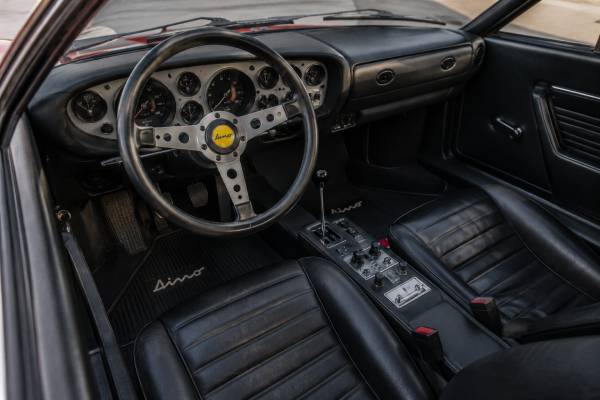
The cockpit is more useful than many people expect. Visibility is good for a mid-engined classic, the windshield is broad, and the seating position is more upright than in some two-seat Ferraris. The rear seats are best treated as occasional seats for children, short trips, or extra luggage space. That may sound like a compromise, but it makes the GT4 far more usable for touring than a strict two-seater.
The sound is another important feature. A carbureted 308 GT4 does not have the piercing scream of later five-valve Ferraris, but it has a hard, busy, mechanical V8 voice. The induction sound from the Webers is close to the driver, and the exhaust note becomes more urgent as the revs rise. The car feels more alive when used properly, not when idled around like a modern automatic GT.
Engineering-wise, the GT4 is a fascinating mix of old and new Ferrari thinking. The tubular chassis, carburetors, manual rack, and analog controls feel traditional. The transverse V8, compact transaxle, and mid-engine 2+2 layout point toward Ferrari’s future. That combination is why the car now feels more significant than its long-standing “entry-level classic Ferrari” reputation suggests.
How the 308 GT4 Drives
A good 308 GT4 feels light, alert, mechanical, and more usable than its exotic layout suggests. It is not brutally fast by modern standards, but it rewards smooth inputs, warm fluids, clean carburetion, and drivers who enjoy working with a car rather than being isolated from it.
At low speed, the steering is heavy because there is no power assistance. Parking and tight maneuvers require effort, especially on modern tires. Once moving, the steering becomes one of the car’s best features. It is direct, detailed, and confidence-building, with far more feedback than most newer performance cars.
The engine has a split personality. Below the midrange, it is tractable but not muscular. It will drive in traffic, but it does not feel special if kept at low rpm. Above roughly 4,000 rpm, the V8 wakes up, the carburetors sound harder, and the car begins to feel properly quick. The 7,700 rpm power peak tells you how Ferrari expected the engine to be used.
Throttle response depends heavily on carburetor condition. A well-set-up GT4 responds cleanly and progressively. A tired one may hesitate, pop, smell rich, idle unevenly, or feel flat. Many buyers mistake these problems for “old-car character.” They are usually maintenance issues.
The gearbox also improves with heat. Cold second-gear reluctance is common in classic Ferraris, but grinding, jumping out of gear, excessive noise, or a vague lever are warning signs. A warm, healthy transaxle should feel deliberate and satisfying. The clutch should be firm but not unreasonable; a very heavy clutch may point to wear, adjustment problems, or hydraulic issues.
Ride quality is better than the wedge shape suggests. The car was designed as a fast road 2+2, not a race special. On correct-size tires and healthy dampers, it can cover distance well. Overly aggressive modern tire choices, lowered suspension, old bushings, or tired dampers can spoil the balance.
Cornering is where the GT4’s layout makes sense. The car turns in cleanly, feels stable through fast bends, and gives the driver time to understand what the chassis is doing. It is more forgiving than some shorter-wheelbase mid-engined cars, but it still deserves respect. Lift abruptly mid-corner on old tires or in the wet, and the rear weight bias will remind you that this is not a front-engined GT.
Brakes are effective when properly maintained, but expectations should be period-correct. The pedal should feel firm, not wooden or sinking. Old hoses, tired calipers, poor fluid, glazed pads, and corroded discs can make the brakes feel worse than they should. A freshly serviced system transforms confidence.
In daily use, the GT4 is more practical than its image. The cabin has reasonable visibility, the engine is not impossibly fragile when maintained, and the rear seats add useful space. The downsides are cabin heat, modest air conditioning performance, noise, heavy parking-speed steering, and the constant need to keep an older Ferrari properly exercised. These cars do not improve when left unused for long periods.
Maintenance, Reliability, and Restoration Risk
The 308 GT4 can be reliable in classic Ferrari terms, but only if it is maintained like a specialist car rather than a cheap old exotic. Deferred maintenance is the main enemy, and the worst cars are often the ones that look presentable but have been run on a minimal budget.
The biggest service item is the timing belt system. Unlike some later Ferraris, belt service does not require removing the engine from the car, but it still needs a knowledgeable specialist. Belts, tensioners, cam seals, valve clearances, ignition timing, carburetor setup, and cooling checks are often best handled together. A seller who says “the belts were done” should be able to prove when, by whom, and what else was replaced.
The engine itself is strong when healthy, but age and neglect create risks. Oil leaks, worn valve guides, low compression, tired ignition components, old hoses, and poor carburetor tuning are common inspection points. Early Ferrari V8 ownership also brings discussion of sodium-filled exhaust valves, so buyers should ask a specialist whether the engine has been inspected or rebuilt with updated parts where relevant.
Fuel-system condition is critical. The GT4 is a carbureted mid-engined car, so old fuel hoses, leaking carburetors, tired clamps, and incorrect routing are not minor issues. Ethanol in modern fuel can accelerate hose and seal deterioration. Any smell of raw fuel should be investigated before regular driving.
Cooling-system health is equally important. Check the radiator, fans, thermostat, water pump, expansion tank, hoses, and signs of air trapped in the system. A car that runs hot in traffic may simply need service, but it may also reveal deeper neglect. Cooling problems on a mid-engined classic should never be dismissed.
Electrical issues are common because of age, heat, grounding problems, old fuse boards, aging relays, and previous owner modifications. Slow windows, weak fans, erratic gauges, poor lighting, and unreliable ignition can often be fixed, but tracing faults takes time. A tidy, uncut wiring harness is far better than a car full of improvised repairs.
Corrosion is one of the most serious buying risks. The GT4’s structure and body should be inspected carefully, especially:
- Sills and lower body seams.
- Door bottoms and lower front wings.
- Wheel arches and inner arches.
- Front valance and nose area.
- Floor sections and jacking points.
- Suspension pickup areas.
- Battery tray and nearby metal.
- Windscreen and rear-window surrounds.
- Engine-bay seams and hidden moisture traps.
Accident damage is another concern. A tubular chassis can be repaired, but it must be repaired correctly. Uneven panel gaps, strange tire wear, poor alignment, distorted suspension mounts, mismatched paint, and crude welding are warning signs. Because the GT4 was undervalued for many years, not every repair was done to Ferrari standards.
Interior restoration can be more difficult than expected. Leather, seat foam, carpets, switches, vents, instruments, and trim pieces are available in varying degrees, but small GT4-specific parts can be expensive or hard to find. A worn but original interior may be more desirable than a cheaply retrimmed one with the wrong materials.
Parts availability is generally better than for some obscure exotics because the 308 family has strong specialist support. Mechanical parts, service items, and many engine components can be sourced. The harder items are often body trim, glass, interior fittings, original wheels, correct emissions pieces, and small hardware.
The best ownership approach is preventative. Drive the car regularly, keep fluids fresh, replace rubber before it fails, maintain the ignition and carburetors, and use a specialist who knows carbureted Ferrari V8s. A well-maintained 308 GT4 is not fragile. A neglected one can become a rolling restoration.
Market Values and Buyer Inspection Guide
The 308 GT4 remains one of the more attainable classic Ferrari V8s, but the market has become more selective. Ordinary driver-quality cars can still look affordable, while exceptional, early, highly original, or carefully restored examples now command far more respect than they once did.
As of 2026, good driver-quality examples often sit in the broad low-$50,000 to $70,000 range in the public market, with stronger cars above that and projects well below it. The best documented cars, especially those with rare colors, early Dino presentation, excellent originality, or high-level restoration quality, can move into six-figure territory. Outlier sales should be treated carefully because one exceptional car does not define the value of an average one.
Value is driven by condition first, then originality and documentation. Mileage matters, but it is less important than proof of care. A low-mileage car that has sat unused may need fuel, brake, cooling, belt, suspension, tire, and electrical work before it is trustworthy. A higher-mileage car with regular specialist maintenance may be a far better ownership experience.
The most valuable examples usually have:
- Verified identity and strong documentation.
- Original engine and gearbox.
- Correct Dino or Ferrari badging for the production period.
- Original or documented factory color combination.
- Clean body structure with no hidden corrosion.
- High-quality paint and panel fit.
- Correct interior materials and details.
- Recent belt, fuel, cooling, brake, and suspension service.
- Original books, tools, jack, manuals, and history file.
- No major accident history or poorly repaired structural damage.
Cars to approach cautiously include freshly painted examples with no restoration photos, long-stored cars advertised as “easy recommissioning,” modified cars missing original parts, cars with inconsistent badging, and cars with no proof of belt service. The cheapest GT4 for sale is rarely the cheapest GT4 to own.
Pre-purchase inspection priorities
A proper inspection should be performed by a Ferrari specialist familiar with carbureted 308-series cars. The inspection should include:
| Area | What to check | Why it matters |
|---|---|---|
| Identity | Chassis, engine, gearbox, title, history | Authenticity strongly affects value |
| Body and chassis | Rust, accident repair, panel gaps, suspension points | Structural repairs can be costly and value-sensitive |
| Engine | Compression, leakdown, oil leaks, smoke, service records | Major engine work can exceed the savings on a cheap car |
| Timing belts | Date, mileage, tensioners, seals, invoice detail | Old belts are a serious ownership risk |
| Fuel system | Hoses, carburetor leaks, fuel smell, pump condition | Fuel leaks are dangerous on a mid-engined carbureted car |
| Cooling system | Fans, radiator, water pump, hoses, overheating | Heat problems can damage confidence and reliability |
| Gearbox and clutch | Warm shift quality, noise, synchros, clutch weight | Transaxle repairs require specialist labor |
| Suspension and brakes | Bushings, dampers, calipers, hoses, discs | Old rubber and hydraulic parts spoil the driving feel |
| Interior and trim | Seats, switches, instruments, vents, carpets, originality | Correct GT4 trim can be expensive to restore |
| Road test | Cold start, warm idle, throttle response, temperatures | The car should feel cohesive, not merely presentable |
The best purchase is usually not a project and not a concours car, but a well-documented, regularly used, structurally clean GT4 with correct details and recent specialist service. That kind of car lets the owner enjoy the model’s strengths without immediately funding years of deferred maintenance.
Long term, the 308 GT4 has several collectability points in its favor. It is the first production Ferrari V8 road car, the only Bertone-designed production Ferrari, a genuine 1970s mid-engined manual Ferrari, and a usable 2+2. Against it are its once-controversial styling, higher production than some rare Ferraris, and the fact that top restoration costs can exceed ordinary market value.
For enthusiasts, that balance is exactly the attraction. The Dino 308 GT4 is still a car to buy carefully, drive properly, and maintain seriously. It rewards buyers who understand its history rather than those chasing the cheapest Ferrari badge.
References
- Ferrari Dino 308 GT4 (1973) 2026 (Manufacturer Specifications)
- Ferrari Dino 208 GT4 (1975) 2026 (Manufacturer Specifications)
- Ferrari / 308 GT4 Dino 1976 / 011 – Weber 40 DCNF Carbs (2 Distributors) 2026 (Parts Catalog)
- 1974 Ferrari Dino 308 GT4 2026 (Valuation Guide)
- Ferrari Dino 308 GT4 Market 2026 (Market Data)
Disclaimer
This article is for informational purposes only and is not a substitute for professional diagnosis, repair, valuation, or restoration advice. Specifications, torque values, service intervals, procedures, emissions equipment, and correct parts can vary by VIN, market, production date, and equipment, so readers should verify all details against official service documentation and a qualified Ferrari specialist before buying, servicing, or restoring a vehicle.
If you found this guide useful, please consider sharing it on Facebook, X/Twitter, or your favorite car community to support our work.