

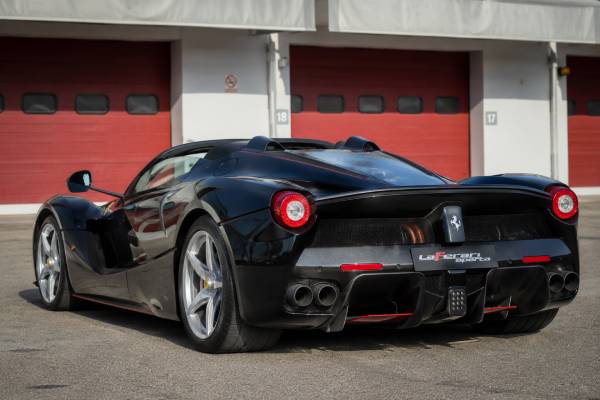

The Ferrari LaFerrari Aperta is the open-top version of Ferrari’s first hybrid flagship hypercar, built around the F140 FE 6.3-liter naturally aspirated V12 and HY-KERS electric assistance. Introduced for Ferrari’s 70th anniversary, it took the already rare LaFerrari coupe formula and made it more exclusive, more dramatic, and more complex to preserve. Official output is 963 CV, commonly rounded in English-language markets to about 950 horsepower, with the V12 doing most of the work and the electric motor filling torque gaps with Formula 1-inspired response. For collectors, the Aperta matters because it combines a limited build, removable roof, carbon structure, hybrid technology, and modern Ferrari halo-car status. For drivers, it remains one of the clearest examples of how electrification can sharpen a naturally aspirated engine rather than replace its character.
Table of Contents
- Why the LaFerrari Aperta Still Matters
- F140 FE HY-KERS Specs and Chassis Data
- Production, Options, and Authenticity Clues
- Carbon Body, Aero, and Hybrid Details
- Open-Top Performance on Road and Track
- Maintenance, Battery, and Service Risks
- Market Values and Buying Checks
Why the LaFerrari Aperta Still Matters
The LaFerrari Aperta matters because it is not simply a roofless LaFerrari. It is Ferrari’s 70th-anniversary open flagship, a limited-series hybrid hypercar that carried the Enzo line into a new era of electrified performance.
Ferrari had used “halo cars” before to show the best technology it could put on the road. The 288 GTO, F40, F50, Enzo, and LaFerrari each marked a different engineering moment. The LaFerrari, internally known as F150, arrived as Ferrari’s answer to a new class of hybrid hypercars that also included the McLaren P1 and Porsche 918 Spyder. What made the Ferrari different was its insistence on keeping the naturally aspirated V12 as the emotional center of the car.
The Aperta followed the coupe and gave Ferrari’s top clients an open version with the same core performance target. That was not easy. Removing a fixed roof from a carbon hypercar can weaken the structure, disturb airflow, add weight, and create cabin turbulence. Ferrari reworked the body, doors, aerodynamics, and carbon structure so the Aperta could keep the LaFerrari identity without feeling like a compromised conversion.
Its place in Ferrari history is unusually strong for several reasons:
- It celebrated Ferrari’s 70th anniversary.
- It used the same F140 FE V12 and HY-KERS system as the coupe.
- It was rarer than the closed LaFerrari.
- It represented Ferrari’s first major step into road-car hybridization.
- It arrived before later plug-in hybrid Ferraris such as the SF90 Stradale and 296 series.
- It remains one of the last Ferrari halo cars dominated by a naturally aspirated V12 sound.
The LaFerrari Aperta is also important because it sits at a turning point. Earlier Ferrari flagships were mechanical theater first, with limited electronic help by modern standards. Later Ferrari flagships and special models would lean more heavily on hybrid systems, software, active controls, and advanced battery management. The Aperta is right in the middle: old-school V12 drama joined to a modern electric boost system.
For collectors, that gives the car a special appeal. It is not the lightest, simplest, or easiest Ferrari to maintain, but it is one of the most symbolically powerful. It represents the end of one era and the start of another. For enthusiasts, it remains fascinating because the electric system does not make the car quiet or clinical. It makes the V12 feel larger, sharper, and more immediate.
The Aperta’s reputation today is built on more than speed. Plenty of newer hypercars make more power. Some accelerate harder. Some use more advanced batteries. The LaFerrari Aperta still stands out because of how it combines rarity, design, engine character, Ferrari invitation-only allocation, and a driving experience that feels tied to Maranello’s racing mythology.
F140 FE HY-KERS Specs and Chassis Data
The LaFerrari Aperta uses a 6,262 cc naturally aspirated V12 paired with a rear-mounted electric motor, giving a total output of 963 CV and more than 900 Nm of system torque. The key point is that the hybrid system is there for performance response, not quiet electric commuting.
| Category | Specification |
|---|---|
| Model | Ferrari LaFerrari Aperta |
| Internal project code | F150 |
| Production era | 2016–2018 |
| Body style | Two-seat open-top hypercar with removable roof |
| Layout | Rear mid-engine, rear-wheel drive |
| Engine | F140 FE 65-degree naturally aspirated V12 |
| Displacement | 6,262 cc |
| V12 output | 800 CV at 9,000 rpm |
| V12 torque | 700 Nm at 6,750 rpm |
| Maximum engine speed | 9,250 rpm |
| Electric motor output | 120 kW / 163 CV |
| Total system output | 963 CV, commonly rounded to about 950 hp |
| Total system torque | More than 900 Nm |
| Transmission | 7-speed F1 dual-clutch automatic |
The V12 is the heart of the car. It uses direct fuel injection, a high compression ratio, dry-sump lubrication, and a very high redline for a road-going 6.3-liter engine. On its own, the engine makes 800 CV, which would already place it among Ferrari’s great road-car V12s. The HY-KERS system adds an electric motor that gives instant torque assistance and supports acceleration when the combustion engine is climbing through the rev range.
HY-KERS is not a plug-in hybrid system. Owners should not think of the Aperta like a modern PHEV with electric-only range. The system harvests and deploys energy to improve performance, throttle response, and power delivery. In simple terms, it helps fill the moments where a naturally aspirated engine would usually need revs before reaching its strongest output.
| Area | Specification |
|---|---|
| Length | 4,702 mm |
| Width | 1,992 mm |
| Height | 1,116 mm |
| Wheelbase | 2,650 mm |
| Weight distribution | 41% front / 59% rear |
| Front suspension | Double wishbone |
| Rear suspension | Multi-link |
| Front tires | 265/30 R19 Pirelli P Zero |
| Rear tires | 345/30 R20 Pirelli P Zero |
| Front brakes | Brembo carbon-ceramic, 398 x 223 x 36 mm |
| Rear brakes | Brembo carbon-ceramic, 380 x 253 x 34 mm |
Ferrari’s performance figures remain serious even by current standards. The Aperta is capable of more than 350 km/h, reaches 100 km/h in under three seconds, and reaches 200 km/h in under seven seconds. Those figures are not just about peak power. They depend on the dual-clutch gearbox, tire temperature, launch strategy, battery state, and the way the electric motor assists during rapid acceleration.
The chassis is built around a carbon-fiber structure rather than a conventional aluminum or steel body shell. That matters for buyers because damage inspection is more specialized. A panel repair on an ordinary sports car and a structural carbon repair on a LaFerrari Aperta are completely different ownership events.
The electronics package includes stability control, high-performance ABS/EBD, F1-Trac traction control, and the E-Diff electronic differential. These systems are part of the car’s performance personality. They are not background luxury electronics; they help manage a rear-drive car with huge torque, very wide rear tires, and a short, intense power band.
Production, Options, and Authenticity Clues
The LaFerrari Aperta is valuable partly because supply is extremely limited, but its desirability depends heavily on specification, documentation, and originality. A low-mile car with factory paperwork, correct roof equipment, complete service history, and strong provenance is a different proposition from a similar-looking car with gaps.
Ferrari built the Aperta as a special-series model, and buyers were selected rather than treated like normal retail customers. That matters in the collector world. Invitation-only allocation gives the car a story before the first mile is driven. Many cars entered serious collections immediately, which is why mileage is often low and service records are closely examined.
The standard identity markers are straightforward: LaFerrari Aperta body, removable roof arrangement, F150 project lineage, F140 FE V12, HY-KERS system, and model-year timing around Ferrari’s 70th anniversary. But a buyer should go deeper than visual confirmation. Because values are so high, small differences in paperwork and factory configuration can have large effects.
Important items to confirm include:
- Ferrari build documentation and original order details.
- Correct VIN, market specification, and delivery records.
- Original exterior color and interior trim.
- Roof equipment, including carbon-fiber hardtop where fitted and the soft roof arrangement where supplied.
- Factory carbon options and exposed-carbon details.
- Original wheels, tire specification, brake equipment, and electronic configuration.
- Ferrari Classiche or special-series documentation where applicable.
- Service invoices from official Ferrari dealers or recognized LaFerrari specialists.
- Warranty, LaFerrari Power, or maintenance-program eligibility.
Because the Aperta was heavily personalized, colors and options can change market behavior. Rosso Corsa has the classic Ferrari look and broad appeal. Darker colors such as Nero Daytona can make the shape look more technical and aggressive. Triple-layer paints, rare tailor-made combinations, special stitching, contrast details, carbon exterior packages, and unusual interior specifications may add desirability when they are factory original and well documented.
How the Aperta differs from the coupe
The Aperta is not merely the coupe with the roof cut away. Ferrari altered the body and airflow management to preserve the car’s performance. The door opening geometry differs from the coupe, and the open cabin required changes around the windshield and roof area. The goal was to maintain rigidity and aerodynamic behavior while allowing open-air driving.
The coupe is often seen as the cleaner expression of the original LaFerrari design, while the Aperta is the rarer, more theatrical version. That distinction matters for buyers. Some collectors prefer the purity and closed-roof silhouette of the coupe. Others see the Aperta as the ultimate road-going expression because it is scarcer and adds open-top sound from the V12.
Factory options and personalization
LaFerrari Aperta options are less about ordinary equipment and more about collector identity. Buyers are usually looking for cars that feel coherent and factory-authentic rather than simply expensive. A heavily optioned car can be desirable, but only when the specification suits the model.
High-value option and specification areas include:
- Carbon-fiber exterior package.
- Removable carbon-fiber hardtop.
- Exposed carbon details.
- Special paint or Atelier configuration.
- Racing seats sized correctly for the owner.
- Contrast stitching and special interior trim.
- Ferrari shields.
- Original books, tools, chargers, roof bags, and accessories.
- Digital or printed factory window sticker.
- Complete maintenance invoices.
A missing accessory may seem minor on a normal used car. On a LaFerrari Aperta, it can become a negotiation point. Buyers at this level want a complete object, not just a fast car.
Carbon Body, Aero, and Hybrid Details
The Aperta’s design is shaped by airflow, cooling, and structural needs rather than decoration. Every major surface has a job, especially because the open roof changes how air moves over and through the car.
The LaFerrari was designed by Ferrari’s in-house styling center under Flavio Manzoni, and it marked a major break from the long period in which Pininfarina shaped many Ferrari road cars. Its form is low, sharp, and cab-forward, with deep channels, flying surfaces, and a cockpit that feels closer to a prototype racer than a grand tourer.
The Aperta keeps that visual language but adds the complexity of open-top packaging. Removing the fixed roof changes pressure around the windshield, doors, side windows, and rear deck. Ferrari’s work focused on keeping drag, downforce, cooling, and cabin comfort under control. The result is a car that looks dramatic when open but still feels like a designed model rather than an aftermarket roof conversion.
The carbon structure is central to the car. Carbon fiber gives high stiffness with low weight, but it also demands careful inspection. Buyers should understand that the LaFerrari Aperta is not repaired like a mass-market aluminum convertible. Any structural concern needs Ferrari-level measurement, carbon expertise, and documented repair history.
The aerodynamics combine fixed body shaping with active elements. Air is managed through the nose, underbody, side channels, radiators, and rear diffuser. The purpose is stability at very high speed without adding large fixed wings that would spoil the road-car shape. This is one reason the LaFerrari looks cleaner than many later track-focused hypercars.
The HY-KERS system in plain language
HY-KERS is best understood as a performance amplifier. The V12 makes the sound, the revs, and the top-end power. The electric motor supports it with immediate torque and energy recovered during driving.
The system helps in three main ways:
- It improves throttle response before the V12 reaches its strongest rev range.
- It adds power during hard acceleration.
- It helps Ferrari use hybrid technology without changing the emotional character of the car.
The high-voltage battery and related electronics are therefore major value items. A buyer should not view them as ordinary wear parts, but they are also not optional curiosities. They are part of what makes the car a LaFerrari.
Cabin and driver interface
Inside, the Aperta feels focused. The seating position is low, the steering wheel carries major controls, and the digital display gives the driver performance information rather than luxury-car theater. The bridge-like center control area and paddle-shift layout create a strong connection to Ferrari’s Formula 1 design language of the period.
Visibility is better than many expect looking forward, but the car is wide, low, and expensive to place in traffic. The open roof adds sound and sensation, but it also makes the driver more aware of heat, wind, tire noise, and the mechanical intensity behind the cabin. That is part of the appeal, not a flaw, as long as expectations are realistic.
Open-Top Performance on Road and Track
The LaFerrari Aperta feels explosive because the electric system and V12 work together, not because either one dominates. Its best quality is the way it combines instant torque with the rising violence of a 9,000-rpm Ferrari V12.
At low and medium speeds, the electric motor makes the car feel alert before the engine is fully on cam. In a normal naturally aspirated supercar, the driver often waits for revs to build. In the Aperta, that waiting period is shortened. The V12 still rewards revs, but the car does not feel lazy below its peak power zone.
The dual-clutch gearbox shifts quickly and suits the powertrain’s character. It is not a soft luxury automatic. At speed, it gives the car the hard, clean gear changes expected of a flagship Ferrari. Around town, the experience depends heavily on heat, calibration, clutch behavior, and the driver’s smoothness. A poorly maintained car or one with outdated software may feel less polished than a properly serviced example.
The steering is fast and direct. Ferrari’s modern steering can feel light to drivers used to older hydraulic systems, but the front axle response is immediate. The driver needs to be precise. This is a wide, powerful, rear-drive hypercar with large tires, active systems, and very high limits. It rewards clean inputs more than drama.
Braking performance is immense when the carbon-ceramic system is healthy and at the right temperature. Buyers and owners should remember that carbon-ceramic brakes can last a long time in gentle road use but are expensive when damaged, worn, or overheated. Track use changes the inspection standard completely. Disc weight, surface condition, pad life, heat marks, and service records matter.
Road character
On the road, the Aperta is not a casual convertible. It is low, wide, loud, and intense. The ride is firm but not crude by hypercar standards, and the hybrid system helps make the engine flexible. The removable roof turns the sound into a major part of the experience. Intake noise, exhaust pitch, gearshifts, and electric torque fill become more obvious with the cabin open.
City use is possible but not where the car is happiest. Speed bumps, steep entrances, tire temperature, traffic attention, and limited visibility all demand care. The front lift system, if fitted and functioning correctly, is important for real-world usability. Any buyer should test it and confirm service history.
On fast roads, the car becomes more natural. The chassis settles, the aero begins to matter, and the V12 has room to breathe. The Aperta is extremely quick, but it is also valuable enough that most owners drive it with restraint. The best examples often see controlled use: private roads, curated events, Ferrari gatherings, and occasional specialist track days.
Track character
On track, the Aperta is capable but not as simple to run as a normal track car. Tire temperature, brake temperature, battery state, hybrid cooling, and software systems all matter. It is not a car to take to an open lapping day without preparation.
The driving experience is defined by traction management. The rear tires are huge, but the torque and power are larger still. The electronics help the driver use the car without making it feel dull. In the best conditions, the Aperta delivers the rare feeling of a naturally aspirated engine with electric torque underneath it.
A serious buyer should ask whether the car has been tracked. Track use is not automatically bad if it was properly supported, inspected, and documented. Hidden track use without proper service records is a different matter. The difference can be worth a large amount of money.
Maintenance, Battery, and Service Risks
The LaFerrari Aperta should be treated as a specialist collector hypercar, not as a normal used Ferrari. The most important ownership risks are hybrid-system condition, brake and tire health, carbon-structure integrity, software status, and continuity of official service documentation.
The V12 itself is a highly developed Ferrari engine, but it is only one part of the maintenance picture. The Aperta also has high-voltage components, cooling systems, battery management, active electronics, carbon-ceramic brakes, specialized body hardware, and low-volume trim pieces. Deferred maintenance can quickly become expensive because diagnosis and parts access require the right equipment and knowledge.
Ferrari introduced the LaFerrari Power program for LaFerrari and LaFerrari Aperta owners. It is a renewable program that includes extended factory warranty coverage and scheduled maintenance, including coverage for major hybrid items such as the HY-KERS system and high-voltage battery where the program applies. For buyers, active eligibility or recent coverage can be a major confidence factor.
Important inspection areas include:
- HY-KERS battery condition and diagnostic reports.
- High-voltage system fault history.
- Cooling system performance for engine, battery, and power electronics.
- Gearbox operation, clutch data, and shift quality.
- Carbon-ceramic brake disc condition and pad life.
- Tire age, tire type, and evidence of heat cycling.
- Suspension lift operation.
- Damper, bushing, and steering component condition.
- Carbon tub and underbody inspection.
- Door, roof, seal, and latch operation.
- Software updates and dealer campaign completion.
- Recall completion, especially brake-related campaigns in affected markets.
The battery is a major focus. Low mileage does not automatically mean low risk, because batteries and electronics age even when a car is stored. A car that has been kept on correct charging equipment, maintained by Ferrari, and periodically exercised may be healthier than a delivery-mile car that sat neglected.
Tires are another common issue. A LaFerrari Aperta may show very low mileage but still sit on old tires. That is not acceptable for serious driving. Tires age by time, heat, and storage conditions, not only by tread depth. Replacement with the correct specification protects performance and value.
Carbon-ceramic brakes need expert assessment. Visual inspection alone is not enough for a high-value purchase. Measure wear using the correct method, inspect for chips or cracks, and review whether the car has seen track use. Replacement costs are large enough to affect the deal.
Known recall and brake concern
In the United States, Ferrari North America filed a safety recall covering certain Ferrari models, including 2017 LaFerrari Aperta vehicles, for a brake fluid reservoir cap issue that could affect brake fluid ventilation and potentially lead to brake fluid loss. For any U.S.-market car, recall status should be verified by VIN and documented before purchase.
This is not a reason to avoid the model, but it is a reason to avoid casual buying. At this value level, “the seller says it was done” is not enough. The buyer should obtain dealer confirmation.
Storage and preservation
Many Aperta examples spend more time in collections than on roads. Storage quality is therefore a maintenance issue. The car should be kept in a controlled environment, connected to approved charging equipment, started and moved correctly, and serviced by date rather than mileage alone.
A strong preservation file should include:
- Annual service records.
- Battery and hybrid-system checks.
- Brake fluid and hydraulic-service records.
- Tire replacement dates.
- Software update records.
- Warranty or LaFerrari Power documentation.
- Photos or reports from inspections.
- Notes on roof storage and accessory completeness.
The best-owned cars are not necessarily the lowest-mile cars. They are the cars with clear, consistent care.
Market Values and Buying Checks
The LaFerrari Aperta sits near the top of the modern Ferrari collector market, above most LaFerrari coupes and below the rarest historic competition Ferraris. Recent public sales show that the right Aperta can trade in the multi-million-dollar range, with specification, mileage, documentation, and warranty coverage driving major differences.
The Aperta’s value is supported by several durable factors. It is rare, it belongs to Ferrari’s flagship lineage, it has a naturally aspirated V12, it introduced hybrid technology in a way collectors still find emotionally appealing, and it was tied to Ferrari’s 70th anniversary. Those are stronger value foundations than simple horsepower.
What drives value most:
| Factor | Why it matters |
|---|---|
| Mileage | Low mileage supports collector value, but only with proper maintenance. |
| Color and specification | Rare factory colors, coherent Atelier builds, and carbon options can add demand. |
| Documentation | Factory records, window sticker, service invoices, and certification reduce risk. |
| Warranty coverage | LaFerrari Power or similar official coverage can reassure buyers about hybrid components. |
| Condition | Paint, carbon, brakes, tires, roof hardware, and interior wear are closely examined. |
| Ownership history | Single-owner or known-collection cars often carry stronger confidence. |
| Market location | Import rules, emissions rules, taxes, and registration limits can affect liquidity. |
The most attractive cars usually have low but credible mileage, recent Ferrari dealer service, complete accessories, clean history, desirable colors, and no story around damage or deferred maintenance. The weakest cars are not always the ones with the highest mileage. A car with gaps in hybrid service, missing accessories, unclear ownership, old tires, or undocumented paintwork can be far riskier than a carefully used example.
Pre-purchase inspection checklist
A normal sports-car inspection is not enough. The inspection should be performed by Ferrari or a specialist with real LaFerrari experience and access to correct diagnostic tools.
Before purchase, confirm:
- VIN, market specification, and title status.
- Original build configuration.
- Ferrari service history from new.
- HY-KERS battery and high-voltage diagnostic condition.
- Recall and campaign completion.
- Gearbox and clutch data.
- Carbon tub, underbody, and suspension mounting points.
- Brake disc condition using proper measurement.
- Tire age and correct specification.
- Roof panel, seals, storage bags, and latches.
- Front lift function.
- Paint depth and evidence of panel repair.
- Interior wear, sticky switches, display condition, and trim condition.
- All books, keys, tools, chargers, and accessories.
- Eligibility for Ferrari-backed warranty or maintenance programs.
A buyer should also understand local registration rules. Some auction listings have market-specific notes, emissions restrictions, or sale limitations. These details can affect where the car can be titled or sold.
Examples to seek and avoid
Seek a car that feels complete and boring on paper: clear ownership, clear service, clear factory specification, clear accessories, and recent Ferrari inspection. The emotional part comes from the car itself. The paperwork should not require imagination.
Be cautious with cars that have:
- Missing roof equipment or accessories.
- Long service gaps.
- Dead or questionable battery history.
- Unverified recall status.
- Old tires presented as “like new.”
- Paintwork without explanation.
- Export/import confusion.
- Track use without supporting service records.
- Seller reluctance to allow Ferrari diagnostic inspection.
Long-term collectability looks strong because the Aperta has the right ingredients: rarity, brand significance, V12 character, hybrid milestone status, and open-top drama. The main risk is not demand. The main risk is buying the wrong car or underestimating the cost of keeping the right car in the right condition.
References
- LaFerrari Aperta (2016) – Ferrari.com 2016 (Manufacturer Specifications)
- LaFerrari (2013) – Ferrari.com 2013 (Manufacturer Specifications)
- LAFERRARI POWER: FERRARI EXPANDS ITS RANGE OF AFTER-SALES SERVICES 2021 (Manufacturer Aftersales)
- Part 573 Safety Recall Report 22V-536 2022 (Recall Database)
- 2017 Ferrari LaFerrari Aperta | Monterey 2025 | RM Sotheby’s 2025 (Auction Result)
Disclaimer
This article is for informational purposes only and is not a substitute for professional diagnosis, repair, valuation, or pre-purchase inspection. Specifications, torque values, service intervals, software procedures, recall status, and repair methods can vary by VIN, market, equipment, and service history. Always verify details against official Ferrari service documentation and a qualified Ferrari specialist before buying, servicing, or repairing a LaFerrari Aperta.
If you found this guide useful, please consider sharing it on Facebook, X/Twitter, or with other Ferrari enthusiasts to support our work.