
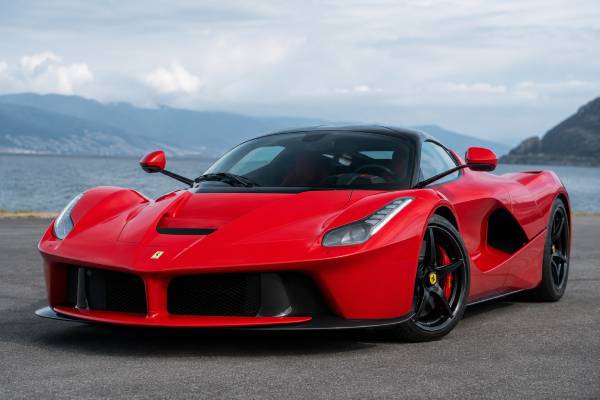

The Ferrari LaFerrari, known internally as the F150 project, is Ferrari’s 2013–2016 hybrid flagship and the direct successor to the Enzo Ferrari. It combined a naturally aspirated 6.3-liter F140 FE V12 with Ferrari’s HY-KERS electric assistance system, producing 963 metric horsepower, or about 950 mechanical horsepower. That made it the most powerful Ferrari road car of its time and the first Ferrari production car to use a hybrid powertrain. Only 499 closed cars were built for selected clients, followed by a later charity-built 500th coupe and the separate LaFerrari Aperta open-top derivative. Collectors care because it sits in the modern Ferrari halo line with the 288 GTO, F40, F50, Enzo, and F80. Enthusiasts care because it joined V12 sound, Formula 1-style energy recovery, carbon construction, active aerodynamics, and extreme performance without becoming a plug-in hybrid.
Table of Contents
- Why the LaFerrari Still Matters
- F140 FE HY-KERS Specifications
- Production, Variants, and Authenticity
- Carbon, Aero, and Hybrid Engineering
- What the LaFerrari Feels Like to Drive
- Maintenance Risks and Ownership Reality
- Market Values and Buyer Checks
Why the LaFerrari Still Matters
The LaFerrari matters because it was the point where Ferrari’s traditional naturally aspirated V12 flagship met serious hybrid performance technology. It was not built to save fuel in the ordinary sense; it used electrification to sharpen response, fill torque, recover braking energy, and raise lap speed.
Ferrari revealed the car in 2013, during a period when the hypercar world was changing quickly. The Porsche 918 Spyder, McLaren P1, and LaFerrari all arrived with hybrid assistance, but each brand used the technology differently. Porsche used plug-in all-wheel drive. McLaren used a turbocharged V8 with electric torque fill. Ferrari stayed closest to its identity: a high-revving V12, rear-wheel drive, carbon fiber, and racing-derived energy recovery.
The model also marked a design and engineering shift inside Ferrari. Earlier halo cars such as the F40, F50, and Enzo were extreme, but still clearly mechanical in personality. LaFerrari added a much deeper layer of software control. Its engine, electric motor, battery, dual-clutch gearbox, active aerodynamics, electronic differential, traction control, dampers, and brake systems had to work as one system. That made it more complex than older Ferrari supercars, but also far faster and more usable.
It also arrived before Ferrari’s broader hybrid era. Later models such as the SF90 Stradale, 296 GTB, and F80 made electrification central to Ferrari’s product strategy. LaFerrari was the bridge between the old and new Ferrari worlds: still V12-led, still naturally aspirated, still dramatic, but already shaped by energy management and software.
For collectors, the appeal comes from more than speed. The car has a fixed place in Ferrari history, a very low production number, and a strong connection to Maranello’s flagship bloodline. It is also one of the last Ferrari halo cars to use a naturally aspirated V12 as the emotional center of the experience. The later F80 moved to a hybrid V6 layout, which makes the LaFerrari feel even more like the end of one era and the beginning of another.
The name was bold, almost risky. “LaFerrari” means “The Ferrari,” and it sounds self-important until you see the intent: Ferrari wanted one car to express the brand’s road-car knowledge at that moment. In practice, the name has aged well because the car did become a reference point for Ferrari’s move into hybrid performance.
F140 FE HY-KERS Specifications
The LaFerrari’s headline specification is its 6,262 cc naturally aspirated V12 supported by a 120 kW electric motor. The total system output is 963 cv, commonly rounded to 950 hp, with more than 900 Nm of combined torque.
| Category | Specification |
|---|---|
| Engine code | F140 FE |
| Engine layout | 65-degree naturally aspirated V12, rear-mid mounted |
| Displacement | 6,262 cc |
| Bore x stroke | 94.0 mm x 75.2 mm |
| Compression ratio | 13.5:1 |
| V12 output | 800 cv at 9,000 rpm |
| V12 torque | 700 Nm at 6,750 rpm |
| Electric motor output | 120 kW, or 163 cv |
| Total system output | 963 cv, about 950 hp |
| Total torque | More than 900 Nm |
| Transmission | 7-speed dual-clutch gearbox |
| Drivetrain | Rear-wheel drive hybrid |
| Top speed | Over 350 km/h, or 217 mph |
| 0–100 km/h | Under 3.0 seconds |
| 0–200 km/h | Under 7.0 seconds |
| 0–300 km/h | About 15 seconds, factory claim |
The V12 is the star. It uses direct injection, four valves per cylinder, variable valve timing, and a very high specific output for a road-going naturally aspirated engine. Its character is different from Ferrari’s later turbocharged and plug-in hybrid models. It builds revs with a hard metallic edge, and it keeps pulling toward the upper end of the tachometer rather than relying on low-rpm boost.
The electric system is not a plug-in system and does not turn the LaFerrari into an EV. HY-KERS recovers energy, stores it in a high-voltage battery pack, and sends power back through an electric motor linked to the drivetrain. In simple terms, the system helps the V12 respond faster and harder, especially where a pure combustion engine would wait for revs to climb.
| Area | Specification |
|---|---|
| Structure | Carbon fiber monocoque with carbon body panels |
| Suspension | Double wishbone front, multi-link rear |
| Dampers | Magnetorheological adaptive dampers |
| Brakes | Brembo carbon-ceramic discs |
| Front brake disc size | 398 mm x 36 mm |
| Rear brake disc size | 380 mm x 34 mm |
| Front tires | 265/30 ZR19 |
| Rear tires | 345/30 ZR20 |
| Length | 4,702 mm |
| Width | 1,992 mm |
| Height | 1,116 mm |
| Wheelbase | 2,650 mm |
| Weight distribution | 41% front, 59% rear |
Weight figures for the LaFerrari should be handled carefully. Dry-weight and running-condition figures vary depending on source, market, fluids, equipment, and measuring method. For buying, the exact number matters less than accident history, carbon structure condition, battery condition, and whether the car remains in original factory specification.
Production, Variants, and Authenticity
The closed LaFerrari coupe was built in 499 customer examples for model years 2013 to 2016, with production of the closed version ending in early 2016. A 500th coupe was later built for charity, making it a special case rather than part of the normal allocation.
Because the car was offered only to selected Ferrari clients, normal showroom comparison shopping never applied. The first ownership history often matters more than it would on a regular supercar. Cars delivered through long-standing Ferrari collectors, retained in major collections, or ordered with notable Tailor Made details tend to have stronger buyer interest.
Coupe, Aperta, and FXX K
The article’s main subject is the 2013–2016 closed LaFerrari coupe, but buyers often compare it with related versions.
| Version | Production role | Buyer relevance |
|---|---|---|
| LaFerrari coupe | Closed road car, 2013–2016 | Core collector model; 499 regular customer cars plus the special charity-built 500th coupe |
| LaFerrari Aperta | Open-top derivative introduced later | Rarer, usually more expensive, and structurally different around the roof and doors |
| FXX K | Track-only Corse Clienti development car | Not road legal; important for Ferrari motorsport-client history but not a normal road-car substitute |
The Aperta is not just a coupe with the roof removed. Ferrari reworked the structure and aerodynamics to preserve performance and stability with an open cabin. It also has a separate market and a much higher price level. The FXX K goes further still, using the LaFerrari platform as the base for a track-only client program car with more power, more aero, and no road-use purpose.
Factory specification and documentation
Authenticity is central to LaFerrari value. The key documents and identifiers include:
- Original Ferrari sales and delivery paperwork.
- Factory build specification.
- Paint and interior trim records.
- Ferrari Classiche or Ferrari-approved documentation where applicable.
- Service invoices from authorized Ferrari dealers or recognized LaFerrari specialists.
- Recall completion records.
- Battery, brake, tire, and software service history.
- Ownership chain, especially for cars from significant collections.
The best cars usually have low mileage, but mileage alone should not decide the purchase. A static car can develop issues from age, fluids, tires, battery management, seals, brake components, and electronic modules. A lightly driven but properly serviced example may be healthier than a delivery-mile car that sat unattended.
Options and personalization
LaFerrari buyers could specify paint, interior materials, stitching, carbon details, seat sizing, and special-order Tailor Made combinations. Unusual factory colors can help value when they are documented and tasteful. Non-factory changes usually hurt value, especially paint alterations, aftermarket audio changes, non-original trim, wheel swaps, or cosmetic carbon additions that cannot be reversed cleanly.
Seat size matters more than many buyers expect. Ferrari offered different seat sizing, and the driving position is semi-bespoke in feel. The seat is part of the car’s cockpit architecture, so buyers should confirm that the car physically suits them before purchase. A collector may accept a display-focused car, but an owner who intends to drive it needs comfort, visibility, pedal reach, and harness or belt fit checked in person.
Carbon, Aero, and Hybrid Engineering
The LaFerrari’s engineering is built around one idea: make the V12 faster, sharper, and more controllable without diluting its character. The carbon tub, active aerodynamics, hybrid system, and electronic chassis controls all serve that goal.
The structure uses a carbon fiber monocoque, not a modified aluminum road-car platform. This matters for rigidity, weight control, crash repair, and long-term inspection. Carbon structures do not rust like steel, but they can suffer from impact damage, delamination, improper repair, and hidden damage around mounting points. Any serious purchase should include inspection by a technician who understands Ferrari carbon monocoques.
Active aerodynamics
LaFerrari’s body is not just low and dramatic. It manages airflow through the front, underbody, cooling areas, and rear aero surfaces. Active elements adjust depending on speed, braking, cornering, and cooling demand. The system’s job is to balance downforce and drag without forcing the driver to choose a fixed wing setting.
The design also shows how tightly the engine and aero packaging are linked. Radiators, brake cooling, battery cooling, engine-bay heat, and underbody flow all compete for space. That is why accident damage, poor repainting, blocked ducts, damaged undertrays, or missing fasteners are not small cosmetic concerns on this car. They can affect cooling and high-speed stability.
HY-KERS integration
The HY-KERS system is often described as Formula 1-inspired, but for a road car it had to do more than deliver a push-to-pass effect. It had to work repeatedly, smoothly, and safely in normal driving. The electric motor assists the V12 rather than replacing it. The battery stores recovered energy and releases it when the control systems decide it can improve acceleration and drivability.
That makes the LaFerrari different from a plug-in hybrid supercar. There is no owner routine of charging it overnight for electric commuting. Instead, the system is part of the drivetrain’s performance loop. The driver feels the result as instant shove, hard acceleration between gears, and a sense that the V12 is even more urgent than its displacement suggests.
Cockpit and control layout
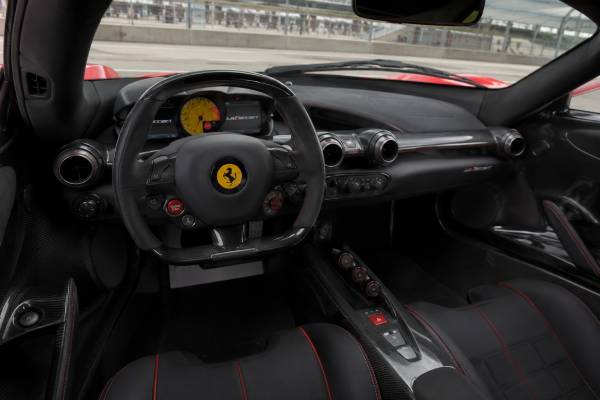
The cabin is race-car influenced but not bare. The steering wheel carries many controls, the shift paddles are fixed to the steering column, and the main driver display presents performance information in a focused layout. The center bridge between the seats gives the cockpit a technical, suspended look.
The driving position is low, legs-forward, and more fixed than in a normal grand tourer. Some controls require familiarity, and some owners coming from newer Ferraris may find the infotainment basic. That is not a flaw in a collector context. The LaFerrari was designed around driving position, visibility over the front arches, shift control, and vehicle settings, not around touchscreen convenience.
What the LaFerrari Feels Like to Drive
The LaFerrari feels defined by immediate response rather than only by peak speed. The electric motor sharpens the first hit of acceleration, then the V12 takes over with a rising, high-rpm force that feels very different from turbocharged torque.
At low speed, the car is easier than its numbers suggest, but it is never ordinary. The nose is low, the car is wide, and tire temperature matters. The dual-clutch gearbox is smooth enough for road use but still quick and firm when driven hard. The engine does not need high revs to feel strong, yet the real drama arrives as it climbs toward the top of the range.
The sound is a major part of the experience. Unlike later hybrids where electric drive can dominate in certain modes, the LaFerrari’s emotional center remains the V12. It has a sharper and more mechanical voice than many turbocharged modern supercars. Intake, exhaust, and gearshift sounds combine to make the car feel alive even before full throttle.
Road behavior
On the road, the LaFerrari is more usable than an F40 or F50 but less relaxed than a front-engined Ferrari GT. The steering is quick, the body control is tight, and the carbon-ceramic brakes need respect until the driver understands their feel. On poor surfaces, the car can feel firm, and the front lift system, where fitted or applicable by market and configuration, should be treated as a protection system rather than a cure for careless driving.
Visibility is reasonable for such a low hypercar, but the rear view is limited and the width demands planning. City driving is possible, but it is not where the car makes sense. The LaFerrari is happiest on clear fast roads, flowing mountain routes, and circuits where tire temperature, braking zones, and aero stability can work properly.
Track behavior
On track, the car’s systems make it faster than its basic layout would suggest. Rear-wheel drive, 950 hp, and a mid-mounted V12 sound intimidating, but Ferrari’s traction control, electronic differential, adaptive dampers, and hybrid management help the driver put power down. The car is still serious machinery. It rewards a disciplined driver who brings the tires and brakes into the right operating window.
Brake performance is strong, but carbon-ceramic systems are expensive and should not be abused without proper cool-down and inspection. Repeated track use can accelerate wear in tires, brake discs, pads, fluids, suspension joints, and drivetrain components. A car with track history is not automatically bad, but it needs more documentation than a collection-kept example.
Compared with its rivals
Against the Porsche 918 Spyder, the Ferrari feels more V12-centered, more dramatic, and less everyday-friendly. Against the McLaren P1, it feels more naturally aspirated and less turbocharged in personality. The Ferrari is not the most practical of the hybrid hypercar trio, but it may be the most traditional in emotional character.
That is why many collectors view it as the purest expression of the early hybrid hypercar moment: not because it had the least technology, but because the technology was used to intensify a Ferrari V12 rather than replace it.
Maintenance Risks and Ownership Reality
A LaFerrari is not judged by normal used-car reliability standards. The real question is whether its carbon structure, hybrid system, brakes, tires, software, and service history support safe ownership at multimillion-dollar value.
Routine Ferrari maintenance is only the beginning. The car needs specialist handling, correct diagnostic equipment, and technicians familiar with LaFerrari-specific systems. General exotic-car experience is not enough. A shop that works on 458s or 488s may still not be the right place for HY-KERS diagnosis or carbon-structure assessment.
Areas that deserve close inspection
Important checks include:
- High-voltage battery condition and documented maintenance.
- Hybrid warning history and diagnostic logs.
- Cooling system condition for engine, battery, gearbox, and electronics.
- Dual-clutch gearbox behavior, leaks, and service records.
- Carbon-ceramic brake disc condition, pad life, and heat history.
- Tire age, tire specification, and correct sizes.
- Suspension lift and damper operation.
- Active aerodynamic actuator function.
- Underbody panel condition and missing fasteners.
- Carbon tub, suspension pick-up points, and crash-repair evidence.
- Recall completion, especially brake, airbag, TPMS, and headrest-related campaigns where applicable.
- Software update history and dealer service notes.
The hybrid battery is one of the main ownership concerns. A poorly maintained high-voltage system can turn a low-mile car into a high-risk purchase. Buyers should not rely on dashboard lights alone. They need dealer-level diagnostics and written confirmation of state of health, service actions, and any pending updates.
The brakes are another major cost area. Carbon-ceramic discs can last a long time in careful road use, but track heat, stone damage, improper washing after heat cycles, or aggressive use can shorten life. Replacement costs are high enough to affect negotiation.
Age-related issues
Age affects every LaFerrari now, even low-mile examples. Tires can age out before they wear out. Fluids need time-based service. Rubber seals, hoses, dampers, and hydraulic parts can deteriorate. Electronics may require software updates. Battery management becomes more important the longer the car sits.
Storage quality matters. A car kept in a climate-controlled facility, correctly maintained on approved charging equipment, and serviced on schedule is very different from a car stored as an ornament. Collectors sometimes prize delivery mileage, but extreme lack of use can create its own problems.
Recalls and campaigns
U.S.-market LaFerrari examples have been associated with several safety recalls and service actions. These include campaigns involving brake fluid reservoir cap ventilation, driver airbag module assembly, TPMS warning-message programming, and L32 seat headrest compliance on affected cars. A buyer should check the car by VIN, not by general model-year assumption.
Recall completion is not just a safety matter. It also affects market confidence. A multimillion-dollar Ferrari with incomplete campaigns, missing dealer records, or unclear software history will raise questions during resale.
Market Values and Buyer Checks
The LaFerrari coupe is now a major blue-chip modern Ferrari, with public auction results and market benchmarks commonly placing strong examples in the multi-million-dollar range. Recent public-market data has shown coupe values often around the mid-seven-figure area, with exceptional color, mileage, provenance, and charity or prototype status creating large outliers.
The lowest-priced car is not usually the best buy. On a LaFerrari, a discount can disappear quickly if the car needs brake work, hybrid-system attention, paint correction, carbon repair, overdue service, tire replacement, or documentation cleanup. The best purchase is usually the clearest car, not the cheapest one.
| Factor | Why it affects value |
|---|---|
| Provenance | Known first ownership, major collection history, and Ferrari client history strengthen confidence |
| Mileage | Very low mileage helps value, but inactivity can create mechanical risk |
| Originality | Factory paint, factory interior, original wheels, and reversible condition are critical |
| Color and specification | Rare factory colors and documented Tailor Made details can add interest |
| Service history | Complete Ferrari dealer or specialist records reduce ownership uncertainty |
| Hybrid system condition | Battery and HY-KERS health can materially affect risk and resale value |
| Brake condition | Carbon-ceramic replacement costs are high and should be priced into the deal |
| Accident history | Carbon-tub or structural repair can severely reduce desirability |
Buyer inspection checklist
A serious pre-purchase inspection should include:
- Confirm VIN, market, original delivery dealer, and build specification.
- Verify Ferrari factory records, service invoices, and recall completion.
- Run full dealer-level diagnostics on powertrain, HY-KERS, gearbox, suspension, and aero systems.
- Inspect the carbon monocoque and underbody with a qualified Ferrari carbon specialist.
- Measure paint where possible and look for panel, fastener, and finish inconsistencies.
- Check tire date codes, correct tire model, and wheel condition.
- Inspect brake disc wear, pad depth, heat marks, and service records.
- Confirm all keys, books, tools, charging equipment, covers, and original accessories.
- Review storage history and battery-maintenance routine.
- Test-drive only with the right insurance, route, temperature, and technician support.
Seek cars that are original, fully documented, correctly serviced, and easy to explain. Avoid cars with unclear ownership history, undocumented paintwork, incomplete recall records, weak hybrid-system documentation, or signs of underside impact. A rare color can be appealing, but it should not outweigh condition and paperwork.
Long-term collectability looks strong because the LaFerrari has all the ingredients collectors usually reward: limited production, historical importance, a flagship position, a naturally aspirated V12, early hybrid technology, and a place in the Ferrari halo-car sequence. Values will still move with the wider collector-car market, interest rates, buyer sentiment, and the availability of comparable cars. But the model’s importance is not likely to fade.
For the right buyer, the LaFerrari is more than a trophy car. It is a working record of Ferrari’s transition from pure combustion flagships to electrified performance. The safest purchase is the car that preserves that story with factory originality, complete documents, healthy mechanical systems, and no excuses.
References
- LaFerrari (2013) – Ferrari.com 2013 (Manufacturer Specifications)
- LaFerrari Aperta (2016) – Ferrari.com 2016 (Manufacturer Specifications)
- Ferrari FXX K (2014) 2014 (Manufacturer Specifications)
- Part 573 Safety Recall Report 22V-536 2022 (Recall Database)
- Ferrari LaFerrari Coupe Market – CLASSIC.COM 2026 (Market Data)
Disclaimer
This article is for informational purposes only and is not a substitute for professional diagnosis, repair, valuation, or pre-purchase inspection. Specifications, torque values, maintenance intervals, software status, recall applicability, and repair procedures can vary by VIN, market, equipment, and service history. Always verify details against official Ferrari service documentation and have any LaFerrari inspected by a qualified Ferrari specialist before purchase or repair.
If you found this guide useful, please share it on Facebook, X/Twitter, or your preferred car community to support our work.