

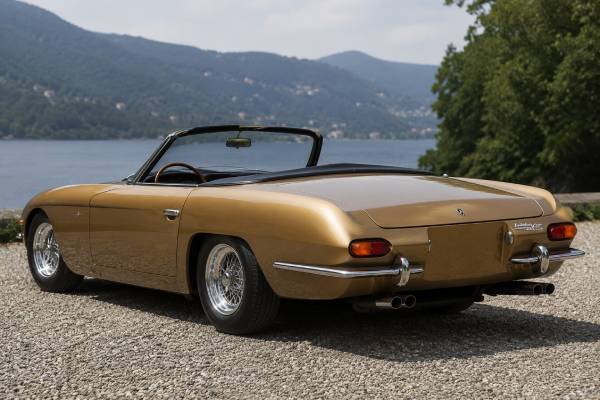
The Lamborghini 350 GTS is the open Touring-built spider version of the 350 GT, Lamborghini’s first production road car and the model that turned Ferruccio Lamborghini’s young company from an ambitious idea into a real grand-touring rival for Ferrari, Maserati, Aston Martin, and ISO. Built in 1965 in only two examples, the 350 GTS used the Tipo L350 3.5-liter V12, a front-engine layout, independent suspension, disc brakes, and coachbuilt Touring Superleggera construction. Its importance is larger than its production number suggests: it shows how quickly Lamborghini moved from a refined coupé into the idea of a factory open grand tourer. For collectors, the 350 GTS is a provenance-first car where chassis identity, body originality, factory records, restoration quality, and unique Touring details matter more than ordinary mileage or options.
Table of Contents
- Why the 350 GTS Matters
- Tipo L350 V12 and Key Specifications
- Two-Car Production and Identification
- Touring Spider Design and Engineering
- Road Character and Performance
- Maintenance, Restoration, and Weak Points
- Values, Provenance, and Buying Checks
Why the 350 GTS Matters
The 350 GTS matters because it is the rarest early expression of Lamborghini’s original grand-touring idea: a refined, front-engine V12 car with advanced engineering and restrained Italian coachwork. It was not a production spider in the modern sense. It was a two-car Touring project that tested whether Lamborghini could turn the 350 GT coupé into a true open luxury GT.
The 350 GT itself was Lamborghini’s first production model. It followed the 350 GTV prototype, softened its wilder ideas, and put the company’s engineering into a usable road car. The formula was serious for the early 1960s: an all-alloy quad-cam V12, a five-speed manual gearbox, independent suspension at all four corners, disc brakes, and hand-built coachwork. At a time when many expensive GT cars still used more traditional chassis or suspension layouts, the 350 GT looked unusually modern beneath its elegant body.
The 350 GTS sits inside that story as the missing factory spider that Lamborghini chose not to build in series. Touring took the basic 350 GT platform and gave it open bodywork, a cleaner rear deck, frameless door glass, and spider-specific trim. The result was a car aimed at the same rarefied world as the Ferrari 275 GTS, Maserati Mistral Spyder, and Aston Martin DB5 Convertible. It had the correct ingredients for a glamorous 1960s open GT, but Ferruccio Lamborghini did not approve regular production.
That decision makes the 350 GTS especially important today. Most rare cars are rare because sales were slow, costs were high, or survival rates were poor. The 350 GTS is rare because it barely entered existence. Only two were built, both tied to Touring and both linked to the earliest Lamborghini chassis sequence. This makes each car a historical object as much as a vehicle.
The model also shows Lamborghini before the Miura changed the company’s image. Later Lamborghinis became known for wedge shapes, mid-engine layouts, scissor doors, and dramatic visual impact. The 350 GTS belongs to the earlier Ferruccio-era vision: fast, technically sophisticated, expensive, comfortable, and elegant rather than theatrical. It is a car for long-distance travel, not poster-wall shock.
For enthusiasts, that makes the 350 GTS fascinating because it feels like Lamborghini before the brand became a caricature of itself. For collectors, it is important because it combines several high-value attributes in one car:
- First-generation Lamborghini history
- Touring Superleggera coachwork
- Tipo L350 V12 engineering
- Two-car production
- Factory spider bodywork rather than a later conversion
- Chassis-specific provenance
- Extreme difficulty of replacement parts and restoration
The 350 GTS is not the easiest Lamborghini to explain to casual observers, but it is one of the easiest to justify to serious historians. It answers a specific question: what would Lamborghini’s first open V12 grand tourer have looked like if the company had committed to production in 1965?
Tipo L350 V12 and Key Specifications
The useful way to read 350 GTS specifications is to treat them as 350 GT-based figures with spider-specific uncertainty. Both GTS cars used the same basic Tipo L350 3,464 cc V12 platform and early 350 GT chassis architecture, but exact weights, trim details, and individual mechanical histories can differ by chassis.
| Category | Specification |
|---|---|
| Model | Lamborghini 350 GTS |
| Production year | 1965 |
| Body style | Two-seat open spider by Carrozzeria Touring |
| Engine code/type | Tipo L350, 60-degree V12 |
| Displacement | 3,464 cc |
| Construction | All-alloy engine, dual overhead camshafts per bank, two valves per cylinder |
| Induction | Six Weber sidedraft carburetors |
| Output | About 280 bhp in commonly listed 350 GT road tune |
| Lubrication | Wet sump for road use |
| Transmission | Five-speed manual |
| Drivetrain | Front engine, rear-wheel drive |
| Rear axle | Salisbury limited-slip differential on early 350 GT specification |
| Suspension | Independent double wishbones with coil springs and anti-roll bars |
| Brakes | Four-wheel Girling disc brakes |
| Wheelbase | 2,550 mm 350 GT platform basis |
| Fuel capacity | Two rear-mounted tanks totaling about 80 liters on 350 GT basis |
The V12 was advanced but softened for road use
The Tipo L350 V12 began as an ambitious, high-revving engine concept associated with Giotto Bizzarrini’s work on the 350 GTV prototype. For the production 350 GT, Lamborghini’s engineers made it more usable. The road engine moved away from the racing-style edge of the prototype and toward smoothness, reliability, and drivability.
The changes mattered. The dry-sump layout of the prototype was not needed for a luxury road car, so the production unit used wet-sump lubrication. Carburetion changed to sidedraft Webers for better packaging under the bonnet. Compression and cam timing were also made more road friendly. The result was still exotic: a small-displacement, quad-cam V12 that loved revs, sounded crisp, and gave Lamborghini a technical calling card from day one.
The 280 hp figure should be understood in period context. Early Lamborghini output claims vary across sources and can be quoted as bhp, hp, or CV depending on market and period material. A buyer should not judge a real 350 GTS only by a headline horsepower number. Engine number, carburetor type, internal specification, restoration records, and dyno behavior after rebuild matter more.
Chassis and suspension were serious for 1965
The 350 GT platform was not a crude ladder-frame grand tourer. It used a tubular chassis, independent suspension, coil springs, telescopic dampers, and anti-roll bars. That gave the car better high-speed composure than many older GT designs and helped Lamborghini market the 350 GT as a technically superior alternative to established rivals.
For the 350 GTS, that platform was both a strength and a restoration challenge. The open body removed the coupé roof structure, so the condition of the chassis, sills, floors, bulkheads, and door apertures is critical. Door fit and shut lines are not just cosmetic details on a coachbuilt spider; they can reveal whether the structure has moved, been repaired poorly, or lost stiffness over time.
Performance figures need careful reading
Period 350 GT performance is usually quoted around 0–100 km/h in the high-six-second range and a top speed around 250 km/h, or roughly 155 mph. The GTS should be considered broadly similar, but there is no reason to treat coupé figures as exact spider test results. Open-body aerodynamics, weight, hood condition, gearing, tire choice, engine tune, and restoration quality all affect real performance.
That said, the 350 GTS was genuinely fast for its time. More important, it delivered speed in the character of a refined V12 grand tourer: long-legged, mechanical, smooth, and expensive-feeling rather than raw or competition-focused.
Two-Car Production and Identification
The 350 GTS production story is simple in number and complex in detail: only two cars were built, and each must be treated by its own chassis history. There is no broad “model-year range,” no normal factory options list, and no large sample of cars from which to define typical equipment.
The two accepted 350 GTS chassis are:
| Chassis | Original identity commonly associated with the car | Key identification notes |
|---|---|---|
| 0325 | Gold exterior with dark interior in period references | Known as one of the two Touring-built open 350 GTS spiders |
| 0328 | Black exterior with green interior in period references | Often noted with a factory hardtop |
Because only two cars exist, authentication is not about decoding a common option plate. It is about proving that the car in front of you is one of the two period-built Touring spiders and that its body, chassis, engine, gearbox, trim, and history align with recognized records.
What separates a 350 GTS from a converted 350 GT
A genuine 350 GTS is not simply a 350 GT coupé with the roof removed. Touring altered the rear body, side glass, hood storage, cockpit details, and exterior proportions. Important identifying areas include:
- Flush spider-style rear deck
- Open-body hood storage arrangement
- Frameless single-piece door glass
- Spider-specific seating and trim details
- Correct Touring body construction methods
- Period-correct chassis identity
- Known documentation chain
- Factory or recognized specialist restoration records
A later conversion, even if beautifully executed, would not have the same historical value. This distinction is vital because the open 350 GT shape is attractive enough that a conversion could tempt future sellers or restorers. A buyer should require evidence, not a story.
Factory records and Polo Storico documentation matter
For any early Lamborghini, documentation is valuable. For a 350 GTS, it is central to the car’s identity. A serious file should include as much as possible:
- Chassis number history
- Engine and gearbox number records
- Touring body references
- Early registration or delivery documents
- Historic photographs
- Restoration invoices
- Ownership chain
- Correspondence with Lamborghini specialists
- Polo Storico certification or comparable factory heritage documentation where available
- Concours records, if the car has been shown
Small details can have large value effects. A correct hardtop, original seats, original instruments, unique body trim, or period photographs showing the car before later restoration can matter more than cosmetic freshness.
Production changes around the 350 GT affect the GTS context
The 350 GT line changed during its short life. Early cars were largely aluminum-bodied Touring Superleggera examples. Later cars introduced different trim, body, gearbox, and drivetrain details depending on timing and specification. Some late cars blurred into 400 GT “interim” territory, and production totals can vary depending on how sources count standard 350 GTs, spiders, specials, and later transitional cars.
That is why the 350 GTS should not be evaluated by generic 350 GT rules alone. The buyer needs to know which 350 GT parts are correct for the particular chassis, which GTS-only parts belong there, and which details reflect later restoration work.
Touring Spider Design and Engineering
The 350 GTS design is important because it translates the refined 350 GT coupé into a lower, cleaner, more relaxed open GT without losing the early Lamborghini character. It is not dramatic in the later Countach sense; its appeal is in proportion, surface quality, hand-built detail, and restraint.
Carrozzeria Touring’s role is central. Touring was one of Italy’s great coachbuilders, known for the Superleggera method that used small-diameter steel tubes to support lightweight aluminum body panels. On the 350 GT, this gave Lamborghini a body that was elegant, expensive to build, and closely tied to traditional Italian coachbuilding. On the GTS, the same craft had to work without the visual and structural help of a fixed roof.
The spider body removed the coupé roofline and created a smoother rear deck. This changed the personality of the car. The coupé has a formal grand-touring shape with a large glass area and a slightly unusual early-Lamborghini face. The GTS looks more leisure-oriented and more exclusive. With the hood lowered, the car becomes cleaner and more horizontal, emphasizing the long bonnet and compact cabin.
Open-body packaging
The hardest part of converting a coupé design into a proper spider is not cutting away the roof. It is packaging the hood, maintaining door fit, controlling body movement, and preserving a finished look with the top up or down. Touring’s solution gave the 350 GTS a concealed hood arrangement, a tidy rear deck, and side glass that avoided a heavy framed look.
That matters for restoration. A poor hood frame, incorrect fabric, weak seals, or misaligned side glass can ruin the car’s usability and appearance. On a two-car model, replacement pieces cannot simply be ordered from a shelf. They must be restored, fabricated, or reverse-engineered with extreme care.
Interior character
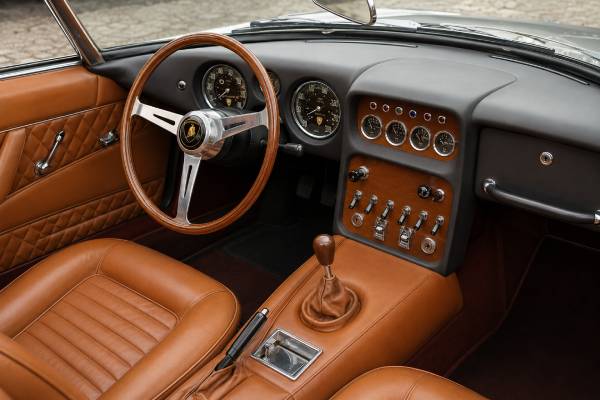
The 350 GT cabin was luxurious for its time, with leather, quality instrumentation, and a refined driving position. The GTS kept the same basic grand-touring purpose but used spider-specific cabin details. Low-backed seats and central control-panel wood inserts are often associated with the GTS layout.
The cockpit should feel like an early handmade GT, not a race car. The driver faces a wood-rimmed steering wheel, large instruments, mechanical switchgear, and a long bonnet ahead. Visibility is a major part of the charm. Unlike later low-slung supercars, the 350 GTS gives the driver a good view out, slim pillars when the roof is up, and a relaxed sense of space when open.
Sound and sensory appeal
The 350 GTS is valuable partly because of how it would have felt in period. The front-mounted V12 sits under a long bonnet, breathing through multiple carburetors and sending its sound through a relatively simple exhaust system. The sound is not the hard-edged howl of a later mid-engine Lamborghini. It is smoother, more mechanical, and more intimate.
In an open car, intake noise, exhaust note, gear whine, tire sound, and wind all become part of the experience. That sensory quality is one reason the GTS idea made sense. The 350 GT was already elegant and fast; the GTS made the same mechanical package more emotional without abandoning refinement.
Road Character and Performance
A properly sorted 350 GTS should feel like a fast, refined 1960s V12 grand tourer, not a modern supercar. Its performance is strong for the era, but the real attraction is the blend of throttle response, mechanical feel, visibility, ride quality, and open-air V12 sound.
The engine is the center of the experience. A small-displacement V12 with six carburetors does not behave like a large lazy engine. It rewards clean tune, warm oil, correct ignition, synchronized carburetors, and a driver who lets it rev. When everything is right, it should pull smoothly from moderate speeds and become more exciting as the revs rise.
The gearbox is also part of the car’s personality. A period five-speed manual needs mechanical sympathy, especially when cold. Quick, careless shifts can punish synchros and linkages. A good car should feel positive once warm, while a tired example may show baulking, noise, or vague engagement.
The steering should be honest rather than light. At parking speeds, a front-engine V12 Lamborghini on period-size tires will not feel effortless. Once moving, the car should become more natural, with a clear sense of front-end load and good straight-line stability. The long wheelbase helps high-speed touring, while the independent suspension keeps the car from feeling old-fashioned.
Braking expectations need period context. Four-wheel discs were advanced for the car’s era, but the system still depends on correct hydraulic condition, proper pads, fresh fluid, sound boosters, and well-restored calipers. A 350 GTS should stop confidently by 1960s GT standards, but it will not feel like a modern carbon-ceramic supercar. Pulling, vibration, long pedal travel, or dragging brakes are warning signs.
What a good example should feel like
A healthy 350 GTS should show:
- Stable idle once warm
- Clean throttle response after carburetor setup
- Even oil pressure behavior
- Controlled coolant temperature in traffic and at speed
- Smooth clutch take-up
- Positive gearbox action when warm
- Straight tracking under braking
- No obvious scuttle shake beyond what is normal for a coachbuilt open car
- Predictable cornering balance
- No fuel smell beyond brief cold-start richness
The phrase “sorted” matters. A freshly restored early Lamborghini can still drive poorly if the carburetors, ignition, suspension geometry, brakes, and cooling system have not been set up by someone who knows the cars. Cosmetic restoration and road fitness are not the same thing.
How a tired car feels
A tired or poorly restored 350 GTS may still look magnificent, but it will often reveal itself quickly on the road. Watch for hot starting trouble, uneven running, heavy smoke, gearbox noise, drivetrain clunks, brake imbalance, steering wander, vibration through the body, and doors that move or rattle over uneven surfaces.
Open coachbuilt cars can also hide structural issues behind fresh paint. If the body flexes too much, if the hood no longer aligns, or if the doors change gaps when the car is lifted, the problem may be deeper than trim adjustment.
Maintenance, Restoration, and Weak Points
The 350 GTS is not maintained like a used exotic; it is preserved like a coachbuilt artifact with a complex V12. The main risks are not ordinary reliability ratings but originality loss, poor structural repair, incorrect restoration decisions, unavailable unique parts, and expensive mechanical rebuilds.
The Tipo L350 V12 can be durable when maintained correctly, but it is not simple. It has multiple carburetors, two cylinder banks, chain-driven valve gear, period ignition hardware, and cooling needs that must be respected. Any inspection should include compression and leak-down tests, oil pressure behavior, coolant condition, carburetor setup, ignition health, and evidence of previous engine work.
Engine and fuel-system concerns
Common areas to inspect include:
- Carburetor wear, leaks, throttle-shaft play, and synchronization
- Fuel hoses, tanks, pumps, filters, and stale-fuel damage
- Ignition distributors, coils, wiring, and timing accuracy
- Oil leaks from cam covers, sump joints, seals, and front covers
- Cooling system corrosion, radiator capacity, fans, hoses, and water pump condition
- Exhaust manifold cracks or incorrect replacement systems
- Evidence of overheating or repeated head-gasket trouble
Because the engine is central to the car’s value, a rebuild must be documented in detail. “Rebuilt engine” is not enough. The file should show who did the work, what was measured, which parts were reused, which were made, and how the engine was run in and tuned afterward.
Gearbox, clutch, and driveline
The five-speed gearbox is part of the 350 GT’s appeal, but parts and expertise are limited. A buyer should check for noisy bearings, weak synchros, oil leaks, poor clutch release, and incorrect later substitutions. Some cars in the 350 GT family have received drivetrain updates for drivability, and those changes may or may not suit the value goals of a specific car.
For the GTS, originality has a higher premium than convenience. A later gearbox, replacement differential, or non-original engine does not automatically make a car unusable, but it changes the value conversation. The original removed components, if present and documented, can greatly reduce the damage to collectability.
Body, chassis, and corrosion
The body is the most dangerous area financially. Touring Superleggera construction is beautiful but demanding. Aluminum panels over steel structures can suffer from corrosion, electrolytic reaction, cracking, filler-heavy repairs, and poor previous restoration. The buyer should inspect:
- Chassis tubes and suspension pickup points
- Sills, floors, bulkheads, and lower door areas
- Front nose and headlight surrounds
- Rear deck and hood storage area
- Door gaps under load and with the car lifted
- Evidence of accident repair
- Aluminum skin condition under paint
- Correct hood frame and sealing
- Hardtop fit if the car has one
- Original Touring body tags or references where applicable
A car can look excellent in photographs and still require deep structural correction. This is especially true if it has been restored more than once across different decades.
Interior and unique trim
Trim is not a minor issue on a 350 GTS. Unique seats, switches, gauges, glass, frames, hood hardware, and brightwork may be impossible to replace quickly. Incorrect leather grain, modern carpet, wrong instrument finishes, poor woodwork, or missing small parts can reduce both authenticity and visual quality.
The best restorations preserve original pieces where possible and reproduce missing parts only after proper research. Over-restoration can be a problem too. A 350 GTS should not look like a modern reinterpretation of a 1965 car. It should look precise, handmade, and period-correct.
Service rhythm
A 350 GTS needs regular use and specialist care. Long storage is harmful. Fuel systems gum up, seals dry, brake hydraulics degrade, tires age, and electrical contacts corrode. A sensible ownership plan includes annual fluid checks, frequent exercise, carburetor and ignition attention, brake inspection, cooling-system monitoring, and tire replacement based on age as much as tread.
There is no single modern service schedule that covers every car because each has a different restoration history. The correct approach is to build a maintenance plan from the car’s actual condition, official service literature where available, and advice from an early Lamborghini specialist.
Values, Provenance, and Buying Checks
The 350 GTS market is not a normal market because only two cars exist. A public price guide for 350 GT coupés can help set context, but a real 350 GTS valuation depends on identity, provenance, originality, restoration quality, and the private appetite of a tiny buyer pool.
Standard 350 GT coupés have traded in the mid-six-figure range in recent auction history, with exceptional early, aluminum-bodied, restored, or highly original cars bringing stronger money. The 350 GTS should logically sit far above a normal coupé because it is a factory-related two-car spider. But because public GTS sales are extremely rare, any precise value claim should be treated carefully.
A serious buyer should think in layers:
| Value factor | Why it matters |
|---|---|
| Chassis identity | The car must be proven as one of the two period Touring-built GTS examples. |
| Original body | Touring spider coachwork is the heart of the car’s value. |
| Matching numbers | Original engine, gearbox, and body references support authenticity and price. |
| Documentation | Factory records, ownership chain, restoration invoices, and period photos reduce risk. |
| Restoration quality | Poor structural or cosmetic work can be extremely expensive to correct. |
| Unique parts | Hardtop, hood hardware, seats, glass, and trim are difficult to replace. |
| Color and presentation | Original or historically documented colors are usually stronger than speculative changes. |
| Concours history | Recognition at major events can support quality and public provenance. |
Buyer inspection priorities
A buyer should not start with paint condition. Start with identity. The correct inspection order is:
- Confirm the chassis number and its documented history.
- Confirm whether the engine, gearbox, body, and major trim align with known records.
- Review factory, Polo Storico, Touring, registration, and ownership documents.
- Study period photographs against the car’s current body details.
- Inspect chassis structure and body construction before judging cosmetics.
- Test the engine, gearbox, brakes, suspension, steering, and cooling system.
- Review restoration invoices and specialist names.
- Price the car against risk, not just rarity.
Cars to seek and cars to avoid
Seek a car with a complete paper trail, known ownership chain, correct body details, specialist restoration records, and retained original components. The ideal example does not need to be perfect, but it must be honest. A well-preserved car with older paint, original trim, and strong documentation may be more important than a visually flawless car with missing history.
Avoid any car where the story depends on vague claims. Warning signs include missing chassis evidence, unclear conversion history, incorrect spider details, heavy filler, undocumented engine replacement, modernized interior trim, poor hood fit, repeated color changes with no record, or restoration work done by shops with no early Lamborghini experience.
Ownership risk and long-term collectability
The 350 GTS is highly collectible because it combines first-generation Lamborghini history, Touring coachbuilding, a V12 drivetrain, and two-car rarity. Its long-term appeal should remain strong among collectors who value early Italian GTs, but liquidity will always be narrow. The buyer pool is small, sophisticated, and documentation-focused.
The biggest ownership risk is not that the car will become unwanted. It is that a buyer pays for rarity before understanding condition. A 350 GTS with hidden structural problems, incorrect parts, or weak documentation can become a costly restoration and authentication challenge. A correct car, maintained carefully and shown with proper records, is one of the most historically interesting front-engine Lamborghinis.
References
- Lamborghini History – 350 GT | Lamborghini.com 2026 (Manufacturer History)
- Milestones | Lamborghini.com 2026 (Manufacturer History)
- Lamborghini 350 GT returns to Geneva 60 years later 2024 (Manufacturer News)
- Lamborghini 350 GT & 350 GTS Guide — Supercar Nostalgia 2022 (Historical Guide)
- Lamborghini 350 GT Market – CLASSIC.COM 2026 (Market Data)
Disclaimer
This article is for informational purposes only and is not a substitute for professional diagnosis, repair, restoration advice, valuation, or authentication. Specifications, torque values, service intervals, procedures, components, and correct finishes can vary by chassis number, market, equipment, restoration history, and factory documentation. Always verify details against official service literature, factory heritage records, and a qualified early Lamborghini specialist before buying, restoring, servicing, or valuing a Lamborghini 350 GTS.
If this guide helped you, please share it on Facebook, X/Twitter, or your preferred car community to support our work.