
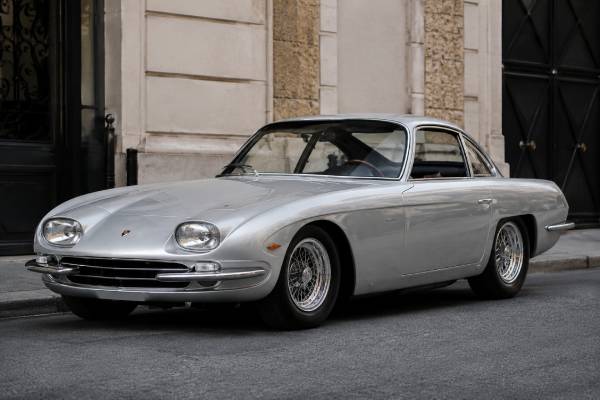
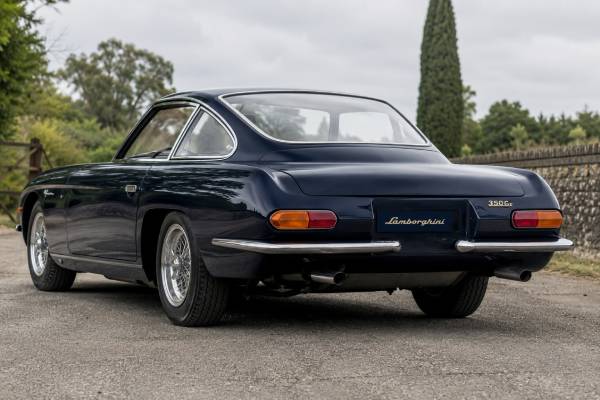
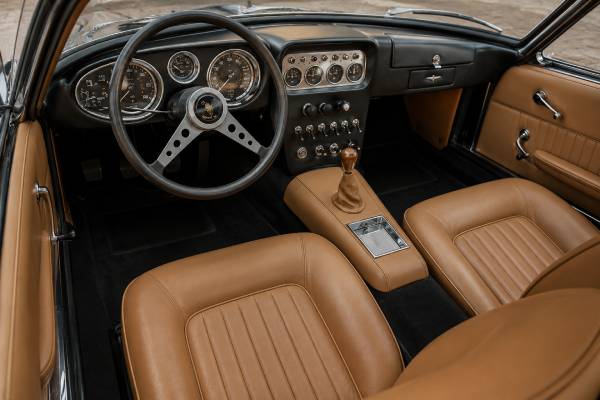
The Lamborghini 350 GT is the car that turned Ferruccio Lamborghini’s idea into a real production marque. Built from 1964 to 1966, it was Lamborghini’s first customer road car and used a front-mounted 3.5-liter V12, a five-speed ZF manual gearbox, independent suspension, four-wheel disc brakes, and Touring Superleggera aluminum coachwork. That mix gave Lamborghini instant credibility against Ferrari, Maserati, Aston Martin, and other grand touring rivals of the period.
Today, the 350 GT matters because it is both historically important and genuinely usable by early-1960s exotic standards. It is rare, hand-built, mechanically sophisticated, and central to the story of Lamborghini’s V12 identity. Buyers care about originality, matching numbers, Touring body integrity, restoration quality, and factory documentation. Enthusiasts care because the 350 GT shows Lamborghini before the visual drama of the Miura and Countach: elegant, restrained, technically ambitious, and built around one of the most important V12 engine families in Italian car history.
Table of Contents
- Why the 350 GT Started Lamborghini
- Tipo L350 Engine, Chassis, and Specs
- Production, Variants, and Authenticity Clues
- Touring Superleggera Design and Engineering
- How the 350 GT Drives
- Maintenance, Restoration, and Known Risks
- Market Values and Buying Checklist
Why the 350 GT Started Lamborghini
The 350 GT is important because it was Lamborghini’s first production car, not just an early experiment. It proved that the new Sant’Agata company could build a refined, fast, expensive grand tourer with its own V12 identity rather than merely challenge Ferrari with talk.
The car followed the 350 GTV prototype shown in 1963. That prototype was dramatic, but it was not ready for series production. The 350 GT turned the idea into something usable: a front-engine, rear-drive Italian GT with a proper cabin, road-friendly engine tuning, a production-ready chassis, and bodywork by Carrozzeria Touring of Milan.
Ferruccio Lamborghini’s original aim was not to build a stripped racing car. He wanted a fast, civilized road car with engineering depth, strong comfort, and better refinement than the high-strung exotics he knew as a customer. That mission shaped the 350 GT. It had a long bonnet, compact cabin, elegant proportions, and a four-cam V12 that sounded exotic without being tuned only for track use.
The car debuted in production form at the Geneva Motor Show in March 1964, less than a year after Automobili Lamborghini was founded. Customer production followed in 1964, and the model remained in the range until the arrival of the 400 GT and 400 GT 2+2. In brand history, the 350 GT sits before the Miura, Espada, Islero, Jarama, Countach, and every later V12 flagship. It is the origin point.
Several names matter in the story:
- Giotto Bizzarrini created the original V12 concept.
- Gian Paolo Dallara and Paolo Stanzani helped turn the engine and chassis into a road car.
- Bob Wallace contributed development and testing knowledge.
- Carrozzeria Touring created the Superleggera body construction and final production styling.
- Ferruccio Lamborghini set the brief: fast, technical, luxurious, and usable.
The 350 GT was also a clear statement of Lamborghini’s early philosophy. It had a V12 when that was still rare and expensive. It used all-independent suspension when many grand tourers still relied on more traditional rear axle layouts. It used disc brakes all around. It had a five-speed gearbox when some rivals still offered four speeds. The result was a car that felt modern for the mid-1960s and helped establish Lamborghini as a serious manufacturer.
Its reputation today is different from the louder Lamborghini icons that came later. The 350 GT is not a wedge-shaped poster car. It is quieter, more elegant, and more coachbuilt. Collectors value it because it combines first-model significance, low production, aluminum Touring bodywork, and the earliest form of the Lamborghini V12 road-car line. Enthusiasts value it because it shows the brand before excess became part of its identity.
Tipo L350 Engine, Chassis, and Specs
The 350 GT’s main technical appeal is its 3.5-liter quad-cam V12 matched to a sophisticated chassis for its time. It was not just a pretty coachbuilt coupe; it had the hardware to compete with the best European GTs of the mid-1960s.
| Category | Specification |
|---|---|
| Production years | 1964–1966 |
| Body style | Two-door grand touring coupe |
| Layout | Front engine, rear-wheel drive |
| Engine | 60-degree aluminum V12 |
| Displacement | 3,464 cc |
| Bore x stroke | 77 mm x 62 mm |
| Valve gear | Double overhead camshafts, two valves per cylinder |
| Fuel system | Six twin-choke Weber carburetors |
| Power | 280 hp at 6,500 rpm |
| Torque | 325 Nm at 4,500 rpm |
| Transmission | ZF five-speed manual |
| Differential | Salisbury limited-slip differential |
| Suspension | Independent front and rear, wishbones, coil springs, telescopic dampers |
| Brakes | Servo-assisted Girling discs front and rear |
| Wheelbase | 2,550 mm |
| Length | 4,640 mm |
| Width | 1,730 mm |
| Height | 1,220 mm |
| Fuel capacity | 80 liters |
The engine is the centerpiece. Bizzarrini’s original V12 was conceived with a much more aggressive character, but Lamborghini’s production engineers made it more suitable for road use. The 350 GT version used wet-sump lubrication, six Weber carburetors, a 9.5:1 compression ratio, and a chain-driven camshaft layout. It still had serious output for the time, but its purpose was high-speed touring rather than racing.
The five-speed ZF manual gearbox was a major part of the car’s appeal. A five-speed transmission gave the 350 GT better flexibility than many period four-speed GTs. The top gear allowed quieter high-speed cruising, while the lower gears kept the V12 in its useful rev range. The Salisbury limited-slip differential helped traction and stability, especially during hard acceleration out of bends.
The chassis used a steel tube structure beneath Touring’s Superleggera body. Suspension was independent at all four corners, with coil springs and telescopic dampers. This gave the 350 GT a more advanced road feel than many older grand tourers, especially on fast, uneven roads. Girling disc brakes on all four wheels were also important because the car could reach serious speeds.
| Measure | Figure |
|---|---|
| 0–100 km/h | About 6.8 seconds |
| Top speed | About 250 km/h / 155 mph |
| Standing kilometer | About 25 seconds |
Weight figures vary by source because some quote dry weight, some quote kerb weight, and some include different equipment or fluids. For buyers, the exact number matters less than the condition of the chassis and body. A correctly restored 350 GT should feel light, balanced, and responsive for a luxury V12 coupe of its era. A tired one can feel heavy, loose, and expensive before the first invoice arrives.
Production, Variants, and Authenticity Clues
The safest way to understand the 350 GT is to separate the true 3.5-liter cars from later 4.0-liter interim cars and restorations that have changed over time. Production numbers are often quoted differently, so buyers should verify each car by chassis, engine, body number, and factory records rather than relying only on a listing description.
Most collector-market references identify about 120 350 GT coupes built with the 3.5-liter V12. Lamborghini’s own historical summary uses broader production wording, and many discussions also include related cars such as the 400 GT Interim and the two 350 GTS Spiders. This is why provenance matters so much. A car described simply as a “350 GT” may be an original 3.5-liter car, a 350 GT body later fitted with a 4.0-liter engine, or one of the rare interim cars that bridge the 350 GT and 400 GT.
Main 350 GT-related versions
| Version | Why It Matters |
|---|---|
| 350 GT coupe | The core production model with 3.5-liter V12 and Touring Superleggera coupe body. |
| 350 GTS Spider | Extremely rare open version built by Touring; only a tiny number were made. |
| 400 GT Interim | Transitional cars with 350 GT-style bodywork and the later 4.0-liter V12. |
| 400 GT 2+2 | The successor with revised body packaging, 4.0-liter engine, and more practical seating. |
Early cars can show small hand-built differences. Touring’s construction method, low production volume, and Lamborghini’s rapid development cycle mean that details may vary between examples. Buyers should not assume every minor difference is wrong, but they should demand documentation for any major change.
Important identification and authenticity checks include:
- Chassis number and engine number correspondence.
- Touring body number and bodywork identity.
- Original engine displacement.
- Gearbox type and whether the original gearbox remains with the car.
- Factory build sheet or Lamborghini Certificate of Original Configuration.
- Polo Storico certification or documentation where available.
- Original color and trim combination.
- Evidence of previous accident damage or major body reconstruction.
- Period photos, long-term ownership records, import papers, and restoration invoices.
Factory colors and interiors varied, and special-order combinations are part of the appeal. A rare original color can add interest, but originality matters more than drama. A tasteful repaint in a non-original shade may look beautiful, yet it usually needs to be priced with that change in mind unless the market strongly favors the specific car’s provenance or restoration quality.
The 350 GT also raises a common collector question: is a later 4.0-liter conversion bad? Not always, but it changes the car’s identity. Some owners fitted the larger 4.0-liter V12 because it offered stronger performance and better parts availability. For driving, that can be attractive. For highest-level collecting, an original 3.5-liter engine with matching documentation is usually more desirable.
A buyer should treat “matching numbers” as a claim to prove, not a phrase to trust. The most valuable cars are those with continuous identity: correct chassis, correct engine, correct Touring body, known ownership history, and restoration work that did not erase factory details. A visually perfect car with unclear numbers can be a weaker purchase than a slightly less polished but thoroughly documented example.
Touring Superleggera Design and Engineering
The 350 GT looks restrained because Lamborghini’s first production car was meant to be an elegant high-speed GT, not a theatrical supercar. Its design strength is proportion, detail, and construction rather than shock value.
Touring’s Superleggera method used aluminum panels over a lightweight tubular framework. The approach helped reduce weight and gave the car its fine, coachbuilt surface quality. It also means every body is a serious restoration project if damaged. Aluminum panels, steel tubes, and hand-built fit are a very different ownership proposition from a mass-produced steel-bodied car.
The exterior shape has classic early-1960s Italian GT proportions: long hood, short rear deck, slim pillars, large glass area, and a cabin set back over the rear half of the wheelbase. Compared with the 350 GTV prototype, the production 350 GT was cleaner and more mature. It lost some show-car drama but gained balance and usability.
Key design features include:
- Long bonnet to house the V12.
- Low roofline with good glass area.
- Slim chrome bumpers and brightwork.
- Touring badging and Superleggera construction details.
- Borrani wire wheels on many cars.
- Elegant rear quarters instead of the later wedge-like Lamborghini look.
- A cabin focused on leather, wool carpeting, clear instruments, and long-distance comfort.
The body construction creates both beauty and risk. Superleggera bodies can hide corrosion in the steel tubes beneath aluminum skin. Moisture trapped between dissimilar metals can cause deterioration that is hard to see from outside. A car may wear excellent paint while hiding expensive structural repairs beneath it. That is why body inspection on a 350 GT must go deeper than panel gaps and shine.
The engine packaging is traditional but impressive. The V12 sits ahead of the cabin, sending power through the ZF manual gearbox to the rear wheels. The long nose is not just styling; it gives room for the engine, cooling system, carburetors, and service access. The cooling layout matters because a poorly maintained 350 GT can suffer in modern traffic, especially if the radiator, fans, thermostat, water pump, or hoses are not healthy.
Inside, the 350 GT reflects Ferruccio Lamborghini’s preference for comfort. The cabin is not a bare racing cockpit. It is a leather-trimmed grand touring interior with rich materials and a more relaxed personality than many competition-influenced exotics. Some cars are described as two-seaters, while others use a 2+1 arrangement with a small rear seat area. In practical terms, the rear space is more useful for luggage or very occasional use than full passenger comfort.
The sound is central to the car’s character. The early Lamborghini V12 has a smoother, more mechanical tone than later, more aggressive supercars. The six Weber carburetors give the engine intake texture, and the exhaust has a refined metallic edge. A correctly tuned 350 GT should sound crisp and expensive, not harsh, smoky, or uneven.
Engineering details also show Lamborghini’s ambition. Independent suspension, disc brakes, a five-speed gearbox, and a limited-slip differential were not ordinary features in the early 1960s. The 350 GT was designed as a fast road machine with real technical confidence, and that confidence is why it still feels important today.
How the 350 GT Drives
A good 350 GT should feel like a fast, refined, mechanical grand tourer, not a modern supercar and not a fragile museum piece. Its appeal comes from smooth V12 power, elegant road manners, and the sense that every control is connected to real machinery.
The engine needs proper warm-up. Carbureted V12s do not like being started cold and immediately driven hard. A healthy 350 GT should settle into a clean idle, pull smoothly once warm, and respond sharply when the carburetors are synchronized. Hesitation, popping, fuel smell, rough idle, or flat spots often point to carburetor, ignition, fuel-pump, or distributor issues.
Power delivery is flexible by 1960s exotic standards. The engine does not need to be thrashed to feel special, but it rewards revs. The 280 hp figure was strong for the period, and the car’s speed is still meaningful on open roads. What stands out most is not just acceleration, but the way the V12 builds speed with smoothness and sound.
The ZF five-speed manual is one of the car’s best features when healthy. It should feel deliberate and mechanical. It will not shift like a modern sports car, but it should not grind, jump out of gear, or feel vague. Weak synchros, clutch drag, incorrect linkage adjustment, or tired mounts can make an otherwise strong car unpleasant.
Steering is unassisted and carries real weight at low speed. Once moving, it should lighten and provide clear front-end information. A properly set-up 350 GT should not wander badly or feel nervous. If it does, look for tire age, wire-wheel condition, suspension bush wear, steering-box wear, alignment problems, or old accident damage.
The ride is part of the car’s charm. The 350 GT was built as a grand tourer, so it should absorb roads better than many harsher sports cars. The independent suspension helps the car feel composed over uneven surfaces. Old dampers, sagging springs, worn bushings, or incorrect tires can ruin this balance.
Braking is strong for its time but still period-correct. The Girling disc brakes need a firm, progressive pedal and proper servo assistance. They should not pull to one side, fade quickly in normal driving, or require excessive pedal effort. A full brake overhaul can become expensive because calipers, lines, servo units, master cylinders, and correct setup all matter.
The car’s road character depends heavily on condition. A fully sorted 350 GT can feel surprisingly modern in balance, gearing, and touring pace. A tired car can feel old, hot, noisy, imprecise, and reluctant. This difference is why a road test with a marque specialist is so valuable. The same model can feel like a jewel or a liability depending on restoration quality and maintenance discipline.
Usability is better than many people expect. Visibility is good for a low Italian GT, luggage space is reasonable, and the engine is less peaky than the prototype story might suggest. City use is less pleasant. Heat, clutch effort, low-speed steering weight, carburetor sensitivity, and the cost of every mile encourage owners to use the car on open roads, tours, concours drives, and carefully planned events rather than daily traffic.
The best driving examples share the same signs:
- Easy hot and cold starting.
- Stable oil pressure.
- Controlled coolant temperature.
- Smooth pull through the rev range.
- Clean shifting after warm-up.
- Straight braking.
- Tight suspension feel.
- No heavy fuel smell.
- No smoke under load or on overrun.
- Calm high-speed tracking.
A 350 GT should not be judged by modern performance numbers alone. Many current hot hatchbacks can match or beat its acceleration. That misses the point. The car’s value is in the V12’s texture, the coachbuilt feel, the steering feedback, the view over the bonnet, and the direct connection to Lamborghini’s first production chapter.
Maintenance, Restoration, and Known Risks
The 350 GT can be reliable in classic exotic terms, but only when maintained by people who understand early Lamborghinis. Neglected cars are not cheap projects; they are complex V12 coachbuilt restorations with rare parts and specialist labor requirements.
The engine is robust when correctly built and serviced, but it is not simple. Six Weber carburetors, twin distributors, a large cooling system, and a hand-built V12 mean tuning quality matters. Poor setup can make the car hard to start, rough at idle, weak under load, or prone to overheating.
Common mechanical areas to inspect include:
- Carburetor wear, synchronization, jetting, and fuel leaks.
- Fuel pumps, hoses, filters, and ethanol-related deterioration.
- Marelli ignition components, distributor condition, coils, and wiring.
- Cooling system condition, including radiator core, fans, water pump, thermostat, and hoses.
- Oil leaks from engine, gearbox, and differential.
- Timing-chain noise or incorrect adjustment.
- Clutch wear, hydraulic leaks, and release issues.
- ZF gearbox synchros, bearings, and linkage adjustment.
- Salisbury differential noise, leaks, and mount condition.
Cooling deserves special attention. A 350 GT that runs cool on a country road may still struggle in slow traffic if the radiator, fans, or water passages are marginal. Buyers should not accept “they all run hot” without proof. A well-restored system should manage normal use, though it will never behave like a modern car with computer-controlled cooling.
The chassis and body are the largest financial risks. The steel tubular structure and aluminum Superleggera panels require specialist inspection. Corrosion can attack tubes hidden beneath the skin. Previous repairs may look acceptable from outside but be poor underneath. Accident damage can distort the structure and create panel-fit problems that are expensive to correct.
Important body and structure inspection points include:
- Lower chassis tubes and floor structure.
- Sills and lower body edges.
- Suspension mounting points.
- Front and rear substructure around crash-prone areas.
- Door fit and hinge areas.
- Evidence of aluminum corrosion or bubbling.
- Paint cracking around stress points.
- Poorly repaired nose or tail damage.
- Touring body number and identity.
- Fit of bonnet, doors, and boot lid.
Borrani wire wheels are beautiful but need attention. Worn splines, loose spokes, corrosion, or incorrect wheels can create vibration and safety issues. Tires should be correct in size and rating, and tire age matters even if tread looks fine. A car worth hundreds of thousands of dollars should not be driven quickly on old rubber.
Electrical systems can be another trouble spot. Age, heat, previous repairs, and added accessories can create hard-to-trace faults. Window motors, gauges, lighting, charging components, relays, and grounds should all be checked. Originality is valuable, but brittle wiring is not something to ignore.
Restoration quality varies widely. Some cars were restored decades ago when originality standards were lower and parts were harder to document. Others have been rebuilt recently to a high concours standard. A shiny restoration is not automatically a good restoration. The best work preserves factory identity, uses correct materials, documents every stage, and avoids over-modernizing the car.
Documentation should include as much as possible:
- Factory certificate or Lamborghini Polo Storico records.
- Build sheet copies or original configuration documents.
- Engine, gearbox, chassis, and body-number evidence.
- Restoration photos showing bare structure and repairs.
- Invoices from recognized specialists.
- Ownership history.
- Import and registration records.
- Period manuals and tool kit details where available.
Parts availability is better than it once was because Lamborghini Polo Storico and marque specialists support historic cars, but “available” does not mean inexpensive or quick. Correct parts may require rebuilding originals, sourcing rare used components, or commissioning specialist fabrication. Any missing trim, instruments, glass, body hardware, or unique Touring details can be surprisingly costly.
Owners should budget like they are maintaining an early V12 exotic, not an ordinary classic. Annual servicing, carburetor tuning, fluids, brake maintenance, and sorting work can be manageable for a well-kept car. Major engine, gearbox, body, or chassis work can move quickly into six-figure territory. The cheapest 350 GT to buy is rarely the cheapest one to own.
Market Values and Buying Checklist
The 350 GT sits in a serious collector tier because it is Lamborghini’s first production model, but values depend sharply on originality, history, condition, and documentation. As of the 2026 market, good public data places many usable or good-quality cars around the mid-six-figure range, while exceptional early, matching-numbers, concours-ready cars can sell higher.
Recent market references show a broad range rather than one simple price. Public listings and auction results have shown project-level or compromised cars in the lower hundreds of thousands, good cars around the $500,000 to $700,000 area, and top examples or special-provenance cars above that when the right bidders are present. Currency, venue, restoration quality, and paperwork can move the result significantly.
| Value Factor | Why It Matters |
|---|---|
| Matching numbers | Correct original engine, chassis, gearbox, and body identity support top-tier collectability. |
| Factory documentation | Build records, certificates, and Polo Storico evidence reduce authenticity risk. |
| Restoration quality | Correct structural, mechanical, and cosmetic work protects value and usability. |
| Original color and trim | Rare or attractive original combinations can improve desirability. |
| Body integrity | Touring Superleggera repairs are specialist work and can be very expensive. |
| Mechanical health | Engine, gearbox, brakes, and suspension condition affect immediate ownership cost. |
| Provenance | Early production, notable ownership, concours history, or factory significance can add value. |
| Completeness | Missing trim, tools, manuals, and rare components can be difficult to replace. |
The best 350 GT to buy is usually not the cheapest and not always the shiniest. It is the car with the clearest identity, the strongest documentation, the best structural condition, and the most transparent recent maintenance. A no-stories car with a slightly older restoration may be safer than a freshly painted car with weak paperwork.
Pre-purchase inspection checklist
A serious buyer should inspect the car in stages:
- Confirm identity: chassis number, engine number, gearbox number, Touring body number, and paperwork.
- Review factory documentation: certificate, build sheet, original colors, delivery details, and Polo Storico records if available.
- Inspect structure: lower tubes, sills, floors, suspension mounts, nose, tail, and evidence of old repairs.
- Check bodywork: panel fit, aluminum corrosion, paint depth, stress cracks, door operation, and bonnet fit.
- Test mechanical health: compression, leak-down, oil pressure, coolant behavior, carburetion, ignition, and exhaust smoke.
- Assess driveline: clutch feel, gearbox synchros, differential noise, mounts, and leaks.
- Evaluate chassis feel: steering play, suspension bushings, dampers, wheel condition, tires, and alignment.
- Check brakes: servo function, caliper condition, line age, pedal feel, and straight stopping.
- Verify interior correctness: seats, instruments, switches, carpets, leather, trim, and any missing parts.
- Price the risk: estimate immediate sorting, long-term maintenance, and any authenticity discount before negotiating.
Avoid cars with unclear identity, hidden structural damage, missing rare parts, poor hot-running behavior, or vague restoration claims. Be cautious with cars described as “recently recommissioned” after long storage unless the work is documented in detail. Recommissioning a V12 Lamborghini after years of inactivity can require fuel system, brake system, cooling system, suspension, electrical, and carburetor work before the car is safe and dependable.
Cars converted to 4.0-liter power can be enjoyable, but they should not be priced like untouched 3.5-liter matching-numbers examples unless there is a specific collector reason. Similarly, concours restoration can justify a premium only when the work is correct, documented, and recognized by knowledgeable Lamborghini specialists.
Long-term collectability looks strong. The 350 GT has everything serious collectors tend to value: first production model, V12 engine, low production, coachbuilt body, important engineering names, and direct brand significance. It is less famous than the Miura, but that may be part of its appeal. It is the thinking collector’s early Lamborghini: elegant, usable, rare, and foundational.
The right 350 GT is best bought with patience. There are not many cars, and public sales are infrequent. Buyers should be ready to move when a documented example appears, but they should also be willing to walk away from a car with expensive unanswered questions. In this market, missing proof can cost as much as missing parts.
References
- Lamborghini History – 350 GT | Lamborghini.com 2026
- Lamborghini Polo Storico 2026
- Lamborghini 350 GT – Specs & Performance – LamboCars 2015
- Lamborghini 350 GT Market – CLASSIC.COM 2026
- 1964 Lamborghini 350 GT by Touring | The Monaco Auction 2026 | RM Sotheby’s 2026
Disclaimer
This article is for informational purposes only and is not a substitute for professional diagnosis, repair, restoration advice, valuation advice, or pre-purchase inspection. Specifications, torque values, service intervals, restoration procedures, and correct parts can vary by chassis number, market, equipment, production changes, and previous work. Always verify details against official service documentation, factory records, and a qualified Lamborghini specialist before buying, repairing, restoring, or driving a Lamborghini 350 GT.
If you found this guide useful, please consider sharing it on Facebook, X/Twitter, or your favorite car community to support our work.