
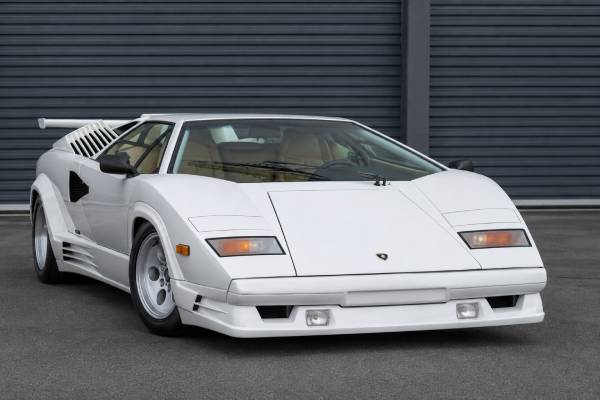
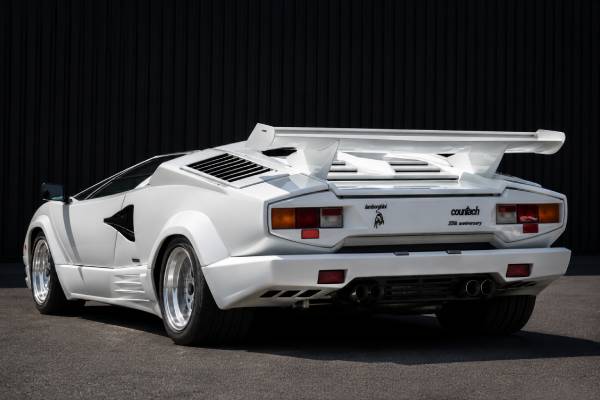
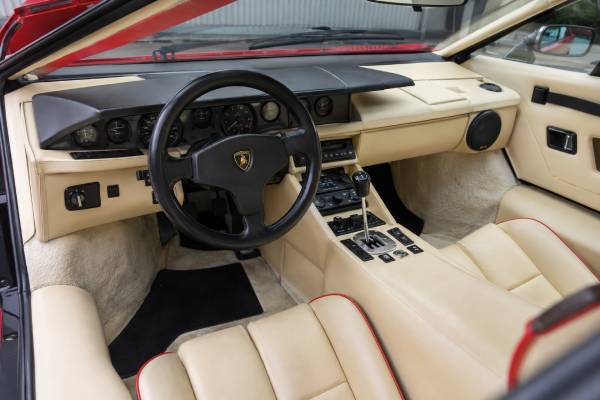
The Lamborghini Countach 25th Anniversary is the final factory evolution of the original LP112 Countach line, built from 1988 to 1990 to mark Automobili Lamborghini’s first 25 years. It kept the wild mid-mounted 5.2-litre L507 V12 layout of the Countach 5000 Quattrovalvole, but added a heavily revised body, improved cooling, updated cabin trim, and a more usable road-car character. In European downdraft-carbureted form, the four-valve-per-cylinder V12 produced 455 hp, making this one of the most powerful and fastest Countach variants sold new. Collectors care about it because it is both the last Countach and the most developed version; buyers care because condition, originality, market specification, and service history can change the car’s value and ownership cost dramatically.
Table of Contents
- Why the 25th Anniversary Countach Matters
- L507 V12 Specs and Chassis Data
- Production Numbers, Versions, and Authenticity
- Pagani Restyle, Cooling, and Countach Details
- How the Final Countach Drives
- Maintenance, Reliability, and Restoration Risks
- Market Values and Buyer Inspection Guide
Why the 25th Anniversary Countach Matters
The 25th Anniversary matters because it closed the original Countach story with the most refined, most produced, and most ownership-friendly version of the car. It is still a raw 1980s Lamborghini, but compared with earlier LP400, LP400 S, LP500 S, and 5000 QV cars, it was designed to be easier to cool, easier to live with, and more mature inside.
The Countach began as Lamborghini’s LP112 project, replacing the Miura’s flowing shape with a low, hard-edged wedge that defined the poster-car supercar. Marcello Gandini’s original Bertone design introduced scissor doors, a cab-forward cabin, deep side intakes, and a visual language that still shapes how people imagine a Lamborghini. By the late 1980s, though, the Countach was no longer a new idea. The Ferrari Testarossa, Porsche 959, Ferrari F40, and newer turbocharged performance cars had moved the supercar world forward.
Lamborghini needed a celebration model while the Diablo was still in development. Chrysler had taken control of Lamborghini in 1987, and the company wanted a Countach that looked fresh enough for the anniversary year without requiring a clean-sheet replacement. The result was the Countach 25th Anniversary, presented in 1988 and sold through the final months of Countach production.
The car’s place in Lamborghini history is unusually strong for a late-life update:
- It was the last production version of the original Countach.
- It used the full 5.2-litre four-valve V12 architecture introduced on the 5000 QV.
- It added the most extensive body revision of any production Countach.
- It was the Countach version built in the highest numbers.
- It directly preceded the Diablo, the car that carried Lamborghini into the 1990s.
The 25th Anniversary is sometimes criticized for having a busier body than the cleaner LP400 or the muscular 5000 QV. That criticism is fair from a pure design standpoint. The added strakes, deeper sills, revised bumpers, and reshaped intakes make it less visually pure. But those changes were not just decoration. Much of the redesign focused on cooling airflow, cabin usability, and high-speed stability.
For collectors, the Anniversary model sits in an interesting middle ground. It is not as rare or minimalist as the early LP400 “Periscopio,” and it does not have the same simple wedge purity. But it is the easiest original Countach to use regularly, and it carries the final-series status that many collectors value. It also has a direct connection to Horacio Pagani, who worked on the restyling before founding Pagani Automobili.
The result is a car with two identities. It is a legitimate collectible Lamborghini and a usable final-development Countach. A good example can feel more complete than earlier cars, but a neglected one can become one of the most expensive 1980s exotics to put right.
L507 V12 Specs and Chassis Data
The key specification is the 5,167 cc Lamborghini L507 V12 with four valves per cylinder, mounted longitudinally behind the cabin and driving the rear wheels through a five-speed manual gearbox. European downdraft-carbureted cars are the 455 hp examples most enthusiasts want; U.S.-market fuel-injected cars are usually quoted with lower output because of emissions equipment.
| Item | Specification |
|---|---|
| Model | Lamborghini Countach 25th Anniversary |
| Internal project line | LP112 Countach family |
| Production years | 1988–1990 |
| Layout | Longitudinal mid-engine, rear-wheel drive |
| Engine | 5.2-litre L507 60-degree V12 |
| Displacement | 5,167 cc |
| Valvetrain | Dual overhead camshafts, four valves per cylinder |
| Bore x stroke | 85.5 mm x 75.0 mm |
| Compression ratio | 9.5:1 |
| European fuel system | Six Weber 44 DCNF downdraft carburetors |
| U.S. fuel system | Bosch KE-Jetronic fuel injection |
| European output | 455 hp at 7,000 rpm |
| Torque | About 500 Nm at 5,200 rpm |
| Transmission | Five-speed manual with limited-slip differential |
| Body style | Two-seat coupe with scissor doors |
The Countach’s drivetrain layout is one of its most important engineering details. The V12 sits lengthwise behind the cockpit, but the gearbox is placed ahead of the engine. Power then travels back through the engine’s sump area to the rear differential. This unusual layout helped Lamborghini package the engine and gearbox while keeping the cabin far forward, creating the Countach’s dramatic proportions.
The chassis is a round-section tubular steel spaceframe, with hand-fitted body panels. Aluminum was used for much of the body, while fiberglass and composite pieces appear in areas such as wheel-arch extensions, spoilers, and engine-cover components. This construction makes the car stiff enough for its period, but it also means accident repair quality matters more than on a mass-produced steel monocoque.
| Area | Specification |
|---|---|
| Chassis | Tubular steel spaceframe |
| Front suspension | Unequal-length double wishbones, coil springs, dampers, anti-roll bar |
| Rear suspension | Independent links with coil springs, dampers, and anti-roll bar |
| Steering | Unassisted rack and pinion |
| Brakes | Ventilated discs with four-piston calipers |
| Front tires | 225/50 VR15 |
| Rear tires | 345/35 VR15 |
| Wheelbase | 2,500 mm |
| Length | About 4,140 mm |
| Width | About 2,000 mm |
| Height | About 1,070 mm |
| Weight | About 1,490 kg, depending on specification and measurement method |
| Fuel capacity | About 120 litres |
Performance figures vary by source, market, test method, and car condition. A healthy European 455 hp Anniversary is commonly associated with a 0–100 km/h time around five seconds and a top speed near 295 km/h, or about 183 mph. Period claims and later summaries can quote slightly quicker acceleration, but buyers should treat condition as more important than the paper number. A tired Countach will not feel like a 455 hp car.
Production Numbers, Versions, and Authenticity
The Anniversary was built in roughly 657 to 658 units, making it the most numerous Countach version but still rare by normal collector-car standards. Most market listings and auction catalogues cite 657 cars, while Lamborghini has also used 658 in recent historical material, so serious buyers should rely on chassis-specific documentation rather than a single rounded production figure.
There are three broad identity questions that matter when evaluating one: market specification, originality, and documentation. The most obvious split is between European downdraft-carbureted cars and U.S.-market fuel-injected cars. The European version is usually the 455 hp car people picture when discussing the final Countach. U.S. cars used Bosch KE-Jetronic injection and emissions equipment, which improved compliance and drivability in some conditions but reduced peak output.
European and U.S. differences
European cars are generally more desirable to purists because of the six downdraft Weber carburetors, higher quoted power, cleaner bumpers, and more direct mechanical character. They also require careful carburetor setup, proper fuel-system maintenance, and specialists who know the engine.
U.S.-market cars can be excellent collector cars, especially with low mileage, strong history, and complete factory equipment. Their values may trail the most desirable European downdraft cars, but condition and provenance can overcome market-spec differences. A poor European car is not automatically better than a documented, well-kept U.S. car.
Key differences to check include:
- Fuel system and emissions equipment.
- Bumper and lighting details.
- Side-marker and reflector specification.
- Instrumentation and market labels.
- Original exhaust equipment.
- Documentation showing original destination market.
Factory options and presentation
The large rear wing is one of the most visible options. It gives the car the full bedroom-poster look, but it adds drag and can affect high-speed balance. Some buyers love it, others prefer wingless cars because the Countach shape looks cleaner and closer to the original wedge. Value depends on originality: a factory-option wing with documentation is different from a later-added wing of uncertain origin.
Common areas of specification interest include exterior color, leather color, piping, wheels, rear wing, radio equipment, books, tools, jack, spare, and factory paperwork. Red, white, black, and silver cars are familiar, but unusual period colors can be very desirable when original and well documented. Interior condition is also important because Countach cabins are expensive to retrim correctly and poor retrims stand out.
Numbers and paperwork
Matching identity matters more here than on an ordinary used exotic. A buyer should confirm chassis number, engine number, gearbox details, build records, import paperwork, registration history, and service records. The Countach was hand-built, and small variations are normal, but that does not excuse unclear identity or undocumented changes.
Strong documentation usually includes:
- Original owner’s handbook or pouch.
- Tool roll and jack.
- Factory or dealer delivery paperwork.
- Service invoices from recognized specialists.
- Import and federalization records where relevant.
- Old photos showing long-term condition.
- Clear title history across countries or states.
- Evidence supporting original color and interior.
Because the Anniversary is the last Countach, some examples were preserved early, while others were driven hard, modified, federalized, repainted, or stored badly. The best cars are not simply the lowest-mileage cars. A long-stored car with dry seals, old tires, weak hydraulics, stale fuel residue, and no recent mechanical sorting can be riskier than a higher-mileage car maintained by a proper Lamborghini specialist.
Pagani Restyle, Cooling, and Countach Details
The 25th Anniversary looks different because its restyle was meant to modernize the Countach and improve cooling, not just decorate an aging supercar. Horacio Pagani’s work reshaped the side intakes, sills, bumpers, engine cover, and lower aero surfaces while keeping the basic LP112 body architecture.
The original Countach shape was a clean wedge. By the Anniversary model, the shape had grown wider, more aggressive, and more complex. The deep side strakes are the most obvious change. They are often compared with the Ferrari Testarossa’s side treatment, but the functional goal was airflow management. The Anniversary’s revised intake layout and body openings helped feed the radiators and manage heat in a car with a large V12 packed tightly behind the cabin.
The front bumper and spoiler were also revised. The nose looks fuller and smoother than earlier versions, with integrated lamps and a more modern lower section. Along the sides, deeper sills make the car look lower and wider. At the rear, the bumper is more developed, and the engine cover has reshaped vents and raised surfaces.
The cabin also received meaningful updates. The Anniversary interior still feels low, tight, and dramatic, but it is more finished than earlier Countach cabins. Better trim, revised seats, improved switches, and more attention to everyday touchpoints make it easier to imagine using than an early LP400 or LP400 S. It is not comfortable in a modern sense, but it is the most polished original Countach cabin.
Distinctive features include:
- Scissor doors that became a Lamborghini signature.
- A very low roofline and wide sill entry.
- Deep side intakes and revised cooling ducts.
- Wide rear tires that define the car’s stance.
- A gated manual shift pattern.
- A high, broad rear body that limits rear visibility.
- Optional rear wing on many cars.
- A loud, mechanical V12 sound with intake roar on carbureted cars.
The design also shows the compromises of evolving a 1970s supercar into the late 1980s. The Anniversary is visually heavier than the first Countach, and the body additions create more surface complexity. But as an engineering response, the changes make sense. The 5.2-litre four-valve engine made serious heat, and the Countach’s packaging left little extra room for airflow, insulation, or service access.
That is why originality is so important. Body panels, ducting, vents, underbody pieces, and trim are not just visual parts. They are part of how the car cools and presents itself. Poor repairs, blocked ducts, missing shields, incorrect exhaust insulation, or badly fitted aftermarket pieces can cause heat problems and reduce value.
How the Final Countach Drives
A good 25th Anniversary feels fast, loud, physical, and demanding, but less intimidating than earlier Countach versions. It is still a heavy-control, low-visibility, mid-engine V12 car, yet its stronger engine, wider tires, improved cooling, and more developed cabin make it the most rounded original Countach to drive.
The engine dominates the experience. The 5.2-litre V12 is not a lazy torque motor in the modern sense. It pulls from low revs if tuned well, but it becomes much more alive in the middle and upper range. The throttle response on carbureted cars can be sharp and vivid once warm, with a layered sound made of induction noise, valvetrain texture, exhaust, and mechanical vibration. Fuel-injected cars can feel smoother and easier in traffic, but they usually lack some of the carbureted car’s top-end drama.
The gearbox needs respect. The five-speed manual can feel heavy when cold, and rushed shifts are a bad idea. A properly adjusted car rewards deliberate inputs. A weak second-gear synchro, dragging clutch, worn linkage, or tired mounts can make the gearbox feel far worse than it should. Warm oil, correct adjustment, and patient shifting matter.
Steering is unassisted, so parking speeds require effort. Once moving, it becomes more communicative. The front end can feel light compared with modern supercars, but the car gives real feedback through the wheel. The wide rear tires provide huge visual and mechanical presence, but old tires can ruin the experience. A Countach on aged rubber is not just less grippy; it can feel nervous, harsh, and misleading.
The brakes are period supercar brakes, not modern carbon-ceramic brakes. They are ventilated discs with proper stopping power when fresh, but the pedal feel, heat capacity, and required pressure differ from modern cars. Brake condition matters. Old hoses, sticky calipers, tired fluid, and glazed pads can make a healthy-looking car feel unsafe.
The driving position is famous for both drama and compromise. The windshield is close, the dashboard is low and wide, the pedals are offset, and the rear view is poor. Reversing often involves opening the door and sitting partly on the sill. Cabin heat can be high, especially if insulation, cooling, or air-conditioning systems are not in excellent condition.
On an open road, the Anniversary can feel more stable and mature than earlier versions. It has enough power to feel genuinely quick even today, but the pleasure is not only acceleration. It is the whole process: warming it properly, managing the gearbox, hearing the carburetors, feeling the chassis load up, and recognizing that the car demands attention at every speed.
For buyers, the road test should answer practical questions:
- Does the engine start cleanly hot and cold?
- Does it idle evenly after warm-up?
- Does temperature remain controlled in traffic?
- Does the clutch engage smoothly without slip or judder?
- Does the gearbox shift cleanly once warm?
- Does the steering track straight without shimmy?
- Does the car brake evenly with a firm pedal?
- Are there fuel, oil, coolant, or exhaust smells beyond normal old-exotic character?
A great Anniversary feels theatrical but coherent. A tired one feels hot, vague, heavy, noisy in the wrong ways, and expensive within the first few miles.
Maintenance, Reliability, and Restoration Risks
The Countach 25th Anniversary can be reliable when serviced correctly, but neglected examples become expensive quickly because almost every job requires specialist knowledge, scarce parts, or many labor hours. The car is not fragile in the simple sense; it is demanding because it is hand-built, tightly packaged, old, and valuable.
The V12 itself is robust when maintained, but it dislikes poor cooling, old fuel, wrong tuning, dirty oil, and long storage. Carbureted cars need careful synchronization and clean fuel delivery. U.S. fuel-injected cars need correct KE-Jetronic diagnosis, not random parts replacement. Ignition problems, weak coils, old plug wires, distributor issues, and poor grounds can mimic carburetor or injection faults.
Cooling-system health is critical. The Anniversary body revisions helped airflow, but the system still depends on clean radiators, working fans, good hoses, proper bleeding, and correct coolant. Overheating can lead to major engine costs. Any car that runs hot in traffic needs diagnosis before purchase, not after.
Common mechanical and age-related issues include:
- Aged coolant hoses and fuel hoses.
- Carburetor leakage, imbalance, or incorrect jetting.
- KE-Jetronic fuel-pressure and warm-up issues on U.S. cars.
- Ignition misfire under load.
- Oil leaks from cam covers, seals, and lines.
- Weak alternator output or poor charging.
- Tired clutch hydraulics.
- Worn synchros or poor gear selection.
- Old brake hoses and sticking calipers.
- Perished suspension bushings.
- Worn wheel bearings.
- Deteriorated engine and gearbox mounts.
- Heat-damaged wiring and insulation.
Body and chassis inspection
Corrosion is less visible than on a normal steel-bodied car because the Countach uses a tubular frame under hand-fitted panels. Inspect the lower frame tubes, suspension pickup points, floor structure, radiator areas, battery area, door hinge mounts, front structure, and rear chassis sections. Accident damage is a major concern because repairs to the spaceframe and hand-formed body can be hidden under paint and trim.
Panel fit should be assessed carefully, but not judged like a modern production car. These cars were hand-built, so slight variation is normal. Big gaps, uneven door operation, strange paint edges, cracked filler, distorted wheel arches, or poor underbody finish can point to past impact or low-quality restoration.
Interior, electrical, and trim
Interior restoration is expensive because correct materials, stitching, switchgear, instruments, vents, and trim pieces are specialized. A cheap retrim can reduce value even if it looks fresh in photos. Air conditioning should be tested, not assumed. Many Countach cabins are hot, but a non-working system can still signal deeper electrical or parts problems.
Electrical systems need careful inspection. Grounds, relays, fuse boxes, fans, window motors, lighting, gauges, and charging circuits all matter. Heat and age are the enemies. A car with added alarm systems, modern audio wiring, non-original switches, or messy repairs should be inspected more deeply.
Restoration tradeoffs
A sympathetic mechanical refresh is often better than a full cosmetic restoration if the car has strong original paint, interior, and paperwork. Originality carries serious value. However, originality should not be used as an excuse for unsafe tires, cracked hoses, leaking fuel lines, weak brakes, or overheating.
The best ownership approach is preventive. Replace age-critical rubber, service fluids, inspect fuel lines, rebuild brakes before they fail, keep the cooling system clean, and drive the car enough to keep systems alive. Storage without use is not preservation if it allows seals, fuel systems, hydraulics, and electrical contacts to decay.
Market Values and Buyer Inspection Guide
As of mid-2026, the Countach 25th Anniversary usually sits in the broad $425,000 to $650,000 market band for many public-sale examples, with exceptional cars, rare specifications, very low mileage, or unusually strong provenance capable of bringing more. Weak history, federalization questions, incorrect colors, tired mechanicals, or older low-quality restoration can push a car well below headline asking prices.
Recent public results show why buyers should not rely on one number. Comparable cars have traded around the low-$400,000 range for higher-mileage or less ideal examples, while stronger cars have sold around the high-$500,000 to low-$600,000 range. Asking prices can be higher than auction results, especially from dealers with highly presented cars. The true value depends on specification and evidence.
The biggest value drivers are:
- European downdraft carburetion versus U.S. fuel injection.
- Original color and interior.
- Factory rear wing status, if fitted.
- Low but believable mileage.
- Complete books, tools, jack, and records.
- Known specialist maintenance.
- Clean import and title history.
- Original panels and strong paint evidence.
- No serious accident or frame damage.
- Correct wheels, trim, lamps, and market equipment.
- Recent major service with invoices.
| Area | What to verify | Why it matters |
|---|---|---|
| Identity | Chassis, engine, gearbox, import papers, market specification | Incorrect or unclear identity can heavily reduce value |
| Engine | Compression, leakdown, oil pressure, leaks, hot and cold running | V12 repairs are expensive and specialist-led |
| Fuel system | Weber setup or KE-Jetronic operation, pumps, hoses, tanks | Poor fuel delivery can cause drivability and fire risks |
| Cooling | Radiators, fans, hoses, temperature stability, coolant condition | Overheating is one of the biggest ownership threats |
| Gearbox and clutch | Warm shifting, synchros, clutch engagement, hydraulics | Labor and parts costs can be high |
| Chassis | Frame tubes, suspension points, accident repair, corrosion | Spaceframe damage is serious and value-sensitive |
| Body | Panel fit, paint depth, original panels, ducting, wing installation | Poor cosmetic work can hide structural problems |
| Interior | Original leather, gauges, switches, air conditioning, trim | Correct restoration is difficult and expensive |
| Documentation | Books, tools, invoices, ownership trail, photos | Paperwork supports provenance and resale confidence |
The best cars to seek are documented, mechanically sorted examples with clear market specification and no stories. A recent service by a recognized Lamborghini specialist is more meaningful than a seller’s claim that the car “just had a tune-up.” A proper inspection should include a lift inspection, road test, compression or leakdown testing where appropriate, paint assessment, cooling-system test, and review of every invoice.
Cars to avoid include examples with unclear import history, missing identification records, inconsistent mileage, overheating during inspection, non-original bodywork sold as original, heavy aftermarket modifications, poor wiring, long storage with no recommissioning, or sellers unwilling to allow specialist inspection.
Long-term collectability looks strong because the Anniversary is the final original Countach, carries a direct link to Lamborghini’s late-1980s transition, and remains one of the most recognizable supercars ever made. It will probably never replace the LP400 as the pure collector favorite, but it does not need to. Its appeal is different: maximum final-series Countach drama with the strongest usable road-car package of the original line.
References
- 50 Years Ago the First Countach in Sant’Agata Bolognese 2024 (Manufacturer History)
- Masterpieces of Lamborghini at Villa d’Este 2024 (Manufacturer History)
- Lamborghini Countach 25th Anniversario – Specs & Performance 2015 (Technical Specifications)
- Lamborghini Countach 25th Anniversary Edition Market – CLASSIC.COM 2026 (Market Data)
- 1989 Lamborghini Countach 25th Anniversary Edition by Bertone | Paris 2026 | RM Sotheby’s 2026 (Auction Result)
Disclaimer
This article is for informational purposes only and is not a substitute for professional diagnosis, repair, valuation, or pre-purchase inspection. Specifications, torque values, service intervals, procedures, parts, emissions equipment, and correct details can vary by VIN, market, production date, and equipment. Always verify information against official Lamborghini service documentation and consult a qualified Lamborghini specialist before buying, restoring, or repairing a Countach.
If this guide helped, please share it on Facebook, X/Twitter, or your favorite enthusiast community to support our work.