
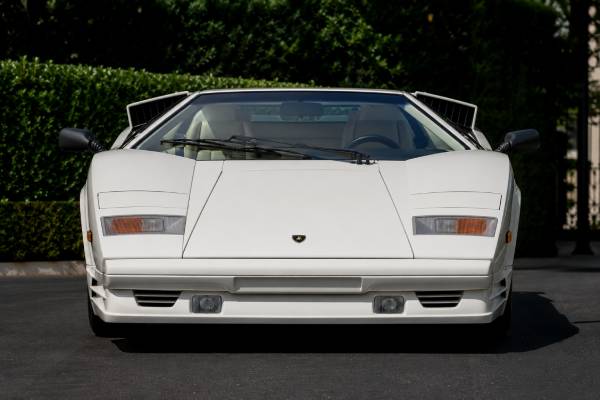
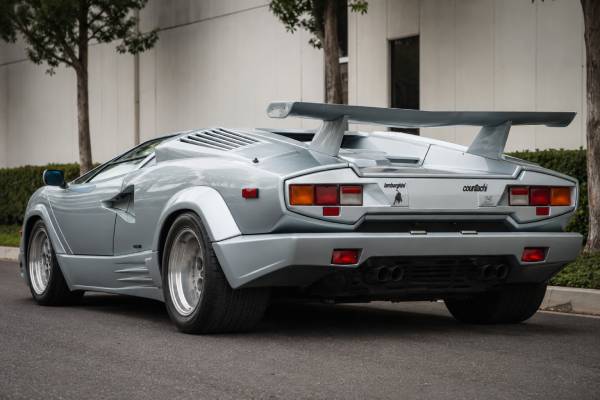
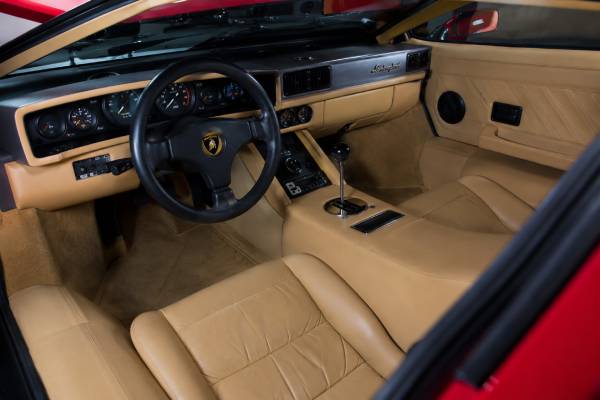
The Lamborghini Countach 25th Anniversary is the final production evolution of the original Countach line, built from 1988 to 1990 as Lamborghini’s 25-year celebration model. In Bosch-injected form, it uses the L507 V4 5.2-liter four-valve V12 with mechanical fuel injection, rated at about 425 hp, paired with a five-speed manual gearbox and rear-wheel drive. It is not the purest Countach, and some collectors still prefer the early LP400 or Weber-carbureted QV cars, but the Anniversary is the most developed, usable, and comfort-oriented version of the poster-car icon. Its value comes from that exact mix: dramatic Marcello Gandini proportions, Horacio Pagani’s final body revisions, a hand-built tube-frame chassis, low production, and a driving experience that still feels raw, loud, demanding, and special.
Table of Contents
- The final Countach and why it matters
- L507 V4 specs and chassis data
- Production numbers, versions, and authenticity
- Pagani refinements, cooling, and cabin details
- How the 425 hp injected Countach drives
- Maintenance risks and restoration priorities
- Market values and buyer inspection guide
The final Countach and why it matters
The 25th Anniversary Countach matters because it closed the first Countach era with the most complete road-car package Lamborghini could build on the LP112 platform. It kept the shock value of the original wedge but added better cooling, improved cabin equipment, revised bodywork, and broader market compliance.
The Countach story began long before the Anniversary model. Lamborghini showed the LP500 prototype at Geneva in 1971, then moved the production LP400 into series build in 1974. The Countach replaced the Miura’s flowing curves with a hard-edged mid-engine shape that became the visual language of the modern supercar. The scissor doors, cab-forward stance, wide rear tires, and extreme height-to-width ratio turned it into one of the most recognized cars of the 1970s and 1980s.
By 1988, the Countach was old in platform terms but still powerful as an image. Lamborghini had already evolved it through the LP400, LP400 S, LP500 S, and LP5000 Quattrovalvole. The 25th Anniversary model was created to celebrate 25 years since the company’s founding in 1963, but it was also a practical answer to a real product problem: the Diablo was still being prepared, and Lamborghini needed a final, saleable, more refined version of its flagship.
The Anniversary did not reinvent the Countach underneath. It was closely related to the 5000 QV, with the same basic 5.2-liter four-valve V12 architecture, tube-frame chassis layout, five-speed manual gearbox, and wide-body stance. The difference was in refinement and execution. Horacio Pagani, then working at Lamborghini before founding Pagani Automobili, helped reshape the front and rear bumpers, side skirts, air intakes, cooling ducts, engine cover treatment, and cabin trim. The result was busier than the early Countach, but also more usable and more stable as a late-1980s exotic.
For collectors, the 25th Anniversary sits in an interesting position. It is not as minimalist or historically clean as a narrow-body LP400 “Periscopio,” and it is not as mechanically theatrical as a downdraft-carbureted European QV. But it is the most mature original Countach. The Bosch-injected 425 hp version is especially relevant for U.S. and emissions-regulated markets because it reflects the factory’s move toward cleaner, more compliant fuel delivery while preserving the character of the big Lamborghini V12.
Today, buyers care about three things above all: originality, documentation, and mechanical condition. A correct Anniversary with factory books, tools, service history, matching identification numbers, and no heavy cosmetic modification is a serious collector car. A neglected one can become a very expensive restoration project, even if it looks spectacular from across the room.
L507 V4 specs and chassis data
The core specification is simple: a 5,167 cc naturally aspirated V12, mounted longitudinally behind the cabin, driving the rear wheels through a five-speed manual gearbox. In Bosch K/KE-Jetronic injected form, the Anniversary is usually quoted at about 425 bhp, below the Weber-carbureted European versions but smoother and more emissions-friendly.
| Item | Specification |
|---|---|
| Model | Lamborghini Countach 25th Anniversary |
| Internal family | LP112 Countach platform |
| Production years | 1988–1990 |
| Engine code | L507 V4 |
| Engine layout | 60-degree V12, longitudinal rear-mid-mounted |
| Displacement | 5,167 cc |
| Valvetrain | Double overhead camshafts, four valves per cylinder |
| Fuel system | Bosch K/KE-Jetronic mechanical fuel injection on regulated-market cars |
| Output | About 425 bhp at 7,000 rpm for injected versions |
| Torque | Commonly quoted around 369 lb-ft near 5,200 rpm |
| Transmission | Five-speed manual |
| Drivetrain | Rear-wheel drive |
The engine is the main reason the car still feels special. The L507 V4 is not a lazy large-displacement unit. It is a high-revving, four-valve Lamborghini V12 that rewards heat, revs, and commitment. The injected version gives away some top-end drama compared with the six-Weber downdraft setup, but it is easier to keep in tune and better suited to emissions-regulated markets.
The chassis is classic Countach. A tubular steel space frame carries the suspension, drivetrain, and body panels. The layout puts the engine longitudinally behind the cabin, while the gearbox sits forward of the engine in typical Countach fashion. This unusual packaging helps explain the car’s shape, high center tunnel, long rear deck, and demanding service access.
| Area | Detail |
|---|---|
| Chassis | Tubular steel space frame |
| Body | Hand-finished panels with aluminum and composite elements depending on panel and market |
| Front suspension | Independent suspension with coil springs and telescopic dampers |
| Rear suspension | Independent suspension with coil springs and telescopic dampers |
| Brakes | Four-wheel ventilated disc brakes |
| Steering | Unassisted rack-and-pinion |
| Wheelbase | About 2,450–2,500 mm depending on published source |
| Length | About 4,140 mm |
| Width | About 2,000 mm |
| Height | About 1,070 mm |
| Weight | About 1,490–1,570 kg depending on market specification and measurement method |
| Tires | Commonly 225/50 VR15 front and 345/35 VR15 rear |
Performance figures vary because period tests, market specifications, emissions equipment, gearing, tires, and measurement methods all differ. A healthy injected Anniversary is best understood as a roughly 180 mph supercar, with 0–60 mph in the high-four-second range when driven hard and launched well. That is still fast, but the experience matters more than the number. The clutch, steering, gearbox, heat, noise, and visibility make every mile feel serious.
Production numbers, versions, and authenticity
The Anniversary was the highest-production original Countach variant, but it is still rare by normal car standards. Published counts usually sit around 657 examples, while Lamborghini’s own anniversary-history material has cited 658, so buyers should focus on chassis documentation rather than one isolated production-number claim.
The model was built for global demand, and market specification matters. European and some other non-U.S. cars are often associated with six Weber carburetors and the higher 455 hp rating. U.S. and emissions-regulated cars used Bosch fuel injection and are normally quoted at about 425 hp. That difference affects character, maintenance, emissions paperwork, and collector preference.
Important version distinctions include:
- Fuel system: Bosch-injected cars are generally smoother, more compliant, and easier to live with in regulated markets. Weber-carbureted cars are louder, sharper, and often more prized by buyers chasing the most dramatic engine character.
- Bumpers and lighting: U.S.-market cars may have market-specific lighting, bumper, side-marker, and emissions details. Some cars were later altered, so originality must be checked carefully.
- Rear wing: The large rear wing is iconic but not always factory-installed in the same way on every car. It can affect value depending on documentation, originality, and buyer taste.
- Interior trim: Anniversary interiors gained revised seats, more comfort equipment, power-operated features, and more finished door panels than earlier Countachs.
- Delivery market: Original market can affect paperwork, emissions equipment, federalization history, speedometer units, lighting, and value.
The chassis number, engine number, gearbox number, body details, color, trim, delivery paperwork, books, tools, and service records all matter. For this car, “matching numbers” means more than a phrase in an auction listing. A serious inspection should confirm that the engine and major components correspond with Lamborghini records or credible period documentation.
Factory paperwork and certification
Lamborghini Polo Storico has become increasingly important for Countach values. Its work matters because it can verify original specifications, colors, materials, identifying numbers, and restoration correctness against factory archive information. A Polo Storico-certified car can carry a premium, especially when the car is preserved rather than heavily restored.
Useful documents include:
- original sales invoice or dealer paperwork
- warranty booklet and owner’s guide
- stamped service book
- factory correspondence or build information
- import and federalization papers for U.S.-market history
- tool roll, jack, spare parts, and manuals
- restoration invoices with specialist names and photographs
- Lamborghini Polo Storico certification or inspection records
A car with low mileage but poor storage history is not automatically better than a properly serviced higher-mileage car. On an Anniversary Countach, sitting can damage fuel-system parts, seals, hoses, brake hydraulics, clutch hydraulics, cooling components, tires, and wiring. Buyers should reward documented care, not just odometer readings.
Pagani refinements, cooling, and cabin details
The 25th Anniversary looks busier than earlier Countachs because its body was revised for airflow, cooling, compliance, and late-1980s visual impact. The key point is that the added strakes, ducts, skirts, and bumpers are not just decoration; much of the redesign was aimed at making the car easier to cool and easier to sell.
Marcello Gandini’s original Countach shape remains underneath: a sharp wedge, low nose, flat windscreen, scissor doors, deep side intakes, and wide rear stance. The Anniversary overlays that with Horacio Pagani-influenced revisions. The nose was softened and raised slightly, bumpers were better integrated, lower skirts became more pronounced, and the rear intakes were reshaped with body-color strakes. The engine cover and ducting changed to manage heat better around the large V12.
Cooling is a major part of the design story. The Countach places a big, hot, naturally aspirated V12 behind the cabin, with radiators and ducting packaged around a very low, dramatic body. The Anniversary’s additional vents and revised intakes were a practical response to heat management. This is one reason owners should avoid judging replacement panels or repainted surfaces only on appearance; ducts, seals, undertrays, and fan operation all affect how well the car works.
The cockpit is still extreme, but it is more civilized than earlier Countachs. The Anniversary received revised seats, updated door panels, power windows, improved trim, and more comfort equipment. It remains cramped by modern standards. The sill is wide, the roof is low, the pedal box is offset, and rear visibility is famously poor. Reversing still often involves opening the scissor door, sitting partly on the sill, and looking back over the roofline.
Important design and engineering features include:
- Scissor doors: A Countach signature, useful for theater and helpful in tight spaces because the doors rise rather than swing wide.
- Wide rear tire package: The massive rear tires define the stance and help traction, but they increase steering effort, tramlining, and replacement cost.
- Low body height: The car’s height is close to that of many racing prototypes, which creates presence but makes entry, exit, and visibility difficult.
- Composite use: The Anniversary introduced more advanced composite-panel thinking into the Countach line, foreshadowing Lamborghini’s later use of lightweight materials.
- Large center tunnel: The drivetrain layout creates a high, wide cabin spine, reinforcing the feeling that the driver is wrapped around the mechanical package rather than sitting in a normal car.
The sound is central to the car’s appeal. The injected V12 is slightly less feral than the downdraft Weber version, but it is still a large-capacity Lamborghini twelve-cylinder with a hard metallic edge at high rpm. Intake, cam drive, gearbox whine, exhaust resonance, cooling fans, and cabin heat all contribute to the experience. Modern supercars may be faster, but few feel as mechanical.
How the 425 hp injected Countach drives
A healthy 425 hp Bosch-injected Anniversary Countach drives like a refined Countach, not like a modern supercar. It is heavy at low speed, loud, hot, wide, and demanding, but it becomes more natural as speed rises and the V12 gets into its working range.
The engine does not deliver its best work at idle or in traffic. It wants temperature, clear road, and revs. The Bosch injection helps starting and low-speed manners compared with a poorly tuned carbureted car, but this is still a hand-built 1980s exotic. Cold running, throttle response, idle quality, and hot restarting should be judged only after the system is properly set up.
The gearbox is part of the ritual. The five-speed manual needs deliberate inputs, especially when cold. First-to-second shifts should not be rushed until the oil warms. A good car feels mechanical but not obstructive; a worn or poorly adjusted car may baulk, grind, or feel vague. Clutch effort is substantial, and repeated stop-start driving is hard on both the driver and the hardware.
Steering is unassisted, so parking speeds require strength and patience. Once moving, the steering becomes clearer and more communicative. The car feels wide, and the front end needs respect over poor roads, but the chassis is more capable than the Countach’s poster-car reputation suggests. The Anniversary’s tire package gives enormous rear grip for its era, while the short height and wide track make it feel planted at speed.
Braking performance is period-correct rather than modern. The ventilated discs can work well when maintained, but the pedal feel, fade resistance, tire grip, and stopping distances are not comparable to a modern carbon-ceramic supercar. Old brake hoses, tired fluid, glazed pads, or sticky calipers can make a Countach feel much worse than it should.
In real use, the Anniversary is best on open roads, fast sweeping routes, and short, memorable drives. It is less happy in dense city traffic, steep parking ramps, tight garages, and hot weather. Cabin heat, poor rear visibility, heavy controls, and low ground clearance are part of the ownership reality.
The driving experience changes dramatically with condition. A freshly serviced, correctly aligned, properly cooled car on fresh tires can feel tight, exciting, and surprisingly usable. A tired one can feel intimidating for all the wrong reasons. Buyers should not assume that “they all drive badly.” Many drive badly because they are overdue for expensive work.
Maintenance risks and restoration priorities
The Anniversary Countach is not fragile when properly maintained, but neglected cars become expensive very quickly. The biggest risks are age, heat, poor storage, weak documentation, incorrect previous repairs, and specialists who do not understand the model.
The V12 itself is robust in concept, but access is difficult and labor time is high. Valve adjustment, timing-chain inspection, fuel-injection setup, cooling-system work, clutch service, and leak diagnosis all require specialist knowledge. A car that has been started occasionally but not properly driven may still need major recommissioning.
High-priority mechanical areas include:
- Fuel injection: Bosch K/KE-Jetronic components must be clean, correctly pressured, and free of vacuum leaks. Old fuel can damage pumps, lines, metering units, injectors, and warm-up control parts.
- Cooling system: Radiators, fans, hoses, expansion tanks, thermostats, sensors, and duct sealing must be right. Overheating can turn a manageable service into an engine-out crisis.
- Clutch and hydraulics: Heavy clutch operation, leaks, dragging, or slipping can point to expensive work.
- Gearbox: Synchro wear, oil leaks, noisy bearings, and poor shift quality need careful diagnosis.
- Brakes: Calipers, master cylinder, flexible hoses, hard lines, and discs should be inspected for age, corrosion, and seizure.
- Suspension: Bushings, dampers, ball joints, wheel bearings, and alignment settings are vital for road feel.
- Electrical system: Aging connectors, relays, switches, fan wiring, window motors, lighting circuits, and aftermarket alarm systems can create persistent faults.
Corrosion is not the only body concern, but it matters. The tube frame, suspension pickup points, lower structure, floors, sill areas, and repair zones should be inspected carefully. Accident damage is a major value risk. A Countach body can hide poor repairs under beautiful paint, and panel fit varied even when new, so an expert inspection is essential.
Restoration versus preservation
Preservation is often better than restoration when the car is original, complete, and structurally sound. Original paint, original leather, factory-applied finishes, correct decals, period glass, and untouched mechanical details can carry real value. A shiny restoration that uses wrong materials, modernized trim, incorrect finishes, or undocumented replacement parts may look good but lose collector credibility.
That said, mechanical preservation must not become mechanical neglect. Tires age out. Fuel hoses crack. Brake seals fail. Cooling hoses soften. Wiring becomes brittle. An Anniversary Countach can be visually original and still need a serious safety and reliability refresh.
Restoration becomes difficult because parts supply is uneven. Some mechanical components can be rebuilt or sourced through specialists, while trim, body pieces, market-specific equipment, and correct small details may be hard to find. The most expensive cars to buy are often the cheapest-looking ones with missing parts, modified interiors, accident history, or incomplete documentation.
A proper pre-purchase inspection should include compression or leak-down testing where appropriate, cooling-system pressure testing, fuel-pressure checks, underbody inspection, paint-depth review, chassis-number verification, road testing from cold, hot restart checks, and a review of every invoice. This is not a car to buy on photos alone.
Market values and buyer inspection guide
The 25th Anniversary market is strong but selective. As of the mid-2020s, ordinary good examples often sit around the mid-six-figure range in U.S. dollars, while very low-mileage, highly original, rare-color, celebrity-linked, or formally certified cars can sell far higher.
Recent public results show a wide spread. Normal transactions can cluster around roughly $500,000–$700,000, but exceptional cars have crossed into seven figures. A 2025 RM Sotheby’s Milan sale brought €1,130,000 for a particularly strong example, while another 1989 Anniversary sold at RM Sotheby’s Monterey 2025 for $555,000. That spread is not random. It reflects mileage, market, color, originality, documentation, emissions status, and buyer confidence.
| Value factor | Why it matters |
|---|---|
| Originality | Unmodified cars with correct finishes, trim, and equipment are easier to authenticate and sell. |
| Documentation | Books, tools, service records, invoices, import papers, and certification reduce buyer uncertainty. |
| Mechanical condition | A cheap car needing engine, gearbox, clutch, cooling, and fuel-system work may become the expensive car. |
| Color combination | Iconic colors can help, but rare factory colors with proof can also command premiums. |
| Market specification | Injected and carbureted cars appeal to different buyers; emissions paperwork can matter greatly in the U.S. |
| Mileage | Low mileage helps only when storage, service, and condition support it. |
| Certification | Polo Storico or comparable specialist verification can strengthen provenance and originality claims. |
For buyers, the safest car is usually not the cheapest one. It is the car with the clearest history, the best specialist inspection, the most complete records, and the fewest questions. A Countach with a known owner chain, correct original colors, no accident history, verified engine and chassis data, sorted cooling, fresh tires, and recent major service deserves a premium.
Avoid cars with unclear federalization history, missing identification plates, inconsistent paintwork, poorly repaired crash damage, non-original interiors, undocumented engine swaps, neglected fuel systems, overheating history, or “just needs tuning” explanations. On a Bosch-injected Countach, vague running problems can mean anything from a small vacuum leak to a costly fuel-system overhaul.
A practical inspection sequence is:
- Confirm the chassis number, engine number, gearbox number, market specification, and title documents.
- Compare paint, trim, options, and color against factory or specialist records.
- Inspect the frame, suspension pickup points, lower panels, sills, and accident-prone areas.
- Start the engine cold and watch idle, oil pressure, smoke, charging, fuel smell, and cooling behavior.
- Road test until fully warm, checking gearbox synchros, clutch action, brakes, steering, temperature stability, and hot restart.
- Review invoices for fuel-system, cooling-system, brake, clutch, tire, and major engine work.
- Price the car after estimating deferred work, not before.
Long-term collectability looks strong. The Anniversary has the final-year appeal, the most developed original Countach body, a direct connection to the Diablo transition, and a strong place in 1980s supercar culture. The 425 hp Bosch-injected version may not be the loudest or most valuable specification, but it has a clear identity: the more usable, regulated-market final Countach with the full visual drama and a slightly calmer mechanical temperament.
For an owner, the best strategy is simple: preserve originality, drive the car enough to keep it healthy, use recognized Lamborghini specialists, document every service, and avoid reversible-looking modifications that become irreversible value problems later. A good Anniversary Countach is not just an investment object. It is a demanding mechanical artifact from the last years before supercars became easier, safer, quieter, and far more digital.
References
- 50 Years Ago the First Countach in Sant’Agata Bolognese 2024
- Automobili Lamborghini at Chantilly Arts & Élégance 2024 2024
- A day as a Lamborghini Polo Storico specialist 2025
- 1989 Lamborghini Countach 25th Anniversary Edition by Bertone | Fort Lauderdale 2019 | RM Sotheby’s 2019
- 1989 Lamborghini Countach 25th Anniversary Edition by Bertone | Monterey 2025 | RM Sotheby’s 2025
Disclaimer
This article is for informational purposes only and is not a substitute for professional diagnosis, repair, valuation, or pre-purchase inspection. Specifications, torque values, service intervals, emissions equipment, procedures, and market details can vary by VIN, market, production date, prior repairs, and equipment. Always verify critical information against official Lamborghini service documentation, factory records, and a qualified Lamborghini specialist before buying, servicing, restoring, or modifying a Countach.
If this guide helped, please consider sharing it on Facebook, X/Twitter, or your preferred car community to support our work.