


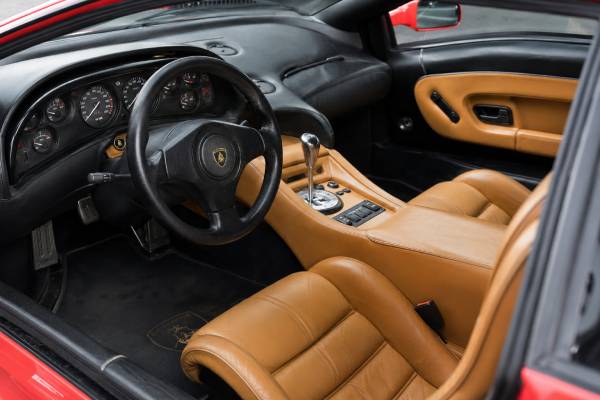
The Lamborghini Diablo SE30 is the sharper, lighter, rear-wheel-drive anniversary version of the early Diablo, built to mark Lamborghini’s 30th birthday. It uses the 5.7-liter naturally aspirated Lamborghini V12, tuned to 523 hp, paired with a five-speed manual gearbox and fewer comfort features than the standard car. That makes it one of the most focused road-going Diablos before the later SV, GT, and 6.0-liter cars changed the model’s character.
Collectors care because Lamborghini built only 150 examples, many in the famous Viola SE30 paint with blue Alcantara trim. Enthusiasts care because the SE30 keeps the raw pre-Audi Diablo feel: no all-wheel drive, no power steering in most cars, no soft luxury mission, and a cabin that feels closer to a race paddock than a grand tourer. Good examples are now serious collector assets, but they demand expert inspection, complete documentation, and careful maintenance.
Table of Contents
- Why the Diablo SE30 Still Matters
- V12, Chassis, and Key Specifications
- Production Numbers, Jota, and Originality
- Design Details That Set It Apart
- How the SE30 Drives
- Maintenance, Risks, and Restoration
- Market Values and Buyer Checks
Why the Diablo SE30 Still Matters
The Diablo SE30 matters because it captures Lamborghini at a rare turning point: still wild and hand-built, but modern enough to deliver genuine 200-mph performance. It is not simply a Diablo with a badge package; it is a lighter, louder, more focused version created before the brand moved into the more polished Audi era.
The wider Diablo story began as Lamborghini’s replacement for the Countach. Internally linked with the P132 development program, the Diablo had to move Lamborghini beyond the 1970s wedge-car era while keeping the visual drama and V12 theater that made the brand famous. The final production design retained Marcello Gandini’s basic wedge idea, later softened under Chrysler ownership. When the Diablo reached buyers in 1990, it became Lamborghini’s 1990s poster car and pushed the company’s V12 flagship into a new performance league.
The SE30 arrived for Lamborghini’s 30th anniversary and was built around a simple idea: take weight and comfort out, add power and sharper chassis control, and make the Diablo feel closer to a road-legal race car. That formula gave the SE30 a special place in the range. The standard early Diablo was already dramatic, fast, and demanding. The VT added all-wheel drive and more usability. The SE30 went the other way. It kept rear-wheel drive, removed luxury equipment, used more lightweight materials, and added a more urgent engine tune.
That character is why the SE30 has become one of the most collectible Diablo variants. It sits between the original Countach-style Lamborghini era and the later Audi-developed cars. It still has pop-up headlights, scissor doors, a huge naturally aspirated V12, a gated manual gearbox, and very little electronic filtering. At the same time, it has enough power, grip, and body control to feel much more capable than many older supercars.
Its significance is also tied to rarity. Lamborghini made 150 SE30 examples, which is a tiny run even by exotic-car standards. The best-known specification is Viola SE30 over blue Alcantara, but cars were also finished in other factory colors and special-order combinations. Some cars received the later Jota upgrade, which further increases interest but also adds questions about use, legality, originality, and documentation.
Today, the SE30 appeals to two groups at once. Drivers value it because it is one of the most intense road-going Diablos. Collectors value it because it combines limited production, anniversary status, recognizable colors, and a clear mechanical identity. It is not the easiest Diablo to use, and that is part of the point. The SE30 is desirable because it feels like Lamborghini chose purity over comfort.
V12, Chassis, and Key Specifications
The SE30’s key technical story is simple: a lighter Diablo body, a stronger 5.7-liter V12, rear-wheel drive, and a manual gearbox. The important detail is how those changes work together, because the SE30’s appeal comes from the full package rather than one headline number.
| Item | Specification |
|---|---|
| Model years covered | 1994–1995 |
| Production purpose | 30th anniversary limited edition |
| Body style | Two-door mid-engine coupe |
| Engine | 5,707 cc naturally aspirated Lamborghini V12 |
| Valve gear | Double overhead camshafts, four valves per cylinder |
| Fuel system | Electronic multi-point injection, revised for SE30 tune |
| Maximum output | 523 hp, commonly listed as 525 PS |
| Torque | About 428 lb-ft / 580 Nm, depending on source and test standard |
| Transmission | Five-speed manual |
| Drivetrain | Rear-wheel drive |
| Chassis | Tubular steel structure with lightweight exterior panels and composite elements |
| Suspension | Independent double-wishbone layout with adjustable anti-roll-bar control |
| Steering | Manual steering on the purer lightweight specification |
| Brakes | Ventilated discs with performance-focused hardware |
| Wheels and tires | Staggered magnesium wheels; common SE30 sizing is 17-inch front and 18-inch rear |
| Weight | About 1,447–1,451 kg, depending on equipment and market |
| 0–60 mph / 0–100 km/h | About 3.9–4.0 seconds in period-style figures |
| Top speed | About 207 mph / 333 km/h |
The engine is the center of the car. The 5.7-liter Lamborghini V12 was already the defining feature of the standard Diablo, but the SE30 received a higher-output tune through changes such as revised fueling, freer breathing, and magnesium intake components. The result was more power than the regular early Diablo and a sharper response at high rpm.
The transmission is a five-speed manual, and that matters more than the gear count suggests. The SE30 comes from a time before automated single-clutch systems took over exotic cars, so the driver must manage clutch weight, shift timing, throttle balance, and rear tire grip directly. That adds effort, but it is also one of the reasons the car has become so valuable.
The chassis layout is classic Lamborghini flagship: the V12 sits behind the cabin in a longitudinal mid-engine position, with drive going to the rear wheels. Unlike the Diablo VT, the SE30 does not use all-wheel drive. That saves weight and gives the car a cleaner, more aggressive feel, but it also means the rear tires and driver inputs matter more.
Weight reduction is central to the specification. Lamborghini deleted or reduced comfort equipment, used fixed lightweight side windows with sliding vents on many cars, fitted lighter seats, and focused the cabin around function rather than luxury. Some cars may have equipment differences because of market rules or special requests, so a buyer should not assume every SE30 has the same exact trim.
The suspension is one of the more interesting features. Instead of simply making the car stiff, Lamborghini gave the SE30 a driver-adjustable anti-roll-bar system. In plain terms, anti-roll bars help control how much the body leans in corners. The SE30 allowed the driver to change the roll stiffness, giving the car a more road-biased or more track-biased feel.
The wheels and tires are also part of the driving character. Period Pirelli P Zero fitments, very wide rear tires, and staggered wheel sizes gave the car huge rear grip for its time. Tire availability, age, and correct sizing now matter a lot, because old or incorrect tires can make a Diablo feel nervous, heavy, or unpredictable.
Production Numbers, Jota, and Originality
The SE30’s value depends heavily on identity, originality, and paperwork because only 150 cars were built and some have unusual specifications. A correct car should be understood as an individual chassis, not just as “a Diablo SE30.”
Production is generally accepted at 150 examples. Within that run, cars vary by market, steering side, color, interior trim, equipment, and later upgrades. The most famous color is Viola SE30, a purple shade strongly linked with the model. The typical interior image is blue Alcantara with anniversary details, but not every car follows the same pattern.
What makes an SE30 different from a standard Diablo
The SE30 differs from a standard early Diablo in several practical ways:
- Higher-output 5.7-liter V12 tune
- Rear-wheel drive rather than VT-style all-wheel drive
- Reduced sound insulation and less luxury equipment
- Lightweight fixed side windows with sliding vents on many cars
- Carbon-fiber or lightweight interior pieces
- More aggressive front and side cooling details
- Unique anniversary trim and badging
- Driver-adjustable anti-roll-bar control
- Lightweight seats and track-focused cabin details
- Stronger collector link to Lamborghini’s 30th anniversary
Those details are important because some Diablos have been visually modified to resemble rarer variants. A buyer should check the chassis number, build records, factory color, engine number, gearbox number, differential number, and any Lamborghini Polo Storico certification or correspondence.
The SE30 Jota question
The Jota upgrade is one of the most desirable and most complicated parts of SE30 collecting. The Jota was a more extreme performance package associated with competition-style use. It added serious engine and intake changes, including roof-mounted intake hardware on Jota-equipped cars, and raised output well beyond the standard SE30. It also made the car less suitable for normal road use in many markets.
The exact number of Jota kits, factory conversions, and later conversions is often discussed among specialists, and public listings do not always use the terms carefully. That makes documentation critical. A real, factory-recognized Jota-status car should have a paper trail that supports when the conversion happened, who performed it, and how it was delivered.
For buyers, the safest approach is simple: treat every Jota claim as unproven until confirmed by factory documentation or a respected Lamborghini specialist. A genuine Jota car can be more valuable, but an undocumented conversion can create legal, service, usability, and resale problems.
Colors, trim, and factory records
Original colors matter. Viola SE30 is the signature finish and often carries a desirability premium when paired with correct blue Alcantara. Unusual one-off colors can also be valuable, especially if they are factory documented. Repaints are not automatically bad, but they need explanation. A repaint in the wrong shade, or a color change from a rare factory specification, can reduce collector confidence.
The same logic applies inside. Correct Alcantara, original seat style, correct door panels, proper anniversary markings, and unmodified dashboard components all matter. Some SE30s had equipment added later to make them more usable, such as air conditioning or audio equipment. Those changes can improve comfort, but a serious collector will want to know whether they were factory, dealer-installed, or later owner changes.
Factory documentation, service invoices, import papers, old registrations, photographs, and ownership history all add value. A thin file is not ideal on any exotic car, but it is especially risky on a limited Lamborghini because originality and specification have a direct effect on price.
Design Details That Set It Apart
The SE30 looks special because its design changes serve cooling, weight reduction, and attitude rather than decoration. It keeps the core Diablo shape but adds enough unique details to make it immediately recognizable to anyone who knows the model.
The Diablo’s shape is low, wide, and dramatic. It is a true 1990s wedge, with a short nose, long rear deck, scissor doors, deep side intakes, and huge rear tire coverage. The SE30 keeps the pop-up headlights and early Diablo face, which many collectors prefer because it links the car visually to the Countach.
The front end has more aggressive cooling and aerodynamic treatment than the standard car. The deeper front spoiler and additional ducting are not just styling tricks. A lighter, faster Diablo needs stable cooling for brakes, engine, and cabin airflow. The SE30’s front details tell the same story as the rest of the car: less softness, more purpose.
The side-window treatment is one of the clearest signs that the SE30 was built with weight and focus in mind. Fixed lightweight side windows with sliding sections remove the convenience of full power windows but give the car a motorsport feel. They also change the cabin experience. You do not sit in an SE30 expecting quiet, sealed luxury. You sit in it expecting heat, intake sound, mechanical noise, and a sense of occasion.
At the rear, the Diablo’s broad haunches and cooling openings dominate the design. The SE30 uses body-color vertical rear intake elements that help distinguish it from regular early Diablos. A rear wing is part of the visual identity on many cars, though buyers should always confirm whether a specific wing and mounting arrangement matches the car’s build and documented specification.
Inside, the SE30 is more purposeful than luxurious. Blue Alcantara, lightweight bucket-style seating, harness-style restraint details on many cars, and reduced comfort equipment make the cabin feel closer to a club-racing machine than a normal supercar. The seating position is low, the windshield is steeply raked, and the dashboard belongs to an era when exotic-car ergonomics were still secondary to drama.
The sound is another design feature, even if it is not visible. The revised intake and exhaust tuning give the SE30 a harder edge than a standard Diablo. At low speed, the V12 is mechanical and busy. At high rpm, it becomes sharper, more metallic, and more urgent. That sound is a major reason buyers chase these cars rather than later, smoother supercars.
The SE30 also shows how Lamborghini was moving between eras. It has lightweight composites and track-style thinking, but it does not have the modern systems later supercars use to hide weight and speed. There is no complex drive-mode stack, no dual-clutch gearbox, and no electronic stability net doing the driver’s work. The result is a car that feels visually and mechanically honest.
How the SE30 Drives
The SE30 drives like a sharper, louder, less forgiving Diablo, and that is exactly why it is special. It is fast by modern standards, but its real character comes from the effort, noise, steering load, and direct connection between the driver and the rear tires.
At low speeds, the SE30 can feel heavy and awkward. Manual steering in a wide mid-engine car with huge tires requires real effort when parking or maneuvering. The clutch is not city-car light. The gearbox needs deliberate inputs, especially when cold. Visibility is dramatic rather than easy: you see the road through a low windscreen, but the corners of the body and rear view require care.
Once moving, the car starts to make sense. The steering gains feel, the gearbox becomes more cooperative, and the V12 pulls with a broad, rising force. The SE30 is not a turbocharged car that delivers one sudden hit. It builds power in a naturally aspirated way, with more urgency as revs climb. The throttle response rewards smooth inputs, and the driver quickly learns that the rear tires are doing serious work.
The rear-wheel-drive layout is a major part of the personality. Compared with a Diablo VT, the SE30 feels lighter on its feet and more alive, but also less forgiving. Hard throttle on cold tires, damp roads, or poor surfaces can make the rear of the car move quickly. This is not a car to drive casually at the limit. It rewards patience, heat in the tires, clean steering, and measured throttle application.
The adjustable anti-roll-bar system adds another layer. In a softer setting, the car is more usable on imperfect roads. In a firmer setting, it feels flatter and more immediate, but also harsher and less forgiving over bumps. Modern drivers used to adaptive dampers may need to recalibrate expectations. The SE30 gives more control to the driver, but it also asks the driver to understand what the controls are doing.
Braking performance depends heavily on condition. A fresh, correctly serviced SE30 with healthy calipers, proper pads, good fluid, and correct tires should feel strong for a 1990s supercar. A tired car can feel long-pedaled, uneven, or confidence-sapping. Brake condition is not a small detail on a Diablo; it is a safety and value issue.
Ride quality is firm but not meaningless. The SE30 is stiff, noisy, and busy, yet it can cover fast roads with surprising composure when properly set up. What it does not like is neglect. Old tires, worn suspension joints, tired dampers, poor alignment, and sticky brake calipers can make the car feel far worse than it should.
On track, the SE30’s appeal is obvious but its risks are high. It has the power, sound, and balance to deliver a memorable experience, but parts are rare and expensive. Heat management, brake wear, tire age, and gearbox stress all matter. Many owners now use these cars sparingly because the financial downside of an off-track mistake or mechanical failure is serious.
The best way to understand the SE30 is not as an easy 200-mph supercar, but as a high-effort analog machine. It is rewarding because it asks something from the driver. It feels special at 40 mph and intense at 140 mph. That range of emotion is the reason the car has outgrown its old reputation as just another wild 1990s exotic.
Maintenance, Risks, and Restoration
The SE30 is not a normal used performance car; it is a limited-production exotic that needs specialist care, expensive parts, and careful preservation. The wrong car can cost far more to correct than the discount you get at purchase.
The engine is strong when maintained properly, but age is now the main enemy. Rubber hoses, fuel lines, coolant lines, seals, gaskets, ignition components, sensors, and wiring connections all deserve close inspection. A car that has covered little mileage may still need major recommissioning because static storage can be hard on seals, fluids, tires, clutch hydraulics, and brake components.
Engine-out service is a major ownership event on many Diablos. It allows access to areas that are difficult to inspect or repair with the engine installed. Buyers should look for invoices that show real work, not just oil changes and cosmetic detailing. A recent engine-out service from a known Lamborghini specialist is a major plus, but the invoice should list what was replaced, adjusted, tested, and inspected.
The clutch is another important cost area. A badly driven or heavily used car can consume clutch life quickly, and replacement is not a cheap job. Slipping under load, a high engagement point, difficulty selecting gears, or vague clutch hydraulics all need investigation. The gearbox itself should shift cleanly once warm. Second-gear stiffness when cold can be normal in many older exotics, but grinding, popping out of gear, or heavy metal in the oil is not.
Cooling-system health is critical. The Diablo’s V12 creates serious heat, and the SE30’s more focused character does not make it a relaxed traffic machine. Radiators, fans, coolant hoses, expansion tanks, water pump condition, thermostat function, and proper bleeding all matter. Any history of overheating should be treated seriously.
Electrical issues are common in aging hand-built exotics. Switches, relays, window-related components on non-lightweight cars, lighting motors, alarm systems, charging systems, fans, and dashboard electronics can all cause trouble. Poor aftermarket wiring is especially dangerous. Audio systems, immobilizers, battery tenders, imported-market lighting changes, and added accessories should be inspected for clean installation.
The brakes need detailed checks. Calipers can stick, hoses age, pads can glaze, and old fluid can cause poor pedal feel. Any SE30 that sat for years should have the braking system inspected before serious driving. Rebuilt calipers and fresh hydraulic components are a strong sign of responsible maintenance.
Suspension and steering condition define how the car feels. Worn bushings, tired dampers, loose joints, incorrect ride height, poor alignment, or aged tires can make the car nervous. Because the SE30 has a focused chassis, small setup problems are easy to feel. A specialist road test is more useful than a basic inspection.
Body and chassis condition are just as important as the mechanicals. Check for accident damage, poor paintwork, panel mismatch, repairs around suspension pickup points, distorted undertrays, damaged jacking points, and signs of hard track use. The wide bodywork can hide previous damage, so paint-depth readings and underside inspection are worthwhile.
Original interior materials can be difficult and expensive to source. Alcantara fades, wears, and stains. Seats, harness hardware, door panels, dashboard trim, switchgear, and anniversary details all influence value. A perfect-looking retrim may not be as valuable as a well-preserved original interior, especially if the materials, stitching, or colors are wrong.
Restoration is possible, but it is not simple. The best approach is preservation-first. Keep original parts when safe. Document every change. Avoid irreversible modifications. Upgrades that improve drivability may make sense for an owner who drives the car, but they should be reversible and clearly recorded. On a car as rare as the SE30, originality usually wins in the long run.
Market Values and Buyer Checks
The SE30 now sits near the top of the Diablo market because it combines rarity, analog driving appeal, anniversary status, and a clear visual identity. Recent public results show that the best documented cars can reach seven-figure territory, while weaker or less original examples trade with wider variation.
The market is not one simple price band. A low-mileage, correct-color, well-documented Viola SE30 with original drivetrain, strong service history, and known ownership can sit in a very different value category from a higher-mileage car with uncertain import history, color change, missing records, or undocumented modifications. Jota-related cars can be more valuable, but only when the paperwork is strong enough to support the claim.
What drives value
The biggest value factors are easy to name but difficult to verify:
- Confirmed SE30 identity and correct chassis details
- Original engine, gearbox, and differential
- Lamborghini Polo Storico certification or strong factory documentation
- Original factory color and interior combination
- Viola SE30 over blue Alcantara, when correct to the car
- Low but believable mileage
- Continuous ownership and service history
- Recent specialist recommissioning
- No accident damage or poor structural repair
- Correct lightweight SE30 equipment
- Documented Jota status, if claimed
- Clean import, title, and registration history
- Original parts retained after any reversible upgrades
A car with beautiful paint and weak paperwork should not be valued like a fully documented example. In this market, history is part of the car.
Inspection checklist before purchase
A proper pre-purchase inspection should be carried out by a Lamborghini specialist familiar with early Diablos, not by a general exotic-car shop. The checklist should include:
| Area | What to verify |
|---|---|
| Identity | Chassis number, build sequence, market, factory color, and SE30-specific records |
| Drivetrain | Engine, gearbox, and differential numbers against documentation |
| Service history | Engine-out work, clutch replacement, fluids, cooling, brakes, fuel system, and invoices |
| Body | Paint depth, panel fit, accident repair, carbon/composite panel condition, underside damage |
| Interior | Correct Alcantara, seats, belts, dashboard, switchgear, anniversary details, and originality |
| Suspension | Anti-roll-bar system, bushings, dampers, alignment, ride height, and steering condition |
| Brakes | Calipers, discs, pads, hoses, fluid, pedal feel, and signs of sticking or overheating |
| Electrical | Fans, lights, charging system, relays, dashboard functions, alarm, and aftermarket wiring |
| Wheels and tires | Correct wheel type, cracks, finish, tire size, date codes, and tire availability |
| Legal status | Title, import papers, emissions status, road registration, and Jota legality if relevant |
Cars to seek and cars to avoid
The best cars are easy to describe: documented, original, serviced, correct, and inspected. They may cost more upfront, but they usually make more sense than a cheaper car with unanswered questions. A strong SE30 should start cleanly, idle evenly, run at stable temperatures, shift well when warm, stop straight, and feel composed rather than loose or nervous.
Avoid cars with missing identity documents, unclear drivetrain numbers, heavy undocumented modifications, accident history without expert repair proof, weak cooling performance, visible fuel smell, poor electrical work, neglected brakes, old tires, or a seller who discourages specialist inspection. A rare Lamborghini with secrets is not a bargain.
The long-term collectability of the SE30 looks strong because it has the right ingredients: limited production, analog controls, naturally aspirated V12 power, manual transmission, brand anniversary status, and a design that is now firmly tied to 1990s supercar culture. The risk is not demand; the risk is buying the wrong car or underestimating maintenance. For the right buyer, a great SE30 is one of the clearest and most exciting Lamborghini collector choices of its era.
References
- Lamborghini Diablo’s 30th anniversary with Cesare Cremonini 2020 (Manufacturer History)
- Lamborghini V12 History: Diablo 2022 (Manufacturer History)
- Milestones | Lamborghini.com 2026 (Manufacturer History)
- 1994 Lamborghini Diablo SE30 | Miami 2026 | RM Sotheby’s 2026 (Auction Result)
- 1995 Lamborghini Diablo SE30 | Monterey 2024 | RM Sotheby’s 2024 (Auction Catalogue)
Disclaimer
This article is for informational purposes only and is not a substitute for professional diagnosis, repair, inspection, valuation, or restoration advice. Specifications, torque values, service intervals, legal requirements, and procedures can vary by VIN, market, equipment, prior modification, and factory documentation. Always verify details against official Lamborghini service information and use a qualified Lamborghini specialist before buying, servicing, or restoring a Diablo SE30.
If you found this guide useful, please consider sharing it on Facebook, X/Twitter, or your preferred car community to support our work.