
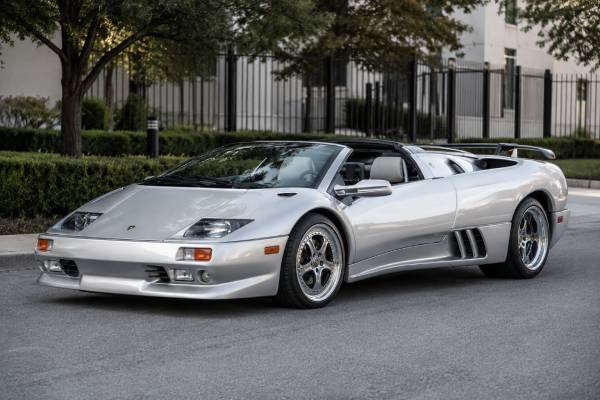
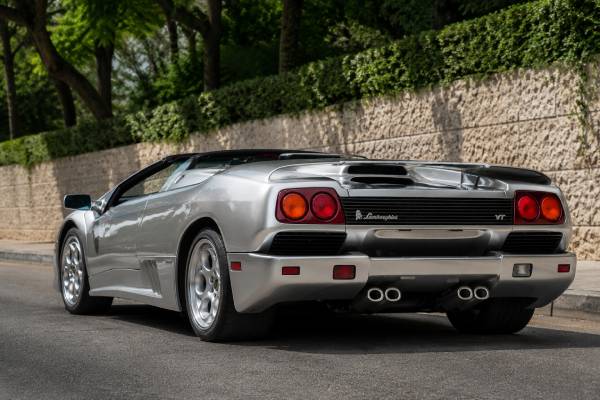
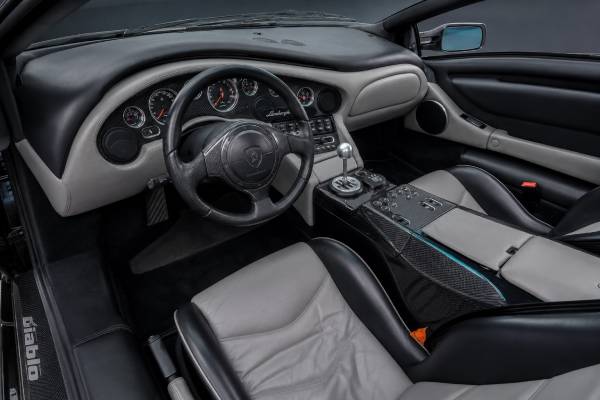
The Lamborghini Diablo Roadster Millennium is the final limited-run version of the 5.7-liter Diablo VT Roadster, built for the 2000 model year as the open-top Diablo era was ending. It belongs to Lamborghini’s P132 Diablo program, the long-awaited successor to the Countach and the bridge between the raw pre-Audi supercar years and the more polished Murciélago age. Its naturally aspirated Lamborghini V12 uses variable valve timing, produces about 530 hp, and sends power through a gated five-speed manual gearbox and VT all-wheel drive.
Collectors care because the Millennium Roadster combines three major traits: final-year status, very low production, and the classic 5.7-liter V12 driving character. Enthusiasts care because it keeps the Diablo’s drama intact: scissor doors, a removable carbon-fiber roof panel, huge rear tires, a wide stance, and the kind of mechanical noise modern supercars rarely deliver.
Table of Contents
- Why the Diablo Millennium Roadster Matters
- V12 VVT Specs, Chassis, and Performance Data
- Millennium Production, Options, and Identification
- Design, Engineering, and Open-Roof Details
- How the Diablo Roadster Drives
- Maintenance, Restoration, and Known Risk Areas
- Values, Buying Checks, and Collector Outlook
Why the Diablo Millennium Roadster Matters
The Diablo Roadster Millennium matters because it is one of the rarest factory open-top Diablos and one of the last 5.7-liter V12 cars before Lamborghini moved fully into the 6.0 VT and Murciélago period. It is not the most powerful Diablo, but it sits at a highly desirable point in the model line: late enough to gain the improved 1999 updates, early enough to retain the original Diablo shape and 5.7-liter engine identity.
The Diablo itself was developed as Project 132, the replacement for the Countach. That job was difficult because the Countach had defined Lamborghini’s visual language for more than a decade. The Diablo needed to be faster, more usable, and more modern while still looking outrageous enough to be a true V12 Lamborghini. It arrived in 1990 with a mid-mounted V12, rear-wheel drive, scissor doors, and a claimed top speed beyond 200 mph in early forms. That made it the supercar poster of the 1990s and a key rival to the Ferrari F40, Jaguar XJ220, Bugatti EB110, and later McLaren F1.
The Roadster version added something Lamborghini had never offered as a regular production V12 model before: factory open-air driving. Earlier open-top ideas existed as concepts or conversions, but the Diablo VT Roadster became Lamborghini’s first production convertible-style flagship. It was not a soft-top cruiser. It used a removable carbon-fiber roof panel that could be latched over the rear engine cover, keeping the shape dramatic and the structure more serious than a simple roof chop.
The Millennium edition came at the end of the 5.7-liter Roadster’s life. Lamborghini had entered the Volkswagen Group in 1998, with Audi influence beginning to improve quality, ergonomics, braking, and development discipline. The facelifted Diablo VT and VT Roadster gained fixed headlamps, a redesigned cabin, improved brakes, ABS, revised chassis details, and the stronger 530 hp V12 with variable valve timing. The Millennium Roadster took that late specification and wrapped it in a short final run.
For collectors, that makes the car more than a normal Diablo Roadster. It carries final-edition appeal, special colors and trim, and low production. For drivers, it gives the rawness of a gated V12 Lamborghini with just enough late-model polish to make it more usable than the earliest Diablos. It is still wide, loud, hot, and demanding. That is part of the appeal. The car feels like the closing chapter of Lamborghini’s analog supercar age.
V12 VVT Specs, Chassis, and Performance Data
The Millennium Roadster uses the late 5.7-liter Diablo VT Roadster mechanical package: a naturally aspirated V12 with variable valve timing, dry-sump lubrication, a five-speed manual gearbox, and VT all-wheel drive. The most useful way to understand it is as a 1999–2000 Diablo VT Roadster with final-edition cosmetic details and, on Millennium cars, shorter SV-style rear gearing.
| Item | Specification |
|---|---|
| Model | Lamborghini Diablo VT Roadster Millennium |
| Internal project family | P132 Diablo |
| Model year | 2000 |
| Body style | Two-door, two-seat removable-roof roadster |
| Engine | 5.7-liter naturally aspirated Lamborghini V12 |
| Displacement | 5,709 cc |
| Valvetrain | DOHC, 48 valves, variable valve timing |
| Induction | Natural aspiration |
| Fuel system | Electronic multi-point fuel injection |
| Power | About 530 hp at 7,100 rpm |
| Torque | About 446 lb-ft at 5,500 rpm |
| Transmission | Five-speed gated manual |
| Drivetrain | VT all-wheel drive with viscous coupling |
| Clutch | Dry single-plate clutch |
| Layout | Longitudinal mid-engine |
The engine is part of the long-running Lamborghini V12 line that began decades earlier, but by this stage it had moved far beyond the earliest forms. The late 5.7-liter Diablo unit used all-alloy construction, four valves per cylinder, dry-sump lubrication, catalytic converters, electronic management, and variable valve timing. VVT improved flexibility and emissions while helping the car reach the 530 hp figure associated with the facelifted VT, SV, and Roadster models.
The VT system is important. VT stands for Viscous Traction. Under normal driving, the Diablo still feels rear-biased, but the system can send torque forward through a viscous coupling when the rear tires start to lose grip. It is not a modern active all-wheel-drive system with constant electronic torque vectoring. It is a more mechanical solution, and that gives the car a particular feel: stable and traction-rich compared with early rear-drive Diablos, but still heavy, wide, and physical.
| Area | Specification |
|---|---|
| Chassis | Steel spaceframe with structural reinforcement |
| Body materials | Aluminum panels with carbon-fiber composite parts including roof and selected panels |
| Front suspension | Independent double wishbones with coil springs and adjustable dampers |
| Rear suspension | Independent double wishbones with coil springs and twin rear damper arrangement |
| Steering | Power-assisted rack-and-pinion |
| Front brakes | Ventilated, cross-drilled Brembo discs, about 355 mm |
| Rear brakes | Ventilated, cross-drilled Brembo discs, about 335 mm |
| ABS | Kelsey-Hayes ABS on late cars |
| Wheels | 18-inch split-rim alloy wheels |
| Front tires | 235/35 ZR18 |
| Rear tires | 335/30 ZR18 |
| Fuel capacity | About 100 liters |
| Curb weight | About 1,625 kg |
| Wheelbase | About 2,650–2,670 mm, depending on source convention |
| Width | About 2,040 mm |
Performance figures vary slightly by market, test conditions, and whether sources quote factory or road-test numbers. A sensible working range is 0–100 km/h in about 3.9 seconds and top speed around 202 mph for the Roadster. The coupe was slightly faster in some references, but the Roadster’s removable roof structure, aero, and weight make the open car a little less slippery.
The numbers still matter, but they do not tell the whole story. A modern performance EV can beat the Diablo’s acceleration, but it cannot reproduce the gated manual, the high-mounted V12 noise, the open roof panel, and the sense of operating a large mechanical device with every limb.
Millennium Production, Options, and Identification
The Millennium Roadster is best understood as a final limited edition of the Diablo VT Roadster rather than a separate engineering redesign. Its value comes from rarity, final-year status, specification details, and documentation that proves it is a true Millennium car.
Production is generally cited at 30 cars worldwide. Of those, 10 were built for the United States market, with the remaining cars going to other markets including Europe and the Middle East. U.S. cars are especially recognizable because they were finished in Titanium Metallic. Non-U.S. Millennium Roadsters could also appear in yellow, typically with matching two-tone interior treatment.
The key Millennium details include:
- limited final-run status for the 2000 model year
- Titanium Metallic finish on U.S.-market cars
- yellow availability for some non-U.S. cars
- two-tone leather interior treatment
- exposed carbon-fiber rear spoiler on many cars
- 18-inch wheels, including Teledial-style wheels or special five-spoke Momo-style wheels depending on car
- shorter SV-style rear final drive ratio
- numbered interior plaque on U.S. cars
- late facelift cabin with improved dashboard and airbags
- fixed headlamps instead of the earlier pop-up lights
The shorter gearing is one of the most useful mechanical identifiers. It does not turn the car into a Diablo SV, and it does not change the engine output, but it sharpens the way the car accelerates. For a roadster, that matters because open-air driving is more about response and theatre than maximum top-speed runs.
How it differs from a standard late VT Roadster
A standard 1999–2000 Diablo VT Roadster already has the major late updates: fixed headlamps, the redesigned interior, larger brakes, 18-inch wheels, ABS, the 530 hp VVT engine, and VT all-wheel drive. The Millennium adds limited-run trim, color restrictions, special interior treatment, the optional or commonly seen carbon-fiber rear wing, and shorter gearing.
That means a buyer should not assume every Titanium late Roadster is a Millennium car. The right car should have paperwork, plaque details where applicable, correct color and trim history, and records that connect the VIN to the edition. Because these cars are now high-value collectibles, authenticity matters as much as mileage.
Factory documentation and originality
For a Millennium Roadster, documentation should be treated as part of the car. Important records include:
- original sales paperwork or dealer documentation
- warranty booklet and stamped service book
- owner’s manual and pouch
- tool roll and factory accessories
- build correspondence or heritage confirmation where available
- service invoices from recognized Lamborghini specialists
- emissions and import paperwork for market-specific cars
- photographs showing original specification before repainting or restoration
Matching original equipment is also important. A missing roof panel, incorrect wheels, missing plaque, aftermarket exhaust, modified interior trim, or repaint away from the original color can all affect value. Some upgrades may make the car better to drive, but collectors normally pay the strongest money for correct, well-documented cars with reversible changes.
Design, Engineering, and Open-Roof Details
The Diablo Roadster Millennium looks dramatic because it keeps the full-width, low-nose, wide-hipped Diablo shape while adding an exposed cockpit and removable roof. The open-roof engineering is not just a styling trick; it changes the body structure, cooling layout, roof storage, and the way the car feels.
The original Diablo design came from Marcello Gandini’s sharp-edged supercar language, later softened and refined during Chrysler’s ownership. By the late 1999 update, Lamborghini had modernized the design without erasing its identity. The fixed headlamps cleaned up the front end, while the huge rear haunches, scissor doors, deep side intakes, and low roofline remained unmistakably Diablo.
The Roadster body required special work. Removing the fixed roof from a mid-engine supercar creates stiffness and heat-management problems. Lamborghini reinforced the structure around the windshield frame, door openings, cockpit, and engine bay. The roof panel itself is a removable carbon-fiber piece. When removed, it can be mounted over the engine cover, which is one of the car’s signature visual features.
That roof storage solution is clever and theatrical, but it also brings practical checks for buyers. The panel must fit properly, the latches must work cleanly, seals must sit correctly, and the engine cover mounting points must not be damaged. Poor alignment can point to worn hardware, incorrect repair, or previous accident damage.
Cooling and airflow also matter. The Roadster has distinctive intake and venting details because the roof panel can sit above the engine cover. The bodywork uses enlarged air intakes and specific ducting to feed and cool the V12. On a Diablo, heat is not a minor issue. The engine bay is tightly packaged, and the car relies on clean airflow, healthy fans, good coolant flow, and correct underbody and rear-body panels.
Inside, the late Diablo cabin is far better organized than the earliest cars. The dashboard became a sweeping, full-width design, the instruments moved closer to the driver, and the switchgear became more coherent. It is still an old-school exotic interior, not a modern luxury cabin. Visibility is limited, the sills are wide, the driving position is offset compared with normal cars, and the cabin can become hot in slow traffic.
The best design details are functional as well as visual:
- Scissor doors help define Lamborghini’s V12 identity and make access easier over wide sills than conventional doors would.
- Removable carbon-fiber roof adds open-air drama while keeping a hard-panel solution.
- Huge rear tires give the car its planted stance and traction-rich character.
- Side intakes and rear vents support engine cooling and make the Roadster look more aggressive than a simple roofless coupe.
- Gated manual shifter gives a direct mechanical link to the drivetrain.
- Fixed headlamps make late cars easier to identify and give better lighting than the earlier pop-up arrangement.
The Millennium Roadster is not subtle. Its engineering is visible, audible, and tactile. That is why it still feels special next to newer, faster cars.
How the Diablo Roadster Drives
The Diablo Roadster Millennium drives like a large, analog V12 supercar with a thin layer of late-1990s refinement. It is fast, stable, noisy, and physical, but the late VT updates make it less intimidating than the earliest rear-drive Diablos.
The engine dominates the experience. At low rpm, the 5.7-liter V12 is flexible enough to drive through town if the clutch is healthy and the cooling system is in good order. As revs rise, the car becomes sharper and louder. The variable valve timing helps broaden the torque curve, so it does not feel like a peaky race engine, but it still rewards revs. Above the midrange, the sound hardens into a metallic V12 wail mixed with intake noise behind the cabin.
The five-speed gated manual is central to the car’s appeal. It needs deliberate inputs, especially when cold. A good gearbox feels mechanical and positive, not light or rubbery. First-to-second can be slow until the oil warms, and rushing shifts is never the right approach. The car responds best to smooth hands, clean clutch work, and patience.
The VT all-wheel-drive system gives the Roadster more traction than early rear-drive Diablos. On dry roads, the rear tires still do most of the emotional work, but the system adds security when the driver asks for power over uneven or imperfect surfaces. It also changes the handling balance. Near the limit, a VT Diablo is not as delicate or adjustable as a lighter rear-drive SV. It prefers clean lines, measured throttle, and respect for its weight and width.
Steering is heavy by modern standards but not crude. It has more feedback than many newer supercars with heavily filtered systems. The wide front tires and all-wheel-drive hardware mean the car can feel substantial in tight corners. On open roads, it settles into a confident rhythm. The long wheelbase, low center of gravity, and wide track make it feel stable at speed.
Ride quality depends heavily on tire condition, damper health, alignment, and wheel setup. A sorted car can ride firmly but acceptably. A tired car can tramline, crash over bumps, or feel nervous. Old tires are a major problem because many Diablos cover little mileage. A car can show deep tread and still be unsafe if the tires are aged out.
Braking is much improved on the late cars thanks to larger Brembo hardware and ABS. The pedal should feel firm, not spongy. Because the Diablo is heavy and fast, brake condition matters. Road use may not reveal problems that appear during repeated high-speed stops, so inspection should include disc wear, caliper condition, brake hoses, fluid age, and ABS operation.
Open-roof driving adds noise and sensation. With the roof removed, the V12 feels closer, the wind is more present, and the car’s theatre increases. With the roof panel installed, buyers should expect more noise than a fixed-roof coupe but not severe rattles, water leaks, or poor latch security. Those issues need investigation.
Maintenance, Restoration, and Known Risk Areas
A Diablo Roadster Millennium is not a normal used car; it is a low-volume exotic that needs specialist care, correct parts, and careful records. Reliability depends less on mileage and more on storage, maintenance quality, originality, and whether previous owners fixed problems properly or postponed them.
The V12 itself is strong when maintained, but neglected cars can become very expensive quickly. Heat, age, old fluids, dried seals, weak hoses, poor electrical grounds, fuel-system varnish, and deferred clutch work are common exotic-car risks. A low-mileage car that sat unused for years can need more recommissioning than a higher-mileage car that was serviced regularly.
Mechanical areas to inspect closely
A proper pre-purchase inspection should focus on the systems that create the largest repair bills:
- Engine health: compression, leakdown, oil leaks, coolant leaks, timing condition, idle quality, and evidence of overheating.
- Cooling system: radiators, fans, coolant hoses, expansion tank, thermostat behavior, and temperature stability in traffic.
- Fuel system: pumps, lines, injectors, tank condition, stale-fuel damage, and any fuel smell around the engine bay.
- Clutch: bite point, slip under load, release bearing noise, hydraulic leaks, and service history.
- Gearbox: cold shift quality, synchro behavior, oil leaks, noisy bearings, and correct engagement through all gears.
- VT drivetrain: front drive components, viscous coupling behavior, differential leaks, CV joints, and axle boots.
- Suspension: Koni damper function, bushings, ball joints, wheel bearings, and correct ride height.
- Brakes: discs, pads, calipers, hoses, fluid age, ABS warning lights, and handbrake operation.
- Electrical system: warning lights, gauges, windows, mirrors, fans, air-conditioning, lighting, and battery drain.
- Roof system: panel fit, latch condition, seals, storage mounting, wind noise, and water sealing.
The clutch is a major cost driver. Diablo clutch life varies widely with driving style. Cars used mostly for careful open-road driving can last far longer than cars used in traffic, hill starts, or show-off launches. A clutch inspection should not rely only on mileage. Feel, adjustment, records, and specialist assessment matter.
The cooling system is another priority. The Diablo’s engine bay runs hot, and the Roadster’s packaging makes correct airflow important. Overheating can lead to warped components, cooked wiring, brittle hoses, and repeated failures. Any car that runs hot during inspection should be treated seriously, not dismissed as “normal for a Diablo.”
Body, chassis, and restoration risks
Accident history is one of the biggest value risks. The Diablo’s wide body, low nose, and expensive panels mean even minor damage can become costly. Look for mismatched paint, uneven panel gaps, overspray, poor underbody repairs, incorrect fasteners, and disturbed seam finishes. The Roadster structure should also be checked for door alignment, windshield-frame repairs, and roof fit.
Corrosion is not usually discussed like it is on older steel-bodied classics, but it should not be ignored. The steel spaceframe, suspension mounts, fasteners, brackets, and hidden areas can suffer from moisture, poor storage, and past repairs. Cars from humid climates or long storage periods deserve extra attention.
Interior restoration is difficult because original trim, leather colors, switches, plaques, and special edition details can be hard to replace. Re-trimmed interiors may look fresh but reduce originality if the materials, stitching, embossing, colors, or patterns are wrong. For a Millennium car, the two-tone interior is part of the identity.
Parts availability is mixed. Some service parts are obtainable through specialists, Lamborghini dealers, or reproduction channels. Other items, especially trim pieces, Roadster-specific hardware, special plaques, wheels, roof components, and unique interior pieces, can be scarce. Buyers should price missing items as real deductions, not minor inconveniences.
Values, Buying Checks, and Collector Outlook
The Diablo Roadster Millennium sits in a strong collector position because it combines low production, manual V12 character, final-edition status, and open-air drama. Current market data for late Diablo VT Roadsters shows values well into the high six-figure range for excellent examples, while special cars with rare specification, low mileage, and strong documentation can command more.
The market does not treat every Diablo Roadster equally. Early Roadsters, late facelift Roadsters, Momo editions, Millennium cars, unusual colors, ultra-low-mileage cars, and fully documented examples all sit in different value bands. A Millennium Roadster should be judged against other Millennium cars first, then against late VT Roadsters, then against the broader Diablo market.
The biggest value drivers are:
- confirmed Millennium authenticity
- original color and interior
- low but believable mileage
- continuous ownership and service history
- factory books, tools, roof panel, accessories, and plaque
- no accident history
- original panels and paint where possible
- correct wheels, spoiler, trim, and special-edition details
- recent specialist service
- clean import, emissions, and title history
- strong cosmetic condition without over-restoration
A high-mileage but well-maintained car can be a better driver than a neglected garage queen. For investment-grade buying, however, collectors usually favor originality, low mileage, and documentation. The best purchase is a car that has both: preserved condition and enough regular use to keep the mechanical systems healthy.
| Priority | What to confirm | Why it matters |
|---|---|---|
| Identity | VIN, edition paperwork, plaque, color, trim, and build history | Authenticity drives collector value |
| Engine | Compression, leakdown, leaks, cooling behavior, service records | V12 repairs are major cost events |
| Transmission and clutch | Shift quality, clutch wear, hydraulic system, service invoices | Labor and parts costs are high |
| Body and chassis | Panel gaps, paint depth, frame condition, underbody damage | Accident repair can severely affect value |
| Roadster hardware | Roof fit, seals, latches, storage mounting, wind noise | Roadster-specific parts can be scarce |
| Interior | Two-tone leather, plaque, trim, gauges, switches, originality | Special-edition details are hard to replace |
| Use history | Storage, tire age, fluid age, annual mileage, recommissioning | Low mileage alone does not guarantee condition |
Avoid cars with vague stories. “Rare edition” claims should be backed by documents. “Recent service” should mean invoices from a qualified Lamborghini shop, not an oil change at an unknown workshop. “No accident history” should be supported by paint readings, underbody inspection, panel analysis, and records, not just a clean vehicle-history report.
The strongest cars are usually those that have never needed a full restoration. Originality matters because restoring a Diablo correctly is expensive and detail-sensitive. Over-restored cars can lose their factory feel, while cheaply refreshed cars often hide deeper problems. A buyer should also be careful with heavy modifications. Exhaust upgrades, audio changes, wheels, and minor reversible items may be acceptable if original parts are retained. Non-original paint, incorrect interior work, structural repairs, missing roof hardware, or undocumented drivetrain work are far more serious.
Long term, the Millennium Roadster has many traits collectors like: it is rare, analog, naturally aspirated, manual, visually dramatic, and connected to the end of an important Lamborghini era. It is also usable enough for careful road enjoyment when properly maintained. The main ownership risk is not depreciation; it is buying the wrong car and spending heavily to correct old neglect.
References
- Lamborghini History – Diablo | Lamborghini.com 2026 (Manufacturer History)
- Recall Campaign | Lamborghini.com 2026 (Recall Lookup)
- Check for Recalls: Vehicle, Car Seat, Tire, Equipment | NHTSA 2026 (Recall Database)
- Lamborghini Diablo VT & VT Roadster (99 MY) Guide — Supercar Nostalgia 2025 (Technical Guide)
- Lamborghini Diablo VT Roadster – 2nd Generation Market – CLASSIC.COM 2026 (Market Data)
Disclaimer
This article is for informational purposes only and is not a substitute for professional diagnosis, repair, valuation, or inspection. Specifications, torque values, service intervals, parts, procedures, recall status, and equipment can vary by VIN, market, production date, and individual vehicle history. Always verify details against official Lamborghini service documentation and consult a qualified Lamborghini specialist before buying, repairing, restoring, or modifying a Diablo Roadster Millennium.
If you found this guide useful, please share it on Facebook, X/Twitter, or your preferred car community to support our work.