

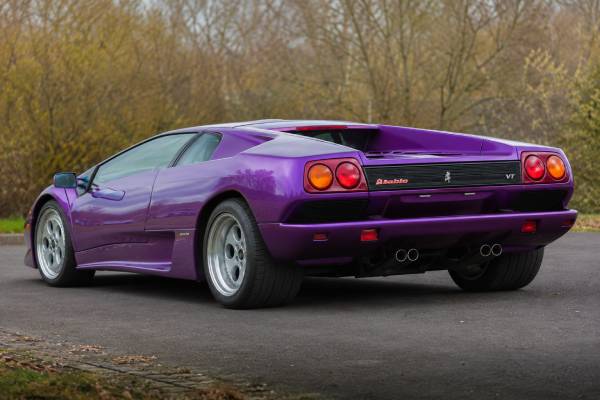
The Lamborghini Diablo VT is the four-wheel-drive evolution of the original Diablo, the P132-generation V12 supercar that carried Lamborghini from the Countach era into the 1990s. Introduced for 1993, the VT kept the 5.7-liter naturally aspirated V12 and five-speed manual gearbox, but added “Viscous Traction,” a viscous-coupling all-wheel-drive system that could send torque to the front axle when the rear tires lost grip. That single change made the Diablo more usable without making it feel ordinary.
For buyers and collectors, the 1993–1998 Diablo VT matters because it combines the early pop-up-headlight body, the classic 5.7 V12, manual-only control, and a major Lamborghini engineering milestone. It is still dramatic, wide, loud, and demanding, but the VT is usually the Diablo that makes the most sense for people who want the original shape with better traction, power steering, and real long-distance ability.
Table of Contents
- Diablo VT’s Place in Lamborghini History
- V12, AWD Specs, and Performance Data
- Production Years, Variants, and Factory Details
- Design, Engineering, and VT-Specific Features
- Driving Character, Speed, and Road Feel
- Maintenance, Reliability, and Restoration Risks
- Market Values, Inspection, and Buying Advice
Diablo VT’s Place in Lamborghini History
The Diablo VT was the version that made Lamborghini’s flagship less intimidating without dulling its identity. It arrived after the rear-wheel-drive Diablo had already proved that Lamborghini could replace the Countach with something faster, wider, more refined, and still outrageous.
The Diablo project began as Lamborghini’s next flagship after the Countach. Internally tied to the P132 development program, it had to carry the same mid-engine V12 drama while meeting higher expectations for speed, comfort, and stability. The finished car appeared for 1990 with dramatic wedge styling, scissor doors, a 5.7-liter V12, and a claimed top speed above 200 mph. It was not a soft grand tourer. Early rear-drive Diablos had no power steering, no all-wheel drive, and little electronic help beyond engine management.
The VT changed that formula in 1993. “VT” stands for Viscous Traction, Lamborghini’s name for the all-wheel-drive system. The basic layout remained rear-biased: the engine sat longitudinally behind the cabin, the gearbox was manual, and the car still behaved like a large mid-engine supercar. The difference was that the drivetrain could help the driver when the rear tires started to lose traction.
That mattered because the Diablo had huge power for its time, wide rear tires, and a reputation for requiring respect. The VT made the car less nervous in cold, wet, or uneven conditions. It also brought a package of improvements that helped the whole Diablo range, including power steering, revised damping, better brake cooling, and a more livable cabin.
For Lamborghini history, the Diablo VT is important for three reasons:
- It was Lamborghini’s first four-wheel-drive production grand-touring supercar.
- It set the template for later V12 Lamborghinis, including the Murciélago and Aventador, where all-wheel drive became central to the flagship formula.
- It kept the visual and mechanical spirit of the early Diablo while making the car easier to exploit.
The 1993–1998 VT sits in a sweet spot. It has the original pop-up-headlight body rather than the later fixed-headlamp restyle. It uses the 5.7-liter engine rather than the later 6.0-liter Audi-era development. It also comes from the period before stability control, paddle-shift gearboxes, active aerodynamics, and digital drive modes reshaped the supercar experience.
Collectors now view the early VT as more than a usable Diablo. It is a bridge car: raw enough to feel close to the Countach lineage, but advanced enough to preview the all-wheel-drive V12 Lamborghinis that followed.
V12, AWD Specs, and Performance Data
The Diablo VT’s core specification is simple: a 5.7-liter naturally aspirated Lamborghini V12, a five-speed manual gearbox, and a rear-biased all-wheel-drive system. The important detail is that the quoted 492 hp figure is usually metric horsepower, or PS; U.S. SAE output is often listed at about 485 hp.
| Item | Specification |
|---|---|
| Model | Lamborghini Diablo VT |
| Internal project reference | P132 Diablo generation |
| Production period covered | 1993–1998 early VT coupe |
| Engine | 5.7-liter naturally aspirated Lamborghini V12 |
| Displacement | 5,707 cc |
| Valvetrain | Dual overhead camshafts, four valves per cylinder |
| Fuel system | Electronic multi-point fuel injection |
| Power | 492 PS / about 485 SAE hp, depending on market rating |
| Torque | 580 Nm / about 428 lb-ft |
| Transmission | Five-speed manual |
| Drivetrain | Rear-biased all-wheel drive with viscous coupling |
| Layout | Longitudinal mid-engine, two-seat coupe |
| Body style | Two-door coupe with scissor doors |
The engine is the heart of the car. It is not turbocharged, not hybrid-assisted, and not filtered through modern software. It is a large-displacement, high-revving, naturally aspirated V12 with a mechanical throttle response that depends heavily on correct tune, clean ignition, sound fuel delivery, and healthy cooling.
The five-speed manual gearbox is also central to the VT’s character. The shift is heavy compared with modern manuals, especially when cold, and the clutch is not something to treat casually. A healthy car rewards deliberate inputs; a worn car can feel obstructive, noisy, or vague.
| Measure | Typical figure | Useful context |
|---|---|---|
| 0–100 km/h | About 4.1–4.5 seconds | Period results vary by test method, tires, surface, and launch technique |
| Top speed | About 325 km/h / 202 mph | Factory and period figures place the Diablo among the fastest production cars of its era |
| Braking | Large ventilated discs with four-piston calipers | Condition, tire age, and hydraulic health matter more than brochure figures today |
| Fuel economy | Very low by normal-car standards | Expect heavy fuel use in city driving and under enthusiastic throttle |
The VT’s all-wheel-drive system is not a modern predictive system. It does not make the car foolproof, and it does not erase the weight, width, or mid-engine balance. Its purpose is to improve traction when the rear axle begins to struggle. In normal hard driving, the car still feels rear-led. That is why many enthusiasts like the VT: it adds security without turning the Diablo into a numb, front-pulling machine.
The chassis uses a tubular steel frame with aluminum and composite body panels. Suspension is independent, and the VT introduced electronically adjustable damping in many markets. The car is very wide, low, and heavy enough that tires, alignment, bushing condition, and damper health make a major difference. A well-sorted VT feels planted and physical. A neglected one can feel heavy, nervous, and expensive before any mechanical diagnosis even begins.
Production Years, Variants, and Factory Details
The 1993–1998 Diablo VT is best understood as the first-generation VT coupe, separate from the VT Roadster and later 1999 restyled VT. Production totals vary by source and counting method, so buyers should treat published numbers as guidance and rely on factory documentation for a specific car.
The early VT arrived for 1993 and ran through the pre-facelift period before the 1999 update. During that time, Lamborghini also offered other Diablo versions, including the rear-drive Diablo, SE30, SV, and VT Roadster. These cars overlap in years but not in purpose.
| Variant | Approximate period | Main difference |
|---|---|---|
| Diablo | 1990–1998 | Original rear-wheel-drive 5.7-liter coupe |
| Diablo VT | 1993–1998 | All-wheel-drive coupe with Viscous Traction |
| Diablo SE30 | 1993–1996 | Lighter, more powerful 30th-anniversary special |
| Diablo SV | 1995–1998 | Rear-drive, more focused Super Veloce model |
| Diablo VT Roadster | 1995–1998 early version | Open-roof VT with removable roof panel and body changes |
| 1999 VT | 1999 | Restyled 5.7-liter VT with fixed headlights and later updates |
For identification, early VT coupes usually have the pop-up headlights, large side intakes, VT-specific brake cooling improvements, power steering, and the all-wheel-drive hardware. Many cars have rear wings, but the wing was not the whole story. A rear wing alone does not prove a car is a VT, and a wingless car is not automatically incorrect.
Factory options and market equipment varied. Items often seen or discussed include:
- rear wing specification and finish
- Alpine audio equipment
- leather color and stitching combinations
- special-order paint
- fitted luggage
- climate control
- market-specific lighting and emissions equipment
- different wheel finishes or later wheel updates
- owner’s manuals, service book, tool roll, and factory wallet
Documentation is unusually important because Diablos often changed countries, received cosmetic updates, had accident repairs, or were modified during the supercar boom years. A strong file should include service invoices, ownership history, import paperwork where relevant, original books, paint and trim confirmation, and ideally Lamborghini Polo Storico certification or correspondence.
Matching-number relevance is also rising. Buyers should verify the VIN, engine number, gearbox number, body tags, and market compliance labels. On a car this valuable, a missing plate, unclear import history, replacement engine, color change, or undocumented restoration can change value dramatically.
The most desirable early VT examples usually share several traits: original body configuration, desirable colors, low but usable mileage, continuous maintenance, clean accident history, factory books, and specialist inspection records. Very low-mile cars can bring attention, but they are not automatically safer to buy. Long storage often creates fuel, seal, clutch, brake, tire, and cooling-system problems that only appear when the car is returned to real use.
Design, Engineering, and VT-Specific Features
The Diablo VT looks like a pure 1990s poster car, but its design is also driven by cooling, traction, packaging, and high-speed stability. The VT’s extra engineering made the Diablo more manageable while preserving the low, wide, scissor-door shape that made the model famous.
The Diablo’s original design came from the wedge-supercar school that Lamborghini helped define with the Countach. Marcello Gandini’s influence is clear in the proportions: short front overhang, huge width, sharply raked glass, high rear mass, and a cabin pushed forward by the longitudinal V12 behind it. Chrysler-era refinement softened some elements before production, but the car never lost its visual aggression.
The VT added functional changes rather than a full redesign. Extra cooling attention was important because the car carried more drivetrain hardware and was expected to work as a more usable grand tourer. The front intakes below the lamps, enlarged rear-side openings, and underbody airflow details all helped the car cope with speed, brake heat, and engine temperature.
The most important engineering feature is the drivetrain. The viscous coupling allows torque to be directed toward the front axle when rear slip occurs. This improves traction, especially when accelerating out of slower corners or driving on imperfect roads. It also adds weight and complexity. For collectors, that is the central VT tradeoff: more usability and historical importance, but more mechanical parts to inspect and maintain.
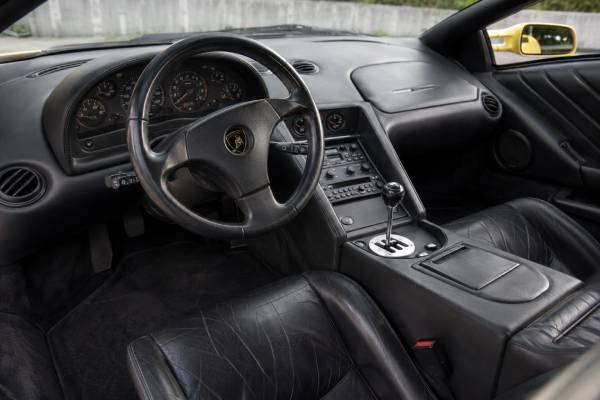
The cockpit is more comfortable than the Countach’s, but it is still a low, wide, specialist car. The doors open upward, the sills are broad, and entry requires a technique rather than a casual slide into the seat. Once inside, the driver faces a low seating position, large transmission tunnel, heavy controls, and limited rear visibility. Later interior updates made the Diablo easier to live with, but the early VT still feels analogue and hand-built.
Important VT-specific or VT-era features include:
- power steering, which greatly improves low-speed usability
- all-wheel drive with rear-biased behavior
- revised suspension tuning and electronic damper control on many cars
- larger brake-cooling attention than the earliest rear-drive cars
- improved interior ergonomics compared with the first Diablos
- the same dramatic scissor doors and pop-up headlights as the original body style
The sound is a major part of the engineering experience. The V12 does not behave like a modern muted supercar engine. It has mechanical noise, intake texture, and exhaust volume that change sharply with throttle opening. A correct exhaust keeps the sound rich and metallic without ruining drivability. Aftermarket systems can sound spectacular, but they may reduce originality, affect emissions compliance, or make long trips tiring.
The Diablo VT also represents a turning point in Lamborghini packaging. It proved that an all-wheel-drive V12 supercar could keep the brand’s theatre while offering more traction and confidence. Later Lamborghinis would refine that idea with stronger structures, better cooling, improved electronics, and more polished interiors. The VT is where that modern V12 Lamborghini formula became visible.
Driving Character, Speed, and Road Feel
A good Diablo VT feels fast, heavy, wide, and alive; it does not feel like a modern supercar with old styling. The car rewards patience, proper warm-up, smooth hands, and decisive inputs more than aggression.
The V12 dominates the experience. At low rpm, it has enough torque to move the car cleanly, but the engine becomes more dramatic as revs rise. The response is direct, and the sound hardens into the kind of mechanical V12 voice that made the Diablo a bedroom-wall icon. It is not effortless in the modern turbocharged sense. It feels like speed is being built by displacement, airflow, gearing, and commitment.
The gearbox needs respect. When cold, shift quality can be stiff, and forcing the lever is poor practice. A careful driver lets fluids warm, uses deliberate movements, and avoids rushing the second-gear shift until the transaxle is ready. Once warm and properly adjusted, the gearbox should feel mechanical rather than obstructive. Grinding, jumping out of gear, severe baulking, or heavy driveline clunks are warning signs.
The VT’s steering is one of the biggest improvements over early rear-drive cars. Power steering makes the car far easier in town and during parking, but it still has weight at speed. The front axle is not delicate in the way a light sports car’s front end is; the Diablo is too wide and too heavy for that. Instead, it feels stable, planted, and serious.
The all-wheel-drive system changes how the car behaves under throttle. In a rear-drive Diablo, the driver has to be more careful when applying power on questionable surfaces. In the VT, there is more traction reserve. That does not mean the car can be driven carelessly. Old tires, cold roads, incorrect alignment, or worn dampers can still make the car difficult. The VT simply gives the driver a wider safety margin.
Ride quality depends heavily on tire age, damper condition, and suspension health. A fresh, correctly aligned car can be surprisingly usable on highways. A tired one may tramline, crash over bumps, or feel nervous in fast bends. Because the car is very low, front overhangs, ramps, potholes, and road crowns require attention.
Braking performance was strong for the period, but modern drivers should judge the system by condition rather than brochure status. Old flexible hoses, tired fluid, worn discs, uneven pads, sticky calipers, or aged tires can make an expensive supercar stop like a neglected old car. A proper brake refresh can transform confidence.
Visibility is part of the Diablo’s personality. Forward vision is dramatic but low. Rearward vision is limited. The width is always present. The driver needs to place the car carefully and leave more room than expected in traffic, parking garages, and narrow roads. This is not a casual commuter, even in VT form.
On the right road, the VT’s appeal is clear. It combines a huge V12, manual control, high-speed stability, and enough traction to let the driver use more of the engine more often. It feels less edgy than the earliest rear-drive Diablo but still far more physical than later electronically managed supercars.
Maintenance, Reliability, and Restoration Risks
The Diablo VT can be dependable when maintained by specialists, but neglected examples become expensive very quickly. Reliability is less about the basic strength of the V12 and more about age, heat, access, parts supply, prior workmanship, and whether the car has been used regularly.
The 5.7-liter V12 is a serious engine, not a fragile ornament. It can cover meaningful mileage when serviced correctly. The problem is that many Diablos live irregular lives. Long storage, short cold starts, deferred fluid changes, old fuel, weak batteries, and poor workshop practices create faults that owners mistake for “Italian character.”
Major areas to inspect include:
- cooling system condition, including radiators, fans, hoses, clamps, and temperature behavior in traffic
- fuel hoses, tanks, pumps, injectors, and signs of varnish from storage
- ignition components, wiring condition, and correct running on all cylinders
- oil leaks from cam covers, seals, lines, and fittings
- clutch wear, pedal effort, release behavior, and service history
- gearbox synchros, shift linkage adjustment, and transaxle noise
- front differential, transfer components, driveshafts, and viscous-coupling health
- suspension bushings, dampers, ball joints, and ride-height settings
- brake calipers, discs, pads, hoses, master cylinder, and fluid age
- air-conditioning operation and climate-control parts
- pop-up headlight operation and electrical reliability
The VT’s all-wheel-drive hardware adds inspection points that rear-drive Diablos do not have. Any vibration, binding, fluid leak, or unusual driveline noise deserves specialist diagnosis. Converting or disabling systems to avoid repairs harms authenticity and may reduce value.
Clutch work is a major cost driver. A Diablo clutch can last well when driven properly, but city driving, poor technique, and repeated hard launches shorten its life. Documentation of clutch replacement is useful only if the invoice identifies the parts, labor, mileage, and specialist involved.
Cooling is another major ownership concern. These cars generate serious heat, and the packaging is tight. A Diablo that runs acceptably on an open road may still overheat in traffic if fans, radiators, relays, or coolant flow are compromised. Buyers should insist on a proper hot-running test, not just a cold start in a showroom.
Body and chassis condition matter as much as mechanical condition. Look for signs of accident repair around the front structure, suspension pick-up points, door openings, underbody, rear frame area, and engine bay. Panel fit on hand-built exotics is not always modern-perfect, but mismatched paint, uneven gaps, cracked composite sections, fresh undercoating, or missing labels need explanation.
Restoration is difficult because the car is complex, low-volume, and parts availability can be uneven. Some parts are available through specialists, some must be rebuilt, and some trim items are hard to source in correct original form. Interior restoration can become expensive if leather, switches, gauges, or unique trim pieces are missing or modified.
Originality versus upgrades is a real decision. Sensible improvements such as modern tires in correct sizes, improved cooling components, careful brake refreshes, and high-quality hose replacement can make the car safer and more usable. Poorly chosen wheels, non-original interior retrims, questionable engine tuning, stereo cutting, color changes, or crude exhaust work can reduce collector appeal.
For ownership planning, the best approach is simple: buy the best documented car, keep it exercised, service it with a known Lamborghini specialist, and fix small problems before they become engine-out or drivetrain-out events.
Market Values, Inspection, and Buying Advice
The early Diablo VT now sits in a serious collector market, with values driven by originality, documentation, mileage, color, condition, and provenance. As of 2026, public-market data commonly places good early VT coupes in the low-to-mid six-figure range, with exceptional cars, special provenance, or roadsters reaching much higher.
A normal used-car mindset does not work here. The cheapest Diablo VT is rarely the best value. A car that needs clutch work, tires, cooling repairs, paint correction, interior restoration, and drivetrain diagnosis can erase any discount quickly. The right car is the one with the clearest story and the fewest hidden risks.
Value drivers include:
- original paint or high-quality documented repaint
- factory-correct color and interior combination
- early VT coupe status with pop-up headlights
- original books, tools, service wallet, and records
- known ownership chain
- specialist maintenance history
- low-to-moderate mileage with evidence of regular use
- clean accident and import history
- correct engine, gearbox, and VIN documentation
- Lamborghini Polo Storico certification or supporting factory records
- desirable provenance, such as press, celebrity, or single-owner history
Cars to treat carefully include:
- cars with missing service records
- cars stored for many years without recommissioning invoices
- cars with unexplained engine or gearbox changes
- cars with modified bodywork or later-model cosmetic conversions
- cars with poor paintwork over accident damage
- cars that overheat, smoke, grind gears, or show warning lights
- cars advertised with vague phrases instead of dated invoices
- cars whose sellers resist specialist inspection
A proper pre-purchase inspection should be done by a Lamborghini specialist who knows Diablos, not just a general exotic-car shop. The inspection should include a cold start, hot idle, road test, lift inspection, paint-depth readings, leak inspection, compression or leak-down testing when justified, diagnostic review where applicable, and documentation check.
| Area | What to check | Why it matters |
|---|---|---|
| Documents | Books, service invoices, ownership history, import papers | Confirms identity, care, mileage pattern, and market value |
| Engine | Leaks, smoke, temperature stability, running quality | V12 repairs are expensive and require specialist labor |
| Gearbox and clutch | Cold and warm shifts, clutch bite, noises, invoices | Major drivetrain work can change the economics of the purchase |
| AWD system | Front drivetrain, viscous coupling behavior, leaks, vibration | VT hardware is central to identity and costly to sort |
| Cooling system | Fans, radiators, hoses, hot traffic behavior | Heat-related issues are common in poorly maintained exotics |
| Body and chassis | Panel fit, paint depth, underbody, suspension points | Accident repair can reduce safety, value, and collectability |
| Interior | Leather, switches, gauges, air conditioning, trim originality | Correct parts and retrim work can be expensive |
From an investment standpoint, the early Diablo VT has a strong case. It is a manual V12 Lamborghini, it has the original Diablo shape, and it introduced a drivetrain concept that became central to the brand’s flagship cars. It also belongs to a period that younger collectors now remember vividly from magazines, posters, games, and early internet supercar culture.
That does not mean every VT will rise equally. The market is selective. The best cars separate themselves through condition, paper trail, color, originality, and expert preparation. Average cars can be hard to sell if priced like exceptional examples. Modified or poorly documented cars need a discount large enough to cover uncertainty.
For most buyers, the best Diablo VT is not the lowest-mile car or the cheapest car. It is a well-kept, regularly serviced, mostly original example with no accident questions and a seller who welcomes expert inspection. That kind of car gives the owner the best chance of enjoying the Diablo’s drama without turning ownership into a restoration project.
References
- Lamborghini Diablo’s 30th anniversary with Cesare Cremonini 2020 (Manufacturer History)
- Campagne de rappel | Lamborghini.com 2026 (Recall Information)
- Tested: 1994 Lamborghini Diablo VT Is a More Civilized Bull 2021 (Period Test Data)
- Lamborghini Diablo VT Market – CLASSIC.COM 2026 (Market Data)
- 1994 Lamborghini Diablo VT | Monterey 2024 | RM Sotheby’s 2024 (Auction Listing)
Disclaimer
This article is for informational purposes only and is not a substitute for professional diagnosis, inspection, repair, valuation, or restoration advice. Specifications, torque values, service intervals, procedures, equipment, and compliance requirements can vary by VIN, market, production date, and individual vehicle history. Always verify details against official service documentation and have any Lamborghini Diablo VT inspected by a qualified specialist before purchase or major repair.
If this guide helped you, please share it on Facebook, X/Twitter, or your favorite car community to support our work.