

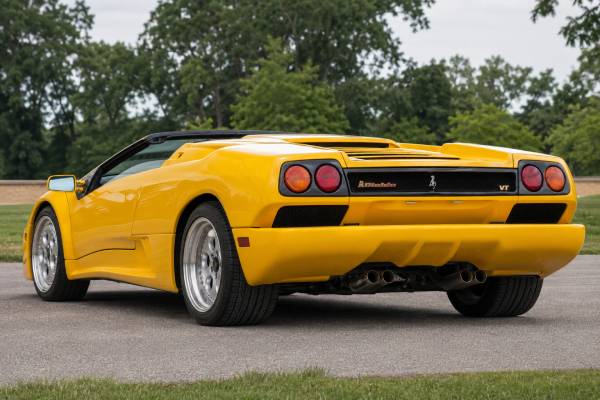
The Lamborghini Diablo VT Roadster is the open-roof, all-wheel-drive version of Lamborghini’s 1990s V12 flagship, built in its first-generation pop-up-headlight form from late 1995 through 1998. It pairs the Diablo’s 5.7-liter naturally aspirated V12 with the VT viscous-traction drivetrain, a five-speed gated manual gearbox, dramatic scissor doors, and a removable roof panel that turns one of the era’s wildest supercars into a more theatrical grand tourer. It matters because it was Lamborghini’s first series-production open-top 12-cylinder model, bridging the raw Countach era and the more polished Audi-influenced Diablos that followed. For collectors, the 1995–1998 VT Roadster is attractive because it keeps the early Diablo look while adding usability, rarity, and open-air character. For owners and buyers, it is also a complex hand-built exotic where originality, documentation, specialist maintenance, and accident history matter as much as mileage.
Table of Contents
- Why the Diablo VT Roadster Matters
- V12 Specs, Chassis, and Performance Data
- Production Years, Variants, and Authenticity
- Design, Engineering, and Roadster Details
- How the VT Roadster Drives
- Maintenance, Reliability, and Restoration Risk
- Market Values and Buyer Checklist
Why the Diablo VT Roadster Matters
The Diablo VT Roadster matters because it gave Lamborghini its first regular-production open V12 supercar while keeping the visual shock of the early Diablo. It was not a soft lifestyle convertible; it was a low, wide, mid-engined V12 machine with a removable roof, a manual gearbox, and a traction system designed to make nearly 500 horsepower usable on real roads.
The Diablo itself arrived in 1990 as the replacement for the Countach. That was a difficult job. The Countach had become the shape people imagined when they thought of Lamborghini: wedge body, scissor doors, huge rear tires, and theatrical impracticality. The Diablo had to look even more extreme while meeting the expectations of a new decade, including more refinement, better ergonomics, stronger cooling, better build quality, and true 200-mph performance.
The design came from Marcello Gandini’s original work, later refined under Chrysler ownership before production. The result was smoother than the Countach but still unmistakably Lamborghini. It kept the low nose, broad stance, upward-opening doors, and rear-mid-mounted V12 layout, but added a more rounded 1990s form and a cabin that could be used for long-distance driving.
The VT Roadster built on the Diablo VT coupe introduced in 1993. “VT” stands for viscous traction, Lamborghini’s all-wheel-drive system using a viscous center coupling. Under normal driving, the car still felt rear-biased, but the system could send torque to the front wheels when rear grip faded. In a powerful, mid-engined V12 car with wide rear tires and no modern stability control, that made a real difference.
The Roadster was introduced in late 1995 and is often associated with the 1996 model year in many markets. The 1995–1998 cars are especially desirable because they are the first-generation VT Roadsters with retractable headlights, the 492 hp 5.7-liter V12, and the cleaner early Diablo identity. Later 1999–2000 VT Roadsters gained fixed headlights, revised interior details, ABS, and more power, but they feel like a different chapter.
For collectors, the first-generation Diablo VT Roadster sits in a valuable middle ground. It is rarer than the standard Diablo coupe, more usable than the early rear-drive cars, and visually more dramatic than many later supercars. It also represents Lamborghini just before the Audi era fully reshaped the brand. That makes condition, provenance, and originality especially important.
V12 Specs, Chassis, and Performance Data
The key specification is simple: a 5.7-liter naturally aspirated Lamborghini V12, a five-speed manual gearbox, and all-wheel drive through the VT viscous-traction system. The car’s numbers still look serious today, but its character comes from the mechanical layout, the roof design, and the lack of modern electronic filtering.
| Category | Specification |
|---|---|
| Model | Lamborghini Diablo VT Roadster |
| Internal family | P132 Diablo platform family |
| Production period covered | Late 1995 to 1998 first-generation Roadster |
| Body style | Two-seat open car with removable hard roof panel |
| Engine | 60-degree naturally aspirated V12 |
| Displacement | 5,707 cc |
| Valvetrain | Dual overhead camshafts, four valves per cylinder |
| Fuel system | Lamborghini electronic sequential multi-point injection |
| Maximum output | 492 bhp at 7,000 rpm |
| Maximum torque | 580 Nm / 428 lb-ft at 5,200 rpm |
| Lubrication | Dry sump |
| Transmission | Five-speed manual with reverse |
| Drivetrain | VT all-wheel drive with viscous center coupling |
| Front differential | Limited slip, 25 percent |
| Rear differential | Limited slip, 45 percent |
The engine is a development of Lamborghini’s long-running V12 line, enlarged and modernized for the Diablo. It uses a light-alloy block, chain-driven camshafts, four-valve heads, dry-sump oiling, and electronic fuel injection. It is not turbocharged, supercharged, hybrid-assisted, or softened by modern automatic transmission logic. Throttle response, intake noise, exhaust note, and engine speed all come directly from the driver’s right foot.
The five-speed manual is part of the car’s value. Modern supercars are quicker, but few offer this kind of mechanical involvement. The long metal gate, heavy clutch, and deliberate shift action define the experience. Buyers should not treat the gearbox like an ordinary manual in a normal used car; wear, adjustment, clutch condition, and synchro behavior all need expert inspection.
| Area | Specification |
|---|---|
| Chassis structure | Steel rectangular tube structure with high-strength alloy and composite carbon-fiber reinforcement |
| Body materials | Aluminum alloy and hand-laid composite panels |
| Wheelbase | 2,650 mm / 104 in |
| Length | 4,470 mm / 176 in |
| Width | 2,040 mm / 80.3 in |
| Height | 1,115 mm / 43.9 in |
| Weight | About 1,625 kg / 3,582 lb |
| Weight distribution | About 47 percent front / 53 percent rear |
| Suspension | Independent unequal-length wishbones with anti-roll bars and electronically adjustable Koni dampers |
| Brakes | Brembo ventilated discs, 330 mm front and 310 mm rear |
| Steering | Power-assisted rack and pinion |
| Front tires | 235/40 ZR17 |
| Rear tires | 335/35 ZR17 |
| Wheels | Three-piece O.Z. Racing alloy wheels |
Performance remains strong by any sensible road standard. The VT Roadster was quoted at about 328 km/h, or 203 mph, with 0–100 km/h in roughly 4.1 seconds. Period test results can vary because launch technique, tire condition, surface, fuel, weather, and clutch preservation all matter. What matters more today is not whether the car is a few tenths quicker or slower than a magazine number. It is that the car delivers its speed through a large, naturally aspirated V12 and a manual transmission with very little electronic mediation.
Production Years, Variants, and Authenticity
The most collectible 1995–1998 VT Roadsters are original, documented first-generation cars with correct pop-up-headlight bodywork, complete roof equipment, known service history, and no hidden accident repair. Production numbers are low, but the exact count depends on whether the source separates first-generation cars from the later 1999–2000 Roadsters.
The first-generation Diablo VT Roadster entered production after the open Diablo concept had already tested public reaction. It used the VT drivetrain rather than the simpler rear-drive layout, making all-wheel drive standard for the Roadster. That matters for identification: a correct 1995–1998 VT Roadster should be a V12, five-speed, all-wheel-drive car with the early Roadster body details.
Published figures commonly put first-generation 1995–1998 Roadster production at about 200 units. The broader VT Roadster family, including 1999–2000 cars, is often quoted at around 466 examples. Buyers should use these numbers as market context, not as a substitute for chassis-level verification. A real purchase needs factory records, registration history, service invoices, and specialist confirmation.
How the first-generation Roadster differs
The early VT Roadster has several details that separate it from both the coupe and the later facelift cars:
- Pop-up headlights, unlike later fixed-headlight Diablos.
- A removable roof panel that stores over the rear engine cover.
- Revised front bumper and lighting layout compared with the VT coupe.
- Roadster-specific engine-cover ventilation.
- Enlarged side and upper intake treatments to manage heat with the roof stored.
- O.Z. wheels and massive rear tires that define the stance.
- VT all-wheel drive as standard equipment.
The 1999–2000 cars are not simply identical continuations. They bring the facelift look, revised interior, higher-output V12 with variable valve timing, and ABS. Those later cars can be more polished, but many collectors prefer the purity and visual identity of the 1995–1998 model.
Documentation and originality
A Diablo VT Roadster should be judged as a collector exotic, not merely as a used performance car. Factory documentation, early registration records, stamped books, invoices, import paperwork, emissions documentation, tool rolls, roof tools, owner’s manuals, spare keys, tire inflator, and accessories all affect value.
Important authenticity checks include:
- VIN, chassis, and engine-number consistency with records.
- Correct Roadster roof panel, latches, storage hardware, and tool kit.
- Matching paint color and interior trim against build documentation.
- Evidence of repaint, panel replacement, or structural repair.
- Correct wheels, lamps, seats, gauges, and trim for the model year.
- Service history from Lamborghini dealers or recognized Diablo specialists.
- Market-specific equipment, especially for U.S., European, Japanese, and Middle Eastern cars.
Color and trim also matter. Bright Lamborghini colors draw attention, but unusual factory colors can command strong collector interest when documented. Interior condition is especially important because Diablo trim pieces, switchgear, seat components, and Roadster-specific details can be difficult or expensive to source.
Design, Engineering, and Roadster Details
The VT Roadster is distinctive because the open roof was engineered into a car that was already wide, hot, powerful, and tightly packaged. Its design is not just a Diablo coupe with the roof removed; the body, cooling, roof storage, and chassis reinforcement all shape the way the car looks and works.
The Diablo’s basic visual language is pure 1990s Lamborghini. The nose is low and broad, the cabin is pushed forward, the rear haunches are huge, and the engine bay dominates the back half of the car. The Roadster keeps the scissor doors and the dramatic proportions, but the removable roof changes the profile. With the roof off, the windscreen, side glass, and rear deck make the car look even lower.
The roof panel is one of the car’s signature details. It is not a modern folding convertible top. It is a removable hard panel designed to attach over the engine cover when not in use. That solution is visually theatrical, but it also affects cooling, rear visibility, storage, and paint protection. A complete, well-fitting roof system is a major part of a good car.
Because the V12 sits behind the cabin, heat management is central to the Roadster’s design. Airflow around the rear deck and side intakes matters, especially when the roof panel is mounted over the engine cover. Lamborghini changed the engine lid and intake treatment to help the open version breathe properly.
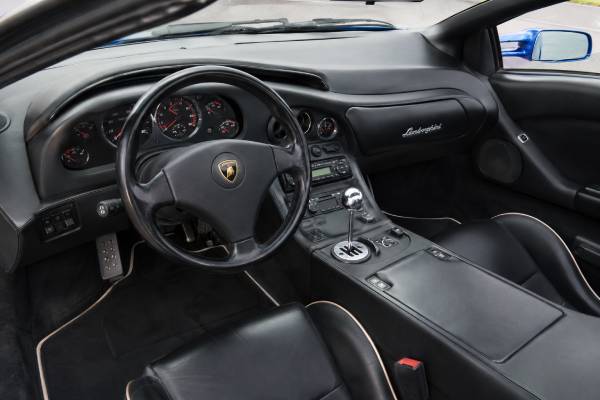
The cockpit is more usable than a Countach but still exotic. The seating position is low, the sills are wide, and the windscreen base feels far away. Visibility forward is better than the car’s shape suggests, but rear visibility is limited, especially with the roof stored behind the cabin. The gated shifter, analog instruments, leather-trimmed interior, and physical switchgear give the car a mechanical feel that later digital supercars cannot copy.
The engineering character is defined by contrasts. The VT system adds traction and stability, but the car still feels old-school. The power steering makes low-speed use easier, but the car is still wide and heavy. The adjustable dampers add sophistication, but the suspension remains firm and road-sensitive. The result is not a relaxed convertible. It is a hand-built V12 supercar that became just civil enough to use more often.
The sound is central to the appeal. The 5.7-liter V12 has a deep mechanical bass at low speed, sharper intake and cam noise as revs rise, and a hard-edged exhaust note near the top of the tachometer. With the roof removed, the driver hears more induction, more exhaust reflection, more gearbox noise, and more cooling-fan activity. That is part of the Roadster’s emotional value.
How the VT Roadster Drives
The Diablo VT Roadster drives like a large-displacement manual V12 supercar from the pre-stability-control era: fast, physical, wide, noisy, and deeply memorable. The VT system makes it more secure than an early rear-drive Diablo, but it never feels like a modern all-wheel-drive car that hides the driver’s mistakes.
At low speed, the car demands patience. The clutch is heavy compared with a modern performance car, the gearbox prefers deliberate inputs, and the car’s width is always obvious. The nose is low, the rear quarters are broad, and parking requires care. The turning circle is not small, and the driver needs to think before entering tight ramps or narrow streets.
Once moving, the car becomes more natural. The V12 is flexible enough to pull from moderate revs, but it comes alive higher in the range. Peak torque arrives at 5,200 rpm, and peak power arrives at 7,000 rpm, so the engine rewards drivers who let it rev. It does not deliver turbo shove; it builds speed with a rising mechanical intensity that feels more special than the numbers alone.
The gated manual is part of the theater. A well-adjusted gearbox should feel firm and mechanical, not vague or crunchy. Cold shifts can be slower, and a careful owner will let fluids warm before asking for quick changes. Any grinding, baulking, or jumping out of gear should be treated seriously during inspection.
The steering has more weight and feedback than most modern supercars. Power assistance removes the worst low-speed effort, but the front tires still communicate road surface, camber, and load. The VT drivetrain changes the car’s corner-exit feel. Instead of lighting the rear tires as easily as a rear-drive Diablo, the Roadster digs in and sends power forward when needed. It still rewards smooth throttle use; sudden inputs can upset balance.
Ride quality depends heavily on damper condition, tire age, alignment, and road surface. A sorted car feels firm but controlled. A tired car can feel nervous, crashy, or loose. Because the Roadster body has less fixed-roof rigidity than a coupe, rattles, roof noises, and scuttle shake can appear, especially on rough roads. Some movement is part of the era, but excessive flex or clunks may point to worn suspension, poor repairs, or missing roof hardware.
The brakes are strong for the period, but they need context. The 1995–1998 Roadster predates the later ABS-equipped Diablo facelift, so the driver must manage pressure, tire grip, and road conditions. Pedal feel should be firm and predictable. Pulling, pulsing, vibration, old tires, tired fluid, or mismatched pads can make a heavy 200-mph car feel far less secure.
The Roadster is best enjoyed on open roads where its size is not a burden. It feels special at moderate speed because the seating position, engine location, roof-off sound, and gated shift are constantly present. On a mountain road, it needs respect and planning. On a highway, it becomes a dramatic V12 grand tourer. On track, it can be exciting but costly; brakes, tires, clutch, cooling, and bodywork are too expensive to treat casually.
Maintenance, Reliability, and Restoration Risk
A Diablo VT Roadster can be reliable when maintained by the right specialists, but neglected examples become expensive quickly. The car is hand-built, rare, hot-running, mechanically dense, and full of model-specific parts that cannot be treated like ordinary used-car consumables.
The engine is strong when healthy, but age matters. The 5.7-liter V12 uses timing chains rather than timing belts, which removes one common exotic-car worry, but it does not make the engine low-maintenance. Oil leaks, coolant leaks, tired hoses, aging seals, fuel-system deterioration, ignition issues, and poor storage can all create major bills. A low-mileage car that sat unused for years may need more attention than a higher-mileage car with steady specialist care.
The cooling system deserves close attention. The Diablo generates serious heat, and the Roadster’s packaging makes airflow and fan operation important. Radiators, fans, thermostats, hoses, clamps, expansion tanks, and coolant condition should be inspected carefully. Any sign of overheating, repeated fan failures, coolant smell, or stained engine-bay components needs investigation.
The clutch and gearbox are high-cost inspection points. A worn clutch can still move the car but feel heavy, grabby, or inconsistent. Gear selection should be clean once warm. Synchro wear, hydraulic problems, poor linkage adjustment, and old fluids can all create symptoms. Because drivetrain access is labor-intensive, a cheap car with a questionable clutch is rarely cheap for long.
The VT system adds value but also adds inspection needs. Front differential condition, viscous-coupling behavior, driveshafts, boots, leaks, and drivetrain noises should be checked by someone who knows Diablos. Mismatched tires, old tires, or incorrect rolling diameters can stress all-wheel-drive components. On this car, tires are not just rubber; they are part of the drivetrain health equation.
Common areas to inspect
A pre-purchase inspection should focus on the actual Diablo weak points, not a generic checklist:
- Engine oil leaks, coolant leaks, fuel odors, and hose condition.
- Clutch wear, clutch hydraulics, gearbox synchros, and linkage adjustment.
- VT drivetrain leaks, front differential noise, and CV boot condition.
- Suspension bushings, ball joints, damper operation, and damper-control electronics.
- Brake disc thickness, caliper condition, brake hoses, fluid age, and pedal feel.
- Roof panel fit, seals, latches, storage mounts, and water leaks.
- Headlight motors, window regulators, mirrors, gauges, relays, and switchgear.
- Air-conditioning function, blower operation, and control-panel behavior.
- Frame tubes, jacking points, underbody panels, and accident-repair evidence.
- Paint thickness, panel gaps, door operation, and signs of heat damage near the rear bodywork.
Parts availability is one of the largest ownership risks. Some mechanical components can be rebuilt, some trim pieces can be restored, and some parts can be sourced through specialists, but many items are rare and expensive. Roadster-specific pieces are especially important: roof panel, seals, latches, storage hardware, interior trim, and body panels can turn a minor-looking defect into a major project.
Restoration quality varies widely. A shiny repaint can hide poor panel fit, overspray, filler, accident repair, or missing details. A car restored without factory references may look impressive but lose value if materials, colors, stitching, fasteners, wheels, or decals are wrong. For a Diablo VT Roadster, originality often beats over-restoration, especially when the original paint, interior, tools, books, and service records survive.
Factory support and specialist knowledge matter. Lamborghini Polo Storico certification and restoration services have become more important as Diablos move deeper into collector territory. Even when a buyer does not pursue certification immediately, the same thinking applies: document what the car is, preserve correct details, and avoid irreversible modifications.
Market Values and Buyer Checklist
The Diablo VT Roadster is now a serious collector Lamborghini, not an overlooked 1990s exotic. First-generation 1995–1998 cars generally trade based on originality, condition, documentation, color, mileage credibility, and the quality of past care rather than mileage alone.
As of the current collector market, first-generation VT Roadsters often sit below the very rare Diablo SE30 and GT variants but above many standard early Diablo coupes. Public data shows a wide spread because cars differ sharply. A documented, low-mile, original Roadster with books, tools, clean history, and desirable colors can command a major premium. A tired car with missing roof equipment, uncertain mileage, weak service history, accident repair, or federalization questions can be much harder to value.
The broad market for VT Roadsters has included public results in the low-to-mid six figures, with exceptional outliers much higher. A useful working range for serious buyers is roughly $350,000 to $550,000 for many good first-generation cars, with special examples exceeding that and compromised cars falling below it. Asking prices can be ambitious, so recent comparable sales matter more than seller confidence.
What drives value
The strongest cars usually have several of these traits:
- Original paint or high-quality documented paintwork.
- Verified low mileage with consistent records.
- Complete service history from known Lamborghini specialists.
- Factory books, tools, roof tools, spare keys, and accessories.
- Correct Roadster roof panel and hardware.
- Desirable factory colors and original interior materials.
- No structural accident history.
- Clean import, emissions, and registration records.
- Matching numbers and factory documentation.
- Recent major service with detailed invoices.
The cars to avoid are the ones with stories that cannot be verified. Mileage inconsistencies, long storage with no recommissioning, cheap repainting, missing roof parts, modified wiring, incomplete import documents, vague service claims, and “just needs adjustment” drivetrain issues should all slow the buyer down. On a Diablo, small uncertainties often become large invoices.
Buyer inspection sequence
A smart purchase should follow a clear process:
- Confirm the exact model, year, market, VIN, and Roadster identity before discussing price seriously.
- Collect records, including service invoices, ownership history, books, tools, roof equipment, and import documents.
- Ask a recognized Diablo specialist to inspect the car cold, warm, on a lift, and on the road.
- Check paint depth, panel gaps, underbody structure, suspension mounts, and jacking points for accident evidence.
- Inspect the roof panel, seals, storage mounts, and latch operation because Roadster parts are difficult to replace.
- Verify gearbox, clutch, cooling, brakes, suspension electronics, and VT drivetrain behavior.
- Price the car after the inspection, not before it.
For owners, the best strategy is preservation through use. These cars do not like being ignored. Regular warm-up, proper fluids, fresh tires, periodic exercise, battery care, and specialist inspections help prevent age-related problems. At the same time, careless driving, deferred maintenance, and cosmetic shortcuts can reduce both enjoyment and value.
Long-term collectability looks strong because the first-generation Diablo VT Roadster has the right ingredients: a naturally aspirated Lamborghini V12, manual gearbox, open roof, all-wheel-drive engineering, low production, dramatic design, and real historical importance as Lamborghini’s first series-production open V12 model. The best examples will likely remain desirable, but buyers should be disciplined. The right car is a spectacular thing. The wrong one is a restoration project wearing a supercar body.
References
- Lamborghini Diablo’s 30th anniversary with Cesare Cremonini 2020
- Microsoft Word – diabloroadsterspecs.doc 2006 (Technical Specification PDF)
- Recall Campaign | Lamborghini.com 2026 (Recall Lookup)
- Vehicle Detail Search – 1997 LAMBORGHINI DIABLO | NHTSA 2026 (Recall Database)
- Lamborghini Diablo VT Roadster Market – CLASSIC.COM 2026 (Market Data)
Disclaimer
This article is for informational purposes only and is not a substitute for professional diagnosis, repair, inspection, appraisal, or restoration advice. Specifications, torque values, service intervals, repair procedures, emissions equipment, and factory details can vary by VIN, market, model year, and equipment. Always verify critical information against official Lamborghini service documentation and use a qualified Lamborghini specialist before buying, repairing, or restoring a Diablo VT Roadster.
If this guide helped you, please consider sharing it on Facebook, X/Twitter, or your favorite automotive community to support our work.