
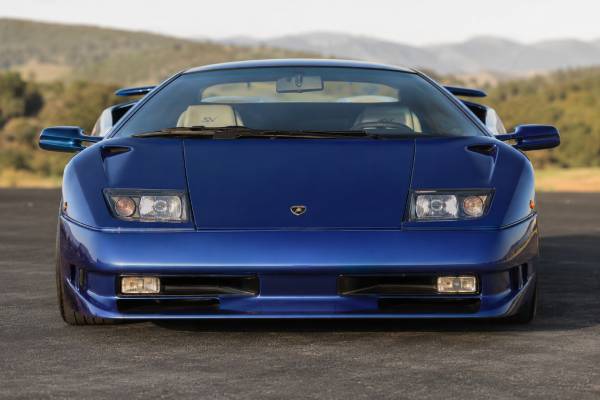
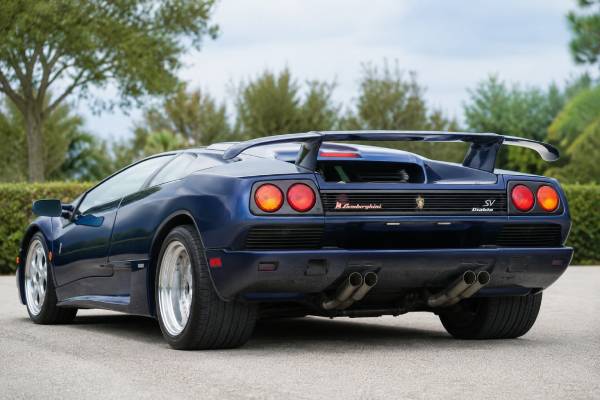
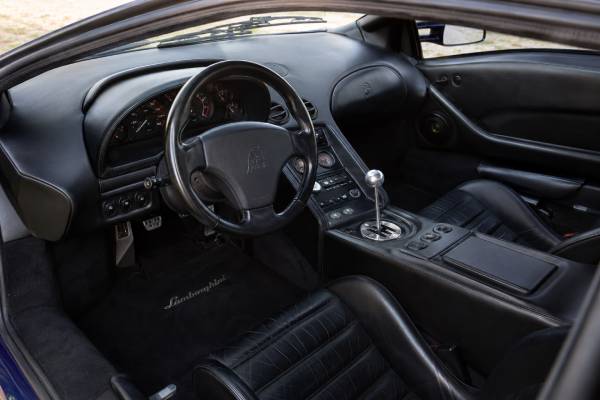
The 1998 Lamborghini Diablo SV Monterey Edition is one of the rarest late pre-facelift Diablos: a U.S.-market, 20-car special based on the rear-wheel-drive Diablo SV. It keeps the drama that made the early Diablo famous—pop-up headlights, a gated five-speed manual, a naturally aspirated 5.7-liter V12, huge side graphics, and a wide wedge body—while adding Monterey-specific details that separate it from a normal SV. For collectors, its importance comes from rarity, U.S. delivery, manual transmission, SV purity, and its position just before the Audi-era facelift replaced the original face of the Diablo. For drivers, it is still one of the most vivid modern-classic Lamborghinis: raw, loud, physical, and demanding in a way later all-wheel-drive and electronically managed supercars are not.
Table of Contents
- Why the Monterey Edition Matters
- V12 Drivetrain and Core Specifications
- Production Details, Options, and Identification
- Body Design, Cooling, and Monterey Features
- Road Feel, Performance, and V12 Character
- Maintenance Risks and Restoration Realities
- Market Values and Buying Priorities
Why the Monterey Edition Matters
The Diablo SV Monterey Edition matters because it combines the most desirable early Diablo traits with very limited U.S.-market production. It is not just a sticker package; it is a 20-car special that sits at the end of the original pop-up-headlight Diablo era.
The Diablo arrived in 1990 as the successor to the Countach, carrying Lamborghini’s flagship V12 line into the 1990s. It kept the mid-engine layout, extreme width, low roofline, and dramatic scissor doors that had become Lamborghini signatures, but it was more powerful, faster, and more usable than the Countach it replaced. The base Diablo used a 5.7-liter version of Lamborghini’s long-running V12, mounted longitudinally behind the cabin.
The SV name returned in 1995. “SV” stands for Super Veloce, and on the Diablo it meant a sharper, simpler, rear-wheel-drive version of the car. Unlike the Diablo VT, which added all-wheel drive, the SV sent power only to the rear wheels. That made it lighter in feel, more direct, and more traditional for drivers who wanted the classic Lamborghini experience without the extra front driveline.
The Monterey Edition was built for 1998, aimed at the U.S. market, and tied to Monterey Car Week’s growing importance in the collector-car world. Only 20 examples were produced. That tiny production run gives the car a different position from a normal Diablo SV, even though the core mechanical layout remains close to the standard SV.
Its historical importance comes from several overlapping qualities:
- It is one of the last original-face Diablos. The following facelifted cars moved to fixed headlights and a more modern interior.
- It is rear-wheel drive. That gives it a purer, more aggressive character than the VT models.
- It keeps the gated manual gearbox. This is now a major collector feature.
- It is U.S.-market limited production. The Monterey Edition was not a global trim sold in large numbers.
- It bridges two eras. It carries early Diablo theater while pointing toward the stronger, more refined late Diablo years.
The result is a car with serious collector appeal but also real enthusiast meaning. A Diablo SV Monterey Edition is valuable because it is rare, but it is loved because it still feels like a raw 1990s Lamborghini.
V12 Drivetrain and Core Specifications
The Diablo SV Monterey Edition uses Lamborghini’s naturally aspirated 5.7-liter V12, a five-speed manual transaxle, and rear-wheel drive. The standard Diablo SV is widely listed at 510 hp, while Monterey Edition auction and collector records often describe the limited cars as 530 bhp; buyers should verify the exact documentation for the individual chassis.
That power-rating nuance is important. The supplied model title uses 510 hp, which matches the core pre-facelift Diablo SV family. Many Monterey Edition sales catalogues, however, identify the Monterey cars as having a 530 bhp version of the 5.7-liter V12, putting them close to the output of the later 1999 updated SV. The safest way to treat the car is as a special 1998 Diablo SV with a documented Monterey specification rather than relying only on generic Diablo SV data.
| Item | Specification |
|---|---|
| Model | Lamborghini Diablo SV Monterey Edition |
| Model year | 1998 |
| Production | 20 examples |
| Market focus | United States |
| Engine | 5,707 cc naturally aspirated V12 |
| Valvetrain | DOHC, four valves per cylinder |
| Fuel system | Electronic multi-point fuel injection |
| Standard SV output | 510 hp at about 7,100 rpm |
| Common Monterey catalogue output | 530 bhp at about 7,100 rpm |
| Transmission | Five-speed manual transaxle |
| Drivetrain | Rear-wheel drive |
| Layout | Longitudinal mid-engine, two-seat coupe |
| Suspension | Independent wishbones with coil springs and anti-roll bars |
| Brakes | Brembo ventilated, cross-drilled discs |
| Steering | Power-assisted rack-and-pinion |
The engine is the heart of the car. It is a 60-degree V12 with an alloy block and heads, chain-driven camshafts, and a broad torque curve by exotic standards. It does not have turbochargers, hybrid assistance, or the heavy electronic smoothing found in later supercars. Its response depends on displacement, compression, intake flow, exhaust tuning, and revs.
The gearbox is just as important to the car’s identity. The gated five-speed is slower than a modern dual-clutch transmission, but it is central to the experience. Each shift is mechanical, deliberate, and audible. A good gearbox should feel firm but not obstructive once warm. A reluctant second gear, grinding synchros, or a dragging clutch can turn a dream car into an expensive repair plan.
The chassis follows traditional Lamborghini supercar practice of the period. A steel tubular structure sits under dramatic bodywork, with lightweight panels and composite sections used where appropriate. The Diablo is not a small car. Its width, low seating position, long doors, and limited rear visibility all shape the driving experience.
| Measure | Typical Diablo SV figure |
|---|---|
| Wheelbase | About 2,650 mm |
| Length | About 4,470 mm |
| Width | About 2,040 mm |
| Height | About 1,105 mm |
| Curb weight | Commonly quoted around 1,570–1,600 kg depending on equipment and source |
| 0–60 mph | Low-4-second range in period-style testing |
| Top speed | Commonly quoted around the low-200-mph range for strong SV variants |
Performance figures vary because Diablo data often differs by market, source, test condition, tire type, and exact variant. For buying and ownership, the more useful point is that even the baseline SV is seriously fast, while the Monterey Edition has the power, gearing, and mechanical feel expected from a top-level late pre-facelift Diablo.
Production Details, Options, and Identification
The Monterey Edition was built in a run of 20 cars, and correct identification depends on more than paint color or SV side graphics. A serious buyer should confirm the numbered plaque, VIN, original selling documents, window sticker, books, tools, and Lamborghini heritage records where available.
The model was created as a special U.S.-market Diablo SV for 1998. It arrived when Monterey Car Week was becoming a key stage for exotic and collector cars, and the edition name reflects that connection. Because production was so small, each car’s individual history matters more than broad model statistics.
Important Monterey Edition identifiers include:
- a numbered Monterey Edition plaque or documentation;
- U.S.-market VIN and delivery history;
- Diablo SV bodywork with Monterey-specific side intake treatment;
- pop-up headlights, confirming it is from the original pre-facelift body style;
- gated five-speed manual transaxle;
- rear-wheel-drive SV specification;
- special trim details, often including Monterey Edition embroidery or interior badging;
- original wheels, side graphics, and factory equipment;
- matching records between VIN, serial plaque, window sticker, books, and service file.
The Monterey Edition’s most visible distinction is the side intake design ahead of the rear wheels. A normal Diablo SV uses a different intake treatment, while the Monterey Edition adopted a style associated with the SE30 and VT Roadster. This gives the car a more complex side profile and helps separate it from standard SVs at a glance.
Factory colors and interior combinations are also central to value. Many Monterey cars are known by their individual specifications, and unusual colors can help or hurt depending on originality, condition, and documentation. A repaint in a famous Lamborghini shade may look attractive, but it will not carry the same collector weight as a documented factory finish.
Original accessories matter. On a car this rare, the following items can affect value:
- original books and pouch;
- stamped service booklet;
- tool kit;
- jack and emergency equipment;
- factory luggage, when supplied;
- original window sticker;
- bill of sale or dealer paperwork;
- manuals, workshop documentation, and records;
- import, title, and ownership history;
- invoices from recognized Lamborghini specialists.
Matching-numbers questions should be handled carefully. Modern Lamborghini V12 cars are not judged exactly like some 1960s coachbuilt classics, but original engine and drivetrain identity still matters. A replacement engine, undocumented major rebuild, swapped gearbox, or missing serial evidence should reduce confidence unless there is clear factory or specialist documentation.
Because the Monterey Edition was built in such low numbers, there is little room for guesswork. The wrong wheels, incorrect side graphics, missing plaque, non-original trim, or undocumented engine work can change the car from a top-tier collector example into a less certain driver-grade car. That does not make it undesirable, but it changes the price and the risk.
Body Design, Cooling, and Monterey Features
The Monterey Edition’s design appeal comes from its mix of early Diablo aggression and special-edition detail. It keeps the pop-up headlights, scissor doors, wide wedge stance, and giant SV graphics, but adds unique side intake and trim cues that make it easier to distinguish from a standard 1998 SV.
The original Diablo shape traces its roots to Marcello Gandini’s design language, although the production car was softened and refined before release. The result is less razor-edged than a Countach but still unmistakably Lamborghini: low nose, steep windshield, cab-forward stance, huge rear haunches, and a body that seems wider than almost anything else on the road.
The Monterey Edition’s body is not subtle. The side graphics announce the SV identity, while the rear wing, deep front bumper openings, black rear trim, quad exhaust outlets, and pop-up lights give the car a poster-car presence that later, cleaner supercars often lack. It looks like a 1990s exotic because it is one, not because it is trying to reference one.
Cooling is a major part of the Diablo’s design. A mid-mounted V12 produces serious heat, and the body has to feed air to the engine bay, radiators, brakes, and intake system. The Monterey side intake treatment is more than visual decoration. It changes the way the car presents its cooling hardware and gives the limited edition a stronger link to other special Diablo variants.
Exterior details that define the car
The most important exterior features are the ones that confirm both SV and Monterey identity:
- pop-up headlights rather than the later fixed lamps;
- large Diablo SV side graphics;
- adjustable rear wing;
- special side intake layout ahead of the rear wheels;
- front brake cooling openings;
- black rear lamp surrounds and aggressive rear trim;
- wide rear tires under swollen rear bodywork;
- chrome or special-finish wheels where original to the car;
- low roof and scissor doors.
The doors remain central to the drama. They are not merely show pieces; they also make entry easier in tight spaces than normal long coupe doors would, though the sill is still wide and the cabin still requires flexibility.
Interior character
The cabin is more 1990s exotic than modern luxury car. The driving position is low, the windscreen is broad but steeply raked, and rear visibility is limited. The dashboard, switchgear, leather trim, white-faced gauges on many cars, and gated shifter all make the car feel hand-built and period-correct.
Compared with later Lamborghinis, the Diablo’s interior is less polished. That is part of the appeal, but it also means condition varies sharply. Shrinking leather, sticky switches, worn bolsters, sagging trim, tired air conditioning, and electrical faults are common concerns on Diablos that have sat unused or have been stored poorly.
A Monterey Edition with clean original trim, correct embroidery or badging, intact carbon-fiber accents, and preserved factory materials will always be more desirable than a car that has been retrimmed without proof of original specification. On this model, originality is not a small bonus. It is one of the main reasons to buy the special edition at all.
Road Feel, Performance, and V12 Character
The Diablo SV Monterey Edition feels fast, physical, loud, and wide. It rewards a careful, skilled driver, but it does not flatter laziness the way a modern all-wheel-drive, stability-controlled supercar can.
The V12 dominates the experience. At low revs, it has enough torque to move the car without drama, but it becomes more urgent and theatrical as the revs rise. The sound is not the polished wail of a later Aventador or the insulated soundscape of a modern supercar. It is harder-edged, more mechanical, and closer to the cabin.
Throttle response is one of the advantages of the naturally aspirated engine. There is no turbo lag and no electric fill. The car responds directly to the driver’s right foot. That directness is thrilling, but it also means poor inputs matter. On cold tires, damp pavement, or uneven roads, a rear-wheel-drive Diablo SV deserves respect.
The five-speed gearbox is part of the car’s rhythm. A good shift through the metal gate feels deliberate and satisfying. It is not something to rush when cold. Owners who force shifts before the gearbox oil is warm risk wear, especially in the lower gears. Once everything is up to temperature, the car feels more cooperative, but it still wants firm, accurate inputs.
Steering is heavy by modern standards, especially at parking speeds. On the move, it becomes more alive. The front end gives useful information, but the car’s width and rear mass are always present. A Diablo SV is not a small mountain-road toy. It is a big, powerful V12 machine that needs space, smoothness, and judgment.
Braking performance is strong for the period when the system is fresh, but it does not feel like a modern carbon-ceramic setup. Pedal feel, pad age, fluid condition, rotor condition, and tire quality make a huge difference. A car that has been stored for years may stop poorly even if the mileage is low.
Ride quality is firm but not unbearable. The car is more usable on highways than its reputation suggests, provided the cooling system, tires, alignment, air conditioning, and clutch are healthy. In city driving, the width, clutch effort, low nose, cabin heat, and limited visibility become the main challenges.
The best way to understand the Monterey Edition is not as a lap-time car. It is a high-intensity road car from a period before supercars became heavily filtered. Its appeal is the combination of V12 sound, manual shifting, rear-drive balance, visual drama, and the sense that every drive is an event.
Maintenance Risks and Restoration Realities
A Diablo SV Monterey Edition is an exotic collector car, not a normal used performance car. Maintenance risk comes from age, rarity, heat, low use, specialist labor, and the cost of correcting old work.
The engine itself is robust when maintained properly, but neglect is expensive. Long storage, old fluids, aged hoses, weak cooling fans, tired ignition components, leaking seals, and stale fuel can create problems that do not show up in a short start-up video. A pre-purchase inspection should include a cold start, warm running behavior, leak check, compression or leak-down testing when appropriate, and a careful review of service records.
Common ownership concerns include:
- clutch wear, especially on cars driven in traffic or loaded onto transporters often;
- gearbox synchro wear, particularly if shifted hard when cold;
- cooling system leaks, blocked radiators, weak fans, or old hoses;
- fuel hose deterioration and injector issues from age or stale fuel;
- oil leaks from seals and gaskets;
- worn engine and gearbox mounts;
- aging suspension bushings, dampers, and ball joints;
- brake rotor, caliper, pad, and line condition;
- electrical issues in windows, lights, gauges, fans, and switches;
- air-conditioning weakness;
- tire age, even when tread depth looks good;
- body damage from low-speed impacts, lift damage, or poor repairs.
A major service can become expensive quickly because access is limited and specialist knowledge matters. Engine-out work may be necessary for certain jobs, and even smaller tasks can take longer than on a mass-produced sports car. Parts availability is improving for some heritage Lamborghinis, but Monterey-specific trim and rare Diablo components can still be difficult to source.
Body and chassis inspection
The body must be inspected as carefully as the engine. A Diablo is low, wide, and easy to damage. Front splitters, lower bumper edges, underbody sections, jacking points, sills, wheel arches, and rear bodywork deserve close attention. Paint thickness readings can help identify repairs, but they are not enough on their own.
A proper inspection should look for:
- uneven panel gaps;
- cracked composite sections;
- corrosion on steel structure or brackets;
- poor repairs around the nose and sills;
- incorrect fasteners or missing undertrays;
- repaint lines around glass and seals;
- heat damage near the engine bay;
- wheel damage from curbs or incorrect tire mounting;
- evidence of accident repair hidden under fresh paint.
Because values are high, cosmetic restoration can hide deeper problems. A shiny Diablo with incomplete history can be riskier than a slightly worn car with transparent records and original paint.
Originality versus upgrades
Some upgrades improve drivability, but they can hurt collector value if they are irreversible. Modern tires, improved cooling fans, updated hoses, better battery management, and careful electrical repairs are usually sensible. Loud aftermarket exhausts, non-original wheels, major interior retrims, stereo cutting, altered graphics, or engine modifications should be judged more carefully.
For a Monterey Edition, originality carries extra weight. Keep removed original parts, document every change, and avoid upgrades that erase Monterey-specific details. A reversible improvement with invoices is far better than an undocumented modification.
Market Values and Buying Priorities
The Diablo SV Monterey Edition now sits in the serious collector tier, with recent public Monterey Edition results and asking prices often clustering around the half-million-dollar range or higher for strong cars. The best examples are valued for rarity, documentation, originality, color, mileage, service history, and verified Monterey identity.
The market has moved sharply since the late 2010s. Earlier public sales below today’s levels now look inexpensive compared with recent Diablo SV results. Strong manual V12 Lamborghinis have benefited from the wider collector shift toward analog supercars, especially limited-production variants with low build numbers and clear visual identity.
For a Monterey Edition, value is driven by more than mileage. Low mileage helps, but a very low-mile car with old tires, stale fluids, weak hydraulics, no recent major service, and missing documents may need expensive recommissioning. A higher-mile car with expert maintenance, original equipment, and transparent history may be the better ownership proposition.
| Value factor | Why it matters |
|---|---|
| Verified Monterey identity | The edition’s 20-car production is central to its value. |
| Original paint and trim | Preserved factory condition is usually preferred over cosmetic restoration. |
| Documentation | Books, tools, window sticker, invoices, and ownership history reduce risk. |
| Mechanical condition | A neglected V12 Lamborghini can require six-figure corrective work. |
| Color combination | Rare, attractive, factory-confirmed colors can lift desirability. |
| Mileage | Lower mileage helps, but only when condition and maintenance support it. |
| Specialist history | Invoices from respected Lamborghini shops carry real weight. |
| Completeness | Missing wheels, plaque, tools, manuals, or trim can be costly and difficult to correct. |
A buyer should focus on the car’s story first. The ideal Monterey Edition has clear chain of ownership, correct plaque, original selling paperwork, consistent mileage records, recent service, original trim, no accident history, and inspection results from a specialist who knows Diablos.
Use this buying checklist before making a serious offer:
- Confirm the VIN, Monterey Edition plaque, and production identity.
- Compare the window sticker, books, service records, and current specification.
- Verify paint originality and inspect for body or chassis repairs.
- Check engine health with specialist testing, not only a warm idle.
- Inspect the clutch, gearbox synchros, and driveline mounts.
- Confirm cooling system condition under real operating temperature.
- Check brake age, tire date codes, suspension wear, and wheel originality.
- Test all electrical items, lights, windows, fans, gauges, and air conditioning.
- Review whether any modifications are reversible and whether original parts remain.
- Budget for immediate service, even if the car presents well.
Avoid cars with missing Monterey-specific identifiers, unclear import or title history, fresh cosmetic work without invoices, non-original interiors presented as factory, poor cold-start behavior, overheating, gearbox noise, or sellers unwilling to allow a specialist inspection.
The long-term collectability case is strong. The Monterey Edition has rarity, a naturally aspirated V12, manual transmission, rear-wheel drive, U.S.-market relevance, and the last-of-era pop-up-headlight look. Those traits are hard to replace. The main risk is not desirability; it is buying the wrong car at the right price and then spending heavily to correct undocumented problems.
References
- Lamborghini Diablo’s 30th anniversary with Cesare Cremonini 2020 (Manufacturer Heritage)
- Lamborghini V12: an engine that made history 2021 (Manufacturer Heritage)
- A day as a Lamborghini Polo Storico specialist 2025 (Manufacturer Heritage)
- Check for Recalls: Vehicle, Car Seat, Tire, Equipment | NHTSA 2026 (Recall Database)
- 1998 Lamborghini Diablo SV Monterey Edition | Gooding Christie’s 2025 (Auction Catalogue)
Disclaimer
This article is for informational purposes only and is not a substitute for professional diagnosis, repair, valuation, or inspection. Specifications, torque values, service intervals, recall status, parts, procedures, and equipment can vary by VIN, market, build date, and individual vehicle history. Always verify details against official Lamborghini service documentation, factory records, and a qualified Lamborghini specialist before buying, servicing, restoring, or modifying any Diablo SV Monterey Edition.
If you found this guide useful, please consider sharing it on Facebook, X/Twitter, or your preferred enthusiast community to support our work.