

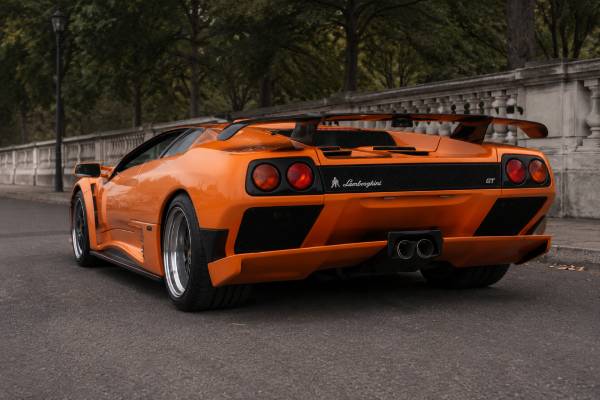
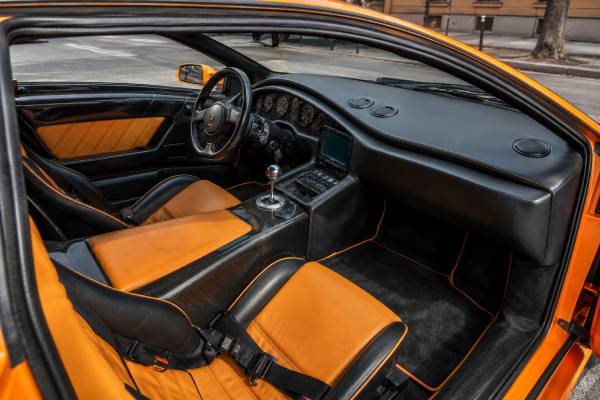
The Lamborghini Diablo GT is the hardest-edged road-going Diablo and one of the most focused V12 Lamborghinis of the late analog era. Built around the P132 Diablo platform, it used a 6.0-liter naturally aspirated V12, rear-wheel drive, a five-speed manual gearbox, wide-track bodywork, extensive carbon-fiber panels, and a stripped cabin aimed more at serious driving than luxury touring. Lamborghini presented the GT in 1999, just as Audi ownership was beginning to reshape the brand’s engineering standards, making it a fascinating bridge between old Sant’Agata drama and a more developed future. With only eighty mass-produced examples commonly recognized, the Diablo GT is now a collector-grade car where originality, documentation, correct specification, and specialist maintenance matter as much as performance. It remains desirable because it combines rarity, outrageous design, mechanical intensity, and a naturally aspirated V12 character that later supercars became progressively less raw.
Table of Contents
- Why the Diablo GT Still Matters
- V12, Chassis, and Key Specifications
- Production Numbers, Options, and Identification
- Carbon Bodywork, Aero, and Cabin Details
- How the Diablo GT Drives
- Maintenance Risks and Restoration Reality
- Market Value and Buying Checks
Why the Diablo GT Still Matters
The Diablo GT matters because it is not simply a faster Diablo; it is the most direct road version of Lamborghini’s 1990s V12 supercar idea. It took the Diablo’s already dramatic layout and pushed it toward race-car thinking with less weight, more cooling, more power, and less comfort-first compromise.
The standard Diablo arrived in 1990 as the Countach replacement. It kept Lamborghini’s defining formula: a mid-mounted V12, a low wedge body, scissor doors, and a sense of occasion that was closer to theater than transportation. Over the decade, Lamborghini added versions such as the VT, SV, Roadster, SE30, and later the 6.0. The GT sat near the top of that family tree because it was built for customers who wanted the rawest road car rather than the easiest one.
Its timing also gives it historical weight. Lamborghini joined the Audi-Volkswagen Group in 1998, and the Diablo GT appeared soon after, before the Murciélago replaced the Diablo in 2001. That makes the GT a late-development Diablo: still brutal, low, loud, and old-school, but with some of the engineering maturity and quality push that arrived during the Audi transition.
The car was linked in spirit to the Diablo GT2 and GT racing programs. It was not a homologation car in the strict modern sense, but it borrowed the look, cooling approach, weight-saving ideas, and aggressive intent of a competition Diablo. That is why collectors often place it alongside the SE30 Jota, Diablo GTR, and later Murciélago SV as one of Lamborghini’s most serious driver-focused V12 cars.
Its appeal today rests on five points:
- Rarity: only eighty mass-produced Diablo GTs are normally cited, making it much rarer than standard Diablo models.
- Powertrain: the 6.0-liter V12 is stronger and more developed than earlier 5.7-liter Diablo engines.
- Layout: rear-wheel drive and a manual gearbox give it a purer feel than the all-wheel-drive VT models.
- Design: the wider carbon body, roof intake, deep front ducts, diffuser, and central exhaust make it visually distinct.
- Collectability: it is one of the final analog-era Lamborghinis before electronic control, automated gearboxes, and emissions complexity changed the supercar formula.
For buyers, the Diablo GT is not a casual purchase. The value lies in originality, provenance, correct numbered identity, factory documents, maintenance records, and whether the car has been preserved rather than merely made shiny.
V12, Chassis, and Key Specifications
The Diablo GT’s core specification is simple but serious: a 5,992 cc naturally aspirated V12, rear-wheel drive, a five-speed manual gearbox, carbon-intensive bodywork, and a curb weight around 1,460 kg. The result was a car capable of roughly 0–100 km/h in about 3.9 seconds and a top speed around 338 km/h, with period claims sometimes quoting higher figures depending on gearing and source.
| Category | Specification |
|---|---|
| Model | Lamborghini Diablo GT |
| Internal platform | P132 Diablo |
| Production period | 1999–2000 |
| Body style | Two-door, two-seat coupe with scissor doors |
| Engine | 5,992 cc naturally aspirated 60-degree V12 |
| Bore x stroke | 87 mm x 84 mm |
| Valvetrain | DOHC, four valves per cylinder, chain drive |
| Fuel system | Sequential multi-point fuel injection |
| Output | 575 hp at 7,300 rpm |
| Torque | 630 Nm at about 5,500 rpm |
| Transmission | Five-speed manual plus reverse |
| Drivetrain | Rear-wheel drive with limited-slip differential |
| Claimed 0–100 km/h | About 3.9 seconds |
| Claimed top speed | About 338 km/h / 210 mph; some period Lamborghini material quoted up to 346 km/h / 215 mph |
| Approximate curb weight | 1,460 kg / 3,219 lb |
The engine is the main technical step forward. Earlier Diablo models used a 5.7-liter V12, but the GT stretched displacement to 6.0 liters by increasing stroke. It also used lightweight internal components, variable valve timing, magnesium intake components, dry-sump lubrication, and revised engine management. In plain terms, the GT engine delivers more torque, sharper response, and stronger top-end power than the earlier 5.7-liter cars.
The five-speed manual gearbox is part of the car’s character. Later supercars made six-speed manuals, automated manuals, and dual-clutch transmissions normal, but the Diablo GT stayed with a heavy, mechanical, old-school manual. The clutch is a dry single-plate unit with hydraulic operation. It is not delicate, but it does not like poor technique, repeated traffic abuse, or slipping on steep driveways.
| Area | Diablo GT detail |
|---|---|
| Chassis structure | High-strength steel tubular structure with composite body components |
| Suspension | Independent front and rear suspension with unequal-length control arms and anti-roll bars |
| Brakes | Brembo ventilated and drilled discs with ABS |
| Front brake discs | 365 mm |
| Rear brake discs | 335 mm |
| Steering | Power-assisted rack and pinion |
| Front tires | 245/35 ZR18 |
| Rear tires | 335/30 ZR18 |
| Wheels | Three-piece OZ Racing alloy wheels |
| Wheelbase | 2,650 mm |
| Length | 4,430 mm |
| Width | 2,040 mm |
| Fuel capacity | About 100 liters |
The GT was lighter than more comfort-focused Diablo versions because it deleted the all-wheel-drive system used on VT models and replaced many body panels with carbon fiber. The weight distribution is rear-biased, around 40/60 front to rear, which suits traction under power but demands respect when the road is cold, wet, uneven, or covered in older tires.
Production Numbers, Options, and Identification
A correct Diablo GT should be treated as a numbered, limited-production collector car, not just a rare trim. The safest buying position is to confirm the numbered identity, VIN, factory specification, colors, engine details, and ownership history through Lamborghini documentation or Polo Storico support.
Lamborghini commonly describes the Diablo GT as a run of eighty mass-produced cars. Some enthusiast sources mention slightly higher totals when prototypes, development cars, or special cases are included, but the collector market usually focuses on the numbered 1-of-80 production identity. When values are this high, a buyer should not rely only on seller claims, auction text, or internet production lists.
What makes a Diablo GT identifiable
The GT is easy to spot when complete and correct, but expensive cars can be modified, rebuilt, or partially converted. Key identifiers include:
- a numbered Diablo GT identity plate or documentation showing its number in the run
- wide front wings and wider track
- carbon front hood with a large air extractor
- NACA-style front quarter-panel ducts
- roof-mounted ram-air intake
- fixed rear wing
- deep rear diffuser
- twin central exhaust outlets
- three-piece OZ Racing wheels
- carbon interior panels
- lightweight bucket seats and harnesses
- 6.0-liter V12 specification rather than earlier 5.7-liter hardware
The GT was built as a coupe only. There was no factory Diablo GT Roadster. A car advertised as a “GT-style” Roadster, SV, VT, or 6.0 may be interesting, but it is not the same collector asset.
Colors and equipment
Known GT colors are limited compared with Lamborghini’s later personalization programs. Period examples include strong late-1990s supercar finishes such as orange, yellow, black, and grey or silver tones. Arancio Atlas is one of the most visually famous GT colors, but a subtler Titanium Silver or black car can be just as important if it is original, documented, and well preserved.
Factory and period options can include details such as:
- shorter final-drive gearing
- rear-view camera provision
- audio or navigation equipment
- different interior trim combinations
- airbag fitment or deletion, depending on market and specification
- exposed carbon-fiber wing or painted exterior details
The optional shorter gearing matters because it changes how the car feels. A short-geared GT can feel more urgent and accelerative at road speeds, but long gearing better suits high-speed use. Neither is automatically better; what matters is whether the car still matches its build record.
Documents that matter
For a Diablo GT, paperwork can be worth real money. Strong documentation should include:
- factory build information
- original books and manuals
- service invoices from Lamborghini dealers or respected specialists
- import and registration documents where relevant
- records of clutch, engine, gearbox, suspension, brake, and cooling-system work
- paint meter readings and body repair documentation
- photos showing long-term condition, not only recent detailing
- Lamborghini Polo Storico certification or an active certification process
A GT without documents should be approached with caution. Missing service history does not always mean a bad car, but it shifts the risk to the buyer because hidden mechanical and body issues can cost more than a normal exotic-car correction.
Carbon Bodywork, Aero, and Cabin Details
The Diablo GT looks extreme because nearly every major visual change serves cooling, weight saving, airflow, or track-inspired packaging. Its bodywork is not decorative in the modern “appearance package” sense; it is part of why the car feels different from a standard Diablo.
The front end is dominated by a deep air dam, large brake ducts, and an extraction vent in the front lid. These features reduce heat buildup and help manage airflow at high speed. The front wings are wider to cover the GT’s broader front track, which gives the car a more planted stance and improves the visual balance of the wedge shape.
The rear treatment is even more aggressive. The usual Diablo rear bumper arrangement was replaced by a deep diffuser area, and the exhaust exits through the center. This makes the GT appear lower and more race-oriented from behind. The fixed rear wing is not subtle, but on this car it fits the purpose. The GT is a car designed to look ready for a circuit, not a valet stand.
Most exterior panels were carbon fiber, while the roof and scissor doors retained their original material approach. This blend matters during inspection. A restored or repaired GT should show correct carbon weave, panel fit, mounting points, and finishing details. Poor carbon repairs, thick paint, uneven panel gaps, or non-factory fasteners can reduce value and raise safety concerns.
Inside, the GT drops much of the normal grand-touring softness. Carbon-fiber trim, bucket seats, harnesses, and a simpler cabin remind the driver that the car was built for focus. Air conditioning was still fitted, which matters because Diablos generate serious cabin heat, but the overall feel is louder, tighter, and less forgiving than a VT or later Diablo 6.0.
The cockpit has typical Diablo compromises. The driving position is low and dramatic, the windshield is steeply raked, rear visibility is poor, and the car is very wide. The roof intake, rear wing, and body shape make reversing an event, not a routine action. A rear camera option was useful when new and is still valuable today if fitted correctly without damaging originality.
The sound is central to the GT’s identity. The 6.0-liter V12 has a hard-edged mechanical tone, more induction presence than a luxury-focused GT car, and a central-exit exhaust note that feels raw even by exotic-car standards. A modified exhaust may sound impressive, but collectors should confirm whether original exhaust components, catalysts, and mounting hardware remain with the car.
How the Diablo GT Drives
The Diablo GT drives like a serious late-1990s supercar: fast, physical, noisy, wide, and deeply rewarding when treated with patience. It is not a modern supercar that flatters every driver with software, all-wheel-drive traction, and quick automatic shifts.
The engine defines the experience. The 6.0-liter V12 pulls strongly from the midrange and keeps building toward the top of the tachometer. It is smoother than its brutal appearance suggests, but it never disappears into the background. Throttle response is immediate enough to make the car feel alive, and the sound becomes sharper as revs rise.
Acceleration is still serious today. The claimed 0–100 km/h time of around 3.9 seconds no longer shocks the way it did in 1999, but the delivery is completely different from a turbocharged or hybrid modern car. There is no electric fill, no launch-control routine, and no dual-clutch gearbox smoothing the process. The driver has to manage revs, clutch take-up, traction, and the manual shift.
The steering has weight and feel. At low speed, the Diablo GT reminds you that it is wide, heavy by racing standards, and fitted with very large rear tires. At speed, it becomes more settled, with a strong sense of front-end placement for a car of its era. The wider track and revised suspension help the GT feel more alert than comfort-focused Diablo versions.
The gearbox rewards careful timing. A healthy five-speed Diablo shift should feel mechanical and deliberate, not vague or crunchy. Cold oil can make the first few miles stiff, so a proper warm-up is part of the experience. Buyers should be suspicious of any seller who encourages hard shifting from cold.
Braking performance is strong for the period, but it is not the same as a modern carbon-ceramic setup. The steel brakes need correct pads, fresh fluid, clean cooling paths, and properly serviced calipers. A car that has spent time sitting may feel poor under braking until the system is restored correctly.
The GT is best on open roads, mountain routes with visibility, private roads, or track sessions with proper preparation. In city traffic, it is hot, wide, attention-grabbing, and clutch-heavy. On a highway, it feels dramatic but more stable than its shape might suggest. On a narrow road, it demands discipline because the rear tires can generate huge grip until they do not.
Tires are critical. Old, hard, or incorrect tires can ruin the car and make it dangerous. The GT’s rear tire size is part of its identity, but availability and age must be checked carefully. A car on aged tires may still look perfect in a showroom and drive badly on the road.
Maintenance Risks and Restoration Reality
The Diablo GT can be reliable when kept by specialists, but neglect is extremely expensive. The biggest ownership risks are not basic service items; they are deferred engine work, clutch wear, cooling problems, old fuel-system parts, carbon-body repairs, electrical faults, and missing GT-specific components.
This is a low-production Lamborghini with race-inspired parts, not a normal used exotic. A cheap service history on a Diablo GT is usually a warning, not a bargain.
Mechanical areas to inspect closely
A pre-purchase inspection should focus on systems that are costly, model-specific, or sensitive to age:
- Engine health: compression, leak-down results, oil pressure, timing-chain condition, valve-train noise, oil leaks, and evidence of overheating.
- Fuel system: old hoses, injectors, tanks, pump operation, pressure regulation, and fuel smell after hot running.
- Cooling system: radiator condition, fans, hoses, expansion tank, thermostat behavior, and coolant temperature under traffic conditions.
- Clutch: engagement point, slipping, judder, release bearing noise, hydraulic leaks, and service records.
- Gearbox: synchro condition, cold-shift behavior, oil leaks, differential noise, and correct ratio history.
- Brakes: disc wear, caliper condition, ABS function, old brake lines, master cylinder condition, and fresh fluid.
- Suspension: bushings, dampers, control arms, ball joints, wheel bearings, alignment history, and accident damage.
- Electrical system: dashboard warning lights, lighting, fans, window motors, harness repairs, battery drain, and aftermarket wiring.
- Exhaust and emissions equipment: catalysts, heat shields, exhaust mounts, oxygen sensors, and correct original parts.
Engine-out work may be needed for some major jobs. Even when not required, access is tight and labor is specialist-heavy. Parts are expensive, and GT-specific trim or carbon pieces may not be immediately available.
Body and carbon-fiber concerns
The GT’s carbon body is one of its greatest strengths and one of its greatest inspection risks. Carbon repairs can be excellent when handled by experts, but poor repairs may hide cracks, impact damage, heat damage, or incorrect panel thickness.
A careful inspection should include:
- paint-depth readings across carbon and metal panels
- underside checks for curb damage and diffuser damage
- panel-gap comparison against known correct cars
- mounting point inspection
- front-lip and brake-duct condition
- roof-intake and engine-cover fit
- signs of heat damage around the exhaust area
- evidence of front-end repair from low-speed impacts
The steel chassis structure must also be checked. A beautiful carbon body does not protect a buyer from a bent chassis, old crash repair, or poor alignment. Any car with accident history should be priced accordingly and documented thoroughly.
Originality versus upgrades
Some upgrades can improve usability, but they must be handled carefully. Cooling improvements, reversible battery-maintainer wiring, modern tires in correct sizes, and discreet camera improvements may make sense for an owner who drives the car. But collectors usually pay most for original parts, original trim, correct wheels, factory exhaust components, and documented factory specification.
A modified Diablo GT should come with every original removed part. If the original parts are missing, the car may be less desirable even if it drives well.
Market Value and Buying Checks
The Diablo GT is now a seven-figure collector Lamborghini in the strongest examples, with recent public sales showing that even cars with meaningful mileage can attract serious money when the specification and history are right. As of the mid-2020s, condition, originality, color, documentation, mileage, and recent major service history can shift value dramatically.
A public Monterey 2025 RM Sotheby’s sale at $1,435,000 confirmed how far the GT market has moved from its older sub-million-dollar position. Market trackers also place the Diablo GT far above ordinary Diablo variants, with the GT benchmark in the low seven figures. Private sales may sit above or below public data because so few cars trade openly.
| Value factor | Why it matters |
|---|---|
| Numbered identity | Confirms the car is a real GT and not a conversion or modified Diablo |
| Original specification | Factory colors, trim, gearing, and equipment affect collector confidence |
| Polo Storico support | Certification or factory archive verification can reduce authenticity risk |
| Maintenance history | Major services, clutch work, cooling repairs, and engine work must be documented |
| Mileage | Low mileage helps, but long-term storage without service can create hidden costs |
| Color | Iconic colors such as orange can bring attention, but originality matters more than popularity |
| Body condition | Carbon-fiber damage or poor repainting can be expensive and value-sensitive |
| Completeness | Books, keys, tools, factory parts, and original removed components all matter |
Buyer inspection checklist
A serious Diablo GT purchase should follow a disciplined process:
- Confirm the VIN, numbered GT identity, and factory specification.
- Request all service invoices, ownership records, import documents, and manuals.
- Use a Lamborghini specialist familiar with Diablo GTs, not just a general exotic-car shop.
- Perform compression and leak-down testing if records are incomplete.
- Inspect the clutch, gearbox, differential, and cooling system under real operating temperature.
- Check carbon panels, chassis alignment, suspension pickup points, and underside damage.
- Verify tire age and correct sizing.
- Check whether any modifications are reversible and whether original parts are included.
- Confirm that all electrical equipment works, including fans, lights, warning lamps, windows, camera equipment, and HVAC.
- Review market context using recent public sales and private-sale knowledge before negotiating.
The best cars are not always the lowest-mileage cars. A well-maintained, regularly exercised GT with documented major work can be a better ownership proposition than a museum-stored example that needs every rubber, fuel, brake, and cooling component renewed.
Avoid cars with unclear identity, missing documents, non-original body parts, accident stories without repair records, cheap repainting, aftermarket wiring, poor cold-shift behavior, overheating, or sellers who resist specialist inspection. At this level, a missed problem can cost more than the premium for a better car.
Long-term collectability looks strong. The Diablo GT has the ingredients collectors usually reward: tiny production, extreme factory specification, manual transmission, naturally aspirated V12, dramatic design, and a clear position in Lamborghini history. Its greatest risk is not demand; it is condition. The market will continue to separate exceptional, documented GTs from cars that need expensive correction.
References
- Masterpieces of Lamborghini at Villa d’Este 2024 (Manufacturer Heritage Article) ([Lamborghini.com][1])
- Lamborghini Polo Storico | Lamborghini.com 2026 (Manufacturer Heritage and Certification) ([Lamborghini.com][2])
- Milestones | Lamborghini.com 2026 (Manufacturer History) ([Lamborghini.com][3])
- Lamborghini Diablo GT – Specs & Performance – LamboCars 2015 (Specifications) ([LamboCars][4])
- 2000 Lamborghini Diablo GT | Monterey 2025 | RM Sotheby’s 2025 (Auction Result) ([RM Sotheby’s][5])
Disclaimer
This article is for informational purposes only and is not a substitute for professional diagnosis, repair, valuation, or pre-purchase inspection. Specifications, torque values, service intervals, procedures, parts availability, and correct equipment can vary by VIN, market, production date, and individual vehicle history. Always verify details against official Lamborghini service documentation, factory records, and a qualified Lamborghini specialist before buying, repairing, restoring, or modifying a Diablo GT.
If you found this guide useful, please consider sharing it on Facebook, X/Twitter, or your favorite car community to support our work.