
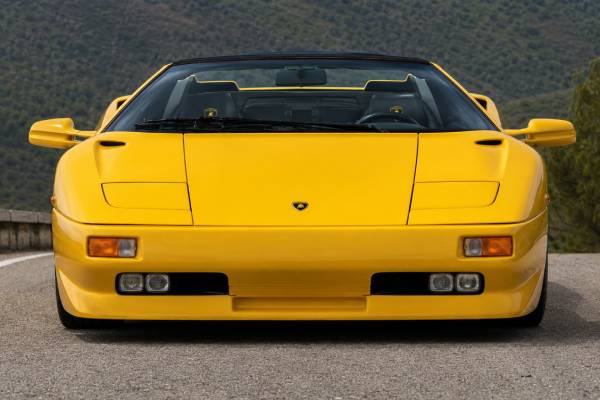
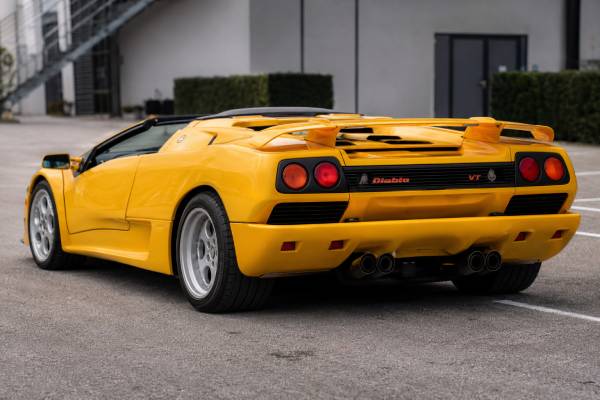
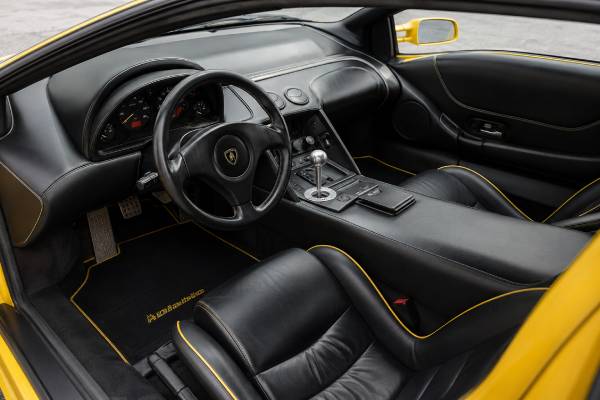
The 1999 Lamborghini Diablo VT Roadster Momo Edition is one of the rarest open-top versions of Lamborghini’s P132-era V12 flagship. It combines the late 5.7-liter Diablo V12 with variable valve timing, the VT viscous all-wheel-drive system, a gated 5-speed manual gearbox, and the carbon-fiber removable roof that made the Diablo Roadster Lamborghini’s first series-production open V12. The Momo Edition matters because it sits at a very specific point in Lamborghini history: after the 1999 facelift added fixed headlights, ABS, a cleaner interior, and 530 hp, but before the Audi-influenced Diablo 6.0 fully reshaped the model. Built for the U.S. market in very small numbers, the Momo car is not simply a trim package for casual collectors. It is a provenance-sensitive, specification-sensitive Diablo that rewards careful research, expert inspection, and disciplined buying.
Table of Contents
- Why the Momo Roadster Matters
- V12 VVT, AWD, and Key Specs
- Production, Identity, and Factory Details
- Design, Engineering, and Momo Details
- Road Feel, Performance, and Sound
- Maintenance, Restoration, and Known Risks
- Market Values and Buying Strategy
Why the Momo Roadster Matters
The Diablo VT Roadster Momo Edition matters because it joins three collector-grade themes in one car: late 5.7-liter Diablo engineering, open-roof V12 theater, and a very limited U.S.-market special specification. It is most valuable when it remains complete, documented, and visibly true to its factory Momo identity.
The Diablo itself arrived as the Countach replacement and carried Lamborghini into the 1990s with a lower, wider, faster, more usable form of the traditional V12 supercar. The project was developed under Lamborghini’s internal P132 program, with Marcello Gandini’s original design language later softened during Chrysler’s ownership. Even with that refinement, the Diablo kept the essential Lamborghini traits: a longitudinal mid-mounted V12, scissor doors, dramatic wedge proportions, and a cabin that felt more like a special event than everyday transport.
The VT part of the name stands for viscous traction. Introduced earlier in the Diablo line, the VT system gave Lamborghini its first production all-wheel-drive supercar. It did not make the Diablo feel like a modern electronic grip machine. Instead, it kept a rear-biased character while allowing part of the engine’s torque to move forward when the rear tires began to slip. For a wide, heavy, high-power 1990s V12 on older tire technology, that made the car more usable and more confidence-inspiring, especially on imperfect roads.
The Roadster brought a different kind of importance. Lamborghini had built open show cars and special one-offs before, but the Diablo VT Roadster was the brand’s first series-production open-roof V12 model. Its removable carbon-fiber roof panel stored over the engine cover, giving the car a visual signature that coupe Diablos did not have. It also made the driving experience more intense because the engine, exhaust, heat, wind, and mechanical noise reached the driver with less filtering.
The 1999 model year is especially important because it brought the late 5.7-liter update. These cars gained fixed exposed headlights, a redesigned interior, larger wheels and brakes, anti-lock braking, and an uprated V12 with variable valve timing. Output rose to about 530 hp, which placed the facelift VT Roadster close to the most developed version of the original 5.7-liter Diablo before the later 6.0-liter cars arrived.
The Momo Edition adds rarity and visual specificity. It was a U.S.-market special run usually described as 12 cars, offered in vivid color combinations with Momo-branded details. The package did not turn the Diablo into a different mechanical model, but it did create a small, identifiable subset of the late VT Roadster. That is why collectors judge these cars by more than mileage and condition. They want evidence that the Momo equipment, color combination, interior details, delivery history, books, tools, roof, decals, trim, and chassis identity all line up.
Today, the Momo Edition sits in a sweet spot for many enthusiasts. It is newer and more usable than early Diablos, rarer than standard VT Roadsters, more analog than modern V12 Lamborghinis, and more theatrical than most later open supercars. It still has a manual gearbox, hydraulic steering, a naturally aspirated V12, and a driving experience that depends heavily on the driver.
V12 VVT, AWD, and Key Specs
The key specification is simple: a 5.7-liter naturally aspirated Lamborghini V12 with variable valve timing, about 530 hp, a 5-speed manual gearbox, and VT all-wheel drive. The Momo Edition follows the late Diablo VT Roadster mechanical package rather than using a unique engine tune.
| Category | Specification |
|---|---|
| Model | Lamborghini Diablo VT Roadster Momo Edition |
| Internal project family | P132 Diablo |
| Model year covered | 1999 |
| Body style | Two-seat roadster with removable carbon-fiber roof panel |
| Engine | 5.7-liter naturally aspirated Lamborghini V12 |
| Valve gear | DOHC, 48 valves, variable valve timing |
| Displacement | 5,707 cc |
| Power | About 530 hp at 7,100 rpm |
| Torque | About 605 Nm / 446 lb-ft |
| Transmission | 5-speed gated manual |
| Drivetrain | Mid-engine, VT viscous all-wheel drive |
| Brakes | Vented disc brakes with ABS |
| Suspension | Independent suspension with adjustable/automatic-leveling equipment on many cars |
| Steering | Power-assisted rack-and-pinion |
The V12 is the center of the car’s value and personality. It traces its basic lineage back through Lamborghini’s classic V12 family, but in 1999 form it was much more developed than the early Diablo engine. The important change is variable valve timing, often shortened to VVT. In plain terms, VVT changes valve timing to improve breathing across a wider rpm range. That helps the engine feel stronger through the middle of the rev range while still pulling hard near the top.
The Diablo’s engine is mounted longitudinally behind the cabin. It is not quiet, compact, or hidden from the experience. Heat management, intake path, exhaust routing, service access, and engine-bay condition all matter because this is a large V12 packed tightly into a low, hand-built supercar.
The 5-speed manual gearbox is a major part of the car’s collector appeal. It uses a traditional open metal gate and a dogleg-style shift pattern on many Diablo layouts, meaning first gear sits down and left rather than in the usual upper-left position. The shift is mechanical and deliberate. It rewards a measured hand, warmed fluids, and correct clutch technique.
| Item | Figure |
|---|---|
| Wheelbase | About 2,650 mm |
| Length | About 4,470 mm |
| Width | About 2,040 mm |
| Height | About 1,115 mm |
| Curb weight | About 1,625 kg / 3,583 lb |
| Weight distribution | About 43/57 front/rear |
| 0–100 km/h | About 3.9–4.0 seconds, depending on test conditions |
| Top speed | Often quoted at just over 200 mph for the late VT Roadster |
The brakes are also important because the 1999 update brought ABS to the Diablo line. Early Diablos demand more respect under heavy braking because they lack that safety net. A 1999 VT Roadster still feels old-school by modern standards, but ABS and larger brake hardware make it easier to use hard without turning every stop into a pure judgment test.
The chassis uses Lamborghini’s traditional steel spaceframe approach, strengthened where needed for the open body. Roadsters need extra stiffness because removing a fixed roof changes how loads move through the structure. On a Diablo, this matters during inspection. Door fit, roof fit, wind noise, water sealing, suspension mounting points, and signs of repaired damage can tell a specialist a lot about how the car has lived.
Production, Identity, and Factory Details
The Momo Edition is best understood as a rare U.S.-market specification built on the 1999 Diablo VT Roadster, not as a separate mechanical model. The commonly cited production figure is 12 cars, which makes authentication and completeness more important than normal used-supercar checks.
The standard Diablo VT Roadster was already scarce. Total Diablo Roadster production is usually quoted in the hundreds, and second-generation 1999 VT Roadsters are often described as roughly 100 examples before the later Millennium Roadster closed out the line. Within that small group, the Momo Edition is a much narrower subset.
The Momo connection gives the car its identity. Momo was strongly associated with steering wheels, racing equipment, and Italian performance culture, so the branding fit the Diablo’s late-1990s character. The package is usually associated with bold red or yellow exterior themes and special interior treatment. Because these cars are rare and sometimes modified, buyers should not rely on a badge or seller description alone.
The most important identification points are:
- VIN and chassis number matching the claimed 1999 Diablo VT Roadster identity.
- Factory or dealer documentation showing Momo Edition delivery or specification.
- Correct exterior and interior color combination for the special run.
- Original Momo-related trim, badging, steering wheel, and interior details where applicable.
- Complete removable roof panel, roof hardware, seals, and storage arrangement.
- Books, tools, service records, import paperwork, window sticker, warranty booklet, and sales documents.
- Evidence that later modifications have not erased or diluted the Momo-specific equipment.
Factory documentation is unusually valuable here. A standard 1999 VT Roadster can be judged mainly by condition, mileage, service history, and originality. A Momo Edition needs that and more. The buyer needs a paper trail that supports the claim, especially because small-run special editions are easy to misdescribe after several ownership changes.
Market-specific equipment also matters. U.S.-market cars can have different lighting, bumper, emissions, instrumentation, and compliance details from European-market examples. For collectors in the United States, a genuine U.S.-delivered Momo car with its original paperwork is usually easier to value than an imported car with unclear history.
The 1999 facelift details help separate this car from earlier Diablo Roadsters. Key visual and equipment changes include exposed fixed headlights instead of pop-up lights, an updated dashboard, ABS, later wheels, improved brakes, and the uprated VVT engine. These features are not Momo-only, but they help confirm that the car fits the correct late VT Roadster period.
Factory options and dealer-installed items require careful handling. Diablos often received stereo upgrades, exhausts, wheels, wings, suspension work, and cosmetic changes. Some may have been done early in life by respected dealers. Others may be later personalization. The collector question is not only “is it expensive?” but “is it correct, reversible, documented, and appropriate for this exact car?”
A fully documented Momo Edition should ideally include:
- Original sales documentation or dealer invoice.
- Lamborghini service history from recognized specialists or authorized dealers.
- Photos from earlier ownership, showing the car before later cosmetic work.
- Records for clutch, fluids, tires, brakes, suspension, and cooling system service.
- Tool kit, books, spare keys, alarm remotes, roof equipment, and factory accessories.
- Clear title history with no salvage, flood, odometer, or major accident concerns.
For a car this rare, missing pieces do not always make it unbuyable, but they change the price and the risk. Replacing a generic service item is one thing. Reconstructing special-edition provenance years later is much harder.
Design, Engineering, and Momo Details
The Momo Edition’s appeal comes from the contrast between brutal Diablo proportions and late-model refinement. It still looks like a low, wide, outrageous Gandini-era Lamborghini, but the 1999 updates make it cleaner, more finished, and easier to live with than earlier examples.
The exterior starts with the Diablo’s classic wedge. The nose is long and low, the cabin sits forward, the rear haunches are wide, and the engine bay dominates the rear half of the car. The scissor doors are not decoration. They help entry and exit in tight spaces because the car is very wide, and they are one of the strongest visual links between the Countach, Diablo, and later Lamborghini V12 flagships.
The Roadster body changes the whole stance. With the roof removed, the cabin looks more exposed and the rear deck becomes more dramatic. With the roof stored above the engine cover, the car takes on a distinct layered look that is unique to the Diablo Roadster. The removable panel is a major part of the car’s identity, so its condition matters. Cracks, poor fit, damaged latches, tired seals, or paint mismatch can point to age, repair, or poor storage.
The 1999 facelift changed the front of the car most clearly. Fixed headlights replaced the earlier pop-up units. Some purists prefer the earlier hidden-lamp look, but the exposed lamps make the late Diablo easier to identify and give the car a more modern face. The updated dashboard also removed some of the older supercar kit-car feel. It is still a hand-built exotic interior, but it feels more integrated than the earliest Diablo cabins.
Cooling and airflow are central to the design. A Diablo VT Roadster has large side intakes, rear deck vents, brake ducts, and an engine bay shaped around the needs of a big V12. These details are not just styling. Heat is a real ownership issue. Clean radiator cores, working fans, intact ducting, healthy coolant hoses, and correct underbody panels all help the car survive traffic and hot weather.
The VT drivetrain adds engineering complexity. The viscous all-wheel-drive system improves traction but brings more components to inspect: front driveline parts, differentials, couplings, boots, seals, mounts, and related service history. A tired or neglected VT system can turn a valuable car into a difficult repair project.
The Momo details add a period-correct layer. The attraction is partly visual and partly cultural. Momo equipment was tied closely to racing and Italian performance cars, and the late 1990s were full of bold brand collaborations, special audio packages, bright leather, and aggressive color blocking. On the Diablo, that can look outrageous in the best possible way. It also means the wrong retrim can hurt the car. Bright leather must be judged for originality, not just freshness.
Inside, the Diablo is still a physical car. The sills are wide, the seating position is low, the windshield is steeply raked, and rear visibility is limited. The instruments are simple compared with modern digital supercars. The gated shifter, analog gauges, leather-trimmed surfaces, and compact switchgear all remind the driver that this is a hand-built 1990s exotic, not a software-defined performance car.
The sound is one of the defining features. The 5.7-liter V12 has a sharp, hard-edged tone at high rpm and a heavy mechanical presence at low speed. Exhaust changes are common, but originality matters. A tasteful period exhaust may please an owner, but a collector will want the original system or clear records. A loud exhaust can also hide mechanical noises during inspection, so serious buyers should hear the car from cold with the engine cover open.
Road Feel, Performance, and Sound
A 1999 Diablo VT Roadster Momo Edition feels fast, wide, loud, and mechanical rather than effortless. It can run with serious modern performance cars in drama and speed, but it demands more planning, more space, and more respect.
The engine dominates the first impression. At low rpm, the V12 feels large and slightly restrained by its own mass. As revs build, it becomes cleaner, harder, and more urgent. The VVT update helps the late 5.7-liter engine feel stronger through the midrange than earlier versions, but this is still a naturally aspirated V12 that rewards revs. It does not deliver turbocharged shove from idle. It builds in a more linear, more traditional way.
The clutch and gearbox shape the experience. A healthy car should shift deliberately, especially when warm. Cold shifts can feel stiff, and rushing the gated gearbox is the wrong approach. The best technique is calm and precise: pause, guide the lever, let the synchros work, and avoid forcing it. A Diablo rewards smoothness more than aggression.
The VT system adds traction without removing the car’s rear-biased personality. On dry roads, it still feels like a heavy, powerful mid-engine Lamborghini. The front end is more secure than a pure rear-drive Diablo under certain conditions, but the driver still needs to respect weight transfer, tire temperature, road camber, and throttle position. The car is wide enough that narrow roads can feel busier than the speedometer suggests.
Steering is one of the car’s strongest traits when the suspension is fresh and the tires are correct. It has hydraulic weight and real texture. It will not feel as quick or filtered as a modern Lamborghini, but it gives clear information once the front tires are loaded. Poor alignment, old tires, worn bushings, or incorrect wheel fitment can ruin that feel, so a disappointing test drive should not be dismissed as “just how Diablos are.”
Ride quality depends heavily on tire age, suspension health, and ride-height equipment. The car is firm, but it should not crash, wander, or feel loose. A Roadster may show more body movement than a coupe, yet a good one still feels structurally serious. Creaks from the roof area, doors, or trim can be normal to a point, but clunks from suspension or drivetrain mounts need investigation.
Braking is better in the 1999 car than in earlier non-ABS Diablos, but it is not modern carbon-ceramic braking. The pedal should feel firm and consistent. Vibration, pulling, long travel, warning lights, or fluid neglect can point to expensive work. Because these cars often sit for long periods, brake condition is about age and use pattern, not only mileage.
The open-roof experience is the reason many buyers choose the Roadster. With the roof off, the V12 noise fills the cabin, the intake and exhaust sound more layered, and even moderate speeds feel special. The tradeoff is more wind, heat, and exposure. On a hot day in traffic, the cabin can feel warm. On long highway drives, the car is memorable rather than relaxing.
Performance figures vary by source and test conditions, but the late VT Roadster is generally in the 0–100 km/h range of about four seconds and capable of more than 200 mph when properly set up. Those numbers still matter, yet they do not explain the car fully. The real point is the way it reaches speed: long gearing, a rising V12 note, visible fenders, heavy controls, and the sense that the car is doing something physically substantial.
Maintenance, Restoration, and Known Risks
The main ownership rule is that condition matters more than mileage. A low-mile Diablo that has sat with old fluids, aged tires, weak seals, poor cooling health, and deferred service can be riskier than a higher-mile car maintained by a known specialist.
The engine itself can be durable when serviced correctly, but it is expensive to access and unforgiving of neglect. Oil leaks, coolant leaks, fuel seepage, weak ignition components, old hoses, and poor running after storage are common concerns on aging exotic cars. The V12 should start cleanly, settle into a stable idle, pull smoothly, and show healthy temperatures. Smoke, misfires, overheating, fuel smell, or uneven throttle response need expert diagnosis before purchase.
Cooling system health is critical. The Diablo has a large engine, tight packaging, and limited tolerance for blocked radiators or tired fans. Buyers should check:
- Radiator condition and signs of corrosion or blockage.
- Coolant hose age, clamps, expansion tank, and water pump history.
- Fan operation and temperature behavior in traffic.
- Evidence of coolant leaks around the engine bay and underbody.
- Correct ducting and underbody panels.
The clutch is a major cost driver. Wear depends on driving style, traffic use, hill starts, and whether previous owners slipped the clutch to manage low-speed maneuvering. A heavy pedal alone is not enough to judge condition. A specialist should inspect engagement point, slip under load, hydraulic health, records, and any signs of clutch-related drivetrain noise.
The gearbox should be treated with respect. Weak synchros, difficult engagement, grinding, and oil leaks can become expensive. Because the gated manual is central to the car’s value, buyers should avoid examples with vague explanations such as “they all shift like that.” Some cold stiffness is expected. Grinding or jumping out of gear is not.
The VT system adds inspection points that a rear-drive car does not have. Front driveline components, differential seals, boots, viscous coupling behavior, and related mounts should all be checked. The system is part of the car’s identity, so deleting, disabling, or ignoring it can affect value.
Electrical issues are common in older hand-built exotics. Windows, climate control, warning lights, fans, lighting, alarm systems, audio equipment, dashboard displays, and battery drain should be tested. A weak battery can create misleading symptoms, but repeated faults usually point to aging wiring, poor grounds, tired modules, or previous alarm and stereo work.
The Roadster roof needs special attention. Inspect the removable panel, latches, seals, storage points, fit, paint, and water sealing. A missing or damaged roof is a serious value issue because replacement is not simple. Wind noise, water leaks, and mismatched finish can also point to accident repair or poor adjustment.
Body and chassis inspection should be done by someone who knows Diablos. Look for uneven panel gaps, repaired composite panels, bent jacking points, cracked paint around stress areas, damaged underbody panels, and signs of front or rear impact. The car sits low, so nose, rocker, and undertray damage is common. Structural damage is different and much more serious.
Restoration is difficult because originality matters and parts availability is uneven. Some mechanical parts can be sourced through specialists, but trim, Momo-specific details, roof pieces, original wheels, correct lights, and interior materials may be hard or expensive to replace. A cheap car missing rare trim can become expensive very quickly.
A sensible ownership plan includes:
- Annual fluid inspection and service planning, even if mileage is low.
- Regular exercise to keep seals, hydraulics, tires, brakes, and fuel systems healthy.
- Battery maintenance with a proper tender.
- Tire replacement by age, not tread depth alone.
- Specialist inspection before long trips or high-speed use.
- Keeping every invoice, photo, removed original part, and service note.
For a Momo Edition, the originality versus upgrade decision is especially important. Reversible upgrades can be acceptable if the original parts are retained. Permanent changes to paint, leather, drivetrain, wheels, badging, or special trim can narrow the buyer pool and reduce confidence.
Market Values and Buying Strategy
The best Momo Edition buys are not the cheapest cars; they are the cars with the clearest identity, strongest documentation, best maintenance history, and least need for rare cosmetic correction. A serious buyer should budget for expert inspection before negotiating, not after falling in love with the color.
The Diablo market has strengthened as collectors have focused on analog supercars with manual gearboxes and naturally aspirated engines. Late VT Roadsters now sit well above the old used-exotic level. Public results and asking prices in recent years show strong six-figure values for good 1999 VT Roadsters, with the best low-mile and highly original examples moving into the upper part of the range. A genuine Momo Edition can justify a premium, but only when the special-edition claim is well supported.
A practical value view looks like this:
| Factor | Why it matters |
|---|---|
| Documented Momo identity | Separates a real special edition from a visually similar modified VT Roadster. |
| Original paint and trim | Preserves collector confidence, especially with rare colors and Momo details. |
| Service history | Shows whether the car was maintained as an exotic, not merely stored. |
| Roof completeness | The removable roof, seals, and hardware are central to Roadster value. |
| Mechanical health | Engine, gearbox, clutch, cooling, brakes, and VT system repairs can be costly. |
| Low but credible mileage | Low mileage helps only when records, condition, and odometer history support it. |
| Reversibility of upgrades | Aftermarket exhaust, wheels, or audio are less harmful if original parts remain. |
| Clean title and accident history | Damage history is a major discount on a hand-built, provenance-sensitive Lamborghini. |
The inspection should start with identity. Before judging paint shine or exhaust sound, confirm VIN, model year, U.S.-market status, Momo documentation, color combination, and ownership trail. Ask the seller for scans of major records before traveling. A seller who cannot support the Momo claim should not receive a Momo-level price.
The next step is mechanical inspection by a Lamborghini specialist familiar with Diablos. A general exotic shop may miss model-specific details. The inspection should include cold start, road test, lift inspection, compression or leak-down testing if justified, brake and suspension inspection, clutch evaluation, cooling system check, electrical test, scan or diagnostic review where possible, and verification of all Roadster roof components.
Cars to seek include:
- Documented Momo Edition examples with clear early history.
- Original or highly original cars with carefully preserved special trim.
- Cars serviced regularly by known Lamborghini specialists.
- Examples with correct wheels, roof, books, tools, keys, and removed original parts.
- Cars that drive properly from cold and maintain stable temperatures in traffic.
Cars to avoid include:
- Undocumented cars advertised as Momo Editions based only on appearance.
- Examples with missing roof panels, incomplete trim, or unclear interior retrims.
- Cars with flood, salvage, major accident, or odometer concerns.
- Highly modified cars with no original parts retained.
- Low-mile cars that have no recent service history and many age-related needs.
The long-term collectability case is strong but selective. The Diablo is old enough to be a modern classic and new enough to be usable with expert care. The Momo Edition adds rarity, color, and story. The gated manual, naturally aspirated V12, open roof, and pre-digital driving character are all features modern collectors actively seek. At the same time, this is not a passive investment object. Storage, maintenance, insurance, parts, and specialist labor are real costs.
The smartest buyer pays for the right car once instead of paying for the wrong car repeatedly. On a 1999 Diablo VT Roadster Momo Edition, the premium for documentation, originality, and expert care is usually cheaper than trying to repair missing provenance later.
References
- Lamborghini Diablo’s 30th anniversary with Cesare Cremonini 2020 (Manufacturer History)
- Lamborghini V12 History: Diablo 2022 (Manufacturer History)
- Lamborghini Diablo VT Roadster Momo Edition | LamboCARS.com 2006 (Model Guide)
- 1999 Lamborghini Diablo VT Roadster “Momo” Edition | Gooding Christie’s 2008 (Auction Record)
- 9k-Mile 1999 Lamborghini Diablo VT Roadster for sale on BaT Auctions – sold for $539,000 on October 1, 2025 (Lot #211,928) | Bring a Trailer 2025 (Auction Record)
Disclaimer
This article is for informational purposes only and is not a substitute for professional diagnosis, repair, appraisal, or inspection. Specifications, torque values, service intervals, procedures, parts, and market-specific equipment can vary by VIN, market, production date, and installed options. Always verify details against official Lamborghini service documentation and consult a qualified Lamborghini specialist before buying, servicing, restoring, or modifying a Diablo.
If this guide helped you, please consider sharing it on Facebook, X/Twitter, or your favorite car community to support our work.