
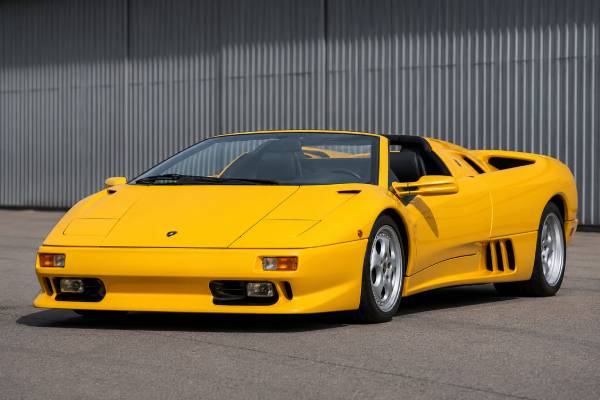

The 1999–2000 Lamborghini Diablo VT Roadster is the final 5.7-liter open-top Diablo and one of the most desirable versions of Lamborghini’s P132 flagship. It combines the original Diablo’s Marcello Gandini-derived shape, V12 drama, scissor doors, and low-slung proportions with the late-production upgrades added after Audi took control of Lamborghini: fixed headlights, a redesigned interior, ABS, larger brakes, and an uprated V12 with variable valve timing. The result is still a raw, analog supercar, but it is more polished and usable than the early cars.
Collectors care because production was low, the roof was a removable carbon-fiber targa panel, the five-speed gated manual remained standard, and the VT all-wheel-drive system made the car more approachable without removing its old-school Lamborghini character. Good examples are now judged less like used exotics and more like collectible artifacts: originality, service history, factory documents, color, mileage, and correct specification matter as much as speed.
Table of Contents
- Why the Late Diablo VT Roadster Matters
- V12 Specs, Chassis, and Performance Data
- Production, Versions, Options, and Identification
- Design, Engineering, and Roadster Details
- How the 530 hp Roadster Drives
- Maintenance, Reliability, and Restoration Risks
- Market Values and Buying Checklist
Why the Late Diablo VT Roadster Matters
The 1999–2000 Diablo VT Roadster matters because it is the most developed open-top version of the original 5.7-liter Diablo. It sits at a sweet point between early Lamborghini wildness and later Audi-era discipline.
The Diablo replaced the Countach as Lamborghini’s flagship and was developed under the internal P132 project. Early styling came from Marcello Gandini, whose wedge-shaped language had already defined the Countach, while Chrysler’s design team softened and refined parts of the final production shape after Chrysler acquired Lamborghini in the late 1980s. The Diablo went on sale for 1990 and gave Lamborghini a genuine 200 mph-era poster car.
The VT Roadster arrived later, after Lamborghini had already introduced the VT coupe. “VT” stands for viscous traction, the all-wheel-drive system that could send torque to the front wheels when the rear tires lost grip. For Lamborghini, the roadster was a major step because it was the company’s first series-production open-top V12 model rather than a one-off, prototype, or coachbuilt experiment.
The 1999 model-year update is the key reason this exact version is so interesting. By this point, Lamborghini had come under Audi ownership, and the Diablo received a meaningful late-life modernization. The updates did not turn it into a modern supercar in the later Murciélago or Aventador sense, but they made it more coherent.
The most important changes included:
- fixed headlights replacing the earlier pop-up lamps
- revised front and rear body details
- 18-inch wheels
- updated cabin layout
- passenger-side airbag provision in many markets
- stronger brakes with ABS
- 5.7-liter V12 upgraded to about 530 hp
- variable valve timing
- continued five-speed manual gearbox
- continued VT all-wheel drive
This makes the late VT Roadster a bridge car. It keeps the classic Diablo ingredients: low roofline, huge width, exposed mechanical noise, heavy controls, a gated shifter, and an engine that dominates the whole experience. At the same time, it has enough development work to feel less crude than the earliest cars.
For collectors, the appeal is also tied to scarcity. The 1999–2000 VT Roadster was produced in small numbers, with roughly 100 standard second-generation roadsters often cited, plus the final Millennium Roadster run. Exact counts can vary by source, market, and how special editions are categorized, so buyers should treat registry data and factory documentation as more important than a casual production claim in a listing.
The late VT Roadster also matters because it represents the last open 5.7-liter Diablo before the Diablo 6.0 VT coupe and the Murciélago era. There was no standard-production Diablo 6.0 Roadster. That gives the 1999–2000 VT Roadster a clean identity: final-generation look, final 5.7-liter VVT engine, open roof, manual gearbox, and the old Diablo body architecture.
Its reputation today is simple: it is theatrical, rare, expensive to maintain, and deeply analog. It is not the lightest or purest Diablo, and some enthusiasts still prefer rear-wheel-drive SV models for feel. But for buyers who want the most usable open Diablo with late-production upgrades, the 1999–2000 VT Roadster is one of the strongest choices in the whole model line.
V12 Specs, Chassis, and Performance Data
The late Diablo VT Roadster uses a naturally aspirated 5.7-liter Lamborghini V12 with variable valve timing, a five-speed manual gearbox, and viscous-coupling all-wheel drive. Its headline numbers are 530 hp, 605 Nm of torque, about 3.9 seconds to 100 km/h, and a top speed around 335 km/h.
| Category | Specification |
|---|---|
| Model | Lamborghini Diablo VT Roadster, late 5.7-liter version |
| Internal project lineage | P132 Diablo family |
| Production years covered | 1999–2000 model years |
| Body style | Two-door, two-seat roadster with removable carbon-fiber targa roof panel |
| Engine | 60-degree Lamborghini V12, rear-mid-mounted, longitudinal |
| Displacement | 5,707 cc, commonly rounded as 5.7 liters |
| Valvetrain | DOHC, four valves per cylinder, variable valve timing |
| Induction | Naturally aspirated |
| Fuel system | Electronic multi-point injection |
| Maximum power | 530 hp at about 7,100 rpm |
| Maximum torque | 605 Nm at about 5,500 rpm |
| Transmission | Five-speed gated manual |
| Drivetrain | VT all-wheel drive with viscous coupling and limited-slip differentials |
| Clutch | Dry single-plate clutch, hydraulically operated |
| Chassis | Steel tube structure with aluminum and composite body panels |
| Suspension | Independent unequal-length wishbones with anti-roll bars and electronically controlled dampers |
| Brakes | Ventilated/perforated discs with four-piston calipers and ABS |
| Steering | Power-assisted rack and pinion |
| Wheels | 18-inch alloy wheels |
| Tires | 235/35 ZR18 front, 335/30 ZR18 rear |
The engine is the centerpiece. It is an evolution of Lamborghini’s long-running V12 architecture, but in this late Diablo form it gained variable valve timing to improve response, emissions, and peak output. The dry-sump lubrication system helps oil control during hard driving, while the longitudinal layout places the engine behind the cabin and ahead of the rear axle line.
The five-speed manual is a major part of the car’s value. Later supercars moved toward automated manuals, dual-clutch gearboxes, and electronic drive modes, but this Diablo remains a fully manual, clutch-pedal car. That makes clutch condition, gearbox feel, and linkage adjustment central to any inspection.
| Item | Figure |
|---|---|
| Wheelbase | 2,650 mm |
| Length | 4,470 mm |
| Width | 2,040 mm |
| Height | 1,115 mm |
| Front track | 1,540 mm |
| Rear track | 1,640 mm |
| Ground clearance | About 140 mm |
| Curb weight | About 1,625 kg |
| Weight distribution | About 43/57 front/rear |
| Fuel capacity | About 100 liters |
| Engine oil capacity | About 13 liters |
| Cooling system capacity | About 15 liters |
The figures explain why the car feels imposing even today. It is very low, very wide, and not especially light. The wide rear tires, all-wheel-drive system, and mid-engine balance give it traction, but the car still needs respect because mass, tire age, alignment, and road surface all change how secure it feels.
| Measure | Claimed or commonly cited figure |
|---|---|
| 0–100 km/h | About 3.9–4.0 seconds |
| Top speed | About 335 km/h / 208 mph |
| Standing kilometer | About 20.3 seconds |
As with many 1990s supercars, period performance numbers can vary by test conditions, tires, fuel quality, and source. The practical takeaway is not that the Diablo VT Roadster is a modern launch-control car. It is fast because it has a large naturally aspirated V12, long gearing, serious traction, and enormous high-speed stability when properly maintained.
Production, Versions, Options, and Identification
The late Diablo VT Roadster is best understood as a short-run 1999 model-year update followed by a final Millennium Roadster batch. Identification depends on body details, interior layout, VIN/build records, market equipment, and whether the car is a standard late Roadster, a Momo Edition, or a Millennium example.
The 1999 update was applied across the Diablo range, but the Roadster kept its own body features. Compared with the coupe, it had roof storage provisions, unique rear deck treatment, roadster-specific side and rear details, and a removable carbon-fiber top. The late cars are easiest to spot by their fixed headlights, 18-inch wheels, revised dashboard, and late-style trim.
Production context
The Diablo VT Roadster as a broader model ran from the mid-1990s to 2000. Earlier cars used pop-up headlights and the earlier interior, while the 1999–2000 version is the facelifted car covered here.
Commonly cited production figures for the late VT Roadster include about 100 standard MY1999 cars, with 30 Millennium Roadsters built for the final run. Some sources also group special editions differently, so serious buyers should avoid relying on one number without checking the individual car’s factory records.
Important late-roadster production notes include:
- The 1999 model-year VT Roadster was presented after Audi/Volkswagen Group involvement began.
- Standard late VT Roadster production was short.
- The Momo Edition was a small U.S.-market special version based on the VT Roadster.
- The Millennium Roadster was a final run associated with the end of the 5.7-liter open Diablo.
- Total Diablo production across all versions was under 3,000 cars, making every genuine variant collectible.
Special editions and late-roadster differences
The Momo Edition is one of the most recognizable late VT Roadster specials. It was built in very small numbers for the U.S. market and used Momo-themed interior and exterior details. Typical features included Momo branding, special trim, numbered identification, and distinctive cosmetic equipment. Because these cars are rare, authenticity matters. A car with Momo wheels or Momo interior pieces is not automatically a factory Momo Edition.
The Millennium Roadster is another important late variant. It is usually described as a final 30-car series produced around 2000. These cars are often associated with special finishes, unique trim, and some mechanical detail differences compared with the standard 1999 Roadster. A genuine Millennium car should have documentation that supports its status.
Factory options and desirable equipment
The Diablo was hand-built and could be ordered with expensive options, special paint, custom leather, and market-specific equipment. On the late VT Roadster, desirable or important features can include:
- exposed carbon-fiber rear wing or body-color rear wing
- front axle lift
- chrome or special-finish wheels
- two-tone leather upholstery
- contrast stitching or piping
- colored gauge faces
- carbon-fiber interior or engine-bay trim
- sports exhaust
- fitted luggage
- Alpine audio equipment
- special-order paint or leather combinations
Originality is a major value factor. A period-correct aftermarket exhaust may make the car sound better, but it can reduce appeal for some collectors if the original exhaust is missing. The same applies to wheels, stereo equipment, carbon trim, and repaint work.
Documentation that matters
A buyer should ask for more than a title and a service receipt. The strongest cars usually have a thick file that supports their identity, mileage, maintenance, and originality.
Important documents include:
- factory build information or Polo Storico documentation
- original books and service booklet
- stamped service history
- invoices from recognized Lamborghini specialists
- import and federalization paperwork where relevant
- ownership history
- paint-meter readings and bodywork documentation
- records for clutch, tires, brakes, cooling work, and engine-out services
- records proving any claimed special-edition status
Matching colors and original specification matter more on this car than on an ordinary used exotic. A Diablo that has been repainted in a non-original color, modified heavily, or missing books can still be enjoyable, but it should be priced accordingly.
Design, Engineering, and Roadster Details
The 1999–2000 VT Roadster looks dramatic because it keeps the Diablo’s wedge shape while adding late-production details that make it cleaner and more modern. The engineering is equally distinctive: a hand-built V12, removable carbon-fiber roof, tube-frame structure, wide rear track, and a mechanical all-wheel-drive system with very little electronic filtering.
The Diablo’s basic shape is pure Lamborghini: low nose, huge windscreen angle, short cabin, wide shoulders, deep side intakes, and scissor doors. The roadster adds another layer of theater because the targa panel changes the whole profile when removed. With the roof off, the car feels more like a rolling engine bay with seats than a normal convertible.
The late fixed-headlight front end is one of the biggest visual differences from earlier Diablos. Some collectors prefer the older pop-up lamps for nostalgia, but the fixed-light cars are tied to the final development phase and have their own appeal. They also visually connect the late 5.7-liter cars to the Diablo 6.0 era, even though the 6.0 coupe received deeper design changes.
Carbon-fiber targa roof
The roof is one of the Roadster’s defining features. It is a removable carbon-fiber panel rather than a conventional power convertible top. When removed, it stores over the engine cover, which gives the car a striking appearance but also affects access and practicality.
This system is part of the car’s charm, but it also demands careful inspection. Buyers should check:
- roof-panel fit at the windshield header and rear mounts
- seals for age, flattening, shrinkage, or leaks
- latch condition
- finish quality on painted or exposed carbon surfaces
- roof-storage hardware
- wind noise and water intrusion
- evidence of stress cracks around mounting points
A missing, damaged, or poorly repaired roof panel is a serious problem. Replacement or restoration is not simple, and incorrect roof fit can make an expensive car unpleasant to use.
Cooling and body details
The Roadster’s body is not just a coupe with the roof cut off. Lamborghini changed the rear deck, side intakes, and cooling paths to suit the open body and roof-storage arrangement. The side scoops and vertical-blade details help define the Roadster look, while the rear engine cover has to manage heat around a large V12 in a tight package.
Heat management is central to the Diablo ownership experience. The car has a large cooling system, long coolant runs, and a hot engine bay. Clean radiators, functioning fans, healthy hoses, proper coolant mixture, and correct bleeding all matter. A Diablo that runs warm in traffic may need serious attention, not just “Italian character” excuses.
Cabin design and ergonomics
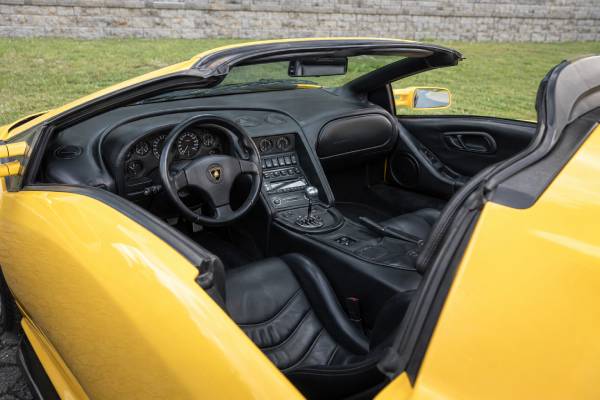
The late interior is more modern than the early Diablo dashboard, but it remains a 1990s exotic cabin. The seating position is low and reclined, the sills are wide, the windscreen is steeply raked, and rear visibility is limited. The driving position can feel offset, and taller drivers should sit in the car before buying.
The gated shifter, analog gauges, leather-trimmed surfaces, and huge center tunnel define the experience. The cabin is not quiet, spacious, or easy to enter gracefully. It is special because it feels mechanical and rare, not because it behaves like a luxury GT.
Common interior inspection areas include sticky switchgear, worn bolsters, shrinking leather, failed climate controls, gauge issues, old audio modifications, damaged roof seals, and incorrect retrimming. A beautiful retrim can still hurt value if it does not match factory materials, stitching, and color.
How the 530 hp Roadster Drives
The Diablo VT Roadster drives like a big, naturally aspirated, manual V12 supercar with real weight in its controls and very little modern insulation. It is fast, loud, physical, and much more demanding than its all-wheel-drive layout might suggest.
At low speed, the car feels wide and expensive. The clutch is heavy compared with modern cars, the gearbox needs deliberate inputs, and visibility requires planning. The nose is low, the rear is broad, and the turning circle is not city-car friendly. Parking ramps, uneven roads, speed bumps, and driveway angles need caution.
Once moving, the car becomes more natural. The steering has more weight and texture than later electronically filtered supercars, and the chassis feels planted when the tires are warm and fresh. The VT system helps traction, especially when accelerating hard out of slower corners, but it does not make the car foolproof. Old tires, poor alignment, tired dampers, or a cold road can still make the car intimidating.
The V12 is the main event. It has the deep mechanical texture of an older Lamborghini engine, but the VVT version pulls hard at high rpm and feels sharper than earlier lower-output versions. It does not deliver torque like a modern turbocharged engine. The reward comes from revs, throttle opening, and the rising intake and exhaust noise behind the cabin.
The gearbox is part of the ritual. A well-adjusted Diablo shift is mechanical and satisfying, but it should not be forced. Cold shifts can be stiff, and second gear deserves patience until fluids warm. A car that crunches, baulks badly, or jumps out of gear needs specialist diagnosis.
Road character
On a fast road, the Diablo VT Roadster feels stable and dramatic. The long wheelbase, wide track, huge rear tires, and all-wheel drive give it serious grip. The car prefers smooth, flowing roads over tight, broken surfaces. It is not a small, agile sports car; it is a wide V12 supercar that rewards smooth hands and early planning.
The brakes are much better than on early non-ABS Diablos, but they still need to be judged as a 1990s system, not a modern carbon-ceramic setup. Pedal feel, rotor condition, pad compound, brake fluid age, caliper condition, and tire quality all change confidence. A properly maintained system should feel strong and stable. A tired system can make the car feel far older than it is.
Ride quality depends heavily on damper health, tire age, and wheel condition. The electronically controlled dampers were advanced for the period, but old units, warning lights, or hacked conversions should be taken seriously. Some cars have been modified to simplify suspension maintenance; that can help usability, but originality-focused buyers should evaluate the tradeoff.
Open-top experience
With the roof removed, the Roadster becomes more intense. Engine noise, intake sound, heat, wind, and road texture all move closer to the driver. The car feels more special at moderate speed than many modern supercars do at illegal speeds.
The tradeoff is refinement. Wind noise is high, the cabin can get hot, and roof-off storage changes access to the engine cover. The Diablo Roadster is not a relaxed convertible for casual commuting. It is an event car, best used when the route, weather, and parking situation suit the machine.
Maintenance, Reliability, and Restoration Risks
The Diablo VT Roadster can be durable when maintained by the right specialists, but neglect is extremely expensive. The biggest risks are deferred engine work, clutch wear, cooling-system problems, aged rubber components, electrical faults, tired suspension, roof issues, and poor-quality cosmetic restoration.
The 5.7-liter V12 is not fragile in the simple sense, but it is complex, tightly packaged, and costly to access. It needs correct fluids, proper warm-up, clean cooling hardware, healthy ignition and injection systems, and regular expert attention. Cars that sit for long periods can be more troublesome than cars that are used carefully and serviced often.
Mechanical issues to inspect
Key mechanical inspection areas include:
- oil leaks from cam covers, seals, dry-sump lines, and fittings
- coolant leaks at hoses, radiators, water pump, and pipe connections
- overheating in traffic or after hard driving
- fuel leaks, old fuel hoses, or stale fuel damage
- misfires from ignition or injection faults
- worn clutch, slipping under load, or poor engagement
- gearbox synchro wear, especially when cold
- driveshaft, differential, or transfer-case noise
- aged suspension bushings and ball joints
- leaking or failed dampers
- brake rotor wear, caliper issues, and old brake hoses
- old tires, even when tread depth looks acceptable
The cooling system deserves special attention. A Diablo that has been stored, run on incorrect coolant, or serviced by general exotic shops can hide corrosion, blocked radiators, weak fans, and air pockets. Overheating can create much larger engine problems, so temperature behavior during inspection matters.
The clutch is another major cost point. Wear depends on driving style, traffic use, adjustment, and driver skill. A low-mileage car may still have clutch issues if it has been moved repeatedly in storage, loaded onto transporters, or driven poorly.
Electrical and cabin concerns
The late Diablo has more electronics than early cars but is still from an era before modern diagnostics became easy. Electrical faults can be time-consuming because parts availability, wiring condition, previous alarm installs, stereo modifications, and aging connectors all play a role.
Common electrical and interior concerns include:
- weak battery or charging issues
- alarm and immobilizer problems
- slow window lifts
- HVAC faults
- gauge or warning-light issues
- sticky or damaged switches
- aftermarket stereo wiring
- poor repairs behind the dashboard
- seat-motor problems
- lighting faults
- ABS warning lights
Battery condition matters because low voltage can trigger strange behavior. A proper battery tender and correct storage routine are basic ownership needs.
Body, chassis, and roof inspection
Accident history is a serious concern on any Diablo. The car is wide, low, powerful, and expensive to repair, so even older damage may have been repaired unevenly. Buyers should inspect the underside, suspension pickup points, front lift areas if equipped, door alignment, panel gaps, paint thickness, and evidence of composite repair.
Important body and roof checks include:
- front splitter and lower nose damage
- cracks around bumper mounts and underbody panels
- door fit and scissor-door hinge condition
- roof panel fit, seals, and latch hardware
- rear deck alignment
- signs of heat damage near the exhaust
- repaired side intakes or rear quarters
- uneven paint texture or overspray
- incorrect decals, badges, or trim
- windshield and side-glass sealing
A Diablo restoration is not like restoring a simple steel-bodied classic. Body panels, trim, lights, glass, roof hardware, electronic dampers, and interior materials can be rare or expensive. A cheap project car can become the most expensive example on the market once properly sorted.
Originality versus upgrades
Some upgrades can improve usability. Better cooling fans, modern tires in correct sizes, carefully chosen exhaust components, improved battery maintenance, and sympathetic suspension refurbishment can make a Diablo easier to enjoy. But the collector market rewards reversible, documented changes.
The best approach is to keep original parts. If the car has an aftermarket exhaust, the factory system should be included. If wheels were changed, the original wheels should be available. If the stereo was upgraded, the factory trim should not be cut. The more complete the original parts package, the easier the car is to defend at resale.
Market Values and Buying Checklist
The late Diablo VT Roadster is now a serious collector car, not just an old exotic. Strong 1999–2000 examples commonly trade or ask in the mid-six-figure range, with the best low-mileage, highly original, well-documented cars bringing a premium.
As of 2026, public market data for second-generation Diablo VT Roadsters shows recent sales and asking prices often clustering around roughly $500,000 or more for attractive examples, while broader VT Roadster averages can sit lower because they include earlier cars, higher-mileage cars, no-sales, and varying condition. Ultra-low-mileage, rare-color, special-edition, or highly documented examples can ask more. Cars with stories, missing records, non-original colors, accident repairs, or deferred service should be discounted heavily.
Value is driven by a specific set of collector factors:
| Value factor | Why it matters |
|---|---|
| Original specification | Factory paint, leather, wheels, trim, and equipment are central to collectability. |
| Documentation | Books, tools, service records, build data, and ownership history support authenticity. |
| Mileage | Low mileage helps, but only when storage and service history are also strong. |
| Service quality | Specialist records are more valuable than vague maintenance claims. |
| Color combination | Iconic and rare colors can increase demand, especially with original interiors. |
| Special edition status | Momo and Millennium cars need proof, not just cosmetic resemblance. |
| Accident history | Structural or poorly repaired damage can sharply reduce value. |
| Completeness | Roof, manuals, tools, keys, luggage, and original parts all matter. |
Cars to seek
The best examples usually share the same traits: original colors, clean history, recent major service, correct roof fit, fresh tires, no warning lights, cold-start video, paint-meter report, and invoices from known Lamborghini experts. A car that has been used modestly but maintained properly can be a better ownership prospect than a museum-mile car with old tires, dried seals, and no recent mechanical sorting.
Strong buyer targets include:
- original-paint or mostly original-paint cars with documented touch-up only
- complete factory books, tools, roof hardware, and service booklet
- recent clutch inspection or replacement record if needed
- recent cooling-system service
- recent tire replacement in correct sizes
- documented brake and suspension work
- original exhaust and wheels included
- no unexplained warning lights
- proven special-edition identity if applicable
- clean import, emissions, and federalization documents for U.S. cars
Cars to avoid
The wrong Diablo can be financially painful. A low asking price often means the car needs expensive work that is not obvious in photos.
Be cautious with cars that show:
- missing roof panel or poor roof fit
- incomplete VIN or build documentation
- accident history without detailed repair records
- heavy modifications with missing original parts
- non-original color changes
- long storage with no recommissioning invoices
- overheating or inconsistent temperature behavior
- clutch slip, gearbox crunching, or driveline noise
- old tires used as “low mileage” evidence
- warning lights dismissed as minor
- vague “major service done” claims without itemized invoices
- seller resistance to a specialist pre-purchase inspection
Pre-purchase inspection priorities
A proper inspection should be done by a Lamborghini specialist who knows Diablos specifically. General exotic-car familiarity is not enough. The inspection should include a cold start, road test, lift inspection, paint readings, roof fitting check, diagnostic review where applicable, and documentation audit.
A practical inspection sequence is:
- Confirm VIN, engine number, body identity, and claimed variant.
- Review factory records, books, service invoices, and ownership history.
- Inspect paint depth, panel alignment, underbody, suspension points, and signs of crash repair.
- Check roof panel, seals, latches, storage mounts, and water intrusion signs.
- Perform cold start and watch for smoke, misfire, warning lights, and abnormal noises.
- Verify clutch take-up, gearbox shift quality, brake feel, steering, damping, and cooling behavior on a proper road test.
- Inspect tires, brakes, suspension, fuel lines, coolant hoses, oil leaks, and electrical systems on a lift.
- Price the car against required work, not against dream-condition auction results.
Long-term collectability looks strong because the late VT Roadster has the ingredients collectors usually reward: low production, open V12 body style, manual gearbox, dramatic design, final 5.7-liter development, and a direct link to Lamborghini’s pre-digital supercar era. The main risk is ownership cost. A buyer should budget for professional care from day one and should not stretch just to buy the car if there is no reserve for immediate sorting.
The best reason to buy one is not speculation alone. It is the experience: the sound of the V12, the open roof, the gated shifter, the width, the smell of hot mechanical parts, and the sense that the car was built before supercars became heavily software-managed. For the right owner, the 1999–2000 Diablo VT Roadster is one of the clearest expressions of late-1990s Lamborghini excess.
References
- Lamborghini Diablo’s 30th anniversary with Cesare Cremonini 2020
- Lamborghini Polo Storico | Lamborghini.com 2026
- Recall Campaign | Lamborghini.com 2026 (Recall Database)
- Lamborghini Diablo VT Roadster MY1999 – Specs & Performance – LamboCars 2015
- Lamborghini Diablo VT Roadster – 2nd Generation Market – CLASSIC.COM 2026
Disclaimer
This article is for informational purposes only and is not a substitute for professional diagnosis, repair, appraisal, or pre-purchase inspection. Specifications, torque values, service intervals, procedures, parts, and equipment can vary by VIN, production date, market, and individual factory specification. Always verify details against official Lamborghini service documentation, factory records, and a qualified Lamborghini specialist before buying, repairing, or restoring a Diablo VT Roadster.
If you found this guide useful, please consider sharing it on Facebook, X/Twitter, or your favorite enthusiast community to support our work.