
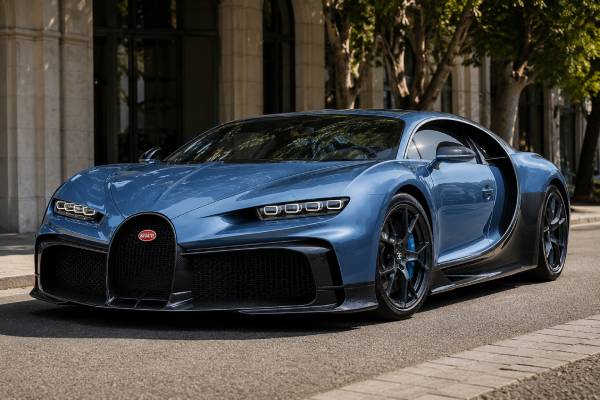
The Bugatti Chiron Profilée is a one-off Chiron created for buyers who wanted the sharper feel of the Chiron Pur Sport without the visual aggression and lower top speed of the Pur Sport. It uses Bugatti’s 8.0-liter quad-turbo W16, all-wheel drive, a 7-speed dual-clutch transmission, and a bespoke aerodynamic package built around a graceful fixed rear tail. Only one example exists, and it was completed to roadgoing European approval rather than treated as a static design study. That matters because the Profilée is not simply a special paint-and-trim Chiron. It is a fully developed final expression of the 1,500 PS Chiron family: faster at the top end than the Pur Sport, more focused than a Chiron Sport, and far rarer than any numbered limited edition. For collectors, its importance comes from three things at once: factory uniqueness, W16 heritage, and documented Bugatti development.
Table of Contents
- Why the Profilée Matters
- W16 Specs and Chassis Data
- One-Off Production and Identity
- Aero Design and Bespoke Details
- How the Profilée Drives
- Maintenance Reality for a One-Off Bugatti
- Collector Buying Guide
Why the Profilée Matters
The Chiron Profilée matters because it is the only factory-built bridge between the grand-touring Chiron character and the more aggressive Chiron Pur Sport. It was developed as a real road car, not a cosmetic commission, and that gives it a place in Bugatti history beyond ordinary rarity.
Bugatti began the Profilée project after some customers asked for a Chiron with Pur Sport influence but a more elegant shape. The Pur Sport was designed around cornering response, shorter gearing, more aggressive chassis tuning, and a large fixed rear wing. The Profilée kept the focus on acceleration and lateral grip, but it replaced the Pur Sport’s overt track-car look with a sleeker tail, unique color treatment, and a more refined visual personality.
Its timing made it even more important. By the time Bugatti had a pre-series Profilée ready, all 500 Chiron build slots had been allocated. Instead of quietly shelving the project, Bugatti completed the single car, brought it to full production-level standards, and offered it publicly through RM Sotheby’s in Paris. That made it a genuine “automotive solitaire”: a single example with factory engineering, factory documentation, and no sister cars.
The Profilée also arrived near the end of Bugatti’s W16 era. The Chiron, W16 Mistral, and Bolide had already become central farewell chapters for the 8.0-liter quad-turbo engine. The Profilée added a different final note: not the fastest Chiron, not the most extreme track tool, but one of the most balanced and collectible interpretations of the 1,500 PS W16 platform.
For enthusiasts, the car is interesting because it proves how much Bugatti could change the Chiron’s character without changing its basic formula. The core ingredients are familiar: carbon-fiber structure, mid-mounted W16, all-wheel drive, immense torque, and a luxury cabin. The result, however, feels more specific. The Profilée is a Chiron shaped around one narrow brief: make the Pur Sport idea more graceful, more usable at speed, and more singular.
W16 Specs and Chassis Data
The Profilée uses the 1,500 PS version of Bugatti’s 8.0-liter quad-turbocharged W16, paired with shorter transmission ratios than the Chiron Sport and permanent all-wheel drive. Its headline figures are 0–100 km/h in 2.3 seconds and a top speed of 380 km/h.
| Category | Specification |
|---|---|
| Model | Bugatti Chiron Profilée |
| Model year coverage | 2023 |
| Production | One example |
| Body style | Two-door, two-seat hyper sports coupe |
| Engine | 8.0-liter quad-turbocharged W16 |
| Power | 1,500 PS |
| Transmission | 7-speed dual-clutch automatic |
| Drivetrain | Permanent all-wheel drive |
| 0–100 km/h | 2.3 seconds |
| 0–200 km/h | 5.5 seconds |
| Top speed | 380 km/h |
| WLTP combined fuel consumption | 25.2 l/100 km |
| WLTP combined CO2 emissions | 572 g/km |
The engine is the central reason the Profilée has such force at any speed. The 8.0-liter W16 combines sixteen cylinders, four turbochargers, and enormous thermal management demands. In the Chiron family, the W16 does not feel like a high-strung racing engine. It feels like a huge pressure system that builds speed with almost unreal ease. The power delivery is broad, the torque arrives hard, and the gearbox has to manage far more force than an ordinary performance dual-clutch unit.
The Profilée’s transmission tuning is one of its most important technical details. Bugatti gave it 15 percent shorter ratios than the Chiron Sport, which sharpens response and keeps the W16 in a more urgent part of its power band. That change is part of the Pur Sport influence. It makes the car feel more alert when the driver asks for acceleration, especially out of slower corners or during fast passing maneuvers.
The top speed also tells a useful story. The Chiron Pur Sport is limited to 350 km/h because its aero and gearing prioritize cornering response. The Profilée reaches 380 km/h, so it offers a wider high-speed envelope while still keeping the more responsive character. It is not as top-speed focused as a Chiron Super Sport, but it is more graceful and faster at the top end than the Pur Sport.
| Area | Profilée detail |
|---|---|
| Rear aero | Fixed sweeping tail designed for stability and engine-bay heat extraction |
| Front aero | Wider air inlets, enlarged horseshoe grille, revised splitter, sculpted underbody |
| Suspension | Stiffer spring setup than Chiron Sport, with front-heavy balance |
| Alignment | Revised camber angles front and rear |
| Rear grip | Rear axle carries 50 percent more negative camber than Chiron Sport |
| Wheels | Unique Profilée wheel design inspired by the Bugatti horseshoe grille |
The official public data does not turn the Profilée into a full service-manual specification sheet. Buyers and technicians still need the exact VIN-based Bugatti documentation for torque values, fluids, component versions, and market equipment. For an article-level guide, the reliable takeaway is clear: the Profilée is a 1,500 PS W16 Chiron with Pur Sport-influenced acceleration and chassis tuning, but with its own aero package and a higher top speed than the Pur Sport.
One-Off Production and Identity
The Profilée was built as a single, factory-authenticated car, and that is the most important fact for value, identification, and long-term collectability. It is not one of a numbered run; it is the run.
Bugatti originally explored the idea because customers wanted a Chiron between the Chiron Sport and Chiron Pur Sport. The company developed and tested the concept, but the timing worked against normal production. The 500 Chiron build slots were already spoken for, so Bugatti could not launch the Profilée as a limited series. The single completed pre-series car became the only example.
That history changes how buyers should think about it. A limited-production hypercar can be compared against similar cars in the same batch. The Profilée cannot. Its authenticity depends on factory records, public Bugatti announcements, auction documentation, specification sheets, service history, and condition. Any future sale would rely heavily on provenance rather than market comparables.
The car’s identity is also tied to its exact configuration. The primary exterior color, Argent Atlantique, was developed specifically for this car. The lower body is exposed carbon fiber tinted Bleu Royal Carbon, linking it to Bugatti’s traditional two-tone look while giving the car a cooler, more modern finish. The wheels are unique to the Profilée and finished in a shade created to harmonize with the lower carbon body.
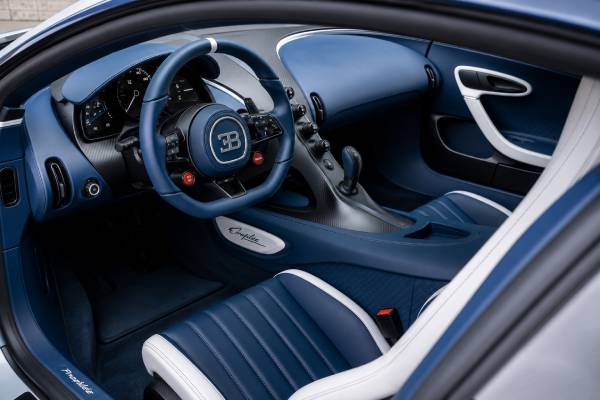
Inside, the Profilée is the first Chiron fitted with woven leather across the dashboard, door panels, and center console. This is more than a trim novelty. Bugatti used more than 2,500 meters of leather strips to create the finish, which means the cabin has its own craft story. The comfort seats, Gris Rafale and Deep Blue leather, and Profilée signature inlay further separate it from other Chiron interiors.
For identification, the practical items to verify are:
- Factory build documentation and Bugatti provenance.
- VIN, type approval paperwork, and market registration history.
- Original auction records and buyer-premium-inclusive sale documentation.
- Paint, carbon tint, wheel finish, and interior trim consistency.
- Service entries performed or approved by Bugatti.
- Any factory correspondence relating to storage, recommissioning, or updates.
The Profilée’s production story also affects how it should be used. Heavy mileage would not destroy its importance, but it would change its market position. A normal Chiron can absorb collector debate about mileage because other cars exist. A one-off car carries every stone chip, service decision, and interior mark into its biography. The best owners will treat use, preservation, and documentation as one connected plan.
Aero Design and Bespoke Details
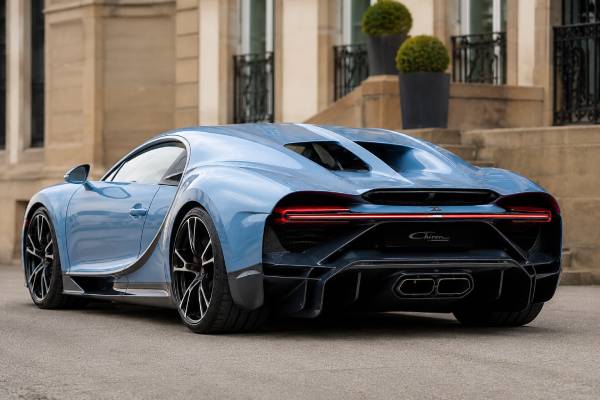
The Profilée’s design is special because its elegance has a technical purpose. The sweeping fixed tail is not only a styling feature; it improves high-speed stability and helps pull hot air from the engine compartment.
The rear profile is the visual signature. Instead of the Pur Sport’s large fixed rear wing, the Profilée uses a smoother tail integrated into the body. It gives the car a cleaner silhouette, but Bugatti designed it to do two jobs. First, it increases rear-axle downforce for control at up to 380 km/h. Second, it uses negative pressure to draw hot air out of the engine bay through internal tunnels in the high-temperature carbon structure.
That matters because the W16 creates exceptional heat. Cooling is not a background detail on a Chiron; it is one of the central engineering problems. The car has to feed radiators, intercoolers, brakes, and the engine compartment while keeping drag and lift under control. The Profilée’s tail, front inlets, enlarged horseshoe grille, splitter, and underbody all work as part of that thermal and aerodynamic system.
At the front, the wider air inlets and larger grille give the car a more assertive face without making it look as severe as the Pur Sport. The revised splitter and sculpted underbody support front-end balance, while the tail settles the rear. The goal is not maximum track downforce at any cost. The goal is a car that feels sharper than a Chiron Sport while keeping the elegance expected from a grand Bugatti coupe.
The details are unusually important because they cannot be replaced by ordering another example. The wheels are specific to the car and echo the horseshoe grille shape. The polished aluminum elements reinforce that theme. The color combination is also part of the engineering-and-design story: Argent Atlantique above, Bleu Royal Carbon below, with the wheel finish chosen to connect both halves.
Inside, the Profilée takes the Chiron cabin and makes it more tactile. The woven leather surfaces add depth without turning the cockpit into a loud showpiece. The design still follows Bugatti’s restrained layout, with key controls placed clearly and material quality doing more of the talking than screens or decorative complexity.
The most distinctive design and feature points are:
- A one-off sweeping fixed tail rather than the Pur Sport’s large rear wing.
- Functional rear aero that contributes to both stability and engine-bay heat extraction.
- Wider front air inlets and enlarged horseshoe grille for cooling.
- Revised splitter and underbody for airflow management.
- Unique Argent Atlantique paint.
- Bleu Royal Carbon exposed carbon-fiber lower body.
- Profilée-only wheels inspired by the Bugatti horseshoe.
- First Chiron interior with woven leather on major cabin surfaces.
- Comfort-oriented seating rather than a stripped track-car cabin.
The emotional result is important. Many modern hypercars look like they are chasing lap-time aggression even when parked. The Profilée looks more composed. It has enough technical drama to justify its performance, but it also carries the old Bugatti idea that speed and beauty should not fight each other.
How the Profilée Drives
The Profilée should feel like a faster-reacting Chiron rather than a harsh track special. Its shorter gearing, W16 torque, stiffer chassis tuning, and aero balance point toward immediate acceleration and strong corner-exit traction, while the cabin and body concept remain closer to grand touring than racing.
From rest, the numbers are brutal: 0–100 km/h in 2.3 seconds and 0–200 km/h in 5.5 seconds. In real driving, those figures matter less as bragging rights and more as clues to how compressed the experience becomes. The car covers road quickly enough that the driver’s attention must move far ahead. Throttle inputs need restraint, tire temperature matters, and open space disappears almost instantly.
The engine character is central. The W16 does not need to be wrung out like a smaller performance engine. It produces the sense of stored pressure being released. The shorter ratios help the Profilée feel more eager than a Chiron Sport, so the driver gets a stronger connection between throttle movement and acceleration. The gearbox is still a refined dual-clutch system, but the ratio choice gives the car a more urgent personality.
Steering and suspension changes aim for grip and precision without sacrificing the comfort expected from the brief. Bugatti changed camber angles and used stiffer springs than the Chiron Sport. The rear axle’s extra negative camber helps tire contact during cornering, which should make the car feel more planted when loaded laterally. The front-heavy spring balance also suggests a deliberate effort to sharpen response.
The Profilée is not best understood as a small-road sports car. It is wide, immensely powerful, and built around speed ranges that normal roads rarely allow. On a fast mountain road, the driver would likely notice its traction and response, but also its size and value. On a high-speed route or private proving ground, its character makes more sense: cleaner aero than the Pur Sport, stronger speed capability, and enough chassis focus to feel alive rather than isolated.
Braking and tire condition are critical to the driving experience. Carbon-ceramic brakes can tolerate enormous speed, but they still need inspection, temperature awareness, and correct bedding. Tires are even more important. A Chiron-level car depends on specific tire construction, correct age, correct pressure, and correct storage history. A buyer should treat tires as safety components first and consumables second.
The Profilée’s likely driving personality can be summarized simply:
- More responsive than a standard Chiron or Chiron Sport.
- Less visually and aerodynamically extreme than a Pur Sport.
- Faster at the top end than a Pur Sport.
- More comfort-minded than a pure track-focused hypercar.
- Most satisfying on roads or facilities where speed, cooling, and stability can matter.
- Still dependent on tire condition, software status, and specialist preparation.
For owners, the wisest approach is to drive it rarely but properly. Short, low-speed display use can be harder on complex cars than carefully planned exercise. A Profilée should be warmed correctly, checked before and after use, and driven within conditions that suit its tires, brakes, and cooling systems.
Maintenance Reality for a One-Off Bugatti
Maintaining a Chiron Profilée is less about ordinary reliability and more about controlled stewardship. The car needs Bugatti-level service access, exact documentation, proper storage, and conservative decisions because every component choice affects a unique factory car.
The W16 itself is not a casual ownership proposition. It is a highly stressed, heat-intensive, quad-turbo engine packaged in a carbon-bodied hypercar. Routine work can involve major labor simply because access is limited and procedures must protect delicate body, cooling, aero, and electronic systems. Even simple neglect can become expensive if the car sits with aging fluids, old tires, weak batteries, or outdated software.
The gearbox and driveline also deserve close attention. The 7-speed dual-clutch transmission has to handle huge torque and all-wheel-drive launch forces. Clutch condition, calibration, fluid service, software status, and launch-control use history all matter. A low-mileage car is not automatically risk-free if it has spent long periods stored without proper maintenance.
The most important maintenance areas are:
- Engine oil service, coolant condition, and W16 leak inspection.
- Turbocharger, intercooler, and intake system checks.
- Dual-clutch gearbox service records and adaptation data.
- All-wheel-drive system inspection.
- Carbon-ceramic brake disc, pad, and caliper condition.
- Tire age, tire specification, pressure history, and storage environment.
- Suspension lift or hydraulic system function where equipped.
- Battery health and battery-maintainer history.
- Control-module scans and software updates.
- Carbon-fiber body, undertray, splitter, and aero-surface inspection.
- Interior leather condition, especially the woven leather surfaces.
Age-related deterioration is one of the quiet risks. Seals, hoses, batteries, sensors, fluids, tires, and adhesive-bonded details can age even when the odometer barely moves. A collector car stored as sculpture may still require recommissioning before real road use. With a Profilée, that recommissioning should be handled by Bugatti or a recognized Bugatti service partner, not a general exotic-car shop.
Parts availability is unusual because the core Chiron platform shares many systems with other Chiron-family cars, while certain Profilée parts are unique. Mechanical support should be possible through Bugatti, but a Profilée-specific wheel, interior trim piece, carbon section, or aero component would be a different matter. Repairing damage may involve factory-level decisions rather than normal parts ordering.
Originality should guide every maintenance choice. Upgrades that might make sense on a more common supercar can damage the story of a one-off Bugatti. Paint protection film, reversible preservation measures, and careful storage improvements are reasonable. Non-factory tuning, aftermarket exhaust changes, altered trim, or non-original wheel finishes would be difficult to justify.
The best maintenance plan is proactive:
- Keep the car on a Bugatti-approved service schedule.
- Maintain a complete file with invoices, inspection reports, photos, and software notes.
- Store it in a climate-controlled environment.
- Replace age-sensitive items before they become risks.
- Use only correct tire specifications and approved procedures.
- Inspect the car after any transport, display event, or spirited drive.
- Avoid any modification that cannot be reversed and documented.
For this car, reliability is not a simple good-or-bad rating. A correctly maintained Profilée should be capable of functioning as Bugatti intended, but the cost of mistakes is extreme. The owner is not just maintaining a Chiron. They are preserving the only Chiron Profilée.
Collector Buying Guide
A buyer should approach the Chiron Profilée as a museum-grade one-off that can still be driven. The correct purchase decision depends on provenance, condition, factory support, and preservation quality more than mileage alone.
The first question is authenticity, even with a car this public. The buyer should verify the VIN, factory identity, original build specification, auction history, and any post-sale ownership trail. The file should show that the car remains the same car Bugatti presented: Argent Atlantique paint, Bleu Royal Carbon lower body, Profilée wheels, woven leather cabin, and factory-specific details intact.
The second question is service readiness. A car may have delivery mileage and still need attention if it has been stored. Before any sale, a Bugatti-authorized inspection should confirm fluid age, tire age, battery health, software status, brake condition, suspension operation, leak status, and diagnostic history. The inspection should also include the underside and aero surfaces, because transport or display handling can damage low carbon pieces.
| Priority | What to confirm | Why it matters |
|---|---|---|
| Provenance | Factory records, auction file, ownership chain | Defines the car’s identity and market trust |
| Original specification | Paint, carbon tint, wheels, woven leather, trim | One-off value depends on exact configuration |
| Service history | Bugatti-authorized inspections and maintenance | Confirms correct stewardship |
| Tires and brakes | Age, wear, specification, storage, brake condition | Critical for safety and value |
| Software and electronics | Diagnostic scan and updates | Modern hypercars depend on control systems |
| Body condition | Carbon fiber, splitter, underbody, tail, paint film | Unique parts may require factory repair |
Market value is difficult because there are no direct comparables. The public auction result established a landmark, but future value would depend on broader Bugatti demand, W16-era sentiment, the car’s condition, and whether it remains publicly recognized as one of the final great Chiron derivatives. The buyer pool is likely small but serious: top-level Bugatti collectors, one-off hypercar collectors, and institutions focused on modern automotive milestones.
The strongest reasons to buy are clear. The Profilée is unique, officially developed, road legal in Europe when launched, visually distinct, and historically tied to the end of the W16 Chiron era. It combines beauty, engineering, and scarcity in a way few modern cars can match.
The reasons to hesitate are also real. Use will be psychologically difficult because every mile changes a one-off car. Insurance, storage, transport, service, and security costs will be significant. Any damage to unique trim or aero pieces could become a factory-level restoration issue. The car is also so valuable that many owners may enjoy it more as a preserved object than as a regularly driven machine.
A sensible ownership strategy is to keep the car original, maintain it through Bugatti, drive it only after proper preparation, and document everything. For a normal enthusiast, that may sound restrictive. For a one-off Bugatti, it is the point. The Profilée is a car to preserve with enough mechanical exercise to keep it alive.
The ideal buyer is not simply someone who can afford it. The ideal buyer understands that the Profilée is a responsibility. It deserves expert care, careful use, and a complete paper trail. Treated that way, it should remain one of the defining collector cars of the late W16 Bugatti period.
References
- The Bugatti Chiron Profilée: an automotive solitaire – Bugatti Newsroom 2022 (Manufacturer Press Release)
- Last available Bugatti powered by the legendary W16 engine to be auctioned this week – Bugatti Newsroom 2023 (Manufacturer Press Release)
- Bugatti Chiron Profilée becomes most valuable new car ever auctioned – Bugatti Newsroom 2023 (Manufacturer Press Release)
Disclaimer
This article is for informational purposes only and is not a substitute for professional diagnosis, repair, inspection, valuation, or legal advice. Specifications, torque values, service intervals, fluids, procedures, software requirements, and equipment can vary by VIN, market, usage history, and factory updates. Owners and buyers should verify all technical information against official Bugatti service documentation and consult qualified Bugatti specialists before maintenance, purchase, transport, storage, or road use.
If this guide helped you, please consider sharing it on Facebook, X/Twitter, or your favorite automotive community to support our work.